







Abstract
How do new ideas flow through networks to reframe policy questions, and what role is played by the growing world of think tanks and policy experts? This article takes the remarkable shift in UK labour migration policy since 2000 and demonstrates how policy was redesigned by networks of actors working between and within the worlds of think tanks and government, including the Prime Minister's Policy and Innovation Unit (PIU), the Treasury, the Home Office and the Institute for Public Policy Research (IPPR). The article shows how different kinds of ideas and knowledge flowed through different actors and networks to influence the reframing of policy, using the epistemic communities hypothesis (ECH) as a theoretical framework for the analysis.
Introduction
This article takes the opportunity to assess the forms and means by which ideas and knowledge play a role in policy change in the UK by looking at a particular area—labour migration 1 —over a decade of policy development: 1997–2007. The central puzzle is about the adoption of a new policy on labour migration under the narrative of ‘managed migration’ and how to explain this change, its timing and its tempo. Of particular use here is the epistemic communities hypothesis (ECH) as outlined by Peter Haas (1992, 2001 and 2004), which provides a framework that proposes a role for experts in the change of policy addressing why, when, how and with what effects governments turn to expertise.
The choice of approach is driven by gaps in our understanding of immigration policy, particularly with respect to the role of ideas and expertise. The policy area of labour migration is one that has experienced dramatic change since the late 1990s as the UK has lurched from a country struggling to keep a lid on immigration to one opening its arms to extraordinary levels of inward flows. Aspects of immigration policies have traditionally provided a strong explanatory challenge for theoretical accounts, which have tended to focus on outcomes and a narrow range of variables exogenous to the political process, betraying an under-conceptualisation of that process. International accounts of policy, for example, have emphasised the role of business interests (Freeman 1995), internationalisation and states' reduced control over borders (Soysal 1994; Sassen 1996) or the liberal influence of courts and bureaucracies (Guiraudon 2000a), but these offer little understanding of the policy-making process, and do not offer a good fit with the UK, long described as a ‘deviant’ case (Freeman 1994). We know, for example, that the UK has relatively weak courts, and has retained its own border regime within the EU (in contrast to Schengen states). In addition, political elites in the UK are known to enjoy relative isolation from the ‘organised public’ and lobbying over immigration and conduct policy in a relatively autonomous way (Statham and Geddes 2006, 266).
Some help is offered by those that emphasise national paradigms in terms of the links between identity politics and migration policies (Brubaker 1992; Hollifield 1994). In the case of the UK, Randel Hansen's excellent study of post-war immigration counters some of the weaknesses of traditional accounts. By bringing political processes back into the analysis, Hansen was able to reject the thesis that politicians were attempting to ‘whitewash’ Britain (Paul 1997), arguing strongly that their actions could be considered responsible issue management under the constraints of the peculiar implications associated with the post-war dismantling of empire (Hansen 2000). Building on Hansen's approach and looking at the ‘new era’ of policy post-2000 I reject the thesis that the UK ‘lost control’ over immigration policy, leading to unprecedented levels of inflows. Instead I argue that policy was redesigned and redeveloped by a government in the thrall of new ideas about governance, with epistemic communities assuming a more central role in policy change. Furthermore, by adopting this perspective, the article addresses the rise and rise of think tanks and ‘policy experts’ in the sphere of immigration, which to date has been largely ignored by those seeking to explain policy change.
I argue that research on immigration has been driven by the interest in (suboptimal) outcomes, which has created what could be described as an epistemic ‘gap’ into which political processes are assumed, subsumed or reified (e.g. Castles 2004), and where the political sociology of policy-making is relatively unknown (Sciortino 2000). This gap extends to our understanding of the kinds of ideas and knowledge that drive policy. There has been some work done on how research fits with policy in the field of immigration, which confirms a range of problems (Brans et al. 2004; Martiniello and Florence 2005). The work of Christina Boswell should be mentioned here as she has looked in detail at the legitimising and instrumental functions of knowledge utilisation in debates over immigration in the EU (Boswell 2008) and in the UK between 2002 and 2004, and the political dilemmas regarding expertise (Boswell 2009). This very useful analysis could be complemented by thinking about why, how and when expertise provides a framing or agenda-setting role, directing and shaping the debate—that is, consideration of the preconditions for knowledge utilisation. The argument here is that the discussion over research usage should take into account the reasons why certain types of knowledge (macroeconomic data, criminal statistics, demographic data, etc.) become more (or less) salient in the policy debate in the first place.
Finally, the approach taken here is especially apposite considering the legacy of more than a decade of Labour governments since 1997. On taking office, the new government was very keen to associate itself with bringing new ideas into policy and to connect with a youthful and fresh mode of politics that was more open. This was illustrated once in office by the creation of new epistemic networks with nodes at the centre of government—where researchers joined the other ‘bright young things’ already plucked from the world of academia, think tanks and the media and rapidly promoted within the Labour party as politicians or special advisers. More than a reflection of the meritocratic society of which Tony Blair spoke, 2 the incoming government's approach was presented as a deliberate marriage between technocracy and managerialism. Labour wanted to put forward the appearance of being a progressive, modernising and reforming government (Hay 1999; Finlayson 2003). This was summed up in a narrative of evidence-based policy-making (EBPM): a style of governance supposedly characterised by an enhanced knowledge dimension; expanded research budgets across Whitehall; greater strategic capacity at the centre; and more input into policy-making from expertise outside government, that is, NGOs and think tanks (Davies et al. 2000; Bullock et al. 2001).
1. The Epistemic Communities Hypothesis and Policy Change
The proposal of this article is that in order to investigate the use of knowledge in the policy process, and to explain the time, timing and tempo of change, we need to pay closer attention to what kinds of ideas and knowledge, and types of actor, play a role in policy development. To do this, the article applies the ECH as a theoretical framework. The ECH has been used to explain why politicians make apparently brave decisions to relinquish political control of certain policy levers, for example the decision by the Labour government to give control of monetary policy to the Bank of England (King 2005). 3 It specifies how certain types of people and their ideas can influence policy change under particular conditions and with observable effects. Specifically, epistemic communities are identifiable groups or networks of experts with shared analytic and normative beliefs or ideas about a particular issue (Haas 1992, 16). Their currency is consensual knowledge which contains ideational structures that provide the source of paradigmatic policy change. The process of change via epistemic communities involves a causal chain of uncertainty, interpretation and institutionalisation (Haas 1992, 3–4). First there is the production of the initial demand or appetite from policy-makers, thought to be a function of uncertainty brought about by exogenous and endogenous factors (Haas 1992, 12). This demand can then be met by epistemic communities that have a shared interpretation of the issue. The extent of their impact is determined and can be observed by the extent to which they can embed their influence in mechanisms that institutionalise the use of expert knowledge.
The next sections present the empirical material, first mapping out the key moments and decisions in the story of labour migration policy change in the UK (1997–2007), and then identifying how certain ideas informed these decisions. In particular I am interested in the role of ideas and their journey in the policy process—focusing on how a new approach was developed and became part of policy. The subsequent section revisits the central tenets of the ECH, linking it with the particular case of labour migration policy change in the UK. The evidence is drawn from a mass of data incorporating policy statements, documents, parliamentary records and more than 20 elite in-depth interviews carried out with key actors involved in policy during the period. This research (presented in greater detail elsewhere; see Balch (forthcoming)) combines to flesh out a kind of ‘intellectual history’ of policy change on labour migration in the UK.
2. Policy Change over Labour Migration 1997–2007: Key Moments and Decisions
In one of the few reviews of immigration policy under New Labour, (Will Somerville 2007, 29) confidently declared that for economic migration the government ‘comprehensively changed policy and marked a decisive break with the previous policy model’. He is, however, less certain about the precise timing of this policy change, admitting that ‘the exact date when a new, more pro-active economic migration policy was introduced is difficult to judge’, and concluding that ‘the benefit of hindsight suggests that late 2000 and early 2001 was a crucial period’ (Somerville 2007, 29).
The reorientation of labour migration policy in the UK since the late 1990s has certainly been eye-catching. Figures from the Office of National Statistics show net immigration more than tripling from well under 100,000 in 1997 to nearly 300,000 in 2006. 4 This contrasts sharply with the main theme of restriction that dominated UK policy throughout the 1960s, 1970s and 1980s and into the mid-1990s (Holmes 1988; Layton-Henry 1994; Hansen 2000; Flynn 2005). The restrictive paradigm has the classic features of a policy of ‘muddling through’ (Lindblom 1959), well illustrated by the response of a Home Office civil servant when asked about immigration policy development. He replied that ‘immigration law in this country has developed mainly as a series of responses to, and attempts to regulate, particular pressures, rather than as a positive means of achieving preconceived social or economic aims’. 5
An early sign in 1997 that the new Labour government might change things was provided by the almost instant announcement abolishing the Primary Purpose rule. 6 However, the 1998 White Paper confirmed Jack Straw's pre-election ‘cigarette paper’ metaphor 7 —there was to be no abrupt shift in policy on immigration following the election victory (Layton-Henry 2004). The 1998 White Paper focused on process and efficiency rather than an overhaul of the system, and dashed the hopes of campaigners and activists hoping for a radical departure in terms of policy (Flynn 2003, 4). 8
It would be broader commitments to modernisation across government that enlarged the potential for a re-evaluation of policy, resulting in reviews of the whole control system—from initial applications through to permanent settlement (HMSO 1998, 4.2), and the work permit system, based in the Department for Education, led by the Treasury in 1998/99. This was followed in late 2000 by the announcement of a new policy direction, based on a concept of ‘managing migration’ for the benefit of the UK economy.
In a clear case of preaching to the converted, Home Office Minister Barbara Roche 9 made a speech on economic migration at an Institute for Public Policy Research (IPPR) conference held at the British Bankers Association in London. The new direction announced by Roche was all about recognising the ‘potentially huge benefits’ of migration and changing policies to adapt to the global economy by bringing in new ideas, including from other countries, and carrying out more research on migration in the UK (Roche 2000). This ‘new’ thinking echoed many of the conclusions of a seminar organised by Sarah Spencer at the IPPR some seven years earlier (Spencer 1994a).
However, there was an important difference—the ‘positive’ approach to refugees outlined by Spencer was largely forgotten in favour of her economic arguments. For the wider policy community around immigration, the injection of utilitarian ideas, although a step change from the restrictive policy that had existed for so long, represented a ‘virtuous Dr Jekyll to the vicious Mr Hyde of asylum policy’ (Flynn 2004, 1). The instrumental linkage between labour migration and national economic interest reflected a commodification of migrant labour that could never fully satisfy the agenda of a rights-based approach (Ryan 2005, 4–5).
I argue that the construction of the concept of ‘managed migration’ can be likened to a policy frame (Entman 1993; Schoen and Rein 1994), or paradigm (Hall 1993). Frames provide signposts and guidance for policy-makers, shape perceptions and influence political outcomes. Hall defines a policy paradigm as ‘a framework of ideas and standards that specifies not only the goals of policy and the kinds of instruments that can be used to attain them, but also the very nature of the problem they are addressing’. A policy paradigm becomes embedded and ‘is influential precisely because so much of it is taken for granted’ (Hall 1993, 279). Thus, the managed migration frame helps us to understand key moments in the years that follow, particularly the decision not to impose transitionary arrangements on A8 nationals 10 in 2002. 11 This was arguably the most significant moment in terms of labour migration policy in the period 1997–2007. The policy decision was based on (as it turns out, wildly inaccurate) evidence about potential inflows (Dustman et al. 2003), and so can be directly linked to the managed migration narrative announced by Roche and repeated by Home Office ministers ever since. 12
The relative inertia of the first few years under Labour stands in contrast to the government's second and third terms in office. Home Office and Immigration and Nationality Directorate (IND) reorganisation gathered pace after 2001 with the incorporation of Work Permits UK signalling a more business-friendly cultural and organisational shift (Duvell and Jordan 2003). Incremental change to the incredibly complex system of labour migration (see Morris 2004) from the late 1990s was significantly geared up under the ‘Five-Year Plan’ (HMSO 2005) and subsequent 2006 Act. This was an attempt to reconstruct the system from the managed migration perspective: systemic streamlining with skills-based selection to maximise economic benefits.
The large inflows related to the 2002 decision on A8 nationals have clearly had a significant political and institutional impact. The effect of institutional, political and organisational pressure can be seen in the decision to restrict access for A2 nationals 13 before the subsequent (2007) enlargement. In contrast to 2002 this decision was taken against expert opinion. Here the managed migration frame was displaced by a political imperative to respond to public concerns over immigration levels (despite the likelihood that A2 migration would be on a different scale to A8 migration).
Institutional and organisational crisis was finally recognised in 2006 with John Reid's comment that the IND was ‘not fit for purpose’. This resulted in a convulsive institutional reaction—the IND scrapped and replaced by the Border and Immigration Agency (BIA), 14 and the creation of the Migration Advisory Committee (MAC) 15 and the Migration Impacts Forum (MIF) 16 in 2007. These changes, with immigration regulated by an ‘agency’ rather than a ‘directorate’, along with new structures to incorporate and regulate expert knowledge flow into the policy process, conform at least at surface level to the evidence-based, depoliticised agenda outlined by Barbara Roche in 2000. Many of the important decisions on labour migration taken post-2001 can therefore be traced to the paradigm shift.
Given the crucial ‘framing’ role this therefore assigns the narrative of ‘managed migration’, 17 that narrative's genesis and genealogy become of great interest for our understanding of policy change, and the role of ideas in the policy process. Roche's ‘landmark’ speech did not arrive fully formed from the top of her head. It was heavily trailed and prepared, and can be linked with similar ideas from other times and places. The question is how this particular configuration of ideas about labour migration—the specific flavour provided by this narrative—arrived, took shape and then successfully dominated the policy debate.
3. ‘Managed Migration’: The Narrative of a Narrative
The ideas presented in Roche's speech owed a great debt to a report titled ‘Migration: An economic and social analysis’ (Portes et al. 2001), a joint research effort from the Home Office and Cabinet Office (Policy and Innovation Unit (PIU)). The research emphasised the positive benefits of immigration to the UK economy, and outlined the linkages between migration, supply-side economics, labour market policy and social exclusion. As one of those academics seconded to the Cabinet Office to advise the PIU points out:
I think that [the 2001 PIU/Home Office report] is probably the most single important thing to pay attention to … I have spoken to others about this, and for me, here is a shifting of both policy and an intellectual framework (Interview, Shamit Saggar, Professor of Political Science, Sussex University, July 2006).
Roche was appointed as ‘sponsor minister’ for the research, and according to Jonathan Portes, who led the research team that wrote the report, she had become a keen supporter:
When she read it [the 2001 PIU/Home Office report] she became very enthusiastic, and insisted on doing a speech, which was a couple of months before it was actually published, but a lot of stuff that was in her speech was taken pretty directly (Interview, Jonathan Portes, Chief economist, Department of Work and Pensions, November 2006).
The report emerged from the ‘strategic challenges’ PIU research programme, started in late 1998, and the review of the work permit system in 1999 led by the Treasury. Given the large number of policy areas that could conceivably be re-examined and rethought, why did the PIU and the Treasury choose to tackle immigration—an area identified as a vote-loser for Labour (Crossman 1977)? 18
In electoral terms, the weakness of the Conservative opposition certainly meant that the political landscape was more favourable for a departure in policy. In the case of the Treasury, healthy economic growth in the UK had also led to a number of sectors, such as health, construction and IT experiencing labour shortages and subsequent demands for migrants (Geddes 2005). Under Labour, the Treasury played a key role in the domestic policy agenda, perceived as part of the deal to maintain the awkward ‘marriage’ between the chancellor and the prime minister (Naughtie 2002). The Treasury showed an interest in streamlining the work permits system, particularly for employees of multinational companies. This was a response to pressure from law firms such as Cameron McCenna, which give advice on work permits for big companies. Juliet Cole, chair of the Immigration Law Practitioners' Association (ILPA) work permits sub-committee, for example, was in constant dialogue with the Treasury and Home Office about reforms on policy. There are also links between the Treasury-led review and another New Labour metanarrative—the ‘be friendly to business’ agenda. As Sarah Spencer explains:
I remember going to a CBI conference round about 1999 when Margaret Hodge [then employment minister] was bending over backwards, effectively saying ‘tell me what you need and I will do it—which red tape don't you like—tell me what it is and it is gone …’. And they were saying this and that about how the [work permits] system was still, despite the reforms, too slow and so on. What Labour did was bring in a private sector person to run Work Permits UK (Interview, Sarah Spencer, Associate Director of Centre on Migration, Policy and Society (COMPAS), March 2006).
However, I would argue that this type of policy-making is more akin to the old ways of ‘muddling through’—tinkering with the system in the interests of business. The narrative provided by the PIU is central to creating the new policy landscape—something the Treasury was less interested in at the beginning, as Portes explains:
It was a lower level issue at the Treasury at that point—they were helpful but they didn't put any effort behind it or give us resources or any great analysis—there was a junior economist in the Treasury who had done some useful work, but later on they got much more into it (Interview, Jonathan Portes, November 2006).
The PIU decision to look at migration can be traced to the Unit's remit to take a broader perspective than that allowed by the demands of individual departments and to cut across issues. Migration was one of 10 ‘strategic challenges’ identified by a group set up in the PIU and led by Jonathan Portes to look at issues not well addressed by existing policy structures.
It is not accidental that the strategy unit goes back to look at migration again and again—because it is a long-standing problem area where almost every front-line politician is of the view that there has been too much symptom-treating and not enough looking at underlying causes (Interview, Shamit Saggar, July 2006).
Portes, working with Suma Chakrubati, was to lead the team looking at migration. As he explains, it was personal, rather than political, interest that drove the project forward:
Migration was the one that I was personally most interested in and most excited about, and Suma was also very keen on it, although there was not a great deal of appetite from the political masters of the PIU—they said if you really want to you can do it, but it wasn't that everyone was saying: ‘this is a great idea please go away and do this for us’ (Interview, Jonathan Portes, November 2006).
The research set out to calculate macroeconomic impacts, concluding that in the financial year 1999/2000, the net fiscal contribution of immigrants to the UK was £2.6 billion (Portes et al. 2001). Another government report closely followed (carried out jointly by the PIU, IPPR and Home Office), specifically looked at the fiscal effects of migration and confirmed the first report's findings (Gott and Johnson 2002). In the UK context, this approach of locating migration within macroeconomic indicators was novel and has hitherto become a central theme in the debate (Geddes 2005, 196–197; Boswell 2009). It might seem that the criss-cross of claim and counter-claim regarding the positive (e.g. Siskandarajah et al. 2005), or negative (MigrationWatch 2004; HMSO 2008) effects of immigration sometimes resembles an exercise in counting angels dancing on the head of a pin—but it strongly illustrates the power of the original research to re-frame the debate.
This impact was created by a combination of a coherent narrative and the willingness of the ‘political masters’ or gatekeepers to be associated with the research, providing the window of opportunity (Kingdon 1995) for a paradigm shift to take place. One of the crucial elements influencing the successful transmission of the ideas was the ability to bring people on board at all stages. This was first of all by getting the Home Office to take ‘ownership’ of the research before it was released, and secondly to get the support of political masters once it was produced. In the first case, this meant overcoming internal Home Office politics. As Spencer explains:
There were people in the Home Office who were saying ‘come on, we've got to change policy—the old approach of simply keeping people out is not tenable’, and there were the operational people in the Home Office at IND who were effectively saying ‘there is only one political imperative: keep people out!’, but the people at Queen Anne's Gate were arguing that it is more complex than that, more nuanced (Interview, Sarah Spencer, March 2006).
The research was essentially produced by a team gathered together under the auspices of the PIU, and with very little in terms of personnel or resources provided by other government departments, but the presentation of the final publication as a joint PIU–Home Office project was key. This strategic co-ordination can be traced to networks of specific individuals in important decision-making positions:
There was actually a surprisingly positive response from the Home Office—we were expecting them to be very much ‘get off our turf’ and it wouldn't have happened without Stephen Boys-Smith 19 who was then the secretary general for IND—Stephen actually recognised that there was a gap and the Home Office didn't have the capacity to do this itself. Home Office policy officials at working level were never too keen on this, but Stephen was, and the head of economics at the Home Office—Richard Price (whose name also appears on the report) who was an old friend of mine from the Treasury—and we are very much of a mind on this—so there was an alliance between Richard, Stephen and I to say that we can work with the Home Office on this (Interview, Jonathan Portes, November 2006).
Despite Home Office co-operation, the PIU was Blair's creature—research results could have been buried if they were not to the liking of the prime minister. Reports can easily be ‘handled’ by assigning greater or lesser weight through classification. 20 It is perhaps surprising that it ever saw the light of day given Straw's pre-election ‘cigarette paper’ analogy. One (unnamed) source suggested that the report arrived at the in-tray of the prime minister without the usual ‘health warning’ or briefing note supplied by special advisers. The story goes that without the hindrance of political considerations Blair was convinced by the arguments for managing migration in the economic interest of the country and recommended that the report be published. Clearly, the narrative chimed elegantly with the pro-business agenda, and openness to cultural diversity and so-called ‘Third Way’ global capitalism (Flynn 2003, 19–20).
Whichever way publication was eventually sanctioned, there was then a political clamour to champion the new approach and assume ownership—chiefly through packaging and delivering it to the public. In her speech, Roche criticised the previous policies of successive governments as seeking to reduce numbers of immigrants without any justification (Flynn 2003, 6). She was very keen to differentiate the question of policy towards asylum seekers from a new policy of ‘managed migration’. This new policy focus would be open and responsive to evidence and expertise on migration in general, but the question this research was supposed to address was clearly formulated in purely economic terms:
In the past we have thought purely about immigration control … Now we need to think about immigration management … The evidence shows that economically driven migration can bring substantial overall benefits for both growth and the economy (Roche 2000).
The speech reflected the shift within government from tough measures for asylum seekers to a focus on work permits and other labour migration schemes (Duvell and Jordan 2003, 302). Although Roche promised ‘modernisation’ of the work permit system, the review over the preceding year had already led to an almost instant rise in permits granted in 1999 (see Figure 1).
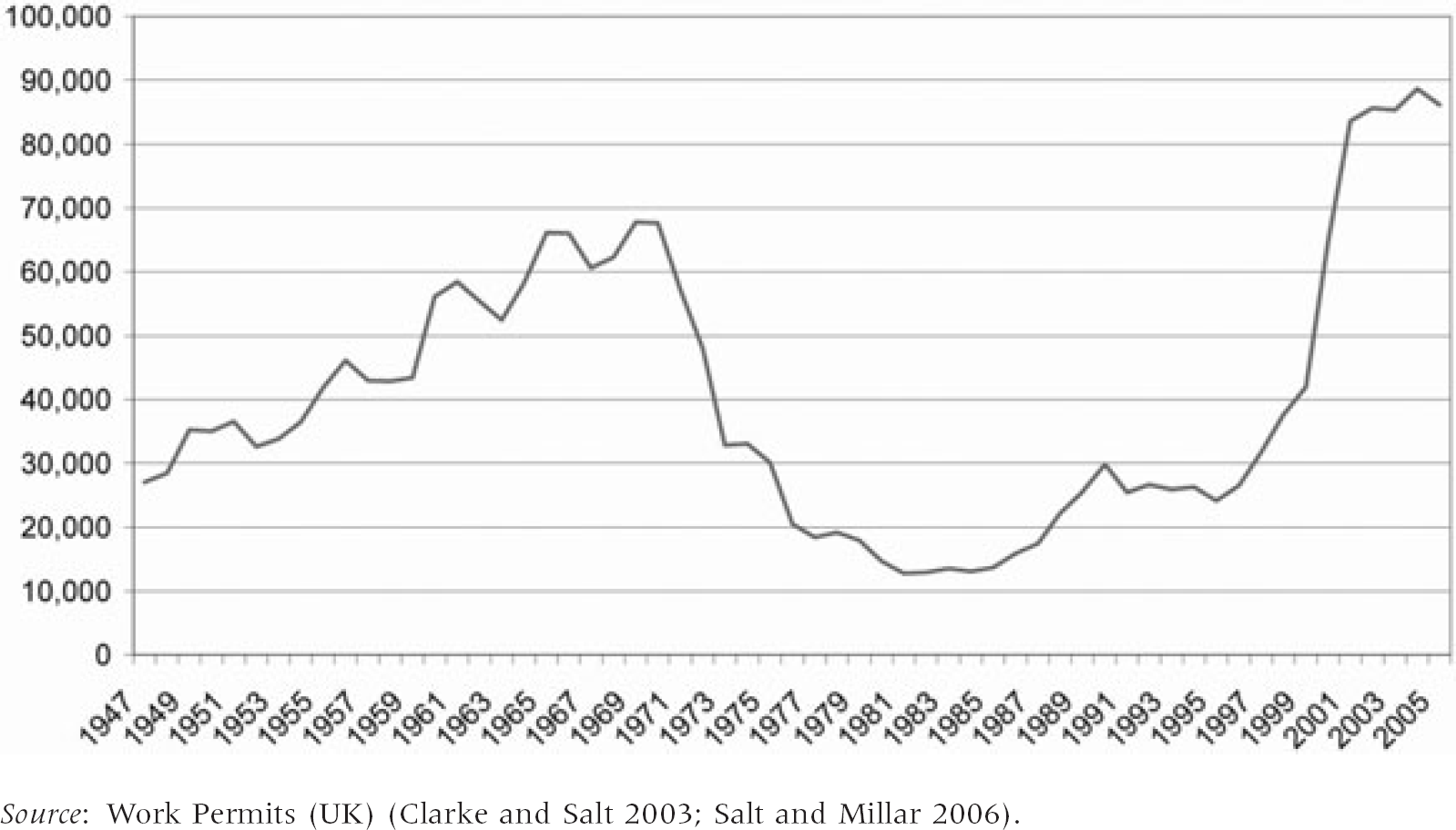
Work Permits Issued per Year (1947–2005)
As one of the top civil servants in Work Permits UK confirmed:
The real changes that influenced size and changed both the policy and organisation were: there was an economic Cabinet Office committee-led review of work permit arrangements at the very end of the 1990s, the beginning of 2000, chaired by the then chancellor, Gordon Brown. The economic Cabinet Committee encompassed all government departments, with key leads being the Department of Education and Skills, who held responsibility then for the Work Permit Schemes and the Home Office with responsibility for immigration (Interview, Steve Lamb, Deputy Director, Work Permits UK, March 2006).
The term ‘managed migration’ provided the essential framework or narrative for communicating a new approach by incorporating ideas regarding positive economic benefits of migration, while also maintaining a dimension of control. The full fanfare for the new approach was reserved for a government-funded conference on migration research convened in 2001. 21 Here the full results of the PIU–Home Office project were presented as the centrepiece of a new research agenda. Later with the 2006 Act and its overhaul of instruments for labour migration there was again to be the quiet hand of PIU expertise guiding policy on labour migration. After ‘Migration: An economic and social analysis’, the work of the Unit continued with a team, headed by Mark Kleinman, producing a second report. Unlike its predecessor, this project was in the ‘private’ category, but conversations with officials from the PIU have confirmed that much of the work of that project subsequently formed the basis of the Home Office ‘Five-Year Plan’ (HMSO 2005).
In conclusion, the evidence presented here shows how a relatively small number of actors in the PIU, IPPR and Home Office were therefore able to construct and enable the launch of a paradigm shift in policy on labour migration. As Portes confirms:
It [the PIU report] is an illustration of the way I think that personalities and people matter—and the fact that because I had a good relationship with Richard that this worked. But also Jitinder Kohli, 22 who was then at the PIU doing a completely different project but became head of productivity at the Treasury and pushed migration then because from the PIU he had been quite interested (Interview, Jonathan Portes, November 2006).
4. The ECH and Labour Migration Policy Change in the UK (1997–2007)
The ‘fit’ between the ECH and labour migration policy change in the UK (1997–2007) at first glance seems good. Haas postulated that when epistemic communities play a role in policy change there are three basic elements in the causal chain: uncertainty, (re)interpretation and institutionalisation (Haas 1992, 4): uncertainty over a policy area prompts policy-makers to turn to epistemic communities for consensual knowledge that contains alternative interpretations; these interpretations provide a new frame for understanding policy; this frame can then become concretised into a new policy settlement via institutional processes and constructions.
It is not much of a stretch then to say that from 1997 to 2007 we can observe conditions of uncertainty over immigration and then a reinterpretation of labour migration policy more closely following the consensus held by a network of experts, including several associated with the IPPR. The think tank is not shy in encouraging this interpretation of events, underlining its role in introducing ideas and knowledge into the policy process and helping to change the approach to labour migration.
IPPR very much welcomes the recognition in the White Paper of the many benefits that migrants bring to Britain and the need for a holistic, consistent, evidence based policy that embraces entry controls through to integration and social cohesion. That approach reflects the argument first put forward in IPPR's 1994 report Strangers and Citizens: a positive approach to migrants and refugees, the subsequent contribution that we made to the PIU/Home Office study Migration, an economic and social analysis (2001), and many of the issues raised at our current seminar series on future migration policy. 23
According to this initial account, then, there appears to be a resemblance between labour migration policy in the UK between 1997 and 2007 and the three different stages of policy change as laid out in the ECH. Such an assertion does not mean we should throw out traditional explanations of migration policy that highlight business interests (e.g. Freeman 1995), path-dependent effects (e.g. Hansen 2002), foreign policy concerns (Meyers 2002) or the liberal features of legal and bureaucratic systems (Guiraudon 2000a). Introducing the influence of ideas into the policy process instead contributes to these accounts by shedding light on the political sociology of immigration policy-making (Sciortino 2000).
When applying a framework such as the ECH to a new policy area there are inevitably challenges and points of weakness, however. One of the key issues, and common to all approaches foregrounding ideational factors, is the difficulty in separating an independent causal influence of ideas from the role of interests: in this case demands from Labour's clients regarding the underlying business case for increased immigration. Gary Freeman's model of immigration politics in liberal democratic states (Freeman 1995), for example, emphasises the role of business interests in securing more expansive immigration policies through client politics. However, I argue that this falls short of explaining timing in this case—there had been such calls for a more rational approach to admissions since the mid-1990s (The Economist, for example, demanded a change to a more positive approach in 1996). 24 The needs of business therefore need to be seen as one set of interests among others in terms of pressure for an opening of the debate about economic migration.
Yes, there was lobbying and in a situation such as this when you are getting more or less the same line from the big employers, the TUC, when they are all coming along to government and there is this stuff happening in the EU at the same time, it meant that we were starting to have a proper discussion about what should be the rules about managed migration (Interview, Neil Gerrard, MP, Labour party, April 2006).
Research looking at the relationship between political elites and the ‘organised public’ over immigration suggests that policy-makers are insulated from pro-migrant lobbying and conduct policy in a relatively autonomous way (Statham and Geddes 2006, 266). Although business clearly played a role in terms of exerting pressure for change, it could be argued that it was more a case of pushing towards a ‘tipping point’, feeding the political desire to change policy. Certain sectors and industries wanted more migrant labour in the late 1990s, but the construction of a new policy in a sensitive area requires more than a response to a simple list of demands. After the new policy frame had been constructed, it proved relatively easy to get agreement from unions and employers on how then to develop that system, as shown by the joint statement in 2005. 25
Thinking more closely about the timing and tempo of change can provide clues as to the explanatory power of the ECH in this case. This leads us to different questions related to each of the three dimensions. First, regarding uncertainty: why did the change of approach happen when it did (a full three years after the change of government, and seven years after the IPPR campaign)? Second, how did the new interpretation actually come to find its way into policy: how closely does the PIU–IPPR–Home Office network identified here, for example, fit the description of an epistemic community? Third, do subsequent developments and the new institutional constructions represent the final stage of the ECH?
First, concerning the timing, the secondment of Sarah Spencer as a policy expert from the IPPR into the PIU in 1999 is potentially significant in terms of the sequence of change. Although Spencer modestly claims that her move into government reflected the fact that a change in thinking had already occurred, the connection with the 1994 work at the IPPR is clear:
At that point when they decided they wanted to do the study, they looked around to see who had said anything about the social and economic impact, and that was why I was seconded into the Cabinet office—on the basis of that 1994 report—I was asked to contribute to that study because it was the only thing that was there that was saying the kind of things that by now they were interested to hear (Interview, Sarah Spencer, March 2006).
In order to understand the timing of policy change, institutional factors and the governing style of Blair need to be brought in, particularly his motivation to push and stretch the policy capacity of the office of the prime minister, sometimes to the detriment of other cabinet ministers (Foley 2000, 301–314; Kavanagh 2001, 3). Within the British form of cabinet government, there is traditionally a delicate balance between the various departments and the role of the prime minister. The decision of the PIU to commission a study on migration therefore becomes crucial, and central to this decision was the perception of immigration as a policy problem, or as an area where there existed a high degree of uncertainty, supporting the ECH. This was one of the findings of the Strategic Challenges project, and the choice of immigration was coloured by the personal interest of key players in the PIU rather than their political masters. Personal links and shared beliefs with key policy actors within the Home Office allowed the report to be issued through this department. This served to distance the prime minister but also fulfilled the PIU aim of building capacity in government departments and involving the network of policy-makers. The team leader, Jonathan Portes, was an ex-Treasury economist, and the inclusion of Sarah Spencer gave the project a frame that was likely to focus on the potential for immigration to provide part of the solution to the aim of greater labour market flexibility.
Second, central to the ECH is the identification of an epistemic community (as opposed to activists, for example) which produces consensual knowledge and provides a new non-political interpretation of the policy issue for policy-makers (Haas 2001). Migration experts and labour market economists are typically thought to believe that migration provides net fiscal benefits, especially for receiving countries (see Simon 1989). The shift in labour migration policy in the UK since 2000 follows this expert interpretation by advocating an increase in legal routes of entry and the management of migration in the interest of national economic growth. We need only look at the Home Office's presentation of its own aims and objectives regarding immigration. In the mid-1990s there was a restrictive rhetoric, with the main aim to keep those coming to work and live in the UK to ‘an irreducible minimum’. By the early 2000s this had been replaced by a more expansive logic of labour migration being used to ‘boost the economy’. This certainly reflects the expert opinion gathered by Sarah Spencer at the IPPR in the early 1990s (Spencer 1994b).
However, there are some problems here: to begin with, the individuals gathered to produce ‘Migration: An economic and social analysis’ were not all exactly experts in labour migration. The team, recruited by the PIU, included not only people from think tanks and the media, but also actors who held significant positions in the Home Office policy network. In addition to this, there should be some doubt over whether IPPR can be considered an epistemic community considering its political links with the Labour party.
Think tanks regularly make claims to objectivity but it is a fairly straightforward task to demonstrate an incredibly close relationship between the IPPR and the Labour party. The IPPR has sometimes been referred to in the press as ‘Labour's civil service’. 26 After Labour's 1997 election victory, 15 members of staff moved into government jobs. 27 The IPPR–Home Office connection was further underlined when David Blunkett's special adviser Nick Pearce (2001–03) became head of the think tank. How far is this description from that given by Haas, where epistemic communities are ‘unlike other organised interest groups active in politics and policymaking’ because they are ‘bound by the truth tests to which they were socialised, and thus are more likely to provide information that is politically untainted’ (Haas 2001, 11580)?
I would argue that the IPPR as a think tank has a certain level of autonomy from government—it finds its own funding, and claims to be driven by ‘progressive’ values: ‘to build a fairer, more democratic and environmentally sustainable world’. 28 While the closeness to Labour is an important caveat to its designation as a non-political epistemic community, it is nevertheless difficult to claim that the IPPR is an entirely political organisation. In some ways the network identified here resembles an advocacy coalition (Sabatier and Jenkins-Smith 1999), including experts and non-experts, but I argue that with the PIU research it operated as an epistemic community.
Third, with respect to the institutionalisation of expert intervention and interpretation (Haas 1992, 30), there was no instant or dramatic shift in the institutional framework around labour migration in 2000–01. In concrete policy terms the second White Paper (HMSO 2002) signalled incremental rather than radical change, despite the fact that the focus of the government had shifted to recruitment schemes and the process of labour migration (Duvell and Jordan 2003, 303). The new routes of entry were actually more of a reworking of older schemes, for example an overhaul of the Working Holidaymaker Scheme (WHS) 29 and the expansion of the Seasonal Agricultural Workers Scheme (SAWS) to other sectors under the Sector-Based Scheme (SBS).
In institutional terms, change came with the incorporation of the newly streamlined work permit system, Work Permits UK, into the Home Office in 2001 and the creation of a new ‘managed migration’ department. Targets were revised to speed up turnarounds in applications from weeks and months to days. The mechanism for deciding the numbers of immigrants entering each year to work in the UK was no longer the government, but the market. This is best illustrated by David Blunkett's comment in 2003 that there was ‘no obvious upper limit’ on migration. Over and above institutional movement, this also represented an injection of change into the organisational culture of the Home Office (Duvell and Jordan 2003).
The follow-ups to the first PIU report published through the Immigration Research and Statistics Service (IRSS) within the Home Office looked at labour market outcomes (Haque et al. 2002) and fiscal effects (Gott and Johnson 2002) to present a new level of detail regarding immigration and the UK economy. This was part of the PIU strategy of building up parallel research capacity within the different departments, in this case through the IRSS and the Strategic Policy Team (SPT).
The creation of MAC and MIF can be seen as part of a decidedly technocratic turn and an attempt to depoliticise decisions over admissions. MAC is made up of ‘independent experts’ 30 who ‘provide independent, transparent and evidence-based advice to government on where labour market shortages exist that can sensibly befilled by migration’. At least one of those appointed to MAC (Diane Coyle) provides a human thread in the story of policy change, being directly involved in the drawing up of the 2001 PIU report (see Appendix I). MIF also brings together experts to discuss evidence regarding ‘the wider social impacts of migration’. This is something the IPPR has pressed for and in its response the think tank welcomed the proposals (although suggesting that the MAC should take on more policy functions) (Cooley et al. 2005). This represents one of the ‘endgames’ for members of the epistemic community around labour migration policy—a place on the advisory board and the opportunity to guide and control labour migration policy.
Conclusions
Research on the role of ideas and knowledge in political science has tended to focus either rather narrowly on (expert) knowledge utilisation, or in a more grand fashion on big epoch-changing policy shifts such as the move from Keynesian to monetarist economics (Hall 1993; Blyth 2002a) or the causal effects of ideas about globalisation (Hay 2004). Policy on labour migration in the UK provides an excellent case to study the causal effects of ideas precisely because the shift from a restrictive paradigm illustrates ‘the contingent and open-ended nature of social and political processes and dynamics—especially those conventionally seen as fixed’ (Hay 2003, 2). In addition this time period is particularly appropriate to this kind of research, given Labour's commitment from the late 1990s, through the rhetoric of EBPM, to tap into scientific knowledge and expertise through the production of evidence to reform and modernise public policy (HMSO 1999).
The evidence presented here shows how ideas about the macroeconomic impacts of migration came to frame a new policy on labour migration. The elaboration of these ideas can first be traced to the PIU–Home Office publication ‘Migration: An economic and social analysis’ (Portes et al. 2001), and then a political journey structured in part by Blair's strategy as prime minister. Although often described as practically presidential (Foley 2000), the Blair era had as one of its central planks the building up of policy resources at the centre of government. This had two main implications for policy on labour migration: a challenge to the monopoly of thinking on the issue in the Home Office, and the recruitment and inclusion of experts into immigration policy-making.
When considering the shift to managed migration after 2000 it is impossible to ignore Spencer's campaign on a positive approach to immigration policy at the IPPR in the early 1990s. Not only did this produce a coherent policy framework with an emphasis on evidence-based policy, it was also very similar to the discourse that the shift to managed migration adopted several years later. Would a change in thinking have occurred if Spencer had not earlier developed a coherent discourse around a positive approach to immigration at the IPPR? Although we might never know, it is possible that elements of the Labour government had at least partially assimilated the recommendations outlined by Spencer in 1994—Blair was shadow home secretary at that point (before he was elected Labour party leader and replaced by Straw). What is more likely however is that Spencer's work influenced others working in the same field. As described in the ECH (Haas 1992) the crucial point is when a government turns to narratives available through epistemic communities rather than actions within those communities. In the case of labour migration policy change we need to take account of the levels of uncertainty in Labour's ranks, and how the discourse made available via the PIU–Home Office report tied in with two overarching narratives of EBPM and business-friendly macroeconomic management. This only provides the background, however, to a story dominated by personalities and contacts between like-minded individuals in the PIU, Home Office and IPPR.
Was the epistemic community used in an instrumental way to serve interests? Yes to an extent, because the narrative of managed migration satisfied a need—namely to present a competent and convincing ‘story’ of how the government is dealing with a traditionally difficult issue. The point here is that, in line with the ECH, the consensual knowledge provided by experts contained new ideas about immigration (as a driver of macroeconomic growth), which had implications for later policy decisions. Identifying an independent causal influence for ideas does not mean dismissing interests as irrelevant—interest-based accounts correctly identify the motivation for change but neglect the path-dependent ways in which a new policy frame can subsequently affect future decisions (Hansen 2002). The decision to allow free movement for A8 nationals is a good example—the new policy framework that led the government to use expertise in its decision-making had far-reaching (if perhaps unintended) consequences, leading to over a million Eastern Europeans coming to the UK between 2004 and 2007 (Pollard et al. 2008). By incorporating the influence of ideas as well as interests we can better understand why the new policy led to the creation of institutional structures to incorporate experts into the policy process, for example through MAC and MIF.
One of the key points that emerged during the research was the difficulty in designating networks of actors and organisations identified here as unequivocally epistemic communities in the same way that Haas describes (Haas 2001, 11580). I therefore resort to describing the network as operating as an epistemic community. Future research should focus on the political function and dimension of organisations such as the IPPR and PIU, but also look in detail at the way in which new structures such as MAC and MIF provide evidence of the institutionalisation phase of the ECH.
The ECH proves to be a useful framework for investigating the role of ideas in policy change. While one of the main problems with using this approach is the difficulty in disaggregating the role of ideas with those of interests, the approach here was to pay closer attention to the timing and tempo of change. On this basis, in the case of labour migration policy in the UK it is argued that in a contingent and conjunctural way a limited opening or ‘window’ for change occurred around 2000. This allowed a specific network of actors in the policy community, operating as an epistemic community, to dislodge the dominant restrictive policy paradigm or ‘frame’, and open the debate around policy. This suggests that to understand policy change we should pay attention to how the political appetite for new policy ideas can be fuelled by uncertainties over policy performance, and the role of expertise in the reframing of policy.
Footnotes
1
It should be noted that this article is concerned with labour migration and so does not touch upon related policies on asylum, family reunion, immigrant integration, etc.
2
3
6
Introduced in the early 1980s, in the first Thatcher government, the Primary Purpose rule regulated entry for spouses who were not British citizens. Couples needed to prove that the primary purpose of the marriage was not to settle in the UK. Once the rule was removed couples still needed to prove that the marriage was genuine.
7
Jack Straw was responding to Michael Howard's attempt to put ‘clear blue water’ between Labour and the Conservative party on immigration (The Guardian, 3 March 1995).
8
It should be noted that there was reduced room for manoeuvre for the incoming Labour government because of pre-election promises to stick to Tory spending plans for the first two years. These plans included a reduction in staffing levels at the Home Office, based on the (with hindsight, absurdly optimistic) expectation that a new IT system would streamline casework, reduce backlogs and cut running costs.
9
Roche was Home Office minister 1999–2001. Before that she was financial secretary to the Treasury.
10
A8 = the Czech Republic, Estonia, Hungary, Latvia, Lithuania, Poland, Slovakia and Slovenia (2004 enlargement of the EU).
11
Announced on 10 December 2002 during the negotiations leading to the accession of the new member states at the Copenhagen European Council (2002).
12
13
A2 = Romania and Bulgaria (2007 enlargement).
14
Eventually becoming the UK Border Agency (UKBA) in April 2008.
17
Although it is difficult to establish when this phrase was first coined, it has been attributed to Stephen Boys-Smith, secretary-general of the IND (1998–2002).
18
See, for example, Andrew Lansley's article in The Guardian (3 September 1995): ‘Immigration, an issue which we raised successfully in 1992 and again in the 1994 Euro-elections campaign, played particularly well in the tabloids and has more potential to hurt’.
19
1998–2002—then took up the post of Director General of the Organised Crime, Drugs and International Group at the Home Office. Succeeded by Bill Jeffrey.
20
For example, a report can be made public in two ways: ‘to’ government—where an outside research group reports findings, or ‘of’ government—where research is presented as being government produced. A third option is when the report is kept private, for internal use only. Given the controversial nature of immigration this report might have remained private, but instead ended up being ‘to’ government.
21
Bridging the Information Gap: A Conference of Research on Asylum and Immigration in the UK, March 2001.
22
24
The Economist, 4 May 1996.
25
27
Some of the most high-profile moves between the IPPR and the Labour government include: Tessa Blackstone, the IPPR's first chair, was appointed minister of Education in 1997; Patricia Hewitt, IPPR director from 1989–1994, became a minister of state for the Department of Trade and Industry in 1999; Matthew Taylor, director of the IPPR from 1998, was seconded to become head of policy for Labour (at the No. 10 Policy Directorate) in September 2003; Nick Pearce moved in the other direction, replacing Taylor as IPPR director by leaving his job as special adviser to David Blunkett.
29
The Working Holidaymaker Scheme (WHS) allowed citizens from commonwealth countries to work in Britain for up to two years. Before the changes in 2002 New Zealand, Australia, Canada and South Africa had accounted for 96 per cent of successful applications.
30
MAC member biographies (see also Appendix I): 
Appendix I
Dr Diane Coyle
Dr Martin Ruhs
Professor Jonathan Wadsworth
Professor Robert Wilson
Professor Mike Campbell (ex officio member)
Paula Higson (government)
Mark Franks (secretary)
Stephen Earl
Vanna Aldin
Andrew Watton
Anna Downs
Anne Ball
Andy Honeyman (Border and Immigration Agency)