







Abstract
This article considers treatments of the Bible story of Naboth and Ahab in the work of two thinkers separated by more than a millennium: St Ambrose and John Ponet. Both men treat this as a story about (among other things) property and political authority. Their emphases are different but there are similarities that make them plausibly part of a common tradition of reading the Bible for political effect.
1: And it came to pass after these things, that Naboth the Jezreelite had a vineyard, which was in Jezreel, hard by the palace of Ahab king of Samaria.
2: And Ahab spake unto Naboth, saying, Give me thy vineyard, that I may have it for a garden of herbs, because it is near unto my house: and I will give thee for it a better vineyard than it; or, if it seem good to thee, I will give thee the worth of it in money.
3: And Naboth said to Ahab, The LORD forbid it me, that I should give the inheritance of my fathers unto thee.
4: And Ahab came into his house heavy and displeased because of the word which Naboth the Jezreelite had spoken to him: for he had said, I will not give thee the inheritance of my fathers. And he laid him down upon his bed, and turned away his face, and would eat no bread.
5: But Jezebel his wife came to him, and said unto him, Why is thy spirit so sad, that thou eatest no bread?
6: And he said unto her, Because I spake unto Naboth the Jezreelite, and said unto him, Give me thy vineyard for money; or else, if it please thee, I will give thee another vineyard for it: and he answered, I will not give thee my vineyard.
7: And Jezebel his wife said unto him, Dost thou now govern the kingdom of Israel? arise, and eat bread, and let thine heart be merry: I will give thee the vineyard of Naboth the Jezreelite.
8: So she wrote letters in Ahab's name, and sealed them with his seal, and sent the letters unto the elders and to the nobles that were in his city, dwelling with Naboth.
9: And she wrote in the letters, saying, Proclaim a fast, and set Naboth on high among the people:
10: And set two men, sons of Belial, before him, to bear witness against him, saying, Thou didst blaspheme God and the king. And then carry him out, and stone him, that he may die.
11: And the men of his city, even the elders and the nobles who were the inhabitants in his city, did as Jezebel had sent unto them, and as it was written in the letters which she had sent unto them.
12: They proclaimed a fast, and set Naboth on high among the people.
13: And there came in two men, children of Belial, and sat before him: and the men of Belial witnessed against him, even against Naboth, in the presence of the people, saying, Naboth did blaspheme God and the king. Then they carried him forth out of the city, and stoned him with stones, that he died.
14: Then they sent to Jezebel, saying, Naboth is stoned, and is dead.
15: And it came to pass, when Jezebel heard that Naboth was stoned, and was dead, that Jezebel said to Ahab, Arise, take possession of the vineyard of Naboth the Jezreelite, which he refused to give thee for money: for Naboth is not alive, but dead.
16: And it came to pass, when Ahab heard that Naboth was dead, that Ahab rose up to go down to the vineyard of Naboth the Jezreelite, to take possession of it.
17: And the word of the LORD came to Elijah the Tishbite, saying,
18: Arise, go down to meet Ahab king of Israel, which is in Samaria: behold, he is in the vineyard of Naboth, whither he is gone down to possess it.
19: And thou shalt speak unto him, saying, Thus saith the LORD, Hast thou killed, and also taken possession? And thou shalt speak unto him, saying, Thus saith the LORD, In the place where dogs licked the blood of Naboth shall dogs lick thy blood, even thine.
20: And Ahab said to Elijah, Hast thou found me, O mine enemy? And he answered, I have found thee: because thou hast sold thyself to work evil in the sight of the LORD.
21: Behold, I will bring evil upon thee, and will take away thy posterity, and will cut off from Ahab him that pisseth against the wall, and him that is shut up and left in Israel,
22: And will make thine house like the house of Jeroboam the son of Nebat, and like the house of Baasha the son of Ahijah, for the provocation wherewith thou hast provoked me to anger, and made Israel to sin.
23: And of Jezebel also spake the LORD, saying, The dogs shall eat Jezebel by the wall of Jezreel.
(1 Kings 21:1–23)
In this article, I set out to explore what might be the limits (and the possibilities and the pitfalls) of trying to take the really long view in the history of ideas. I do this by considering the treatment of the biblical story of Naboth, taken from the Old Testament Book of Kings, in the work of two men separated by more than a millennium—St Ambrose, Bishop of Milan (339–97) and the Marian exile and some time Bishop of Rochester and Winchester, John Ponet (1516–56). The two textual sources are Ambrose's De Nabuthae (On Naboth), written in Latin in Milan around 387 and the fifth chapter of John Ponet's Short Treatise of Politic Power, written in English, though while in exile in Frankfurt, in 1555. Both men took the story of Naboth to be about political authority and property (among other things) and it is this aspect of their work that I shall explore.
Ambrose was one of the most prominent of the early Church Fathers, twenty years older than Augustine and already bishop in Milan when Augustine arrived there (as court rhetorician) in 384
There were many things that the two men shared. Both were ordained members of the Christian church and both became bishops of important dioceses (although Ponet's tenure of the see at Winchester lasted barely two years). Both men clashed with the worldly authorities, but while Ponet ended his days in exile in Frankfurt, Ambrose is reported to have bested not just one but three Roman emperors! (McLynn 1994, 1) Both men had a good working knowledge of Latin and Greek, which was significant in terms of their bible scholarship (Homes Dudden 1935, I, 456; Hudson 1942, 13–16). Ponet was a keen student of the works of the early Church Fathers and he knew and cited Ambrose's work extensively (not least in his defence of the marriage of priests; Ponet 1567). Ambrose had been a lawyer before he became a bishop and both he and Ponet had a sound knowledge of the contemporary Roman law (in Ponet's case, this would have meant the Corpus Iuris Civilis and its canon law accretions).
Bibles
Of course, by far the most important resource that both men shared, and itself the single most important source of moral and political authority throughout the millennium that divided them and beyond, was the Christian Bible. It was from a reading of the Book of Kings that both men took the story of Naboth. The history of such biblical sources is one of Byzantine complexity (see Jones 1984, 1, 2–82). If the account of Naboth's murder were history rather than simply a story, the events described would have had to have taken place around 850
We know that both men used (what is now) chapter 21 of the First Book of Kings as their source. But were they reading the same story (in the same language)? There is widespread agreement that Ambrose's chosen source was the Septuagint Bible (or LXX), the oldest extant Greek text which had been translated from Hebrew by Jewish scholars working at Alexandria between the third and first centuries
Given Ponet's proficiency as a Greek scholar (he was university lecturer in the language at Cambridge), we may well suppose that he was using the Septuagint as one of perhaps several biblical sources. He probably also had access to (at least parts of) Origen's Hexapla (Origen 1875), compiled in the first half of the third century, which provided six variants of the Bible (including a corrected Septuagint) in parallel columns. In the end, we cannot say definitively which text or texts Ambrose and Ponet had in front of them when they wrote. As both were accomplished linguists, we know that they would have been competent to read the sacred texts in both Greek and Latin. The very least that we can say is that they both read versions of the story of Naboth that were very similar, not just in their broad outlines but also in their detail. This is borne out by the textual evidence of De Nabuthae and the Short Treatise themselves.
Ambrose and De Officiis
And yet their readings of the story of Naboth differ in important ways. For Ambrose, the story of Naboth is, above all else, the (timeless) story of rich and poor: ‘daily is Naboth struck down, daily is a poor man put to death’ (Ambrose 1927 [c.387], 47). 2 And the universal Naboth of De Nabuthae often appears in the guise and predicament of a property-less day-labourer, perhaps capturing Ambrose's sense that his poverty is caused (and an injustice committed) by the expropriation of the poor man from ‘his little acre’ (Ambrose 1927 [c.387], 47). No less ubiquitous is the universal Ahab:
For who of the rich does not daily covet the goods of others? Who of the wealthy does not strive to drive off the poor man from his little acre and turn out the needy from the boundaries of his ancestral fields? Who is content with his own? What rich man's heart is not set on fire by a neighbour's possession? (Ambrose 1927 [c.387], 47)
For Ambrose, it is the rich who are the truly needy, for their covetousness knows no bounds and the more they have the more they crave: ‘for everyone in abundance judges himself all the poorer, because he thinks he lacks whatever is possessed by others’ (Ambrose 1927 [c.387], 81). The characteristic rich man is the miser, unable even to enjoy his riches for fear that he may lose what he has or that some opportunity to increase his wealth may escape him: ‘Avarice is enkindled by gain, not quenched’ (Ambrose 1927 [c.387], 49). It is the rich man (Ahab) who craves the wealth of the poor man (Naboth) and not the other way around. Indeed, Ambrose argues that the rich man craves insufficiency for everyone else as it is this which most reliably pushes up the value of his own possessions.
The miser is always deeply worried by abundant crops because he thereby foresees a cheapness in food-stuffs. For abundance belongs to all, scarcity is lucrative to the miser alone. He is pleased rather by enormous prices than by the abundance of commodities, and he prefers to have what he alone may sell than what he may sell together with all. See him in fear lest his heap of grain overflow, lest, streaming out over the barns, it may pour upon the poor, and an occasion for some good be obtained by those in want (Ambrose 1927 [c.387], 69).
Nor is Ambrose's appeal to the rich to give up their wealth based upon a duty of charity to the poor. Ambrose seems to be clear that the wealth of the rich is a form of theft and based upon the exploitation of the poor.
Not from your own do you bestow upon the poor man, but you make return from what is his. For what has been given as common for the use of all, you appropriate to yourself alone. The earth belongs to all, not to the rich. Therefore you are paying a debt, you are not bestowing what is not due … How far, O ye rich, do you push your mad desires? Shall ye alone dwell upon the earth? Why do you cast out your consort in nature and claim for yourselves the possession of nature? The earth was made in common for all, both rich and poor (Ambrose 1927 [c.387], 83, 47, emphasis in original).
This point is repeated throughout Ambrose's polemic: ‘for all has the world been created, which you few rich men are trying to keep for yourselves’ (Ambrose 1927 [c.387], 53); ‘rich men sorrow, if they cannot steal the things of others’ (p. 55); ‘rich men eat rather another's bread than their own, and they live on plunder and pay their expenses by acts of robbery’ (p. 55); ‘they are made sad if they are not seizing the property of others; they renounce food, they fast, not that they may lessen their sin but that they may commit crime’ (p. 75).
Patristic Views of Property
Judgements upon Ambrose's view of the legitimacy of private property vary. Arthur Lovejoy (1942) and Ambrose's first modern biographer, F. Homes Dudden (1935), are among those who take seriously the claim that Ambrose's text can be read as a sort of ‘primitivistic communism [preaching] a virtually equalitarian and communistic ideal of a Christian society’ or as the advocacy of ‘the ideal of a socialistic community’ (Homes Dudden 1935, 545–550; Lovejoy 1942, 458, 468). Certainly, there are passages in the text of De Nabuthae which seem to be open to such a reading. Close to the other extreme is Vincent Vasey who, in contesting the ‘communistic’ reading of Ambrose, finds in De Nabuthae an ‘affirmation of private property’; for Vasey's Ambrose, it just is the case that ‘private property is good’ (Vasey, 1982, 126).
This uncertainty over the nature of Ambrose's views actually belongs to a much wider debate about the character of legitimate property which we find in all of the early patristic writers (on which, see Christophe 1963; Hengel 1974; Countryman 1980). A key part of ‘the problem’ for both the fathers and later apologists was that the teachings of Jesus on property and riches were at best ambivalent and, in the eyes of their critics, quite explicitly and consistently hostile. Added to this was the ‘example’ of the common ownership reported (in Acts 4:32–34) to have existed in the earliest (and exemplary) Christian community at Jerusalem. Among the most awkward of all these stories was Jesus' command to the rich young man to ‘sell whatever thou hast, and give to the poor, and thou shalt have treasure in heaven’ (Mark 10:21). Ever since St Clement of Alexandria had penned Quis Dives salvatur? (Who is the Rich Man that Shall be Saved?) in the middle of the 2nd century
But alongside this apologetic tradition, there remained a strain of writing that was much more critical of wealth and of exclusive claims to possess the earth. Thus, writing in the early third century
whatever is of God is common in our use … he who, as a possessor in the earth, shares his returns and his fruits with the fraternity, while he is common and just in his gratuitous bounties, is an imitator of God the Father (Cyprian, quoted in Schaff 1994, 5, 483).
St John Chrysostom, Archbishop of Constantinople and a near contemporary of Ambrose, writing a commentary on Paul's First Epistle to Timothy—in which Paul rails against the pursuit of ‘filthy lucre’ and insists that ‘the love of money is the root of all evil’—mounts a sustained attack on the roots of wealth: ‘so destructive a passion is avarice, that to grow rich without injustice is impossible’ (1 Timothy 3:3, 8; 6:10; Chrysostom, quoted in Schaff 1886, 13, 447, emphasis in original). Inheritance, in particular, must always arise from a historical injustice:
Tell me, then, whence art thou rich? From whom didst thou receive it, and from whom he who transmitted it to thee? From his father and his grandfather. But canst thou, ascending through many generations, show the acquisition just? It cannot be. The root and origin of it must have been injustice. Why? Because God in the beginning made not one man rich, and another poor. Nor did He afterwards take and show to one treasures of gold, and deny to the other the right of searching for it: but He left the earth free to all alike. Why then, if it is common, have you so many acres of land, while your neighbour has not a portion of it? It was transmitted to me by my father. And by whom to him? By his forefathers. But you must go back to the original owner. Jacob had wealth, but it was earned as the hire of his labors. 3
Where does Ambrose fit into this larger story? Ambrose's most recent biographer, Neil McLynn (1994) has no time for ‘the completely misguided debate on whether Ambrose embraced communism’. Chrysostom may have meant what he said but Ambrose's sophisticated Milanese audience ‘would know better than to take [his condemnations of the wealthy] literally’. He concludes that ‘Ambrose's whole style and presentation ensured that any glass he held up to his society was bound to be riddling and dark’ (McLynn 1994, 245–249). It seems clear that Ambrose was not an advocate of common ownership here and now, even if he believed that to live without property might represent the ‘more perfect way’. His own property dealings with the inheritance he jointly possessed with his brother and sister are somewhat obscure but it seems that, upon taking up his post in Milan, he divested himself of most of his own personal wealth. 4 At the same time, he fiercely defended the corporate right of the Church to retain possession of its own buildings. In a letter to the Emperor Valentinian, Ambrose reminds him of the story of Naboth, concluding: ‘If Naboth did not hand over his vineyard, shall we hand over the Church of Christ?’ (Ambrose 2005 [385–6], 151) More than this, in De Nabuthae Ambrose clearly defends the legitimacy of Naboth's inheritance. The story of the common possession of the earth may have been a way of reminding the rich of the responsibilities that were a part of their stewardship of that which, in the end, only truly belonged to God. And it may well be that it was the expropriation of the indebted smallholder by the larger and wealthier landowner that Ambrose has uppermost in his mind in telling the story of Naboth. This chimes with the contemporary evidence that life for peasant farmers and the indentured was becoming more difficult in an economic crisis which combined ‘demographic contraction, the ravages of war, growing military expenses, tax pressure, economic decline, the coercion of workers and state interventions’ (Giardana 2007, 743–768; see also Jones 1974, 83–88, 135–136; Hopkins 1980, 121; Wickham 1994, 13; Garnsey 1998). 5
Ambrose and De Officiis
De Nabuthae has its origins in a set of sermons (which must have been awesomely long!). These would surely have been strongly rhetorical in style and to this extent may be an unreliable guide to Ambrose's considered opinion. We might expect something a little more measured in Ambrose's major treatise on Christian ethics, De Officiis (Ambrose 2002 [387]). In this work, Ambrose reworks Cicero's (1991 [44 bce]) famous text of the same name (itself an updating of an earlier and now lost text of the 2nd-century
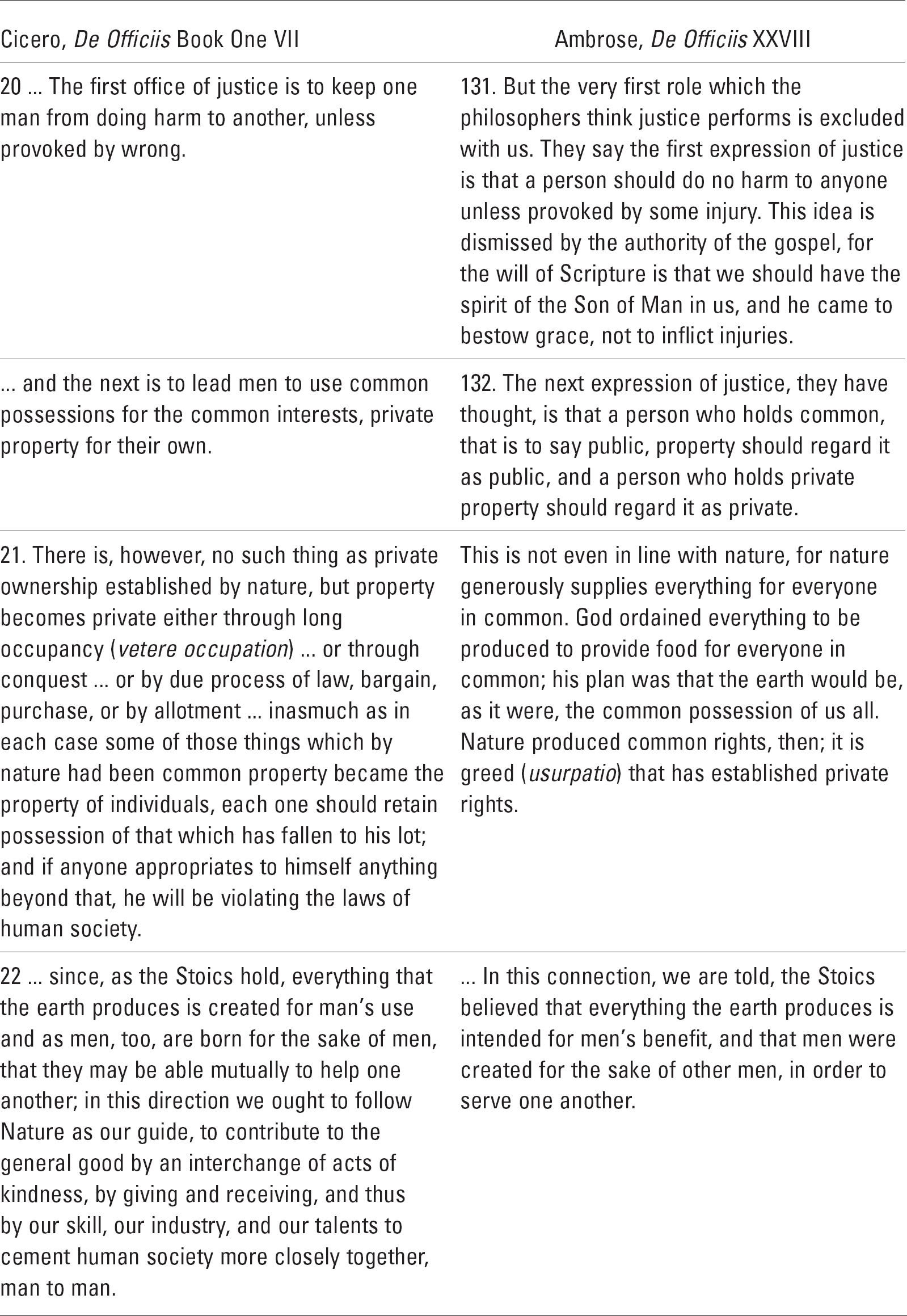
Having claimed that all these good Stoic ideas were stolen from the Holy Scriptures (from Moses and David, respectively), Ambrose concludes his discussion in the following terms:
137. Who would not want to occupy this citadel of virtue [i.e. justice], had not the force of the virtue in all its glory been left weakened and warped by primeval greed? For the fact is, in our desire to extend our own assets, to pile up our own money, to seize people's lands as our own personal possessions, and to outdo others in the wealth that we have, we have removed the character of justice, and we have lost the principle of showing kindness to all in common. How can someone be called [just] if all he longs for is to snatch something from his neighbour because he wants it for himself?
In the secondary literature (which is extensive; see Davidson 2001, 570–1 for sources), much has been made of whether Ambrose's usurpatio here is really equivalent to Cicero's vetus occupatio. The consensus seems to be that, while usurpatio was sometimes deployed with a more neutral sense (of ‘usage’ or ‘occupation’), by this time and certainly in this context its sense is pejorative. So, initial occupation is in some sense ‘illegitimate’. At the same time, Ambrose is clearly not calling for all to be returned to common ownership. The unlawful origins of private property simply reinforce the duty upon present custodians to be generous and to share use of their resources with the poor. 6 It serves to remind the wealthy man that ‘you are the custodian, not the master of your wealth’ (Ambrose 1927 [c.387], 87).
It may be that Ambrose's thinking here is influenced less by Cicero than by Seneca (whether at first or second hand; see Homes Dudden 1935, I, 8). It is in the work of Seneca that we find the clearest expression of the idea that the existence of private property represents a ‘second best’, the regrettable necessity of men who have lost the innocence of their golden age, largely because they have been ensnared by avarice. The crucial source is Seneca's Epistula LXXXX. Here Seneca writes enthusiastically of:
That fortune-favoured period when the bounties of nature lay open to all, for men's indiscriminate use, before avarice and luxury had broken the bonds which held mortals together, and they, abandoning their communal existence, had separated and turned to plunder … there is no other condition of the human race that anyone could regard more highly; and if God should commission a man to fashion earthly creatures and to bestow institutions upon peoples, this man would approve of no other system than that which obtained among the men of that age, when
No ploughman tilled the soil, nor was it right
To portion off or bound one's property.
Men shared their gains, and earth more freely gave
Her riches to her sons who sought them not.
What race was ever more blest than that race? They enjoyed all nature in partnership. Nature sufficed for them … and this her gift consisted of the assured possession by each man of the common resources (Epistula 90, Seneca 2006; the poet cited is Virgil).
This primitive communism was destroyed by the arrival of avarice which ‘by its eagerness to lay something away and to turn it to its own private use, made all things the property of others, and reduced itself from boundless wealth to straitened need’. Private property brings with it inequality, poverty, contestation, hatred, envy, disingenuousness, fretfulness, fear, vanity, viciousness. It creates a state of unfreedom; ‘a thatched roof covered free men; under marble and gold dwells slavery’ (Epistula 90). But, for Seneca, it is an irreversible change—and reflects the degenerate state of ‘fallen’ men.
If you are indignant at men being ungrateful, you ought also to be indignant at their being luxurious, avaricious and lustful; you might as well be indignant with sick men for being ugly, or with old men for being pale. It is, indeed, a serious vice, it is not to be borne, and sets men at variance with one another; nay, it rends and destroys that union by which alone our human weakness can be supported; yet it is so absolutely universal, that even those who complain of it most are not themselves free from it (De Benificiis VII, 27, Seneca 1887). 7
This story could easily be Christianised by placing the golden age in the Garden of Eden and identifying its end with the Fall and the original sin of Adam and Eve. In the words of Ambrose's De Officiis: ‘Nature produced common rights, then; it is greed (usurpatio) that has established private rights’ (Ambrose 2002 [387], 1, 195). A world without property would be a better world but in our fallen condition this is not possible and it is better that fallen men should have rules about property than none, for such anarchy would simply open the way to perpetual violence and rapine.
Augustine and the City of God
This view is brought out much more explicitly in the work of St Augustine, within just a few years of Ambrose's death. Writing early in the fifth century, Augustine accepted the by now conventional view that in the beginning (and before the Fall) the earth was given by God to all mankind in common. But fallen men, in the grip of the vices of lust and avarice, need civil laws that distinguish ‘mine’ from ‘thine’, just as they need the other laws of the earthly state, to save them from falling into the anarchy of mutual self-destruction. According to the unchanging divine law, all things belong to God or maybe, by his dispensation, to those whom he deems righteous; but according to the (changeable) civil law, possessions belong to those whom the king (for now) decrees to be their owners.
By what right does every man possess what he possesses? Is it not by human right? For by divine right ‘The earth is the Lord's and the fullness thereof’. God has made poor and rich of one clay: the same earth supports poor and rich alike. By human right, however, someone says, This estate is mine, this house is mine, this slave is mine. By human right, therefore: that is, by right of the emperors. Why? Because God has distributed to mankind these very human rights through the emperors and kings of this world … But you say, what is the emperor to me? It is by a right derived from him that you possess the land. Otherwise, if you take away rights created by emperors, who will dare say, That estate is mine, or that slave is mine, or this house is mine. If therefore you have said, What is the king to me? Do not say that your possessions are yours; because, in so doing, you are referring precisely to those human rights by which men enjoy their possessions (Augustine, quoted in Schaff 1886, 7, 47–48; translation from Dyson 2001, 116).
Elsewhere, Augustine evokes the shadow world of divinely lawful ownership, quoting the Book of Proverbs to the effect that ‘the whole world is the wealth of the faithful man, but the unfaithful one has not a penny’ (Augustine 2001, 87). Since to possess ‘lawfully’ is to possess ‘justly’ and to possess ‘justly’ is to possess ‘rightly’, the many men who do not use their wealth well (i.e. in the service of God) are in the wrongful possession of what is properly the property of another: ‘money can be wrongly possessed by bad people, and as for the good, the less they love it, the more rightly they possess it’ (Augustine 2001, 87). But, in Augustine's view, it is best to tolerate the actual and ‘unjust’ disposition of property in the real world because this is part of the price that we pay to secure some sort of civil peace in our sojourn through this the earthly city (whose sin is incurable). Thus, the rule of the tyrant and the wealth of the wicked are also a part of God's plan, sent to test and punish the righteous. It is only in the City of God that every one ‘will truly own what he possesses’ (Augustine 2001, 87).
Ponet and the Short Treatise
For Ambrose, the story of Naboth is a story about property. It is, above all, about the duties of the wealthy and the powerful to respect the proprietary rights of the poor and the powerless. But even though Ahab is a king and although Ambrose cites the story against the Emperor Valentinian, it is really for him much more a story of rich and poor than it is one of state and citizen. Its target is the vice of avarice rather than overweening political power. The inflection of the story of Naboth as this reappears in the crucial fifth chapter of Ponet's Short Treatise of Politic Power is rather different (Ponet 1970 [1556]). 8
Under Edward VI, Ponet had risen into the highest echelons of the established Protestant church, succeeding Stephen Gardiner as Bishop of Winchester in 1551. With the accession of Mary to the throne in 1553 and her vigorous efforts to re-impose Catholicism, Ponet was deprived of his office and briefly imprisoned. Having been released, he was suspected of involvement in the early stage of Wyatt's rebellion (in late January and early February 1554). At this point, Ponet fled to the continent where he is next heard of in residence in Frankfurt. It was here that he wrote the Short Treatise (probably in 1555). It is widely suggested (see Hudson 1942; Skinner 1978, II) that Ponet's real purpose in this work is to establish the limits of the ruler's powers and to justify even the private subject in killing a tyrant (indeed, the latter is not really a right but rather a duty given by the law of nature, which is God's law). An important secondary theme is to establish the indefeasible right of the citizen to the ownership of private property. Indeed, (Barbara Peardon 1982, 40–41) suggests that the proximate cause of Ponet's intervention was not a general hostility to Mary's attempt to re-impose Catholic orthodoxy but rather a more specific attack upon the property of Protestant exiles which the queen was pursuing throughout 1554 and 1555.
In Ponet's account, legitimate property comes into being after the Fall but before the creation of political power (which itself is only instituted after the Flood). In the beginning, there was simply the law of nature or the rule of God (which were and are the same thing). Before the Fall, men simply knew to follow the will of God: ‘this rule is the lawe of nature, furst planted and grafted only in the mynde of man’. And, before the Fall, ‘whan ther was no sinne, all thinges were common’. After the Fall, man's ‘mynde was through synne defiled, filled with darknesse, and encombered with many doubtes’ and God set forth his law ‘in writing in the decaloge or 10 commaundmentes’. This in turn was to be reduced in Jesus' teaching to just two commands: ‘thou shalt love thy lorde God above all thinges, and thy neighbour as thy self’:
In this lawe is comprehended all justice, the perfite way to serve and glorifie God, and the right meane to rule every man particularly, and all men generally: and the only staye to mayntayne every commonwealthe. This is the touchestone to trye every manes doinges (be he king or begger) whether they be good or evil. Bi this all menes lawes will be discerned, whether they be juste or unjuste, godly or wicked (Ponet 1970 [1556]).
Ponet says nothing explicitly about how several property arose. But he does say that, after the Fall, ‘God ordained that man should get his living by the swette of his browes: and that he should be the more forced to labour, the distinction of thinges and propertie (mine, and thine) was (contrary to platoes opinion) ordained’. That this is God's will is said to be evident in ‘these two lawes: Thou shalt not steale: Thou shall not covet thy neighbors wife, nor his servant, nor his maide, nor his oxe, nor his asse, nor any thing that is his’.
Originally, God simply gave fallen man the law, but when he persisted in his wickedness, God brought first the Flood and then, in its wake, corporal punishment. At this point, God also ‘institut[ed] politike power and geveth authoritie to men to make more lawes’. This included ‘autoritie over goodes, landes, possessions and all suche thinges as might bried controversies and discordes’ (Ponet 1970 [1556]). The form of this magistracy (and whether monarchy, aristocracy or democracy) it was left to the people to choose. The one purpose of such government, whatever its form, was ‘the mayntenaunce of justice, to the wealthe and benefite of the hole multitude; and not of the Superiour and governours alone’ (Ponet 1970 [1556]). To secure this end, the people instituted checks upon their rulers (the Ephors at Sparta, the Decemviri at Rome and, in more recent times, parliaments). But the people always retain the right to change their form of government if the rulers breach their trust and fail to govern according to God's law. Rulers and ruled are alike subject to God's law (the law of nature) and it is our duty to defy those rulers who act against God's will.
What are the consequences of this political dispensation for the property regime? It is Ponet's intention to refute the claim of those who argue that all property within the kingdom is, in the last instance, held by the monarch. Before the Fall, all things were common (to this extent, but only to this extent, the Anabaptists are right) but in a sinful world, common ownership is impossible. (The sharing of goods in the early Christian church was supererogatory and exceptional.) But ‘in these daies … many wicked governours and rulers’ are worse than the Anabaptists—for they wish to make everyone's goods common except their own. They dress this up in various ways—as the taxation of moral evils (such as drink), by debasing the coinage, or as ‘God's will’, justified by a selective reference to the Scriptures (especially to the story of God's description of kingship in 1 Samuel 8:10–18, a favourite text of the absolutists; Ponet 1970 [1556], 83–85; see below). But rulers no less than the people are subject to God's natural law—including both the seventh and eighth commandments. No one can exercise absolute political power: ‘kinges, princes, and governours of common wealthes have not nor can justly clayme any absolute autoritie, but that the ende of their autoritie is to maintene justice, to defende the innocent, to punishe the evil’ (Ponet 1970 [1556]).
It is in this context that Ponet evokes the story of Naboth, Jezebel and Ahab. In Ponet's account, there is no mention of Naboth being a poor man: he simply refused to sell his vineyard, ‘as he might doo, for by Goddes lawe he had a propretie therin, from which without his will and consent, he could not be forced to departe’ (Ponet 1970 [1556], emphasis in original). It is not absolutely clear how Naboth has attained a right in his property ‘by Goddes lawe’. Clearly, the vineyard is ‘the inheritance of his fathers’. And the Books of Numbers and Leviticus contain a good deal of God-given law (divine positive law) which minutely prescribes paths of inheritance (of land that is originally given to the Jews by God) including rules forbidding the permanent alienation of the land. It is in this sense that Naboth's inheritance has a God-given pedigree (even if private property only exists as the result of man's sinfulness).
As we know, Jezebel schemed Naboth's murder and the king got his vineyard but God's wrath was visited upon Ahab and, in the end, his house was ‘so destroied, that ther was not lefte therof so muche as a dogge to pisse against the wall’ (Ponet 1970 [1556]). The more general lesson that Ponet draws is this:
a christian king or governour, must remember, that he is a christian man, and that bi being made a king, he is not exempt from the lawes and duetie of a christian man, which everi one professeth in Baptisme: but as he is called and exalted above the rest of his brethren, so should be an example to them of good lyving and vertue, in observing the lawe, which saieth as well to kinges as to beggers: Thou shalt not steale, thou shalt not covet anything that is thy neighbors: and so it stablisheth and confirmeth, that every one maie justly kepe that is his owne, and none maie take it from him by ani means against his will, be it king or Kaiser (Ponet 1970 [1556]).
To this Ponet adds one last and uncharacteristically pragmatic argument. If it were true ‘that all the subjects goods were the princes’, this would be a recipe for economic disaster (Ponet 1970 [1556]). Were people so uncertain about keeping the proceeds of their labour, they would abandon all their productive efforts. Indeed, they would cease to bring children into a world in which they were to be so deprived of their just rewards. This, so Ponet argues, has been the experience of the indigenous peoples of the New World where a flourishing domestic economy (and population) was crushed by the Spanish invaders' ruthless exploitation of native labour to extract gold (Ponet 1970 [1556]).
Conclusion
There is something more than a few hundred miles separating Ambrose's Milan from Ponet's Frankfurt. But despite the twelve and a half centuries that lie between De Nabuthae and the Short Treatise, there is a sense in which they belong to a shared tradition. They worked from the same source. They shared a wider epistemology (grounded in the truths of the Bible) and (in a similarly very broad sense) a world-view. They shared the view that the ultimate moral and political authority (and, in the last instance, the one truly legitimate owner) is God. They belong to a more general Christian apologetics which defends private property as a ‘second best’, as rooted in sinfulness but not itself wrong, which predates and postdates both men (and indeed continues into the present). Both men exhibit a surprisingly sophisticated ‘folk economics’—in Ambrose's case, a recognition of the effects of monopoly upon price and supply; in Ponet's case, a recognition of the impact of insecure property rights on incentives to produce and reproduce. Both men (however indirectly) see labour as a (perhaps the) legitimate source of individual property.
At the same time, there are important differences. While Ambrose cares about the economic consequences of the existing property regime, especially its consequences for the poor and the dispossessed, his is above all else a moral argument against the vice of avarice (since in the end the ‘right’ attitude to wealth is one of indifference). For Ponet, what is crucial is the integrity of the individual's property holdings over against the state. He is just not much interested in the desperate state of the poor. For Ambrose, the crucial Bible teaching is the duty to share with others; for Ponet what really matters are the eighth and tenth commandments: thou shalt not steal, thou shalt not covet. Both men evoke the idea of a God-given natural law but to different effects. For Ambrose, the natural law would give us a world in common; it is our fall from our original, natural condition that requires us to have laws of property (for fear of the descent into something worse). For Ponet, our claims of several property follow directly from God's natural law as set out in the Ten Commandments. We need laws and property because we are fallen but the injunction ‘Thou Shalt not Steal’ gives God's imprimatur to our having what we hold and holding what we have. The filling out of these differences would require us to trace the lineages of Christian writing on property from Ambrose to Ponet (through Augustine, Isidore, Gratian, Aquinas, John of Salisbury, William of Ockham, Marsilius of Padua, Erasmus, More and Luther among others). But that is another story.
Footnotes
2
In fact, there is no textual evidence that Naboth was a poor man and Ponet does not portray him as such. Indeed, as a vineyard owner he was a man of at least some property.
3
4
Ambrose's first and nearly contemporary biographer, Paulinus, has him giving away all his possessions but it seems that this cannot have been true; see Homes Dudden (1935, I, 107;  , 68–70).
5
There were contemporaries of Ambrose who did follow the logic of the illegitimacy of private property to its most radical conclusion. The most extraordinary of all these condemnations of wealth is that found in the De Divitiis of an anonymous author, sometimes referred to as the ‘Sicilian Briton’, written around 415 , 22, emphasis added).
6
The idea that, in the last instance, property is to be used in common was to be a repeated theme in the Church's treatment of property over the centuries that followed up to and beyond Aquinas' great Summa (Aquinas 1964–80 [1266–73]).
7
Ironically, it is this fall from grace that makes virtue possible. The men of the golden age lived an idyllic life—but they were not sages and they were ignorant of justice (for they had no need of it). It is open to us, as it was not to them, to acquire virtue.
8
The original edition has no page numbers.