






Abstract
The 1998 Good Friday Agreement (GFA) led to a major realignment in unionist politics in Northern Ireland. The Ulster Unionist party (UUP), hitherto the dominant force within the Protestant British tradition, was usurped in electoral popularity by the Democratic Unionist party (DUP). In its post-GFA rise, the DUP garnered majority support from members of the Orange Order, the largest organisation in Protestant civil society. Drawing upon a recent membership survey of the Orange Order conducted by the authors, this article examines the demographic and attitudinal bases of support for unionist political parties among its members, and tests whether the locus of support for the DUP is evenly distributed, or instead biased towards particular age groups, social classes or Protestant denominations within the Order, as well as assessing whether attitudinal variations may be influential in determining party loyalties.
The 1998 Good Friday Agreement (GFA) led to a major realignment in unionist politics in Northern Ireland. The Ulster Unionist party (UUP), hitherto the dominant force within the Protestant British tradition, was usurped in electoral popularity by the Democratic Unionist party (DUP). Prior to the Agreement, the DUP had persistently trailed its rival in all non-European election contests, whereas since the deal the DUP has dominated. The DUP's hostility to the GFA, in contrast to the support offered by the UUP, reaped electoral rewards from a unionist electorate that was often sceptical of the value of the deal. The main feature of intra-unionist electoral rivalries in the decade immediately following the GFA was the rise of the DUP.
Amid the analyses of ‘Orange vs. Green’ politics in Northern Ireland, there has been a surprising dearth of analysis of the core Orange vote. In its post-GFA rise, the DUP garnered majority support from members of the Orange Order, the largest organisation in Protestant civil society. Founded in 1790, the Orange Order had been the major lightning rod of popular unionism for over a century from the 1880s onwards and, despite a recent decline in membership, it remains an important vehicle of unionist thought.
The backing of Orange Order members for the DUP could be seen as surprising, given that, for a century, the Order and the UUP had been part of the same movement. The Order represented the religious wing of unionism and its delegates sat on the Ulster Unionist Council, the decision-making body of the political party. Formal severance of that relationship by the Order in 2005 reflected the ‘new Order’—one hostile to the UUP's support for the GFA and cognisant of the bulk of Orange Order members having shifted their support to the DUP.
Drawing upon a new membership survey of the Orange Order (the first extensive survey undertaken), this article examines the demographic and attitudinal bases of support for unionist political parties among its members. 1 We test whether the locus of support for the DUP is evenly distributed, or instead biased towards particular age groups, social classes or Protestant denominations within the Order, as well as assessing whether attitudinal variations may be influential in determining party loyalties. We begin with an overview of the demographic profile of the Orange Order, as represented by our survey sample, before considering the significance of the contemporary Orange Order within Northern Ireland politics and society, particularly with regard to the religious and political affiliation and attitudes of its members. We then move to a more formalised model of party support, differentiating between DUP and UUP voters in the Order. This model tests the demographic and attitudinal bases of particular party allegiances held by Orange Order members.
The Demographics of Orange Order Membership
Before considering in much more detail the specific bases of unionist party support within the Order, it is worth outlining the overall demographics of Orange Order membership. Our 2007–8 survey of Orange Order members, which randomly sampled 1,376 respondents. This primarily involved a questionnaire survey (101 questions) of Orange Order members from 90 private lodges across Northern Ireland, weighted according to district geographical strength (see Table 1).
Socio-demographic Profile of Orange Order Membership (%)
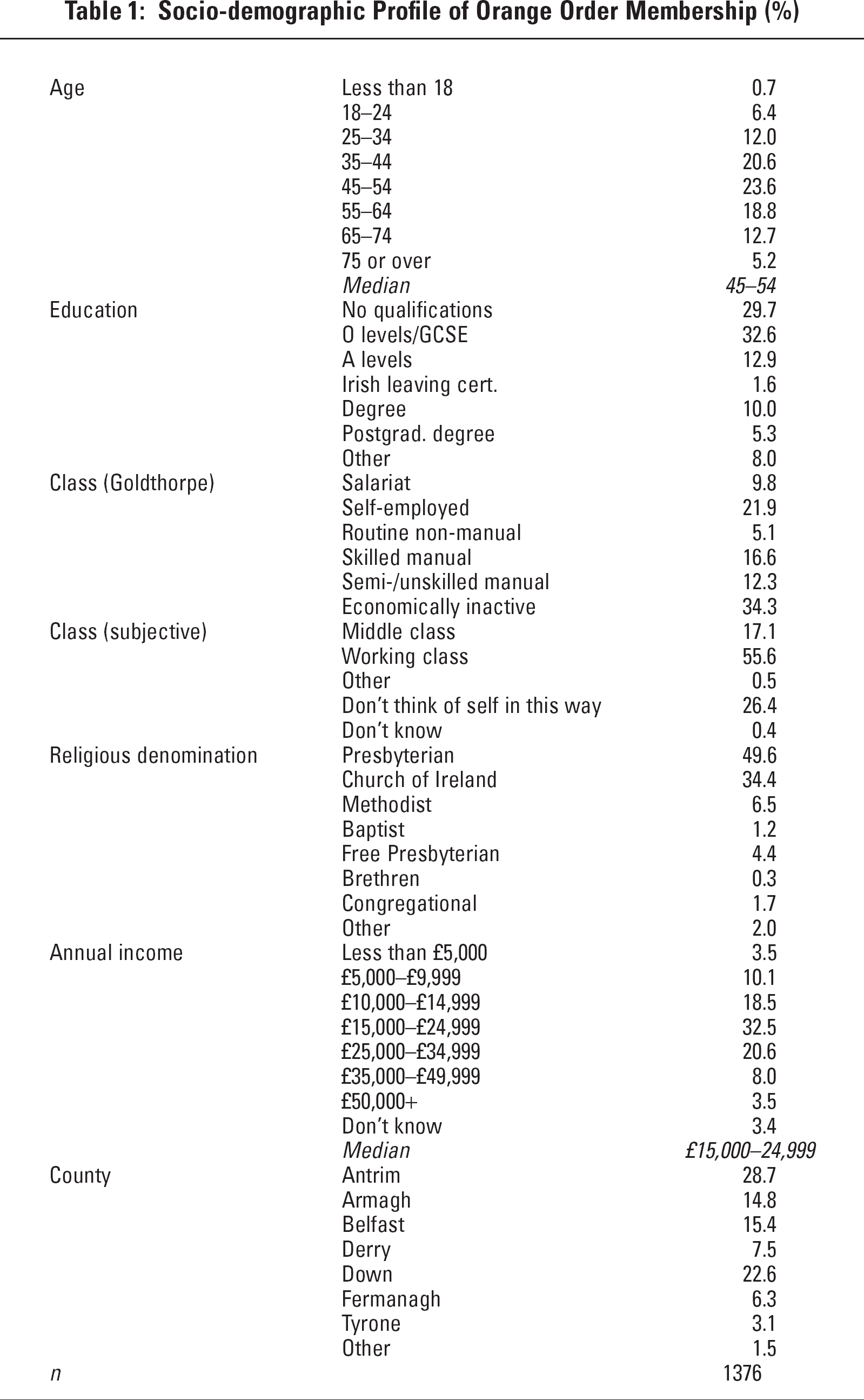
Almost half of the members are Presbyterian; one third belong to the Church of Ireland with a further 7 and 4 per cent, respectively, belonging to the Methodist or Free Presbyterian churches. Free Presbyterianism was not associated with Orangeism, being aligned to Ian Paisley's DUP (he founded and led both organisations until 2008), which perhaps emphasises the political nature of the Orange conversion to the DUP, as distinct from a religious reorientation. The retreat of the Protestant population west of the Bann in Northern Ireland is reflected in the geographical distribution of Orange membership, with the counties of Fermanagh, Tyrone and Londonderry/Derry yielding only 17 per cent of members.
Objectively, the Order is a mainly, but not overwhelmingly, working-class organisation. Subjectively, a majority of members (56 per cent) regard themselves as working class, but 26 per cent do not see themselves as a member of any social class and 17 per cent view themselves as middle class. While Henry Patterson and Eric Kaufmann's (2007) proletarianisation thesis appears likely given the current class status of members, the absence of time series data means we cannot confirm longer-term trends. The presence of a significant middle-class membership distinguishes the Orange Order in Northern Ireland from its almost exclusively working-class counterparts in Scotland and Merseyside. Few Orange Order members in Northern Ireland are drawn from the unskilled and semi-skilled working class, with skilled workers more common. One in five Orange Order members are self-employed. Not only is this above the Northern Ireland average of 15 per cent, but Northern Ireland itself has the second highest rate of self-employment in the UK.
A traditional image of the Orange Order as comprising a local labour aristocracy of skilled workers (over half work in manual jobs) or small business owners is not without foundation. Fourteen per cent have A level or ILC qualifications, and an additional 15 per cent possess university degrees, but 30 per cent possess no educational qualifications. Almost 90 per cent of members are homeowners. Median income is in the £15,000–£24,999 range (incomes generally are 20 per cent lower in Northern Ireland than elsewhere in the UK). Although often seen as an elderly, ailing institution, the median age range is 45–54, slightly lower than that for political parties such as the UUP and SDLP for which data were gathered by the researchers in other projects.
Faith, Crown and State: Modern Orange Discourses
The Orange Order is a cross-denominational organisation committed to the defence of the Protestant faith, support for Northern Ireland's constitution and loyalty to the monarch. The Order's membership figures are disputed, although a decline in the number of members is acknowledged by all. A peak of 93,447 members in 1968, falling to 35,578 by 2006, is claimed by the Order, while Kaufmann (2007, 283) suggests an earlier, but lower, membership high of slightly under 70,000 members in 1959–61. Despite its reduction in size, the Orange Order's membership nonetheless still exceeds the combined total of all the political parties in Northern Ireland. 2 The Order is the largest non-church organisation in Northern Ireland and may remain an important barometer of public opinion within the Protestant community. Moreover, one half of unionist members of the Northern Ireland Assembly belong to the Orange Order. The percentage figure is slightly above 50 per cent of DUP Assembly members (MLAs) and slightly below in respect of UUP MLAs, figures reflective of the realignment of Orangeism towards the DUP.
In Northern Ireland, the boundaries between society and the state, between civil activity and the political realm, remain blurred. This is readily identified in the roles undertaken by Orangeism and the structures and discourses of the Orange Order. Such discourses are based upon core elements of Protestantism, the Crown and constitutional assertions of civil and religious liberty. What appears to have altered is the basis of membership. Political influence and patronage have long disappeared. Although politics may influence joining, membership benefits are confined to social networking, cultural reinforcement, parading and collective religious observance (McAuley and Tonge 2007).
Although politics is not in isolation a major motivation for joining, Orange Order members tend to be politicised, with for instance a substantial majority—almost 85 per cent—claiming interest in politics, and only 5 per cent admitting, for example, that they did not vote at the last general election. Moreover, the view of Brian Kennaway (2007) that the present generation of Ulster Protestants look at their religion through political eyes is evident in the ways in which members make linkages between the two. The politics of the Order are a derivative of the Ulster loyalist identity held by many members. This Ulster loyalism tends to be more working class and emphasise the localised Protestant aspects of their Britishness, whereas the Ulster British may adopt a more secular, liberal and contractual rationality in terms of support for Westminster and British institutions (Todd 1987; Aughey 2005; Mitchell 2008a). When the UUP increasingly adopted political approaches derived from Ulster Britishness in its support for the Good Friday Agreement, based upon a formal, contractual securing of Northern Ireland's place within the United Kingdom, and appeared to eschew a religious basis to its politics, the party's alliance with Orangeism became strained.
The Orange Order has always been associated with a form of Protestantism hostile to the perceived threat of Roman Catholicism. Table 2 highlights Order positions on oppositional religious issues. Orange Order members are divided over whether their organisation could be construed as ‘anti-Roman Catholic Church’, but a majority accept this proposition, while rejecting the idea that the Order is ‘anti-Roman Catholic’. Few favour ecumenical projects and only a tiny proportion would ‘be happy for their child to marry a Roman Catholic’, the vast majority disagreeing, and three quarters of these ‘strongly’. The hostility of the Order towards ‘Romanism’ and its supposed expansionary traits remains overt. As the Orange Standard (June 2003) commented, ‘the naivety of ecumenical-minded Protestants never ceases to amaze’.
Order Positions on Religious Issues (%)
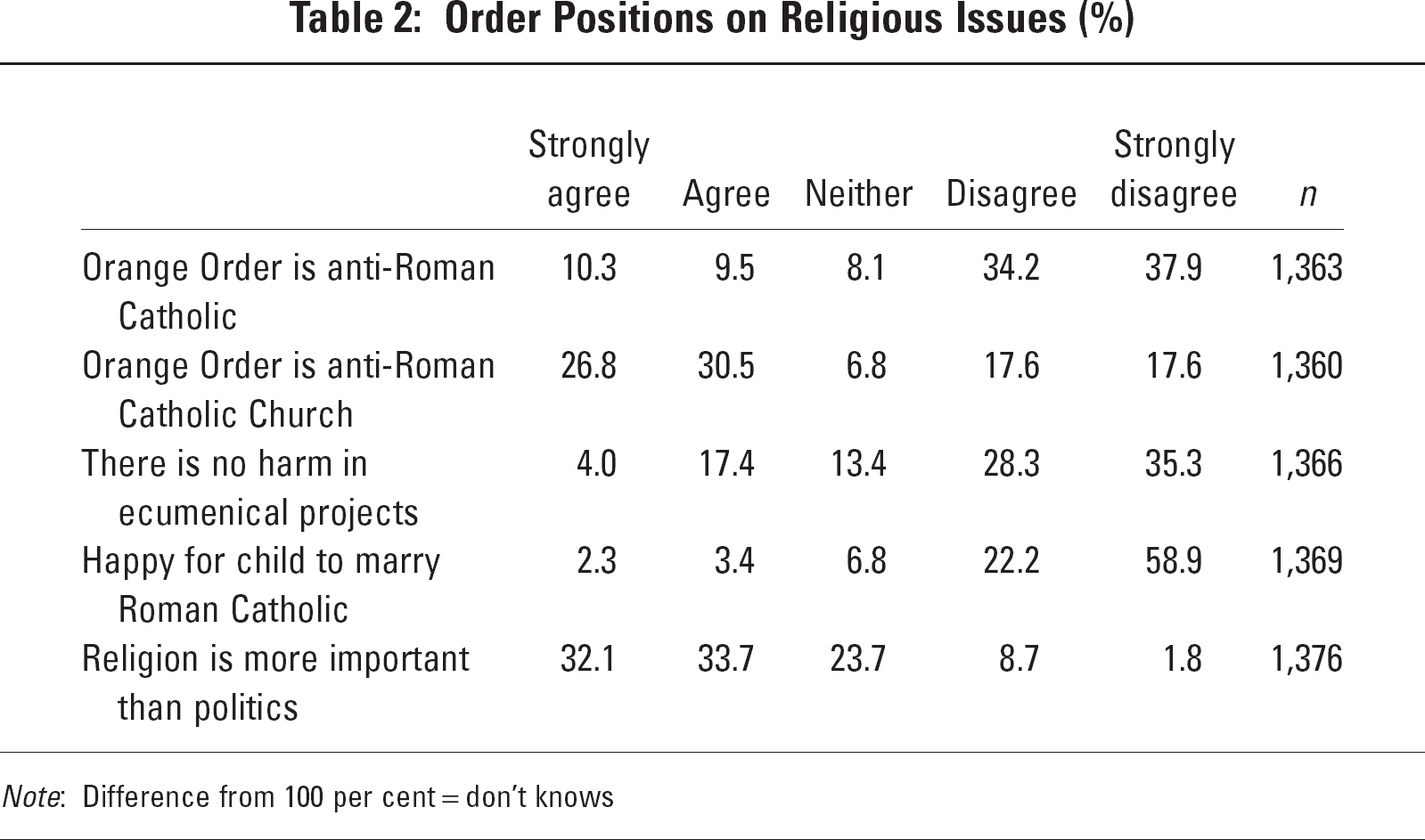
Note: Difference from 100 per cent = don't knows
Such consistency across the Order membership in terms of ecumenical antipathy is not as evident with regard to baseline religiosity, however. As Table 3 shows, there is a good deal of variance in religious practice, and this is strongly associated with age. Younger members of the Order lack the level of religious observation of their elders, significantly at odds with older members. For young members, weekly religious observation is far from negligible, but considerably lower than that undertaken by those over 55. This age disparity is reflected in other facets of religious influence. Older and rural members tend to be more sympathetic to the Kennaway (2007) view that the Orange Order has lost some of its religious aspects. The views of Orange Order members are infused with a conservative social outlook and a sense of cultural and religious threat (Tonge and McAuley 2008).
Religious Practice by Age
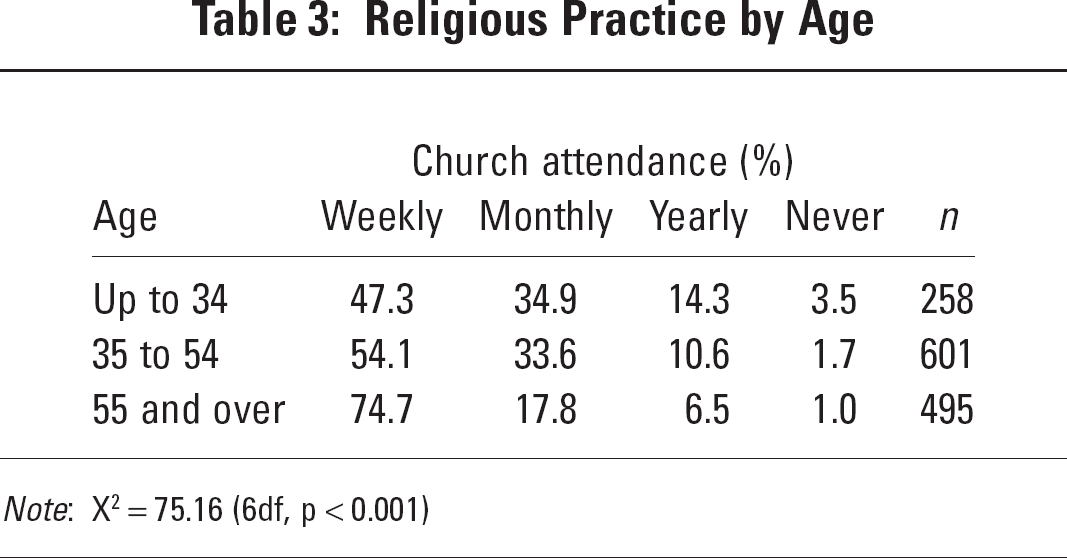
Note: X 2 = 75.16 (6df, p < 0.001)
The decline in participation in communal religious worship evident in Table 3 may provide an example of how the Orange Order has thus been afflicted by broader societal problems of declining social capital and greater individual passivity (see Putnam 2001). In 2004, the most prominent academic exponent of notions of diminished social capital, Robert Putnam, was invited to address the Orange Order as part of the organisation's attempt to resolve these issues.
Moreover, the nature of socialisation through the Order appears to be changing. Whereas Orange Order membership in previous eras involved considerable church and lodge (local Orange branch) activity, many members now acknowledge that their membership is largely passive, amid the above-mentioned declining religious participation but also faith-influenced lifestyle.
Table 4 indicates some decline in religious observance, with clear variance by age on the sensitive issue of Sunday shopping. While almost three quarters of the two younger cohorts clearly do not regard this as anathema, almost half of the oldest cohorts do. Moreover, this variable influence of religion goes beyond daily life to the political views of members, and whence these derive (Table 5). The extent to which Order members’ faith influences their politics has changed across time. Older members in particular are more likely to agree strongly with this premise than younger members, although generational difference here should not be overstated.
Traditionalist Conservative Attitudes by Age
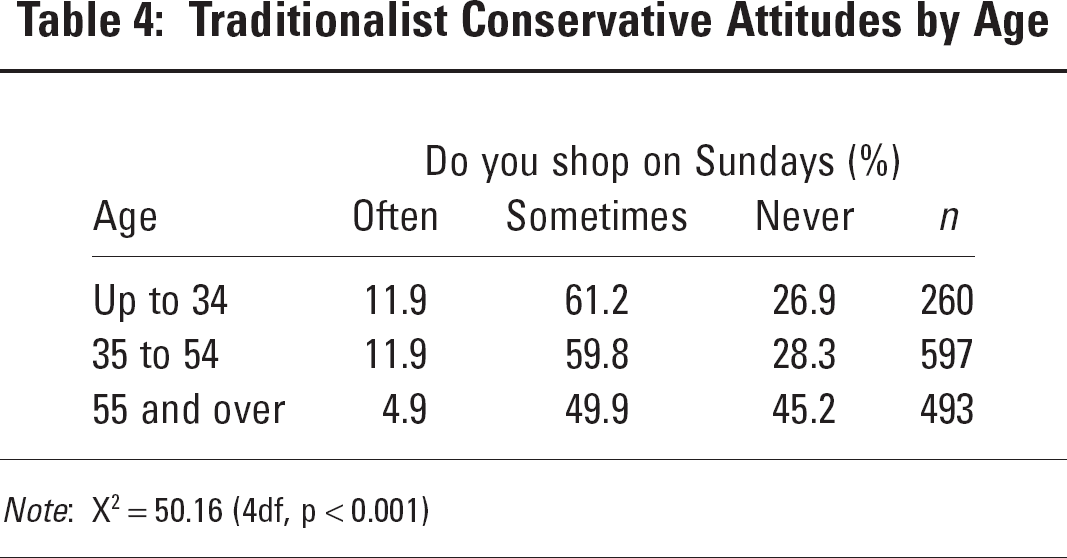
Note: X 2 = 50.16 (4df, p < 0.001)
Traditionalist Conservative Attitudes by Age
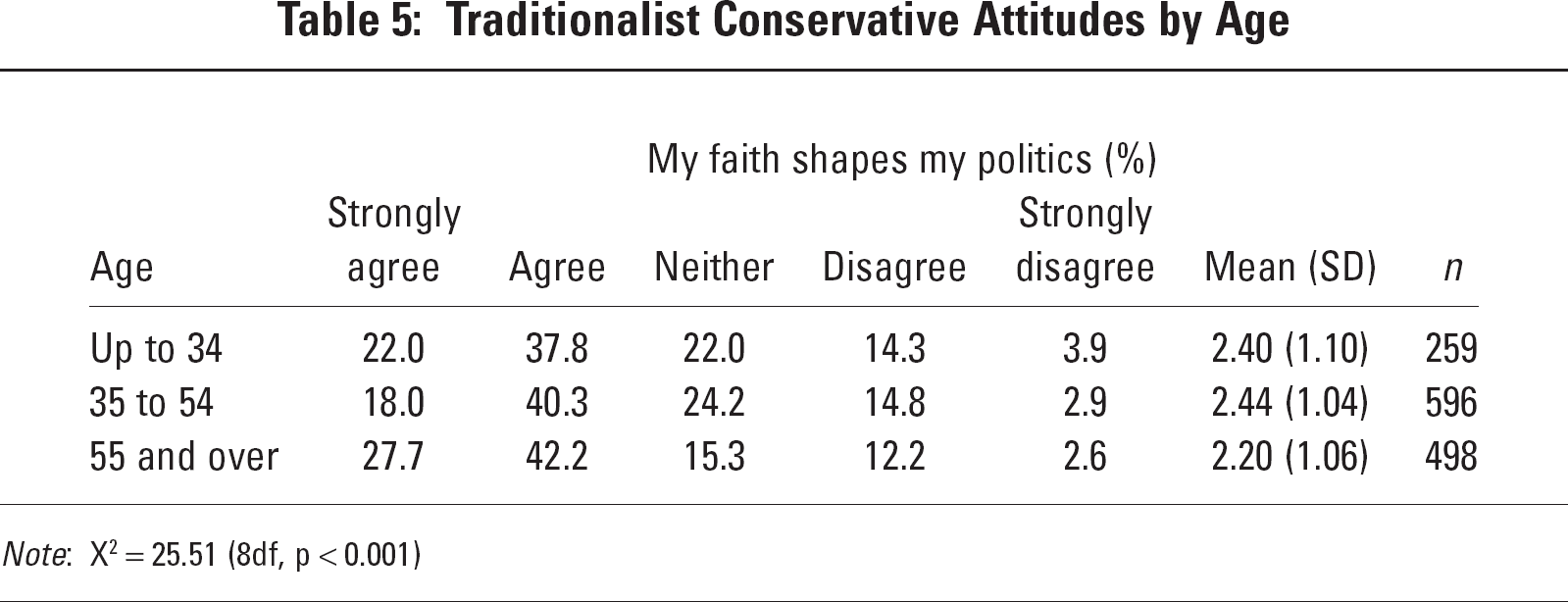
Note: X 2 = 25.51 (8df, p < 0.001)
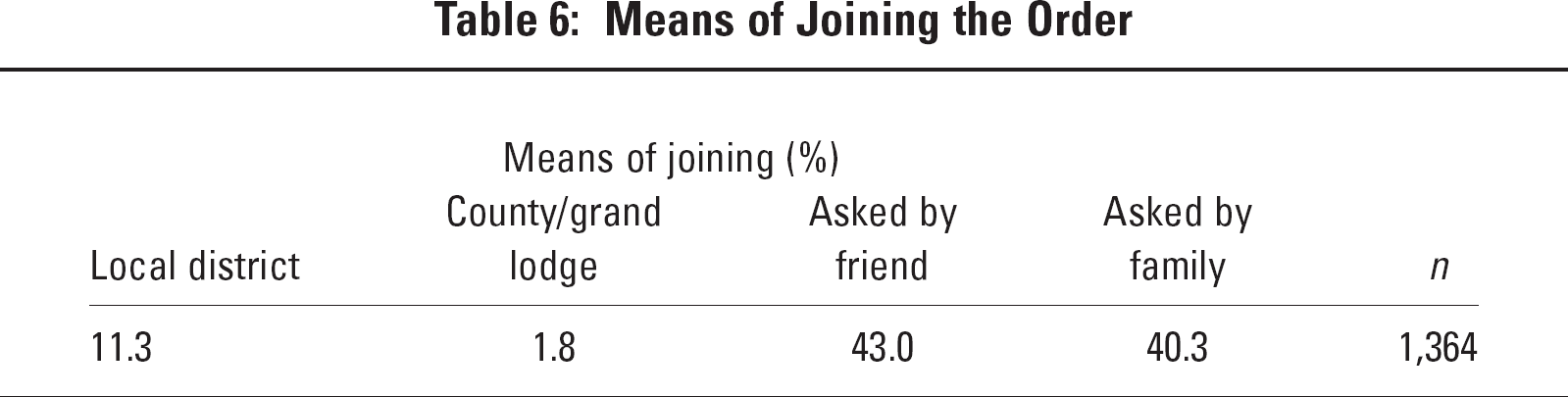
As the main interdenominational Protestant organisation, the Orange Order plays a significant role within that community. Although social reasons are not seen as a primary reason to join the Orange Order, joining is part of a local socialisation process, most joiners being asked to sign up by family or friends, although the categories in Table 6 may not be mutually exclusive. The joining process is important in reinforcing the unity of the Orange movement, from which two broad categories of discourse are discernible: first, that which contains ‘internal’ messages, as Orangeism represents a classic discourse community of those with a shared outlook. Second, the Orange Order also projects ‘external’ messages that seek to frame and position the Order within distinct moral, social and political arenas of life. Within these categories, there are several sometimes overlapping discourses currently on offer within Orangeism: official; continuity; political; unity; and cultural resistance (McAuley and Tonge 2008a).
Means of Joining the Order
Our demographic findings indicate that, in effect, two types of Orange Order member may coexist within the same organisation. Older, conservative, religious Orange tendencies are found alongside younger, less religiously oriented and potentially more politically infused leanings. The question begged is whether the newer, less overtly religious breed of Orange Order member also represents a different political tendency, one instrumentally aligned to the DUP, rather than socialised into UUP support.
The traditionally conservative and cautious Orange Order has undergone transformation in recent years. Having undergone rapid transformation from ‘establishment’ body to politically dispossessed organisation at the beginning of the 1970s, the Orange institution has struggled to adapt to reduced circumstances. This has meant the triumph of what Kaufmann (2007) identified as the less deferential, ‘rebel’ strand of Orangeism, more militant in tone than its genteel predecessor, in defence of what it sees as fundamental rights of procession and amid hostility to compromise. However, as Northern Ireland's conflict has subsided, the militancy and defiance evident through political dislocation, cultural retreat and religious indifference is being addressed. The Orange leadership, if not all members, appear conscious of a need to ‘de-sectarianise’ the public image of the Order so that the institution can play a constructive role in an increasingly multicultural, multi- or even no-faith Northern Ireland. This represents a challenge given that some Orange band parades are associated with tough and uncompromising displays of aggressive loyalism. As Claire Mitchell (2008b, 145) notes, ‘the urban and fairly secular “blood and thunder” flute band parades are now more popular than the rural and more religious Orange Order parades and are better known from the proliferation of Buckfast than Bibles’ (see also Bryan 2000; Kennaway 2007).
For leaders and members, the GFA, which, as we shall see below, is still resented, presents an opportunity equally as much as a challenge. The Agreement's explicit focus on the equal legitimacy of Protestant unionist British and Catholic Irish nationalist identities has reinforced Orange determination that ‘their’ community should be afforded equal treatment and respect. This, however, leads to the continued negative portrayal of Orangeism as a sectarian ethno-religious entity rather than a contributor to any embryonic civic pluralist dispensation.
The Orange leadership's attempt to rebrand the climax of the Order's ‘marching season’ as ‘Orangefest’, described by the Northern Ireland Tourist Board as ‘one of Europe's largest cultural festivals with music, marching and street pageantry’ undertaken in a ‘carnival atmosphere’ (http://www.discovernorthernireland.com) and containing less emphasis on ‘Faith, Crown and Loyalty’ platform resolutions, has been met with a mixed response among members. Some endorse the Order's need to promote a more benign, less sectarian image, whereas others argue that dilution of the Protestant British traditions of the Order represents a further retreat from the articulation and defence of Protestantism that the institution once represented. The Orange leadership has become more cognisant of the need to adapt to changed circumstances, promoting the organisation as a religious and cultural, but non-sectarian, entity whose modern relevance lies in its defence of (rarely fully defined) ‘Protestant values’ and its contribution to community social capital.
Changing Political Allegiances: The Shift from UUP to DUP Support
Although the UUP–Orange Order alliance was strong from formal inception, via the creation of the Ulster Unionist Council in 1905, Kaufmann (2007) and Patterson and Kaufmann (2007) refute perceptions of a century of a homogeneous, united Orange unionist movement, instead offering a more nuanced and convincing picture of, firstly, intra-Orange divisions between urban, left-leaning working-class Orangemen and conservative rural brethren suspicious of Catholic encroachment and, secondly, a sometimes fractious relationship between Orange Order militants and more moderate UUP leadership. Nonetheless, an overarching sense of cross-class Protestant–unionist unity usually inhibited serious fragmentation. The Orange Order contributed towards the maintenance of a conservative Protestant British political, religious and cultural outlook offered by the UUP.
The Northern Ireland peace process and the GFA brought to the fore internal unionist divisions. Although the UUP supported the deal, it was soon evident that this backing was not shared by many Protestants. The party was itself fractured between rational and literal readers of the Agreement, who noted how it secured the Union in its constitutional passages, and Orange sceptics who feared a ‘stripping out’ of Britishness (Tonge and Evans 2001).
As Table 7 shows, antipathy remains—a majority of Orange Order members opposed the Agreement and the number indicating that they would still vote ‘no’ if a second referendum was held tomorrow had actually risen by 2007. Fewer than one in three claim to have voted ‘yes’ to the deal in 1998 and only a quarter say they would support the Agreement in a second referendum. The Orange Standard (the Order's newspaper) declared in April 1998 that ‘no Protestant in good conscience could support’ the Agreement. For many, nothing has changed in that respect.
Attitude and Vote on Good Friday Agreement (%)
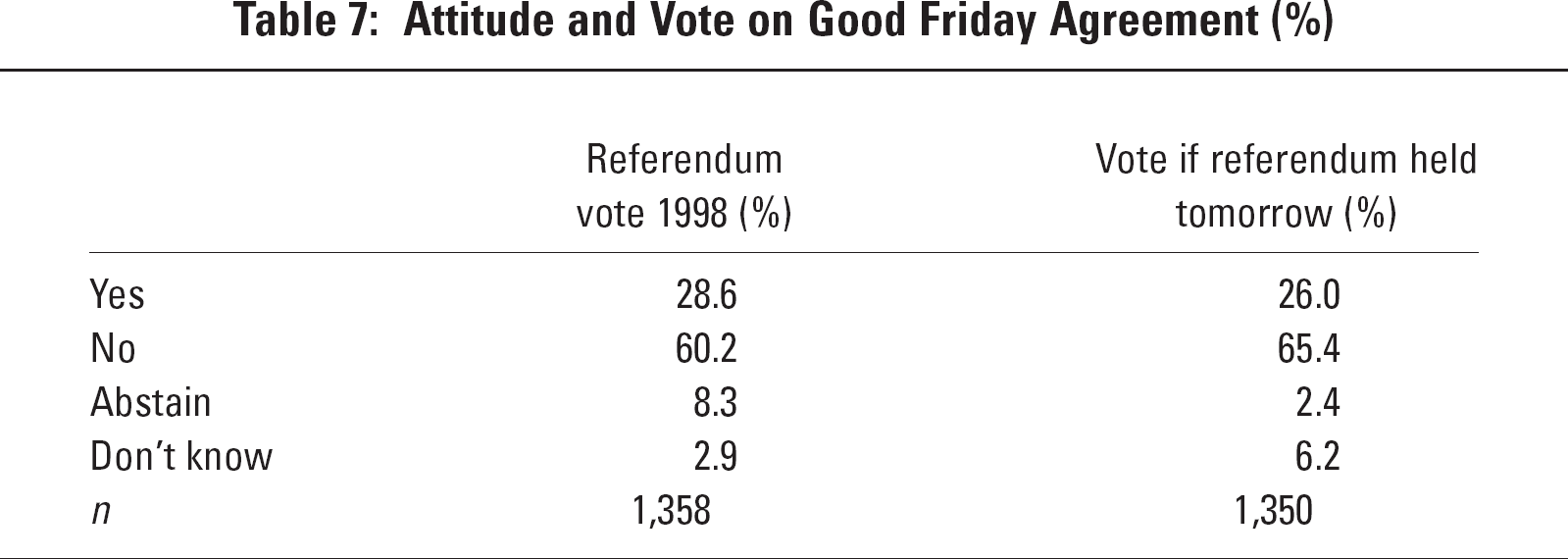
A majority of Orange Protestants thus opposed unionist power sharing with Sinn Fein and backed the DUP in its opposition to the deal. The DUP eventually changed its stance on support for power sharing with Sinn Fein, following IRA decommissioning of its weapons in 2005 and then the St Andrews Agreement of 2006, a deal which slightly modified the GFA and, crucially, paved the way for Sinn Fein's declaration of support for the Police Service of Northern Ireland early in 2007. Until this point, however, the DUP had acted as a political vehicle for that majority within the Order who strongly disapproved of the Good Friday Agreement's political demands. Although Orange Order members are overwhelmingly supportive of devolved government—in our survey, only one in ten indicated their opposition to this—the inclusion of republicans in government, despite, until 2005, their possession of an ‘armed wing’, and the conflict transformation measures of paramilitary prisoner releases and policing reform were too much for many within the Order. This hostility did not abate despite the DUP's eventual U-turn. A Grand Lodge (the leadership of the Order) resolution in 2007, passed on the Order's main parading day, the Boyne commemoration on 12 July, declared: ‘like many others within the unionist community, [Orangemen] share grave reservations about the presence of those in government whom we would not see as democrats in the accepted sense of the term’.
As the main repository of anti-Agreement sentiment from 1998 until 2007, the DUP increased its support among Orange Order members long bereft of political influence, strongly opposed to the Agreement and fearful of a dilution of their Protestant British culture (a concern exacerbated by restrictions upon some contentious Orange parades). The DUP's appeal to Orange Order members was considerable. Although the party took its seats in the ruling executive (which collapsed amid acrimony in 2002), the DUP opposed the early release of paramilitary prisoners, was hostile to changes to policing, including the introduction of 50:50 Catholic–non-Catholic quota recruitment, and boycotted the all-Ireland aspects of the Agreement, stances which endeared the party to equally hostile Orange Protestants.
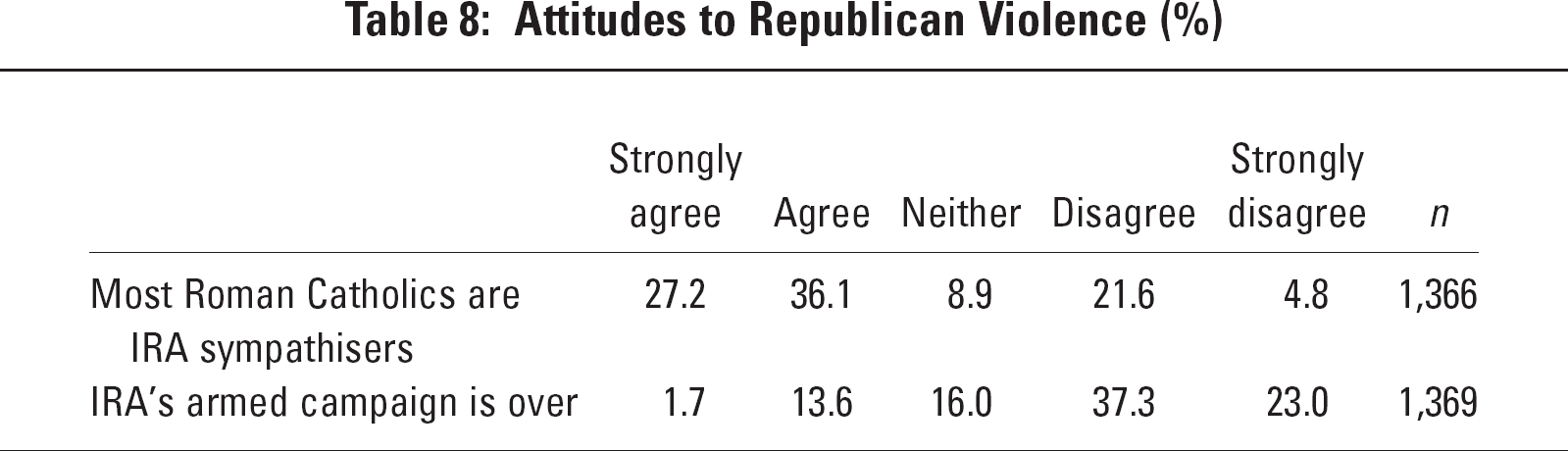
Moreover, the DUP's continuing assertions that republicans were still a threat to Northern Ireland's position within the United Kingdom resonates with Orange Order members. As can be seen from Table 8, a decade after the IRA's 1997 ceasefire, only 15 per cent of such members believed the IRA's armed campaign was over. Almost two thirds believe that ‘most Roman Catholics sympathise with the IRA’. Given this, a discourse of ‘siege’ and ‘need for vigilance’ remains apparent within the Order. Even those who believe the IRA's campaign to be over feel it has simply transferred into a different phase, one designed to remove Britishness from Northern Ireland. On this interpretation, the physical war has been replaced by ‘a cultural war being waged against unionism and Orangeism’ (David Hume, News Letter, 13 July 2007; McAuley and Tonge 2008b). As the Orange Standard (July 2007) expressed it:
The shooting and bombing ‘war’ in Northern Ireland is hopefully over, but the battle for the hearts and minds of the people will be fought with greater intensity than ever. Let no one be under any illusions. The campaign by republicans and nationalists to erode the British identity of Northern Ireland will be stepped up in many ways, and the Orange Order will need to be in the vanguard of resistance to this latest phase in the strategy of the republican–nationalist alliance to try and achieve their objective.
Attitudes to Republican Violence (%)
The primary concerns of Orange Order members are thus to stop what they see as the removal of symbols of British faith and culture. They tend to see the cultural retreat as part of ‘official’ government policy, while also pointing to local sectarian actions, with over 300 arson attacks upon Orange halls since 1990. These, and local territorial disputes at sectarian interfaces, led to the Grand Master of the Orange Order, Robert Saulters, using the Twelfth of July commemorations in 2009 to denounce the ‘ethnic cleansing’ of Protestant communities being undertaken by Irish nationalists (News Letter, 13 July 2009).
The Grand Orange Lodge of Northern Ireland (2007) has lamented ‘the general loss of confidence and alienation within the Protestant community’, seen as being in cultural and political retreat. The belief that there is discrimination against Protestants in Northern Ireland is held by an overwhelming majority of Orange Order members. 3 The Parades Commission, responsible for the re-routing of several Orange parades away from nationalist areas, is frequently offered as an example of an institution discriminating against the Protestant British tradition.
It is within the above contexts that the DUP, offering itself to unionist electors as the stout defender of Protestant Britishness, has prospered among Orange Order members. This will constitute the analytical focus of the remainder of the article, in particular looking at the profile of DUP supporters as distinct from UUP counterparts. Given the cross-sectional nature of the data, we are unable to look directly at vote changers, but we can still look at the extent to which socio-attitudinal factors can distinguish between the two parties’ support bases among the contemporary Order. A considerable majority (62 per cent) voted for the DUP in the 2005 general election, double the level of support for the UUP and in line with the wider Protestant vote. Nonetheless, as Table 9 also shows, the legacy of the severed historic link with the UUP remains. Older (over-55) Orange Order members continued (slightly) to favour the UUP over the DUP. Among young (under-25) members of the Order, whose political socialisation has occurred since the era of UUP dominance, support for the DUP runs at five times the level of that for the UUP.
Party Support by Age
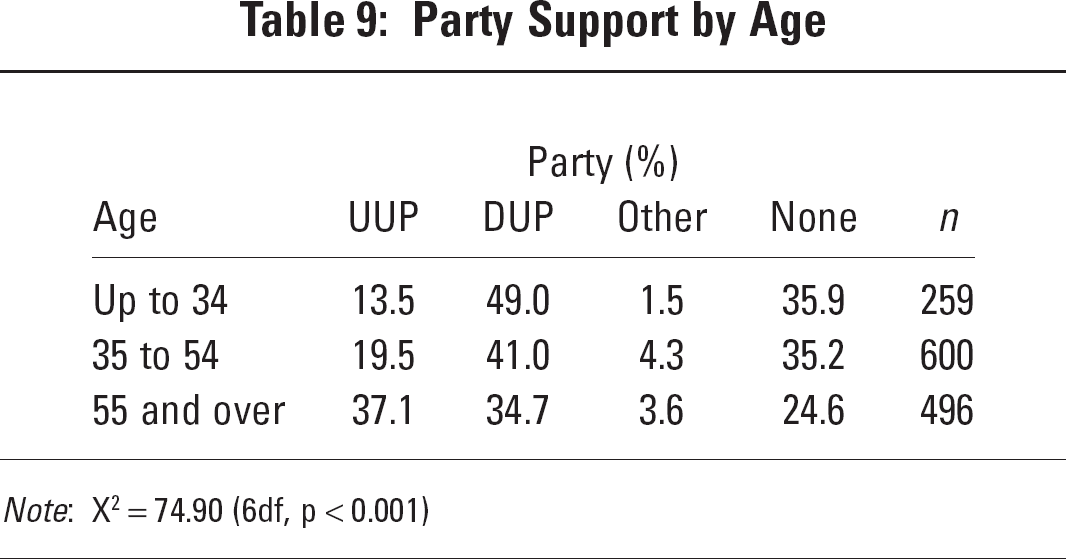
Note: X 2 = 74.90 (6df, p < 0.001)
Evaluating the Bases of Party Support within the Order: Data and Method
To explore further the structural and political differences in party support discussed above, we test competing explanations for UUP–DUP differentiation using a series of multivariate models. We construct three nested binary logit models to explore the relative impact of various demographic controls, attitudinal items and vote in the 1998 Good Friday Agreement referendum. The dependent variable is based upon the question ‘how would you vote if an election were held tomorrow?’ reduced to two categories which together account for 86.2 per cent of voter preferences. This outcome was coded 0 for the UUP and 1 for the DUP.
Which factors do we pick to explain the UUP–DUP contrast? The first nest includes a range of demographic predictors potentially associated with unionist voting. Age is included given that the descriptive data discussed above indicate a propensity among younger members to hold allegiance to the DUP, whereas older members may have been more cautious over switching from their ‘natural’ party. As before, age is coded into three categories (up to 34 years; 35–54 years; 55 years and older). We also include year of joining the Order. While there is of course a strong association between age and when the individual joined the Orange Order, equally we cannot expect that a member of similar age will have been socialised outside the Order similarly to someone who has been a member for longer. In particular, the social and political context of the Province may well prompt waves of joining according to prevalent political attitudes among the Protestant community. We therefore collapse year of joining into three categories (1920–66, covering 23.2 per cent of joiners; 1967–97, when 58.3 per cent joined; and 1998–2007, when 18.5 per cent joined) guided by the demarcation of three distinct periods of interest (‘pre-Troubles’, ‘Troubles’ and ‘post-GFA’). Orange Order membership reached its height, of around 100,000 members, at the onset of the Troubles in the late 1960s. It is since then that the processes of declining membership and proletarianisation have occurred, while the 1998–2007 period has been the era of electoral realignment. We use the oldest age and latest joining categories, respectively, as the references.
We wish to test whether occupational class is important, with the expectation that those in manual occupations are more commonly associated with DUP support, the UUP's backing tending to come from those in white-collar occupations (Evans and Duffy 1997; Tilley et al. 2008). This class divide in terms of unionist party choice reflects the different orientations of the two main unionist parties. The UUP was formally linked to the Conservative party until the 1980s, and the association has recently been revived. While the party always sought cross-class support, with the Orange Order playing a key role in its attainment, the emergence of a serious unionist contender in 1971, in the form of the DUP, meant that the UUP was seen as predominantly the party of the conservative and comfortable unionist middle class (Walker 2004). The party's middle-class ‘respectability’ was drawn from its greater support for political institutions than that of the DUP, while the UUP's economic approach during decades of one-party government was fiscally conservative and non-redistributive.
In contrast, the DUP from inception wished to pitch directly for the urban loyalist working-class vote. This was reflected in an avowed stance of being left of centre on economic issues, while right wing on constitutional matters (Bruce 1986; McGarry and O'Leary 1995; Evans and Duffy 1997). Accompanied by a religious pitch appealing to fundamentalist rural Protestants, the DUP's constitutional robustness offered much to urban working-class loyalists fearful of a British ‘sell-out’ on the Union, while those loyalists were also encouraged by the DUP's apparent concern with their social plight and redistributive economic orientation. Ultimately the DUP's appeal has always been based more upon constitution than class. Nonetheless, the UUP failed to recover much of the working-class vote conceded to the DUP from the 1970s onwards. It is thus reasonable to test whether class divisions in intra-bloc party choice are evident among Orange Order members.
Occupational class was constructed from three variables (employment status, nature of job and skill level of job) to create a six-class variable analogous to the Goldthorpe class schema (salariat; self-employed; routine non-manual; skilled manual; unskilled manual; and the economically inactive reference, principally comprising retired respondents). 4 Given data constraints, we could not differentiate between Goldthorpe's two categories of petite bourgeoisie (small proprietors and farmers, smallholders), or between semi-skilled and unskilled labour; nor do we include the category ‘workers in primary production’, given its inapplicability to the Northern Ireland context (see Goldthorpe, cited in Edgell 1993, 29). We do not feel these issues will undermine our analysis, however. This class scale is similar to the ‘compressed Goldthorpe’ scale used in the Northern Ireland Attitudes Survey (NISA) (see Evans and Tonge 2009). Education comprises four categories (none/GCSE; A/ILC; university; and an ‘other’ reference).
Perhaps most self-evidently, religious denomination, and particularly Free Presbyterianism through the Paisley link, should be a predictor of party support. In terms of religious denomination, Free Presbyterian, the religion aligned with the DUP, is coded as the reference, contrasted to Presbyterian, Church of Ireland and other Protestant denomination categories. For religious practice, those attending church weekly or more frequently is coded as a dummy variable. Lastly, the standard demographic control for gender was not included due to the tiny female proportion (0.9 per cent) of the sample, reflecting the almost exclusively male profile of the Order and the separate existence of the Loyal Association of Orangewomen.
For the second nest, two attitudinal items are included. Firstly, we include the item ‘all Roman Catholics sympathise with the IRA’ to test the extent of loyalist hard line attitudes. A number of the items discussed earlier displayed little variance in attitudes to republicanism and the Catholic community. 5 Secondly, we also wish to test whether any aspect of ‘traditional’ policy concerns motivates differences between DUP and UUP support. Moreover, given that a significant part of the literature has looked at this possibility we might have included the left–right self-placement (Evans and Duffy 1997; Tilley et al. 2008). However, this covaries strongly with loyalist intensity, and therefore was unsuitable. A recent study suggests an absence of inter-party differences on left–right economic questions and that ‘UUP and DUP voters are also indistinguishable in terms of the liberal–conservative dimension’ (Garry 2009, 463–464). Nonetheless, we wish to test whether economic issues do matter in terms of party choice among Orange Order members and to do this we have chosen one of the classic battery of economic questions—‘attitude to private enterprise’. 6
The full model includes a single additional item, ‘Vote in 1998 Good Friday Agreement referendum’, in which the UUP campaigned for a ‘yes’ vote and the DUP urged opposition. While the majority of the Orange Order voted ‘no’, this majority was not overwhelming, and given the two unionist parties’ opposing stances, it seems clear that this factor should be associated with party support. This is included in a separate model from the other attitudinal indicators, due to its measuring of political behaviour that can only be causally subsequent to other items, as well as the likely overwhelming effect which may wash out other relevant socio-attitudinal effects. Finally, all missing cases were excluded.
Analysis
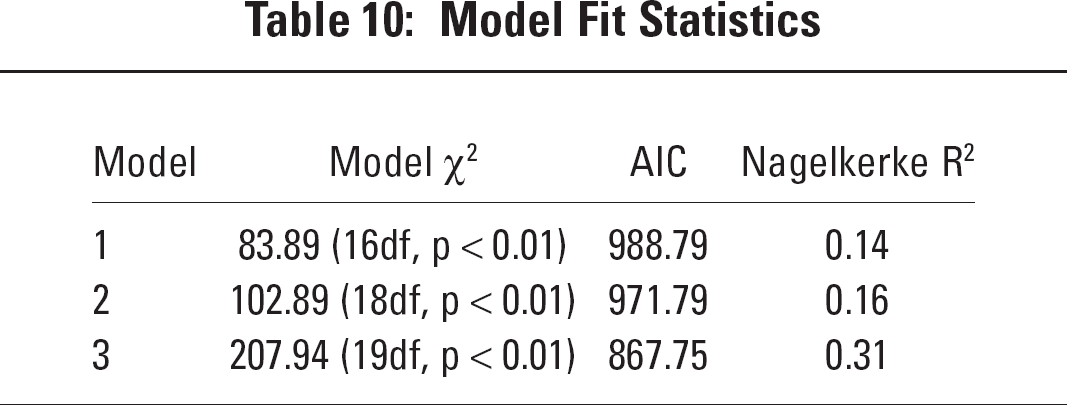
We look first at the overall model statistics (see Table 10). In the first nest, we include the demographic items: age, joining year, class, education, church attendance and denomination. This step is significant and explains more than 14 per cent of the variance in the model. In the second step we add the attitudinal items ‘private enterprise is always best’ and ‘most Roman Catholics are IRA sympathisers’. This step is also significant and the Akaike Information Criterion (AIC) confirms a parsimonious increase in the explanatory power of the model. With the inclusion of vote in the 1998 GFA referendum the additional step is significant and again represents an increase in the explained variance. The increase in model chi-square indicates that this nest represents the greatest improvement in the model of any of the steps, pointing to the importance of 1998 referendum vote in predicting putative voter behaviour. Similarly, the AIC confirms a parsimonious increase in the explanatory power of the model at each step. Overall, each model provides significant explanatory improvement in vote preference among Orange Order members (see Table 10).
Model Fit Statistics
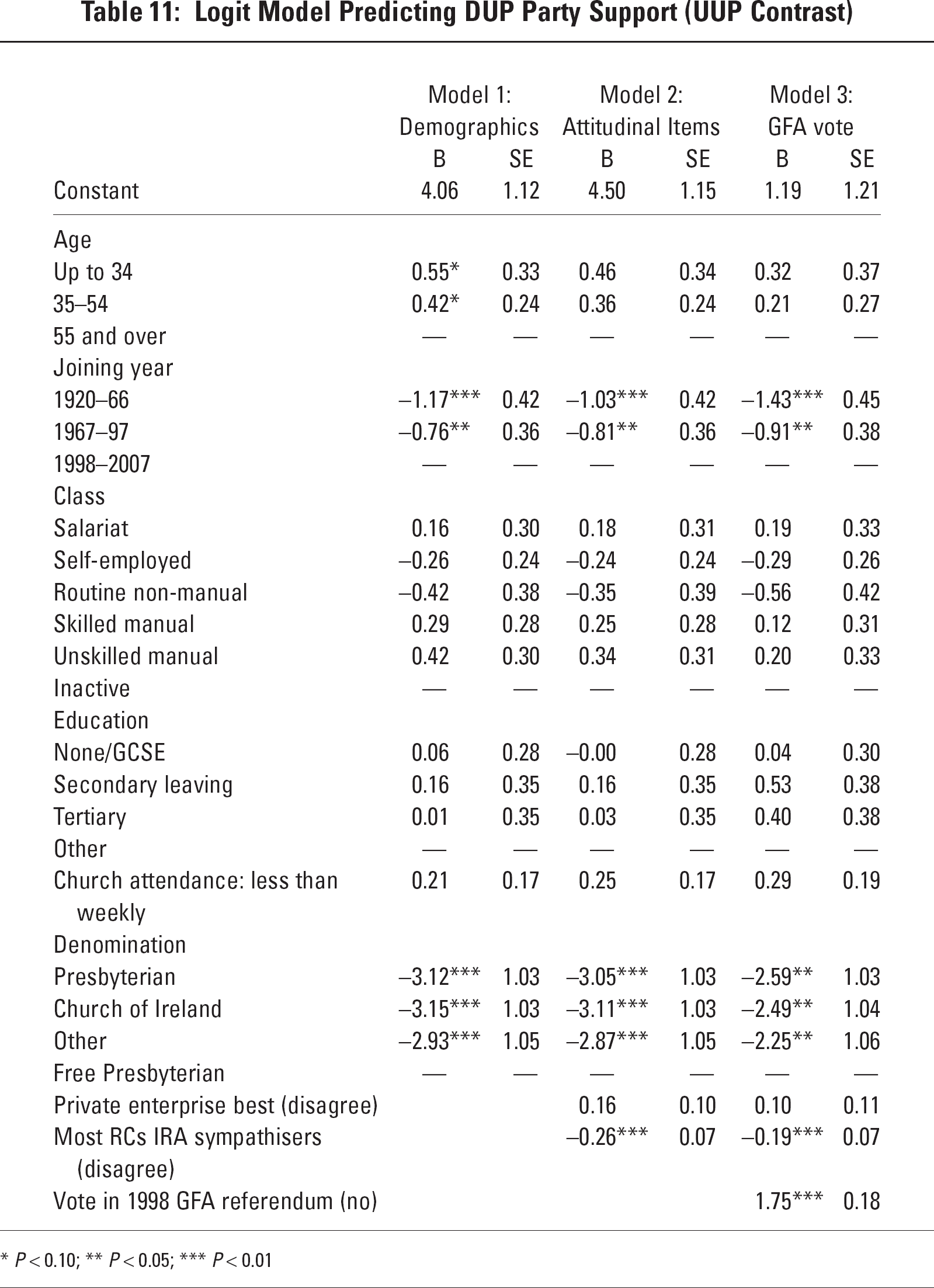
Turning to the individual parameter effects, however, there are clear disparities among the demographic variables (see Table 11), in particular in their explanatory power. Age has a moderate effect, with those in both the youngest and the middle age category tending towards the DUP (as compared to the over-55 reference group), with the effect most marked in the youngest age category. This effect is significant at around the 10 per cent probability level in the first model of other demographics (joining year, class, education and religion), but significance falls with the inclusion of attitudinal items, and especially with the item of GFA vote, in the second and third models. Joining year has a much stronger effect on voter behaviour, independently of age, with those joining in the first (1920–66) and second periods (1967–97) more likely to vote UUP (as compared with the reference period: 1998–2007), with the contrast between the earliest period and the reference being most marked. 7 Indeed the effect of joining age is significant at the 0.05 level throughout the different nests of the model, and thus shows a strong unmediated period effect.
Logit Model Predicting DUP Party Support (UUP Contrast)
P < 0.10
P < 0.05
P < 0.01
Conversely, and most notably, the Goldthorpe schema of occupational class was not significant at any stage of the model. If class is included in a bivariate regression, salariat, skilled and unskilled manual are significantly more likely to support the DUP than the inactive class. Indeed, a likelihood ratio test indicates a significant decline in model fit when these are removed from the equation. Because the inactive class is made up almost entirely of retired people, the inclusion of either age or year of joining washes out these contrasts. There is of course the chance that we are making a Type II error due to inflated standard errors. However, the model also reflects a reality within the Orange Order, namely that the dominance of an ageing membership socialised into supporting the UUP outweighs any class effects among younger cohorts. Indeed, if we run the model with subjective class, as noted earlier, we find that those who willingly identify as middle class moderately tend towards the UUP (significant at p < 0.1). But again, as further variables are added, the impact of subjective class quickly washes out. Similarly, age–class interactions hint at a possible nuance in class terms among younger cohorts, but not to the extent that previous research has demonstrated of growing class differentials in the broader Protestant population (Tilley et al. 2008; Evans and Tonge 2009).
Similarly to class, education fails to reach significance throughout, as does church attendance. The strongest effect relates to denomination, with all other denominations displaying a greater likelihood of supporting the UUP, as compared to our Free Presbyterian reference group. This tendency is slightly more pronounced for Presbyterians and Church of Ireland adherents as compared to ‘Other’ denominations. Given the association of Ian Paisley with the Free Presbyterian Church (which he founded in 1956 and led until 2008), the inverse of this association—that Free Presbyterians are more minded to support the DUP—would be expected. These effects remain significant throughout all three models, suggesting that this is not an ideological disposition towards the DUP, but rather the effect of politicised social encapsulation through the Reverend Ian Paisley (party leader from the DUP's foundation in 1971 until 2008) as opinion leader.
Moving to the attitudinal effects, those who disagree that private enterprise is best tend slightly towards the DUP, as compared to those who agree. In addition to the weakness of the effect, the relationship is only on the cusp of significance at the p < 0.1 level, 8 and indeed washes out with the inclusion of 1998 Good Friday Agreement vote. There is a weak-to-moderate independent effect whereby those who disagree that all Roman Catholics are IRA sympathisers are more likely to vote UUP, as compared to the reference group of those who agree with the preceding statement. The relationship remains significant in the full model.
There is a very strong relationship between 1998 referendum vote and current voting intentions, with those who voted ‘no’ in 1998 unsurprisingly gravitating towards the DUP. With the inclusion of this variable, the washing out of age and views on private enterprise grows more marked, while independently significant effects remain for joining year, denomination and radical loyalism. The strongest effects contributing to the prediction of the dependent variable are joining year, denomination and GFA 1998 vote. The reduction in AIC for the full model indicates that this represents the greatest improvement in the model of any of the steps, pointing to the importance of 1998 referendum vote in differentiating party support behaviour. The Nagelkerke R 2 indicates that just over one third of the variance within the data set is explicable using the outlined model.
The bases of the support for the DUP within the Orange Order are thus clear. Political socialisation is crucial in respect of which party is supported. Those reared in the benign pre-Troubles era, in which Order, (Ulster Unionist) party and state were strongly interlinked, continue to look to the UUP as the embodiment of their interests. This group will obviously diminish, however, due to their age and the UUP will need to re-pitch its appeal if it is to recapture the majority of Orange Order support. The linkage between anti-Good Friday Agreement vote and support for the DUP is clearly demonstrated.
In stressing how the DUP embraced these anti-deal sentiments, it is worth emphasising what they represent. The Orange Order and the DUP were not against power sharing per se. Rather, they were against the imposition of mandatory power sharing with Sinn Fein while that party still retained an armed alter ego. Equally, the Order and the DUP loathed as immoral those aspects of the deal that they believed elevated paramilitary groups to the status of armies whose existence governments recognised and respected. Party and Order supported devolved power sharing as an idea. As Mitchell et al. (2009) have convincingly demonstrated, Protestants were not enamoured with much of the detail of the deal, but nonetheless supported its basic idea of local self-government incorporating both traditions and sought the best deal possible within this ‘ethnic valence’ from their strongest party, or ‘ethnic tribune’. The Orange tradition sought to revive fortunes via realignment to the ostensibly sympathetic DUP.
Conclusion
The story of much of the first decade of post-Agreement unionist politics was that of the rise of the DUP from bit player to main force. This rise was assisted by its appeals to the Orange Order and the wider Protestant population and the mobilisation of hostility to aspects of the GFA. The Orange Order's marginalisation from institutional politics since the collapse of unionist government in 1972 had been matched by estrangement from its own party, the UUP, from 1998 onwards, leading to a non-amicable divorce. The separation reflected the problems of secularism, diminished size and relevance and proletarianisation confronting the Order, but, above all, it was based on a pro- vs. anti-Good Friday Agreement fault-line.
Orange Order members see their organisation as the most important promoter of a British Protestant way of life. They fear that their cultural-religious form of Britishness is under greater immediate threat than is the Union per se, but believe both are being challenged. Their ultimate desire is for intra-unionist unity in terms of the promotion of common cultural-religious values, impossible in the political sphere given continuing unionist party rivalries. The rivalry for the decade after the Good Friday Agreement concerned attitudes to that deal, the biggest ever fault-line within unionism. The electoral fault-lines within the Orange Order can now clearly be seen.
Those most resistant to the DUP are Orange Order members politically socialised in a less troubled era of Northern Irish politics prior to the 1970s, in which mostly cordial relationships between the Orange Order and the UUP prevailed, with party and religious-civic organisation combining to preside over the (often partisan) governance of the state. The challenges since the onset of the Troubles have diminished the Order in terms of relevance and size, the latter element most evident in the flight of its middle-class members. More recent joiners and younger members have preferred what they see as the more robust articulation of Orange and Protestant interests by the DUP. Such joiners have relied upon instrumentalism rather than nostalgia in determining their choice of party. The GFA allowed Orange Order members to make a clear choice—recently blurred by the DUP's tactical adjustments—between support for a particular form of Protestant British unionism and the newer more civic variant articulated by the UUP. As such, the Good Friday Agreement vote achieved a very high level of significance as an indicator of party support within the Orange Order, more than frequency of church attendance, denomination (with the obvious exception of the DUP–Free Presbyterian link), social class or left–right differences between members.
The debates over these different visions of unionism continue between the political parties and, crucially, within the Orange Order, contributing to debates over how to rebrand, ‘de-sectarianise’ and make politically relevant an institution that still forms an important aspect of life for many Protestants in Northern Ireland. Three caveats to the idea of modern DUP dominance of the preferences of Orange Order members should be offered. Firstly, despite favouring the DUP a large majority of the sample also claim to desire unionist political unity, against a perceived republican threat. The appeal for the reconstruction of the ‘unionist family’ is persistently made, as it ‘is not too late for Unionists to get their act together and to defeat this evil conspiracy which seeks to destroy their position and this Province and put it under the heel of Dublin’ (Orange Standard, April 2003). Such calls for unity have become central to much of the public discourse of Orangeism, and can be seen in claims that for Orangemen ‘the great desire is still for a single Unionist party’ (Orange Standard, June 2005) and that the Order ‘will lobby for Unionist unity on all key issues’ (Orange Standard, April 2005) or through demands that ‘Unionist parties must agree’ (Orange Standard, July 2005).
Secondly, the growth of the DUP was temporarily slowed by the anti-power sharing Traditional Unionist Voice (TUV) party and the qualitative research undertaken by the authors suggests a significant level of Orange sympathy for the TUV. Finally, given its sectarian reputation among critics, few might expect the Orange Order membership to be an arena for electoral defrosting. Ethnic thawing may nonetheless be apparent in the claim of 36 per cent of Orange Order members that they would consider a lower-preference transfer vote to the SDLP (less than 2 per cent said likewise in respect of Sinn Fein). While there is no statistical relationship between age and propensity towards lower-preference voting across the confessional divide, there is a significant association between social class and bloc straddling. Middle-class members of the Orange Order are significantly more likely to transfer across the ethnic divide, with working-class members (more likely to live in residentially segregated areas) far less tempted.
The far-reaching consociational deal struck between the DUP and Sinn Fein in 2007 may yet reshape the nature of unionist electoral realignment as those Orange Order members who deserted the UUP in favour of the DUP's anti-Good Friday Agreement credentials have been obliged to contemplate the new, pro-Agreement (albeit the 2006 St Andrews version) dispensation of their recent party of choice. Undoubtedly this has led to some ebbing of Orange support to the TUV, fervently opposed to power sharing with republicans. The new test for the DUP is to retain the Orange support it took several decades to win.
Footnotes
We are very grateful to the Economic and Social Research Council, RES-000-23-1614, ‘The Social and Political Bases of the Orange Order in Northern Ireland’, for funding the membership study. We also offer our grateful thanks to the David Hume MBE, Drew Nelson and the other officers of the Orange Order who facilitated the survey. We also wish to thank the research assistant, Dr Andrew Mycock.
1
For this survey 1,376 questionnaires were completed by Orange Order members, from 2,520 distributed on a weighted basis of the geographical spread of Orange lodges throughout Northern Ireland, a response rate of 54.6 per cent. Limited findings from a much smaller pilot survey of 300 members were reported in  . This article is based upon much more extensive quantitative data on Orange voting preferences and also utilises qualitative research on attitudes of Orange Order members, elicited via a series of group discussion sessions with a cross-section of the organisation's adherents and via extensive (86) one-to-one semi-structured interviews with Orange Order officials and members.
2
Newsletter, 30 June 2009.
3
Ninety per cent of our sample agreed with this proposition.
4
The high proportion of retired respondents in the sample reflects the age profile of the Orange Order, but does see a large number of cases coded in a single residual category. We looked at other class codings, including an approximation of classification by previous employment for retired respondents (unfortunately, the employment status variable includes both self-employed and retired responses, preventing the construction of an entirely valid variable) but this did not produce substantively different results. Equally, there was no evidence of serious collinearity between age and class.
5
Exploratory cross-tabulations revealed that heavily biased responses to many attitudinal items regarding nationalist and Catholic identity mitigated against their inclusion in the model. The radical nature of the question included can be seen as an a priori indicator of the extremity of Orange Order views.
6
We also tested other attitudinal items in the model, such as the necessity of policing reforms and attitude to the European single currency. However, these effects were essentially identical to those we include in the models presented, and therefore simply washed out.
7
If joining year is removed from the equation, the contribution of age relative to the other variables increases, and the variable remains significant at the .01 level throughout all models. This suggests that to some extent joining year is capturing some of the effects of age, which is to be expected. However, the fact that in the first model both variables are significant indicates that this is very far from perfect collinearity, and points to the impact of cohort effects above and beyond age.
8
The actual significance is p = 0.11.