







Abstract
This article uses the Westminster Model to construct a framework for interpreting the nature of power relations presented in British political memoirs, one that emphasises the role of ‘historical impact’. It then argues that the model's ethos has a culture of honourable secrecy and club regulation which conditions the memoirs of politicians and civil servants in contrasting ways. The article examines the current batch of New Labour memoirs and observes that, despite attempts at reform, a culture of club regulation persists. This is evidenced in a detailed case study of David Blunkett's diaries. The article concludes by suggesting that if the legitimising mythology of the Westminster Model is to be sustained by Britain's political elite, then it will require a more robust form of regulation.
Introduction
In British politics, there is a long-established tradition of ministers providing memoir-style accounts of their experience of government, most commonly in the form of either autobiographies or political diaries. 1 Despite the potential value of this primary empirical resource, the literature from political science reflecting on the genre of political memoirs tends either to be rather defensive apologias for its use or else concerns itself with methodology (Seldon and Pappworth 1983; Pimlott 1999; Theakston 2000; McGrath 2002; Arklay 2006; Walter 2006; Riall 2010). In contrast, this article attempts to shift the debate beyond such discussions by exploring memoirs through a now well-established literature concerned with theorising and analysing the nature of power relations within British politics. The aim is to respond to a plea prompted by Andrew Gamble, who in an article reviewing the memoirs of the 1979–97 Conservative administration, concluded that they ‘are valuable sources on the inside story but often have less to say on the outside story, the wider context in which governments operate, in particular the structures of power that shape British society and the British state’ (Gamble 2002, 150).
Since 1997, a rich store of new material has been published by ministers from the Labour administration and, to a lesser extent, by public servants (see Table 1). These contributions provide a suitable opportunity both to reflect on current developments in the tradition of political memoirs and, more importantly, to consider what memoirs offer in terms of insights into the ‘wider context’, in particular the way ministers perceive and interpret the world they inhabit and their relationship to the structures of power that shape British politics.
Political Memoirs: 1964–2008*
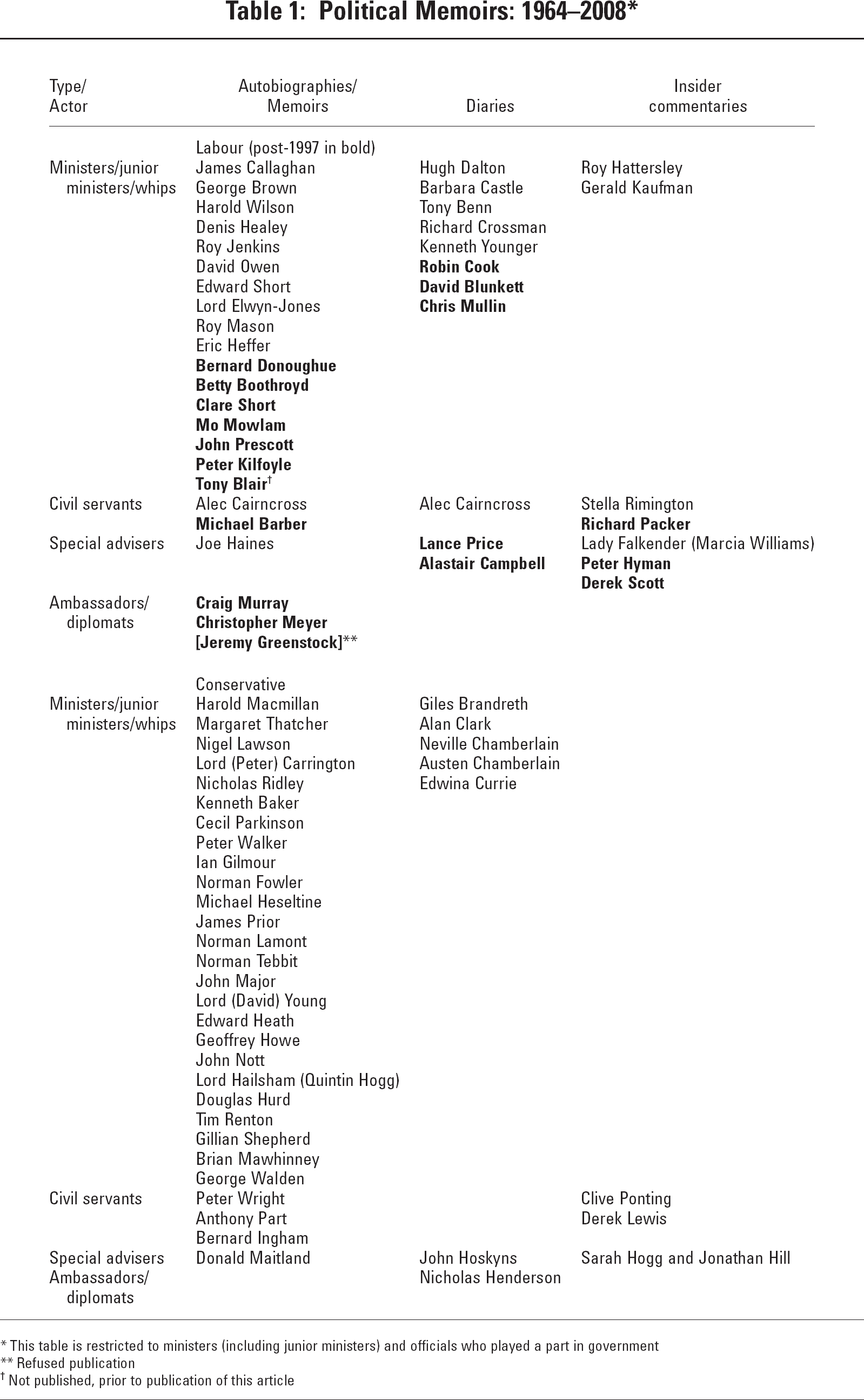
This table is restricted to ministers (including junior ministers) and officials who played a part in government
Refused publication
Not published, prior to publication of this article
The article begins by arguing that the Westminster Model acts as a powerful force in conditioning the narratives of British political memoirs. The model is understood as an aggregate concept that shapes the perceptions elites hold of British politics. Nevertheless, it is important to disaggregate this concept. In so doing, it is argued that the overarching narrative of a minister's political memoir—drawn from the Westminster Model and influenced by the formal convention that it is ‘ministers who decide’—is conditioned by what can be referred to as ‘historical impact’ (Richards and Smith 2004).
The article briefly explores the evolution of the ‘formal and informal rules of the game’ for ministers when writing their memoirs, before offering an analysis of the political memoirs that have appeared since 1997, labelled in some quarters as the era of the ‘instant memoir’. There then follows a more detailed examination of David Blunkett's taped memoirs which draws on in-depth interviews with both the politician and the production team involved in the publishing process. The article concludes by arguing that the rules of the game surrounding political memoirs have been further challenged in the post-1997 period. It suggests that the pressure for ever more frank revelations defies a number of the conventions associated with the Westminster Model, but one that the existing culture of self-regulation may not be able to address effectively.
The Westminster Model and Political Memoirs: Interpreting the Constructed Worlds of Ministers and Civil Servants
The Westminster Model has traditionally dominated studies of British government. There is of course no single definitive version of the model, but it essentially acts as an organising perspective which defines an area to be studied (see Rhodes 1997). Implicit within the model is a particular view of the nature of power in the British political system. Power is regarded as sealed within the domain of Westminster and based on an elitist, hierarchical, top-down view associated with the British political tradition. This is premised first on a limited, liberal notion of representative democracy, encapsulating the view that it is the government that governs in the interests of the nation and therefore power should rest with the government, alongside a conservative notion of responsibility. 2 In her memoirs, (Gillian Shephard 2000, 288) succinctly articulates this view: ‘People are not interested in politics, they lead busy lives with many demands on their time and energy. They put a government in place and they expect it to get on with the job’.
The Westminster Model does of course have its critics (see for example Rhodes 1997; Marsh et al. 2001). Nevertheless, in the modern era it is important to recognise that it continues to be defended by the core executive because it acts as a legitimising mythology for the extensive power it conveys (Richards and Smith 2000). 3 It should also be noted that ministers rhetorically appeal to the model, often implicitly, sometimes unwittingly, as the cornerstone framing their understanding of the political world. As (Mark Bevir and R. A. W. Rhodes 2003, 25) observe, this model or tradition can be understood as the concept which ‘explain[s] how British Government works with the beliefs and preferences of the relevant actors as the basic building blocks’. From this perspective, it is argued that the Westminster Model casts a shadow across the memoirs of politicians, acting as an aggregate concept shaping the narratives they present of the court politics of Westminster and Whitehall (see Bulpitt 1983; Rawnsley 2000; Bevir and Rhodes 2006).
To understand the way in which this court politics is mediated, interpreted and narrated in the political memoirs of ministers, it is important to disaggregate the Westminster Model. Formally, the model portrays ministers as the decision-takers, for which they are accountable first to parliament and, through elections, to the public. They make decisions based on the ‘facts’ and advice outlined by officials, who are neutral, permanent and loyal. It should be pointed out that the range of behaviour that is acceptable for ministers is much wider and less prescriptive than that for civil servants. The boundaries of official behaviour depend on constitutional niceties, while the limits on ministerial behaviour often depend on political expediency (see Alderman and Carter 1991; Dowding 1995; Theakston 2000; Fleming and Holland 2001). This is formally evidenced by contrasting the lengthy and detailed regulations in the Civil Service Management Code with that of the Ministerial Code (see Cabinet Office 2007 and 2008). The constitutional view embraced by Whitehall is that the minister is master and the official is there to serve. The Westminster Model therefore formally defines the power relations between ministers and their officials.
The view offered by (Erving Goffman 1959, 44) that political actors often have ‘an idealised view of the situation’ has particular resonance when analysing the narratives by ministers in their memoirs. For ministers, the Westminster Model suggests that the essence of their behaviour is formulated on the view that, when making a decision, it is they who are responsible and are acting in the national interest. The idealised performance of the minister is about being perceived to be in command or in charge, particularly when wearing their departmental cap. They have to demonstrate an image of control, for example, when appearing in cabinet, parliament or to the media. It reflects the traditional Weberian view of politics as a top-down activity, whereby ministers located at the apex of the system effect change by taking the ‘necessary’, sometimes ‘unpopular’, usually ‘tough’, decisions in the interest of the public good. As Philip Norton observes, ministers are like ‘medieval barons in that they preside over their own, sometimes vast, policy territory. Within that territory they are largely supreme. No one else enjoys that power’ (Norton 2000, 116). A clear expression of this idealised view of ministers is captured in the title of the memoir by the former Conservative minister Norman Fowler—Ministers Decide.
(Conor McGrath 2002, 70) argues that political memoirs tend ‘to be characterised by their self-serving perspective’ highlighting a concern ‘with establishing the author's self-defined place in the history books’. Unsurprisingly, the world of the minister, as presented in their memoirs, is dominated by a narrative of what they feel they have achieved in office and the notion that they have made a difference. These reflections offer a heavily skewed, agency-centred construction of Westminster's court politics, being primarily concerned with legacy, derived from a particular understanding of power conferred by the Westminster Model. Throughout this article, such a construction is referred to as ‘historical impact’. For as (David Marquand 2009, 194) observes of the genre:
the spotlight is trained on one single actor, who may or may not be the most important one from an historian's or political scientist's point of view. As the old saw had it, biography is, in the end, ‘about chaps’—and nowadays, to some degree, about chapesses. Everything else is secondary.
But not all memoirs are the same and some disaggregation is required. (Gamble's 1994, 35) analysis of political memoirs provides a useful typology, classifying them according to ‘the kind of insights they give into party politics; ethos and style; argument and doctrine; policy formulation and implementation’. Elsewhere, the literature on British cabinet ministers offers an alternative perspective, depicting a range of ministerial types: those who made an impact, ‘agenda-setters’ or ‘policy initiators’; those who were less ambitious or went with the status quo, ‘minimalists’; and those who found their ministerial goals/ambitions thwarted (see Headey 1974; Marsh et al. 2000). In the context of memoirs, it is the first category that tends to dominate the genre, offering an agency-centred, historical-impact narrative of achievement in office, but it is the latter (smaller) category that is as interesting, as these memoirs tend to draw on a more structural set of explanations, relaying a minister's constant struggle against a variety of malign forces, be it in the shape of an obstructionist department, most likely the Treasury, a dissenting cabinet or economic imperatives beyond their control (see, for example, Crossman 1975 and 1981; Benn 1989; Heath 1998; Lamont 1999; Shephard 2000).
Of course, a form of political memoir that puts ministerial failure almost exclusively down to personal shortcomings, the ‘mea culpa memoir’ if you like, has yet to be penned, at least within the British tradition. This is something of a surprise, if we invoke the Powellism that ‘all political careers end in failure’. The closest there may be, unless Estelle Morris goes into print, is John Major's autobiography: part critical self-examination, but also part railing against the divisive legacy he inherits and the subsequent uncontrollable storm clouds that quickly gather over his prime ministerial watch.
I shall regret always that I rarely found my own authentic voice in politics. I was too conservative, too conventional. Too safe, too often. Too defensive. Too reactive. Later, too often on the back foot. I inherited a sick economy and passed on a sound one … I made only a beginning and it was not enough (Major 1999, xxi).
The dominance then of the historical-impact, agency-centred account in British political memoirs raises an important methodological issue: how to interpret the often idealised view of core executive power relations they tend to depict? What is portrayed in memoirs as the normal or moral order is in fact a social construction and the assumptions underpinning it contain important implications for the nature of power (Goffman 1959). To illustrate this point, it is worth contrasting the idealised view publicly presented by ministers with that of their officials. Richards and Smith (2004) have observed that the way in which civil servants present themselves publicly, for example in front of a Select Committee, is different to how they informally act with a minister in an internal, departmental meeting. Publicly, officials present the conventional image of themselves as apolitical, neutral and without any real influence. They are the bearers of their master's wishes, never political actors. This image stresses the role of structure, depicting a highly rule-bound universe, defined and codified by formal and informal conventions, in which they have no personality beyond that of the constitution (or, in practice, their minister). Little or no emphasis is given to the role of agency. The point here is that a researcher wishing to draw on political memoirs as a resource and, in particular, interpret core executive power relations, cannot avoid confronting this structure–agency issue. It requires identifying and then interpreting the type of memoir that is to be analysed; is it a narrative that is skewed towards an agency-centred account concerned primarily with historical impact or one that emphasises the role of structure when accounting for legacy? However, on this issue, (Marquand 2009, 194) somewhat provocatively muses:
straightforward historians, and still more straightforward political scientists, are apt to concentrate too much on structure and not enough on agency. When they do focus on agency, they are apt to overemphasise the role of reason, logic and calculation and to underemphasise the role of feeling. This is not to say that rational calculation plays no part in political life; patently it plays a large part. But no one who hopes to understand political decision-making should forget Hume's famous dictum that reason is the slave of passions.
Political Memoirs: Identifying the Rules of the Game
So far, then, we have made the case for the need to recognise the influence of the Westminster Model and the normative view it provides of core executive power relations to help explain the emphasis on historical legacy in ministerial memoirs. But the influence of the Westminster Model on memoirs reaches further, if we consider the tradition/convention of the core executive operating within a self-regulating arena to protect itself against outside, potentially undemocratic, influence (see Judge 1993; Moran 2003). This modus operandi can be traced back to the 19th century, where, alongside the emergence of a new democratic settlement, was the embedding first of what Michael Moran (2003) refers to as a system of ‘club regulation’ among Britain's political elite, but also what David Vincent (1998) identifies as the principle of ‘honourable secrecy’. In terms of the former, (Moran 2003, 32) notes that one of the original accounts of the Westminster Model by Marquand was used as:
a synonym for the ‘club model’ … The atmosphere of British government was that of a club, whose members trusted each other to observe the spirit of the club rules: the notion that the principles underlying the rules should be clearly defined and publicly proclaimed was profoundly alien (Moran 2003, 32).
The emergence of a culture of club regulation is coupled with the development by Britain's political elite of an ethical code of honourable secrecy which Vincent (1998) traces back to the 1860s. This code was formulated on the creation of a culture of ‘instinctive self-censorship which … would render unnecessary the overt use of formal regulations’ (Vincent 1998, 28–29). It was based on the notion of ‘gentlemanly honour’ and all the social, hierarchical and class characteristics of mid-19th century Britain such a concept evokes. Initially, the code was used as a defence against the need for an Official Secrets Act, but after 1911 its legacy, as we see below, as an ethos espousing ‘discreet reserve’ and the ‘negation of personal interest’, particularly in matters concerning public policy negotiations, continued to shape the outlook of Britain's political class (Vincent 1998, 315).
In practice, what followed over the next 150 years was the core executive resolutely defending the principle that they alone should act as their own judge and jury. This was captured in key characteristics of the Westminster Model: the doctrine of ministerial responsibility meant that only democratically elected politicians faced public accountability for their actions, though in practice the secrecy surrounding the policy-making process offered a welcome comfort blanket of protection; civil servants remained anonymous, shielded from public view. Crucially, responsibility for this self-regulating system was vested in Whitehall's senior elite who were seen to be imbued with the values associated with gentlemanly honour. The ‘arbiter of last resort’ in this system is the Cabinet Secretary (Chapman 1993; Hennessy 1995). It is perhaps indicative of the insularity of this approach that a former Cabinet Secretary, William Armstrong, could say without any sense of irony that he was accountable to himself, the great taskmaster: ‘I am accountable to my own ideal of a civil servant’ (Richards and Smith 2000, 61).
The point here is that if one traces the evolution of both the formal and informal rules of the game concerning the publication of British political memoirs, in the absence of a written constitution, the culture of club regulation and the principle of honourable secrecy looms large. It is also a culture that is contingent on the Whiggish notion of the rules being self-correcting, emphasising ‘gradualism and the capacity of British institutions to evolve and cope with crises’ (Bevir and Rhodes 2003, 27). Successive generations of political elites have tested the foundations on which this edifice is constructed; none more so than the generation caught up in the parliamentary expenses scandal of 2009. The rules have thus evolved as a reaction to these challenges, although, as we see below, the political elites have tended to ensure that it is they who specify what the rules are and continue to act as guardian over them.
The Evolution of the Rules of the Game Governing Publication of Political Memoirs
As part of the tradition of club regulation and honourable secrecy, the evolution of the conventions concerning the publication of political memoirs has remained informal, despite attempts at various times by the Cabinet Office to impose more formal codification. When recognising the different but shared universes within which ministers and civil servants operate, it is not surprising that there are contrasting interpretations of the rules and conventions governing the publication of memoirs for ministers and civil servants. As we see below, civil servants have had to operate in a much more censorious environment than that of their political masters. Conversely, it is politicians who have regularly been able to play fast and loose with the codes of practice, even, on occasions, ignoring them completely.
The evolution of the present rules can be traced back to the early part of the 20th century when the Cabinet Secretary, Maurice Hankey, drafted a set of instructions restricting the use of official papers in the memoirs of public servants (see Table 2). Crucially, the cabinet made a distinction between ministers and officials and refused to impose the same strictures on former cabinet ministers. The expectation that ministers should submit drafts to government departments and to the Cabinet Office began in 1926, when Winston Churchill submitted the proposed text of his World Crisis Volume 3. Earlier volumes had been criticised for quoting too freely from confidential government papers.
The Evolving Rules of the Game for Political Memoirs
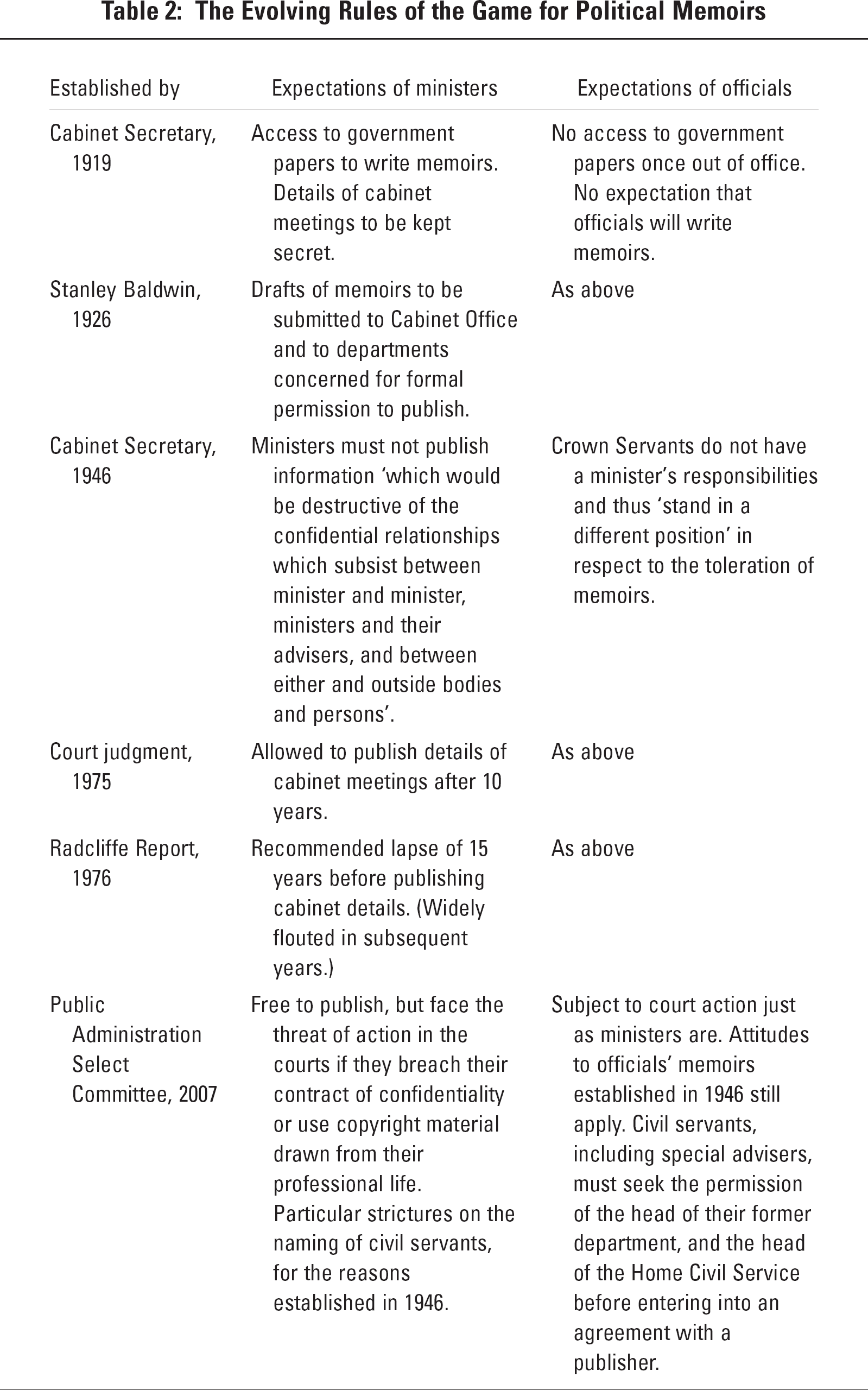
In 1960, Harold Macmillan restated the principle of consultation, but the conventions were notably tested in 1975 and were found wanting. Initial extracts from the first volume of Crossman's diaries were printed in the Sunday Times without the consent of the Cabinet Secretary and included full accounts of cabinet meetings—the first memoir to do so. The Attorney-General failed with a legal injunction to prevent the publication of the book. Prime Minister Wilson could have used the Official Secrets Act, but lacked the nerve (Theakston 2003; Howard 2004). This led to the Radcliffe review and subsequent report (Cmnd 6386 1976) recommending a period of 15 years for the maintenance of confidences within government. A distinction was made between the memoirs of ministers, who are publicly accountable and therefore entitled to report on their stewardship, and officials, who provide advice in confidence and are protected from public exposure. 4
Radcliffe's recommendations were generally accepted by members of the 1974–79 Labour administration, but with exceptions—Roy Jenkins, Barbara Castle, Tony Benn, Peter Shore and Michael Foot. A few years later, both Barbara Castle and Tony Benn published diaries which included detailed accounts of heated cabinet discussions. As with Crossman earlier, cabinet colleagues were aware that note-taking for diaries was taking place. These Labour diarists all contravened both the spirit and the actuality of the conventions and faced no formal recriminations, but their diaries were all published after the demise of the government in which they served. (Kevin Theakston 2003, 28) argues that there is little evidence to suggest that discussions either in cabinet or in departments between ministers and civil servants were affected by the knowledge that diaries were being kept. It appears that the fears expressed in Radcliffe about the potential damage of diary keeping on ‘confidential relationships’ were unfounded.
During the 1979–97 Conservative administration, disaffected ‘wets’ such as Jim Prior (1986) and Ian Gilmour (1992) published memoirs offering highly critical accounts of the Thatcher years while the Conservatives remained in office. But of more note was Nigel Lawson's resignation in 1989, swiftly followed by his memoir The View from Number 11 (1992). It included accounts of discussions between cabinet members and linked advice to named Treasury civil servants, as he sought to validate his own role in the tracking of sterling to the German Deutschmark (Lawson 1992). The Cabinet Secretary, Robin Butler, appealed to the code of honourable secrecy, pleading with Lawson to remove the names, but to no avail (HC 689-I 2005, para. 42).
After Lawson, and with a spate of former Conservative ministers all on the verge of publishing their own memoirs, another review was set up in 1993 led by Lord Wakeham. The ethos of club regulation continued to loom large in his subsequent report, which ‘did not move the discussion on from … Radcliffe’ (HC 689-I 2005, para. 24). It stressed that authors must ‘refrain from publishing information destructive of the confidential relationships of ministers with each other, and ministers with officials’ (HC 689-I 2005, para. 24). This advice was reproduced in the Directory of Civil Service Guidance, but was not referred to in the Ministerial Code, which continued to cite only the Radcliffe rules. Both the formal and informal rules surrounding memoirs continued to be open to interpretation, leaving those ministers with an eye on a lucrative publishing deal to conclude that ‘who dares wins’.
From Crossman to Lawson, ministers tested the boundaries of what was deemed acceptable without incurring formal reprisal. Publications by officials during the same period met with a different response. It should be pointed out that the vast majority of senior officials, like their predecessors, continued the tradition of honourable secrecy and opted for anonymous retirement, compensated, in part, by the financial rewards of pantouflage. But there were exceptions. For (Anthony King 2007, 240), the period since the 1970s reflects a ‘more nervy’ era in minister–civil servant relations and a greater willingness on ‘the part of officials to kiss and tell’. Some prominent examples include the economics adviser Alec Cairncross' (1997 and 1999) diaries of the Wilson years, followed by his autobiography; Anthony Part's memoirs of his time as Permanent Secretary in Industry, charting the conflicts with his minister Tony Benn, and Clive Ponting's (1985 and 1986) revelations about the Falkland conflict and cover-up in Whitehall. Following an unsuccessful attempt to prosecute Ponting, the government tightened up the existing 1911 Official Secrets Act by removing the principle of ‘public interest’ as a defence for the disclosure of public information. Elsewhere, the government tried to ban Spycatcher by the former Assistant Director of MI5 Peter Wright, which contained details of M15's work, and ensured a decade's delay in the publishing of Nicholas Henderson's Mandarin: The Diaries of an Ambassador 1969–82 (Henderson 1994). Finally, the former Chief Executive of the Prison Services Agency, Derek Lewis (1997), published an account of his conflict with Michael Howard. In all these cases, the code of honourable secrecy was ignored, prompting (King 2007, 241) to reflect that ‘this was not how the gentlemen of Whitehall had once comported themselves’. One official who did receive more sympathetic treatment, despite relaying numerous confidences concerning the details of ministerial and official discussions, was Margaret Thatcher's press secretary Bernard Ingham (1991). It is surely no coincidence that Ingham was not reprimanded or censored: his memoir was a robust apologia of his political mistress's years in office.
The evolution of political memoirs from the 1960s–90s highlights the extent to which ministers were willing to stretch the boundaries concerning what did or did not contravene the spirit of its own self-regulatory code of practice. It exposed reluctance on the part of the political elite to challenge its own, in particular where confidences, either in the form of private discussions in cabinet or the department, had been repeated. Former ministers were quick to recognise that if they wanted to provide an account of their time in government there were few constraints. Conversely, on the rare occasions when public officials, albeit generally from specialist not generalist posts, offered similar commentaries, the government tended to react in a censorious manner. In what continued to be a largely self-regulatory environment, based on the principles of trust and informal club rules, there remained a disparity in treatment between politicians and officials when it came to the publication of memoirs.
New Labour's Political Memoirs
The period since 1997 has witnessed the publication of a collection of memoirs from various ministers, alongside a growing number of commentaries by civil servants, ambassadors and special advisers. By 2010, 18 volumes of reminiscences had appeared (see Table 1). The tone of the offerings from Labour ministers was surprisingly frank, given that the party was still in power, providing details of conversations, decisions and judgements previously not in the public domain. Some were openly critical of the actions of colleagues (see Mowlam 2002; Cook 2003; Short 2004; Blunkett 2006; Prescott 2008). The nature and number of publications by ministers, from a still incumbent government, prompted the Public Affairs Select Committee to review the practices surrounding political memoirs. Its subsequent report, Whitehall Confidential, referred to the post-1997 period as an era of the ‘instant memoir’, which it viewed with concern, arguing it could undermine ‘confidentiality, and erode the trust which is necessary for ministers, officials and advisers to work together’ (HC 689-I 2005, summary).
The tone of Whitehall Confidential reflects the extent to which the present batch of memoirs has ridden roughshod over both the spirit and the letter of Radcliffe and Wakeham. Since 1997, there has been no serious attempt to discourage ministers from publishing. Clare Short, Robin Cook and David Blunkett submitted drafts for clearance through the Cabinet Office in the usual way. 5 As with the previous generation, but in larger numbers, there have been some notable revelatory memoirs from officials, particularly from the increased number of special advisers employed by Labour (Scott 2004; Price 2005), which prompted official recrimination. Controversy also surrounded the former US Ambassador Christopher Meyer's refusal to submit his draft text to the Foreign and Commonwealth Office (FCO), even though Diplomatic Service regulations clearly required him to do so (HC 689-I 2005, para. 7). Another ambassadorial memoir by Craig Murray, Murder in Samarkand (Murray 2006), appeared without clearance by the FCO. Finally, Richard Packer (2006), a former Permanent Secretary at MAFF, published a highly critical insider account of both the Major and Blair governments' handling of the BSE food crisis.
Whitehall Confidential recognised that ‘if an author is unwilling to co-operate, unless national security is at stake, there is nothing effectively the government can do to prevent publication’ (HC 689-I 2005, summary). It proposed a reformed system, whereby authors were free to publish, but faced the threat of action in the courts if they breached their contract of confidentiality or used copyright material drawn from their professional life. The report appealed to the well-established tradition of club regulation and honourable secrecy by arguing that most authors understood the rules of the game and would willingly clear their texts in advance. The government, for its part, would have to negotiate and reach a compromise if possible, since otherwise it would have to convince a court that there was no public interest in publication. The report paraphrased the Westminster Model when it placed particular strictures on the naming of civil servants in memoirs, arguing: ‘free and frank exchanges between politicians and civil servants depend on confidentiality and trust in government, and this implies a degree of subsequent reticence on both sides’ (HC 689-I 2005, para. 68). It suggested that those who ignored the code of club regulation would find themselves rapidly shunned by the court of Westminster and Whitehall, specifically referring to the Meyer case and Jack Straw's observation that ‘[He] has destroyed his reputation … The guy has been completely ostracised … I think there will be very, very few members of the Diplomatic Service doing a Meyer in the foreseeable future’ (HC 689-I 2005, para. 34).
But Whitehall Confidential did little to stem the flow of memoirs. In 2007, Blair's press secretary Alastair Campbell published his diary, described as ‘the most compelling and revealing account of contemporary politics you will ever read’. 6 He made two concessions—the diaries were abridged ‘extracts’ with the promise of an unexpurgated future edition and they were not published until after Blair resigned. John Prescott's (2008) ghostwritten autobiography lived up to its subtitle Pulling No Punches by offering frank insights into the court politics of Blair, as well as details of his relationships (both good and bad) with ministerial colleagues and senior civil servants. A year later, from Labour's outer ring, Chris Mullin's (2009) diaries provide details of policy discussions with officials as a junior minister in three departments, as well as witness statements on the personal spats within the Blair court.
But the notion that the ‘instant memoir’ began with New Labour is far from accurate. George Brown's (1971) reflections on the first Wilson Labour government, published a year after its demise, would certainly fall into this category. Likewise, as noted above, the last Conservative administration saw contributions from ex-cabinet ministers published while the party remained in office. What may have changed in recent years are attitudes and the related pressures they bring to bear. First, in an increasingly transient age, the commercial pressure to publish swiftly has grown. Second, as (Marquand 2009, 192) observes, political biography has changed in that:
it has become almost de rigueur for biographers to discuss the private lives of their subjects (and particularly their sexual lives), even if the evidence is scanty or if the exercise reveals nothing of value; it is not difficult to see why this convention should have taken root in our prurient age of ‘kiss and tell’.
This certainly rings true for the self-penned political memoir. Ex-ministers (with one eye on their own publishing potential) have recognised that frankness has increasingly become the order of the day. This may involve bowing to commercial pressures to provide greater revelations of private, personal matters: Edwina Currie's account of her affair with John Major; Alastair Campbell's regular tearful episodes, alongside his bouts of depression; or John Prescott's bulimia. However, the extent to which an individual's private foibles affect their public life remains a moot point (see Brown 2006). Third, and of greatest relevance to this article, is the increasing pressure for memoirs to provide detailed accounts of the personal clashes between actors in the core executive. This has particular implications for the Westminster Model, since the issue facing the author is that revealing the machinations, dealings and discussions at the heart of Westminster and Whitehall's court politics carries with it the potential risk of contravening the code of honourable secrecy. For example, defenders of the constitution claim that if a minister publicly reveals the advice that has been offered by a senior civil servant, then this can potentially threaten the convention of civil service neutrality, break the bond of trust between ministers and civil servants and constrain officials from offering their full but frank advice. It is argued that such details have traditionally been viewed as off-limits to the public and counter to the tradition of the Westminster Model. The indivisible, symbiotic relationship supposedly forged between ministers and officials, codified in both the Haldane Report (1918) and the Carltona Doctrine (1943), the cornerstone of which is the principle of trust (see Richards 2008, 143, 237 n. 2), is threatened where the potential exists, either real or perceived, for such revelations to be made through the medium of memoirs.
What has been crystallised by the post-1997 contribution to the genre of political memoirs is that if an individual, either a minister or an official, is intent on going to print there remain few formal sanctions, prior to publication, that can be imposed. The culture of club rules, self-regulation and self-censorship persists: those who break the rules may no longer be deemed ‘good chaps’ or ‘gentlemen’ and can be swiftly cast out of the club (HC 689-I 2005, para. 33; see also Hennessy 1995; Moran 2003). 7 Here, there is an important and continuing distinction to be discerned between ministers and officials. The former have always been able to stretch the rules—testing the boundaries of what is deemed acceptable. There has been a long line of politicians, though not always cabinet ministers (here Chips Channon, Woodrow Wyatt, Richard Crossman, Tony Benn, Gyles Brandreth, Alan Clark and George Walden come to mind) who clearly broke the club rules but were not ostracised. Conversely, the cases of Ponting, Wright, Meyer and Price reveal how officials still exist in a more rule-bound arena, where publication can lead to them being ostracised or deemed ineligible for the ranks of the ‘Great and the Good’ (see Hennessy 1986). This contradicts the view of the former Cabinet Secretary, Andrew Turnbull, that the same set of rules applies to both sets of actors: ‘over time the enforcement process has really become the same for both, though in my view the official/diplomat has a less compelling case to publish his memoirs and that needs to be built into the system’ (HC 689-II 2005, Ev. 16).
In an era in which pressure for greater frankness detailing ministerial and official relations has increased, the line defining what is acceptable and unacceptable has further shifted. The next section examines one such ministerial memoir, published after Whitehall Confidential, by the former Labour cabinet minister, David Blunkett, covering his time as Education and Employment Secretary (1997–2001), Home Secretary (2001–04) and Work and Pensions Secretary (2005). It explores the motivations behind the publication of his memoir The Blunkett Tapes (Blunkett 2006), the nature of its composition, the impact of the club rules on the final draft and, finally, the way in which it is conditioned both by the Westminster Model and a concern with legacy.
‘The Blunkett Tapes’ 8
David Blunkett did not keep a diary until joining the first Labour cabinet and indeed did not find time to chronicle the events of the first few weeks in office until June 1997. Thereafter, he dictated a weekly account, normally on Sunday at his home or sometimes on Monday morning as he returned by train to London. He kept the diary going until he finally left office in November 2005. Blunkett was asked to reflect on the origins of the decision to keep a taped diary:
I decided I would keep notes … reflections from the moment we were elected. I found myself talking into a tape recorder almost like therapy to actually capture what seemed to me to be a really important moment in time. It felt … seminal; the world was changing and a bygone era was being brought to an end. I thought ‘I must keep some thoughts of my own about these’. A few months in I thought ‘I'd better keep these a bit more properly; you never know when I might need them and I might want to reflect on them’. Partly in the back of my mind was ‘I might want to reference back, because I can't trust the civil service to have any memory at all’. And I've since thought ‘well maybe that was a bit of a smoke screen; that was an emotional cover for saying ‘maybe you want to use these in the future if you want to write a book’. But not necessarily a diary.
It is important to note the claim that the original motivation was private reflection and note-taking, but that the idea of producing a book was also present at an early stage. These considerations affect the author in the act of composition—complete honesty is less likely when personal reflections stand a strong chance of becoming public knowledge. However it is reasonable to assume that Blunkett spoke with little restraint when recording. Comparisons between the notes from the original transcript and the published version bear this out. Blunkett knew that any future published version would be edited, but unlike for example Benn or Castle, he kept the existence of the tapes secret, taking care to ensure that they did not fall into any hands other than those of his private secretary.
To explore the extent to which historical impact was a key driver in the decision to publish his memoirs, Blunkett was asked about his motivations for going into print:
Firstly, I wanted to put the record straight; secondly because I needed the money; thirdly because it was damn good therapy, it actually put my head straight having something to do because nobody was offering me anything at that stage. So I had to rehabilitate myself. This was good hard work; and, fourthly, I did genuinely want to get it out before there was a general election.
He also suggested that after his departure from Work and Pensions, the likelihood of a return to cabinet was slim and that it was vital that his taped memoirs were published swiftly because ‘we now live in a very ephemeral era’ and that interest in his story would quickly fade ‘if I'd have waited until 2010, well forget it really’.
Blunkett resisted initial attempts by his first editor to rewrite the transcript ‘so that it was almost being written in retrospect rather than as a diary, and starting to change the tenses’. Bloomsbury was also trying to reduce the volume's size, but after a less interventionist editor was appointed, Blunkett retained most of what he wanted. The final volume ran to 450,000 words rather than the 300,000 originally negotiated.
One of the issues raised by a memoir's first-hand account of political history that sets out one's stall in terms of historical impact is the temptation to alter the original narrative. Here, the issue of the veracity of the diaries' published entries is crucial, particularly when, as with Blunkett, substantial editing occurs. The editors of the manuscript numbered at least three—his secretary, the Bloomsbury editor and Blunkett himself—and there were also other interventions within the publishing house. Blunkett acknowledged the implications of this: ‘I don't mind being on the record saying there is a danger that in making something read coherently, and actually reflecting on “what is it that I've put down here?”, you write it in a way that might not be exactly what you put down at the time’. 9 A comparison of sections of the original text with the published version suggests that in general the content and mood were not changed. Some comments were toned down; Blunkett observed that ‘I didn't change the wording, but I did drop some of the more hysterical observations, like ‘if I could get hold of him, I'd break his nose!’
Crucial to veracity is the amount of material excluded. This judgement was often made for reasons of perceived lack of interest. When interviewed, the editor suggested that 300,000–400,000 words were expunged, particularly on policy detail. Blunkett accepted the publisher's decision to ‘cut out chunks because they thought it was boring’. For example, he justified the omission of the development of employment strategy, a major policy area during Labour's first term, by saying: ‘How much interest was there in our employment policy, once we'd started to get unemployment down and have policies for it?’ This may reflect another feature of current political memoirs, the commercial pressure to move away from accounts that, employing Gamble's typology, predominantly focus on ‘policy formulation and implementation’, towards the type that emphasises ‘ethos and style’. It is of course the former that tends to be viewed by political science as being of far greater use as an empirical source.
If we recognise that, within the British tradition, the roles of informal club rules, self-regulation and honourable secrecy act as powerful drivers, then potentially the most contentious area concerns omission or rewriting motivated by political considerations. Blunkett was certainly sensitive to the informal club rules and edited observations that he felt might upset colleagues:
I did drop some of the things that I thought would firstly detract from what I was trying to do, i.e. would be a massive distraction from what I was really trying to reflect on and recall. Secondly, I was affected by what had happened to me with Stephen Pollard. We might as well be honest about this. If Stephen Pollard hadn't done to me what he did, with the Daily Mail article on 6 December 2004, I might have been tougher in leaving in some of the comments about my colleagues. But the reaction and the damage that did to me, writing up the diaries eighteen months later, made me very circumspect. I thought those things have been said and let's leave sleeping dogs lie.
This reflection refers to some unguarded comments Blunkett made about his colleagues to his unauthorised biographer, Stephen Pollard, that were also printed in the Daily Mail. Blunkett had contravened the spirit of the club rules and received a frosty reception from some within the Westminster court. This event affected the editing process prior to publishing his memoirs.
Gordon Brown was the greatest recipient of his caution. When asked whether he had changed some of the harsher comments about Gordon Brown, Blunkett observed: ‘I plead guilty to leaving in nicer things at the expense of some of the harsher things, and that is true on the grounds that I was not out to tell a lie, but I wasn't out to damage my party’. He went on to note that ‘I protected both Gordon and myself by dropping things that were absolutely central to the rows we were having at the time … But had I put those in the diary, my God, the world would have imploded’.
Of course, in Westminster's court politics, a fractious relationship between a minister and chancellor is by no means unusual (see Dell 1997; Lipsey 2000). In the first term, the pair regularly clashed privately, particularly over employment policies like the New Deal. Both wished to take credit for such policies and Blunkett resented Brown's propensity to make announcements that had not been agreed in advance. 10 The editing of material relating to Brown in the original transcript does at times distort the impression presented in the published version. Some comments on Brown's relationship with Blair were also edited out. For example, the following entry in September 2000 was not printed:
It is absolutely clear that this relationship between Tony and Gordon which was once so productive in the early years of New Labour is now really the tremendous thorn in our flesh and a potential source of disaster. Gordon's inability to consult and to take people into his confidence, and Tony's lack of economic advice … is yielding very bitter fruit indeed.
Other edits, also prompted by political considerations, concerned minor alterations in tone, for example changing ‘clash’ with Gordon to ‘fencing’ or ‘disagreement’ (Blunkett 2006, 66–67). On publication, Blunkett made candid statements about the omissions relating to government ministers 11 and was duly criticised by newspapers which hoped for more sensational quotes. But elsewhere, despite the obvious commercial pressure to reveal details of his personal life, most notably concerning his relationship with Kimberly Quinn, such passages were not omitted from the final version, as they were never included in the first place: ‘I have chosen in this diary, as I have throughout my life, to do what I can to protect my privacy, and in this I am grateful to Bloomsbury for their understanding’ (Blunkett 2006, x). As the original transcripts confirm, Blunkett had decided from the outset that his taped musings were to be exclusively political reflections, where commentary on any intimate liaisons had no place.
If, then, we accept that Blunkett's diaries received some understandable editing, the final draft nevertheless remains broadly faithful to the original entries. Blunkett added an extra feature, of crucial importance in relation to historical impact: the use of post hoc reflective commentaries which intermittently appear in italics as a companion to the diary entries. These commentaries allowed Blunkett to justify, explain or regret his previous actions. In some cases he revised his original ‘somewhat hasty thoughts’ (Blunkett 2006, x). These reflections allowed Blunkett to have it both ways, creating a hybrid consisting of the immediacy of diary entries coupled to the reflective commentary that could be used to establish his own version of history. He observed:
Diaries are terribly harsh to yourself, because when you look back you think ‘God, did I really say that, or think like that at the time?’ So it does help to mellow the picture a bit. It is a little bit self-justifying, but it has an honesty about it as well, so it does balance really.
These summaries were sometimes used to soften the tone of the original text. Some of the heated arguments Blunkett had with Brown over childcare policy were summarised as: ‘Gordon had spotted very quickly that childcare was going to be a major issue for the coming decade and it took me a little while to realise that I was not going to be sorting this policy out alone’ (Blunkett 2006, 28). The italic sections also act as a summary for lengthy passages found in the original recordings which were too long to quote. For example, the agonising preceding Chris Woodhead's resignation as Chief Inspector in 2000 is briefly summed up in italics (Blunkett 2006, 212–216).
While it is clear that the informal club rules concerning self-censorship, particularly in the light of the Pollard affair, had an impact on the diaries, the formal rules, in terms of the official guidelines on political memoirs, were given less consideration. Blunkett observed that ‘I wasn't as familiar as I ought to have been’ with the Radcliffe Report when he submitted his draft to the Cabinet Office and its rules ‘didn't really impinge very much at all’. The Cabinet Office's overseeing role was both light touch and inconsistent when applying its own guidelines. For example, Blunkett claimed that it showed little concern about the use of government documents because ‘it was a diary rather than an autobiography, [so I wasn't] quoting extensively from papers’. Nevertheless, he was ‘surprised that they let me leave in some things to do with counter-terrorism, like the Sugar Ship incident’. 12 They were censorious about ‘relatively minor revelations that involved mentioning individuals’, especially if they were connected with an ongoing inquiry or court case. He concluded that, in his dealings with the Cabinet Office, ‘I thought we got a draw, other than on just a couple of places where I'd liked to have said more, because it would have given a much better feel for what we were dealing with on counter-terrorism’.
Prior to publication, Blunkett's real concern was the reaction of his colleagues. This concern is the main explanation for the degree of self-censorship outlined above—which was far more substantial than the cuts imposed by the Cabinet Office. Blunkett was sensitive to the charge of publishing material ‘which would be destructive of the confidential relationships’ of government (HC 689-I 2005, para. 15). However, he received the support of Blair, who in response to a House of Commons question, gave the formal reply that Blunkett had submitted a manuscript to Gus O'Donnell, the Cabinet Secretary, ‘as required by the ministerial code’ and that the discussions were confidential. 13 It is unlikely that Blair was unduly concerned about the diary, as it overwhelmingly supported him and presents most of his premiership in a favourable light.
Staying loyal to the code of honourable secrecy, Blunkett removed the names of nearly all civil servants from his original entries, but included strong criticisms of his departments and Whitehall more generally, often giving the impression, particularly when at the Home Office, that he was battling against a tide of incompetence. A typical entry reads: ‘Some of these HO officials are the worst, most obstructive, miserable, disengaged and disinterested group of people I have ever come across, which indicates a degree of demoralisation and complete lack of leadership’ (Blunkett 2006, 342). His Permanent Secretary, John Gieve, is clearly tarred by implication, suggesting that Blunkett was being less than discreet when it came to Whitehall. The Immigration and Nationality Directorate (IND) in particular receives ceaseless criticism for incompetence and constant leaking. An entry for February 2002 describes it as ‘a shambles’ and by October, despite replacing the chief executive, he still regarded the management as ‘utterly useless’ (Blunkett 2006, 354, 409).
By contrast, his comments on the work of his special advisers are consistently supportive and sympathetic. He had trusting and close relationships with all of them. He also got on well with the officials in his private office. There were times when he felt that ministers and advisers were seen by Whitehall as the adversary. For example, he describes a newspaper article by Martin Sixsmith, Director of Communications at the DETR, over the Jo Moore/Stephen Byers affair as:
a clear example of the kind of betrayal we're now getting from the civil service … They have clearly declared war on special advisers and on some ministers and are determined to bring Steve Byers down. It is absolutely appalling but it's impossible to hit back when you are in government—so I'm going to have to tell the truth once I'm out (Blunkett 2006, 352).
Blunkett did subsequently provide a critique of Whitehall (Richards et al. 2008), but as with Benn or Crossman, this occurred when he was out of office and no longer required the support of Whitehall (Richards 2008).
Reflecting back on the final version of his diaries 18 months after publication, Blunkett felt that his comments on departmental affairs could have been more hard-hitting and that he was ‘more gentle on the things I didn't like, than the other way round’. In terms of its reception and the version of history it presented, he recognised he had angered some former associates, who were quick to rebut the diary's account. For example, Blunkett's depiction of a riot at Lincoln prison, suggesting that he took control as all around him were ‘dithering’, received short shrift from Martin Narey, then Chief Executive of the Prisons Service. He claimed that it was Blunkett who panicked by demanding that rioters should be ‘machine-gunned’, and that it was his staff who eventually contained the situation (The Times, 17 October 2006; Sunday Times, 18 October 2006). Narey's account was supported by the Chief Constable of Lincolnshire at the time. Elsewhere, Lord Boyce, a former Chief of Defence staff, accused Blunkett of ‘losing the plot’ by claiming that military leaders were complacent after the invasion of Iraq (Sunday Times, 22 October 2006). Other critics included Chris Woodhead, who accused Blunkett of ‘rewriting history’ (The Observer, 22 October 2006). 14
Despite Blunkett's self-censorship, some cabinet colleagues were also upset. He recalled: ‘I copped a lot of backwash from colleagues for doing it quickly’. Media reports suggested Jack Straw, John Prescott and Geoff Hoon were ‘furious’, particularly because they were not shown contentious passages in draft (Sunday Telegraph, 22 October 2006). The diaries were not a hatchet job, and contain only modest criticisms of fellow ministers—for example, that Geoff Hoon was ‘gung ho’ about the Iraq War, or accounts of Blunkett's rows with John Prescott. Jack Straw had most cause for anger, since his complaint that Blunkett was ‘overturning everything’ he had done at the Home Office was reported in detail. 15 But there was never a danger that Blunkett would be ostracised and frozen out of the Westminster court. Indeed, he reflected in January 2009, following unsubstantiated media reports that he might again return to cabinet, that the siren voices surrounding his diaries had fallen completely silent. Interestingly, most of Blunkett's colleagues gave no public reaction to the diary and, when interviewed, a number claimed they had not read it.
How then should The Blunkett Tapes be judged in terms of the British tradition of political memoirs? This tradition emphasises the key role played by the Westminster Model in shaping political memoirs, with a stress on the minister as being at the apex of the political system and being firmly in control. This perspective, not surprisingly, concentrates the mind of a minister when it comes to composing memoirs. In particular, it magnifies the need to convey what it is they feel they have achieved in office. This article has argued that the Westminster Model and its elitist view of power can be seen to act as a force of fascination for ministers, leading to a fixation with legacy or ‘historical impact’.
Blunkett is certainly an example of a minister concerned with ‘historical impact’. He suggested his diary was ‘aimed at future historians, who might see you in a better light, than clearly they did at the time’. He reflected that the considerable effort of keeping and publishing his political diary was, fundamentally, about legacy:
I think it's because as politicians, we're not more self-centred than other people; we're actually more committed to the role of the individual in history. We've got to be, because what's the point in us being there if we don't think that our being there makes a difference? And therefore it's not ‘were we just a competent filler of a post?’, but ‘did we change things; were we able to make decisions that changed people's lives, that moved things on?’ So, by the very nature of that, it becomes more self-centred and the role of the individual in history.
For the historian and political scientist, this comes uncomfortably close to the ‘great man’ theory of history propounded by Carlyle. 16 It also explains the motives behind the often highly agency-centred focus of accounts provided by most ministers. The need to frame their legacy is clearly a key motivator when penning memoirs.
In the case of Blunkett, the concern for both legacy and self-justification is brought sharply into focus by the ‘DNA Bioscience’ affair. The matter led to Blunkett's resignation from the Department of Work and Pensions in November 2005. In the aftermath, he felt malign forces had misrepresented him. Blunkett's version of this affair is relayed at some length in the diary, prompting one reviewer to suggest that the original entries had been augmented (Roy Hattersley, The Observer, 15 October 2008). The published version records in (surprising) detail Blunkett's reasons for joining DNA Bioscience in April 2005 (Blunkett 2006, 58–60, 765–766). Clearly the need ‘to clear my name and restore my integrity’ was an overwhelming concern (Blunkett 2006, 855). Blunkett subsequently confirmed his desire to ‘set the record straight’ but commented that the Cabinet Secretary, Sir Gus O'Donnell, had confirmed his version of events.
Despite Blunkett's recognition that the motivation for publication was predominantly driven by a concern with historical impact and the desire to assert his own narrative on events to counter criticisms from elsewhere, his diaries, like those of Crossman and Benn, recount numerous structural barriers he had to overcome, most notably with Whitehall, especially during his time at the Home Office. So, for example, in one of many similar passages from his memoirs, he argues that failings in government can be laid at Whitehall's door:
The civil service has a particular line that they've developed well over the years. First, if they don't want you to do something, they produce, the lengthiest, most obscurantist document, with no clear recommendations, but in the text itself all the so-called pluses and minuses, except without the minuses (which avoid them having to do what it is they do not wish to do) highlighted. Alternative ways forward are either not laid out in detail or simply ignored … The second element is to put up costings that make it impossible even to contemplate arguing with the Treasury … The other element is to prevaricate and not produce a report at all until you force them to (Blunkett 2006, 355–356).
Yet, as with Crossman, the Blunkett view is that a strong, powerful, effective minister can thwart these malign forces and win over the day, which of course is synonymous with the narrative of ‘ministers decide’ conveyed by the Westminster Model.
The Blunkett Tapes offers various insights into the genre of contemporary political memoirs: it demonstrates the extent to which the informal rather than the formal club rules constrained what appeared in the final draft and reveals an interpretation of power relations and a depiction of British politics that draws directly from the Westminster Model. Indeed, elsewhere Blunkett has provided an extended commentary on the socialising force of the Westminster Model in shaping the actions of ministers, even those, like himself, who wish to regard themselves as ‘radicals’ (see Richards et al. 2008). His diaries also provide a clear example of the way British ministerial memoirs are rooted in a desire to convey a sense of historical impact. Where it differs from some of the other published outputs by his Labour colleagues is the extent to which there is significant self-censorship when it comes to revelations about individuals rather than the institutions of government. As noted above, the trend by politicians to push the limits of what is deemed acceptable for publication is well established and one that the post-1997 batch of memoirs has certainly continued. In this area, Blunkett is more circumspect than Short, Cook, Prescott et al. in protecting the private from the public, a result most probably of his experiences during the Pollard affair. Nevertheless, as Blunkett reveals, he was surprised by what he did ‘get away with’, for example over issues concerning national security and the rather ad hoc approach adopted by the Cabinet Office.
Conclusion: The Future of Political Memoirs
This article has attempted to move the debate beyond traditional discussions of the status of memoirs within political science by exploring the genre through a literature concerned with understanding power relations in British politics. In so doing, it emphasises the relevance of the Westminster Model when it comes to understanding the memoirs of political elites. It also sets out to explain how power relations within the court politics of Westminster and Whitehall are mediated, interpreted and narrated within political memoirs. In so doing, the article provides a framework for helping understand the narratives found in ministerial memoirs: a tendency to offer a heavily agency-centred account, driven by a concern with legacy and the desire to convey a particular version of history. By contrast, it is argued that officials exist in a more structured, rule-bound universe. Most operate by the formal and informal rules of the Westminster Model that embraces an honourable code of secrecy. Where officials have published, it tends to be because they have either fallen out with their political masters, or they wish to expose systematic incompetence or nefarious activities on the part of government.
When reflecting on the current status of the political memoir, the article identifies an increasing pressure on politicians to be ever more revealing, not only about their own personal foibles, but also in disclosing clashes between key actors over the machinations, negotiations, bargaining and personal dealings at the centre of Westminster and Whitehall's court politics—what might be termed ‘Westminster gossip’. Such revelations potentially challenge the principle of trust, which is the cornerstone of ministerial and civil servant relationships, formally codified by the Haldane Model of government and only recently restated: ‘The Government agrees that free and frank exchanges between politicians and civil servants depend on confidentiality and trust. If this relationship breaks down it will be to the detriment of our system of government’ (PASC 2007, para. 68). As we have seen above, the existing culture of self-regulation, premised on the Whiggish notion of the system's ability to adapt and be self-correcting, has proved ineffectual on a number of occasions in addressing this issue. Indeed, the government's response to Whitehall Confidential recognises this, but still continues to appeal to the traditions of the club ethos and the culture of the ‘good chap’ by pleading for a sense of discretion:
The strength of the market for sensational or titillating material makes it even more important that there should be a clear understanding about the kind of discretion necessary to protect relationships inside government. We have no doubt that some discretion is necessary, on both sides. The dangers do not come from the single shocking memoir, but from the steady erosion of confidence and trust driven by the prospect of commercial gain (PASC 2007, para. 58).
This passage could have been lifted straight from a Whitehall memo of the 1860s, when the concept of honourable secrecy first emerged. PASC was disappointed by the government's response to its report and again called for the establishment of an independent advisory committee to take responsibility for overseeing political memoirs, a request rejected by the government (PASC 2007; HC 664 2008).
It is reasonable then to conclude that unless the mechanism of self-regulation is reformed or the Westminster Model of government moves towards greater openness, the strains placed on the existing status quo are likely to increase. Following the 2009 parliamentary expenses scandal and the degree to which the affair shed a highly public light on the pathology of Westminster's club rules and its culture of self-regulation, it remains unclear whether a critical juncture leading to systemic change has been reached. The initial, formal response to this affair, as evidenced in the Constitutional Reform and Governance Bill, suggests not (see Flinders 2010; Seaward 2010). The Westminster Model still bewitches Britain's political elite, an issue (Blunkett 2006, 193) himself testifies to in his own diaries:
Evidently, we were so bound into our history, to parliamentarianism, to playing the game, that we as a radical party couldn't break the traditions—and as soon as we had, we started to return to them … My own view is that until Parliament has procedures that accord with the normal common-sense view of men and women across the country and behaves in a way that everyone else would expect, then we really cannot expect to receive the respect we seek.
Footnotes
The authors would like to thank Dennis Kavanagh (Liverpool), Kevin Theakston (Leeds), James Walters (Monash), Rod Rhodes (ANU) and three anonymous reviewers for their comments on earlier drafts of this article.
1
2
The convention of ministerial responsibility ensures executive government by placing responsibility for decision-making within the hands of ministers. However, this notion is also useful to legitimise elite rule because it justifies the concentration of power in central government generally and departments particularly. See  .
.
3
For a wider discussion of this argument, the key features of the Westminster Model and the associated asymmetric model of core executive power, see Marsh et al. (2001); (Richards and Smith 2000, 45–66; 2004, 777–800); Richards (2008); .
5
This is confirmed by Clare Short and Robin Cook (HC 689-I 2005, para. 4), and by David Blunkett, interview with authors.
7
8
The following material is drawn from an ESRC-funded research project, part of which explored the process behind the composition and publication of his memoirs. The research involved 10 in-depth interviews with David Blunkett between 2006 and 2009, as well as access to private papers and parts of the original draft of his memoirs. The authors also conducted interviews with the editorial team at Bloomsbury and 83 interviews with ministers and officials who worked with David Blunkett during his time in office. Details of both the methodology and the project can be found at:
9
11
For example: ‘I've edited it and I have left the bodies buried’, The Guardian, 7 October 2006.
12
13
Sunday Telegraph, 22 October 2006; Hansard, 12 October 2006, col. 868-9W, 20 October 2006, col. 1448W. Blair was replying to a question from Gordon Prentice.
14
In a written response to a draft of this article, David Blunkett gave the following statement: ‘I am keen to point out that, with the exception of Lord Boyce, I have crossed swords in a substantial manner with those who subsequently criticised my version of events and that there was therefore a history behind their immediate and vocal reaction’. He added that he had been ‘somewhat dismissive of the role played by Martin Narey in resolving the stand-off at Lincoln Prison’ but continues to refute Narey's version of events.
15
For example, (, 85). There are also revelations about the personal circumstances of political friends, like Mo Mowlam, which do not sit easily with Blunkett's refusal to write about his own private life (Blunkett 2006, 161).