






Abstract
The prime minister's role in policy-making is paradoxical in that, although seemingly very powerful, prime ministers in fact have few rights to set policy unilaterally. It is then important to discover how prime ministers exercise influence over policy. Some studies suggest that it is through using resources within policy networks. From agenda-setting theory, this article proposes that prime ministers influence other actors by structuring the choices they face. This is illustrated using an example of a highly contested policy: the decision in the UK to support the US-led invasion of Iraq in 2003. It is shown that to influence two crucial actors, parliament and the cabinet, the prime minister, Tony Blair, and his office selectively released and withheld information in order to structure the choice facing these actors.
Introduction
The decision to go to war in Iraq was one of the most controversial policy decisions made by the Labour governments under Tony Blair. It was a somewhat unusual decision for a Labour government to take. One might have expected that it would not have wished to commit billions of pounds of taxpayers' money to a war that seemed to be driven by a right-wing US administration's desire to install a friendly government into power against the wishes of the United Nations and in probable contravention of international law. Despite this, a majority in the UK cabinet and Labour's parliamentary party supported the prime minister's decision to go to war. This episode lends great credence to the contention by political scientists and commentators that Britain has a predominant prime minister (Heffernan 2003), and maybe even a ‘presidential’ prime minister (Foley 1993; Foley 2000). 1
However, unlike US presidents, the UK prime minister has few unilateral policy-making prerogatives. Prime ministers cannot change policy without reference to other groups, such as cabinet, parliament or departmental ministers. As proponents of the policy network model of UK government point out, policy-making power is divided among interdependent and interlocking actors, each with resources that are exchanged (Rhodes and Dunleavy 1995; Rhodes 1997; Smith 1999). Therefore, Tony Blair needed the (political and legal) support of both parliament and cabinet in order to commit British troops to Iraq. 2 It was also politically necessary to have the support of a majority of Labour MPs. To fail to achieve this would have called into question Blair's leadership of the party. Given Labour's historical antipathy to military action, it is puzzling as to how this policy was accepted.
The inability of the UK prime minister to set policy unilaterally makes it likely that prime ministers would need to use resources to achieve policy gains and lends credence to the network analysis. To be true, however, one would expect that where a prime minister achieves his or her policy goals and appears dominant, network scholars would expect either policy compromise to ensue or control of policy to be ceded in other areas. This does not seem to have happened in this case. Blair seemed dominant on this issue, but did not have to concede on the conduct of war or its aftermath or on other controversial issues such as foundation hospitals and university tuition fees in order to get his way. Network analyses allow that ‘the balance of exchange rests heavily in favour of the powerful executive’ (Marsh et al. 2001, 9) but it is not clear that the policy network approach is more than a descriptive model; it does not show why one actor dominates another. As a descriptive model it provides a much more nuanced view of UK policy-making than institutionalist or pluralist analyses provide. However, this approach does not, a priori, explain how prime ministers influence policy-making. A theory of prime ministerial power is proposed here which, following E. E. Schattschneider (1960, 68) who argued that ‘the definition of alternatives is the supreme instrument of power’, contends that prime ministers can achieve policy dominance by defining the alternatives from which other actors in the policy-making process must choose.
Thomas Romer and Howard Rosenthal (1978) have shown how the formal ability to structure the choices facing others gives the agenda setter control to determine policy. William Riker (1986) has offered real examples of the effect of agenda setting on political decisions. Others have shown the impact of how issues are ‘framed’ on how people form judgements (Kahneman and Tversky 1984). Essentially framing an issue in a different way causes a choice to be structured differently.
The need to set difficult choices for parliament was explicitly recognised by Harold Wilson. He instructed one of his ministers that to avoid defeat in the Commons, where between 1964 and 1966 his government had a wafer-thin majority, he was to structure the opposition's choices:
My strategy is to put the Tories on the defensive and always give them awkward choices … They have an awkward choice voting for or against the pension increase. We have given them an awkward choice on office building and, Dick, you'll be giving them an awkward choice with your Bill for preventing evictions. Whatever we do we must keep the initiative and always give them awkward choices (Crossman 1975, 50).
Prime ministers, and especially UK prime ministers, have some important institutional prerogatives that allow them to set ‘awkward choices’ for others: the right to call confidence motions; to dissolve parliament; to dismiss ministers. This article studies these and places a unified theoretical framework on previous approaches to prime ministerial power. More specifically, I offer a case study to illustrate how setting choices might be important for determining policy outcomes. It is argued that through the selective use of information Tony Blair was effectively able to define the alternatives from which other actors chose. It was this that made this unlikely decision possible.
Resource-based Approaches to Prime Ministerial Power
While there have been serious divisions in debates about prime ministerial dominance in the UK, most agree that prime ministers possess and use resources to achieve policy goals, and face constraints from other actors. Two major debates have occurred on the UK prime minister; one that emphasises the control prime ministers have over other actors in cabinet and parliament, and another that has sought to broaden the focus of governance beyond these institutions, and to emphasise the dependency of different actors in the broader policy-making process.
The first debate centred on whether the UK prime minister has moved up the continuum of prime ministerial power to a position occupied by a strong president. It took hold in the early 1960s as a result of the publication of works by John Mackintosh (1968a and 1977) and Richard Crossman (1963 and 1972). Crossman (1963, 51) argued that, before 1867 (when Bagehot wrote The English Constitution), the UK prime minister had ‘near Presidential powers’ and ‘since then his powers have been steadily increased’. Mackintosh (1968a, 529) was more measured in his views, and could only conclude that ‘now the country is governed by the Prime Minister, who … stands at the apex supported by and giving point to a widening series of rings of senior ministers’. The cabinet, Crossman argued, paraphrasing Bagehot, was reduced to a dignified part of the constitution and ‘the hyphen which joins, the buckle which fastens … become one single man’ (Crossman 1963, 48–51). A former UK premier Harold Macmillan shared the view that ‘the power of the prime minister has steadily grown. Although he is only primus inter pares, the very complexity of affairs leads to the concentration of authority in his hands’ (Macmillan 1972, 31).
Proponents of this opinion pointed to a number of resources that allow prime ministers to dominate cabinet and parliament. The UK prime minister has the right to select and dismiss members of the cabinet ‘at will’ and controls other areas of patronage (within the civil service, to knighthoods and the House of Lords, as well as other state boards and bodies). The prime minister also dominates cabinet by controlling the agenda and the decision-making process there. As leader of the largest party in parliament, the prime minister controls the apparatus of the political party. The prime minister has the ability to bring down the government and call an election at a time of their choosing and, finally, the prime minister controls the flow of information from the government (Crossman 1963, 51–56 and 1972, 62–68; Mackintosh 1968a, ch. 20 and 1968b).
There is by no means a consensual acceptance of the ‘Prime Ministerial Government’ thesis. Harold Wilson (1976, 4, 56) claimed that ‘the doctrine [of prime ministerial government] is pure fantasy’. For him,
the classic refutation of this 1963 assertion was Richard Crossman as a minister, and his unfailing, frequently argumentative, role from 1964 to 1970 in ruthlessly examining every proposal, policy or projection put before the Cabinet by departmental ministers—or the prime minister.
Simon James (1999, 92), a civil servant in the Cabinet Office during John Major's premiership, regards Crossman's essay as ‘greatly over-rated’ and the ‘Prime Ministerial Government’ thesis as ‘remote from the truth’. George W. Jones in particular was sceptical of such claims. Jones (1985 [1965], 196) did not argue that they were completely wrong per se but that ‘there are grounds to argue that the prime minister's power has been exaggerated’ by these writers. All the prerogatives mentioned by Crossman and Mackintosh may be influential and, if prime ministers could use all these powers, they might be very powerful. Jones (1985 [1965], 203) argued that the proponents of the ‘Prime Ministerial Government’ thesis ‘neglect many factors which restrain the prime minister in the exercise of his power’.
All of the Crossman-Mackintosh claims and Jones' counter claims were backed up with no more than anecdotal examples. Anthony King (1975, 232) characterised the defence of this type of argument as ‘proof by illustration’, with case and counter case being flung to and fro in support of each side's thesis. Academic writing on the ‘Prime Ministerial Government’ debate receded without having made significant theoretical advances. While both sides of the debate made plausible arguments and almost certainly highlighted the likely causes of variation in prime ministerial power, they did not show how the prime minister exerted influence in the policy-making system in a theoretically coherent way. It was not shown why some prime ministers can use prerogatives that others cannot. And, in the absence of systematic empirical evidence, they could not rise above the charge of biased case selection. Many scholars argued that the debate about prime ministerial government became a sterile dispute between those who said cabinet government was dead and those who argued that ‘the cabinet was in charge all along’. Questions like ‘Has prime ministerial power replaced cabinet government?’, ‘Who is dominant, ministers or civil servants?’ and ‘Does parliament control the executive?’ are regarded as ‘oft repeated, and unhelpful’ (Smith 1999, 1). Rod Rhodes correctly pointed out that power cannot be located as simply as the ‘Prime Ministerial Government’ thesis suggests. Policy-making is conducted between ‘multiple actors whose relative power shifts over time and between policy areas’. So, it is wrong to assert that one or other of the cabinet or prime minister controls and organises policy-making. These scholars proposed that studying policy networks and policy communities within the core executive would offer a way out of the ‘theoretical and methodological impasse’ (Rhodes 1995, 26).
The policy networks approach broadens the focus of the policy-making process. Analysts of government studied the cabinet, while public administration scholars concentrated on the civil service. This separation was criticised because it delineated the policy-making process in a way that is not found in real life. In contrast, ‘Policy Communities’ are held to identify the actors in the policy universe who share a common interest. The actors in a policy community interact and the network is the linking process (Wright 1988, 600). Advocates of policy networks proposed that executive politics and public administration be studied together under a new term: the core executive (Rhodes and Dunleavy 1995).
Proponents of the policy network approach argue that the power within the ‘core executive’ is not hierarchical but a ‘maze of institutions that makes up the differentiated polity … Services continue to be delivered but by a network of organizations which resist central direction’ (Rhodes, quoted in Smith 1999, 16). Without strict hierarchies of power (Wright 1988), these policy networks combine formal and informal aspects of relationships in central government. It is argued that studying the networks enables the interaction of the different institutions and actors to be viewed. Networks also allow different institutional cultures and attitudes to be studied. As Richard Heffernan (2003) has pointed out, the policy network scholars are only partially accurate in their characterisation of power as relational, and not based on domination. They oversell the case if by concentrating on dependency they deny the possibility of domination. Nor do core executive scholars investigate how dependency occurs or varies. In a convincing essay, Keith Dowding (1995) argues that the policy network approach offers a useful metaphor to understand policy-making but not a model or explanation of the process.
Others, such as Heffernan, Ludger Helms (2001 and 2005), Jones (1991) and King (1994) acknowledge the central importance of the role of the prime minister and allow for the possibility of variation in prime ministerial power. They study the resources and constraints facing prime ministers more systematically than proponents of the ‘Prime Ministerial Government’ thesis but, unlike the policy network scholars, they accept the possibility of prime ministerial domination.
In this literature it is argued that personal power resources such as ‘high personal standing in the party’ and public popularity are important for achieving policy goals. They point to similar institutional factors as those indicated by Crossman and Mackintosh, but as well as citing the resources prime ministers have, they cite the significant constraints facing prime ministers. Some differentiate between the different types of resources and the interplay between these. In order to use the institutional resources, Heffernan (2003) argues, one needs personal resources. Institutional resources (prerogatives) can be used to set choices for other actors, and personal resources (electoral popularity) can make these credible. This insight can be developed and from this we can build an understanding of the operation of prime ministerial power and how resources are used.
Understanding How Resources and Constraints are Used: A Choice-based Approach
While ministers are often authorised to issue directives and make orders, prime ministers cannot set policy unilaterally—they have no direct policy-making function. After his first week as prime minister, Jim Callaghan (1987, 403) famously noted that he had ‘nothing to do’. This poses a puzzle: how do prime ministers achieve policy power when they have few if any direct instruments of policy power? For prime ministers to achieve anything they rely on others to act. These actors may be thought of as veto players because if ministers, cabinet or parliament refuse to accede to a prime minister's demands, the status quo will remain (Tsebelis 2000 and 2002). Nigel Lawson saw British government as an area ‘where what might be called a mutual blackball system exists’:
If a Minister wishes to do something within his own field which the Prime Minister profoundly disapproves of, then the Prime Minster has a blackball which he or she can cast … he [or she] will effectively veto the idea … If the Prime Minister wants something done in a particular area, and the minister responsible disagrees with it, then it will not happen because [the minister] will effectively veto that idea: he has a blackball too’ (Lawson 1994, 444).
As prime ministers cannot force others to act in the ways they may wish them to, prime ministers must convince those actors to do so. Prime ministers, ministers, cabinet and parliament are interdependent, so prime ministers have some means to convince the other actors. The ministers that comprise cabinet may depend on the prime minister for their job. Thus we can see that some ministers, such as Jim Prior, have been moved to other jobs, ostensibly for not delivering on policy (in Prior's case radical trades union reform for Margaret Thatcher (Young 1991)). Parliament is also dependent on the prime minister as they can dissolve parliament. For instance, John Major threatened Euro-sceptics within his own party who refused to support the Maastricht Treaty with an election and loss of power unless they accepted his proposal (Huber 1996).
These are just two examples of British prime ministers structuring the decision mechanism facing other actors in the policy process—giving them awkward choices. Of course the dependency runs both ways. Parliament and parties can remove prime ministers at will, as Thatcher saw to her cost. And, cabinet ministers are usually senior party members who command support within the party. Harold Wilson found it difficult to resist Jim Callaghan's objections to In Place of Strife. Blair seemed to need Gordon Brown's tacit support for policy change (Naughtie 2002).
However, prime ministers have strong institutional resources that allow them to define the alternatives facing other veto players in the policy-making system. With the prerogative to decide the composition of the cabinet, prime ministers can offer ministers choices between accepting the prime ministerial will and returning to the backbenches. The confidence motion, especially when connected, as it is in Britain, to the dissolution of parliament, forces MPs to choose between the alternatives of the policy the prime minister proposes or retaining the status quo policy with a general election. As the chairman of cabinet, the prime minister ‘calls the consensus’. This gives the prime minister the ability to make a type of ‘final offer’ to cabinet to choose between accepting his or her summing up and possibly incurring the displeasure of the cabinet and prime minister by questioning this ‘consensus’. There is some evidence that Thatcher used to announce her ‘consensus’ before opening discussions, a ploy Major (1999, 209) felt was ‘shameless, but effective’.
Of course, having institutional prerogatives to hand does not mean that it will be politically judicious to use them. All prime ministers, even seemingly dominant prime ministers such as Thatcher and Blair, recognised that they needed to temper their use. For instance, although Major began his tenure as Thatcher's chancellor, by adopting Thatcher's policy on European Monetary Union, he was keenly aware that she could not afford to lose another chancellor so soon after Nigel Lawson's departure (Young 1991, 565, 570). Thus, Major was able to make the UK far more involved in deliberations on a European economic policy than Thatcher's instincts would normally have allowed.
So, even though institutional prerogatives can be used to structure the choices of veto players in the political system, even in benign institutional environments, prime ministers remain hostage to party support. As Heffernan (2003) has argued, to use the institutional prerogatives or resources, a prime minister depends on personal political resources. In the UK, probably the most important of these will be electoral popularity. King sums up the importance of popularity to a UK prime minister well:
A prime minister thought to be leading his party to electoral disaster is likely to find that his colleagues increasingly question his judgement and are reluctant to acknowledge his authority. By contrast, a prime minister believed to be an election winner will almost certainly find that outside prestige can be translated into inside influence (King 1985, 109).
Electoral popularity can be used on its own to structure positively others’ choices. As party leader, the prime minister may be seen as a valuable vote getter to MPs. Therefore, prime ministers include the implicit threat to resign in their dealing with others. Blair, for instance, is found to have adopted a ‘back-me-or-sack-me’ approach to rebels within his own party (Bagehot, The Economist, 2004; The Guardian, 20 December 2005).
Electoral popularity on its own does not guarantee parliamentary backing. Although there are some accounts of members of the US Congress following the lead of a popular president, even electorally popular US presidents sometimes find it difficult to realise changes to domestic policy (Light 1999, 28–29). In parliamentary democracies, where parliament, cabinet and prime ministers are mutually dependent, many MPs depend on a popular prime minister to be re-elected. Popular prime ministers are valuable to MPs in a direct way, dissimilar to a president's relationship to Congressmen. Popularity will enable a prime minister to use the prerogatives available to them without risk of removal from office by their parliamentary party because removal of the prime minister could risk the position of their MPs. The ‘awkward choices’ offered by prime ministers then become credible threats.
If this approach were useful we should see that powerful prime ministers in some way affect the choices facing the other veto actors in the core executive. The special circumstances surrounding each policy decision make it difficult to study a whole premiership as a single unit of analysis. Prime ministerial influence varies over time, and across policy areas. A prime minister who is dominant in foreign policy may have little influence in economic policy. A prime minister's influence may rise and fall with public popularity. A difficult choice that a prime minister can set for one minister may not represent a credible threat against another. So, it is instructive to study specific policy-making events in detail if one is to understand the motivations and constraints of the relevant actors.
Decision-Making on the Iraq War
Despite the numerous investigations into events surrounding the decision to invade Iraq, it is still not clear exactly what occurred as many of these events are contested. Nor is it clear what theory best explains the decision. Steven Kettell (2006) has argued that Blair had essentially no limits on executive action. He found that ‘with no constitutional impediments Blair's inner circle was free to determine [British policy]’ (Kettell 2006, 79). However, it is clear that Blair was not unconstrained, for why else did he try to convince his party, parliament and the public? He needed their support.
Case Selection
Unlike Paul Hoggett (2005) and Christoph Bluth (2004 and 2005), this article ignores the actors' motivations, the veracity of the case made or the arguments for and against the decision to invade. Rather, I offer a theoretical explanation to study a case of policy-making. The case of policy-making on Iraq is not offered as proof for the theoretical framework made here. The case is not typical of the thousands of policy decisions made in the UK each year. However, it is a ‘critical case’ in so far as it is, without doubt, an important example of a policy that was highly contested among policy-making actors at the highest levels. Therefore, one would expect that a prime minister would have to use strategies and resources in order to get their way. If we do not see the attempt to structure the choices of others, and rather see that Blair's attempts to persuade were in the form of concessions, then this approach may not be useful. As a test of a theory of prime ministerial power this case offers a number of advantages: first, its importance and high profile in UK policy-making means that we can be certain that all relevant policy-making actors were involved in the decision. Second, a number of occurrences surrounding the decision to invade Iraq mean that it is one of the few cases for which there is a good deal of data. The Hutton Inquiry and the leaking of documents and memoirs both provide glimpses into the black box of government decision-making.
An Unlikely Decision
By the 1997 general election, the British Labour party had gone through a two-decade-long ‘civil war’ that the moderate left had eventually won. This ‘civil war’ was not without its casualties. Many on the right of the party left Labour to form the Social Democratic party (SDP) (see Crewe and King 1995). The generation of young MPs that were ultimately to form the bulk of the Labour cabinet were on the left of the party and supported policies that included unilateral nuclear disarmament even after the soft-left Neil Kinnock became leader. Indeed, Robin Cook and David Blunkett, among others, rebuked Kinnock in his attempts to remove the policy that the leader saw as an electoral handicap (Shaw 1994). The party eventually did remove this and other policies that had allowed it to be cast as weak on defence by successive Conservative governments. However, by 1997, Labour was still the highest-rated UK party on Budge et al.'s (2001, Appendix 5) ‘International Peace’ measure taken from manifesto data.
Even if Labour MPs and activists had latterly moderated their policies as a result of almost two decades of opposition, the decision to invade Iraq was one that they still might have been expected to reject. In late 2002 it was hardly electorally popular, especially among those who had been seen as traditional Labour voters. A majority of the country and a majority of Labour voters were against the war, even with UN backing (The Guardian, 28 August 2002). On 15 February 2003, between one and two million people marched on the streets of Britain in opposition to the invasion of Iraq. One could also assume that for every one person marching, many more were against the war. Surveys carried out at that time show that a majority of Britons were still opposed to the war (The Guardian, 18 February 2003). In a society that is sometimes seen as having become politically apathetic this level of protest may have worried Labour politicians more than most.
As well as the political grounds to want to oppose the war, there were appealing moral grounds. In May 1997 the new Labour government announced a new ‘ethical foreign policy’, so one might expect that moral arguments would have been important to Labour. Apart from the humanitarian argument highlighted by church leaders that war would inflict intolerable conditions on ordinary Iraqis (The Guardian, 15 November 2002), the main assertion of those against the war was that the Iraqi regime posed little real threat to the outside world. It was argued that after 10 years of sanctions and a terrible defeat in the First Gulf War, Iraq was hardly able to feed itself and was in no position to attack its neighbours, never mind Europe or the US. A UN aid worker argued that ‘one does not need to be a specialist in weapons of mass destruction to conclude that [Iraqi weapons] sites had been rendered harmless and have remained in this condition’ (The Guardian, 22 July 2002). Others were concerned that to wage a unilateral campaign would be illegal in international law, and would lead to a more anarchical system of international relations (Sands 2005).
Nor had Labour governments historically felt the need to support the US's more questionable foreign ventures. The centrist leadership of the Labour party in the 1960s backed the US administration at the time of its intervention in Vietnam, but no serious attempt was made to offer anything other than moral support. This was because the defence secretary, Denis Healey, vetoed the Wilson proposal (Healey's own comments in Keegan 2004) and because of fears that it would have split the Labour party (Ponting 1989, 218–226).
Against this background it is surprising that Blair achieved his policy objectives. Despite the fact that, in March 2003, 139 Labour MPs voted against going to war and that one senior cabinet minister resigned, the government still managed to defeat an anti-war motion and won its own motion quite comfortably, which passed with a majority of Labour backbenchers supporting the government's position. The government's success was also thanks to the support of the opposition Conservative party, which had firmly supported the possible invasion of Iraq in the preceding months. Its support was less surprising; not only was its then leader a retired military officer, but the party traditionally supported both the US and military solutions. However, had it suspected mendacity it could have sought to expose government weakness and unpopularity by opposing the war. How did Blair manage to convince a majority of his own backbenchers and cabinet to support military action?
Applying the Choice Approach
The choice approach proposes that prime ministerial influence occurs by prime ministers' ability to structure the choice of other actors whose agreement is needed to change policy. Prime ministers can do this through the use of prerogatives, but also because of electoral popularity and the control of information. If the choice approach were useful to understanding policy-making, one would see that Tony Blair structured the choices faced by the effective veto players—the Commons, the parliamentary Labour party and the cabinet—so that Blair's preferred option was seen as preferable for these actors. An analysis of Blair's words and actions shows how he effectively defined the choice facing many MPs in the lead-up to the invasion of Iraq as one between appeasing an evil and dangerous dictator who was able and likely to attack British targets at any time and a just war to liberate a downtrodden people. The Prime Minister's Office, in particular, tried to persuade those MPs who were agnostic on the issue of war by selectively releasing information that was not available to any other groups.
The extant policy at the time was to keep up diplomatic pressure on the Iraqi regime. An uneasy status quo had been in place for the previous decade whereby sanctions were operated against Iraq and UN weapons inspectors searched for weapons of mass destruction (WMD). That none had been found either indicated that none existed, or that they existed and were being hidden. The apparent attempts of the regime in Baghdad to obstruct the weapons inspectors lent credence to the latter possibility. We now know, following extensive searches, that these weapons did not exist, and that, even had they existed, they would not have been operational (‘harmless, useless goo’ is how a former UN weapons inspector described the anthrax Iraq was alleged to have possessed would have been).
Yet, from when the second Bush administration indicated a desire to reinvade Iraq, Blair argued and lobbied both domestically and internationally in favour of military action. In September 2002 many Labour MPs conveyed their hostility to the possible invasion. One hundred and sixty backbench Labour MPs had signed a motion expressing deep unease at the prospect of a war with Iraq. Blair's own election agent noted that ‘People would like more proof that Saddam Hussein is as dangerous as George Bush says [he is]’ (The Economist, 5 September 2002).
Blair, it seemed, had some work to do. But, he was convinced that war was necessary and had ‘an almost mystical faith in his powers of persuasion’ (The Economist, 5 September 2002). As well as his ‘powers of persuasion’, Blair had another significant advantage over his own backbenchers, much of his cabinet and the opposition: information. In the build-up to the Iraq War, there are two clear cases where the access to information was used to affect the opinions and actions of other actors central to the decision. Firstly, in a highly unusual move, the Blair government released intelligence information to strengthen the resolve of those behind the war and convince sceptics. Secondly, Downing Street did not circulate the legal advice prepared by the Attorney General for the government before the cabinet meeting to make the final decision (Sands 2005, 196–201), even though legally it should have done so.
The Dossiers and Control of Information
The first problem that Blair had to overcome was to convince the Commons and the public that war was necessary. Figure 1 shows that the British public was sceptical of the need to go to war. There was a consistent lead of those who disapproved of the possible war over those who approved up to September 2002. That the British government was keenly aware of the need to persuade is evident from comments by the foreign secretary and the UK ambassador to Washington. Although Blair told the Hutton Inquiry that the release of these dossiers was to assist public debate, Jack Straw told the Butler Inquiry, ‘if we were going to be able to make out a case for war against Iraq, we were going to have to publish the material’ (cited in Kettell 2006, 69–70). Sir Christopher Meyer (2002), in a leaked letter reporting a conversation with Paul Wolfowitz, said that regime change would be a ‘tough sell’ and that the ‘UK was giving serious thought to publishing a paper that would make the case against Saddam … to be able to take the critical mass of parliamentary and public opinion with us’.
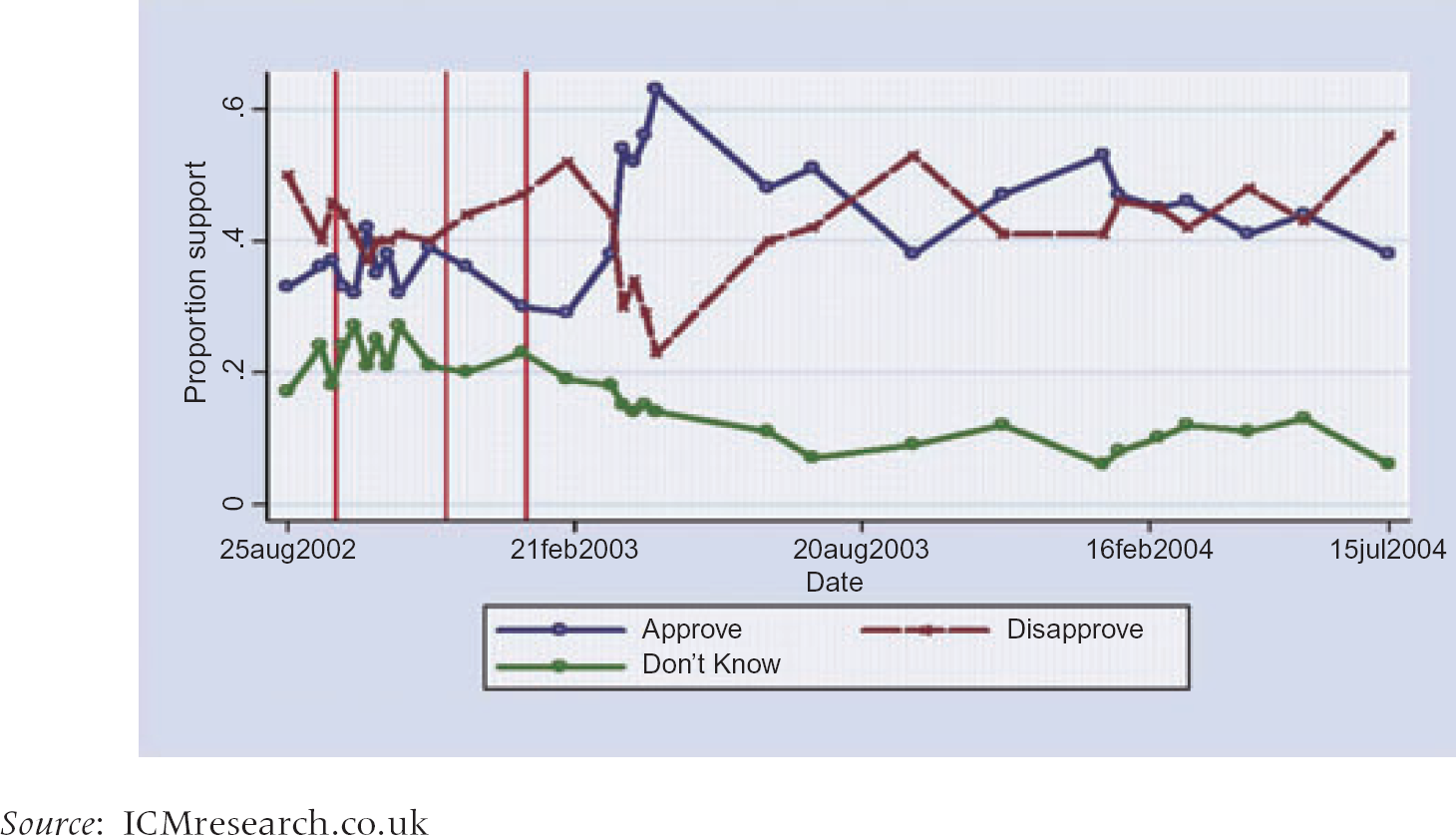
Support for Invasion of Iraq in UK
On 24 September, in an explicit attempt to convince the public and MPs, the British government released a ‘dossier’ on Iraq's Weapons of Mass Destruction. It contained the intelligence the government held on Iraq stating that Iraq was developing missiles with a range of 750 miles—capable of attacking 3,000 British troops in Cyprus. Iraq, it was alleged, had plans to employ its existing weapons, some of which were deployable within 45 minutes of an order to use them. It added that Iraq had sought to acquire ‘significant quantities’ of uranium from Africa, despite having no civil nuclear programme that could require it (UK Government 2002, 5–6).
In releasing this information Blair defied ‘anyone to say that this cruel and sadistic dictator should be allowed any possibility of getting his hands on chemical, biological or nuclear weapons’ (Hansard, col. 5, 24 September 2002). This dossier convinced many. The Conservative leader, Iain Duncan-Smith, told the House of Commons at the same time that the dossier showed that Iraq had not abandoned its weapons programme, which posed a threat to Britain. ‘He has been willing to defy the world order and to terrorise and starve his own people to continue his weapons programme. He has diverted £3bn in the last year alone for that very purpose: money that could have gone to feed his own population’, he said. ‘The only question remaining is whether he has the motive to strike against Britain. I believe it is fair to assume he would’ (Hansard, col. 8, 24 September 2002).
We have no reliable record of the opinions of Labour MPs, but we might use public opinion as a rough proxy. Public opinion may also have influenced MPs' decisions to support or oppose the invasion. This dossier seemed to have little immediate impact on British public opinion (first vertical line in Figure 1). There was continued suspicion on Labour backbenches that the decision to go to war had already been made, and that this was an exercise in persuasion rather than genuine debate. Against this background, the British government released a further dossier on 2 December 2002. The 23-page, Saddam Hussein: Crimes and Human Rights Abuses (Foreign and Commonwealth Office 2002), provided horrifying accounts of abuses but was condemned by Amnesty International as ‘opportunistic and selective’ (The Guardian, 3 December 2002). Again, public opinion did not respond; real shifts in public opinion seemed to coincide with other events such as the Bali bombing on 12 October 2002.
By the end of January 2003, when the likelihood of receiving the backing of the UN Security Council seemed low, public opinion needed to be convinced that war was necessary, especially without Security Council approval. At this stage another dossier was released that made further claims about the control of the Saddam Hussein regime over Iraq. In Iraq: Its Infrastructure of Concealment, Deception and Intimidation, published on 30 January 2003, Downing Street re-emphasised the dangers associated with inaction. This dossier, it was immediately discovered, contained elements rehashed from a decade-old Ph.D. thesis. By March 2003, the public's view was increasingly against the war. It was only when the invasion took place on 20 March 2003 that public opinion swung behind the war, arguably because the troops were on the ground and the media coverage changed qualitatively.
It is clear that the intention of the release was to convince the public and MPs of the need for war, whether UN-sanctioned or not. One observer with access to Downing Street noted that the prime minister's advisers searched desperately for better ways to present their case, and his account of the time up to the war portrays the group in Blair's office as a group of persuaders (Stothard 2003). We do not know that Downing Street deliberately sought to mislead politicians, the press and the public. Robin Cook does not believe that it did. He felt that the PM's office used information to convince a sceptical public, but that the government's enthusiasm for action carried over to civil servants and intelligence officials eager to please their masters who provided the type of information they thought was wanted (Cook 2003, 219). However, one senior official in the Foreign Office who has since resigned regards decision-making in the UK as based on the selective use of truths gathered together to strengthen the government policy for war (Ross 2005). He noted that French and German officials selected and collated information from the same documents to make the case against war.
Although it is impossible to say with certainty that in the absence of the information provided by Downing Street and the FCO the decision taken would have been different, there is some evidence to suggest that the information played an important role in determining MPs' choice structures. The best indication that the selective release of information was important is, firstly, that those who defended their decision to support the war at the time used the information provided by Downing Street, and secondly, that it was released at all. Michael Howard, the subsequent leader of the Conservative party, argued that his decision to support the government's motion was based on information he received from the government. Speaking in the House of Commons, Howard said:
That motion began by recognising that Iraq's weapons of mass destruction and long-range missiles posed a threat to international peace. It went on to support the Government's decision to use all means necessary to ensure the disarmament of Iraq's weapons of mass destruction. Now, we know that those weapons were not there. The Prime Minister said so last week. So of course it is the case that, had I known then what I know now, I would not have been able to vote for that motion … I do not see how any Hon. Member, had they known then what we know now, could have voted for that motion (Hansard, cols 207–208, 20 July 2004).
Although it was in Howard's political interests to claim this, his predecessor's reliance on this information shows that the Conservatives' decision was in part based on the dossiers.
Secondly, it is clear that the release of this information was a significant part of the strategy to convince the public and the Commons of the case for war. Debate at the time was dominated by information about the threat posed by the Iraqi regime. But, it was normal that intelligence information is kept secret, and that what was alleged by governments be taken on trust. Blair was forced by sceptics in his own party to release the dossiers on the intelligence the government possessed, so, one can assume, he would have found it much more difficult to convince these sceptics without this information. These three dossiers, it has become apparent, contained contested intelligence that supported the government policy, yet were portrayed in an unequivocal way.
Downing Street may not have changed many minds of those who were against the invasion, but Blair was without doubt forced to release dossiers of the intelligence in an unprecedented way (The Guardian, 3 June 2003). Up to then intelligence information was treated as highly secret and only shown to privy councillors and senior officials. These may have been released to prevent a bandwagon rolling against war. Between August 2002 and March 2003 Blair succeeded in clawing back support from some of the sceptics within his own party. So, although we cannot see a connection between the release of dossiers of intelligence and public opinion fluctuations, the unusual release of information succeeded in preventing the agenda of those opposing the war from dominating the debate. Without this information many undecided MPs might have moved to the anti-war side of the debate.
The Legal Advice and Collective Decision-making
The selective release of information was also used to bolster the pro-intervention lobby in cabinet. In theory the British government makes decisions collectively. What actually goes to cabinet depends on rules, the style of the prime minister and other factors such as budget implications and political sensitivity. The Ministerial Code provides the basic rulebook for cabinet operation, which is clear that departments sponsoring a policy change must provide all necessary information to all interested departments well in advance of cabinet (Cabinet Office 2001). Ministers, through their departments, should be able to request clarification from the sponsoring departments.
A prime minister controls or at least co-ordinates the procedure of cabinet. Through this role, the prime minister, with the cabinet secretary, decides what is brought to cabinet and when. Prime ministers can choose to make cabinet committees the forum for decision, and can restrict the information that goes to cabinet. The ability to decide the forum and timing of debates can impact on the outcomes. We can see that in this case certain ministers have reported that Blair used his control of the decision-making process to control the decision. Clare Short (2005, 142) alleges that Blair told her that he did not want a cabinet discussion because it might get hyped. He postponed cabinet discussion until the decision was inevitable (Cook 2003, 135–136; Short 2005, 149–151, 180–188).
A fundamental aspect of British cabinet government is that the Attorney-General is the legal adviser to the government as a whole. Although they are hired, and can be removed, by the prime minister, all ministers can consult the AG for their advice. Philippe Sands (2005, 196–201) has found that the opinion of the government's chief legal officer as to the legality of the war changed over a short period of time, and alleges that this legal opinion was altered by Downing Street officials—though this is denied. More interestingly, only a small number of senior ministers were given the full legal opinion of 7 March in which Lord Goldsmith, the Attorney-General, argued that a further UN resolution was probably needed, and without one the legal basis for the invasion was open to challenge. Goldsmith proceeded to produce a ‘clearer’ opinion for the army, which formed the basis for an answer to a parliamentary question, and one that the cabinet was given. The cabinet was not offered the original opinion of 7 March. This is in direct contravention of the Ministerial Code which states that:
When advice from the Law Officers is included in correspondence between Ministers, or in papers for the Cabinet or Ministerial Committees, the conclusions may if necessary be summarised but, if this is done, the complete text of the advice should be attached (ch. 2, para. 23).
Obviously, in cases of strict national security, intelligence will not be given to the public, and only the relevant line ministers can see this information. Perhaps for this reason only the senior security ministers had access to this advice. However, one could hardly argue that offering legal opinion to ministers who are bound by the rules of cabinet confidentiality would represent a threat to national security. And, given Downing Street's willingness to release intelligence information, it seems more plausible that cabinet was not given the more equivocal opinion because this would have raised more doubts and perhaps given a stronger basis for ministerial resignations.
In evidence to the Butler Inquiry two cabinet ministers expressed concern at the ‘informal nature of the Government's decision-making process’ (Butler of Brockwell 2004, para. 606). The process had the effect ‘to concentrate detailed knowledge and effective decision-making in fewer minds at the top’ (ibid., para. 608). This, the Butler Report found, limited Cabinet discussion to:
frequent but unscripted occasions when the Prime Minister, Foreign Secretary, Defence Secretary briefed the Cabinet orally. Excellent quality papers were written by officials, but these were not discussed in Cabinet or Cabinet Committee. Without papers circulated in advance, it remains possible but is obviously much more difficult for members of the Cabinet outside the small circle directly involved to bring their political judgment and experience to bear on the major decisions for which the whole Cabinet must carry responsibility. The absence of such papers on the cabinet agenda so that ministers could obtain briefings in advance from the Cabinet Office, their own departments or from the intelligence agencies plainly reduced their ability to prepare properly for such discussions … in the vital matter of war and peace (ibid., para. 610, emphasis added).
As chairman of cabinet meetings, and arguably the head of the sponsoring department for this policy, Blair was able to and should have insisted that this information was available to colleagues before they took their decision. It seems clear that either by oversight or design the cabinet was regularly denied information that might have made a significant difference to the decision to support the US-led war. Indeed it is reported that Gordon Brown questioned much of the debate at the time centred on the legality of the war, so the evidence of the government's chief legal officer would have been central to the cabinet's decision. To misrepresent this advice as having been unequivocally of the opinion that war was legal would have significantly structured the choices ministers faced. Short (2005, 187) said, perhaps self-servingly, that for her the supply of the legal advice ‘was a significant moment. Up until 17 March there was no legal authority for war … I was very surprised by the Attorney General's advice, but then I accepted it’. Peter Hennessy (2005, 10) is perhaps unfair in categorising the cabinet's role in this decision as ‘supine’; the cabinet may have only been acquiescent because it was not given the information it needed and had a right to see.
Conclusion
The question of whether the cabinet was supine or misled over the invasion of Iraq is debatable, as is whether the release of intelligence information had an impact on public and elite opinion. What seems certain is that the Prime Minister's Office sought to persuade the opinion of the public and political actors through the selective release and withholding of information. We can look to the comments of some of the main protagonists to find that they claim to have been persuaded by this information. Resources were used, but these were used to control the choices other actors faced. There is little evidence for the interpretation that prime ministers achieve their preferred policies through a series of exchange, nor is there evidence for Kettell's (2006) argument that Blair was an unconstrained actor. While one could argue that Short was offered certain resources (her involvement in the reconstruction of Iraq) in exchange for her support, it could equally be interpreted that this is a case of Blair attempting to structure the choice she faced.
This theoretically-informed case study does not offer an exhaustive account of the case for war, the decision to go to war or the conduct and consequences of the war itself. This article offers an explanation of how prime ministers can influence public policy decisions in the absence of prerogatives allowing them to set public policy. This is through structuring the choices facing those other actors whose agreement is needed for policy change to ensue.
Specifically, the article has looked at how the decision to invade Iraq was made when many of the actors needed to approve this decision would not have been expected to support it. The prime minister, partly through his superior information, was able to convince a large number of Labour MPs and the Conservative party that military action was necessary because the alternative to war was no longer an uneasy peace, but a likelihood of attacks, if not directly at Britain, then at British troops and interests. Downing Street was able to quell doubts about the legality of the war by selecting the legal advice other actors could see.
The article has also highlighted the importance of information in policy-making. This case allows one to see why ‘information is power, and control of information is the first step in propaganda’ (Denton and Woodward 1990, 42). Therefore, the centralisation of information and expertise in certain systems allows those who control the information to affect the incentives in the decision structure that others face. Where information is held competitively, that is, many groups hold information on any issue, the ability to control the way others regard events is diminished. Then persuasion must occur through appeals to logical argument based on more easily verifiable facts. Information is probably held by more competing actors in the foreign policy arena because sometimes different countries release different information. In domestic policy, especially where few well-resourced pressure groups exist, certain information may be known only to the government.
Information is one resource prime ministers have, but there are many other means by which prime ministers can structure the choices others face that may not be thought of as resources per se. Through institutional factors such as the right to call elections, propose confidence motions or control the agenda of parliament, prime ministers can effectively determine the alternatives from which other actors choose. If one is to understand how prime ministers influence public policy, more systematic study of these mechanisms is needed in particular cases of policy-making.
Footnotes
Thanks go to Francesco Cavatorta, Michael Gallagher, Michael Laver and Catherine Lynch for comments on the article and ideas in it. The support of the Irish Research Council for humanities and Social Sciences is also gratefully acknowledged.
1
When writers use the term ‘presidential’ it is not always clear what is meant. It could either be used to refer to a more singular or personalised leadership style, or it could mean that political power is concentrated in the hands of one person. While the two concepts might correlate, they are distinct. It is probably better to consider the term to mean presidential in terms of style, as it is far from clear that, within their own systems, chief executives in presidential systems are more powerful than their counterparts in parliamentary democracies.
2
Although the UK government did not need specific approval from parliament, it committed itself to achieving it, and war without it may have been politically too risky.