






Abstract
The first part of this article develops a critique of Anthony Downs’ An Economic Theory of Democracy and, more generally, of rational choice theories of party competition. Drawing on and adapting Joseph Schumpeter's critique of general equilibrium theory, it is argued that the use of the equilibrium method within rational choice theory precludes the analysis of policy innovation. Having developed this theoretical argument, the second part of the article offers a ‘Schumpeterian’ account of the dynamics of British electoral competition between 1950 and 2005. Drawing on an analysis of 1,984 policy commitments within Conservative, Labour and Liberal general election manifestos, the fate of 758 policy innovations is tracked. Policy innovation, it is argued, generates an ongoing process of divergence and convergence between the political parties very different to that predicted within rational choice equilibrium analysis.
Introduction
Economists attempt to predict and explain events by showing how they were a unique equilibrium or, failing that, one of a small number of possible equilibria. Although now an established orthodoxy within economics, the use of the equilibrium method was vigorously challenged in the 1920s and 1930s by the Austrian economist Joseph Schumpeter. Schumpeter (1942, 83) argued that equilibrium analysis was fatally flawed because it ignored what he regarded as being the ‘essential fact’ of product innovation. This meant that it was incapable of accounting for the existence of economic development and business cycles.
This article adapts and applies Schumpeter's critique of the equilibrium method to one particular area of rational choice theory, party competition, and, in the first instance at least, to one particularly influential work, Anthony Downs’ (1957) An Economic Theory of Democracy. Given a particular set of assumptions, Downs famously argues that parties will find it in their interest to converge upon the position of the median voter and, in doing so, to offer voters identical policies. Downs’ analysis is essentially one of a static equilibrium. Rational choice theory has come a long way since the publication of An Economic Theory. By relaxing one or more of Downs’ assumptions, theorists have shown how and why vote-maximising parties may find it in their interests to adopt divergent policy positions (Hindmoor 2006, 32–45). Yet rational choice theory nevertheless remains wedded to the use of the equilibrium method.
Just as Schumpeter argues that general equilibrium theory ignores the essential fact of product innovation, it is argued here that rational choice theory ignores the equally essential fact of policy innovation. Furthermore, just as Schumpeter argues that the neglect of product innovation leaves economists unable to account for the existence of economic development or business cycles, it is argued here that the neglect of policy innovation leaves rational choice theorists unable to account for a process of party competition in which parties adopt convergent and divergent policy positions.
This argument is developed and applied over five subsequent sections. The first identifies the nature of equilibrium analysis within the social sciences and describes Schumpeter's critique of the equilibrium method and his arguments about the relationship between product innovation and business cycles. The second section shows how Downs, although citing Schumpeter as a major influence upon his work, constructs his spatial model of party competition in such a way as to preclude the very possibility of policy innovation. Having initially focused first on Schumpeter and then on Downs’ work, the third section shows how the equilibrium method continues to be used within party competition theory and how, therefore, my argument about the limitations of the rational choice approach do not simply apply to Downs’ work. The remaining part of the article uses this theoretical discussion to provide a ‘Schumpeterian’ account of the dynamics of British electoral politics between 1950 and 2005. The fourth section describes how policy commitments contained within Labour, Liberal and Conservative party manifestos were classified as either innovative or non-innovative by two research assistants. The final section tracks the fate of these policy innovations over time and shows how divergence gives way to periods of convergence when innovative policies are either abandoned or implemented.
Schumpeterian Economics
Natural scientists conceive of equilibrium as arising when physical forces interact in such a way that a process is either endlessly repeated or comes to an eventual rest. Social scientists usually conceive of equilibrium as arising when individuals act and interact in such a way that no one has any incentive to change their actions. Economists and rational choice theorists rely upon the notion of equilibrium because the identification of some outcome as equilibrium can be used to explain how and why that outcome might have been expected to arise (Hindmoor 2006, 20). As William Riker (1990, 175) suggests, ‘equilibria are valuable, indeed essential … because they are the identified consequences of decisions that are necessary and sufficient to bring them about’.
Within economics, general equilibrium theory explains how prices are determined and how markets co-ordinate individual behaviour. The notion of there being a general equilibrium can be found within the work of the French physiocrats (Hausman 1992, 54). Yet credit for the development of a rigorous general equilibrium framework is usually given to Leon Walras. In The Principles of Economics, Walras (1954 [1877]) first showed how the maximising behaviour of consumers and producers could, under certain circumstances, result in an equilibrium between the amounts demanded and supplied across different but connected markets. In his monumental History of Economic Analysis, published posthumously in 1954, Schumpeter (1954, 242) describes Walras’ book as the ‘magna carta’ of economics. Walras’ equilibrium analysis, he suggests elsewhere, explains the ‘bare bones’ of economic life and so most perfectly ‘illuminates the pure logic of interdependence between economic quantities’ (Schumpeter, quoted in Medearis 2001, 359). Furthermore, Walras’ model of perfect competition, in which prices automatically adjust in equilibrium, describes an ‘actual tendency’ in capitalist economies (Schumpeter 1939, 70).
Yet Schumpeter also argues that economists cannot hope to understand or evaluate economic systems in exclusively equilibrium terms. Economists, he maintains, ought to examine not simply the movement of economies towards equilibrium but the ‘creative destruction’ of equilibrium through innovation (Schumpeter 1942, 83). For Schumpeter, innovation is the ‘outstanding’ or sometimes ‘essential’ fact about capitalism. Economic theories and models which leave no room for innovation are, he cautions, like ‘Hamlet without the Danish prince’ (Schumpeter 1942, 6). Whereas a stationary feudal economy would still be a feudal economy, ‘stationary capitalism is a contradiction in terms’ (Schumpeter 1951, 27). By innovation Schumpeter has in mind a number of different activities: the introduction of a new good or service; the introduction of new methods of production; the opening up of new markets; the conquest of new sources of supply; and the carrying out of new forms of organisation (Schumpeter 1939, 84). What all these activities have in common is ‘setting up of a new production function’, or ‘the development of a new way of doing things’ (Schumpeter 1942, 83). Innovations are those which
forever alter and displace the equilibrium state previously existing … [such that the new equilibrium] cannot be reached from the old one by infinitesimal steps … add successively as many mail coaches as you like, you will never get a railway thereby (Schumpeter 1934, 64).
The flaw in Walras’ equilibrium model is its ‘rigorously static … character’.
He [Walras] would have said … that of course economic life is essentially passive and merely adapts itself to the natural and social influences which may be acting upon it … I felt very strongly that this was wrong, and that there was a source of energy within the economic system which would of itself disrupt any equilibrium that might be attained (Schumpeter, quoted in Medearis 2001, 362).
What difference does Schumpeter's emphasis upon innovation make to his analysis of capitalism? Most fundamentally, it provides him with an explanation of how and why economic development occurs (Schumpeter 1934, 4–10). Economic growth of the sort which has transformed living standards in capitalist countries has occurred as a result of entrepreneurial innovation; that is as a result of the destruction of existing equilibria. More significantly for our purposes, innovation also provides Schumpeter with an explanation of how and why business cycles occur. Innovation is fraught with difficulty. Entrepreneurs offering new goods and services and methods of production must confront naturally conservative consumers. At one point, Schumpeter (1939, 117) suggests that over 90 per cent of new entrepreneurial ventures are doomed to fail. Those few entrepreneurs who do succeed are however rewarded with a temporary monopoly and ‘spectacular’ profits (Schumpeter 1942, 73). Over time, these monopolies are whittled away as competitors, alerted to the apparent profits on offer and adopt, adapt and refine the entrepreneur's innovation. How does this relate to the existence of business cycles? Economic booms occur when the full benefits of some innovation are still being explored and exploited by consumers and other producers. These give way to periods of recession if and when the number of capitalists entering the market exhausts all possible profits, triggering a wave of bankruptcies and a collapse in business confidence. Business cycles are, Schumpeter concludes, an inevitable feature of capitalist economic development.
Downsian Politics
Anthony Downs’ An Economic Theory of Democracy is generally recognised as being one of the most influential works of post-war political science. As Bernard Grofman (1995, 1) writes in the introduction to a series of essays on his work, it is now ‘virtually impossible’ to think about spatial models of party competition without also thinking about Downs. Downs’ book ranges across a number of subjects including the rationality of voting, the collection of political information, vote trading, the role of ideology and the level of government expenditure. Yet it is for the exposition of what has subsequently become known as the median voter theorem that An Economic Theory is most often celebrated. 1 The basic argument here is well known. If there are two vote-maximising parties and one dimension of competition, if parties can adopt any position they want and voters have fixed preferences and vote for the party closest to them, then parties will converge upon the position of the median voter by committing themselves to identical policies (see Hindmoor 2006, 26–31).
Some commentators have pointed to the similarities between Downs’ theory of party competition and that offered by Schumpeter in Capitalism, Socialism and Democracy (Miller 1983; Medearis 2001). That such similarities exist is hardly surprising. In his account of how he came to write An Economic Theory, Downs (1995, 197) credits Schumpeter's ‘profound analysis’ of democracy with having provided the ‘inspiration and foundation of my whole thesis’. Yet there are important differences between these works. Whereas Schumpeter (1942, 263) suggests that the popular will is ‘the product and not the motive power for the political process’, Downs attributes to voters not only fixed preferences but the capacity to discern which party is closest to their own position. More significantly, and as I will now go on to argue, Downs apparently ignores Schumpeter's more general arguments about the limitations of the equilibrium method contained within his economic theory and adopts a static framework which cannot account for the existence of policy innovation. 2
Downs wrote An Economic Theory while a graduate student at Stanford in 1956. The timing is significant. For it was only two years earlier that Downs’ supervisor, Kenneth Arrow, had, together with Gerard Debreu (1954), formulated what was to prove the ‘most precise statement of general equilibrium theory’ (Stiglitz 1996, 5). Making use of advances in mathematical theory in general and game theory in particular, Arrow and Debreu developed Walras’ work by constructing a model of a perfectly competitive economy which established not simply the possibility but the logical existence of an equilibrium price vector (see Ingaro and Israel 1990, 298). Arrow and Debreu's work was immediately lauded and eventually recognised in the award of Nobel prizes. It is therefore no surprise that Downs should have sought to apply the equilibrium method to the study of politics. At the very start of the first chapter of An Economic Theory, Downs (1957, 3) writes that
little progress has been made toward a generalised yet realistic behaviour rule for a rational government similar to the rules traditionally used for rational consumers and producers. As a result, government has not been successfully integrated with private decision-makers in a general equilibrium theory. This thesis is an attempt to provide such a behaviour rule for democratic government and to trace its implications.
At the start of the chapter in which he introduces his spatial model, Downs (1957, 115) assumes that voters’ ‘political preferences can be ordered from left to right’ and that these preferences can be represented using a linear scale (the following draws on Hindmoor 2004, 27–30). Yet to illustrate his argument and make it ‘more plausible’, Downs (1957, 116) goes on to reduce ‘all political questions to their bearing upon one crucial issue: the degree of private ownership’. Private ownership can, he suggests, range anywhere between 100 per cent and 0 per cent of the economy. These options are mapped on to a scale running from 0 per cent private ownership on the left to 100 per cent private ownership on the right with each point in between representing an additional 1 per cent of private ownership. With this framework in place, Downs goes on to develop his argument that parties will converge upon the position of the median voter. Only when this is done does he return, once more, to a general, left–right, conception of political space. Dropping the assumption that politics is entirely a matter of ownership, he suggests that ‘each party takes stands on many issues, that each stand can be assigned a position on our left–right scale’ and that a party's net position along that scale is a ‘weighted average of all the particular policies it upholds’ (Downs 1957, 132).
That Downs develops his argument in this way may seem entirely unimportant; merely a matter, as he suggests, of illustration. But the ownership example is important because it allows Downs to present the political space over which parties compete as containing a fixed and pre-given number of policy options. Because policy options are derived from an underlying numeric scale there is no possibility here of parties offering to the electorate innovative policy proposals. There can be no level of private ownership lower than 0 per cent or higher than 100 per cent. The producers in Walras’ model are price-takers who respond to price signals announced by a central auctioneer. The parties in Downs’ model are policy-takers who must choose between a finite and fixed range of policies. Downs’ use of the equilibrium method allows him to derive from a basic set of assumptions some quite specific predictions (Downs 1957, 295–299) about the behaviour of voters and political parties. Yet Downs’ work is vulnerable to the very criticism Schumpeter levelled at Walras: that an equilibrium approach leaves no room for the ‘essential fact’ of innovation.
What difference can the inclusion of policy innovation make to an account of party competition? Schumpeter, it will be recalled, argues that innovation explains how and why business cycles occur and there is no obvious equivalent of the business cycle within political competition. Schumpeter's work does however suggest an alternative to Downs’ argument about the way in which party competition leads to convergence between parties. In the case of economic competition, the ‘essential fact’ of innovation results in an ongoing process of divergence and then convergence as firms introduce new products which either fail and are withdrawn from the market or succeed and are emulated by others. In the case of political competition, policy innovation can also be hypothesised to lead to an ongoing process of divergence and convergence as parties introduce new policies which either fail and are withdrawn or succeed and are emulated or accepted by others. To conclude, while Downs’ equilibrium theory maintains that party competition leads to policy convergence, a Schumpeterian account suggests a dynamic process of both convergence and divergence.
Beyond Downs: Equilibrium and Position
The argument has, so far, focused solely on Downs’ analysis of party competition. Is the contrast drawn here between a Schumpeterian and rational choice approach to party competition sustainable in light of the enormous rational choice literature published since then? We can start here by making two very general points. The first is that rational choice continues—with one important exception which we will come to in a moment—to revolve around the use of equilibrium analysis. The second is that it increasingly makes use of a more sophisticated account of the relationship between policy and position than that offered by Downs.
In order to show why parties might adopt divergent policy platforms, theorists have relaxed or modified nearly all of the assumptions Downs’ theorem rests upon (Hindmoor 2006, 32–45). In this way it has been shown that parties or individual candidates may adopt divergent policies in order to deter the entry of third parties (Palfrey 1984), win primary elections (Gerber and Morton 1998), attract campaign funds (Schofield 2003), appease party activists (Aldrich 1983), appeal to ‘directional’ (Rabinowitz and McDonald 1989) or ‘expressive’ voters (Brennan and Hamlin 1998) and compensate for voters’ doubts about their capacity to implement policy promises (Grofman 1985). Yet although they employ a different set of assumptions about what might be called the circumstances of competition, these theorists continue, like Downs, to employ the equilibrium method. Unlike Downs they suggest that parties will sometimes adopt divergent policy positions but like Downs they suggest that party competition will be essentially static: that once parties have chosen their policies these policies will remain in place. By contrast, the Schumpeterian account developed in the previous section suggests that party competition results in an ongoing process of both divergence and convergence.
The partial exception to the general rule of equilibrium analysis within rational choice theory can be found in the ‘chaos’ theories developed by Richard McKelvey and Norman Schofield (McKelvey 1976; McKelvey and Schofield 1978). Downs assumed the existence of a single, left-to-right, dimension of competition. In developing a multidimensional model of party competition, McKelvey and Schofield demonstrated that, for most plausible distributions of preferences, no equilibrium existed. The result, as they showed, was an apparent chaos in which parties could endlessly cycle around political space, sometimes adopting convergent and, at other times, divergent policy positions. These models come closest in spirit to the Schumpeterian account previously outlined. There is however one important difference between them. Chaos theorists search for but fail to find an equilibrium and account for this in terms of the distribution of voters’ preferences. The Schumpeterian account instead emphasises the destruction of an existing equilibrium through policy innovation.
What of the second point concerning the relationship between policy and position? In his formulation of the spatial model, Downs, as we have seen, posits a relationship between policies and position such that each policy option (ranging from 0 to 100 per cent private ownership) is equivalent to one point in political space. In some recent work, the position a party occupies is instead understood as being a function of both policy and non-policy factors, the latter including the character of a party's leader, its reputation for integrity and voters’ underlying partisan identifications (Enelow and Hinich 1989; Erikson and Romero 1990; Adams 2001; Adams et al. 2005). This is significant because it means that parties can, in principle, change their policies without changing their position and change their position without changing their policies. The former could occur if, for example, a party adopted a set of more right-wing policies at the same time as electing a more left-wing leader. The latter could occur if, for example, a party retained its policies at the same time that voters changed their views about its leader.
Why does this matter? It has been suggested here that policy innovation leads to an ongoing process of divergence and convergence between the parties at the level of individual policies very different to that envisaged within rational choice equilibrium analysis. But rational choice theorists may argue that they are primarily interested not in individual policies or even in clusters of those policies but in spatial position. Does policy innovation entail divergence and convergence in spatial position? In Downs’ case it must because as we have seen, he constructs his model in such a way that changes in policy are equivalent to changes in position. But if spatial position is determined by both policy and non-policy factors then changes in policy need not entail changes in spatial position. The analysis in the following section will sidestep this argument in so far as it concentrates upon tracking divergence and convergence at the level of individual policies. It might however be noted that there is an important difference between observing that policy innovation need not necessarily lead to positional change and concluding that it never does so. Indeed we might imagine that it is precisely because changes in policy usually entail changes in spatial position that policy innovations are pursued. If parties wanted simply to retain the same spatial position why would they offer innovative policies? Policy innovation can be expected to lead to divergence and convergence in the policies parties are committed to. It can also usually be expected to lead to changes in the spatial position a party is thought to occupy.
Measuring Policy Innovation in British Electoral Politics
Having developed a critique of the dominant equilibrium approaches to the study of party competition, the rest of this article presents a Schumpeterian account of the dynamics of British electoral competition between 1950 and 2005, drawing attention to the way in which policy innovation generates an ongoing process of divergence and convergence between political parties.
How can we distinguish between innovative and non-innovative policies? New policy ideas are constantly being formulated by, among others, academics, think tanks, politicians, pressure groups and journalists. Should we count each new idea as an example of policy innovation? As we have seen, Schumpeter (1942, 83) argues that innovation results in the ‘setting up of a new production function’ and, with this, the ‘creative destruction’ of an existing equilibrium. He cites as forms of innovation the introduction of a new good or service, the introduction of new methods of production, the opening up of new markets, the conquest of new sources of supply and the carrying out of new forms of organisation (Schumpeter 1939, 84).
In applying Schumpeter's arguments about innovation to the political arena, the first issue to deal with is the range of political activities to be measured under the heading of innovation. The introduction of new campaigning techniques, new methods of internal party management and the identification of new issue dimensions by which competition is structured (Riker 1982 and 1986) might all be described as innovative. In this article I will however focus exclusively upon policy innovation. 3 So which policy ideas should we count as innovative? Here, we might note the distinction Schumpeter (1934, 88–89) draws between invention and innovation. Invention refers to the ‘discovery’ of a new way of doing something. Inventions do not however result in the destruction of an existing equilibrium and are, in themselves, of no ‘economic significance’ (Schumpeter 1934, 89). Inventions only become noteworthy if and when they result in an innovation: the actual introduction of a new good or service. Invention is neither a necessary nor a sufficient condition for innovation. It is not necessary because some innovations require no invention. It is not sufficient because most inventions do not result in the launch of a new product (Schumpeter 1934, 89). In the same way we might say that policy ideas are, in themselves, of no ‘political significance’. Policy ideas only become noteworthy if and when they result in actual policy proposals being offered to the electorate by a political party within an election manifesto.
The argument for using manifestos as a source of information about policy is well known. Manifestos offer a single, clear, coherent and accessible statement of policy intent. No other single source of information represents the combined and authoritative views of the party as a single organisation (Budge 2001, 210–223). Furthermore, and because they are published at approximately the same time, manifestos can easily be compared with each other. But manifestos are composed of hundreds if not thousands of proposals. We can discount those which consist of no more than a commitment to review some policy or issue and those which consist of general statements of objective, aspiration or principle. But which of the remaining policies should we count as innovative? If the term itself is to retain any meaning we cannot afford to count any and all policy proposals as innovative. How though are we to distinguish between innovative and non-innovative policy proposals? Schumpeter's writings suggest two possible answers.
The first is that innovations are necessarily of huge and lasting economic importance: products like the railways which ‘forever alter and displace the [existing] equilibrium state’ (Schumpeter 1934, 64). Understood in this way, we might only consider counting as innovative those policies like the creation of the National Health Service (NHS) or the sale of council houses which most people could agree were of lasting political importance. Yet, as Schumpeter (1939, 227) himself recognises, one problem with this definition is that innovation is very nearly always a matter of evolution rather than revolution.
What we designate as a big invention hardly ever springs out of the current of events … every change seems to consist in the accumulation of many small influences and events and comes about precisely by steps so small as to make any exact dating and any sharp distinction of epochs almost meaningless (Schumpeter 1934, 227).
Consider, for example, the policy of giving council tenants the right to buy their homes. This is now most closely associated with the Conservative government first elected in 1979. The proposal itself was however included in the Conservatives’ 1974 manifesto. The proposal to offer existing tenants a significant discount was trailed in the 1970 manifesto. The principle of encouraging local authorities to sell their council houses emerged in the 1959 manifesto. So if we were to adopt this definition and only count as innovative those policies which were of lasting political importance, we would be left with the problem not only of distinguishing between significant and insignificant innovations but of dating those which are considered as being of significance.
Although Schumpeter returns time and again to examples like the railways and motor car when illustrating his arguments about innovation, he sometimes offers a broader definition of the term. In Business Cycles (Schumpeter 1939, 92) he is, for example, adamant that ‘we must try to divest ourselves of the idea that innovation necessarily means something spectacularly important’. Innovation consists not only of the economically significant but of ‘innumerable’ modest advances such as ‘making a success of a particular kind of sausage or toothbrush’ (Schumpeter 1942, 132). At this point we seem suddenly to be in danger of counting any new policy proposal as innovative. But it is here that we come to the second way in which we might distinguish between innovative and non-innovative policies. For at one point Schumpeter (1934, 68) argues that we should only count as innovative products which are qualitatively rather than merely quantitatively different from existing products. This is not, unfortunately, a distinction Schumpeter chooses to elaborate upon. As we will see in the following section, it does however offer hope of a way of defining innovation that is neither so narrow that it only counts as innovative proposals of lasting political significance or so broad that it counts as innovative any new policy proposal.
Convergence and Divergence in British Electoral Politics
The reference points for this part of the study are the policy commitments contained within the 17 general election manifestos published by the Labour, Liberal and Conservative parties in the post-war years (in 1983 and 1987 a joint SDP–Liberal manifesto was issued). Two research assistants independently read each manifesto in order to identify specific policy commitments in the following areas: economy, business and taxation, education, health, welfare, law and order, housing, the environment, transport, sport and media and political and constitutional reform. 4 One thousand nine hundred and eighty-four such policies were identified by both researchers. 5
In an attempt to apply to these policies the distinction Schumpeter draws between quantitative and qualitative changes in policy, the two research assistants were then asked to classify these policies as being either: (i) identical to or differing only in some relatively unimportant way from a policy previously advocated by one of the parties in a previous manifesto; (ii) quantitatively different from an existing policy in the sense of either involving the application of an existing policy or policy principle to a new policy area or changing the details of a policy in such a way that the underlying policy itself was left unchanged; or (iii) qualitatively different from those previously made by any party in any previous election in the sense of entailing a commitment not simply to alter the terms of an existing policy but to create a new policy. Clearly the difference between qualitative and quantitative change is itself a matter of degree rather than of kind and requires subjective judgements to be made. 6 Working independently of each other, the two researchers nevertheless made the same classification 79 per cent of the time. 7 On the 417 occasions when they disagreed, the author then reached a final judgement.
To see how individual policies were classified, consider, for example, the Conservatives’ 2001 manifesto. Here, examples of policies identical to or differing only in some relatively unimportant way from previous policies included cutting taxes on low-emission vehicles (advocated in the Liberals’ 1992 and 1997 manifestos), introducing a rent-to-mortgage scheme (advocated in the Conservatives’ 1992 manifesto), developing a benefit card in order to reduce fraud (promoted in the Conservatives’ 1997 manifesto) and introducing a ‘substantial elected’ element into the House of Lords (a commitment mirrored in the Liberals’ 1997 manifesto). Policies classified as being only quantitatively different from existing policies included increasing the income level at which students must pay back loans, cutting business rates on village shops, pubs, garages and post offices, increasing the discounts available for tenants to buy their council houses and extending Prime Minister's Question Time from once to twice a week. Policies classified as being qualitatively different and so innovative included creating a permanent endowment fund for universities, charging foreign lorries to use British roads through the use of a ‘BritDisc’ scheme, the establishment of a new Office for Civil Society to promote voluntary service and the introduction of a new constitutional rule barring Scottish MPs from voting on matters only affecting English and Welsh constituencies.
A total of 758 polices were classified as being innovative. Figure 1 breaks this total down by both party and election. With the exceptions of the 2005 and October 1974 elections when the Conservatives proposed significantly fewer policy innovations than Labour or the Liberals, and the 1983 election, when Labour proposed far more, the parties have offered broadly the same number of policy innovations at each election. The Conservatives are not a notably more conservative party than Labour. The overall number of innovations has however grown steadily over time. In the eight elections between 1950 and February 1974, the three parties offered an average of 29 policy innovations in each election. In the eight elections between October 1974 and 2005 this figure rose to 65. This increase was largely a result of the increased number of policy commitments parties made at each election rather than an increase in the proportion of innovative policies offered at each election. Between 1950 and February 1974 an average of 38 per cent of policies were classified as being innovative. Between October 1974 and 2005 the equivalent figure was 35 per cent. Over the same period, the average number of total policy commitments made by the three parties in each election rose from 69 to 178.
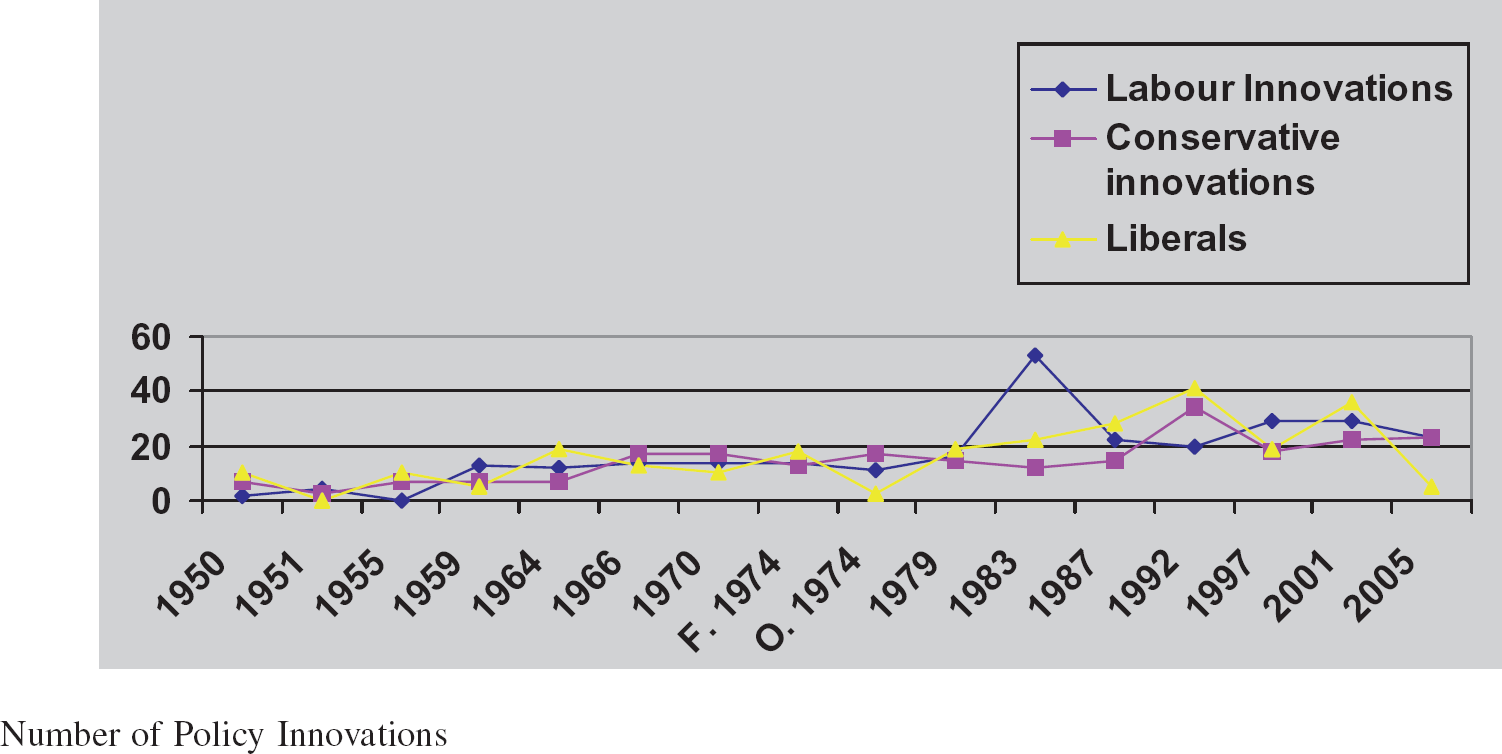
Policy Innovation, 1950–1997
Schumpeter suggests that product innovation results in an ongoing process of both divergence and convergence. Divergence occurs because product innovation means that firms are offering different goods to the same consumers at the same time. Convergence occurs for two reasons: firstly, because most of these products fail and are therefore withdrawn from the market, and secondly, because those products which succeed are copied by rival firms. My findings indicate that policy innovation results in a similar pattern of divergence and convergence. Divergence occurs because (1) most innovative policy proposals are made by only one party. Convergence occurs because (2) many innovative policy proposals are withdrawn before a party returns to office; because (3) parties, even when elected, do not always act upon their innovative policy proposals; and because (4) most innovative policy proposals which are implemented are subsequently accepted by the opposition upon its return to office. We will examine each of these in turn.
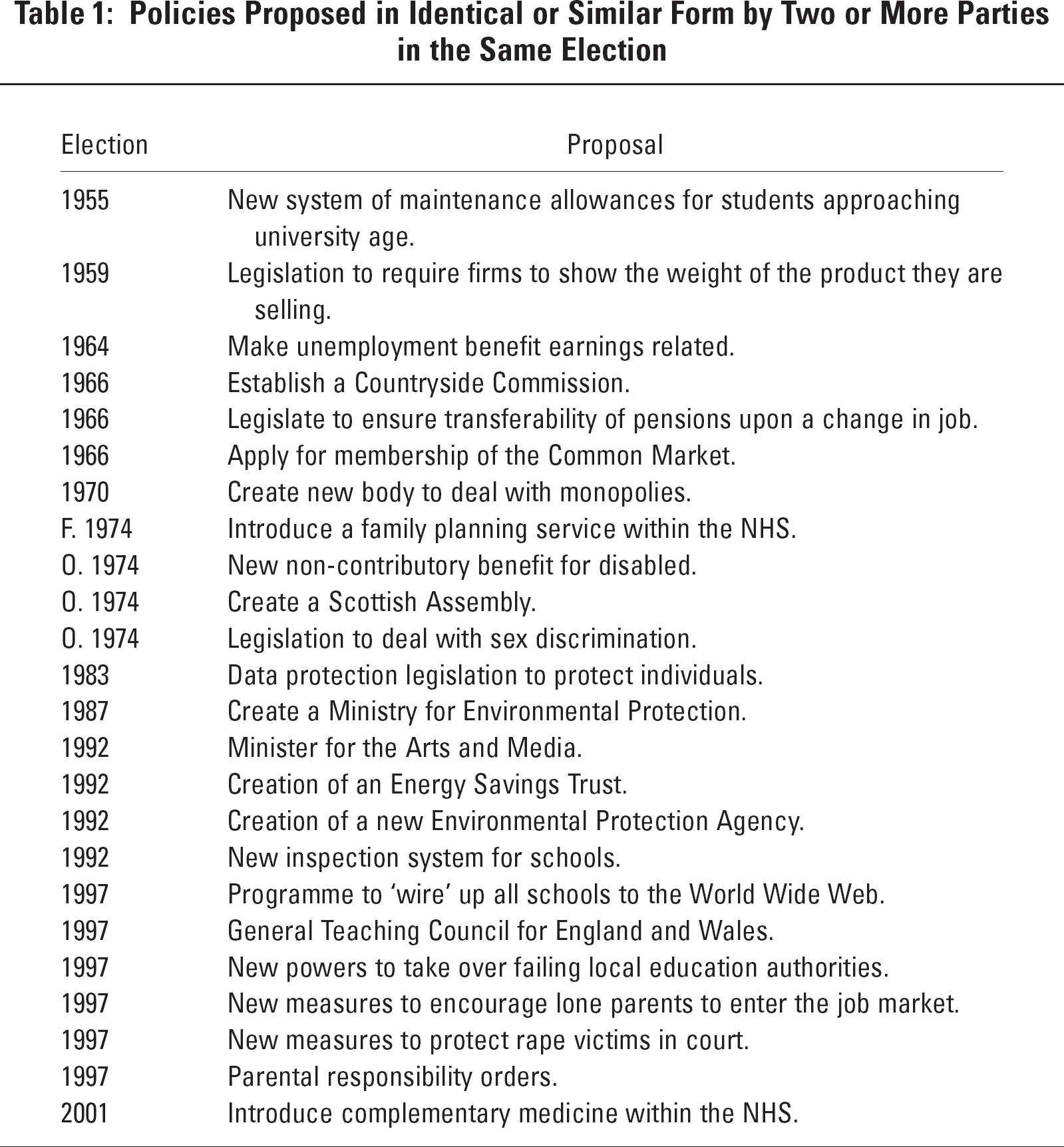
Of the 758 innovative policy proposals, 22 were proposed in similar or identical form by both parties at the same election. In 2001 the Conservatives and Liberals promised, if elected, to make more use of complementary medicine within the NHS. In 1997 all three parties pledged to connect every state school to the Web. In 1987 the Liberals and Labour promised to create a Ministry for Environmental Protection and in October 1974 the Conservatives and Labour promised to introduce a new benefit targeted at the disabled. These policies are listed in Table 1. In addition, a further 12 policies proposed by one party at one election were subsequently proposed by the other party at a later election. These are listed in Table 2. In the first case most obviously and in the second case more problematically, innovation was not a cause of divergence between the parties. Yet on all the other occasions, 96 per cent of the total, policy innovation led to divergence between the parties. Policies Proposed in Identical or Similar Form by Two or More Parties in the Same Election
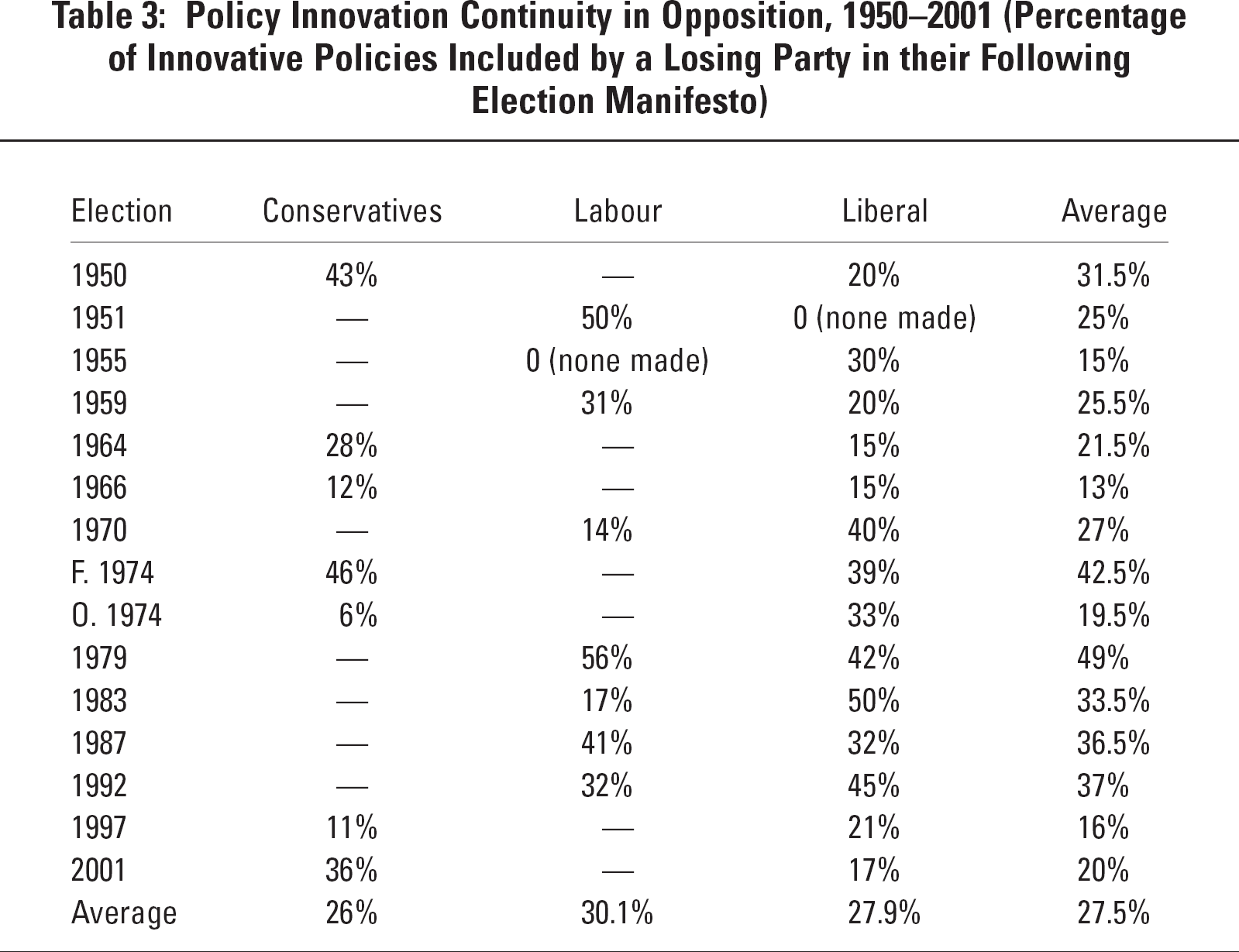
Policy innovation is a source of divergence between the parties. Tracking the fate of particular policy innovations it is however clear that divergence usually gives way to convergence. One reason convergence occurs is that parties frequently abandon policy innovations after they lose an election. Parties do sometimes sustain a commitment to some policy innovation through a prolonged period in opposition. The Conservatives pledged themselves to the abolition of prison early release schemes in 2001 and 2005. Labour promised to guarantee a place in full-time education for anyone aged between 16 and 18 in its 1987, 1992 and 1997 manifestos. Yet more often than not, innovative policies offered by a party at the start of a period in opposition have long been abandoned by the time it has been re-elected. In total and across all three parties, an average of only 27 per cent of policy innovations proposed by one party in an election it lost were still being offered by it in the following election. 8
Policies Proposed by One Party and either Proposed in a Similar or Identical Form by the Other Party at a Subsequent Election or Implemented by the Other Party in the Absence of Any Manifesto Commitment
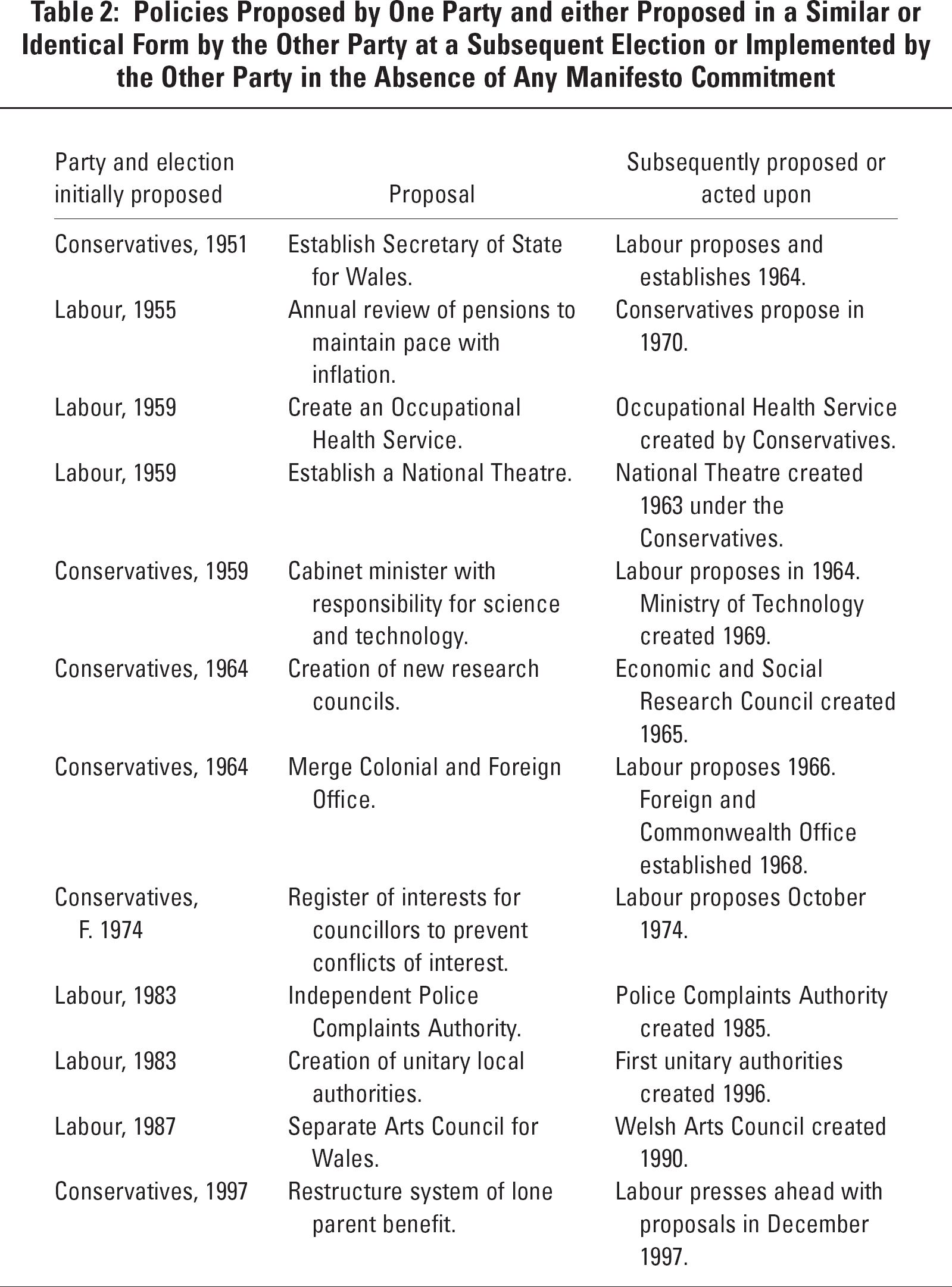
Table 3 breaks this figure down by both party and election. The final row shows that no party has been significantly more likely than any other to abandon its innovative policies. The final column indicates that parties have not become any more likely to abandon policies as time has passed. Parties do however seem particularly likely to abandon innovative policies following the election of a new leader. Between 1997 and 2001 the Conservatives changed their leader and only retained 11 per cent of their innovative policies. Between October 1974 and 1979 and between 1964 and 1966 when they also changed their leader, they retained only 6 and 12 per cent of policy innovations, respectively. When Labour changed its leader between the 1983 and 1987 elections it retained only 17 per cent of policy innovations while the Liberal Democrats retained only 21 per cent between 1997 and 2001.
Policy Innovation Continuity in Opposition, 1950–2001 (Percentage of Innovative Policies Included by a Losing Party in their Following Election Manifesto)
At the level of individual policies, convergence also occurs when an elected party fails to implement an innovative policy proposal contained within its manifesto. Labour failed to implement 16 such policies including statutory provision for 100 per cent mortgages (1974) and legislation to prevent ‘gazumping’ (1997). The Conservatives failed to implement 18 policies including the establishment of a negative income tax for child support (1970) and the establishment of binding guarantees for NHS waiting lists (1992). On a further three occasions a party implemented but then abandoned an innovative policy proposal.
Finally, policy convergence also occurs because incoming parties appear largely to accept the innovative policies previously implemented by their opponents. On 155 occasions parties promised to reverse a policy introduced by the existing government. In 1983 Labour made 21 such pledges, 5 in 1987, 14 in 1992 and 1 in 1997. In 2001 the Conservatives made 10 such pledges and in 2005 they made 7 including abolishing taxation on private medical insurance, reversing the partial decriminalisation of cannabis, overturning the ban on hunting and abolishing strategic health authorities. Yet we also found that on 147 occasions a party returning to office accepted an innovative policy first implemented by its opponent. Labour accepted 77 policies introduced by the Conservatives including the establishment of a system of private local radio channels (1970) and ‘rate capping’ (1983). The Conservatives accepted 70 policies introduced by Labour including the introduction of a national pay severance scheme (1964) and maternity allowance (October 1974).
Conclusion
Along with Kenneth Arrow's Social Choice and Individual Values (1951), Duncan Black's The Theory of Committees and Elections (1958), James Buchanan and Gordon Tullock's The Calculus of Consent (1962), Mancur Olson's The Logic of Collective Action (1965) and William Riker's The Theory of Political Coalitions (1962), An Economic Theory was one of the founding texts of the rational choice method (Grofman 1995). Rational choice's proponents regard it as having developed ‘insightful, rigorous, [and] parsimonious explanations of political outcomes’ (Monroe 1991, 2). The late William Riker goes so far as to argue that the failure of the social sciences to have kept pace with the development of the natural sciences can be attributed to their reluctance to embrace the rational choice approach (Riker 1990, 154). Why does rational choice theory offer such promise? Riker is in no doubt that it is its commitment to the equilibrium method which makes all the difference.
Drawing on Schumpeter's critique of Walras’ general equilibrium theory, this article has argued that the equilibrium method is, in the case of party competition theory, a source of weakness as well as strength in so far as it leads theorists to ignore the ‘essential fact’ of policy innovation. Over the last 50 years, rational choice theorists have engaged in a protracted debate about the extent to which and the reasons why competition induces parties to adopt convergent or divergent policy positions. An application of Schumpeter's arguments about product innovation suggests that this may be to posit a false alternative. Party competition leads to an ongoing process of both divergence and convergence.
Footnotes
I am grateful for the comments of two anonymous referees, David Denver and the Editor for comments on an earlier draft of this article.
1.
Although it now carries his name, Downs was not the first to apply the spatial metaphor to the analysis of party competition, does not actually use the nomenclature of the median voter and does not list precisely the assumptions needed to sustain the conclusion that parties will move to the electoral centre ( , 5).
, 5).
2.
It is however a curious feature of Schumpeter's argument that, while it presents an obviously dynamic account of party competition, it makes no reference to the concepts of innovation or entrepreneurship emphasised in his other work.
3.
It is worth noting that, having identified a number of different categories of innovation, Schumpeter also focuses his attention almost exclusively upon product innovation.
4.
Defence and foreign affairs were excluded from the study. The researchers were asked to ignore general statements of policy aspiration or vague promises to review some policy. They were asked only to record specific policy promises.
5.
An additional 173 policy commitments were recorded by one of the two researchers. These were then ignored for the purposes of classification.
6.
Patent registers provide economists with a ready source of data allowing them to distinguish between innovative and non-innovative products: see Tong and Frame (1994); Evangelista et al. (1998); . Measurements of innovation have even been prepared by governments themselves: see Commission of the European Communities (2004). Because public policies do not have to be registered in a similar way, there is no straightforward way in which innovative policies can be distinguished from non-innovative ones.
7.
This Ratio of Coding Agreement remains the most intuitively reliable measure of coding accuracy. The problem here is that with a small number of coding categories there is a greater chance of agreement occurring randomly. See Krippendorff (2003). For a recent application see .
8.
This figure underestimates policy continuity in so far as some policy innovations are initially abandoned only to be rediscovered at a subsequent point.