







Abstract
Schizophrenia is the most devastating form of psychopathology known to humankind, and it has been slow to yield clues to its origins. Meehl's (1962, 1990) model detailed the nature of the latent liability for schizophrenia known as schizotypy and provided a major organizing function for research on schizophrenia. The schizotypy model integrates genetic and environmental contributions to liability as well as accounting for a range of clinical outcomes, all deriving from a genuine liability for the illness. Schizotypy, as a latent personality organization that harbors the liability for schizophrenia, provides a framework for detecting fundamental features of liability to schizophrenia prior to the onset of clinical illness. The schizotypy model is reviewed, the strategic benefits of it are discussed, and methods for detecting schizotypy are presented. A focus on perceptual aberrations—a schizotypic feature—in individuals unaffected by schizophrenia has yielded valuable clues to preclinical disturbances in neurocognitive processes, risk for schizophrenia among biological relatives, and genomic substrates, all of which are of interest to schizophrenia researchers.
Understanding the origins and development of schizophrenia looms large as a research and clinical goal for psychopathologists. Because of the considerable heterogeneity in its manifestations and in its likely determinants, the illness remains a frustrating enigma at many levels of inquiry, including genetics, neuroimaging, and neurocognition. Affecting 1 in every 100 persons, the illness is massively debilitating and the economic cost and societal burden of schizophrenia are consistently estimated as exceeding those of most other physical and mental illnesses. Efforts to gain leverage on the pathological processes in schizophrenia have focused increasingly on persons carrying the liability for schizophrenia but who have not expressed the illness per se. Such individuals are referred to as schizotypes due to the fact that they possess (or carry) schizotypy, or a latent personality organization that harbors the genetic liability for schizophrenia.
P.E. MEEHL'S MODEL OF SCHIZOTAXIA, SCHIZOTYPY, AND SCHIZOPHRENIA
The central model in schizophrenia research that defined schizotypy and placed it within a developmental-psychopathology context was proposed by Paul Meehl (1962, 1990). His model encompassed not only genetic factors, social-learning influences, and clinical symptomatology, but also set forth hypotheses about the precise nature of the fundamental defect underlying schizotypic functioning. Proposed in the 1960s, when many psychologists and psychiatrists thought schizophrenia was caused by unhealthy childrearing practices (e.g., the “schizophrenogenic mother”), Meehl emphasized the role of genetics in the etiology of the illness. Today, his model of schizotypy is so firmly implanted in schizophrenia research that it is often assumed to be the organizing framework (and, on occasion, is not even cited), or it is presented from time to time as a “new” model.
Meehl's (1962, 1990) model holds that a single major gene (which he called the “schizogene”) exerts its influence during brain development by coding for a specific “aberration of the synaptic control system” in the central nervous system (CNS; Meehl, 1990, pp. 14–15). He suggested that this neuronal-level aberration, which he termed hypokrisia, is characterized by an “insufficiency of separation, differentiation, or discrimination” in neural transmission. It amounts to slippage of neural transmission at the CNS synapse, which manifests itself behaviorally in the glaring symptomatology of clinically expressed schizophrenia. Hypokrisia was hypothesized to characterize neuronal-functioning difficulty throughout the brain, thus producing a ubiquitous CNS anomaly (Meehl, 1990; p. 14), which Meehl termed schizotaxia. Schizotaxia, therefore, is the “genetically determined integrative defect, predisposing to schizophrenia and a sine qua non for that disorder” (Meehl, 1990; p. 35) and is conjectured to occur in 10% of the general population (see Lenzenweger & Korfine, 1992).
Schizotaxia denotes an aberration in brain functioning—it is not itself a behavior or observable personality pattern. The schizotaxic brain, however, becomes the foundation that other factors will build upon and interact adversely with to possibly produce clinically diagnosable schizophrenia. In particular, those factors may include (a) the individual's social-learning history (i.e., environmental influences) and (b) other genetic factors, termed polygenic potentiators (i.e., personality dimensions independent of schizotaxia, such as social introversion, anxiety proneness, aggressivity, and diminished pleasure capacity; Fig. 1). Such potentiators interact with the established schizotypic personality organization and the social environment to facilitate (or, in some cases, hinder) the development of schizophrenia. According to the model, all (or nearly all) schizotaxic individuals would develop schizotypy in most social environments. Schizotypy, therefore, refers to the latent psychological and personality organization resulting from the schizotaxic individual interacting with and developing within the world of social-learning influences. An individual who displays schizotypy is considered a schizotype according to the model (schizotype does not connote a diagnosable entity according to the Diagnostic and Statistical Manual of Mental Disorders, DSM, or the International Classification of Diseases).
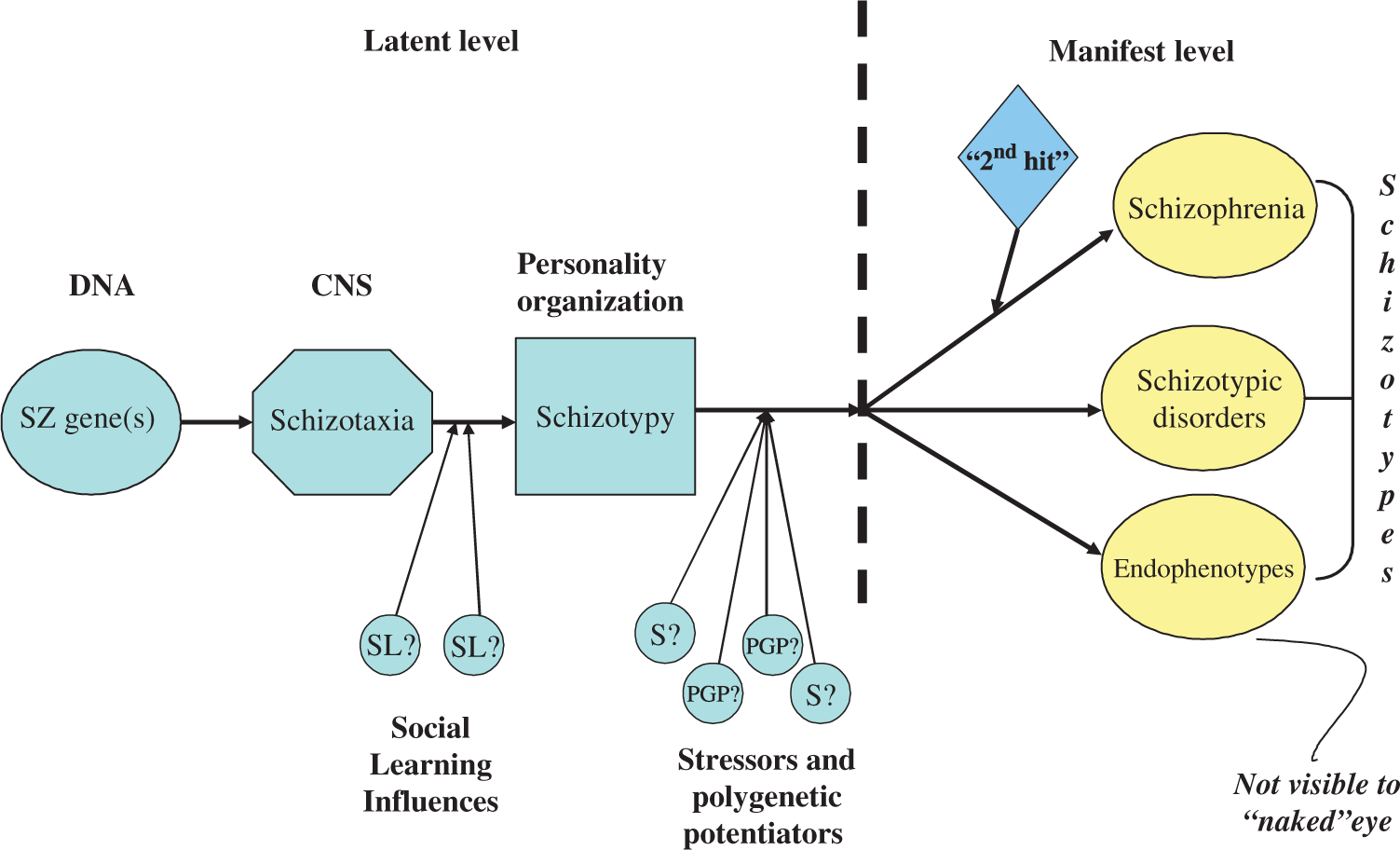
Developmental model relating the genetic diathesis for schizophrenia, schizotaxia, and schizotypy and implied levels of analysis (following Meehl 1962, 1990). A DNA-based liability (SZ = schizophrenia) creates impaired neural circuitry (schizotaxia) in the central nervous system (CNS) that eventuates in a personality organization (schizotypy) that harbors the liability for schizophrenia. Social-learning (SL) schedules interact with schizotaxia to yield schizotypy. Psychosocial stressors (S) and polygenic potentiators (PGP) interact with schizotypy to yield manifest outcomes across a range of clinical expression (from essentially asymptomatic to full-blown clinical illness). Various possible manifest developmental outcomes are schizophrenia (assuming a “second hit,” e.g., in utero exposure to maternal influenza); schizotypic psychopathology (e.g., schizotypal and/or paranoid personality disorders); or endophenotypes (e.g., sustained attention deficits, eye-tracking dysfunction, working-memory impairments, and/or psychometric deviance; see Gottesman & Gould, 2003), which are invisible to the naked eye (but detectable with appropriate technologies). All individuals represented across this range of manifest outcomes are considered “schizotypes,” which does not necessarily imply an International Classification of Diseases or Diagnostic and Statistical Manual of Mental Disorders diagnosis.
Meehl theorized a “mixed” model of genetic influence—namely, a single major gene with two alleles (alternate forms) operating against an additive polygenic (i.e., sum of individual genetic effects) and environmental background. Although modern genetic research does not support a simple single-major-locus model, empirical and simulation studies have long suggested that a mixed model is clearly plausible for schizophrenia (as are several other models).
Contemporary Research Strategies That Are Derivative of the Schizotypy Model
The schizotypy model has been a potent intellectual engine in the development of a number of derivative research strategies. These strategies depart from traditional psychopathology studies that focus solely on clinically expressed schizophrenia as the unit of analysis. Simply stated, reliance on the study of expressed cases—i.e., ones that have already developed—can never illuminate how schizophrenia emerges and develops in the first place. Such strategies include studies of those who are at high genetic risk, psychometric-high-risk research (i.e., studies of persons who are found to be deviant on psychometric measures of schizophrenia liability), and the recently reinvigorated focus on prodromal schizophrenia (the prospective study of early emerging signs of clinical schizophrenia in nonpsychotic individuals that are likely in transition, or “converting,” to psychosis). All of these strategies fundamentally derive from Meehl's schizotypy model as they all posit a genetically influenced latent liability for schizophrenia that interacts with environmental stressors as well as other genetically determined assets or liabilities.
Strategic Value of the Approach
Mapping the Liability Construct
Schizophrenia liability does not manifest itself only in the form of clinical psychotic illness, and a comprehensive mapping of liability manifestations is required for a valid survey of the liability construct. This mapping derives in large part from the study of schizotypes, who are not so-called “analogs” of schizophrenia but are, rather, carriers of genuine schizophrenia liability. There is also considerable interest in determining the likelihood of schizophrenia outcomes given the presence of deviance on one or another schizotypy indicators or measures.
Eluding Third-Variable Confounds
The study of nonpsychotic and prepsychotic variants of schizophrenia liability allows for a cleaner window on underlying pathological processes—one that is free of the contaminatory effects of medication, cognitive and personality deterioration, and institutionalization.
Illumination of Premorbid Indicators
The study of schizotypy allows for illumination of truly premorbid indicators of schizophrenia rather than epiphenomena (i.e., secondary phenomena accompanying the clinical illness but not of causal importance for it), as such study is undertaken in persons who have never been psychotic.
Enhanced Statistical Power of Genetic Investigations
The use of reliable and valid schizotypy indicators can enhance the statistical power of genomic investigations of schizophrenia, even if such indicators are only modestly correlated with schizophrenia liability.
Endophenotype Approach
The schizotypy model clearly suggests that all who possess schizotypy will show some, even if very subtle, manifestation of that latent liability; therefore it implicitly embraces the endophenotype approach (Gottesman & Gould, 2003). Endophenotypes are those processes or markers invisible to the naked eye—but detectable with appropriate technologies—that, in principle, provide simpler clues to genetic underpinnings of schizophrenia than complex symptom patterns do (see Fig. 1).
HOW TO IDENTIFY THE SCHIZOTYPE
Schizotypes can be identified in one of three ways (Lenzenweger, 1998) that are best viewed as complementary and somewhat overlapping. The familial/biologic approach focuses on the biological first-degree relatives of persons affected by schizophrenia. Such persons represent, as a group, an enriched sample for schizophrenia liability, though not all such relatives necessarily carry schizophrenia liability. The clinical approach relies on psychiatrically defined schizotypic psychopathology such as schizotypal personality disorder (e.g., DSM-IV). Finally, the laboratory approach makes use of reliable and valid quantitative measures (e.g., sustained attention, eye tracking, psychometric inventories) that are indicators of schizophrenia liability. The benefit of the laboratory approach is that, in many cases, it makes use of phenomena that can be counted rather than rated, offering enhanced precision in measurement.
PERCEPTUAL ABERRATIONS, SCHIZOTYPY, AND SCHIZOPHRENIA: FROM PHENOMENOLOGY TO GENOMICS
The research utility of the schizotypy model is illustrated by following the development of one particular schizotypic feature—body-image and perceptual aberrations—from early clinical descriptions (Rado, 1960) and theoretical conjectures (Meehl, 1964), through empirical validation work, to current genomic investigations. There are other schizotypic features that are the focus of research efforts (e.g., magical ideation, social anhedonia). Rado (1960) described two key components of the diathesis (constitutional weakness or predisposition) for schizophrenia carried by the schizotype, one being a proposed proprioceptive (kinesthetic or body-sense) diathesis that results in an aberrant awareness of the body (a feature giving rise to schizotypic body-image distortions). Meehl (1964) richly described schizotypic signs and symptoms, one of which concerned body-image aberrations. These clinical observations were operationalized by a well-known psychometric measure, the Perceptual Aberration Scale (PAS; Chapman, Chapman, & Raulin, 1978). The PAS has been used as a tool for identifying subjects who may be at enhanced risk for schizophrenia (or, more generally, nonaffective psychosis).
A large research corpus has established links between deviance on the PAS and numerous valid indicators of schizophrenia liability. In my lab, we initially demonstrated that PAS deviance predicted an increased risk for schizophrenia in biological first-degree relatives, elevated and clinically significant schizotypal personality features, and numerous deficits in neurocognitive processes that are central to our understanding of schizophrenia (see Lenzenweger, 1998 for review). For example, PAS-identified schizotypes and persons with clinically diagnosed schizophrenia show deficits in sustained attention, executive functioning, working memory, attentional inhibition, smooth-pursuit eye tracking (smooth visual tracking of a target), and antisaccade (intentional movement of the eye away from a target that one would normally want to look at) performance, as well as increased thought disorder and schizophrenia-related deviance on the Minnesota Multiphasic Personality Inventory. This pattern of data demonstrated that psychometrically identified schizotypy is similar to schizophrenia in terms of associations with various psychological, cognitive, and other factors known to be validly related to schizophrenia, and is likely to reflect schizophrenia liability.
CURRENT FRUITFUL DIRECTIONS OF INQUIRY INTO SCHIZOTYPY
Reduction of Heterogeneity: How to Refine Signal and Reduce Noise
No schizophrenia patient or schizotype will reveal deviant performance on all measures that tap liability, thus heterogeneity in performance data across measures is the norm. Heterogeneity poses a massive methodological and statistical challenge in efforts to detect the signal of schizophrenia liability. Any measure of schizotypy that is used to assemble a group of schizotypes for study will necessarily generate an admixture of “genuine” schizotypes as well as what might be termed false-positive cases. My colleagues and I developed a statistical model that parses a group of putative schizotypes into genuine versus false-positive cases (Lenzenweger, Jensen, & Rubin, 2003). This model makes use of the performance characteristics of both normal and schizotypic subjects in seeking to identify the true status of those subjects initially identified as being part of a putative schizotypic group. Our statistical model approaches the heterogeneity issue as a missing-data problem and provides a statistical framework for determining which of the putative schizotypes might be better classified as nonschizotypic. We applied our method to neuropsychological and eye-tracking performance data, conditioned on initial psychometric schizotypy status (i.e., presence or absence of deviance on the PAS), and we were able to parse out genuine from false-positive schizotypes. The genuine schizotypes were found to be significantly more impaired on measures of sustained attention, thought disorder, and working memory relative to both controls and false-positive cases (Lenzenweger et al., 2003).
Simpler May Be Better: Probing Basic Motor and Somatosensory Processes
Research in schizophrenia has long focused heavily on relatively complex cognitive processes, but the early observations of schizophrenia by Kraepelin and Bleuler pointed to deficits in very basic perception and motor processes. We have pursued some of these seminal clinical insights and used experimental methods to probe somatosensation and motor performance in schizotypic subjects. Initial work revealed deficits in exteroceptive sensitivity (perception of fine touch) in relation to psychometric schizotypy indicators, including the PAS. I (Lenzenweger, 2000) showed that elevations on the PAS were found among those subjects who had the most deviant two-point discrimination thresholds (i.e., threshold at which two points touching the skin can be differentiated from one point). Subsequent work (Chang & Lenzenweger, 2001) revealed that deficits in two-point discrimination among the first-degree relatives of schizophrenia patients was due to poor sensitivity rather than response bias, a finding subsequently replicated (Chang & Lenzenweger, 2005). We studied another aspect of somatosensation, namely proprioception (i.e., perception of movement and spatial orientation), in those at elevated risk for schizophrenia (i.e., first-degree relatives of schizophrenia patients) and, as predicted by Rado and Meehl, deficits on a proprioceptive task suggested genuine sensitivity impairments (rather than response-bias differences). The psychometric schizotypy reality-distortion factor, which includes perceptual aberrations, was significantly inversely correlated with sensitivity on both the exteroceptive and proprioceptive task-performance indices. Finally, probing fine psychomotor functioning, using a simple, low-demand line-drawing task, we have been able to demonstrate that motor deficits, assessed in persons with no history of psychosis, are also associated with increased levels of perceptual aberration (Lenzenweger & Maher, 2002). This association, moreover, maintained even in the face of numerous statistical controls for factors such as anxiety, depression, attention, and others. We emphasize the benefits of a focus on simpler psychological processes in schizotypy research, as such processes are not subserved by numerous neurocognitive systems, which often blur the meaning of findings from the study of complex constructs. Moreover, simpler processes may be more easily related to underlying biological and genomic substrates.
Long-Term Follow-up
It is known that deviance on the PAS, in part, helps to predict later psychosis and schizotypic features in previously nonpsychotic individuals. We are currently conducting a 17-year follow-up study to assess the extent to which initial deviance on the PAS and deviance on a measure of sustained attention jointly predict schizophrenia and nonaffective psychosis in subjects who were nonpsychotic upon initial evaluation—thus, joining two promising endophenotypes. This study is examining a wide range of psychosocial and psychological factors to illuminate the impact of schizotypy across the life course beyond simply psychopathological outcomes.
Latent Structure and the Link to Genomic Influences
An implication of Meehl's model is that individuals who carry schizotypy should constitute a qualitatively distinct class of persons, differing from others by kind, not by degree. Taxometric analysis (a statistical procedure designed to detect whether a construct is quantitative or qualitative in nature) of the PAS has consistently yielded evidence that supports this hypothesis: Large samples of individuals assessed on the PAS appear to represent a mixture of two latent classes; importantly, the smaller of these two classes (5–10% of the samples) demarcates a highly schizotypic group (Korfine & Lenzenweger, 1995; Lenzenweger & Korfine, 1992). Finally, although it is well known that taxometric analysis does not test genetic conjectures directly and only tests one aspect of Meehl's conjectures regarding the nature of schizotypy (see Lenzenweger, 2003), taxometric results can be suggestive regarding the possible structure of a genetic influence for schizotypy. Indeed, recent research (Lin et al., 2005) demonstrated one genomic association (the single nucleotide polymorphism rs3924999 for the neuregulin 1 [NRG1] gene at chromosome 8p22–p12, which is a locus of interest to schizophrenia researchers) with quantitative deviance on the PAS. Finally, in our most recent work we have been applying the statistical tool known as finite mixture modeling (an advanced statistical procedure for resolving latent components) to performance on objective laboratory measures known to be associated with schizophrenia liability (e.g., sustained attention and eye tracking) in order to examine latent structure (i.e., the underlying nature of the variables of interest). This work, consistent with the early taxometric work, suggests the presence of discontinuities underlying performance on these tasks, and thus a real distinction between groups; moreover, this method allows us to identify with considerable precision, via statistical probabilities, those persons thought to be members of the schizotypy-positive class.
CONCLUSION
Use of laboratory measures to tap constructs of central importance within a schizotypy framework, in conjunction with statistical methods directed at the resolution of heterogeneity as well as latent structure, will provide a more precise and, hopefully, more fruitful direction in the discovery of genetic factors of causal importance for schizophrenia.
Footnotes
Acknowledgements
I thank Irving I. Gottesman for helpful comments on an earlier version of this article.
This work was supported in part by a National Alliance for Research in Schizophrenia and Depression Distinguished Investigator Award to the author.