







Abstract
Habits are response dispositions that are activated automatically by the context cues that co-occurred with responses during past performance. Experience-sampling diary studies indicate that much of everyday action is characterized by habitual repetition. We consider various mechanisms that could underlie the habitual control of action, and we conclude that direct cuing and motivated contexts best account for the characteristic features of habit responding—in particular, for the rigid repetition of action that can be initiated without intention and that runs to completion with minimal conscious control. We explain the utility of contemporary habit research for issues central to psychology, especially for behavior prediction, behavior change, and self-regulation.
From self-help guru Anthony Robbins to the religion of Zen Buddhism, received wisdom exhorts people to be mindful, deliberative, and conscious in all they do. In contrast, contemporary research in psychology shows that it is actually people's unthinking routines—or habits—that form the bedrock of everyday life. Without habits, people would be doomed to plan, consciously guide, and monitor every action, from making that first cup of coffee in the morning to sequencing the finger movements in a Chopin piano concerto.
But what is a habit? The cognitive revolution radically reshaped the behaviorist view that habits rely on simple stimulus–response associations devoid of mental representation. Emerging is a more nuanced construct that includes roles for consciousness, goals, and motivational states. Fundamental questions persist, however, especially when comparing evidence across neuropsychology, animal-learning, and social-cognition literatures. Data from these fields support three views of habit, which we term the direct-context-cuing, implicit-goal, and motivated-context models. In this article, we consider these models and explain the relevance for psychology of a reinvigorated habit construct.
HABITS AFTER BEHAVIORISM
Within current theorizing, habits are automated response dispositions that are cued by aspects of the performance context (i.e., environment, preceding actions). They are learned through a process in which repetition incrementally tunes cognitive processors in procedural memory (i.e., the memory system that supports the minimally conscious control of skilled action). The relatively primitive associative learning that promotes habits is shared in some form across mammalian species.
Our own interest in habits has been fueled by the recognition that much of everyday action is characterized by repetition. In experience-sampling diary studies using both student and community samples, approximately 45% of everyday behaviors tended to be repeated in the same location almost every day (Quinn & Wood, 2005; Wood, Quinn, & Kashy, 2002). In these studies, people reported a heterogeneous set of actions that varied in habit strength, including reading the newspaper, exercising, and eating fast food.
Although a consensual perspective on habit mechanisms has yet to develop, common to all views is the idea that many behavioral sequences (e.g., one's morning coffee-making routine) are performed repeatedly in similar contexts. When responses and features of context occur in contiguity, the potential exists for associations to form between them, such that contexts come to cue responses. In what follows, we outline three views of habitual control that build on this understanding.
Direct Context Cuing
According to the direct-context-cuing model, repeated co-activation forges direct links in memory between context and response representations. Once these links are formed via associative learning, merely perceiving a context triggers associated responses. Supporting evidence comes from research in which merely activating a construct, such as the elderly stereotype, influences the performance of relevant behaviors, such as a slow speed of walking (e.g., Bargh, Chen, & Burrows, 1996).
Readers might wonder if it is realistic that contexts cue responses through this simple mechanism in the absence of an implicit or explicit goal. The answer is not clear, given that social-cognition research has thus far demonstrated only a limited version of direct-cuing effects. For example, activating the elderly stereotype influences walking speed, but it remains to be demonstrated whether such activation can initiate walking itself. However, the direct cuing of repeated action by contexts is suggested by myriad findings in cognitive neuroscience that reveal reduced involvement of goal-related neural structures, such as the prefrontal cortex, when behaviors have come under habitual control (see Daw, Niv, & Dayan, 2005). Furthermore, animal-learning research using a clever paradigm in which reinforcers are devalued suggests direct control by context. When rats initially perform an instrumental behavior (e.g., pressing a bar for a food pellet), they appear to be guided by specific goal expectations; they cease the behavior if the reward is devalued (e.g., by pairing it with a toxin; Dickinson & Balleine, 1995). In contrast, when rats have extensively repeated a behavior, their responses appear to be cued directly by contextual stimuli (e.g., the bar); reward devaluation has little impact on continued performance. These data are commonly interpreted as indicating that habit formation involves a shift to direct context cuing.
Implicit Goals
Associative learning explains not only the direct binding of contexts and actions but also the binding of contexts and goals. In implicit-goal models, habits develop when people repeatedly pursue a goal via a specific behavior in a given context. An indirect association then forms between the context and behavior within the broader goal system. In support, Aarts and Dijksterhuis (2000) found in several experiments that the automatic activation of habitual responses (e.g., bicycle riding) only occurs when a relevant goal has first been made accessible (e.g., the thought of attending class). These studies did not measure people's real-world behavior, however, but focused instead on judgments about behavior. It remains to be seen whether such judgments tap the cognitive processes that actually drive behavior. In addition, there is good reason to think that habit performance itself does not depend on goal activation. Goal-driven responses tend to be dynamic and flexible, as evidenced by people sometimes substituting behaviors that serve a common goal. In contrast, habits emerge in a rigid pattern such that, for example, a habitual runner is unlikely to substitute a cycling class for running. Thus, although implicit goals provide potentially powerful guides to action, they do not plausibly explain the context cuing of habits.
Motivated Contexts
In another framework for understanding context-cued responses, contexts can acquire diffuse motivational value when they have preceded rewards in the past. When contexts predict rewards in this way, they energize associated responses without activating specific goals. Evidence of the motivating quality of contexts comes from animal studies of the neurotransmitters that mediate reward learning. For example, when monkeys first learn that a feature of the environment (e.g., a light) predicts a reward (e.g., a drop of juice) when a response is made (e.g., a lever press), neurotransmitter activity (i.e., dopamine release) occurs just after the reward (see Schultz, Dayan, & Montague, 1997). After repeated practice, the animal reaches for the lever when the light is illuminated. Furthermore, the neurotransmitter response is no longer elicited by the juice but instead by the light. In this way, environmental cues can acquire motivational value.
Reward-predicting environments are thought to signal the cached (or long-run future) value of an action without signaling a specific outcome (e.g., juice; Daw et al., 2005). This diffuse motivation may explain the rigid nature of context cuing, given that cached values do not convey a specific desired outcome that could be met by substitutable means. Contributing further to the rigidity of habits, neural evidence indicates that, with repetition, whole sequences of responses become chunked or integrated in memory with the contexts that predict them (Barnes, Kubota, Hu, Jin, & Graybiel, 2005). Chunked responses are cued and implemented as a unit, consistent with the idea that habits require limited conscious control to proceed to completion. This quality of habitual responding is frustratingly evident when, for example, trying to fix a well-practiced but badly executed golf swing or dance-step sequence.
As yet, the motivated-context idea has been tested primarily with animals. Its promise as a model of human habits comes from evidence that reward-related neurotransmitter systems are shared across species (e.g., in humans, dopamine is elicited by monetary reward).
Multiple Habit Mechanisms
The high degree of repetition in daily life observed in the diary research of Wood et al. (2002) is likely to be a product of multiple habit-control mechanisms that draw, in various cases, on direct context associations as well as on diffuse motivations. Although we consider implicit goals to be an implausible mediator of habitual behavior, they undoubtedly contribute to some types of repetition. Whether habits are cued directly or are diffusely motivated, they are triggered automatically by contexts and performed in a relatively rigid way. These features of responding have important implications for theories of behavior prediction, behavior change, and self-regulation.
BEHAVIOR PREDICTION
Predicting behavior is a central project in many areas of psychology. The automated repetition of habits sets limits on when mindful constructs such as intentions, attitudes, and decisions predict future action. In illustration, Ji Song and Wood (2006) predicted how often college students purchased fast food or watched TV news during a week-long period from their behavioral intentions and from their habits. Students acted on their intentions when their habits were weak or moderate in strength (as indicated by infrequent past performance or unstable contexts). Thus, for example, students who intended to purchase fast food in fact did so (Fig. 1). In contrast, students with strong habits (frequent past performance in stable contexts) repeated their past behavior regardless of their intentions. In short, the utility of intentions as predictors of behavior declined as habit strength increased. Intentions guided actions primarily when habits had not been formed. This pattern supports the claim that habitual responding can be cued independently of people's intentions.
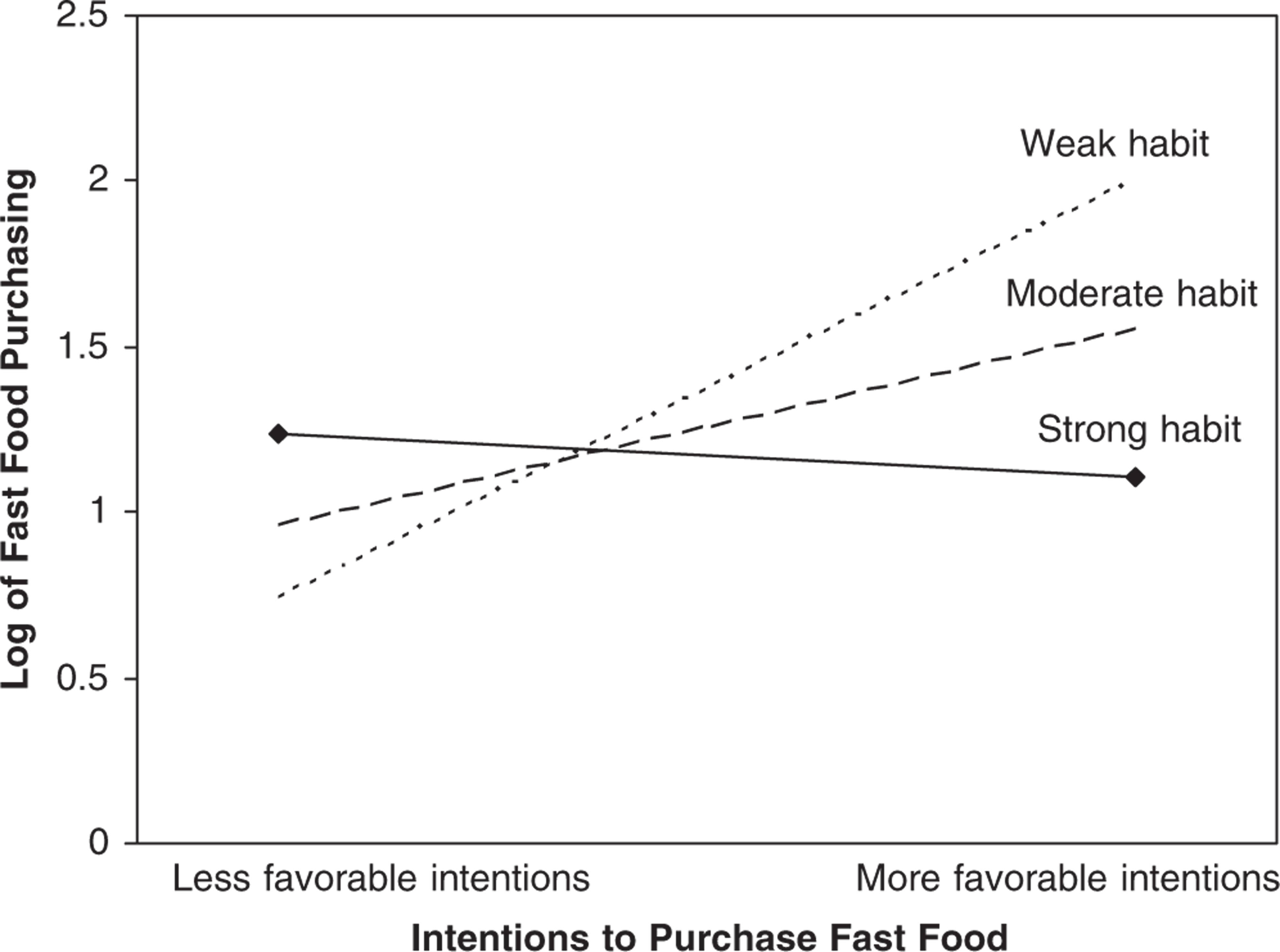
Frequency of purchasing fast food over 1 week as a function of habit strength (based on frequency of past fast-food purchasing in the presence of particular other people) and the intention to purchase fast food. Habit strength moderated the extent to which intentions guided action. Data from Ji Song and Wood (2006).
Researchers sometimes equate strong habits simply with frequent past performance. This may be appropriate for actions that tend to be performed narrowly in a given context (e.g., using seat belts). However, for actions performed across multiple circumstances, habits depend on contiguity between behavior and contexts. Thus, the pattern in Figure 1 emerged when habits were assessed from frequency of past purchasing with certain others, but not when assessed from measures of frequency alone.
BEHAVIOR CHANGE
The mechanisms of habitual control pose a particular challenge for changing behavior. Public health campaigns and other informational interventions are designed to change beliefs. However, for habits, changing minds does not necessarily mean changing behavior. In illustration, Webb and Sheeran's (2006) meta-analytic review compared the effectiveness of persuasive messages and other interventions in changing people's intentions versus changing their behavior. For course enrollment and other actions that were not easily repeated into habits, interventions that changed intentions also changed behavior. But for exercising and other behaviors that people could repeat into habits, interventions that changed intentions had limited effect on behavior.
Despite insensitivity to informational interventions, habit performance should be vulnerable to changes in the performance context. To test this idea, Wood, Tam, and Guerrero Witt (2005) examined change in college students' habitual behaviors of exercising, reading the paper, and watching TV upon transferring to a new university. In general, students performed these actions when they intended to do so. However, a mark of strong habits is frequent performance regardless of people's intentions, provided that contexts remain stable. In support, habit performance continued to be cued independently of intention only when students perceived that the context of performance was stable across the transfer. When the performance context changed with the transfer, apparently strong habits were no longer cued automatically, and students continued to exercise only if they intended to do so. Thus, context change disrupted performance of strong habits, bringing them under intentional control. The performance of weak habits, in contrast, varied with intentions regardless of context stability. The data for exercising and for newspaper reading are presented in Figure 2.
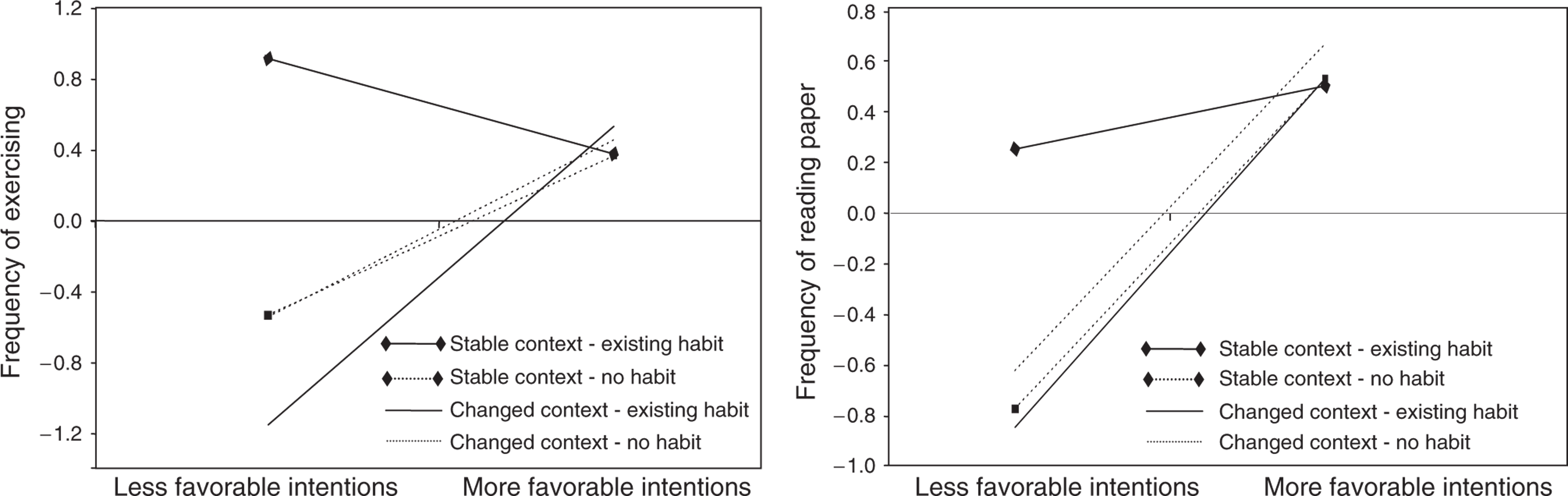
Frequency of students' exercise (left panel) and newspaper-reading (right panel) behavior after moving to a new university as a function of (a) whether students had an existing habit for the behavior at their old university, (b) their intentions to perform the behavior at the new university, and (c) change in the contexts in which they performed the behavior after the move. Students with strong habits whose performance contexts changed little across the transfer carried over their habits to the new university regardless of their intentions. In contrast, students with strong habits who experienced a change in performance contexts carried over their habits only when the behavior was accompanied by a favorable intention. For those without habits, behavior performance was predicted by favorable intentions irrespective of context change. Data from Wood, Tam, and Guerrero Witt (2005).
In general, change in performance contexts is likely to be an important ingredient in interventions to change many everyday behaviors. This is especially true within the health domain, given that five of the leading health risks in the U.S. emerge from everyday repetition of action—substance abuse, obesity, tobacco use, risky sexual behavior, and inadequate exercise. Verplanken and Wood (2006) proposed that effective habit-change strategies might target interventions for times when people are naturally changing performance contexts. For example, to increase bus ridership, some metropolitan transit services provide free passes and route information to new residents, a group yet to establish relevant habits and hence open to such influence. Also, given the importance of context cues in changing habits, public policy can be oriented toward structural changes and supports for desired behaviors (e.g., sidewalks to encourage exercise).
SELF-REGULATION
Self-regulation involves monitoring and adjusting responses in the service of the self. In current theorizing, this process occurs by comparing current states with goals and engaging control processes when the two are discrepant. Given that habits are not guided by goals, how are they regulated? One answer comes from research on the brain systems involved with conflict monitoring (Yeung, Botvinick, & Cohen, 2004). This work suggests that negative behavioral outcomes can be detected indirectly through the activation of multiple conflicting responses. For example, people asked to identify the ink color when they see the word red written in green ink (i.e., the Stroop task) can become aware of incorrect responses by detecting the activation of two incompatible responses (i.e., “red” and “green”). The presence of multiple conflicting responses is apparently a common feature of situations in which negative outcomes occur, and therefore can be used as a proxy for evaluating outcomes. Thus, conflict monitoring provides a precedent for self-regulation without goals.
Self-regulation also involves controlling the implementation and inhibition of behavior. The automatic qualities of habits influence regulatory success through the ease with which responses are executed versus withheld. These effects of habits are most apparent when people have limited self-control resources. Thus, Vohs, Baumeister, and Ciarocco (2005) showed experimentally the difficulty of inhibiting habitual modes of self-presentation when self-control resources have been reduced. Our four-day diary study (Neal & Wood, 2006) extended this investigation to the regulation of behavior in real life. For two of the days, we depleted people's control resources by requiring them to use their nondominant hand for everyday activities. When depleted, participants were less likely to perform nonhabitual behaviors but continued to perform habits successfully. They not only maintained beneficial habitual behavior, such as attending the gym, but also maintained bad habits, such as an afternoon trip to Krispy Kreme. Thus, habits represent a double-edged sword within self-regulation; when self-control is limited, people perform desirable habits but fail to inhibit undesirable ones.
Finally, habits influence the role of the self within self-regulation. Because people perform these actions often, it makes sense that habits would be central components of the self-concept. However, people generally consider their habits less informative about themselves than nonhabitual actions (Wood et al., 2002). In part, this may reflect that behaviors that are cued by context are unlikely to feel self-willed. In addition, the disconnection between habits and the self could emerge from their independent representation in memory. People's sense of self is informed by autobiographical memories, which are stored in the declarative system. Given that habits rely on procedural memory, they may be somewhat removed from these autobiographies and hence from the self-concept.
CONCLUSION
Having moved beyond its behaviorist connotations, the habit construct has a valuable and expanding role in many topics of concern to contemporary psychologists. Exciting research programs address how habits drive consumer choices, influence large-scale social processes, become shared across individuals and groups, and inform moral reasoning. Such applications need to be informed by continued work addressing the basic mechanisms underlying habit performance, especially the mechanisms by which contexts motivate responding and by which responses, once initiated, can proceed independently of intentions and with minimal conscious control. Particularly needed is research that applies these specific mechanisms to understand the powerful effects of everyday habits observed in behavior prediction, change, and regulation.
More generally, the pervasive effect of habits in everyday behavior is a key to understanding the difficulty people frequently experience in changing their behavior. People often fail in their attempts at changing everyday lifestyle habits such as their diet and level of exercise. Such failures are understandable given that cues such as time of day and location trigger repetition of past responses. Failures to change do not necessarily indicate poor willpower or insufficient understanding of health issues but instead the power of situations to trigger past responses. Habits keep us doing what we have always done, despite our best intentions to act otherwise.