







Abstract
Newly licensed drivers are disproportionally involved in fatal crashes, and there is evidence that failure to attend to potentially relevant information is a major contributor to this problem. Corroborating this, in controlled scenarios on a driving simulator, we have found that younger drivers attend to (i.e., fixate) target regions in the virtual world that contain information about potential risks much less frequently than do more experienced drivers. We have developed a PC-based training program that substantially improves younger drivers' attention to these regions in the driving simulator and have recently replicated these training results on the road in a real driving situation.
Younger drivers, especially newly licensed drivers (those who have had their license 6 months or less), are disproportionally involved in fatal crashes. Per 100 million vehicle miles, a 16-year-old is almost eight times as likely to get into a fatal crash as a 45- to 64-year-old is, and an 18-year-old is four times as likely. Despite this ongoing tragedy, there exists no training program that has demonstrably reduced crashes (Mayhew and Simpson, 2002).
In the popular culture, the disproportional involvement of newly licensed drivers in crashes is often ascribed to factors such as emotional immaturity, very high speeds, and generally reckless driving. However, other factors appear to be at work. For example, in a review of almost 1,000 crashes involving 16- and 17-year-old drivers, McKnight and McKnight (2003) found that failures to search ahead, to the side, and to the rear were together implicated in 42.7% of the crashes. The data from studies of drivers' eye movements on the road are also consistent with the conclusion that younger drivers do not adequately search for potential dangers (Crundall and Underwood, 1998; Mourant and Rockwell, 1972).
What causes these failures to search effectively? One possibility is that the problem is structural: Younger, less-experienced drivers are less skilled at the mechanics of driving and thus are less able to attend to areas of the roadway other than straight ahead. A second possibility is that the problem is informational: They do not appreciate the situations in which it is highly desirable to look elsewhere to help avoid risks, and in these situations they do not know where to look. To help determine which of these is the case, we have created specific traffic scenarios in which there is information at a particular location and time that needs to be processed by the driver if the risk of an accident is to be minimized. If the problem is mainly that inexperienced drivers do not look at such locations because they have little spare attentional capacity to do so, then a training program that shows why certain situations are risky and where to attend in these situations to minimize the risks should be relatively ineffective. On the other hand, if the problem is largely informational (i.e., they don't know where and when to look), then such a training program should be quite effective. Because the scenarios we are most interested in studying inherently place the driver at risk, our initial work used a driving simulator. However, we have now completed a study on the road, also using, as our dependent variable, eye movements to areas that indicate information about potential risks.
SCENARIOS AND THE DRIVING SIMULATOR
Most of the scenarios that we developed for the driving simulator contained locations where hidden risks could easily materialize. A careful driver should scan for the appearance of risks at these locations. For example, in one such scenario, a truck is parked on the shoulder near a crosswalk, from behind which a pedestrian might suddenly emerge (see Fig. 1). A careful driver in such a situation should scan for approaching pedestrians or bicycles emerging from behind the truck (see Fig. 2—a perspective view of what the drivers see in the simulator; a circle is placed where the driver should look). In a minority of the scenarios, the location the driver should attend to is one that contains a signal that a risky situation is ahead (e.g., a Stop Ahead sign).
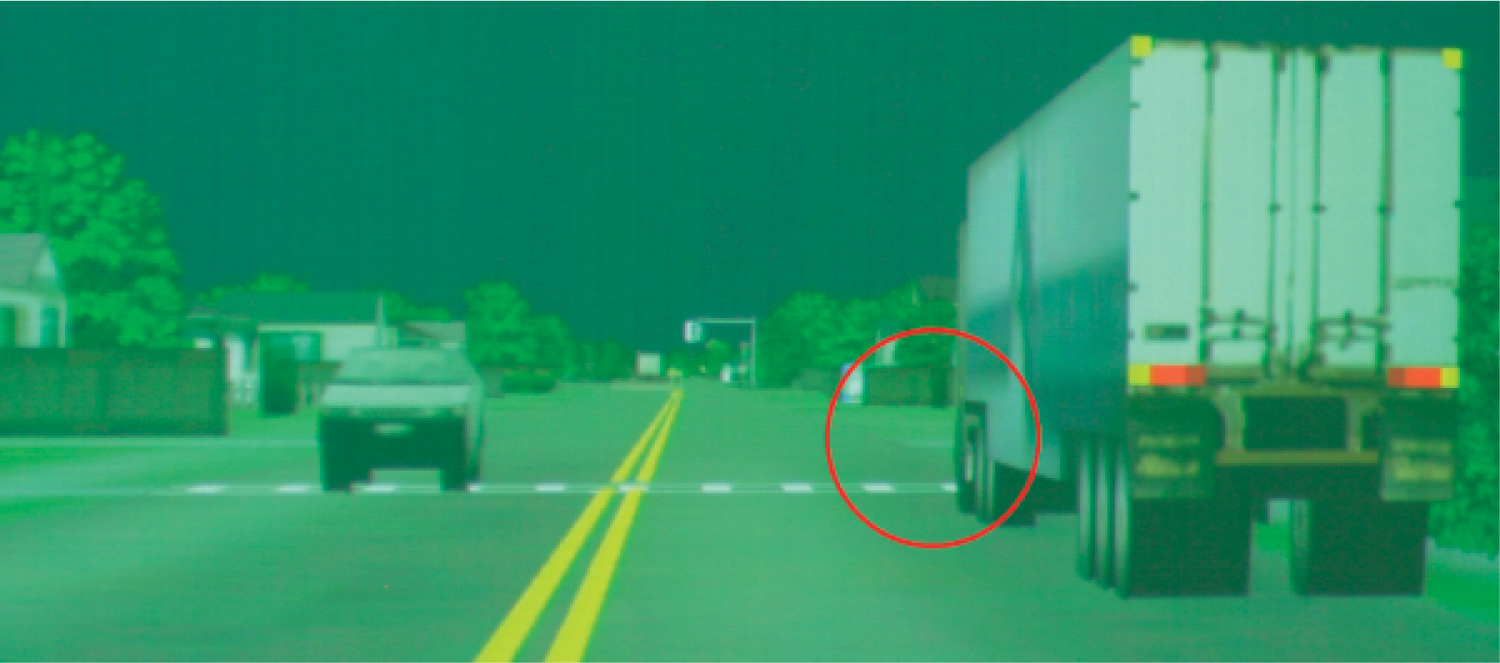
Perspective view of the truck crosswalk scenario as it appears in the driving simulator. The circle shows where a pedestrian might emerge from behind the parked truck.
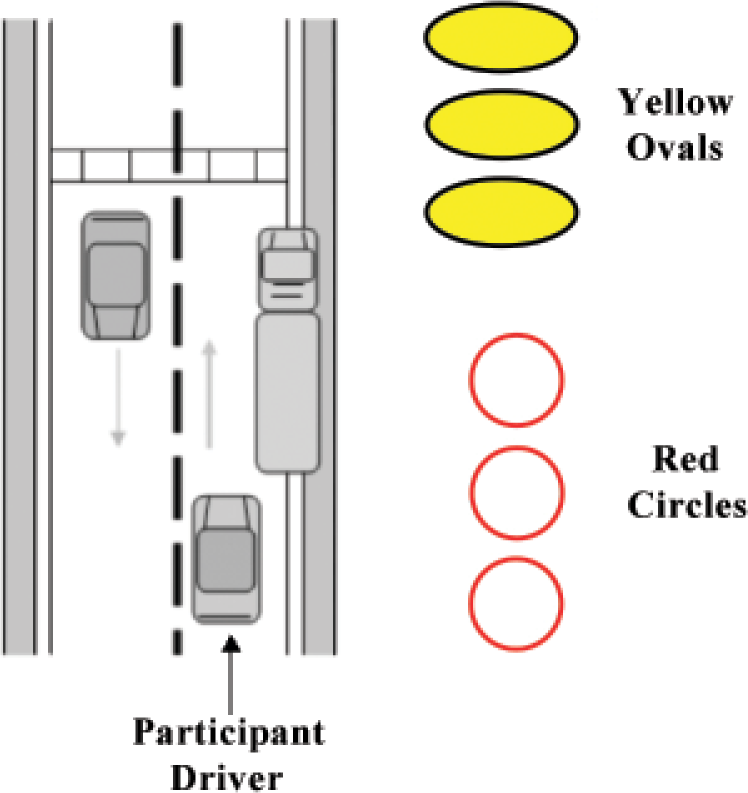
Plan view of truck crosswalk scenario used in Risk Awareness and Perception Training (RAPT) program. Trainees used a mouse to drag yellow ovals to the areas that could contain information hidden from view but relevant to making a response that could reduce their risks (such as the segment of crosswalk directly in front of the parked truck) and red circles to areas of the roadway that they should be continually monitoring (such as immediately to the left front edge of the truck, where a pedestrian could emerge).
In our driving test on the simulator, data are provided by 16 scored scenarios. Typically, the score is 1 in a scenario if the participant attends to (fixates) the appropriate area within an appropriate time window; it is zero if the participant never fixates this area. (The scoring is “blind” with respect to the age and gender of the driver and whether he or she has been trained or not.) The simulator uses a 1995 Saturn Sedan, and a virtual world is projected onto three screens surrounding the front of the car (Fig. 3). Participants manipulate the controls of the vehicle, just like the controls of a normal vehicle, in order to move appropriately through the virtual world. Each participant wore a head-mounted eye tracker integrated with a magnetic head tracker. Together, these two trackers can be used to compute the eye-position of the participant with respect to the environment; this is then converted to the external point of gaze and superimposed as crosshairs upon what is being projected to the driver.
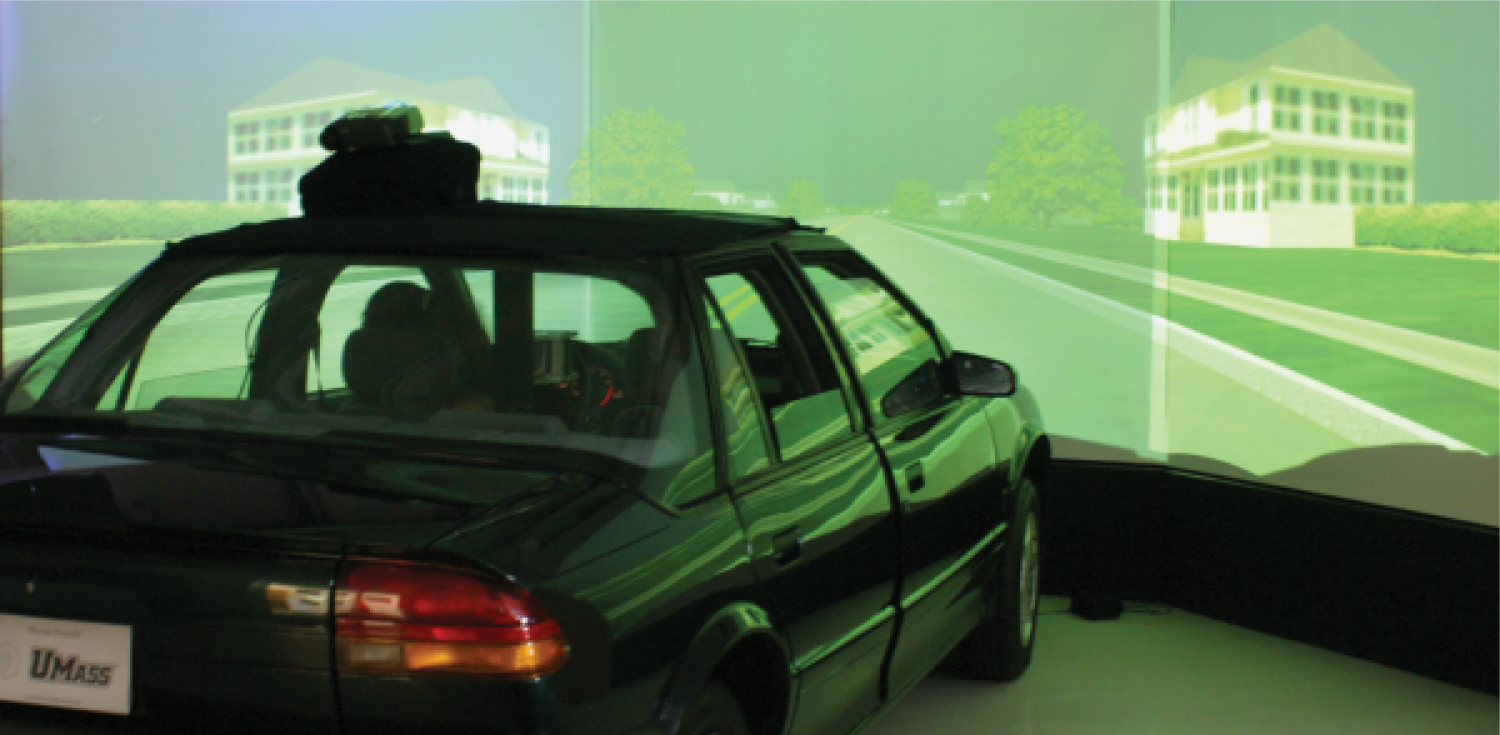
University of Massachusetts at Amherst driving simulator. The simulator consists of a 1995 Saturn sedan surrounded by three screens.
SELECTIVE ATTENTION DEFICITS: THE SIMULATOR
Our first simulator study (labeled here as Experiment 1) examined whether there were differences in ability to scan the visual field selectively for information about potential risks among older drivers (aged 60–75), younger drivers (aged 18–26), and novice drivers (aged 16–17)—differences that were plausibly related to differences in crash rates (Pradhan et al., 2005). In the studies done on the simulator, risks never materialized in any of the scenarios (e.g., a pedestrian never actually stepped out in front of the driver). There were quite large differences between the groups (24 participants per group): The older, younger, and novice drivers fixated appropriately 66%, 51%, and 36% of the time, respectively (all pairwise differences were significant). It thus appears that there are indeed differences between drivers of different ages (and experience) in attending selectively to aspects of the roadway that will help to deal with potential risks, and that this phenomenon can be captured in the laboratory. We realize that the use of the eye tracker may have made drivers aware of the need to pay attention to the roadway; however, our critical findings here and below are differences among groups rather than in the absolute level of performance.
REMEDYING SELECTIVE-ATTENTION DEFICITS: SIMULATOR STUDIES
Our next step was to devise a training program that could remedy this attentional problem in younger drivers. We have produced several generations of a training program (RAPT, for Risk Awareness and Perception Training) that can be run on any PC (available either on the internet or a CD) and takes less than an hour for the trainee to complete (Fisher, Pollatsek, & Pradhan, 2006). Earlier versions of the program relied solely on plan views such as that displayed in Figure 1. In the pretest phase, trainees were asked to use the mouse to drag red circles to areas of the roadway that they should be continually monitoring and to drag yellow ovals to the areas that could contain information hidden from view but relevant to making a response that could reduce their risks. Figure 1 shows an example pretest scenario. After responding, the trainees were coached to appreciate where they should be looking for information that could reduce their risks. The coaching on a scenario typically involved both the use of diagrams to indicate what could be hidden from view and pointing out plausible risks, such as pedestrians emerging from behind hedges or parked vehicles or cars being obscured by trucks. After the training of one scenario was complete, the pretest slide for the next scenario was presented. There were 10 scenarios employed in the training. After all the training, there was a posttest that was identical to the pretest.
Our first test of our training program was on the driving simulator (Pollatsek, Narayanaan, Pradhan, & Fisher, 2006; labeled here as Experiment 2). The experiment employed the standard randomized-controlled design in which one set of novice (16- and 17-year-old) drivers was assigned to the training group and the other set was assigned to the control group. All drivers had their learner's permits and had been driving for at least 5 hours with a parent. The test on the driving simulator consisted of both near-transfer scenarios (scenarios quite close to those presented in training, e.g., the test situation in Figure 2 and the training slide in Figure 1) and far-transfer scenarios (scenarios in which the risk could be reduced by looking at a particular location at a specific point in time but that had not appeared similarly configured or with the same objects as in training). As before, participants were scored on whether they fixated the area that could reduce their potential risk and whether their fixation was within a specified window of time. The training proved quite successful: The trained drivers fixated the appropriate region 58% of the time, whereas the untrained drivers fixated it only 35% of the time (Fig. 4). The training effect was about the same in the far-transfer and near-transfer scenarios (20% and 25%, respectively). Both differences were highly significant.
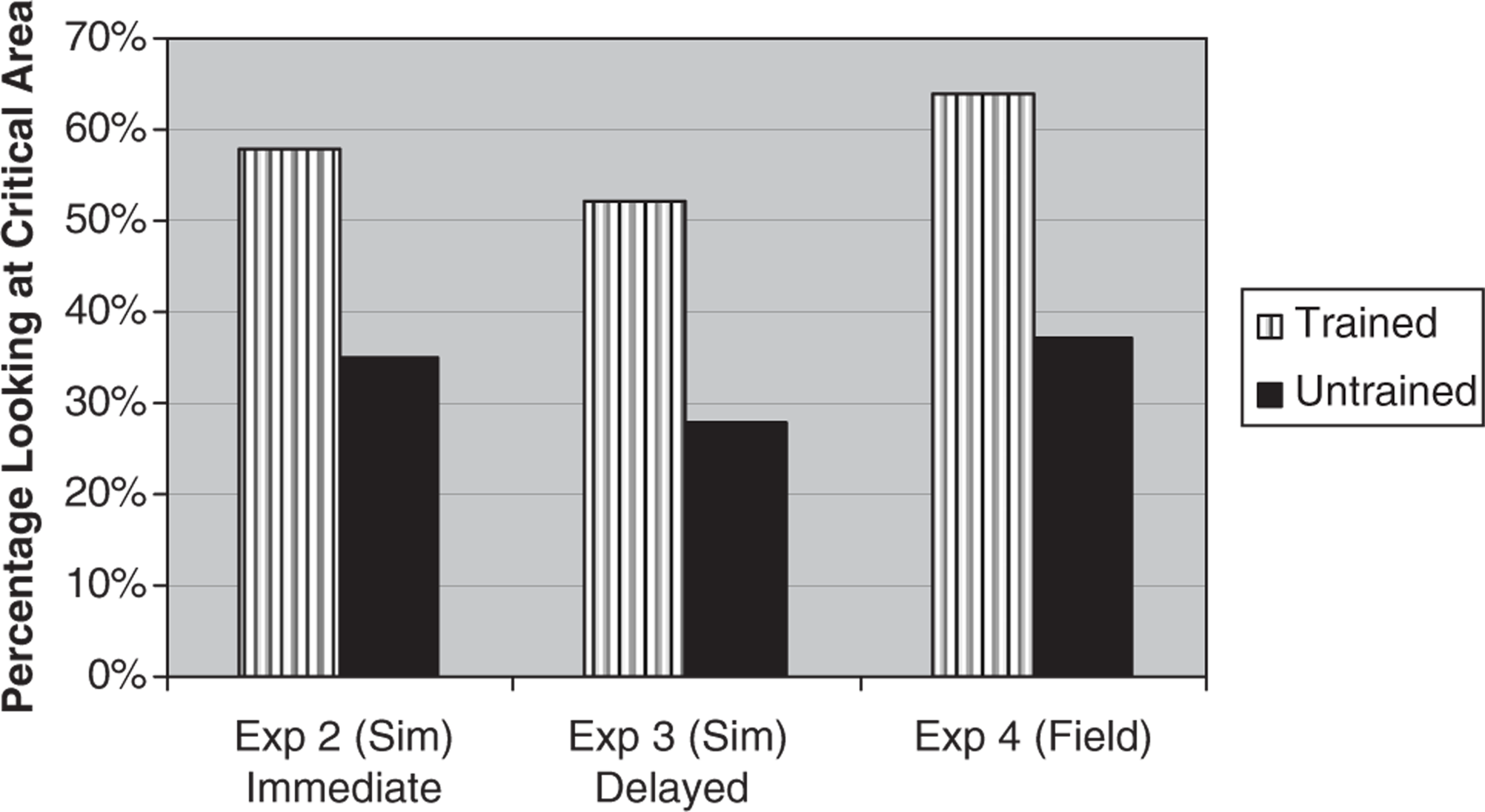
Effects of PC training (using Risk Awareness and Perception Training, RAPT) on probability of novice drivers looking at areas in the roadway environment containing critical information in simulator and field tests. In Experiment 2, simulator evaluation occurred immediately after training; in Experiment 3, simulator evaluation occurred several days after training; in Experiment 4, evaluation occurred in the field—in a car on local roads—immediately after training.
In this study, the test on the simulator was given right after the training. We also ran a follow-up study (Experiment 3), in which the test on the driving simulator was given 3 to 5 days after the training (Pradhan, Fisher, & Pollatsek, in press). (There were only minor changes in the training module.) The data indicated that there was no decrement in the effectiveness of the training caused by the delay. Overall, the trained group fixated the appropriate regions 52% of the time, compared to 28% percent of the time for the control group (Fig. 4). As above, the training effect was highly significant and about equal for far and near transfer (26% and 23%, respectively). Thus, our PC-based risk-awareness training is effective, at least on a driving simulator, both when evaluated immediately after training and 3 to 5 days after training. Three other PC-based risk-awareness driver-training programs have been evaluated on a driving simulator (e.g., DriveSmart; Regan, Triggs, & Godly, 2000) and each inferred the driver's awareness of risk from measures of vehicle behavior (e.g., brake onset time). Ours was the first to use eye behavior.
REMEDYING SELECTIVE-ATTENTION DEFICITS: FIELD STUDIES
The above studies indicate that drivers can be trained to attend selectively to potentially threat-containing areas of the roadway and thereby minimize their risks in a simulated environment. Can the same results be obtained in an actual driving situation on the road? There is one study that used eye movements in the field to assess the effects of PC training on novice drivers' awareness of risks (Chapman, Underwood, & Roberts, 2002). It found that PC-based training increased the percentage of horizontal eye movements in the car; this plausibly represents increased scanning to the side for sources of potential danger. However, one would like to know whether a training procedure actually produces increased awareness of and attention to specific risky situations. Our field study (Experiment 4) had the same basic design as the previous two, but the test was made in a course that we fashioned in the Amherst, Massachusetts, area that contained both urban and relatively rural stretches (Pradhan, Fisher, Pollatsek, Knodler, & Langone, 2006). Most of the crucial scenarios in this course were natural (some were the inspiration for the scenarios used in the training) and one or two were staged (e.g., we parked a van on the side of a street). A lightweight portable eye tracker was used. The vehicles were lent by a driving school. The front passenger seat was occupied by a driving instructor who could step on a second brake in case of emergency; an experimenter in the back seat instructed the driver when and where to turn.
For this on-road test, the RAPT training module was modified and hopefully improved. Instead of relying on the top-down plan views used in earlier training, it also included (and mainly relied on) photographic images. These images were a sequence of still photographs that represented what a driver would see at roughly 3-second intervals when driving in a particular situation. (The complete set of training slides used for the field study is available on the Web at http://www.ecs.umass.edu/hpl; click on “Younger Drivers.”) The drivers' task was similar to that with the plan views: to mark places (with a cursor controlled by a mouse) that might contain information that could reduce the likelihood of an accident, and thus to which attention should be directed. One difference was that, in the training used in the field study, participants needed to respond within 3 seconds for their responses to count. The training also used the plan views to illustrate the geometry of the scenario and why information at a particular location was useful.
As with the studies on the simulator, the eye-movement behavior in the critical scenarios was scored; and again, the effectiveness of training was tested using a trained group and an untrained control group. Overall, there was a highly significant training effect of 27% (64% vs. 37%), and both the 39% training effect for the near-transfer scenarios and the 20% training effect for the far-transfer scenarios were significant (Fig. 4). However, unlike in the earlier studies, the near-transfer effect was significantly greater than the far-transfer effect, possibly due to the greater similarity between the photographic images used during training and the situations actually tested.
DISCUSSION
We think the studies reported above represent a promising start in a research program designed to reduce crashes on the highway; however, they are clearly only a beginning. There are several important “leaps of faith” that we are making. First, looking at an area of the roadway where a potential risk may emerge doesn't guarantee that the driver will respond appropriately to that risk; however, we feel quite safe in concluding that not looking at it will just about guarantee that it will not be responded to appropriately. Second, we are tacitly assuming that the types of scenarios we are training people on are similar to (and will generalize to) the real-world scenarios in which less experienced drivers disproportionally get involved in accidents (McKnight & McKnight, 2003). Although we think this assumption is plausible, we obviously need more concrete evidence. To help bridge the gap, we are beginning a study in which we will train a random half of a large set of just-licensed younger drivers (drivers who have had their licenses for 2 months or less) and then examine their crash rates in the subsequent 6 months (when the crash rates are most elevated).
We also would like to better understand the differences between more and less experienced drivers at a process level and the changes that are effected in training. As we indicated above, one possible reason for differences between more- and less-experienced drivers in attending to relevant locations that are not directly ahead in the roadway is that the less experienced drivers have less structural capacity for this kind of task because they need to focus more attention on the driving task. However, our training studies indicate that, although driving is undoubtedly less automated for less experienced drivers, structural limitations do not put a cap on performance, as our training regimen raised the attentional performance of the trained younger drivers to approximately the level of more experienced untrained drivers. We should also add that, although we did not score the quality of the driving performance (which is difficult to assess objectively), our casual impression was that the driving performance of the trained drivers on the road was, if anything, better than that of the untrained drivers.
Footnotes
Acknowledgements
Various aspects of this research were funded by grants from the Link Foundation for Simulation and Training, the American Automobile Association Foundation for Traffic Safety, the Massachusetts Governor's Highway Safety Bureau, the National Center for Injury Prevention and Control, the National Highway Traffic Safety Administration, and the National Science Foundation (equipment Grant SBR 9413733 for the partial acquisition of the driving simulator).