






Abstract
Hedonic adaptation refers to the process by which individuals return to baseline levels of happiness following a change in life circumstances. Dominant models of subjective well-being (SWB) suggest that people can adapt to almost any life event and that happiness levels fluctuate around a biologically determined set point that rarely changes. Recent evidence from large-scale panel studies challenges aspects of this conclusion. Although inborn factors certainly matter and some adaptation does occur, events such as divorce, death of a spouse, unemployment, and disability are associated with lasting changes in SWB. These recent studies also show that there are considerable individual differences in the extent to which people adapt. Thus, happiness levels do change, and adaptation is not inevitable.
People's greatest hopes and fears often center on the possible occurrence of rare but important life events. People may dread the possibility of losing a loved one or becoming disabled, and they may go to great lengths to find true love or to increase their chances of winning the lottery. In many cases, people strive to attain or avoid these outcomes because of the outcomes' presumed effect on happiness. But do these major life events really affect long-term levels of subjective well-being (SWB)? Dominant models of SWB suggest that after experiencing major life events, people inevitably adapt. More specifically, set-point theorists posit that inborn personality factors cause an inevitable return to genetically determined happiness set points. However, recent evidence from large-scale longitudinal studies challenges some of the stronger conclusions from these models.
ADAPTATION RESEARCH AND THEORY
Although the thought that levels of happiness cannot change may distress some people, researchers believe that adaptation processes serve important functions (Frederick & Loewenstein, 1999). For one thing, these processes protect people from potentially dangerous psychological and physiological consequences of prolonged emotional states. In addition, because adaptation processes allow unchanging stimuli to fade into the attentional background, these processes ensure that change in the environment receives extra attention. Attention to environmental change is advantageous because threats that have existed for prolonged periods of time are likely to be less dangerous than novel threats. Similarly, because rewards that have persisted are less likely to disappear quickly than are novel rewards, it will often be advantageous to attend and react more strongly to these novel rewards. Finally, by reducing emotional reactions over time, adaptation processes allow individuals to disengage from goals that have little chance of success. Thus, adaptation can be beneficial, and some amount of adaptation to life circumstances surely occurs.
Yet many questions about the strength and ubiquity of adaptation effects remain, partly because of the types of evidence that have been used to support adaptation theories. In many cases, adaptation is not directly observed. Instead, it must be inferred from indirect evidence. For instance, psychologists often cite the low correlation between happiness and life circumstances as evidence for adaptation effects. Factors such as income, age, health, marital status, and number of friends account for only a small percentage of the variance in SWB (Diener, Suh, Lucas, & Smith, 1999). One explanation that has been offered for this counterintuitive finding is that these factors initially have an impact but that people adapt over time. However, the weak associations between life circumstances and SWB themselves provide only suggestive evidence for this explanation.
Additional indirect support for the set-point model comes from research that takes a personality perspective on SWB. Three pieces of evidence are relevant (Lucas, in press-b). First, SWB exhibits moderate stability even over very long periods of time and even in the face of changing life circumstances. Recent reviews suggest that approximately 30 to 40% of the variance in life-satisfaction measures is stable over periods as long as 20 years. Second, a number of studies have shown that well-being variables are about 40 to 50% heritable. These heritability estimates appear to be even higher (about 80%) for long-term levels of happiness (Lykken & Tellegen, 1996). Finally, personality variables like extroversion and neuroticism are relatively strong predictors of happiness, at least when compared to the predictive power of external factors. The explanation for this set of findings is that events can influence short-term levels of happiness, but personality-based adaptation processes inevitably move people back to their genetically determined set point after a relatively short period of time.
More direct evidence for hedonic adaptation comes from studies that examine the well-being of individuals who have experienced important life events. However, even these studies can be somewhat equivocal. For instance, one of the most famous studies is that of Brickman, Coates, and Janoff-Bulman (1978) comparing lottery winners and patients with spinal-cord injuries to people in a control group. Brickman et al. showed that lottery winners were not significantly happier than the control-group participants and that individuals with spinal-cord injuries “did not appear nearly as unhappy as might be expected” (p. 921). This study appears to show adaptation to even the most extreme events imaginable. What is often not mentioned, however, is that although the participants with spinal-cord injuries were above neutral on the happiness scale (which is what led Brickman et al. to conclude that they were happier than might be expected), they were significantly less happy than the people in the control group, and the difference between the groups was actually quite large. Individuals with spinal-cord injuries were more than three quarters of a standard deviation below the mean of the control group. This means that the average participant from the control group was happier than approximately 78% of participants with spinal-cord injuries. This result has now been replicated quite often—most existing studies show relatively large differences between individuals with spinal-cord injuries and healthy participants in control groups (Dijkers, 1997).
In addition to problems that result from the interpretation of effect sizes, methodological limitations restrict the conclusions that can be drawn from many existing studies of adaptation. Most studies are not longitudinal, and even fewer are prospective (though there are some notable exceptions; see e.g., Bonanno, 2004; Caspi et al., 2003). Because participants' pre-event levels of SWB are not known, it is always possible that individuals who experienced an event were more or less happy than average before the event occurred. Certain people may be predisposed to experience life events, and these predisposing factors may be responsible for their happiness levels being lower than average. For instance, in a review of the literature examining the well-being of children who had lost limbs from various causes, Tyc (1992) suggested that those who lost limbs due to accidents tended to have higher levels of premorbid psychological disorders than did those who lost limbs due to disease. Thus, simply comparing the well-being of children who lost limbs to those who did not might overestimate the effect of the injury. Psychologists have demonstrated that level of happiness predicts the occurrence of a variety of events and outcomes (Lyubomirsky, King, & Diener, 2005), and therefore, studies that compare individuals who have experienced a particular event with those who have not but that do not take into account previous happiness level must be interpreted cautiously.
A second methodological concern relates to what are known as demand characteristics. When researchers recruit participants specifically because they have experienced a given life event, participants may over- or underreport SWB. These reports may occur because people believe the life event should have an impact, because they want to appear well-adjusted, or simply because the context of the study makes the event more salient. For instance, Smith, Schwarz, Roberts, and Ubel (2006) showed that patients with Parkinson's disease reported lower life satisfaction when the study instructions indicated that Parkinson's disease was a focus than when the instructions indicated that the study focused on the general population.
USING LARGE-SCALE PANEL STUDIES TO ASSESS ADAPTATION TO LIFE EVENTS
Recently, my colleagues and I have turned to archival data analysis using large, nationally representative panel studies to address questions about adaptation to life events. These studies have a number of advantages over alternative designs. First, they are prospective, which means that pre-event levels of SWB are known. Second, they are longitudinal, which means that change over time can be accurately modeled. Third, very large samples are often involved, which means that even rare events are sampled. Finally, because designers of these studies often recruit nationally representative samples, and because the questionnaires often focus on a variety of issues, demand characteristics are unlikely to have much of an effect.
We have used two such panel studies—the German Socioeconomic Panel Study (GSOEP) and the British Household Panel Study (BHPS)—to examine the amount of adaptation that occurs following major life events. The GSOEP includes almost 40,000 individuals living in Germany who have been assessed yearly for up to 21 years. The BHPS includes more than 27,000 individuals living in Great Britain who have been assessed yearly for up to 14 years. We have used these data sets to examine the extent to which people adapt to events such as marital transitions (Lucas, 2005; Lucas, Clark, Georgellis, & Diener, 2003), bouts of unemployment (Lucas, Clark, Georgellis, & Diener, 2004), and the onset of a disability (Lucas, in press-a). At least three important findings have emerged (see Diener, Lucas, & Scollon, 2006, for a more detailed review).
First, long-term levels of SWB do change, and adaptation is not inevitable. In fact, these studies show that there is no single answer to the question of whether people adapt to life events. Instead, the pattern of adaptation varies across different events. Figure 1 shows the average within-person trajectories for life satisfaction before and after various life events. These data show that although the average person adapts to marriage (and this adaptation tends to occur within just a couple of years; Lucas et al., 2003), adaptation to other events is often very slow or incomplete. Widows and widowers return very close (within about .15 points) to the level of life satisfaction that they reported before their spouse died, but this process of adaptation takes approximately 7 years (Lucas et al., 2003). Individuals who get divorced or experience unemployment report what appear to be permanent changes in life satisfaction following these events (Lucas, 2005; Lucas et al., 2004). Furthermore, these changes can sometimes be very large. Individuals who acquire a severe disability report life-satisfaction levels that are more than a full standard deviation below their baseline levels, and these levels do not appear to rebound over time (Lucas, in press-a).
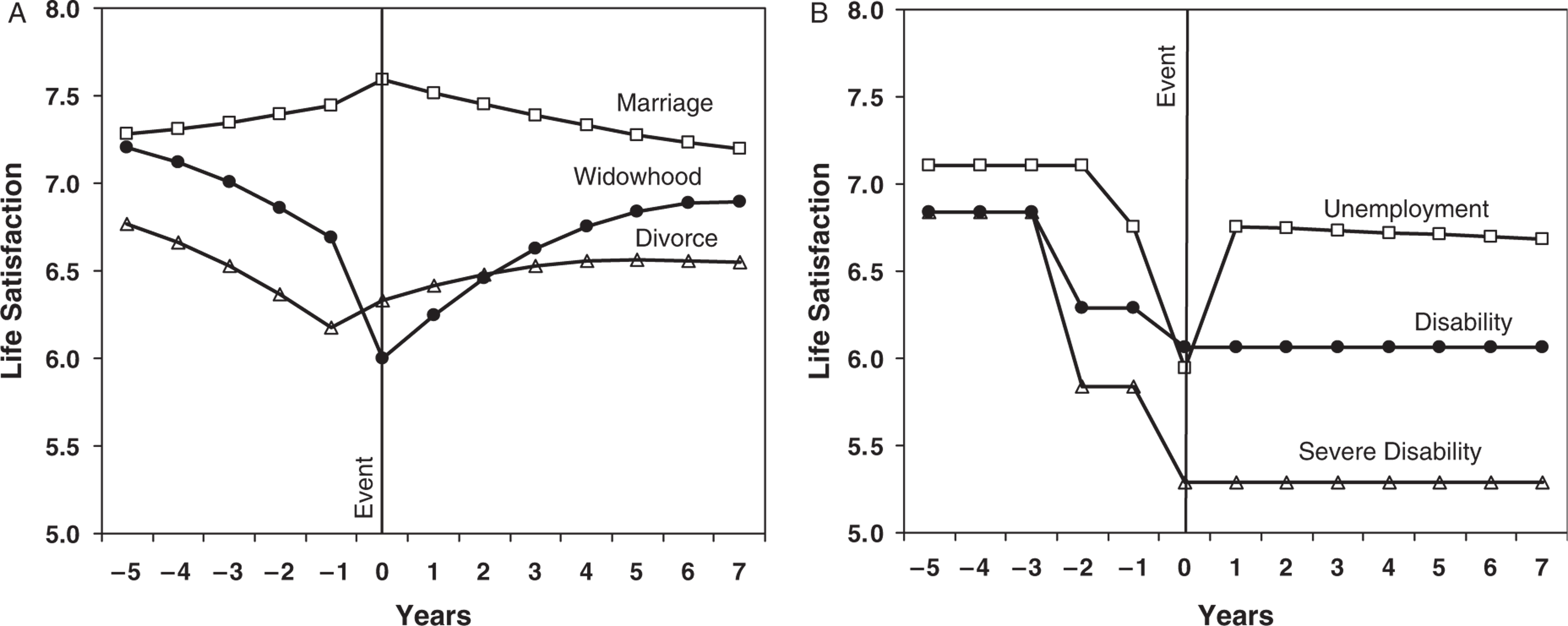
Average within-person trajectories for life satisfaction before and after various life events. Panel A shows reaction and adaptation to marriage, death of a spouse, and divorce. Panel B shows reaction and adaptation to unemployment and the onset of varying degrees of disability. Adapted from Lucas (2005), Lucas (in press-a), Lucas, Clark, Georgellis, and Diener (2003), and Lucas, Clark, Georgellis, and Diener (2004).
A second important finding is that, for all events we have studied, there are large individual differences in the amount of adaptation that occurs. To demonstrate, it is possible to calculate the variability in within-person change that occurs before and after the event. In the case of marriage, very little change occurs on average. However, the standard deviation for the amount of change that occurs was approximately 1.0 (for responses derived from an 11-point scale). This means that approximately 30% of participants reported lasting changes in satisfaction of between a half and a full point, and an additional 32% reported lasting changes of more than a full point. These effects are quite large in relation to the amount of variance that exists in baseline levels of well-being. A participant who began the study with an average level of life satisfaction but experienced a change that was one standard deviation above the mean change would move to the 74th percentile overall in level of life satisfaction. Similarly, someone who experienced a change that was one standard deviation below the mean would move to the 26th percentile overall. These individual differences in reaction and adaptation likely result both from variability in the nature of the event (some marriages are better than others) and from variability in people's reactions to similar events. In either case, the average trajectory does not tell the whole story about the potential for life events to have a major impact on people's long-term levels of SWB.
A third major finding is that people who will eventually experience a major life event often differ from people who will not, even before the event occurs. Therefore prospective longitudinal studies are necessary to separate pre-existing differences from longitudinal change. For instance, cross-sectional studies have consistently shown that married people are happier than single, divorced, or widowed people; yet our studies showed that marriage was not associated with lasting increases in happiness. Instead, people who eventually married were happier than average (or at least happier than those who married and then divorced) even more than 5 years before the marriage (Lucas, 2005; Lucas et al., 2003). People who eventually divorced, on the other hand, started out with lower levels of well-being than those who did not divorce, and they reported lasting changes following this event. These findings are illustrated in Figure 2, in which levels of life satisfaction before and after marriage are plotted for participants who eventually divorced and for those who stayed married. These results suggest that about half of the difference that is typically found between married and divorced individuals in cross-sectional studies is the result of selection effects, and half is the result of lasting changes that follow divorce.
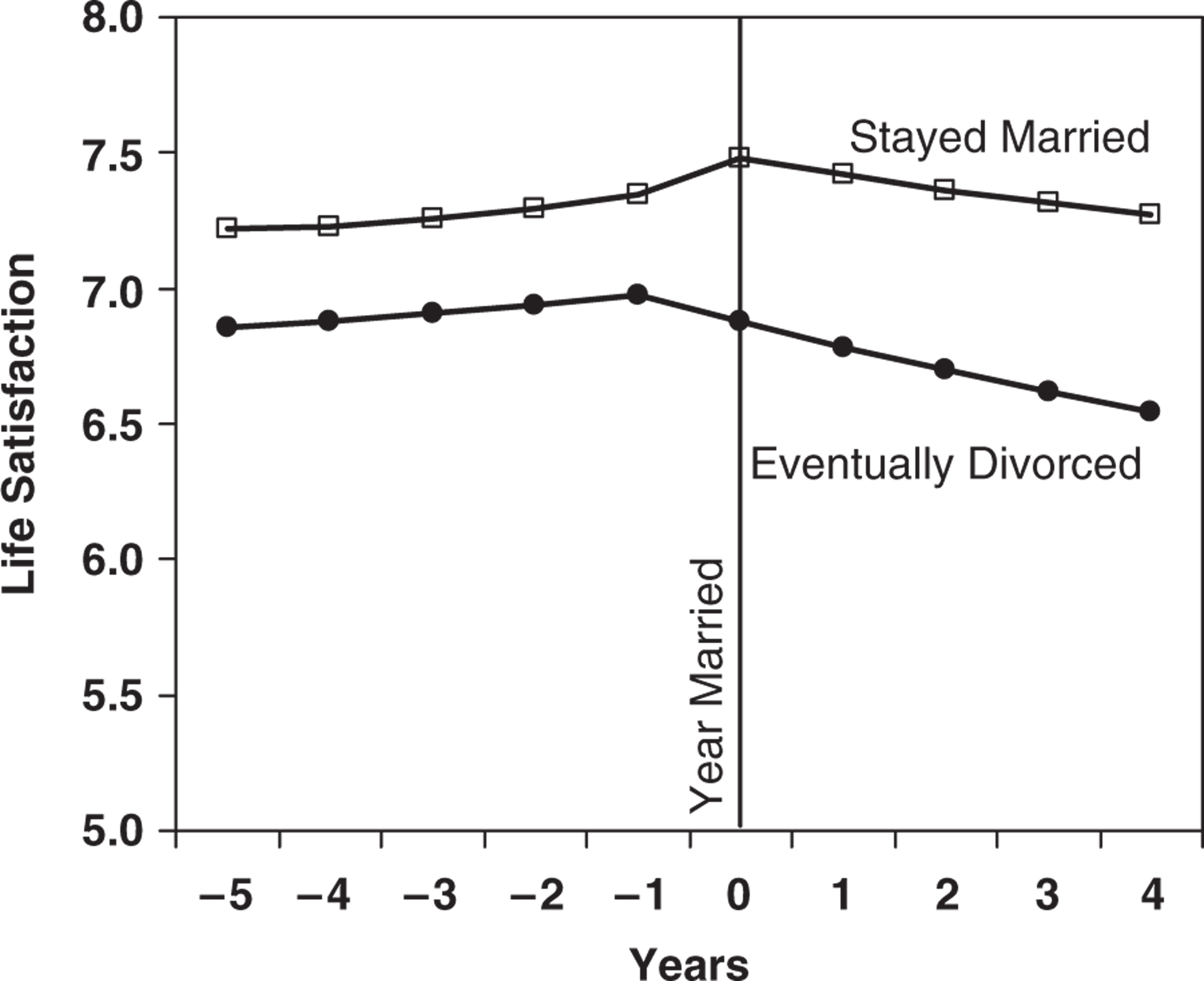
Trajectories of life satisfaction before and after marriage for individuals who remain married and those who eventually divorce. Adapted from Lucas (2005).
FUTURE DIRECTIONS
Although large-scale, nationally representative panel studies are an important tool for answering questions about adaptation, they are not without limitations. The set of psychological variables that has been assessed thus far is relatively limited. This lack of information about psychological characteristics means that moderators and process variables cannot be examined. Future research on adaptation should focus on achieving the following three goals.
First, sophisticated methodologies to assess adaptation to a wide variety of events must be used, so that researchers can develop a clear picture of the events to which people can and cannot adapt. As these events are catalogued, hypotheses about the characteristics that distinguish these events can be formulated and tested. For instance, Frederick and Loewenstein (1999) suggested that people may be able to adapt to one-time events like the loss of a spouse or the onset of an unchanging medical condition but may be less able to adapt to conditions that change or worsen over time.
A second goal is that programmatic research should lead to greater insight into the processes that underlie hedonic adaptation. Adaptation may result from physiological processes that reduce emotional reactivity to constant stimuli, or it could result from psychological processes that change the way people think about events that have occurred in their lives. For instance, adaptation effects may emerge when people disengage from goals that have become unattainable and set new goals toward which they can strive, or it may occur as people develop strengths or acquire new skills that enable them to deal more effectively with less-than-ideal life circumstances.
A third research goal is to clarify the individual-level characteristics that promote or prevent adaptation. Our studies (Lucas, 2005, in press-a; Lucas et al., 2003, 2004) show that there are considerable individual differences in the amount of adaptation that occurs. One fruitful avenue for understanding these individual differences is to look for personality variables that moderate adaptation effects over time. For instance, Bonanno and colleagues have identified distinct trajectories of distress following major traumatic life events like the loss of a spouse or a child (Bonanno, 2004). Notably, characteristics including hardiness, self-enhancement, and positive emotions have been shown to be associated with the most resilient pattern of reactions. In addition, Caspi and colleagues have shown that interactions between stressful life events and specific genes predict the onset of depression (Caspi et al., 2003). It is possible that similar gene-by-environment interactions would also affect reaction and adaptation to life events. Future research must identify additional demographic, social, and personality factors that promote positive reactions to major life events.
IS THERE A HAPPINESS SET POINT?
The studies reviewed in this paper do not refute the set-point model of happiness. Instead, they put the empirical findings that have emerged from that model in a broader context. What does it mean to an individual that happiness is 50% or even 80% heritable? What does it mean that 35% of the variance in well-being is stable over time? Do these empirical facts mean that long-term levels of happiness do not change? The results reviewed in this paper show that the answer to this question is no. They confirm that although happiness levels are moderately stable over time, this stability does not preclude large and lasting changes. Happiness levels do change, adaptation is not inevitable, and life events do matter.