







Abstract
Children acquire complex relational representations of the world. Explaining the acquisition of these representations has been a significant challenge for theories of cognitive development. Recent work suggests that two processes, theory revision and redescription, operate in an iterative, complementary fashion to produce new representations. Given a novel situation, children use theory revision to generate a candidate relational structure and can modify that structure in response to error. Redescription detects regularities created through successful use of that structure in interaction with the environment; these regularities are consolidated into new representations, which are then available to the theory-revision process. The complementary nature of these processes is illustrated by recent work on representational change in a gear-system task and in arithmetic concepts. Theory revision and redescription occupy different, but mutually supportive, niches in knowledge acquisition.
Children appear to rapidly and effortlessly develop an understanding of the complex relational structures in their physical and social environments. For example, children acquire an understanding of the properties of objects, such as the simple fact that one object can physically support another (Casasola, 2005). Likewise, they understand properties of social systems, such as popularity in their peer group (Cillessen & Rose, 2005). Researchers in cognitive development have long recognized that children must possess powerful mechanisms for acquiring new representations in order to develop such a rich understanding of the world. Delineating the mechanisms of representational change has been an important and long-standing challenge for researchers working in the Genevan tradition, grounded in the work of Piaget and his colleagues (e.g., Karmiloff-Smith & Inhelder, 1974; Piaget, 1954), as well as the mainstream cognitive tradition (e.g., Case & Okamoto, 1996; Siegler & Araya, 2005).
Much of this work on children's cognitive development has focused on how children generate hypotheses and test them against external evidence, a process we refer to as theory revision. A smaller body of research has focused on how representations self-modify as a result of their own activity, a process we call redescription. These two processes, theory revision and redescription, although not the only identified mechanisms of representational change, appear to be central to knowledge acquisition. Moreover, recent research shows that these two processes iteratively build on one another, thereby driving the development of knowledge structures. Here we review work demonstrating this complementary relationship.
THEORY REVISION AND REDESCRIPTION
Theory Revision
Previous research suggests that the process of representational change is akin to theory revision (e.g., Halford, Brown, & Thompson, 1986; Kuhn, Garcia-Mila, Zohar, & Andersen, 1995). When a child encounters a novel object or situation, he or she proposes a relational structure among its constituent parts. As the child interacts with the new object or situation, evidence accumulates regarding the adequacy of the hypothesized relational structure. If the hypothesized structure fails to predict the properties of the new object or situation (i.e., generates errors), the child will refine the hypothesis or perhaps propose a completely new one. For example, Halford et al. (1986) gave children information about a block's width, depth, and height and asked them to predict whether it would sink or float. Children proposed initial hypotheses and adjusted those hypotheses based on feedback about the flotation of individual blocks. This process of proposing a relational structure, evaluating it relative to evidence, and changing it in response to error has been demonstrated in a wide variety of domains.
Redescription
Although theory revision is clearly important for knowledge acquisition, evidence suggests that representational change also occurs through redescription. 1 Redescription capitalizes on successful, rather than erroneous, performance (Dixon & Bangert, 2002, 2005; Karmiloff-Smith, 1992; Pine, Lufkin, & Messer, 2004). More specifically, redescription captures regularities embedded in successful interaction with the environment. For example, young children do not understand the relative magnitude of numbers (e.g., that 6 is larger than 4). However, successfully counting objects in a set creates embedded information about the relative magnitude of the set—that is, larger sets require more counting actions. As children repeatedly count the number of objects in sets, the information embedded in their counting actions becomes represented more explicitly (Karmiloff-Smith, 1992); in this way, children become increasingly able to access and manipulate a representation of relative magnitudes. Although theory revision and redescription may initially appear to be competing explanations of how representational changes occur, recent work suggests that they are complementary processes. Each process fills a particular niche in knowledge acquisition.
NICHES IN KNOWLEDGE ACQUISITION
An example of theory revision and redescription occupying separate niches in knowledge acquisition is the representational changes children and adults undergo in solving gear-system problems. In the gear-system task, participants are given the turning direction of the initial gear and asked to predict the turning direction of the final gear in a system (see the upper panel of Fig. 1). Dixon and Bangert (2002) asked 8-, 12-, and 19-year-olds to solve gear-system problems in the context of a computerized game. Participants were encouraged to think aloud, and their strategy use was coded on each trial. Feedback about whether they had correctly predicted the motion of the final gear was provided verbally and visually, but the other gears did not actually move.
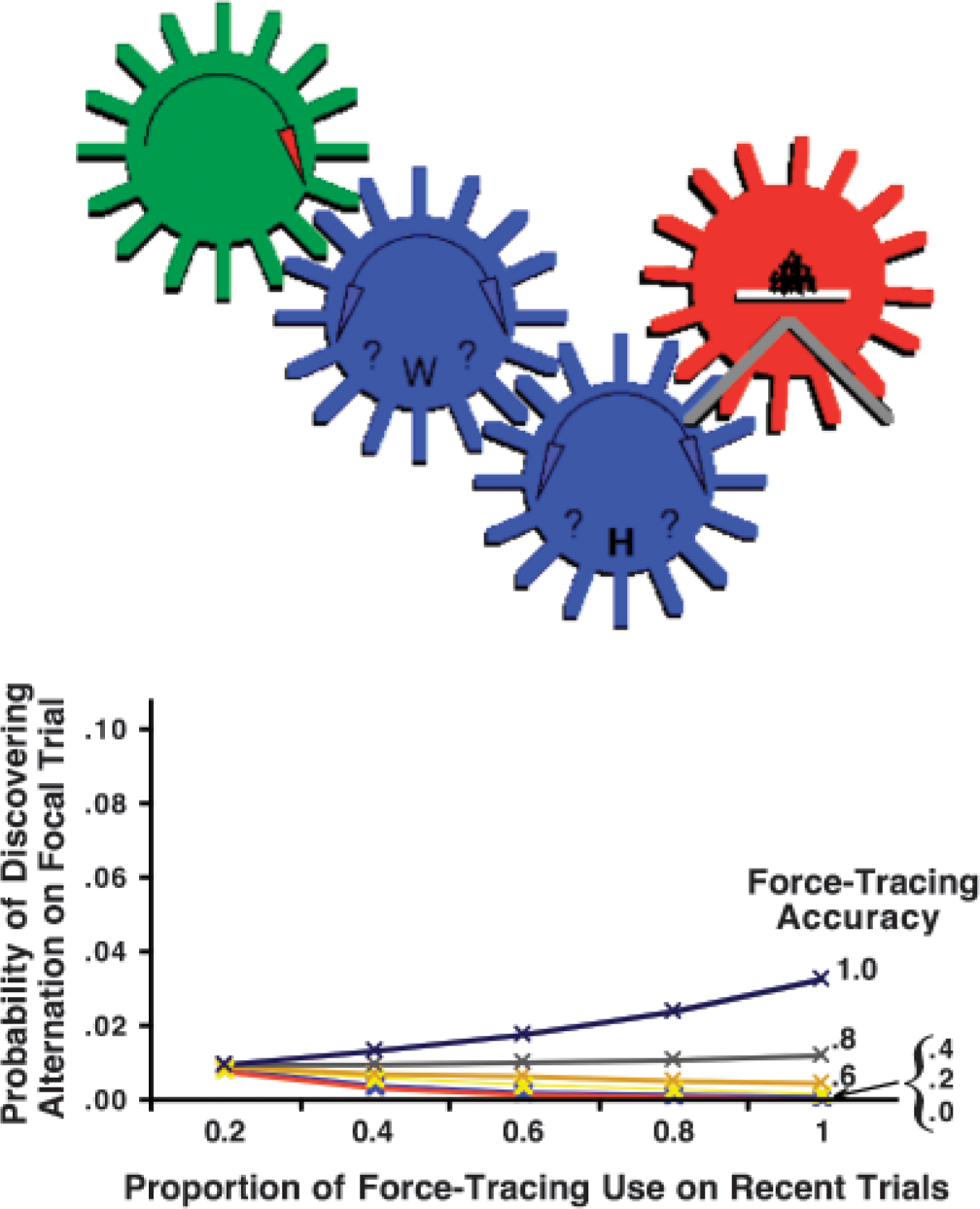
Gear-system task and the probability of discovering the alternation strategy as a function of using the force-tracing strategy, for participants aged 9 to 19 years. The driving gear (green) turns clockwise as indicated by the arrow on its face. Two intermediate gears (blue) connect the driving gear and the target gear (red). Participants were asked to predict the turning direction of the target gear as part of a game in which their train raced another train controlled by the computer. To make their train go faster, participants had to position it to catch the fuel that sat on the shelf of the target gear. When the target gear turned, the fuel fell to one side or the other. Participants selected one of the two ramps below the fuel shelf to indicate which way they thought the fuel would fall. The lower panel shows the probability of discovering the alternation relation (the fact that gears alternate in their direction of rotation) on an individual trial, as a function of recent use of the force-tracing strategy (i.e., tracing the turning force from gear to gear), with separate curves for different levels of accuracy with the force-tracing strategy. Because accurate use of force tracing creates information about alternation, this latter predictor indexes the degree to which participants' episodic memory contained alternation information. As both accuracy and recent use increased, the probability of discovering alternation increased.
Discovering a Representation Through Theory Revision
A substantial proportion of participants, primarily from the two younger age groups, initially used an incorrect approach to solving the gear problem (e.g., proposing that all the gears turned the same way or explicitly just guessing), thereby demonstrating an inappropriate representation of the task. However, over the course of the experiment, many of these participants spontaneously discovered an appropriate representation based on the local forces in the gear system: As a gear turns, its teeth push those of the next gear in the series. By correctly tracing the force (i.e., the mechanical turning and pushing) across the system, participants could determine the motion of the final gear.
To investigate the source of this spontaneous representational change, we used participants' performance on prediscovery trials to predict their discovery of force tracing (i.e., solving the problem by simulating the mechanics of turning and pushing). Two opposing effects implicated theory revision in the discovery of force tracing. First, proposing an incorrect representation on immediately prior trials predicted the discovery of force tracing. Consistent with theory revision, positing a relational structure that produced errors resulted in changing that structure and, thus, increased the probability of discovering an appropriate representation. Second, explicitly guessing on prior trials was negatively associated with discovery (i.e., decreased its probability). Proposing an incorrect representation and guessing produced errors at exactly the same rate, but unlike proposing an incorrect representation, guessing does not engage theory revision.
Discovering a Higher-Order Representation Through Redescription
When performed appropriately, the force-tracing strategy produces correct answers, and all age groups performed fairly well with it (over 80% answered correctly). However, many participants went on to discover a higher-order representation of the system: The gears form an alternating sequence. These participants spontaneously discovered that adjacent gears turn in opposite directions, as evidenced by the participants' sudden shift from tracing the force across the system to categorizing the gears as “clockwise” or “counterclockwise” without reference to physical forces. Discovering alternation in this context is surprising, in part, because nothing in the displayed gear system alternates direction; only the final gear actually moves. The movement of the final gear, which provided feedback about the participant's prediction, occurred after the other gears were occluded by a virtual screen. Crucially, however, the participant's own actions alternate from gear to gear as he or she performs the force-tracing strategy. Tracing the force across the system results in an action pattern that contains alternation information.
We showed that, rather than being driven by errors, discovery of alternation depended on accurate performance with the force-tracing strategy. More specifically, discovering alternation was predicted by (a) having a history of correct performance with force tracing across all previous trials and (b) using force tracing in tight temporal succession on recent trials. The convergence of these two factors dramatically increased the probability of discovering alternation (see the lower panel of Fig. 1). Each correct use of force tracing creates an instance in episodic memory that contains alternation information. When force tracing is used repeatedly and successively, these episodic memories become strongly activated, and their common property, alternation, emerges (Hintzman, 1986). Thus, participants discovered alternation through redescription; their interaction with the task created new information about the system, and that information was consolidated into a new representation.
Theory revision begins with a search for a representation that reduces errors—in the case of the gear system, a representation of physical forces. Repeatedly using this representation reveals a new relational property of the system. By tracing the local forces across the gear system, the participant's actions literally produce new information, the alternation relation. Redescription creates a representation of this new relation. Although the details of the processes underlying the formation of new representations are unknown, our work suggests that episodic memories of actions play a key role (Trudeau & Dixon, in press). Actions create instances in episodic memory, and these episodic memories become increasingly activated as an action is repeated. On reaching a critical level of activation, the traces reorganize into a new representation. Recently, we have explored this process as an instance of self-organization using principles from nonlinear dynamics. The key idea here is to predict the emergence of a new representation based on measures of the changing organizational properties of the system (Stephen, Dixon, & Isenhower, 2006).
REDESCRIPTION IN THE DEVELOPMENT OF ARITHMETIC CONCEPTS
The theory-revision process has been shown to operate across a broad range of levels within the cognitive system, from the perception–action level, as in the gear-system task, to more abstract, conceptual levels such as scientific reasoning. Although data on redescription are still accumulating, the available evidence suggests that redescription also operates across a wide range of cognitive levels. To the extent that the interaction between the proposed representation and the task reveals new relations, redescription appears to be capable of creating representations of those relations. Thus, redescription may play an important role in knowledge acquisition.
For example, redescription captures relations in mathematics that are revealed by performing the arithmetic operations. Because children learn the procedures for computing arithmetic operations, such as addition and multiplication, well in advance of achieving a conceptual understanding of the operations, redescription offers a potential means through which procedures may create relational concepts. For instance, children in 8th grade (approximately 13 years of age), who are quite skilled at multiplying with positive integers, do not yet understand that increasing either operand increases the product. We call this relation the direction-of-effect principle, because it captures how the answer changes in response to changes in an operand (Dixon, Deets, & Bangert, 2001).
To investigate how children might acquire this important principle, Dixon and Bangert (2005) asked participants (aged 9 to 13) to play a game in which the task on each trial was to locate a hidden object (i.e., a tool capable of cleaning up the environment). The object was hidden in one of three “pods” arranged along a vertical number line; thus, each pod corresponded to a region of the number line. A pair of related multiplication problems were presented as clues; the problems always had an operand in common (e.g., 31 × 8 = 248, 23 × 8 = ?). The answer to one problem was shown. The answer to the other problem indicated which pod contained the object.
Given their procedural knowledge of multiplication, participants could generate, via theory revision, an appropriate representation of this task (i.e., computing the answer identifies the correct pod). However, each time they multiplied correctly, information about the direction-of-effect principle was produced; their computed answer was related to the answer presented for the other problem. We showed that change in children's representation of the direction-of-effect principle was predicted by the degree to which they repeatedly and successively produced correct answers, rather than being driven by errors. Just as in the gear task, the relational information created by interacting with the environment was consolidated through strong activation. These effects did not depend on age or participants' accuracy on the task. Thus, using procedural knowledge of multiplication can produce conceptual knowledge of relations, such as direction-of-effect, through redescription.
THE ITERATIVE PROCESS OF KNOWLEDGE ACQUISITION
Theory revision and redescription occupy different niches in knowledge acquisition. Theory revision is a means by which children can effectively search their current repertoire of relations until they find a representation that minimizes error. This type of process operates across a wide range of levels within the cognitive system. Theory revision may also be sensitive to additional parameters beyond success/error, such as efficiency (Goldfield, 1995; Siegler & Araya, 2005). Once theory revision has settled on a relational structure, redescription detects regularities in the interaction between that structure and the environment, ultimately creating a new representation of the relation. The new representation is then added to the child's repertoire of relations and, thus, becomes available to the theory-revision process as a potential hypothesis for subsequent new situations. For example, participants who discovered the alternation relation through redescription were likely to propose alternation on a subsequent, structurally analogous task in which participants were shown a series of balance beams connected end-to-end. Their task was to predict the movement of the final beam, given the movement of the initial beam. The new relation was available to theory revision when a novel situation was encountered. This line of work suggests that redescription creates relational representations that are disembedded or abstracted from their original contexts and thus particularly amenable to transfer (Dixon & Dohn, 2003). In this way, the cognitive system iteratively builds on (i.e., bootstraps) earlier knowledge by capitalizing on the relational information created through even quite simple actions. Figure 2 shows the proposed roles of theory revision and redescription in knowledge acquisition.
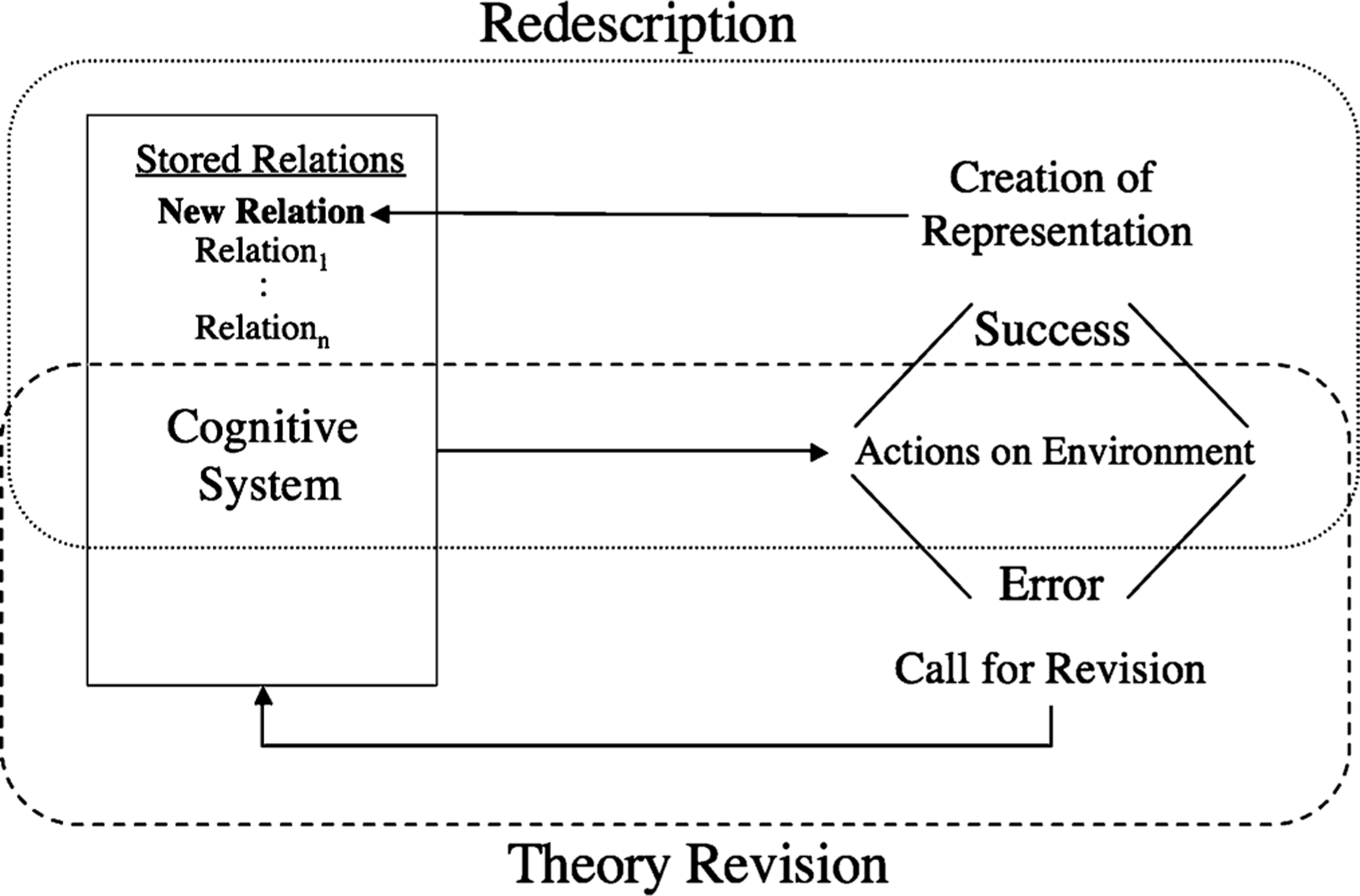
A schematic representation of the roles of theory revision and redescription. In this example, the cognitive system generates a candidate relation from the set of stored relations, resulting in some set of actions in the environment. If the actions generate error, the cognitive system revises the current representation by recruiting another stored relation. This cycle, called theory revision (enclosed by the dashed-line rectangle), repeats until a representation that minimizes error is selected. If the actions generate repeated, successful interaction with the environment, the redescription process (upper rectangle) creates a representation of the new relational information that emerges from that interaction. This new relation becomes stored for later possible use by the theory-revision system.
The important role of action-driven processes (i.e., redescription), in addition to processes driven by error, resonates with recent work in a variety of areas. For example, Gentner and her colleagues have shown that repeatedly comparing the surface features of two objects can reveal their deeper relational commonalities (Namy & Gentner, 2002). Children appear to detect structural relations through repeated, successful alignment of the surface-level features. Recent work in computational modeling has shown that connectionist models that self-organize based on their own patterns of firing may play an important role in development alongside error-driven processes (McClelland, 2006). In this self-organizing regime, called Hebbian learning, connections among nodes become stronger if the nodes fire together. Hebbian learning, which operates without feedback from errors, has been shown to contribute to early structural developments in a variety of systems (e.g., vision).
Current challenges for understanding theory revision and redescription include learning how patterns of action provide the basis for representation. Episodic memory appears to play an important role, but the details of how a representation emerges from the activation of episodic instances of action are not well understood. The self-organizing properties of perception–action systems (Goldfield, 1995) may also be implicated in redescription. As organization emerges at the perception–action level, the higher-order properties of that organization may form the basis for representation. An adequate account of these processes will have important implications for theories of knowledge acquisition.
Footnotes
1The account of redescription presented here has much in common with Karmiloff-Smith's theory of representational redescription (Karmiloff-Smith, 1992). However, Karmiloff-Smith's theory focuses on the quality of the knowledge representations that result from redescription rather than on the details of the process itself. Thus, our account of the process of redescription complements Karmiloff-Smith's work.
Acknowledgements
Portions of the research reported here were supported by National Science Foundation Grant BCS-9996353.