







Abstract
Skilled performance, whether it involves rapid and accurate motor movements (such as playing a video game or using a scalpel in the operating room) or a high degree of domain knowledge (such as finding a small tumor in an X-ray or writing a journal article) typically involves learning and practice over an extended period of time. In light of recent theory and empirical research, I consider two enduring issues associated with skill acquisition: whether individuals become more alike in performance or more different over the course of skill acquisition, and what the determinants of individual differences in skilled performance are. Two broad classes of tasks are considered: tasks that involve speed and accuracy of motor movements and tasks that primarily involve domain knowledge. Issues of practice, ability, and other determinants of skilled performance such as gender and aging are discussed.
It is a profoundly erroneous truism, repeated by all copy-books and by eminent people when they are making speeches, that we should cultivate the habit of thinking of what we are doing. The precise opposite is the case. Civilization advances by extending the number of important operations which we can perform without thinking about them. Operations of thought are like cavalry charges in a battle—they are strictly limited in number, they require fresh horses, and must only be made at decisive moments. (Whitehead, 1911, p. 61).
Although Whitehead was referring to “Civilization” with a capital C, his point is equally relevant to individuals. Consider the daily tasks we engage in, such as showering, getting to work, using a computer, and so on. At some point in our lives, when we were first learning them, these tasks were slow, effortful, and error prone, but for most adults, they have become routine, requiring relatively little thought. Similarly, understanding the daily newspaper is highly effortful if one is not familiar with current events. Such skills and domain knowledge are critical tools without which one would be nearly helpless in today's fast-paced world.
Understanding how individuals develop skills and predicting which individuals are most likely to excel at them are critical issues for psychological research. In fact, the topic of skilled performance and skill acquisition has interested both theorists and applied-oriented psychologists since the beginning of modern psychology (Bryan & Harter, 1899). Of the many related issues addressed, researchers have attempted to answer two fundamental questions pertaining to skilled performance: Does practice on a task make individuals more similar to one another or more different? And what are the determinants of individual differences in skilled performance? Although early efforts focused on obtaining general answers to these questions, in recent years it has become increasingly clear that the answer to both questions is “It depends.” The answers depend on a relatively small number of task characteristics, such as the degree to which the task depends on speed and accuracy of motor movement, the consistency of the relations between stimuli and responses from one occasion of performing the task to another, and the degree to which the task depends on domain knowledge and abstract reasoning abilities.
TASKS INVOLVING SPEED AND ACCURACY OF MOTOR MOVEMENTS
Convergence/Divergence in Skilled Performance
Many real-world tasks involving speed and accuracy of motor movements that are performed on a daily basis are highly consistent in terms of their requirements from one occasion to the next. Even though it may take a considerable amount of time and effort to acquire speed and accuracy for performing a task such as operating an automobile, once the skills are acquired, many aspects of the task can be performed with little or no effort. This is what some investigators have referred to as a rough level of autonomous performance. Allocating more attention to such a task might improve performance (although see Beilock, Carr, MacMahon, & Starkes, 2002), but, generally speaking, acceptable performance is attained even while engaged in other mental activities (such as thinking about one's to-do list while driving to work). For novices at such tasks, however, performance is slow and error prone. On a first trip to a Starbucks, for example, an individual might cause a long line of impatient customers to form while contemplating the translation of small, medium, and large containers into “tall,” “grande,” and “venti” terminology. But a little practice yields a customer who can shout out an order while simultaneously chatting on a cell phone.
For tasks in which initially successful (though slow and error-prone) performance is within the ability of most individuals, consistent practice makes the most difference in terms of performance speed and accuracy. For example, Card, Moran, and Newell (1983) estimated that, when operating a typewriter, there is a 10:1 difference in speed of performance (i.e., time between successive keystrokes) between novices and experts. Differences between individuals, while they may be large for novices, tend to be much smaller after practice (e.g., see Ackerman, 1987). That is, along with a general improvement in speed and accuracy, individuals become more alike in performance once extensive practice is provided—a reduction in the interindividual variance. Figure 1 illustrates how, over the course of 6 hours learning the Kanfer-Ackerman Air Traffic Control Task (a relatively complex task involving declarative and procedural knowledge), mean performance improves substantially while between-individual standard deviations decline.
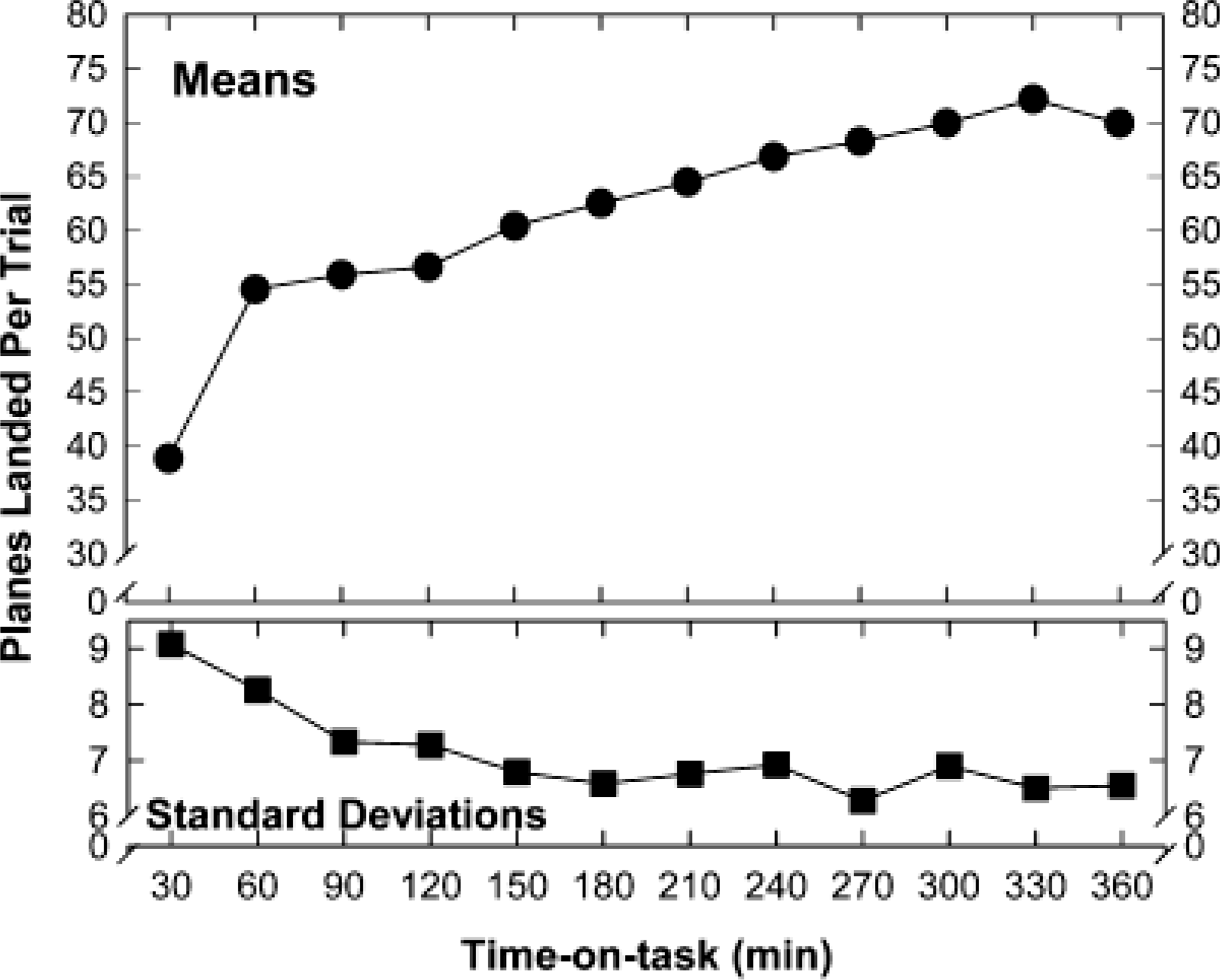
Performance (planes landed per trial) on the Kanfer-Ackerman Air Traffic Control Task. Shown are means and between-individual standard deviations over the course of 6 hours of time-on-task. From data reported in Ackerman & Cianciolo (2000).
For more complex tasks, some individuals may attain highly fast and accurate performance, while others never progress beyond a novice level. This is especially true for tasks that allow for successful performance via differentially effective strategies beyond the capabilities of many novices (e.g., doing addition problems by doing mental operations versus counting on one's fingers and toes) and requiring inconsistent information-processing components (e.g., when one must acquire competing skills, such as might occur if one were trying to simultaneously master two or more different cell phones, two foreign languages, or both a PC and Mac). Under such circumstances, interindividual variances may stay constant or increase over task practice, as those individuals who grasp the optimal solution strategies markedly improve but other individuals are left farther behind (e.g., see Ackerman & Woltz, 1994). (The average parent who tries to keep up with a teenager playing a new computer video game often experiences this kind of situation.) If there are underlying consistencies in the task, however, it is often possible to modify the learning situation by breaking the task into constituent components and providing part-task training for those individuals who cannot grasp the entire task at once.
Determinants of Individual Differences in Skilled Performance
Aside from the sheer amount of practice on consistent tasks, individual differences in abilities appear to play an important role in determining which individuals will reach the highest levels of skilled performance in tasks involving speed and accuracy of motor movements. Content abilities (e.g., verbal, math, and spatial abilities) appear to be especially important in predicting individual differences in performance for novice learners. However, once learners have attained an understanding of the task's requirements and derived an effective strategy for solving it, these abilities tend to be less important predictors of performance. Two other classes of abilities, perceptual speed and psychomotor abilities, appear to be at least as good, if not better, predictors of performance after extensive practice. Perceptual-speed abilities are assessed by a large class of measures that include things like visual scanning, pattern recognition, speeded memory coding, and so on (e.g., Symbol/Digit, Number Checking, Finding As tests). Psychomotor abilities are assessed by measures ranging from fine motor coordination and eye–hand dexterity to gross motor coordination and balance (e.g., Tapping Boards, Maze Tracing, Serial Reaction Time tests). When most learners have achieved a rough level of automaticity, performance appears to be reasonably well predicted by these kinds of measures. Unfortunately, until recently, assessment of perceptual speed and psychomotor abilities required either paper-and-pencil tests, which are time-consuming to score, or specialized testing apparatus, such stopclocks and counters. In the past decade, the introduction of touch-sensitive computer monitors and tablet PCs has made it possible to assess many such abilities using a computer (see Ackerman & Cianciolo, 1999, 2000).
SKILLED PERFORMANCE INVOLVING DOMAIN KNOWLEDGE
Convergence/Divergence in Skilled Performance
When tasks are more dependent on declarative knowledge than on speed and accuracy of motor responding, the answers to the two fundamental questions posed at the start of this paper are generally different. First, for knowledge tasks, whether or not individuals converge in performance levels appears to be determined by whether the task is “open” or “closed.” Closed tasks are those that are bounded by a reasonably finite domain of knowledge. For example, in arithmetic, addition and subtraction are essentially closed tasks, in that once the general knowledge of how to perform these tasks is learned—such as moving from counting on one's fingers to counting mentally (Bryan & Harter, 1899)—there is nothing more to learn that will markedly improve one's performance. But mathematics education as a whole can be considered an open task, because once the individual has mastered addition and subtraction, another new task (e.g., multiplication) is added, followed by additional tasks (algebra, geometry, etc.), until the individual reaches some limit of interest, ability, or time. Even though each new task may be closed, the knowledge demands are generally cumulative, and the probability that the individual may not be able to grasp the new task increases with task complexity. When this happens, there will be an increasing difference between the levels of the highest- and lowest-performing learners (e.g., as illustrated by smaller numbers of individuals reaching the higher levels of mathematics through high school; Campbell, Hombo, & Mazzeo, 2000).
The general phenomenon of increasing variability in knowledge-dependent skilled performance has been referred to as the “fan-spread effect” or the “Matthew effect,” reflecting the notion that the rich get richer while the poor do not (Stanovich, 1986). Figure 2 (Lohman, 1999) illustrates such a pattern on vocabulary test performance from kindergarten to 12th grade. Similar results are found in studies of reading comprehension. Moreover, gains in performance from one year to the next are correlated with initial standing. These results are consistent with Ferguson's (1956) idea that intellectual abilities are most critical in the context of transfer (i.e., when the acquisition of new knowledge is facilitated by existing knowledge).
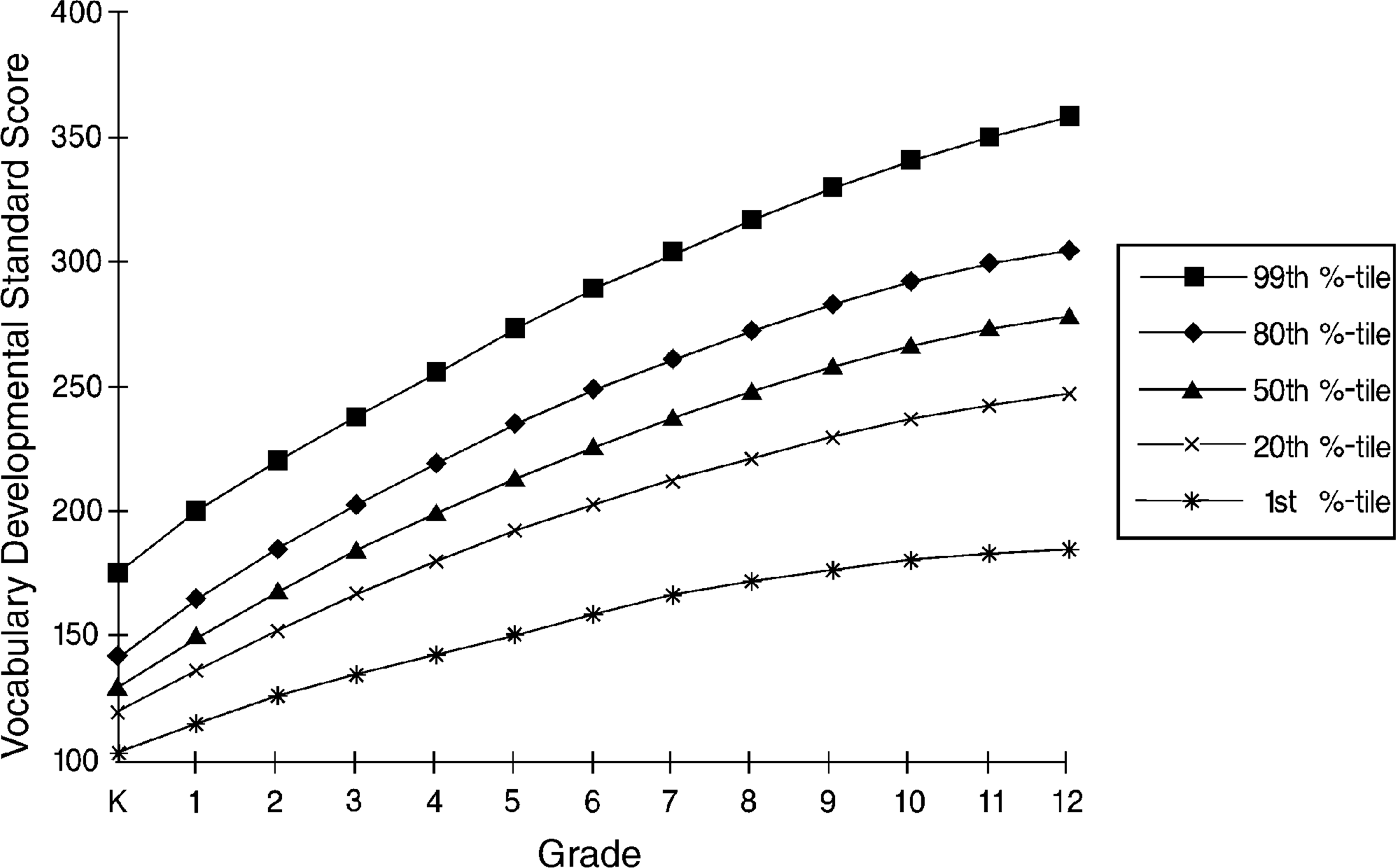
Vocabulary test performance (developmental standard scores on the Reading Vocabulary subtest of the Iowa Tests of Basic Skills) from kindergarten (K) through 12th grade, for students scoring at the 1st, 20th, 50th, 80th, and 99th percentiles within each grade level. Reprinted from “Minding Our P's and Q's,” by D.F. Lohman, 1999, in P.L. Ackerman, P.C. Kyllonen, and R.D. Roberts, Eds., Learning and Individual Differences: Process, Trait, and Content Determinants, p. 60. Copyright 1999, American Psychological Association. Reprinted with permission.
Determinants of Individual Differences in Skilled Performance
The involvement of abilities in determining individual differences in skilled performance on tasks requiring domain knowledge appears to be more diffuse than it is for motor skills, partly because domain knowledge tends to be more highly distributed in the brain than concrete motor skills. For laboratory domain-knowledge tasks that have been mostly stripped of any real-world context, abstract reasoning and short-term/working-memory abilities appear to be substantially related to learning the tasks (Hambrick & Engle, 2002). However, for tasks that allow individuals to use what they know and build on that existing knowledge, individual differences in prior knowledge have a larger effect on the acquisition of new knowledge than do individual differences in working memory—at least among adults between ages 18 and 70 (e.g., see Beier & Ackerman, 2005). Having both high preexisting specific domain knowledge and high general crystallized abilities (e.g., vocabulary, fluency, general knowledge) provides a greater advantage to learners than having a high level of reasoning ability or working-memory ability. In other words, what one already knows is a more important determinant of the knowledge one acquires than one's working memory is—although this difference is much smaller in math and physical sciences than it is in areas such as health literacy or financial planning.
In addition to ability determinants of individual differences in skilled performance on domain knowledge tasks, there are several non-ability trait complexes that are related to both preexisting domain knowledge and the acquisition of new knowledge. Trait complexes (Ackerman, 2003) represent combinations of interests, personality, motivation, and self-concept traits that facilitate or impede the acquisition of domain knowledge. Two trait complexes in particular—intellectual/cultural (which includes artistic interests, verbal self-concept, typical intellectual engagement, and similar traits) and math/science (which includes realistic and investigative interests and math, spatial, and science self-concepts)—appear to have facilitative properties, such that individuals who are higher on these complexes have higher levels of domain knowledge. One trait complex—social/enterprising (which includes related personality traits such as extroversion and social closeness and interest traits such as enterprising and supportive vocational interest themes)—appears to impede domain knowledge, especially in academic domains (Ackerman, 2003).
ADDITIONAL ISSUES
Two findings on individual differences in skilled performance in domain knowledge have emerged in the context of the research described above. The first is that middle-aged adults are a lot more knowledgeable than are young adults in domains as diverse as humanities, civics, health and nutrition, and business/law. This finding runs counter to traditional views on aging, which hold that young adults are more intelligent, on average, than middle-aged or older adults. The second finding is that there are large gender differences in knowledge across many academic domains, and most of these favor males (Ackerman, 2006). These differences appear to have substantial real-world implications, especially in postsecondary education, as they are reflected in Advanced Placement (AP) test performance differences. Males perform, on average, substantially higher on 22 of the AP tests, while females perform substantially higher on only 5 of the AP tests. The reasons for these differences are complex, but given the importance of prior knowledge on the acquisition of new knowledge, they may be important to policy discussions in higher education.
CURRENT STATUS AND FUTURE DIRECTIONS
Across 100 years of psychological research addressing the development of skilled performance, much has been learned. The conditions under which individuals converge or fail to converge over task practice or training are now generally well known. The role of general abilities in the early phases of skill and knowledge acquisition has been extensively documented, though the specific role of other abilities in skill acquisition is not as well worked out. Regardless, it is clear that through a judicious selection of measures, performance at late stages of practice can be well predicted, contrary to mid-century views. Educators and trainers now have several tools they may use to improve the overall delivery of instruction and training.
Although there is a long history of the study of skilled performance in modern psychology, there is a great amount that still is unknown. Although practice is the primary determinant of individual differences in skilled performance of tasks with significant motor requirements, the sheer amount of practice provides only a moderate amount of explanatory power. The kind of practice (e.g., motivated, purposeful) appears to be an important factor, especially for sports and musical skills. Similarly, although crystallized intellectual abilities and facilitative/impeding trait complexes are related to individual differences in both preexisting knowledge and learning, it is not known how these traits relate specifically to an individual's choices of what knowledge to acquire in relatively unconstrained learning situations. Discovering the determinants of which knowledge and skills an individual acquires outside of the classroom or laboratory is a task that awaits longitudinal study.