







Abstract
Déjà vu occurs when one feels as though a situation is familiar, despite evidence that the situation could not have been experienced before. Until recently, the topic of déjà vu remained largely outside of the realm of mainstream scientific investigation. However, interest in investigating the nature of déjà vu is growing among researchers of cognitive processes. In some cases, déjà vu may be understood within the context of research on human recognition memory. Specifically, déjà vu may sometimes result from familiarity-based recognition, or recognition that is based on feelings of familiarity that occur without identification of their source.
Keywords
What produces a déjà vu experience? For over 100 years, thinkers and writers have pondered this question. Explanations have ranged from the paranormal to neurological dysfunction. In recent years, the topic has begun to receive scientific scrutiny, with several theories of déjà vu emerging (Brown, 2003, 2004a, 2004b). The present article focuses on one particular theory, which suggests that déjà vu results from a form of recognition memory known as familiarity-based recognition.
RECOGNITION MEMORY
Recognition memory is the type of memory that allows people to realize that what they are currently experiencing was experienced before, as when one realizes that a face was seen before, or that a song was heard before. In a déjà vu experience, one has a feeling of recognition in the face of evidence that the situation was never before experienced, and the source of that feeling is unclear. Recognition researchers have used a dual-process approach to study such feelings of prior experience (Diana, Reder, Arndt, & Park, 2006; Yonelinas, 2002), with some actually using the example of déjà vu to illustrate how such feelings can sometimes lead us astray (Jacoby & Whitehouse, 1989).
According to dual-process theory, two processes can give rise to recognition memory: recollection and familiarity. Recollection-based recognition occurs when one brings to mind the prior instance in which the current situation previously occurred. For example, you may encounter a man at the grocery store and recognize him by recollecting exactly when you saw him before: He was on the bus yesterday. Familiarity-based recognition occurs when one experiences only a feeling of familiarity with the current situation. For example, you may encounter a man at the grocery store and recognize him as familiar without being able to identify where or when you saw him before.
FAMILIARITY-BASED RECOGNITION
Familiarity-based recognition is more like a feeling than a bringing-to-mind of a specific prior experience, and the source of that feeling may not be identifiable. Jacoby, Kelley, Brown and Jasechko (1989) showed that presenting nonfamous people's names to participants increased the probability of calling those names famous on a fame-judgment task the next day. Presumably, exposure to nonfamous names led to a feeling of familiarity with the names the next day; when that familiarity was unaccompanied by recall of its source, it was misattributed to the famousness of the names.
The idea that feelings of familiarity can occur without identification of their source is central to many laboratory-based methods of separating familiarity-based from recollection-based recognition. An example is the method of eliciting recognition without identification (e.g., Cleary, 2004; Cleary, Langley, & Seiler, 2004; Peynircioglu, 1990), which examines recognition memory in situations where participants cannot identify the experimental source of the familiarity. For example, Cleary and Specker (2007) gave participants celebrity names during a study phase (e.g., Adrien Brody, Jennifer Connelly). Then in a test phase, participants received pictures of celebrity faces, half of which were of people whose names had been studied and half of which were not. Participants attempted to identify each celebrity face on the test and also rated the likelihood that each person's name had been studied. Among faces that went unidentified, participants discriminated between faces of celebrities whose names had been studied and faces of celebrities whose names had not been studied (see Panel A of Fig. 1). The unidentifiable experimental source of the familiarity here was the celebrity name that had been presented at study. In an analogous paradigm with famous scenes, Cleary and Reyes (2008) had participants study names of famous places (e.g., Stonehenge, Taj Majal) and then tested these participants with pictures of famous scenes. They observed a pattern similar to that found for celebrity faces (see Panel B of Fig. 1). Specifically, scene recognition occurred despite an inability to identify the experimental source of the familiarity with a scene, which in this case was the scene name that had been presented in the study phase.
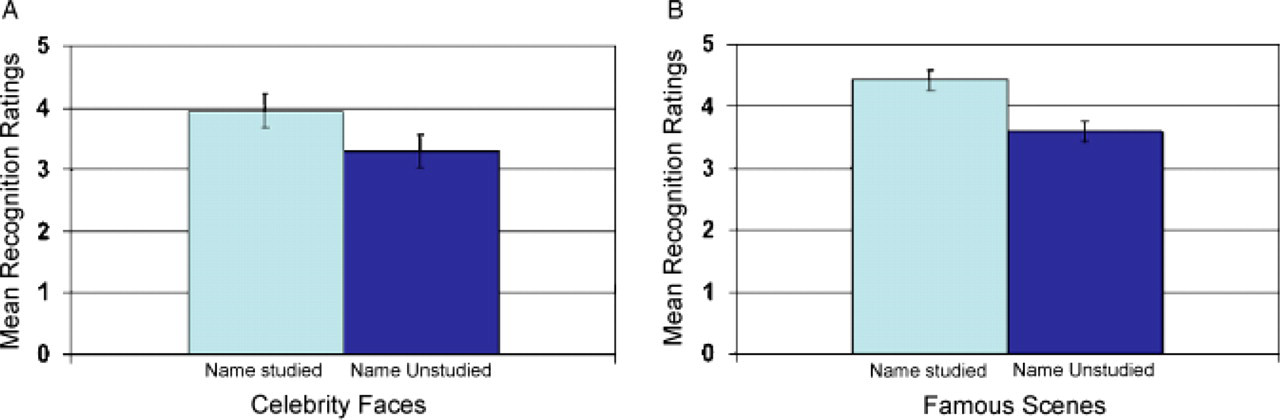
Recognition without identification for faces (A) and scenes (B). In Panel A are the mean recognition ratings given to celebrity faces that could not be identified (Cleary & Specker, 2007). For each celebrity face on the test, participants rated the likelihood that the celebrity's name had appeared on an earlier list (0 = definitely not presented, 10 = definitely presented). Even when participants could not call to mind a celebrity's name, they still had a general sense of whether the face corresponded to a name that had been presented previously. In Panel B, the same pattern is shown with pictures of famous scenes (Cleary & Reyes, 2008). Here, participants had a general sense of which scenes corresponded to scene names that had been presented previously, despite being unable to identify the scenes on the test.
DÉJÀ VU AS A CASE OF FAMILIARITY-BASED RECOGNITION
Déjà vu may represent a form of recognition without identification that occurs in day-to-day life: It may involve recognizing a situation as familiar without identifying the source of that familiarity. In support of this idea, there is a positive relationship between frequency of reported déjà vu experiences and frequency of travel (Brown, 2003), frequency of reported dreams (Brown, 2003; Wallisch, 2007), and frequency of movie watching (Wallisch, 2007). Such relationships would be expected if déjà vu reflects familiarity-based recognition, as people who travel more often, dream more often, and watch movies more often should have more potential sources of familiarity stored in memory than people who experience these activities less frequently. One who watches many movies may be more likely to experience déjà vu when traveling to a new location, as the location (or similar locations) may have appeared in previously seen movies. Such previous exposure could be a source of familiarity with locations to which a person has never been.
Laboratory methods that elicit feelings of familiarity without identification of their source may provide a means of investigating the processes underlying déjà vu. One such method was recently reported by Brown and Marsh (2008), who presented students with pictures of visual scenes from their own college campus and from an unfamiliar college campus. Then, either 1 or 3 weeks later, they tested students' ability to discriminate scenes that had been previously visited from scenes that had not been visited. Prior experimental exposure to pictures of unfamiliar scenes from a distant campus increased memory illusions: Students were more likely to report having been to an unfamiliar location when they had briefly been presented with a picture of that location previously. Presumably, familiarity with the visual scenes, when unaccompanied by memory for that familiarity's source, leads to a sense of having been there before.
WHAT PRODUCES A SENSE OF FAMILIARITY?
What produces an unspecified sense that something has happened before? A longstanding theoretical assumption within the recognition-memory literature is that familiarity is produced by the individual features or elements of a situation. Most models of recognition assume that episodes and events are represented in memory as sets of features, or elements from which the episodes and events were originally composed (see Clark & Gronlund, 1996, for a review of such models). Familiarity-based recognition occurs through a matching of the features or elements of the current situation with the features or elements of previously experienced situations stored in memory. A high degree of overlap between the features of the current situation and the features of previous experiences in memory produces a relatively strong familiarity signal; a low degree of overlap produces a relatively weak familiarity signal. The matching process occurs between the current situation and all prior situations in memory: Thus, a strong familiarity signal can stem from a high degree of overlap between the elements of the current situation and those of one particular prior situation, or it can stem from more global familiarity resulting from a moderate degree of overlap between the current situation and each of multiple prior situations that have been stored in memory.
Feature-based accounts of familiarity can explain the long-established finding that similarity to a previously experienced situation can elicit a feeling of familiarity with it. Familiarity should increase with increases in resemblance (feature overlap) between a given situation and prior situations stored in memory. Thus, a high degree of overlap between the features present in memory and the features present in a given situation can serve both as a source of correct recognition and as a source of familiarity-based memory illusions, including the déjà vu illusion (Lampinen, 2002). Because déjà vu occurs when one experiences a sense of having experienced something before despite evidence to the contrary, déjà vu experiences may be limited to situations in which there is a strong global match producing a feeling of familiarity, an inability to identify the source of the familiarity, and evidence suggesting that the event could not have been experienced before. When a situation meets the first two criteria but not the third, it may simply be labeled as a feeling of familiarity (and not a déjà vu experience). However, in both cases, the underlying process may be the same: It may be familiarity operating in the absence of identification of its source.
Some laboratory-based methods of investigating the features that can produce familiarity capitalize on the idea that familiarity can stem from the similarity of an event to ones that were previously experienced. In a variation of the recognition-without-identification method (Cleary, 2004), participants viewed words (e.g., raft, eighty) during the study phase. On a later recognition test, some of the items resembled studied items on a particular feature dimension, such as phonology (e.g., laughed and lady resemble raft and eighty phonologically), while others shared no resemblance to studied items. Even when unable to identify the studied items that the test items resembled (such as when the study word raft could not be identified as the source of a feeling of familiarity with the test word laughed ), participants discriminated between test items that resembled studied items and those that did not. This suggests that resemblance can be used to study the types of features, such as a word's phonological features, that produce feelings of familiarity.
Just as feature overlap with studied items can produce familiarity-based recognition of test items in laboratory situations (e.g., Cleary, 2004), the features of a real-life situation may overlap with those stored in memory to produce feelings of familiarity. Such feature overlap may at times give rise to a déjà vu experience. Brown (2003, 2004a) suggested some ways in which feature overlap between a new scenario and a previously experienced scenario might produce déjà vu. One way might be that a single feature or element of a new situation was also part of a previously experienced situation. For example, a person might enter a room that has a lamp that had been seen previously in another location. In the absence of retrieving the source of the feeling of familiarity produced by the lamp, the entire situation may seem strangely familiar and may be labeled as a déjà vu experience. Configuration might be another feature that can produce familiarity. For example, one may enter a home for the first time, and the layout of the home may resemble the layout of a home visited previously, giving rise to familiarity. Note that these examples are day-to-day analogues to the laboratory method of using resemblance (Cleary, 2004), in which test items resemble studied items on one particular feature dimension to produce familiarity.
Whereas resemblance is one method of studying the types of features that can produce familiarity (e.g., Cleary, 2004), feature isolation is another. Cleary et al. (2004) used fragmentation to isolate particular stimulus features on a recognition test. After studying a list of pictures of objects (e.g., airplane, stool), participants were given a recognition test containing picture fragments, some from studied and some from nonstudied pictures. Sometimes, the fragments contained isolated geometric shapes from their corresponding pictures; in other cases, the fragments contained only line-segment information without component-shape information. Recognition without identification was evident when the picture fragments contained geometric shapes from their original pictures but not when the picture fragments contained only line-segment information. In short, people could use objects' component shapes to recognize pictorial information as familiar when unable to identify the experimental source of that familiarity, the source in this case being the study episode that produced the familiarity (e.g., the picture of the airplane that appeared at study). Thus, component shapes of an object appear to be a type of feature that can produce familiarity with it.
A potential disadvantage to the method of feature isolation is that real-life situations that evoke familiarity (as when recognizing a face or a scene as familiar while being unable to identify the source of the familiarity) do not generally involve features in isolation. In such real-life situations, the stimuli are more likely to overlap in features with information in memory through resemblance, such as when a new stimulus contains a subset of familiar elements from a prior situation, as in Brown's (2003, 2004a) example of déjà vu experiences brought on by familiar elements within a scene. Thus, the method of relying on resemblance to investigate the kinds of features that may produce familiarity (e.g., Cleary, 2004) may more closely approximate real-life situations of familiarity-based recognition.
FUTURE DIRECTIONS
Future research should aim to identify the situational features (e.g., spatial configuration, specific familiar elements) that can produce déjà vu. Future studies might also examine whether familiarity processes also underlie experiences that relate to déjà vu, such as jamais vu and presque vu. Jamais vu is a feeling of unfamiliarity with a situation that should be familiar. Brown (2004b) hints at a possible link between jamais vu and “word blindness,” which can occur when a person stares at a word long enough for it to look as if it is not a word. Indeed, recent research suggests that overexposure to a stimulus can saturate its memory representation, thereby decreasing the level of familiarity that it evokes (Huber, Clark, Curran & Winkielman, in press); this may be a promising avenue for investigating jamais vu in the laboratory.
Presque vu is the feeling that one is on the verge of an epiphany. Research suggests that people generally have little warning that an actual moment of insight is imminent (Metcalfe & Wiebe, 1987). However, it is possible that presque vu results from feelings of familiarity that are not necessarily predictive of an epiphany. Some research suggests that actual moments of insight can result from the detection of an analogical relationship between an unsolved problem and a situation in memory (Gick & Holyoak, 1980). It is possible that when analogical resemblance to a memory is detected in the absence of an ability to identify the source analogy in memory, a sense of familiarity that feels like a near-epiphany results. If so, such a feeling may be related to tip-of-the-tongue experiences. Research in my laboratory is currently investigating these ideas.
Finally, future research might also examine an apparent paradox with regard to the familiarity explanation of déjà vu: Familiarity-based recognition is thought to remain fairly impervious to aging, whereas the ability to recollect the sources of memories declines (Mantyla, 1993); yet, frequency of reported déjà vu experiences declines with age (e.g., Brown, 2003). Because reliance on familiarity likely increases with age, people may become accustomed to experiencing familiarity-based recognition as they age. Thus, older people may frequently attribute feelings of familiarity to failures of recalling specific prior experiences or to forgetting rather than labeling them as déjà vu instances.
In summary, there is growing acceptance that déjà vu can be studied scientifically; there is also a growing repertoire of laboratory methods for probing its mechanisms. Many parallels between explanations of déjà vu and theories of human recognition memory exist. Theories of familiarity-based recognition and the laboratory methods used to study it may be especially useful for elucidating the processes underlying déjà vu experiences.