







Abstract
Two world trends are powerfully reshaping human existence: the degradation, if not destruction, of large parts of the natural world, and unprecedented technological development. At the nexus of these two trends lies technological nature—technologies that in various ways mediate, augment, or simulate the natural world. Current examples of technological nature include videos and live webcams of nature, robot animals, and immersive virtual environments. Does it matter for the physical and psychological well-being of the human species that actual nature is being replaced with technological nature? As the basis for our provisional answer (it is “yes”), we draw on evolutionary and cross-cultural developmental accounts of the human relation with nature and some recent psychological research on the effects of technological nature. Finally, we discuss the issue—and area for future research—of “environmental generational amnesia.” The concern is that, by adapting gradually to the loss of actual nature and to the increase of technological nature, humans will lower the baseline across generations for what counts as a full measure of the human experience and of human flourishing.
Technology has begun to change our species' long-standing experiences with nature. Now we have technological nature—technologies that in various ways mediate, augment, or simulate the natural world. Entire television networks, such as the Discovery Channel and Animal Planet, provide us with mediated digital experiences of nature: the lion's hunt, the Monarch's migration, or a climb high into the Himalayan peaks. Video games like Zoo Tycoon engage children with animal life. Zoos themselves are bringing technologies such as webcams into their exhibits so that we can, for example, watch animals from the leisure of our home or a café. Inexpensive robot pets have been big sellers in the Wal-Marts and Targets of the world. Sony's higher-end robot dog AIBO sold well. Real people now spend substantial time in virtual environments (e.g., Second Life).
In terms of the physical and psychological well-being of our species, does it matter that we are replacing actual nature with technological nature? To support our provisional answer that it does matter, we draw on evolutionary and cross-cultural developmental accounts of the human relation with the natural world and then consider some recent psychological research on the effects of technological nature.
BIOPHILIA—AN EVOLUTIONARY ACCOUNT OF THE HUMAN RELATION WITH NATURE
E.O. Wilson (1984) coined the term “biophilia” to refer to what he and his colleagues hypothesized is a fundamental, genetically based human need and propensity to affiliate with “life and lifelike processes” (p. 1; see also Kellert & Wilson, 1993). Studies have shown, for example, that even minimal connection with nature—such as looking at it through a window—can promote the healing of hospitalized patients, can increase health in the workplace, and can reduce the frequency of sickness in prisons. In hundreds of other studies, interaction with pets has been shown to benefit a wide range of clinical patients—from adults with Alzheimer's disease to children with autism—as well as people within the general population. Young children develop rich interactions with animals (Myers, 2007). Based on preference ratings for different sorts of landscapes, people tend to prefer natural environments more than built environments, and built environments with water, trees, and other vegetation more than built environments without such features (Kaplan & Kaplan, 1989). Indeed, it would appear more than a mere cultural convention that flowers are often sent to people who are in the hospital or who are going through periods of mourning. The need and propensity to affiliate with nature appears great, as do the resulting benefits.
The evolutionary explanation for biophilia is akin to the evolutionary explanation for most behaviors: During ancestral times certain genotypes made certain behavioral responses more frequent; some of those responses increased the chances of the organism's survival and reproductive success, causing those genotypes to spread through the population and through the centuries, and finally to us in modern times. Thus, according to proponents of biophilia: (a) Biophilia has been adaptive in our evolutionary history, (b) biophilia is still today woven into the architecture of the human mind, and (c) the human species cannot achieve its full measure of sensibility and meaning apart from the natural world.
Four questions have structured much of the debate around biophilia. One question arises when biophilia is understood largely as a genetically determined affiliation: When it is cast this narrowly, where is the place for cognition, free will, development, and culture? We take up aspects of this question in the next section. A second question is whether biophilia includes only the human affiliation with life (the “bio” part of biophilia) or whether it should also include the human affiliation with nonliving nature, such as mountains, canyons, caves, and geysers. In our view, biophilia should include the human affiliation with nonliving nature, and this opens up an interesting line of future research. A third question is whether biophilia includes only positive “loving” relations to nature (the “philia” part of biophilia). We believe that biophilia makes the most sense (and charts a more productive research program) when it incorporates both positive and negative affiliations. A fourth question is whether biophilia is cast so broadly that it can never be disconfirmed. Our answer: Perhaps so! That is troubling, from the scientific perspective. Yet it may be that biophilia is best understood not as a testable hypothesis in and of itself (any more than, say, the idea that people have an affinity for other people) but as a broad construct that helps to generate hundreds of important testable empirical questions and gives voice to the importance of the human–nature affiliation.
CHILDREN'S ENVIRONMENTAL REASONING AND VALUES
If the construct of biophilia has merit—and we believe it does—it still leaves unanswered major questions about the development and cultural underpinnings of the human relation with nature. Toward addressing these questions, Kahn (1999) and his colleagues conducted a series of cross-cultural studies on children's environmental reasoning and values. Populations included, for example, African American children (ages 7, 9, and 11) in the inner city of Houston, Texas (Kahn & Friedman, 1995); Brazilian children (age 14) in an urban setting and in a remote location in the Amazon rainforest (Howe, Kahn, & Friedman, 1996); and Portuguese children and adolescents (ages 10, 13, 16, and 19) in Lisbon (Kahn & Lourenço, 2002). The methods were aligned with structural-developmental theory (Turiel, 1983), which posits that children's conceptual knowledge undergoes qualitative changes in development through interaction with the physical and social world. Children were interviewed individually, with structured questions focused on such topics as water pollution, air pollution, parks and open spaces, plants, forests, individual animals, species, and living in harmony with nature. For example, one representative question (of 42 total questions) in Kahn and Lourenço (2002) was: “Let's say that in Lisbon everyone throws their garbage in the river, would that be all right or not all right?” (p. 410).
Across studies, results showed that animals, plants, and parks and open spaces played an important role in children's lives. Children were aware that water pollution can harm birds, water, insects, and landscape aesthetics. Moreover, it mattered to children that harm might occur to each of these environmental constituents. Based on measures that controlled for magnitude of environmental harm and proximity to harm, children also believed that polluting a waterway violates a moral obligation. Other results across the above studies showed two overarching forms of children's environmental reasoning: anthropocentric and biocentric. Anthropocentric reasoning concerns the ways that affecting the environment affects human beings—including appeals to personal predilections, aesthetics, justice, and physical, material, and psychological welfare considerations. Biocentric reasoning, while allowing for human interests, fundamentally concerns the moral standing of nature—including appeals to the intrinsic value of nature and justice for its constituents (e.g., animal rights). Quantitatively, across studies (and across cultures), anthropocentric reasoning was the predominant form of children's reasoning, with only about 4% of the children offering biocentric reasons. Thus one important finding from this body of research is that children in diverse cultures—and even in harsh urban landscapes—have meaningful and moral relations with nature in at least some respects.
TECHNOLOGICAL NATURE
Recall that Wilson defined biophilia as the human affiliation with life and lifelike processes. To our knowledge, Wilson has never elaborated on what he means by lifelike processes. But the idea is provocative. Might interacting with lifelike nature—technological nature—provide humans the same psychological experience and benefits as actual nature?
Toward addressing this question, Kahn and colleagues have embarked on a research program cutting across different technological forms. One form involves high-definition television (HDTV)-quality real-time views of nature through a 50-inch plasma-display “window.” In one study (Friedman, Freier, Kahn, Lin, & Sodeman, 2008), these plasma windows were installed in windowless offices of seven faculty and staff in a university setting (Fig. 1a). As shown in Table 1, over a 16-week period, we assessed participants' practices, judgments, beliefs, and moods. Results showed that participants enjoyed the plasma-display window and benefited from it in terms of their psychological well-being, cognitive functioning, and connection to the natural world.
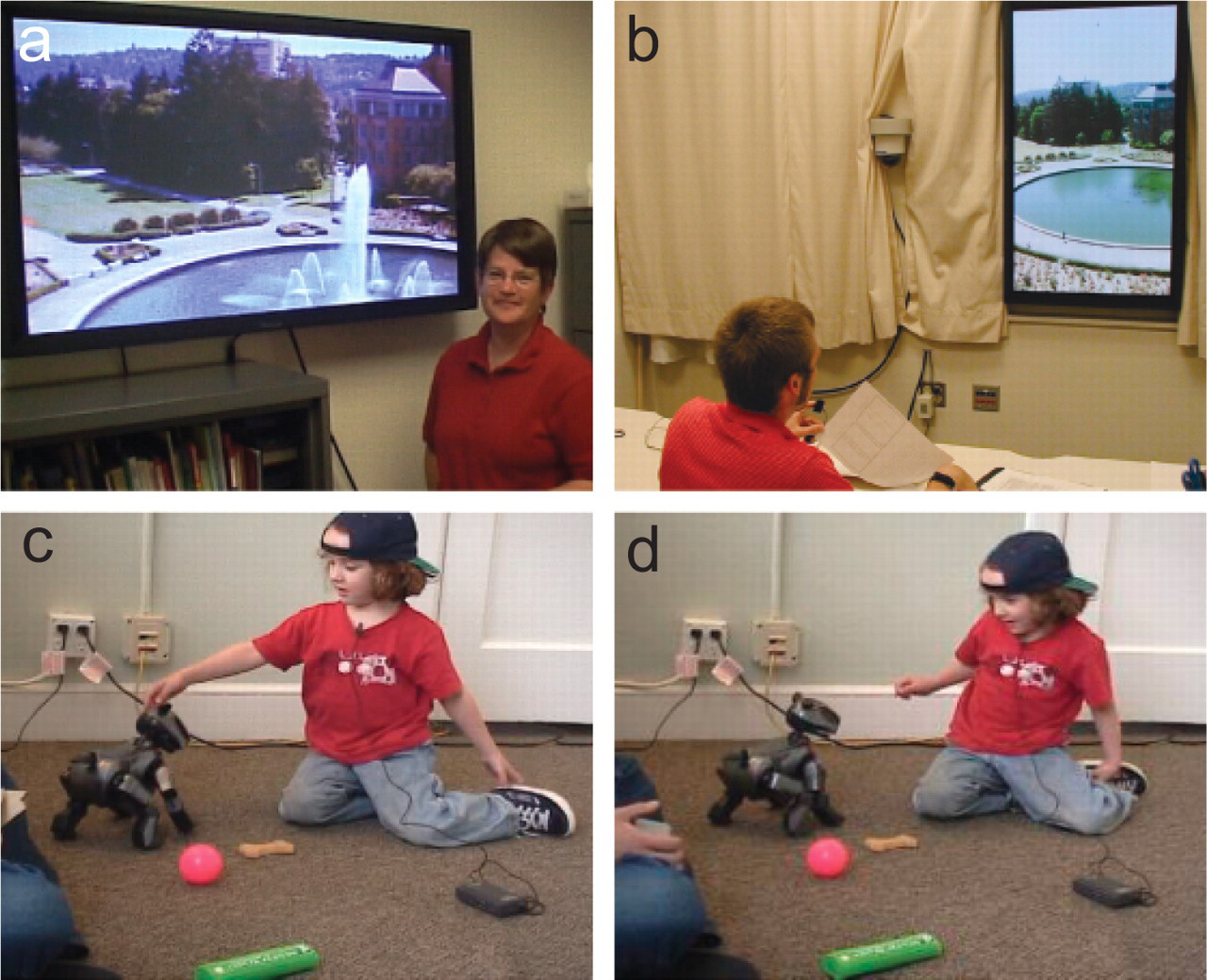
Examples of technological nature. HDTV plasma “windows” displaying real-time images of the local nature scene outside the building are shown (a) installed in a participant's office in a long-term field study (Friedman, Freier, Kahn, Lin, & Sodeman, 2008); and (b) covering up a real window in the plasma-window condition of an experimental study in the lab (Kahn et al., 2008). The camera that recorded looking behavior can be seen poking out from the drapes to the left of the plasma window. The plasma screen was not present in the glass-window condition of the experimental study; and the drapes were pulled across the entire wall for the blank-wall condition. The bottom pictures show technological nature in the form of a robot dog (AIBO; from Kahn, Friedman, Perez-Granados, & Freier, 2006). In (c), the participant has just been introduced to AIBO and approaches the robot a little apprehensively. Within a couple of seconds, AIBO begins to move toward the participant; in (d), the participant is startled and appears slightly apprehensive (not unlike how a person might respond when encountering a biological dog that he or she has never met before).
Summary of Technological Nature Studies and Their Key Results
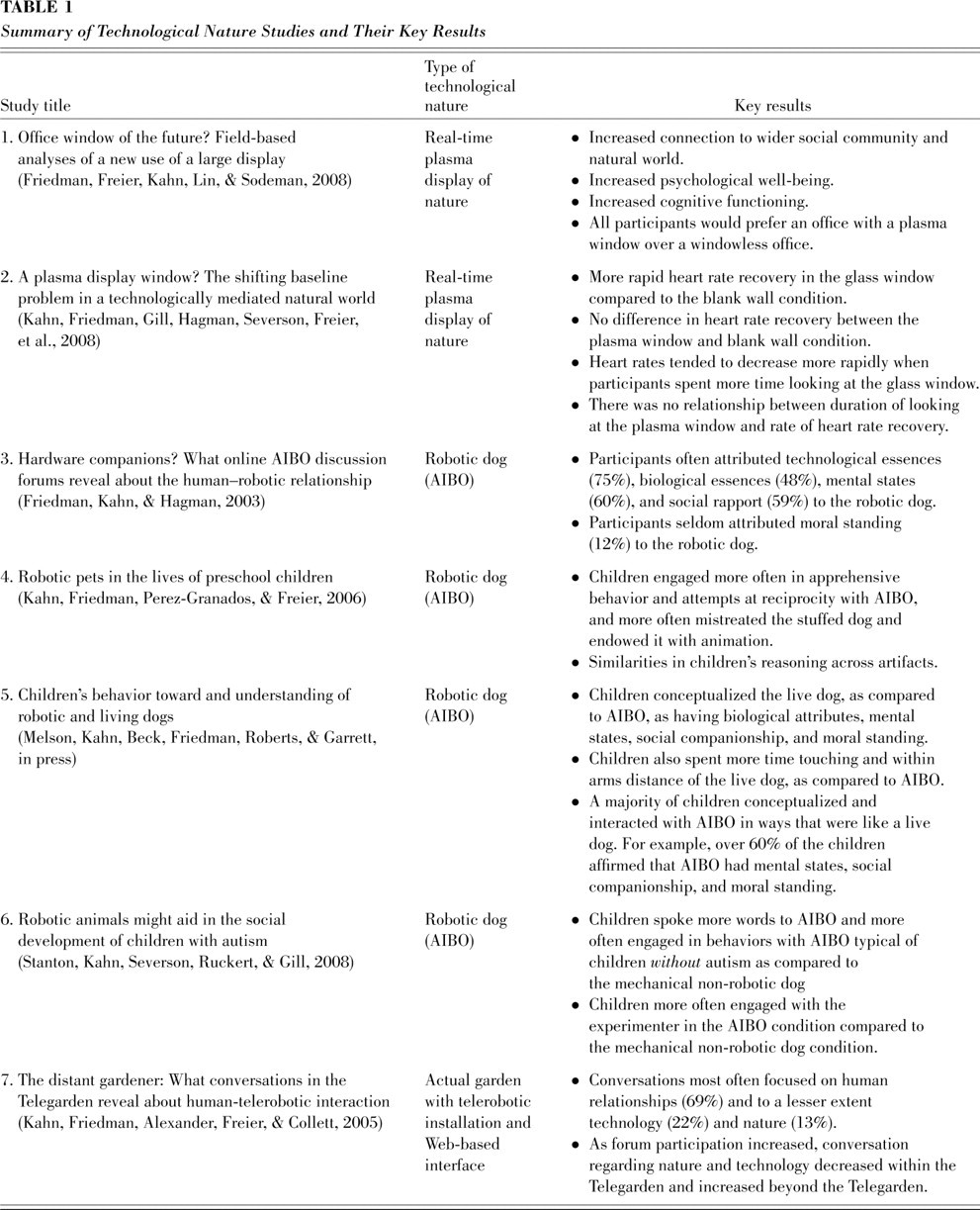
This study suggests that experiencing one kind of technological nature may be better than experiencing no nature at all. But is this type of technological nature as good as actual nature? To address this question, we conducted another study (Kahn et al., 2008), in which 90 participants (30 per group) in an office setting were exposed either to (a) a glass window that afforded a view of a nature scene, (b) a plasma window that afforded a real-time HDTV view of essentially the same scene (Fig. 1b), or (c) a blank wall. As shown in Table 1, we found that, in terms of heart-rate recovery from low-level stress, the glass window was more restorative than a blank wall, but a plasma window was no more restorative than a blank wall. Moreover, when participants in the glass-window condition actually looked out the glass window, their heart rate tended to decrease more rapidly than when they were not looking out the glass window. (In the plasma-window condition, there was no difference in heart-rate recovery when participants looked at the plasma window vs. when they looked elsewhere.)
Taking both studies together, the plasma nature window appears better than no nature but not as good as actual nature. We are finding supporting evidence of this pattern in our other five studies across two other forms of technological nature: an advanced robotic dog (AIBO) and a Telegarden—an actual garden in Austria that allowed remote “gardeners” to plant and tend seeds by controlling a robotic arm through a Web-based interface (see Table 1). For example, in Melson et al. (in press) children and adolescents more often affirmed that a live dog, in comparison to AIBO, had mental states (83.6% live dog, 56.2% AIBO), could be a companion (91.4% live dog, 70.0% AIBO), and had moral standing (86.3% live dog, 75.7% AIBO). What is particularly interesting in not just that AIBO was not as compelling as a live dog, but that AIBO was as compelling as it was. AIBO also appears somewhat compelling as a social other to adults. As highlighted in Table 1, 60% of anonymous (presumably adult) AIBO owners spontaneously affirmed in their postings in AIBO online discussion forums the social standing of AIBO. For example, one AIBO owner wrote:
Oh yeah I love Spaz [the name for this member's AIBO], I tell him that all the time. … When I first bought him I was fascinated by the technology. Since then I feel I care about him as a pal, not as a cool piece of technology. I do view him as a companion, among other things he always makes me feel better when things aren't so great. I dunno about how strong my emotional attachment to him is. … I find it's strong enough that I consider him to be part of my family, that he's not just a ‘toy,’ he's more of a person to me.
CONCLUSION
Let us imagine that, as more research emerges on the topic of technological nature, the general trend we have found so far holds up: namely, that interacting with technological nature provides some but not all of the enjoyments and benefits of interacting with actual nature. At first glance, such a finding would speak to how we can improve human life: When actual nature is not available, substitute technological nature. But such substitutions contribute to an insidious problem. Let us explain.
In the study of African American children's environmental views and values in Houston, Texas (Kahn & Friedman, 1995) that we described earlier, results showed that a significant number of the children understood the idea of air pollution; but they did not believe that Houston had such a problem even though Houston was then (and still remains) one of the most polluted cities in the United States. In interpreting these results, Kahn and Friedman suggested that these children may have lacked a comparative experiential baseline from areas with less pollution by which to recognize that Houston was itself polluted. Granted, it is not possible to exclude the counterexplanation that the children had simply not yet learned about their local pollution.
Nonetheless, the comparative-baseline interpretation is consistent with the phenomenon of the “shifting baseline” as described by other researchers. Pauly (1995), for example, has written about what he calls the “shifting baseline syndrome” of fisheries:
Essentially, this syndrome has arisen because each generation of fisheries scientists accepts as a baseline the stock size and species composition that occurred at the beginning of their careers, and uses this to evaluate changes. When the next generation starts its career, the stocks have further declined, but it is the stocks at that time that serve as a new baseline. The result obviously is a gradual shift of the baseline, a gradual accommodation of the creeping disappearance of resource species…. (p. 430)
Along similar lines, Evans, Jacobs, and Frager (1982) found that long-term residents of Los Angeles judged the smog problem in their city as less detrimental to their health than recent arrivals did. Dubos (1965/1980), too, has shown that any “disease, or any kind of deficiency, that is very widespread in a given social group comes to be considered as the ‘normal’ state and consequently is accepted as a matter of course within that group” (pp. 250–251).
Thus, it is possible—and, in our view, likely—that, across generations, people experience psychologically something quite similar to the African American children in Houston: that members of each generation construct their conception of what is environmentally normal based on the natural world they encountered in childhood. The crux is that, with each ensuing generation, the amount of environmental degradation can increase, but each generation tends to take that degraded condition as the nondegraded condition—that is, as the normal experience—a condition that (Kahn 1999, 2002) has termed environmental generational amnesia.
That, in a nutshell, is the potential problem with technological nature, at least as we see it from this early vantage point: We as a species will adapt to the loss of actual nature. How could we not? We either adapt or go extinct. But because of biophilia—because of our evolutionary need to affiliate with nature—we will suffer physical and psychological costs. We will also be drawn to increasingly sophisticated and pervasive forms of technological nature, which will provide some but not all of the benefits of actual nature. In turn, there will be a downward shift (as there has been already) in the baseline across generations for what counts as a full measure of the human experience and of human flourishing. This shift makes and will continue to make societal change difficult. For example, if you try to explain to a person what we, as humans, are missing in terms of the fullness of the human relation with nature, a well-meaning person can look at you blankly and respond “but I don't think we're missing anything.” It is hard enough to address environmental problems, such as global climate change, when people are aware of them; it is all the harder when they are not. Thus, the problem of environmental generational amnesia may emerge as one of the central psychological problems of our lifetime.
Footnotes
Acknowledgements
Preparation of this article, and some research summarized in it, was supported by the National Science Foundation under Grant Nos. IIS-0102558 and IIS-0325035.