







Abstract
The perception of others as intentional agents is fundamental to human experience and foundational to development. Recent research reveals that this cornerstone of social perception has its roots early in infancy, and that it is influenced by the universal, early-emerging human experience of engaging in goal-directed action. Infants' own action capabilities correlate with their emerging tendency to view others' actions as organized by goals. Moreover, interventions that facilitate new goal-directed actions alter infants' perception of those same actions in others. These effects seem to depend on the first-person aspects of infants' experience. These findings open new questions about how doing leads to knowing in the social domain.
Fundamental to human experience is the perception that we live in a world of intentional agents. The apprehension of others' intentions is both mundane and mysterious. A person's bodily movements are physically concrete. The goals and states of attention they embody are entirely abstract, yet real to human observers. We see others' actions not as raw physical movements but, rather, as movements organized by intentional relations between agents and their goals and objects of attention. We can conceive of intentional relations from the very concrete (getting or wanting real objects) to the very abstract (imagining the future or regretting missed opportunities).
This cornerstone of social perception is pervasive in adults' memory for, reasoning about, and communication of event information. It also plays a critical role in development. Much of what children learn in the first years of life they learn from other people, including language, culture, societal values, and collaborative activities. Learning in these domains depends on understanding others' intentions (Tomasello, Carpenter, Call, Behne, & Moll, 2005). To illustrate, when young children learn new words, they do not simply relate the words they hear to the things they see. Instead, they look at the person who uttered the word, analyze her focus of attention and probable intentions, and use this information to interpret the word (Baldwin & Moses, 2001).
Research from across laboratories has shown that the perception of others' actions as intentional begins to emerge in the first year of life. The earliest evidence for this ability involves actions that are directed at concrete goals, such as reaching. Consider the action in Figure 1A: A woman reaches toward and grasps a toy. This action could be represented in terms of its physical properties (e.g., the movement and angle of the arm). But, to mature observers, the event is more naturally described in terms of the relation between the agent and her goal (e.g., “She grasped the toy”). Infants see it this way as well. To illustrate, in a visual-habituation experiment, infants were first habituated to repeated examples of a person reaching for one of two objects, similar to the event in Figure 1A. Then, the objects' positions were reversed and infants viewed two kinds of test trials: On new-goal trials, the person reached to the same location to grasp the new object; thus, her physical movements were the same, but her goal had changed. On new-side trials, the person reached to the other side to grasp the same object; thus, she moved in a new way, but still acted on the same goal. By 5 months, infants show increased looking (a response to novelty) on new-goal trials but not on new-side trials in experiments like this one (Woodward, 1998, 2005).
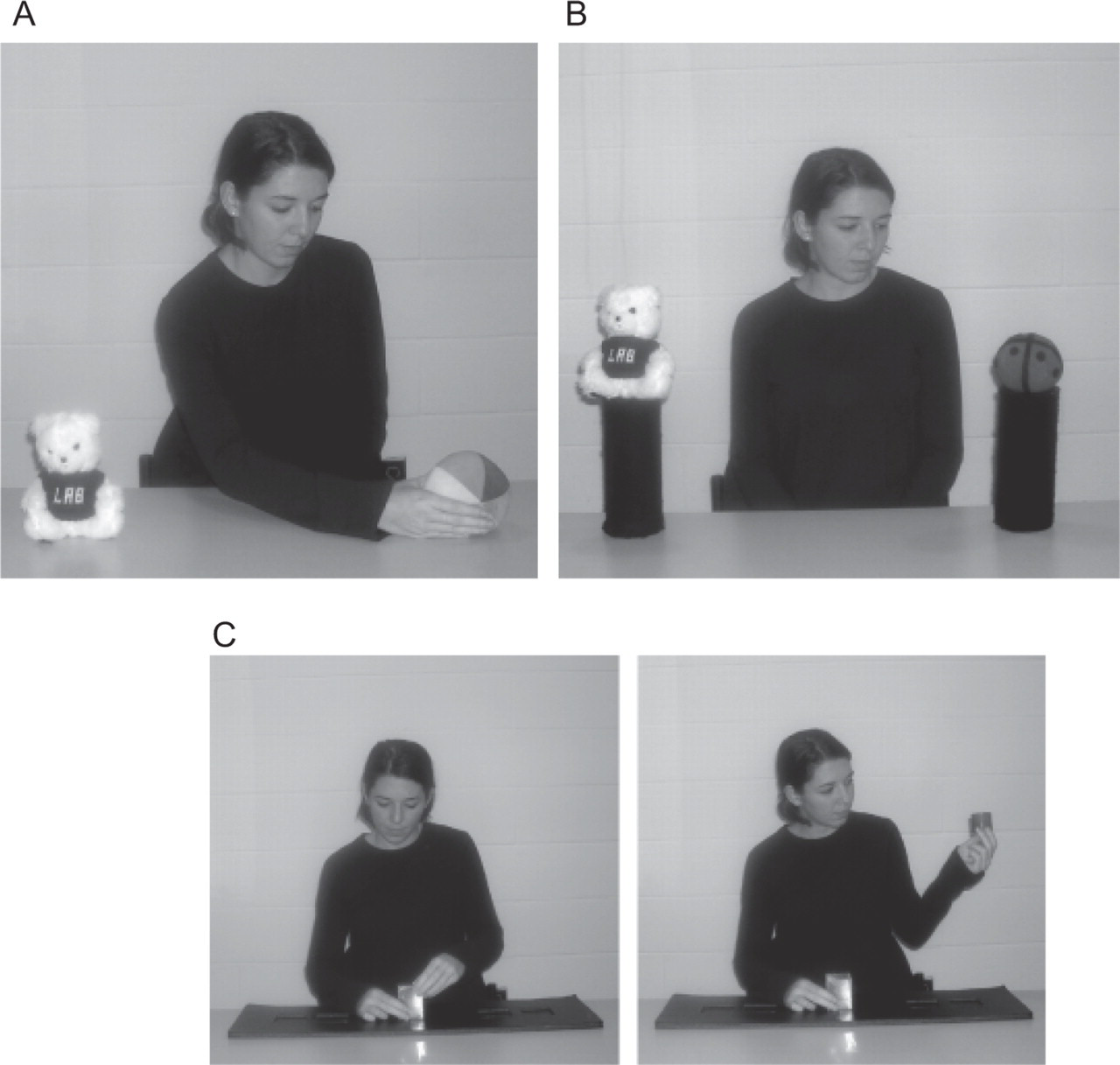
Experimental stimuli presented to infants in habituation and imitation experiments, representing goal relations in typical human actions. By 5 to 6 months, infants represent grasping events (A) as organized by the relation between agent and object. By 9 to 12 months, infants represent looking events (B) in this way, and they also understand actions on an intermediary (the box in C) as directed at the ultimate goal (the toy inside the box), rather than at the box itself.
Critically, infants do not respond in this way when the moving entity is not readily identified as an agent (Woodward, 1998; Hofer, Hauf, & Aschersleben, 2005) or when the action is ambiguous (Woodward, 2005). Further, when viewing novel events, infants respond differentially depending on the presence of cues indicating the animacy of the agent or goal-directedness of the action (Biro & Leslie, 2007; Luo & Baillargeon, 2005). Thus, infants' response to goal changes is not readily explained by lower-level factors, such as the repeated physical contact between the agent and the object or the way the action draws attention to the object. Rather, infants selectively attend to the relational structure of goal-directed actions.
This selective attention to goals is also evident in infants' overt actions. When 7-month-old infants see an adult reach toward one of two toys, as in Figure 1A, they subsequently select that toy themselves (Hamlin, Hallinan, & Woodward, 2008). However, if infants see the adult direct an ambiguous action toward one of the toys, they choose randomly when given the choice between them. Even though both kinds of movements lead infants to attend to an object, only one, the reach, is seen as goal-directed, and this interpretation drives infants' responses. Like older children, 7-month-old infants selectively reproduce the goals of observed actions (Meltzoff, 2006).
DO INFANTS READ ACTIONS OR MINDS?
These findings show that infants represent actions as organized by the relation between agent and object. But how do infants understand this relation? Do they understand the mental connections expressed in concrete actions? Or do they understand the relational structure of action in more behavioral terms? There is currently active debate on this issue (for varying perspectives, see Gergely & Csibra, 2003; Luo & Baillargeon, 2005; Woodward, 2005). The fact that infants cannot report their social reasoning verbally makes it particularly difficult to resolve.
Nevertheless, evidence indicates that by 9 to 12 months, if not before, infants discern relatively abstract aspects of action structure. To start, infants understand not only physical intentional relations but also the entirely abstract relation between a person and the object of his or her attention. To illustrate, infants, like adults, see the woman in Figure 1B as connected to the toy at which her eyes are pointed (Woodward, 2005). Infants also modify their interpretations of instrumental actions based on the agent's prior focus of attention (Luo & Johnson, in press; Phillips, Wellman, & Spelke, 2002). For example, infants expect that a person will act on the object to which she has just attended (Phillips et al., 2002). Further, infants understand the higher-order plans that structure sequences of individual actions. To illustrate, they understand that a person's actions on a container or tool are directed at the goal it enables the user to attain rather than the tool or container itself. To illustrate, infants view the woman's actions on the box in Figure 1C as directed at the toy within the box rather than at the box itself (Sommerville, Hildebrand, & Crane, 2008; Sommerville & Woodward, 2005). These findings indicate that infants understand goals as distinct from particular, physical connections, seeing them instead as more abstract relations that organize physical actions. Finally, infants understand goals not as properties of events but as attributes of the individual person. Infants do not generalize goal information from one person to another, unless the action takes a conventional form, such as the use of a linguistic symbol (Buresh & Woodward, 2007).
Thus, although it is unlikely that infants understand others' mental lives in all the ways that adults do, infants understand intentions as existing independently of particular concrete actions and as residing within the individual. Each of these is essential to recovering intentions from observed actions and each is part of what it means to understand intention in psychological terms.
ORIGINS OF INFANTS' GOAL PERCEPTION
The perception of others' intentions is automatic and universal in adults. Because this ability is essential to human survival, it is reasonable to assume that it is the product of natural selection. Further, as just illustrated, the beginnings of this ability emerge in infancy. These considerations have led several theorists to hypothesize that core elements of intention concepts are innate (Biro & Leslie, 2007; Gergely & Csibra, 2003). However, early-emerging, universal abilities may also reflect the effects of early and universally available experience. Indeed, it is common for the development of species-typical abilities to utilize information that is reliably present in the early environment. Often, the critical experiences are reliably present because they are produced by the developing organism itself. In our recent work, we have begun to test whether early, self-produced action contributes to infants' perception of others' goals.
The initial motivation for considering this possibility was both empirical and theoretical. Empirically, we noted that infants began to show systematic responses in laboratory measures of goal perception for particular actions at around the same ages they gained control over the action themselves. Theoretically, it has long been hypothesized that first-person agentive experience provides insight into understanding others' intentions. Recent interest in the role of embodied cognition in development has led to renewed attention to this possibility (Meltzoff, 2006; Shipley & Zacks, 2008; von Hofsten, 2004). We first approached this question by asking whether developmental variation in infants' own actions correlates with their action perception. Then we conducted intervention experiments to gain a clearer view of the influence of acting on action perception.
Developmental Variation in Action Production Correlates With Goal Perception
During the first year, infants become increasingly able to coordinate their goal-directed actions. If first-person experience provides insight into others' goals, then developments in infants' own actions should correlate with their ability to discern goal structure in the actions of others. This prediction has been confirmed. At 9 months, infants who are able to point at objects understand others' points as object-directed; infants who do not yet point do not (Brune & Woodward, 2007). At 10 months, infants who are skilled at producing means-end sequences understand the means-end structure of others' actions, but those who are less skilled do not (Sommerville & Woodward, 2005). Of course, these correlations do not reveal the causal relations at work. Nevertheless, they provide an important test of ecological validity by showing that infants' naturally emerging actions relate to their perception of others' actions.
Acting Changes Infants' Goal Perception
Our next step was to attempt to alter infants' actions and then assess whether this produced changes in their action perception. We began with infants who are very limited in both the production and perception of goal-directed actions—3-month-olds. Although 3-month-old infants are not yet skilled at reaching, they can learn to apprehend objects by swiping at them while wearing Velcro-covered “sticky mittens” (Needham, Barrett, & Peterman, 2002). We gave one group of infants practice with sticky mittens immediately prior to a habituation session assessing their perception of others' mittened reaches as goal-directed (Sommerville, Woodward, & Needham, 2005). A control group, who viewed the habituation events without mittens training, did not respond systematically, indicating that infants did not spontaneously view the habituation events as goal-directed. In contrast, infants who had mittens training showed a selective novelty response on goal-change trials. Furthermore, there was a significant correlation between the extent to which infants engaged in object-directed actions with the mittens and their selective response on goal-change trials. Thus, producing goal-directed actions led infants to subsequently view others' actions as goal-directed (see Fig. 2).
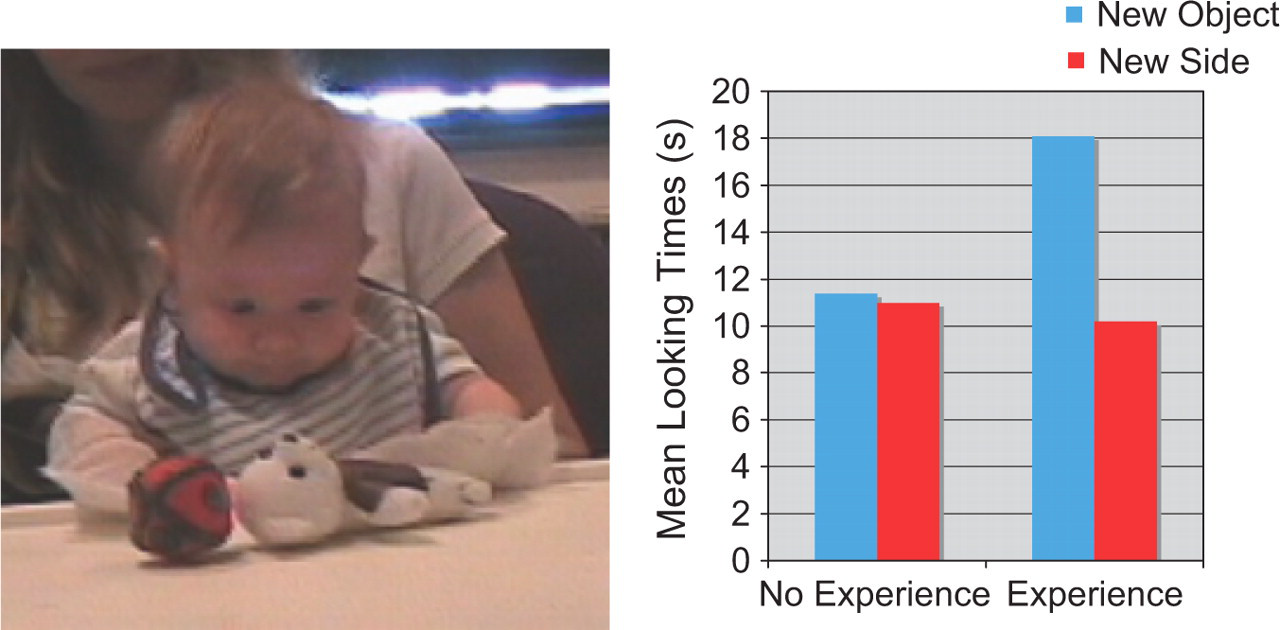
Effects of active “sticky mittens” training on infants' perception of others' goals. Three-month-old infants who underwent mittens training (experience condition) subsequently responded to changes in the goal structure (new object) of observed reaches, whereas untrained infants (no-experience condition) did not. Data are from Sommerville, Woodward, and Needham (2005).
These findings leave open the question of why infants' actions had this effect. One possibility is that infants extract goal structure via visual analysis and that they created for themselves a set of salient visual examples. In this case, infants' learning from their own actions would be no different from their observational learning from others' actions. Alternatively, first-person agency may provide unique information about action structure that could not be gleaned from observation alone. Goal-directed action requires that, at some level, the agent represent the goal that structures the action. This is the case even in young infants, who prospectively adjust their actions to apprehend objects (von Hofsten, 2004). The tacit knowledge that guides infants' own goal-directed actions could provide a key for understanding the goal structure of others' actions.
To distinguish these possibilities, Sarah Gerson and I tested one group of infants in the active-mittens-training condition and a second group of infants in a matched observational condition. In the observational condition, each infant viewed an adult who produced mittened actions according to a script that had been generated from the actions of an infant in the active training condition. Thus, infants in the two conditions were matched in their amount of experience, but they differed as to whether that experience was self-produced or observed. Our preliminary findings indicate that this difference was critical. As in the earlier study, active experience led infants to view others' actions as goal-directed, and individual variation in infants' level of mittened activity correlated with their response to goal-change trials. In contrast, observational experience did not have these effects.
Sommerville and her colleagues (Somerville et al., 2008) found similar patterns when they trained 10-month-old infants in producing a means-end action. Infants who received active training in pulling a cane to retrieve a toy subsequently discerned the means-end structure of another person's cane-pulling actions. Infants who underwent observational training did not show this response. Thus, these findings suggest that first-person experience provides unique insights into the goal structure of others' actions.
Initial Insights and Next Questions
Our findings indicate that action perception, like many other species-typical abilities, recruits information from self-produced experience during development. These findings highlight the role of learning and active engagement in early social-cognitive development and in infant cognitive development more generally. They also raise pressing questions about the ways in which acting informs infants' social perception.
To start, the mechanisms by which information is translated from action into perception have not yet been identified. One interesting possibility is that no translation is needed because acting and perceiving share overlapping neurocognitive representations. This possibility is consistent with recent findings of so-called mirror neurons—neurons that fire during both action production and action perception—in nonhuman primates and similar neural mirroring in adult humans. However, there are many open questions about the existence of mirror representations in infants and their role in development (Gerson & Woodward, in press; Meltzoff, 2006).
Furthermore, we do not yet know how far infants go with what they learn from acting. When infants engage in a particular intentional action, does this inform their understanding of only very similar actions in similar contexts, or does this knowledge generalize across contexts or broader classes of actions? The answers to this question may vary depending on general developmental changes as well as specific expertise. We have hypothesized that the general cognitive ability to create analogies may support the generalization of action knowledge (Gerson & Woodward, in press). In some cases, infants seem able to perceive goal structure in novel actions or very abstract events (Biro & Leslie, 2007; Gergely & Csibra, 2003; Luo & Baillargeon, 2005). One possibility is that these cases represent analogical extensions of goal representations initially derived from action. Alternatively, these responses to abstract displays may reflect the output of a separate, perceptually based system (Woodward, 2005).
This point raises a more general question: How does goal perception relate to other aspects of infants' social knowledge? Infants see much more than goals in others' actions. They are sensitive to biological patterns of motion, emotional expressions, contingency, facial identity and expressions, social categories, and systematic patterns in the actions of their caretakers, as well as other classes of social information. One possibility is that these different aspects of social knowledge are integrated into a single system in infants. If so, then knowledge acquired in one local domain should readily connect with other kinds of social information. Alternatively, especially early on, infants may begin with relatively isolated pockets of social knowledge. These issues await investigation.
Footnotes
Acknowledgements
The research described here was supported by grants from the National Institutes of Health (HD35707) and the National Science Foundation (0634796). I thank Sarah Gerson, Harry Reis, and two anonymous reviewers for their comments on prior versions of the paper.