







Abstract
Attachment security in adulthood is not profitably conceptualized as a single, monolithic construct. It is reflected both in adults' confidence in themselves and others in close relationships (as noted by social-personality psychologists) and in their ability to successfully construct a coherent life narrative about childhood experiences with primary attachment figures (as emphasized by developmental psychologists). Evidence suggests that measures tapping these forms of attachment-related variation represent the underlying structure of adult attachment similarly, in that both may be best captured by two continuously distributed, albeit correlated dimensions tapping anxiety and avoidance. Nonetheless, differing approaches to measuring adult security demonstrate weak empirical overlap, and emerging evidence suggests that each is associated with personal and interpersonal outcomes central to attachment theory in empirically distinct ways. Discussion focuses on how recent insights—in combination with needed experimental and longitudinal data—can help reconcile the developmental- and social-psychological literatures on adult attachment.
Despite having roots in a common theoretical tradition, research on adult attachment is largely conducted in two distinct methodological cultures (Cassidy & Shaver, 2008). One culture—better represented in developmental psychology—is based on narrative-generation procedures such as the Adult Attachment Interview (AAI; Main, Kaplan, & Cassidy, 1985), which is used to assess whether adults have come to construct coherent (i.e., internally consistent but not emotionally overwrought) narratives regarding childhood experiences with caregivers. Rather than focusing on what individuals recall about their early experiences, AAI coders implicitly examine whether adults have developed a secure attachment-related “script”—that is, an understanding that effective attachment relationships serve two complementary roles in human development: (a) the provision of a secure base of exploration and (b) a safe haven in times of uncertainty. The other culture—better represented in social and personality psychology—relies on self-reports of attachment-related thoughts and feelings in adult relationships (Hazan & Shaver, 1987), thereby focusing explicitly on adults' appraisals of current experiences in close adult (especially romantic) relationships. Said another way, the AAI examines whether adults have developed a psychologically mature account of earlier attachment experiences and their ongoing impact on personality, whereas self-reports largely focus on felt security—the confidence that one is worthy of love and support and that others are likely to provide it.
In the early years of adult attachment research, many psychologists assumed that these alternative ways of assessing individual differences had much in common. The self-report measures used by social and personality psychologists, for example, employed constructs, such as secure and insecure attachment, that—at least on the surface—resembled those variables assessed by developmental psychologists using the AAI. As researchers began to compare alternative ways of assessing individual differences in attachment, however, it became apparent that the measures were not interchangeable. This raised controversial questions about which methodology “best” captures the constructs fundamental to attachment theory in adulthood (Fraley, 2002).
Despite repeated caveats offered by both social-personality and developmental psychologists about the distinctiveness of their measures of adult attachment, it is standard practice in narrative reviews to discuss findings based on different attachment measures without reference to methodological differences in the assessment of “security.” One of the reasons this trend continues is that, although there is widespread speculation about precisely why the AAI and self-report measures differ (e.g., broad vs. narrow relationships focus, method of assessment; see Crowell, Fraley, & Shaver, 1999), there are surprisingly few studies in which both kinds of attachment assessments have been administered in tandem. Furthermore, available evidence is not always consistent with intuition. For example, it is often claimed that a primary distinction between the AAI and self-reports of attachment style is that the measures tap security at different levels of accessibility. However, there is little evidence that the AAI reflects mental processes that operate outside of awareness, as is often assumed. In contrast, studies involving subliminal priming have produced evidence that self-reports of attachment are correlated with implicit attachment-related attitudes (Shaver & Mikulincer, 2002).
Given the cross-disciplinary nature of attachment theory and the burgeoning literatures in each research tradition, it is crucial to identify how different measures of adult attachment converge and where they diverge, and to reconcile both in a manner that is productive for the broader research enterprise. The objective of this review is to summarize some of the preliminary steps that my students, colleagues, and I have taken toward addressing these issues, as well as to briefly outline some steps toward a true rapprochement of these literatures. Specifically, the current review focuses on two questions critical to framing such an integration in adult attachment research: (a) Do self-reports of attachment style and the AAI show conceptual convergence in how they represent the latent structure of adult attachment? And (b) Do self-reports of attachment style and the AAI show empirical convergence, and are these measures associated with personal and interpersonal outcomes central to attachment theory (i.e., psychopathology, interpersonal functioning) in similar ways?
CONCEPTUAL CONVERGENCE
Research on adult attachment got its start in both social-personality and developmental psychology in the mid-1980s, albeit with different emphases in each subdiscipline. For example, Hazan and Shaver (1987) initially developed a three-category self-report attachment-style measure (secure, avoidant, and anxious-resistant; later it was replaced by a four-category system; Bartholomew & Horowitz, 1991), based on the expectation that the way in which adults' behavior, cognition, and emotion is organized in their romantic relationships might parallel conceptually the three kinds of attachment relationships earlier identified in studies of infants (Ainsworth, Blehar, Waters, & Wall, 1978). Thus, from the beginning, the goals of this research program included (a) examining how the attachment-behavioral system is organized mentally with respect to adult–adult attachment relationships and (b) explicating the consequences of having either positive or negative models of self and others for personal and interpersonal functioning.
In contrast, the development of the AAI was based on a concerted effort to understand how adults organize their discourse when reflecting upon their early childhood experiences. Through careful analysis, developmental psychologists were able to discover which aspects of parents' narratives regarding their childhood experiences predict whether their children will be classified as secure or insecure in infancy (van IJzendoorn, 1995). This knowledge is typically used to classify adults into one of several categories that reflect whether the interviewee is able to construct a coherent (secure) narrative about his or her early experiences without idealizing caregivers and/or normalizing negative experiences (dismissing) or becoming emotionally overwhelmed while talking about childhood relationship experiences generally (preoccupied) or loss/abuse in particular (unresolved).
In research on adult attachment, there has been some attention to the question of whether such categories are the most appropriate way to demarcate individual differences, particularly because treating continuously distributed data as categorical reduces statistical power. Taxometric research has revealed that the latent variation reflected in self-report assessments of attachment is continuously and not categorically distributed (Fraley & Waller, 1998), so most studies of self-reported attachment style now rely on a dimensional model of individual differences. This model is based on the premise that variation in attachment-related anxiety (i.e., worrying about the availability and responsiveness of relationship partners) and avoidance (i.e., discomfort relying upon others for attachment-related functions) are crucial to organizing individual differences in adult attachment.
In contrast, although the AAI is sometimes coded using systems that treat individual differences as continuously distributed (e.g., Kobak's [1993] Q-sort), categorical coding is clearly regarded as the gold standard in developmental psychology. Our recent taxometric analysis of a large sample of AAIs drawn from both community and college samples, however, calls this standard practice into question (Roisman, Fraley, & Belsky, 2007). Interestingly, when we taxometrically analyzed the scales used by coders to make AAI classifications, we found scant evidence that individual differences reflected in the AAI are categorically distributed, despite hundreds of studies that treat it as such. More critically, in conducting what we believe was the first large-sample Principal Components Analysis of the scales coders use to sort participants into AAI categories, we discovered what appear to be two broad-band, at-least-somewhat-independent patterns of variation underlying individual differences in AAI narratives: one that reflects the degree to which adults either freely evaluate their early experiences or discuss them defensively (i.e., avoidance) and the other reflecting different forms of attachment-related preoccupation (i.e., anxiety).
Findings from Roisman, Fraley, and Belsky (2007) are interesting in several respects—in part, because they suggest that AAI researchers using categorical coding systems may be subtly misrepresenting the underlying structure of adult attachment—but one of the more notable results of this analysis is that it revealed that self-report measures of attachment style and the AAI show conceptual convergence in terms of how each represents the latent structure of adult attachment. This finding is all the more remarkable in light of emerging evidence that individual differences in infant attachment—likewise widely viewed as categorically distributed—also may be best represented on the same two continuously distributed dimensions of variability (Fraley & Spieker, 2003). Although future large-sample taxometric research on the AAI would be especially useful for addressing outstanding questions related to the whether preoccupied discourse is categorically or continuously distributed, it could be that avoidance and anxiety together constitute the universal signature of individual differences in security as currently measured using diverse methods (see Table 1 for a comparison of indicators of avoidance and anxiety across attachment measures).
Sample Indicators of Avoidance and Anxiety on the Adult Attachment Interview (AAI), Self-Report Attachment-Style Measures, and the Strange Situation Assessment of Infant Security
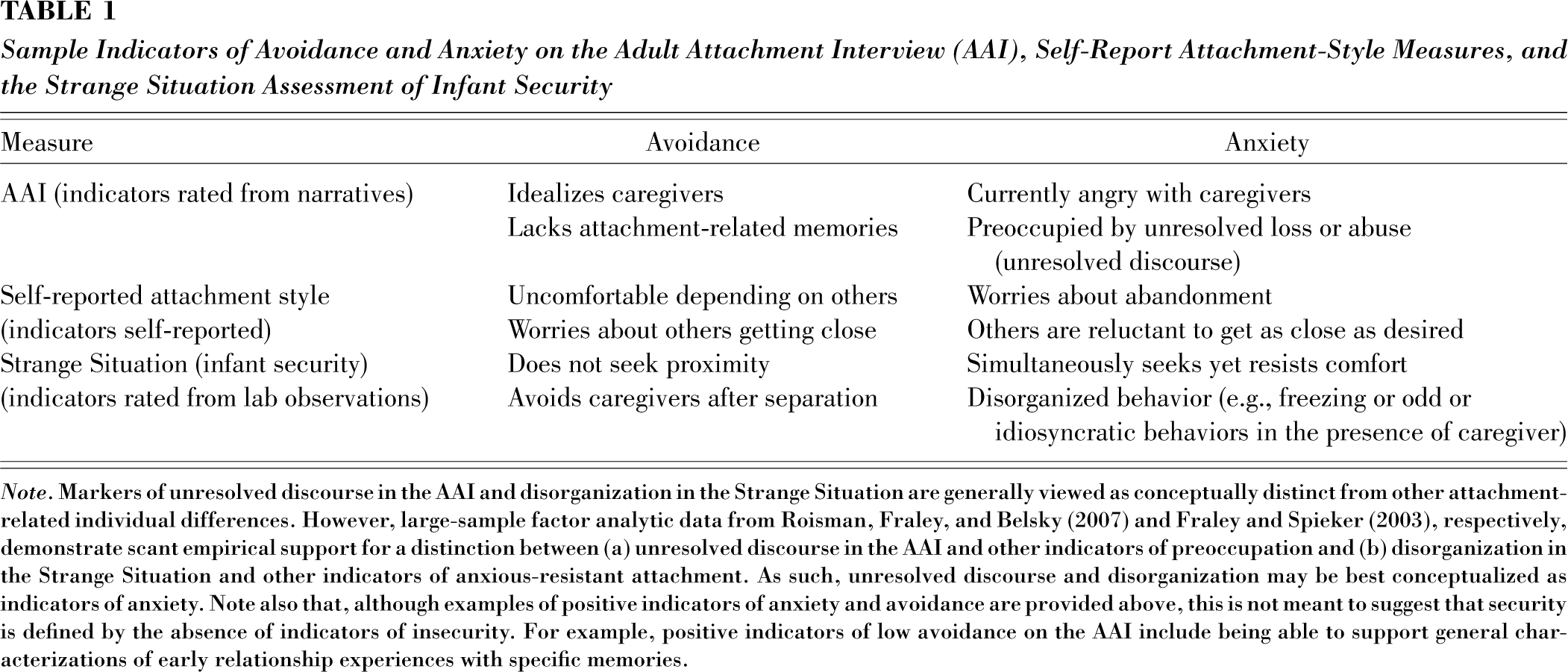
Note. Markers of unresolved discourse in the AAI and disorganization in the Strange Situation are generally viewed as conceptually distinct from other attachment-related individual differences. However, large-sample factor analytic data from Roisman, Fraley, and Belsky (2007) and Fraley and Spieker (2003), respectively, demonstrate scant empirical support for a distinction between (a) unresolved discourse in the AAI and other indicators of preoccupation and (b) disorganization in the Strange Situation and other indicators of anxious-resistant attachment. As such, unresolved discourse and disorganization may be best conceptualized as indicators of anxiety. Note also that, although examples of positive indicators of anxiety and avoidance are provided above, this is not meant to suggest that security is defined by the absence of indicators of insecurity. For example, positive indicators of low avoidance on the AAI include being able to support general characterizations of early relationship experiences with specific memories.
EMPIRICAL DIVERGENCE
Given the emerging evidence that individual differences reflected in self-reports of attachment style and the AAI show rather striking conceptual convergence—this, despite the distinctive approach each takes to the assessment of adult attachment—it seems reasonable to question how much empirical overlap these measures have and whether they are both associated in similar ways with outcome domains central to attachment theory. Recently, we began to address these issues, starting with a quantitative review (i.e., meta-analysis) of the extent to which the AAI and self-report measures of attachment converge empirically (Roisman, Holland, Fortuna, Fraley, Clausell, & Clarke, 2007). Such an analysis was necessary because, given the variation in empirical findings on the correspondence between the AAI and self-reports, scholars have tended to focus on data that are most compatible with their perspective on the debate (Fraley, 2002). For example, Shaver, Belsky, and Brennan (2000) have often been cited to claim that there is moderate convergence between the AAI and attachment-style dimensions, a conclusion that neglects less well-cited contributions to this literature that have reported weaker associations.
In our meta-analysis, we converted associations between individual differences as assessed by the AAI and self-report measures of attachment style into the common metric of correlation coefficients, averaged across all studies in this literature and weighted by the sample size of each study. We then interpreted these findings in light of well-established criteria for characterizing the magnitude of correlations. In summary, we found only trivial to small overlap between self-reported attachment-style dimensions and AAI security. Specifically, we estimated that the association between insecurity in the AAI and the attachment-style dimensions of avoidance and anxiety was equal to a correlation of .09 (a trivial effect), based on data from over 1,000 participants. Nonetheless, our overview of the literature did point to two small but reliable associations between AAI and self-report attachment dimensions: (a) self-reported anxiety and AAI unresolved status and (b) self-reported avoidance and dismissing discourse in the AAI. Because meta-analyzed studies were not informed by the Roisman, Fraley, and Belsky (2007) analysis described earlier, we also examined with new data whether continuously distributed AAI scales more strongly correlated with self-report attachment-style dimensions, including all of the scales used by AAI coders to sort participants into the standard categories. They did not.
In a series of subsequent studies, we have found further evidence for distinctions between AAI and self-report attachment dimensions with respect to their associations with interpersonal and personal outcomes central to attachment theory. First, in Roisman, Holland, et al. (2007) we concluded that self-reports of attachment style were primarily associated with the observed quality of adults' relationships under conditions of high levels of interpersonal stress, whereas AAI security was associated with the observed quality of adults' relationships irrespective of how stressful participants perceived their interactions to be. Perhaps not surprisingly, individuals who have developed a coherent understanding of childhood experiences tend to engage their adult relationships constructively, whereas individuals who lack confidence in themselves or others tend to interact less competently with significant others primarily under conditions in which their security is threatened.
A different pattern of results emerged, however, when examining how measures of adult attachment were associated with reports of psychopathology (Fortuna & Roisman, 2008). Specifically, we recently demonstrated that insecurity reflected in the AAI was associated with self-reports of psychiatric symptomatology principally for individuals experiencing high levels of life stress, whereas self-reports of attachment-related avoidance and anxiety in close relationships correlated robustly with psychopathology under conditions of both relatively high and low life stress (consistent with a risk model). Said another way, individuals who lack a script-like understanding of how attachment relationships support healthy functioning in the face of adversity find themselves especially challenged by stressful circumstances, whereas adults who perceive themselves to be insecure may be at more general risk for psychological maladjustment.
NEXT STEPS TOWARD A RAPPROCHEMENT
Based on the data now available, it is no longer reasonable to conceptualize attachment security as a monolithic construct—and psychologists must therefore be precise about what kind(s) of variation in adult attachment may be most pertinent to the aims of their investigations. More critical toward a rapprochement of these literatures, however, is taking up the challenging task of understanding why such measures are empirically distinctive, especially in light of the conceptual convergence I have highlighted.
Building on work presented here, it is clear that such an effort will require the methodological expertise represented among both social-personality and development psychologists as applied to the main concern of attachment theory: how childhood experiences come to be embodied, in enduring ways, as potent social schemas. By administering both the AAI and attachment-style self-reports in the contexts of the kinds of experimental designs commonly used by social-personality psychologists, for example, it may be possible to understand how different forms of attachment-related variation are (distinctively) mentally represented. Historically, developmental psychologists have not made use of priming techniques that could help in examining whether individual differences in adults' AAI narratives have automatic and controlled components. In parallel, longitudinal programs of research highlight the potential contributions of developmental psychologists to this long-overdue reconciliation of methodological approaches, especially given that social-personality psychologists have speculated for some time—in the absence of much prospective data from childhood—that self-reported attachment style may have roots in early caregiving experiences. That adults' appraisals of current attachment-related experiences and the manner in which early-life experiences are integrated in the discourse of adults may be differentially (a) rooted in prior experiences and (b) represented in the mind represents an intriguing hypothesis for this next generation of integrative research on adult attachment.
Footnotes
Acknowledgements
I gratefully acknowledge Harry Reis, two anonymous reviewers, my colleagues Kelly Bost and Chris Fraley, and my students Keren Fortuna and Ashley Holland for improving this review through their insightful comments on earlier drafts.