







Abstract
The prefrontal cortex is crucial for the ability to regulate thought and control behavior. The development of the human cerebral cortex is characterized by an extended period of maturation during which young children exhibit marked deficits in cognitive control. We contend that prolonged prefrontal immaturity is, on balance, advantageous and that the positive consequences of this developmental trajectory outweigh the negative. Particularly, we argue that cognitive control impedes convention learning and that delayed prefrontal maturation is a necessary adaptation for human learning of social and linguistic conventions. We conclude with a discussion of recent observations that are relevant to this claim of evolutionary trade-offs in a wide range of research areas, including attention-deficit hyperactivity disorder, autism spectrum disorders, creativity, and sleep.
If you are eating right now, be warned: You can choke to death on your food. You suffer this danger because of the position of your larynx, which sits atop your trachea in your neck. In most animals (and human infants) the larynx sits high in the throat and food passes from the mouth into the esophagus without ever crossing the larynx. But in adult humans (and some aquatic mammals), the larynx is lower in the neck; consequently, food must pass over the larynx on its way to the stomach. Our primate cousins do not have this odd conjunction of the eating and breathing apparatus, which has led some evolutionary biologists to speculate on the reasons for this point of divergence in human evolution.
What advantage might this risky anatomical arrangement afford humans? Vibrations of the vocal folds of the larynx produce sounds, which are altered as they travel through the vocal tract from the larynx to the mouth; the peculiar configuration of the elongated human supralaryngeal vocal tract permits a greater repertoire of potential sounds. Thus, one hypothesis—albeit controversial—is that the change in the position of the human larynx, compared to nonhuman primates, was a critical event in the evolution of human language (Lieberman, 1991).
In On the Origin of Species, Darwin (1909) emphasized the crucial role engineering trade-offs play in evolution: “If a fair balance be struck between the good and evil caused by each part, each will be found on the whole advantageous” (p. 213). This is the lesson of the human larynx: Its position in the neck is worse for aspiration but better for phonation. On balance, this is advantageous. An analogous trade-off is at the heart of our proposal about the development of human prefrontal cortex (PFC). As we will discuss, the last part of the human brain to develop is the region humans prize for its ability to regulate our thoughts and behaviors. We argue that early in development, the advantages of prefrontal immaturity outstrip the disadvantages. While most research to date has focused on the negative consequences of this developmental trajectory, we consider here the counterbalancing positive consequences of “cognition without control.”
THE MATURATION OF THE PREFRONTAL CORTEX IN HUMAN AND NONHUMAN PRIMATES
Like other primates, humans are born with an immature brain. After birth, the cerebral cortex undergoes a massive proliferation of synapses (synaptogenesis), followed by an extended pruning period (synaptic elimination). In the Rhesus macaque—an old-world monkey whose brain development has been studied extensively—these developmental processes occur at the same rate in all cortical areas (Rakic, Bourgeois, Eckenhoff, Zecevic, & Goldman-Rakic, 1986). In contrast, analyses of the human cortex across the life span (using autopsy tissue samples) reveal a different pattern: In humans, synaptogenesis reaches its peak in the visual and auditory cortex within a few months after birth, but the increase in the number of synaptic junctions occurs much more slowly in the PFC (Huttenlocher & Dabholkar, 1997). In the evolution of the human brain, there has thus been a shift from concurrent to heterochronous cortical development. The synaptic density of the human PFC does not “catch up” with the auditory cortex until the fourth year. Heterochronicity in human cortical development is also observed in measurements of dendritic arborization (the development of treelike terminal branching of nerve fibers), regional metabolism (the extent of anabolic and catabolic processes within a brain region), and myelination (the formation of the insulating myelin sheath around nerve fibers); for example, positron emission tomography (PET) data indicate a lag of up to 8 months in glucose metabolism in the human PFC as compared to occipital, temporal, and parietal cortices (Chugani & Phelps, 1986).
As a result of this long period of prefrontal development, human children exhibit impaired behavioral and cognitive control—akin to patients with neurological PFC damage—for years. Changes in both working-memory capacity and the ability to produce behaviors that conflict with prepotent responses—two canonical frontal lobe functions—are linked to the maturation of the PFC (e.g., Diamond & Doar, 1989). Furthermore, the extended immaturity of the PFC may carry the cost of a longer period of vulnerability than that which occurs in more rapidly developing cortical systems. Prefrontal sensitivity to environmental factors has been described in children with phenylketonuria (PKU; Diamond, 1996) and may contribute to specific cognitive deficits associated with poverty (Farah et al., 2006). The accumulation of evidence for the prolonged period of prefrontal immaturity—and the behavioral consequences thereof—has spurred the scientific community to develop programs to facilitate the development of cognitive-control abilities. While these efforts might be useful to apply in vulnerable populations, some caution might be warranted in a more widespread effort to hasten PFC development.
LEARNING VERSUS PERFORMANCE: THE CASE OF PROBABILITY MATCHING
Late prefrontal development clearly has some negative consequences for childhood behavior. Yet despite this, there are many examples of learning tasks (e.g., language acquisition) at which children do better than adults. Recalling the lesson of the larynx, we propose that these differences may reflect the costs and benefits of an immature frontal cortex (hypofrontality) that arise from the inherent trade-offs between learning and performance. That is, a system optimized for performance may not be optimal for learning, and vice versa.
Discussions of cognitive control are usually about performance: For example, how is one able to ignore the meaning of a word in order to follow the instructions to identify the ink color in which it is printed (i.e., the Stroop task)? Solving this task involves resolving conflict between possible responses; in models, this type of flexible thinking is made possible by control mechanisms that bias responses according to a goal or context. To optimize performance, the PFC functions as a dynamic filter, selectively maintaining task-relevant information and discarding task-irrelevant information (Shimamura, 2000).
But during learning, in contrast, using control processes to supervise competitive interactions may have negative consequences. The existence of competitors is an advantage in learning, not an obstacle. Learning is usually modeled as a process through which an organism's ability to discriminate and predict its environment is successively refined by competition (e.g., between cues in associative models, or between hypotheses in Bayesian models; see Xu & Tenenbaum, 2007). This competitive process is particularly useful in finding consistent patterns in probabilistic, or inconsistent, evidence (Ramscar & Yarlett, 2007). Consider the following example: You are watching a football game with friends, and although you know nothing about football you decide to join them in a guessing game: When the home team has the ball, will they call a running play or a passing play? You notice that about three fourths of the time they pass, so you guess “pass” 75% of the time and “run” 25% of the time. This is called probability matching, and if your goal is to be right more often than not, in the absence of any other information, it is a suboptimal strategy. To maximize the number of correct predictions, you should always pick the more frequent outcome (i.e., always pick “pass”).
If you were playing this football guessing game with your toddler, you might see that they employ this latter strategy: Children under the age of 4 tend to overmatch; that is, they come closer to maximization than to probability matching (Derks & Paclisanu, 1967). Only as children get older do they gradually begin probability matching. Why do you use a less optimal decision strategy than your toddler? One possibility is that your well-developed PFC-mediated cognitive control system allows you to override brute-strength competition and guess: In an unregulated competition between alternate responses, the most frequent form dominates (i.e., maximization). In order to make a less frequent (but potentially goal-relevant) response (i.e., probability matching), a control mechanism intervenes. You do badly because you can guess, unlike your toddler who cannot. Evidence for this conjecture comes from the finding that neurological patients with left-PFC damage made decisions on a binary choice task that were closer to maximization than to probability matching (Wolford, Miller, & Gazzaniga, 2000).
CONVENTION LEARNING
Clearly, there are advantages for adults in being able to think flexibly through cognitive control: Returning to the example of the football contest, suppose you see a recurring pattern: pass-pass-pass-run. That adult override ability will now allow you to beat your maximizing toddler. Yet, are there instances in which thinking inflexibly is advantageous? This question brings us back to language acquisition. To thrive as social animals, we need to master a myriad of cultural and linguistic conventions. In other words, we need to be able to do and say and understand the right thing in the right context, and we must agree with one another on what these right things are. This is a formidable task. We suggest that in convention learning, the ability to think unconventionally (i.e., flexibly) is a disadvantage. The consequences of conventional versus flexible thinking have been computationally demonstrated for the acquisition of irregular plurals (e.g., mice), a set of linguistic conventions adults find particularly difficult to master. The trajectory of learning of these exceptions is nonmonotonic (i.e., not continuously increasing) in children, marked by a brief period in which overregularization errors (e.g., “mouses”) replace previously correct plural forms. An associative learning model that simply practices and reinforces the most frequent forms it “hears” easily simulates this U-shaped pattern (Ramscar & Yarlett, 2007).
Our account explains the developmental trajectories and sensitive periods in language acquisition in terms of the gradual development of the PFC (and its associated control mechanisms) rather than a change to some putative language-specific device. Consider the case of Simon, a deaf child who learned American Sign Language (ASL) from parents who were late learners of ASL; by age 7, Simon had acquired an orderly morphological-rule system that far surpassed the imperfect input he got from his parents (Singleton & Newport, 2004). From the perspective we propose here, the adults' ability to control their responses allows them to mix and match correct and incorrect signs for the same things at different times, such that staying true to their probabilistic understanding leads them to produce noisy patterns of input. Without those same control abilities, young children will practice (and hence learn) only the most frequent of any alternate patterns they hear (Ramscar & Yarlett, 2007). This allows children to learn conventions from the output of parents who, because of their ability to monitor and control their responses, may never master them themselves!
COGNITION WITHOUT CONTROL: CURRENT AND FUTURE DIRECTIONS
Just as the human supralaryngeal tract sacrifices aspiration for phonation, we believe that the protracted maturation of the human PFC sacrifices performance for learning early in development (see Fig. 1). We end with a few examples of research areas in which this idea could guide new hypotheses and inspire insightful interpretations.
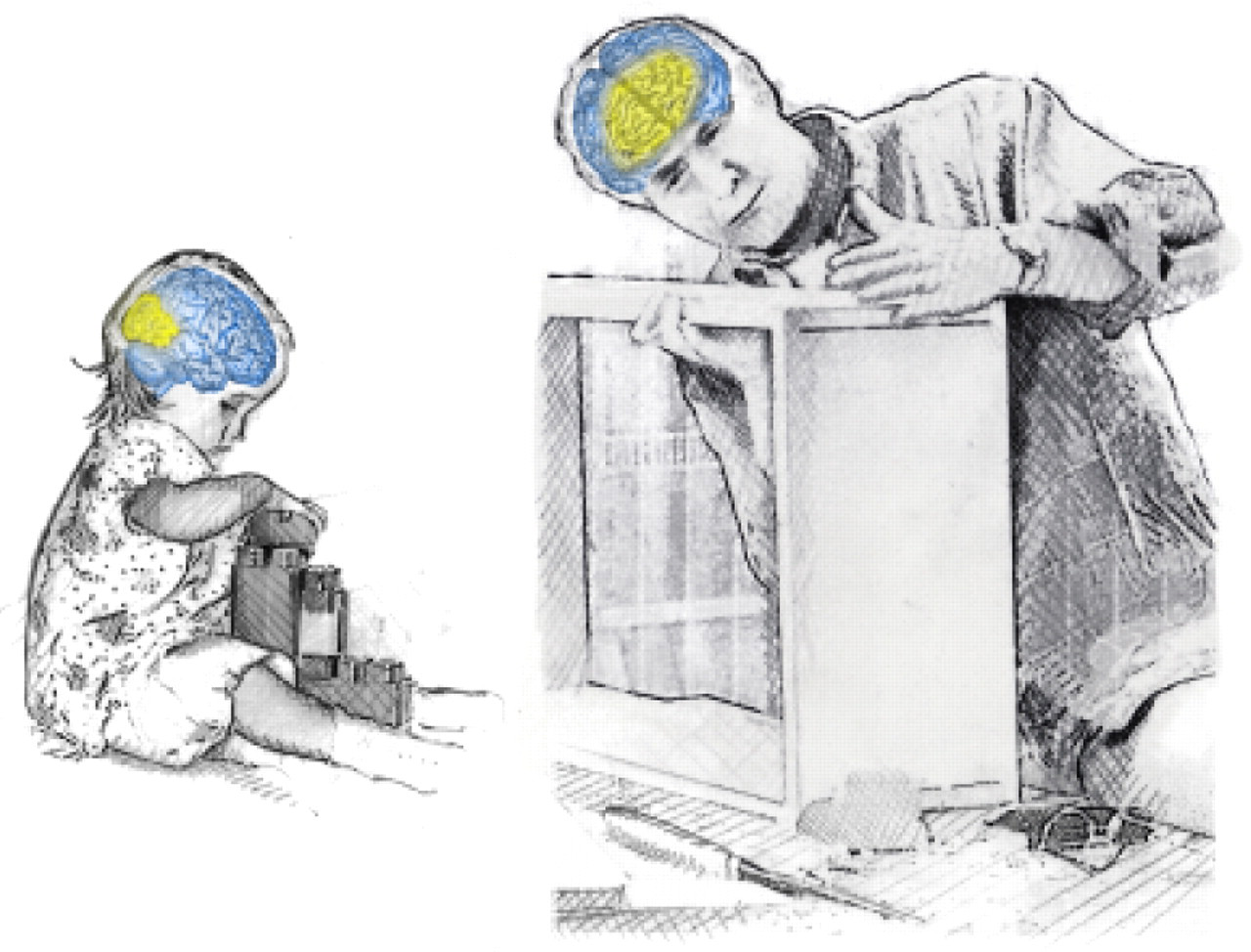
An adult with a developed prefrontal cortex (marked in yellow in the adult portion of the figure) can perform better than children in situations that require goal-directed actions—as, for example, when building a bookshelf. In contrast, a child experiencing an extended period of hypofrontality may engage more primary, posterior brain regions (marked in yellow in the child portion of the figure) and has a clear advantage over an adult when it comes to certain types of learning such as language acquisition, or certain activities like flexible object use during problem solving. These differences highlight inherent trade-offs between learning and performance that give rise to both costs and benefits of cognition without control.
Variations in Neurocognitive Development
Central to our proposal is the claim that the timing of PFC development has been the target of selection and, therefore, that variations in timing are functionally meaningful. Recent neuroimaging studies have revealed potentially important differences in the timing of PFC development across typical and atypical individuals. Variations in the trajectory of PFC maturation (based on repeated measures of cortical thickness) have been associated with cognitive measures in typically developing children (Shaw et al., 2006). Children with attention-deficit hyperactivity disorder (ADHD) exhibit a delay in cortical maturation that is most prominent in the PFC (Shaw et al., 2007). In contrast, children with autism spectrum disorders (ASD) undergo early maturation of the PFC (Carper, Moses, Tigue, & Courchesne, 2002). A better understanding of the implications of these timing changes for both learning and performance may illuminate some of the behavioral and cognitive patterns associated with these diagnoses (e.g., impaired acquisition of social conventions in ASD), as well as offer a fertile ground for testing the validity of our hypothesis that typical PFC development involves a trade-off in favor of learning to the detriment of performance in infancy and early childhood.
Creativity
Creativity—the ability to approach an object or a situation from an alternative perspective—may benefit from the unsupervised competition that occurs in the absence of prefrontal control. Consider one common assessment of creative thinking, the Alternative Uses Task: When attempting to think of ways to use an object in some atypical way, adults struggle. In this case, an active PFC might, paradoxically, hinder flexible thinking, because the representation of the object is sculpted by prior experience and expectations. Interestingly, young children are immune to this kind of functional fixedness (German & Defeyter, 2000). Successful performance in similar tasks of ideational fluency has been associated with EEG changes in prefrontal regions (e.g., Mölle, Marshall, Wolf, Fehm, & Born, 1999). Furthermore, patients with PFC damage solve insight-problem-solving tasks better than do their healthy counterparts (Reverberi, Toraldo, D'Agostini, & Skrap, 2005). This apparent flexibility of behavior can be interpreted as a stimulus-driven response: A mind that is at the mercy of its environment is not shaped by expectations or beliefs. This interpretation highlights a parallel between functional fixedness and probability matching, in that both of these “adult” phenomena involve biasing stimulus–response associations based on expectations. This proposal suggests new avenues of investigation into the processes that support creative thought and into putative relations between creativity and psychological disorders associated with hypometabolic prefrontal function (i.e., a state of lower energy consumption in the PFC, as in bipolar disorder, for example).
Sleep
Humans may experience a return to frontal “immaturity” every day: REM sleep is characterized by decreased activation of the frontal cortex (but heightened activation of the sensory cortex; Braun et al., 1997), and electroencephalogram recordings during REM sleep reveal a decoupling between frontal and perceptual regions that is characteristic of patients with frontal lobe damage (Perez-Garci, del-Rio-Portilla, Guevara, Arce, & Corsi-Cabrera, 2001). These neural data may explain the fact that dream reports share some of the features associated with frontal lesions (e.g., reality distortions, alterations of temporal sequencing, heightened perceptual experiences) and also lead to predictions about what benefits sleep may have for cognition (e.g., the ability to make inferential judgments about recently learned information; Ellenbogen, Hu, Payne, Titone, & Walker, 2007). These studies may demonstrate the importance of regular periods of hypofrontality in adults, during a period when performance optimality is irrelevant (i.e., sleep).
LIMITATIONS AND CONCLUSIONS
Our bodies and minds are a collection of careful evolutionary compromises. The position of the larynx is one example. Here, we have advanced the view that the heterochronicity of human cortical development—specifically, the protracted period of prefrontal maturation—is another such compromise, one that arises from the differing demands of learning and performance at different points in development. In this context, we emphasize the need for future research to examine the strength of this proposal to account for individual differences in cognitive abilities among different developmental groups (i.e., infants, toddlers, adolescents), for which different stages of prefrontal maturation are coupled with different learning opportunities. A better characterization of which specific types of learning are most likely to benefit from delayed onset of cognitive control could both guide research and inform educational policy. Finally, we have focused on the implications of the protracted period of prefrontal maturation for tasks involving cognitive control; in-depth connectivity analyses of the cortical and subcortical systems supporting learning and control have the potential to reveal how an initially underdeveloped PFC may allow for other subcortical networks (e.g., basal ganglia, hippocampus) to facilitate certain types of learning at different developmental time points (cf. Aston-Jones & Cohen, 2005).
The study of “cognition without control” may illuminate developmental trajectories in learning and cognition in both typically and atypically developing children and it may also have implications for cognitive abilities throughout the life span. What we are proposing here is less an answer than a series of questions. A consideration of why the human brain develops the way it does simply provides a starting point in this endeavor.
Footnotes
Acknowledgements
Preparation of this article was supported by grants from the National Institutes of Health (R01-MH70850, R01-MH67008, R01-DC009209) and by a James McKeen Cattell Fund Sabbatical Award to S.T.S. and National Science Foundation Grant Nos. 0547775 and 0624345 to M.R. Conversations with many colleagues contributed to the development of these ideas, with special thanks to members of the Thompson-Schill and Ramscar labs.