







Abstract
Individuals regularly confront situations in which acceptance of short-term costs may lead to long-term gains. Given that individuals frequently discount the utility of future benefits with respect to more immediate ones, successfully solving such intertemporal choice dilemmas has been theorized to involve self-regulation aimed at controlling emotional responses that are sensitive to immediate rewards. In this article, I argue for a more multifaceted view of the role played by emotions in intertemporal choice. In support of this view, I review emerging evidence demonstrating the ability of specific, socially oriented emotions to facilitate behaviors designed to build social and economic capital in the long run.
Intertemporal choice—or making decisions with consequences that differentially unfold over time—is a hallmark of the human experience. Like it or not, individuals are continually confronted with situations requiring them to make decisions in the present that hold consequences for the building of stable and supportive social networks (i.e., social capital) and financial resources (i.e., economic capital) in the future. For example: Should I skip going to a party this weekend in order to get ahead on a project at work? Should I buy that new iPod or put more of my salary toward repaying a loan from a friend? In each of these cases and myriad ones like them, an obvious fact emerges: Of two presented options, one is clearly preferable in the short term but problematic in the long term. Partying now is more fun than working for future benefit; buying that iPod is more immediately enjoyable than conserving to repay a friend. Yet immediately gratifying choices may not be the best for building stable relationships that provide support and resources in the future.
CONTROLLING YOUR ID: THE COLD, HARD NECESSITY OF DELAY
How people solve intertemporal choice dilemmas has been a topic of great interest to psychologists and economists alike. Older rational choice models assumed that individuals simply weighed corresponding options and made a decision that maximized benefits. If one is likely to get greater benefits from an increased salary due to working harder, then one will likely take less vacation time. Yet, decades of research have revealed that people tend to discount pleasures resulting from future benefits relative to immediate ones (Ainslie, 1975; Loewenstein & Thaler, 1989). Simply put, gaining $5 today may be perceived as preferable to gaining $10 in two weeks. Such discounting often leads people to select options with a short-term benefit but greater long-term cost. Of course, individuals do not always select the immediately expedient option, and, accordingly, the interesting question becomes: Why?
The easy answer is that exclusive focus on short-term interests would not be an adaptive strategy. Much that is central to building social networks and exchange relationships depends on the ability to act cooperatively, and cooperation often involves delaying gratification. Being a trustworthy partner as opposed to a cheat, offering help to those in distress rather then ignoring or taking advantage of their predicament, working hard to develop skills that are valued by the group as opposed to loafing—each of these actions entails taking a short-term hit, whether in terms of actual resources or hedonic rewards, that correspondingly increases the probability of being viewed as a valuable partner in the long run.
The more difficult question of “Why?” is the one centering on the proximate mechanisms underlying such choices. Neuroimaging studies have suggested that the tension between short-term and long-term views stems from competition between two types of mental systems: one that is sensitive to anticipation of future consequences and one that is focusing on acquiring immediate benefits. The ways in which such “forward looking” systems might tamp down the cravings of the immediate reward systems are manifold, but one primary hypothesis involves strategies of executive control or self-regulation (Berns, Laibson, & Loewenstein, 2007).
One of the classic demonstrations of self-regulation in intertemporal choice is Walter Mischel's famous “marshmallow test” (Mischel, Shoda, & Rodriguez, 1989). In these experiments, children were presented with a marshmallow and told that if they could resist eating it until the experimenter returned, they could have two. The children who were able to exert self-control and thereby delay cravings for immediate gratification were found years later to possess numerous social benefits in comparison to the “gobblers.” These and related findings have been taken to imply that many emotional or “hot” processes are the bane of long-term success.
SOCIAL SENTIMENTS: A WARMER ROUTE TO LONG-TERM SUCCESS
Although I concur that self-regulation can inhibit preferences for short-term rewards, I believe it is an error to conclude that emotions can only function as a hindrance to taking a long-term view. After all, emotions are theorized to increase the probability and efficiency of adaptive responding (Barrett, Mesquita, Ochsner, & Gross, 2007). For humans, the universe of challenges encompasses not only those posed by the physical environment but also those posed by the social one. Consequently, it follows that distinct emotions meant to address social challenges, which are often characterized by the need to consider reciprocal and temporally removed interactions, should exist. Among such social emotions (i.e., states whose evocation and focus involves interpersonal interactions) should be ones that parry the influence of affective states centered on immediate reward.
I do not mean to imply that one type of emotion is superior to the other, but rather that the tension between the two reflects the inherent trade-offs between short-term and long-terms gains. Social emotions need not always favor long-term outcomes; emotions such as jealousy, for example, can lead to decisions providing important short-term benefits (e.g., preventing potential mate poaching) that may nonetheless lead to longer term problems (e.g., decreased relationship satisfaction). However, given the need to balance short- versus long-term costs in decision making, particular emotional responses could be expected to enhance delays in gratification.
The view that intertemporal choice and related social behavior may be guided by emotions is not new. The notion that such “moral sentiments” underlie the long-term building of social and economic capital was advanced by Adam Smith (1790/1976) over 2 centuries ago (see Frank, 1988, and Keltner, Haidt, & Shiota, 2006, for modern perspectives). It is also evident in Trivers's (1971) formulation of reciprocal altruism, in which he theorized that moral emotions would be the primary mediators of cooperative behaviors. These views, however, have been seemingly lost in current models of intertemporal choice, most likely due to a dearth of rigorous empirical investigation on the roles played by social emotions. Undoubtedly, this lacuna stems in part from the historical focus of the field on more basic emotional states (e.g., fear, anger). Social emotions, by necessity, are more effortful to study, as inducing them requires highly orchestrated social interactions. Yet, if psychologists are to uncover the differing roles played by emotions in behavioral decision making, such investigations are needed.
The difficult aspect in conducting such work involves dissociating the influence of emotions from that of related alternatives. For example, evoking gratitude necessarily depends upon receipt of a benefit that cannot occur without simultaneous awareness of norms for reciprocity. Similarly, part of the induction of pride involves receiving information that one is good at something—information that in itself may also increase self-efficacy. Consequently, to make an argument that emotion is a driving factor in guiding behavior, care must be taken to rule out potential “colder” explanations.
EMERGING EMPIRICAL SUPPORT
Reciprocity: To Pay Back or Take the Money and Run?
One common intertemporal choice dilemma involves reciprocity—when one has received a benefit from another and subsequently is asked for a favor in return. At this juncture, two paths exist. The recipient of the initial benefit can refuse to help or can acquiesce and repay in kind. In the short term, refusing to reciprocate certainly adds to one's resources; one has benefited from others without incurring costs. Yet, in the long term, this strategy is untenable for members of a social species that depends on engagement in cooperative endeavors (Frank, 1988). As one's reputation became known, ostracism from social and trading networks would ensue. Consequently, individuals frequently pay back favors in an effort to keep the wheels of exchange rolling.
Although the ultimate rationale for reciprocity is readily apparent, the proximate mechanism(s) guiding such choices are open to debate. Is the engine underlying control of short-term interests simple awareness of norms, or is it emotional responses? My lab set out to investigate the second possibility. More specifically, we sought to identify the role of gratitude in shaping reciprocity. To accomplish this goal, we conducted a series of experiments that took the following form (Bartlett & DeSteno, 2006). Participants interacted with a confederate in staged situations designed to induce feelings of gratitude (i.e., receiving assistance from the confederate), happiness (i.e., watching and discussing comedy clips with the confederate), or neutrality (i.e., talking with the confederate about mundane issues). After leaving the lab, participants “happened upon” the confederate, who was seeking help to complete her campus job involving data collection for a study on problem solving. At this point, she asked participants to help by completing as many of the onerous problems in a questionnaire as they could. If they agreed, they were left alone to work for as long as they wished.
The choice confronting participants was whether to repay the favor at immediate cost to themselves in terms of time and hedonic state or simply to maximize their present utility through avoiding this effort. After all, they were left alone to work on the task. Confirming our expectations, results showed that grateful participants more frequently complied with the request for help and, importantly, worked longer on the task than did those who were happy or feeling neutral. Additional analyses revealed that the intensity of gratitude directly mediated these actions. Although this finding suggests that gratitude, as opposed to simple awareness of social norms, drove reciprocity, we conducted a second experiment to demonstrate the causal relation more clearly. This time, the gratitude and neutral conditions were crossed with the identity of the person who subsequently requested help. That is, sometimes grateful and neutral participants were asked for assistance by the person with whom they previously interacted (i.e., the confederate in the session with them); other times it was a confederate whom participants had never met. As depicted in Figure 1, gratitude exerted a similar effect in each case. No matter who requested help, feeling grateful led to increased prosociality. It served as a cue to engage in behaviors that, although possessing short-term costs, were more likely to engender social benefits in the long term.
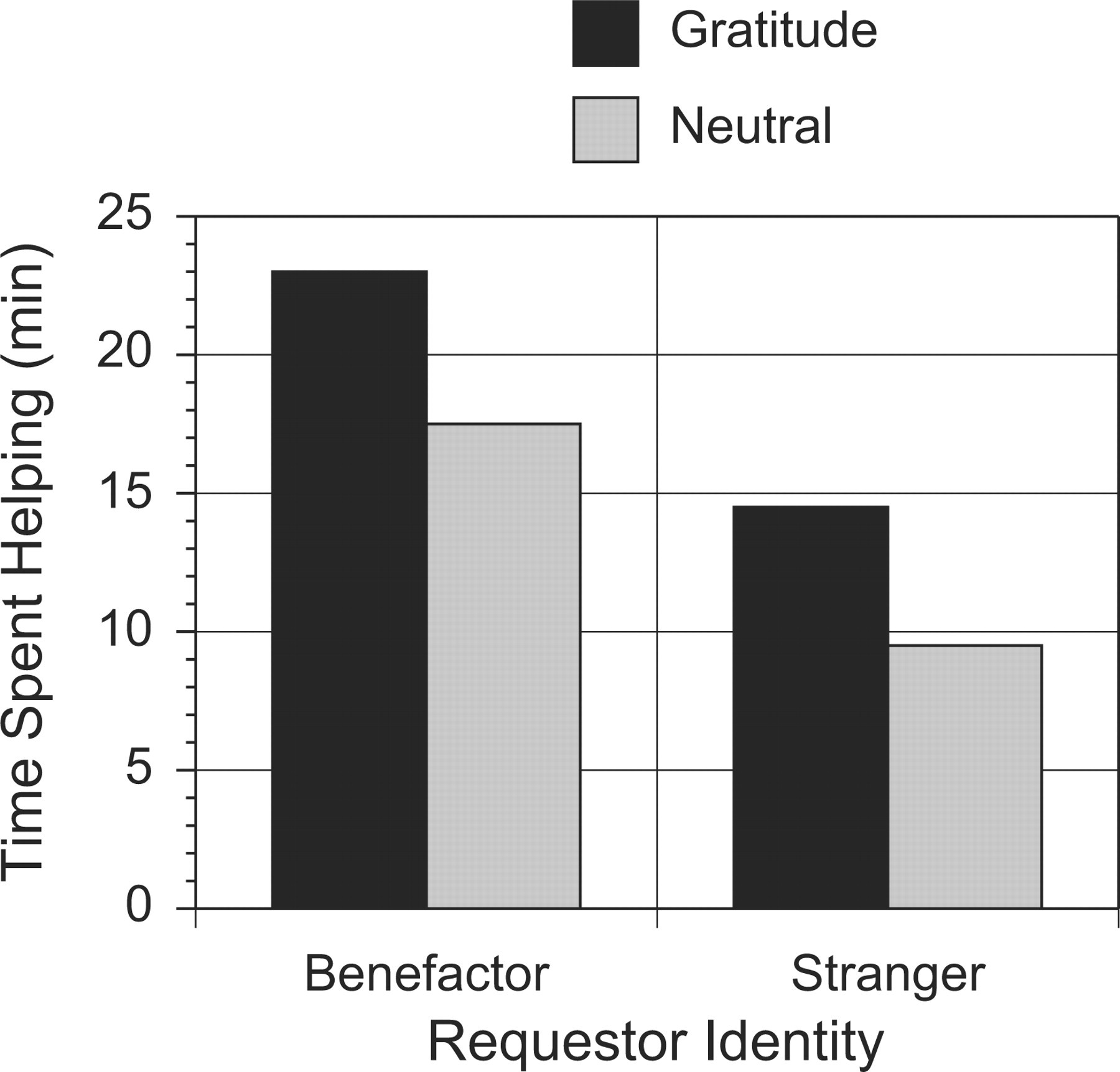
Time spent working to assist another as a function of emotional state (i.e., gratitude vs. neutrality) and identity of the requestor (i.e., a previous benefactor or a complete stranger). Note that no interaction is present; grateful individuals helped more, irrespective of the identity of the requestor. Data are taken from Experiment 2 of Bartlett and DeSteno (2006).
Finally, to demonstrate that increased helping did not stem from other norms (e.g., pay it forward), we showed that if participants were prevented from misattributing their gratitude to a new confederate requesting help, increased helping of strangers disappeared—if participants were reminded before leaving that they received help from the confederate in the session with them, they refused to help a second, new confederate who subsequently asked them for help. The norm of helping others was clearly activated by this reminder, but feelings of gratitude could not then easily be misdirected toward the second confederate. Taken together, these findings suggest that gratitude impels acceptance of short-term costs in an effort to increase long-term gains in social capital. Indeed, our most recent work demonstrates that gratitude leads individuals to choose options that maximize joint profit at the expense of their own individual profit within the context of behavioral economic games (DeSteno, Bartlett, Baumann, Williams, & Dickens, in press).
Perseverance: Is Pride Virtue or Vice?
Another prototypical instance of intertemporal choice involves decisions to persevere. What motivates individuals to exert effort to develop skills as opposed to simply engage in enjoyable activities or loaf? Clearly, working hard can be taxing, yet in the long term it offers the potential to acquire abilities and status that increase one's value to social groups. Although several mechanisms involving self-regulation can be offered to explain perseverance on difficult tasks, the emotion pride may also foster a long-term focus. As suggested by Tracy and colleagues, pride may possess both adaptive and maladaptive forms (Tracy & Robins, 2007).
To examine this issue, we conducted a series of experiments in which we induced pride through providing false feedback regarding participants' performance on an ambiguous measure of cognitive ability. Given its ambiguous nature, participants would be expected to care about this ability only if it were socially valuable. Consequently, pride was induced through receipt of high performance scores and explicit praise by the experimenter. Other participants received either equally high performance scores in the absence of acclaim (i.e., absence of perceived social value) or no feedback at all. Participants next worked on an onerous task ostensibly related to the initial ability-assessing one. Supporting the view that pride motivates perseverance, proud participants worked significantly longer on this task. Moreover, levels of perseverance were directly predicted by the intensity of pride participants felt. Subsequent analyses confirmed that increased perseverance could not be attributed to associated changes in self-esteem, self-efficacy, or general positive affect (Williams & DeSteno, 2008).
These findings indicate that pride leads to increased acceptance of short-term costs related to perseverance, but by themselves they do not show that such efforts lead to increased social capital. Consequently, we conducted an experiment in which participants worked in groups of three to solve a complex puzzle. One participant received an induction of pride via private acclaim for ability on a prior task that was related to skills relevant to solving the puzzle. We expected that proud individuals would not only take on a dominant leadership role in working on the puzzle but would also be perceived as more likable by their partners. Confirming this view, proud participants were viewed as the most dominant members of the groups and, and as shown in Figure 2, were more liked by their counterparts than vice versa (Williams & DeSteno, 2009). It is important to note that this increased social attractiveness of the proud participants did not stem solely from their increased efforts on the task, as effort alone did not predict liking. Rather, increased liking of proud participants derived from the informational signal value associated with their experience and expression of pride, thereby attesting to pride as a marker of social attractiveness to others (cf. Shariff & Tracy, in press).
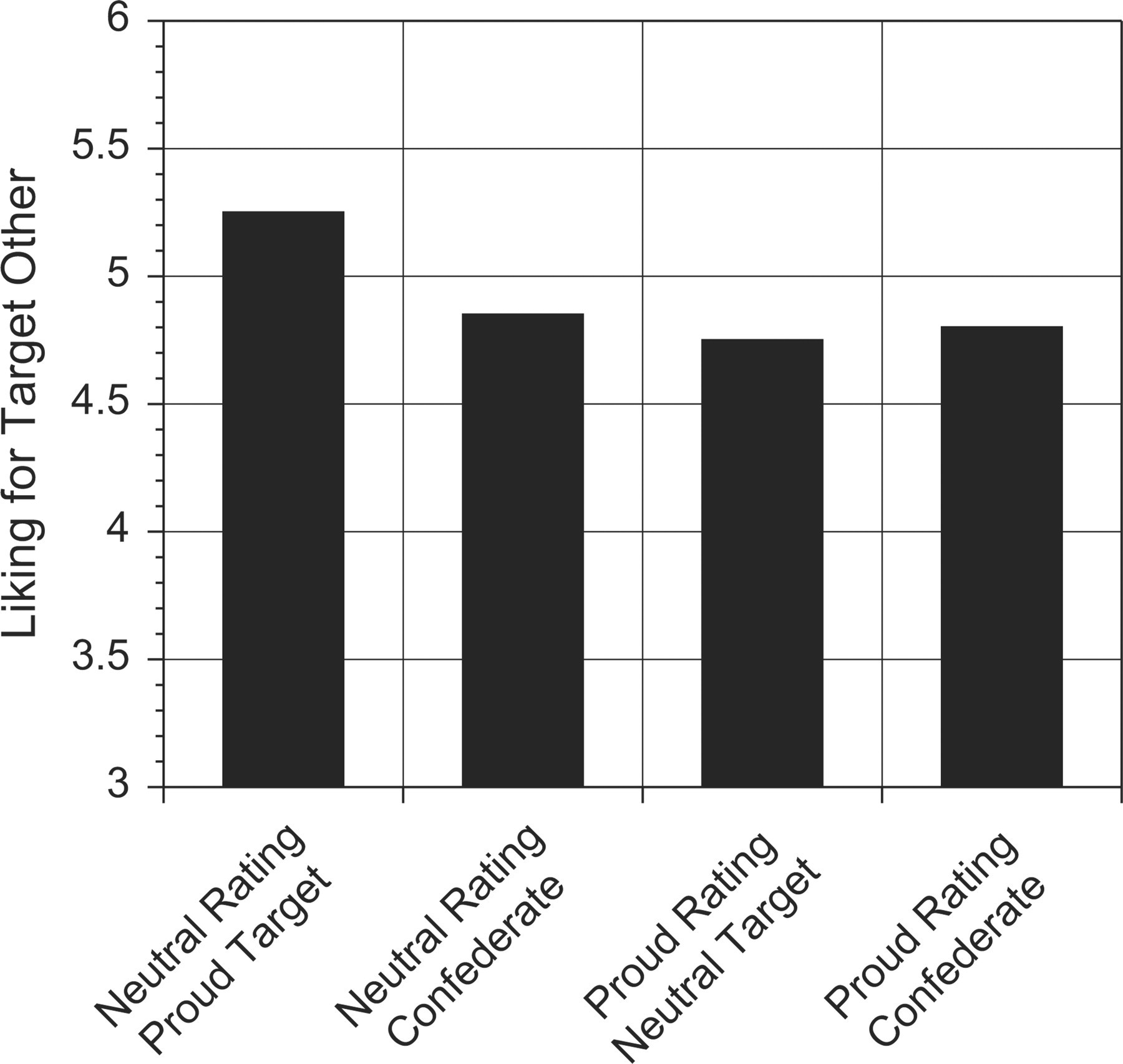
Liking for group members during a problem-solving task as a function of emotional state of the observer and the target. All triads consisted of a proud participant, a neutral participant, and a confederate. Note that significantly elevated liking only occurred for neutral participants rating proud participants. Data are taken from Williams and DeSteno (2009).
FUTURE DIRECTIONS
These and related findings provide growing evidence for the existence of emotions whose primary purpose is to motivate longer-term perspectives within contexts of intertemporal choice. This is not to say that self-regulation does not play a role in fostering adaptive behavior; it most certainly does. However, specific social emotions may represent phylogenetically older response systems that enhance social networks and the interpersonal and economic rewards they bring.
Initial identification of such “hot” mechanisms for building social networks opens important avenues for both scientific investigation and practical application. A basic starting point would be investigation of other emotions involving short- versus long-term trade-offs (e.g., compassion) with respect to their behavioral outcomes. However, two basic questions need to be asked if we are to gain greater understanding of how emotions shape human social dynamics.
The first question centers on individual differences in emotional experience. Given that people show large variation in their abilities to identify and experience discrete emotions (Barrett & Gross, 2001), their ability to benefit from these states may vary. Is it the case that those who can better differentiate feelings of gratitude or pride from simple happiness will be at an advantage for navigating the social world? If so, then curricula or interventions based not only on learning social skills but also on developing emotional competencies may foster healthier living and increased well-being.
A second and related question centers on the impact of these emotions at the societal level. What consequences, if any, do emotion-induced increases in prosocial behavior by specific individuals have for groups as a whole? Intriguing work by Nowak and Roch (2006) suggests that single instances of prosocial acts can engender increasing cascades of associated future-looking behaviors in populations (e.g., upstream reciprocity). It may be, therefore, that the impact of emotion-induced prosociality has the potential to be magnified at the societal level through increasing similar actions by others. If so, then bringing a multilevel analysis to these issues promises to be fruitful in uncovering the dynamic systems shaping sociality.
Footnotes
Acknowledgements
I thank Monica Bartlett, Jolie Baumann, Leah Dickens, Lisa Williams, and Piercarlo Valdesolo for insightful conversations that have shaped my thinking on the topics contained herein. This work was supported by grants from the National Science Foundation (BCS 0645384 and BCS 0827084).