







Abstract
Leading researchers are questioning the continued use of competitive model testing to explain participation within British political parties. This paper argues that difficulties with this approach have not arisen out of the use of model testing per se, but because of the shortcomings of the models currently in use. A multidisciplinary approach towards accounting for participation exposes some of the theoretical and analytical shortcomings in previous research into political party members, and identifies relevant factors underlying participation that merit investigation in greater detail. In particular, analytical frameworks derived from the disciplines of marketing, nonprofit management and organisational behaviour provide appropriate and robust instruments for measuring factors underlying participation that are generally ignored in the political science literature. Alternative models comprising appropriately theorized variables drawn from a number of disciplines are presented, and the implications of a multidisciplinary approach towards explaining party activism are discussed.
For well over a decade, our understanding of the antecedents of activism in British political parties has been shaped by extensive research into the membership of two major parties (Seyd and Whiteley, 1992, 2002; Whiteley, Seyd and Richardson, 1994; Whiteley and Seyd, 2002). A distinguishing feature of this research has been the creation of contrasting theoretical models to explain participation, and the statistical testing of these models in the context of empirical data collected from substantial numbers of party members. After a continuing process of refinement, four models have been developed for testing (Whiteley and Seyd, 2002). These models are:
a civic voluntarism model comprising a measure of political efficacy, and measures of full-time employment, household income, social class, educational attainment and method of recruitment to the party; a social psychological model comprising a measure of political efficacy, social norms, expressive/altruistic concerns, and a measure of respondents’ perceptions that a particular method of participation is effective or influential for their chosen party; a rational choice model comprising a measure of political efficacy, collective benefits and the costs of participation, together with an item which is intended to measure political ambition, a measure of attitudes towards participation and of respondents’ position on the ideological spectrum; and a general incentives model comprising the rational choice model with the addition of measures of group influence, and expressive incentives.
But, recently, the usefulness of these models in accounting for membership participation has been called into question – by none other than the researchers who devised them. In their recent work, Whiteley and Seyd (2002, p. 90) comment: ‘… there is no clear optimal model that encompasses all the others, so it appears that different variables from the civic voluntarism, social psychological and general incentives models are needed to define such an optimal model’. In short, Britain's leading scholars of political party membership are moving towards the idea that a multidisciplinary approach offers the optimal explanation for participation.
This article explores how the theorization underlying the development of these models could have contributed to these limitations, and how the way in which some of the key constructs in these models have been operationalised has obscured our understanding of what motivates political activism rather than aiding it. Key analytical frameworks from other disciplines are introduced to explore a variety of factors that precede participation. This article challenges the implicit assumption inherent in the political science literature that political parties are different from other types of organisation, and offers the multidisciplinary framework necessary to move towards the ‘optimal explanation of participation’ that is beyond the reach of current research.
The Hybrid Role of Political Party Members
Heywood (2002) suggests that political parties can be conceptualized as organisations of individuals united in an ideological cause for the purpose of winning power of government. What, then, are the roles that these individuals play in such organisations? Despite the vast literature written on political parties and their members, there are only a handful of studies that attempt to define what grassroots members do for their party (see Table 1). In practice, these studies describe membership as a hybrid role – part supporter, part funder and part worker. These descriptions across studies are remarkably consistent, and the similarities between them are particularly noticeable when presented together.
Supporters, Funders and Workers as Elements of Political Party Members Roles
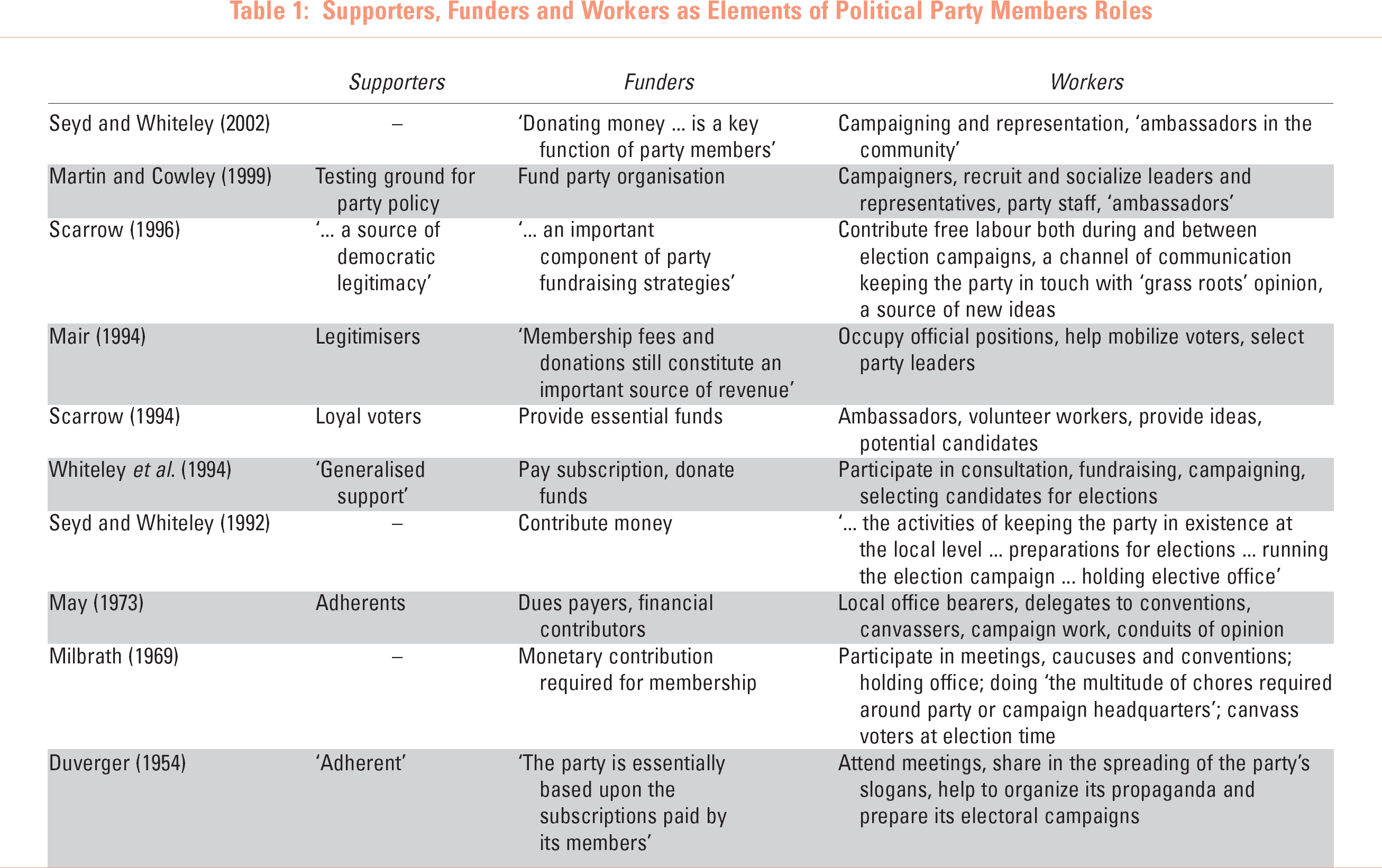
However, the theoretical implications of this hybrid role have not yet been recognized. The general assumption of the political science literature is that the supporter role of members predicts the roles of funder and worker (for example Mair, 1994, Scarrow, 1996). This paper will argue that the theoretical frameworks used to analyse the behaviour of individuals who fund organisations and those who work for organisations are appropriate and relevant in increasing our understanding of the motivations and behaviours of political party members. Similarly, as much of the work undertaken for political parties by its members is done so in an entirely voluntary capacity, frameworks for analyzing the motivations of volunteers are also appropriate.
Whilst the exclusion of potentially helpful analytical frameworks has created one set of difficulties in exploring what motivates participation in political parties, another set of difficulties has arisen because of the terminology used to describe what party members do. Work is not called work in the political science literature. Work is called activism. This may appear to be a minor point, but it would seem to account for many of the shortcomings in current research into the behaviour of political party members. A dictionary definition of activism (Concise Oxford Dictionary, 1976) describes it as a ‘policy of vigorous action in politics’. This immediately gives rise to two conceptual difficulties. The first, and most serious, problem is to locate the boundary between what constitutes vigorous action and what does not. A number of studies deal with this problem by avoiding it; focusing research only on those members who participate in party activities to very high levels (for example Abramowitz, McGlennon and Rapoport, 1983; Costantini and King, 1984; Costantini and Valenty, 1996; Archer and Whitehorn, 1997). Other studies attempt to define this boundary. Most recently, British researchers have introduced a concept of ‘high-intensity participation’ (Whiteley and Seyd, 2002), defined as ‘participation that takes a lot of time and effort on the part of those who are involved in it’ (p. 1). This definition is clearly problematic. There is no guidance as to what constitutes ‘a lot’ of time and effort. A data-driven exercise designed to isolate the components of such participation resulted in the grouping together of five activities: delivering leaflets, attending meetings, canvassing voters, running for party office and standing for elected office (Whiteley and Seyd, 2002 p. 63). There is no theoretical justification as to how such a diverse group of activities are united under the same definition. For example, on what basis can similarities be drawn between the time and effort involved in delivering leaflets and that necessary for standing for elected office?
The second conceptual difficulty with defining work as activism is that, as the scope of activism is confined only to action within a political context, analytical frameworks have been developed within the political science arena with no recourse to theories from any other relevant discipline. Political scientists may have assumed that only ‘political’ frameworks are relevant because activism is ‘different’ from work. But there is nothing in a dictionary definition of work, ‘Expenditure of energy, striving, application of effort or exertion to a purpose’ (Concise Oxford Dictionary, 1976), which precludes the possibility that activism is a form of work.
Accordingly, there is currently a considerable lacuna in the literature on political party members, the parameters of which can be defined as follows: The value of the political science literature regarding the motivation and behaviours of political party members is diminished by the use of analytical frameworks which are inappropriate for use in exploring the behaviour of individuals in organisations. Much of the academic literature concerning organisational behaviour is limited to organisations where individuals work in exchange for payment. This research has not been applied to organisations where the flow of money is the precise opposite – from person to organisation. Research into membership associations – where individuals pay to join – has concentrated on joining and renewal behaviours, not participation. And comprehensive research into the motivations of volunteer workers has simply not been applied to the study of political party members.
Activism: The Political Science Literature
This section will consider the contribution of political science to our understanding of participation in political parties. Two contrasting frameworks analyzing participation that are frequently cited by political scientists are described, as is the way in which the role of incentives for participation has, to date, been dealt with. Relevant empirical findings from previous studies of British party members are presented and discussed.
May's Law
If activism has overriding associations with political work, the temptation to explain it in terms of political belief is very strong. A number of political scientists have attempted to explain grassroots activism by linking it to belief in party ideology. For the past three decades, the theory generally known as May's Law (May, 1973) has provided the underpinning for this line of enquiry. May argued that a ‘special law of curvilinear disparity’ applied to the opinion structure of party leaders, activists and voters: activists had more extreme opinions than either party voters or party leaders. Those operating along purely ideological considerations had more freedom to be active without the constraints of having to appeal to electorates in order to retain elected office. Their belief in ideology led to aspirations of shaping candidate selections and party policies in order to promote their particular point of view. This argument was based on historical data, and not subjected to empirical testing by its originator.
Empirical work across western European parties and party systems has failed to demonstrate that it is generally applicable. Kitschelt (1989), who carried out research in two Belgian ecology parties, found support for May's Law in one party, but not the other. He concluded that, rather than the concept of curvilinear disparity establishing a general rule, it was only valid under distinctive behavioural, organisational and institutional conditions. Seyd and Whiteley (1992) claimed that their study of British Labour Party activists demonstrated some support for May's Law. However, this finding was not repeated in their subsequent study of the Conservative Party (Whiteley, Seyd and Richardson, 1994), nor in a re-examination of Labour Party members (Seyd and Whiteley, 2002; Whiteley and Seyd, 2002). Norris (1995) suggested that only those who are the most committed to party principles are motivated to do the rather mundane chores that form the backbone of party life. But her study, using data from the 1992 British Candidate Survey and British General Election Study concluded that party leaders tended to be more radical than their followers. Narud and Skare (1999) also cast doubts on the robustness of May's theory. Their study of differences in opinion between Norwegian voters, party activists and leaders on a number of different issues showed that only one party out of six, the Conservatives, demonstrated curvilinear disparity of opinion structure over a majority of those issues. However, these authors did not provide any mechanism for linking opinion structure to participation.
Rational Choice Theories, Motivation and Incentive Theories
A contrasting theory used by political scientists to analyse participation is that of rational choice. This model is closely associated with Downs (1957) who suggested that individuals can make a decision from a range of alternatives by ranking these alternatives in order of preference and choosing the alternative which is ranked highest. Olson (1965) is closely identified with the applications of rational choice theory specifically to participation, and, in his opinion, rational individuals simply cannot and do not act in order to achieve collective goods derived from ideological goals. He identifies a crucial difficulty that surrounds participation in an organisation working to provide collective goals resulting in collective goods. Collective goods, by their very nature, are available to everyone, whether or not they participate in the organisations’ efforts to realize these collective goods. Therefore if individuals realize that they will reap the benefits of success whether or not they participate in the organisation, they will generally choose not to participate – the phenomenon of free-riding.
More recently, rational choice theory has been criticized on the grounds that it is based on highly restrictive assumptions and that it is frequently, although not exclusively, associated with right-wing political values (Dunleavy, 1991). However, even Dunleavy states that: ‘the rational choice approach is too powerful an analytical tool-kit to neglect or abandon’ (1991, p. 5). In the field of interest groups and collective action, other approaches simply give unsatisfactory explanations of participation. Dunleavy argues that ‘pluralist accounts’ are ungrounded in their ‘prevailing optimism about the group process’ (p. 43); nor can they counter satisfactorily some of the points made by the proponents of rational choice. Indeed, in the Preface to his key text on rational choice theory, he states that despite initial hostility towards rational choice theories: ‘I now recognize the value of instrumental models as a mode of thinking clearly about the manifold complexities of political life and could not pursue research without using them’ (1991, p. xi).
The instrumentalism inherent in rational choice theory that some political scientists find abhorrent, is, in fact, drawn from the psychological literature of motivation. Here a substantial body of thought assumes that motivation arises out of what is essentially individual selfishness. There are conflicting ideas as to the ends to which that selfishness is directed; for example, whether the desired outcome is to fill individual needs in a hierarchical order (Maslow, 1954), or along a series of discrete dimensions (McClelland, 1961), or whether motivation arises from the expectation that using ability and effort will produce the anticipated satisfaction from an outcome (Vroom, 1964). This latter theory suggests that, in addition to need fulfilment, efficacy might also underlie action. An individual will not embark on a course of action if there is uncertainty about being able to sustain or complete it. When Olson (1965, p. 5) suggests altruism as motivation for joining is exceptionally rare and argues that ‘rational, self-interested individuals will not act to achieve their common or group interests’ without either coercion or ‘some separate incentive’, this reflects psychological theory more than it reflects any one given set of political values.
If motivation is essentially selfish, incentives theory (Clark and Wilson, 1961) argues that organisations seeking to motivate individuals to work for them must provide incentives for those individuals to do so. Indeed, the incentive system may be regarded as the principal variable affecting organisational behaviour. Incentives may be material, solidary or purposive. Material incentives are tangible; they have a monetary value or a monetary value can be easily placed on them. Solidary incentives are intangible and derived from the act of belonging to an organisation, but are generally independent of organisational aims. Purposive incentives, conversely, are those deriving from the aims of the organisation itself and not from the act of association. These benefits are also intangible but are easier to identify as their origin lies in the goals of the organisation.
Clearly then, incentives theory also displays a high degree of congruence with rational choice theory, indicating that the precise identification of possible incentives for participation is crucial towards understanding why it occurs. If political science thinking assumes that the worker role of members is predicted by the supporter role, then it follows that political scientists will explore evidence of purposive incentives operating amongst party members. But if other roles predict activity, relevant selective incentives may become increasingly salient to individual members.
Problems and Anomalies in Current Participation Research
British political scientists consider that rational choice theory presents a ‘paradox of participation’ (Seyd and Whiteley, 1992; Whiteley, Seyd and Richardson, 1994; Whiteley et al., 1994). Why should anyone participate at all, if, by free-riding, they can get the collective goods they seek without having to incur any of the costs of participation? This question assumes that participation is ‘atypical’ in some way and that there must be something distinguishing participants from free-riders. The purpose of research into participation is, accordingly, to find out what makes participants ‘different’ from non-participants. Yet the authors’ treatment of rational choice and incentives theories is somewhat ambiguous. Olsonian theory is cited to advance the argument that individuals respond to incentives in the context of joining a political party or becoming active within it; a number of categories of incentive to which individuals might respond are formulated. But none of the major texts on incentives theory are used to underpin the theorization behind the formulation of these categories. Included amongst the categories are variables such as ‘collective incentives … motivated by collective goods’ which directly contradict Olsonian theory: Olson's view is that free riding occurs precisely because rational individuals will not join forces to promote collective goals. Another anomaly is the inclusion of one category of incentive labelled ‘“altruism” deriving from emotional attachment’; yet it is unclear what the role of emotional attachment is in relation to rational choice theory (Olson, 1965). Having identified categories of incentives that might be used to explain the ‘paradox of participation’, there is no further use of incentives theory precisely to define any specific incentives falling within each category.
The congruence between motivation and incentives theories and rational choice suggests that participation is better explained by an alternative question. Which selective incentives are so valued by individuals that they choose to participate in organisations working for collective goals in order to receive them? This question suggests an analytical framework where participation is not a paradox. Indeed, it suggests that there could be a ‘pre-requisite of participation’ for members of organisations that are ostensibly set up to achieve collective goals. Individuals who value the selective incentives offered by participation must participate in order to get them. Additionally, in this scenario, there is no such thing as free-riding. Those who do not participate simply do not value the selective incentives offered by the organisation enough to be motivated by these incentives. Whether or not they want the collective goods on offer may have been a reason to join the group initially, but may not be a relevant factor in any decision to participate further. This latter approach is echoed strongly in research in the fields of marketing and volunteering that suggests that the selective incentives for participation are of crucial importance in understanding why it occurs. But this is not a line of enquiry that has been pursued methodically within the political science literature.
Instead, current British political science thinking has suggested three selective incentives for participation (Seyd and Whiteley, 1992; Whiteley, Seyd and Richardson, 1994) although, as noted above, very little theoretical underpinning is provided for any of the three hypothesized selective incentives. In an echo of Clark and Wilson's (1961) classification of purposive and solidary incentives, it is suggested that selective incentives are either outcome-oriented, concerned with achieving private goals through the political process, or process incentives, deriving from the process of participation itself. Three incentives are identified: one outcome-oriented incentive, political ambition, and two process incentives, ‘the individual's attitude to political activism in general’, and ‘left-right ideology’.
Political ambition, the only outcome-oriented incentive to be identified, refers to the desire to pursue a career in politics. But no theoretical justification is provided to explain why this should be the only outcome-oriented incentive potentially available to political party members. For example, whilst a category of ‘social norms’ is used to indicate which members join because of the influence of family or friends, this desire for social approval is not interpreted as an outcome-oriented incentive for participation. This omission illustrates clearly the differences in approach between political scientists and scholars in other disciplines: in the systematic preparation for a measure of volunteer motivations to be discussed later in this article, the desire for social approval emerged as a consistent and important motivation for volunteers across a variety of organisations. In the more ad hoc approach used in studies of political party members, the desire for social approval appears simply not to be considered a relevant ‘outcome’ incentive.
Additionally, the measurement of political ambition is substantially flawed. In their first study of Labour party members (Seyd and Whiteley, 1992), the authors admitted using what they called an ‘indirect approach to the measurement of political ambitions’ on the grounds that their pilot work showed members were uncomfortable with divulging their personal political ambitions. However, the pilot work in question appears to have comprised face to face interviews (Seyd and Whiteley, 1992, p. 221) and this alone might well have inhibited response. Unfortunately, the items used in the subsequent questionnaires for anonymous self-completion were so indirect that what they actually measure are respondents’ perceptions of their political efficacy, defined as a ‘feeling that the individual can have an impact on the political process’ (Kelly and Breinlinger, 1996, p. 28). These items asked respondents to record, for example, whether they thought ‘people like them’ would make good local councillors, rather than being asked whether they wanted to stand for or hold that office. Outcome incentives are measured in a similar way throughout subsequent research produced by these authors.
Process incentives, defined as deriving from the process of participation have also been measured in a way somewhat at odds with their definition. Process incentives, as defined above, could include concepts such as job satisfaction and socialization, as recourse to the literature of organisational behaviour demonstrates. But, in practice, the two process incentives identified in the Labour and Conservative studies appear to be based on the assumption that attitudes precede participation.
The authors describe the first of these two process incentives as ‘the individual's attitude to political activism in general’. Two substantial flaws undermine this line of reasoning. Firstly, a simple psychological definition of attitude – ‘an evaluative reaction toward something or someone, exhibited in one's beliefs, feelings or intended behaviour’ (Myers, 1999, p. 130) – indicates that holding any given attitude does not necessarily constitute an incentive for actual behaviour. Indeed, at the time of preparation for the first Labour party study, there would have been a considerable body of empirical evidence available to demonstrate the converse – that behaviour can determine attitudes (Myers, 1999). Secondly, if attitudes precede participation, how can they be a direct incentive for it?
The second process incentive identified in the Labour and Conservative studies is labelled ‘Left-right ideology’ and is intended to represent May's (1973) ‘special law of curvilinear disparity’: those who are activists must have the most extreme political opinions. The authors claim that holding extreme opinions operates as an incentive for participation because ‘it gives … a chance to give expression to deeply-held views which are deviant from the dominant political values in society’ (Seyd and Whiteley, 1992, p. 106). Although this is the only selective incentive to be supported by any theoretical justification, there is a serious difficulty with the argument; it fails to account for participation by party members whose opinions fall well within the parameters of extremity. Nor was the construct operationalised accurately; respondents were asked only to place themselves on an ideological spectrum without subsequently being asked whether they considered that they had sufficient opportunities to express their views. It simply is not plausible to infer from peoples’ ideological views alone whether or not they consider that political party membership allows them adequate expression of those views.
A further feature of the measurement of selective incentives by British political scientists is that some incentives were measured differently across political parties. For example, Labour members’ attitudes to activism were measured by the statement ‘Labour party members are part of a great movement of like-minded people who work together in solidarity’; Conservative attitudes were measured by the statement ‘Getting involved in party activities during an election can be fun’. It is therefore very difficult to compare the findings between the first study of Labour party members and the Conservative study. Nor are any comparable results provided in the most recently published surveys of Labour party members (Seyd and Whiteley, 2002; Whiteley and Seyd, 2002). Therefore, it is not possible accurately to compare the results regarding the role of incentives and participation between parties, or over time within the same party.
In summary then, British studies to date shed little light on the incentives that encourage participation and leave unanswered the question of what incentives members are looking for when they decide to participate in their party. We simply do not know what people are buying when they pay their subscriptions to enter into political party membership. This is a crucial point to explore because the benefits that individuals seek to realize by joining a party may well influence their subsequent behaviours and attitudes. It is at this point that the marketing literature becomes relevant as this provides the analytical frameworks necessary for exploring the behaviour and attitudes of those who pay for access to goods or services – customers.
Political Marketing Approaches Towards Explaining Participation
Incentives theory (Clark and Wilson, 1961), expectancy theory (Vroom, 1964) and Olson's arguments on the role of incentives in participation (1965) provide the theoretical background for the use of marketing theory in studies of membership participation. Marketing is defined by the UK Chartered Institute of Marketing (2002) as the ‘process responsible for identifying, anticipating and satisfying customer requirements profitably’. However, in nonprofit organisations, where profit generation is not the primary organisational goal, this definition can be adapted appropriately, for example ‘Marketing is the process of identifying, anticipating and satisfying customer needs in line with organisational objectives’.
The political science literature does not dispute that the relationship between party and member begins with a financial transaction – payment of a subscription fee – but does not satisfactorily explore the implications of this relationship. The political marketing literature has begun to investigate whether any comparison between the behaviours of party members and consumers can be theoretically or empirically justified; however, this work is sparse and, to date, is limited to work on joining behaviour and retention. Bauer et al., (1996) suggested that political party members go through a process similar to pre-purchase and post-purchase evaluation when deciding whether to join or stay in a party. This suggestion was theoretically derived and not subjected to empirical testing. Limited exploratory empirical research found evidence that new political party members exhibited distinct consumer behaviours when deciding to renew their subscriptions for the first time (Granik, 2001). These behaviours included post-purchase evaluation of membership (supporting the hypothesis of Bauer et al., 1996).
Crucially, this research also suggested that members’ self-reported experience of membership bears a number of similarities to characteristics of the extraordinary service experience documented by Arnould and Price (1993). The ability to compare the experience of political party membership with the experience of a commercially-provided service is important because it offers, in part, an alternative explanation as to why members participate. A documented feature of behaviour in service settings is that customers purchasing a service learn that to gain maximum benefit from it, they have to play an appropriate role (Zeithaml and Bitner, 1996). If the service proves unsatisfactory, customers may often blame themselves for their own inadequate behaviour. This phenomenon was paralleled in another of the consumer behaviours found by Granik (2001). The most active respondents in the study were more than two and a half times more likely to renew their subscription than the least active party members. Additionally, members who renewed their subscriptions reported higher participation rates across a range of activities than those members who let their subscription lapse. This feature of consumer behaviour appears to corroborate the validity of asking what it is that members buy with their subscription fee. If membership is, at least in part, a vehicle for realizing selective benefits, then clearly members have to participate in order to get the benefits they want.
Nonprofit Approaches Towards Explaining Participation
The role played by incentives in participation in organisations pursuing collective goals is covered in some depth in two discrete areas of the nonprofit literature: studies of trades unions and of voluntary organisations.
The Trade Union Literature
The evidence that collective benefits can influence participation in union is more conclusive than their ability to influence participation in a political party setting. Flood et al., (1996) found that the presence of a vibrant branch committee had a significant relationship with workplace union participation. Unions that can demonstrate evidence of collective benefits on behalf of their members are able to use these examples to encourage further recruitment and participation (Premack and Hunter, 1988; Newton and Shore, 1992; Bamburger et al., 1999). These findings suggest that the perceived efficacy of a membership organisation both at local level and on a wider scale has a relationship with participation. Whilst political party studies point to personal political efficacy as being a major predictor of participation, the evidence that personal efficacy is an antecedent of union activity is mixed. McShane (1986) found that members with the higher levels of education associated with personal efficacy were significantly more likely to participate in union administration. Kelly and Kelly (1994), who took a more direct measure of political efficacy, found that it did not have a significant relationship with individual participation in trade unions, except for when members identified only weakly with their union.
Trades union studies provide some evidence that, as the marketing literature would suggest, satisfaction with the experience of membership and desirable membership behaviours are related. A major study of union commitment (Gordon et al., 1980) found that satisfaction variables displayed significant positive correlations with union loyalty, although not with willingness to participate. An earlier study (Glick et al., 1977) had previously found evidence of a positively correlated relationship between satisfaction with the union and willingness to participate in union activities – but only amongst individuals indicating strong ‘higher order needs’ for example, decision making and accomplishment. Gordon et al., (1980) found that the benefits unions provided to their members emerged as the most important basis for commitment. Van de Veen and Klandermans (1989) found that negative experience with union services was frequently cited as a reason for leaving, and Klandermans (1997) subsequently suggested that services prevented quitting but did not motivate participation.
Trade union studies have also explored the effects on participation of one variable that has not previously been explored in British political science research. Socialization is described as the process by which individuals acquire the skills, social knowledge and behaviours needed to participate as an organisational member (Van Maanen and Schein, 1979). Socialization into a union has been found to be closely associated with member loyalty, highly correlated with a general belief in unions and enjoying a significant relationship with commitment (Gordon et al., 1980). McShane (1986) demonstrated that union members who were more ‘socially integrated’ into their union branch were likely to attend more union meetings and more likely to participate in strikes than those members who knew fewer people. A later study (Flood et al., 1996) was able to replicate Gordon's finding that the existence of an induction procedure impacted positively on pro-union orientation, but also found that induction procedures only had a significant relationship with one specific type of participation.
Studies of Volunteering
Less acknowledged in mainstream political science research, is the literature concerning the motivations and behaviours of volunteers. Yet the volunteering literature parallels one approach by political scientists in that it involves extensive use of rational choice theory. In consequence, there is a substantial body of research exploring the incentives that motivate individuals to work for ‘nothing’. Possible motivations range from opportunities to give service (Widmer, 1985; Bhattacharya, 1998), or express one's values (Carroll and Harris, 1999) to personal development (Covelli, 1985; Widmer, 1985; Omoto and Snyder, 1993), social incentives (Pearce, 1993; Bhattacharya, 1998; Carroll and Harris, 1999), career enhancement (Vaillancourt and Payette, 1986), and increasing one's self-esteem (Covelli, 1985; Vaillancourt and Payette, 1986; Pearce, 1993).
Development of Instruments for Measuring Motivation
One writer with practitioner experience of managing volunteers (Francies, 1983) examined the concept of the fulfilment of psychological needs as motivation for volunteering, and concluded that the degree of match between psychological need and work assignment had a positive relationship with volunteer satisfaction and with retention. This theme was developed further by psychologists with an interest in volunteering (Clary and Snyder, 1991; Clary, Snyder and Ridge, 1992), resulting in an analytical framework measuring six distinct functional motivations which lead to volunteering: the Volunteer Functions Inventory (VFI).
The six functional motivations measured by the VFI are values, understanding, career, social, enhancement and protective motivations. These were identified by reference to the results of earlier empirical studies of volunteers in a number of different settings and noting which benefits of volunteering emerged most clearly and most consistently from these studies (Clary and Snyder, 1991). The values motivation refers to the individual's perceived congruence of their personal values and the values of the organisation to which they belong, and to opportunities for individuals to serve a cause that has some personal meaning for them. The understanding motivation is the desire to know more about the cause which one serves, or even to learn for the sake of learning. The career motivation is satisfied when individuals can learn additional skills through volunteering, or when volunteering can lead to opportunities to explore new careers, or introductions to potential contacts. The social motivation is identified as using volunteering to gain social approval. Family, friends or social groups may provide a normative influence to volunteer, or individuals may wish to be seen to behave in socially desired ways. Volunteering can enhance esteem by making the individual appear needed and important, whilst the protective motivations are defined as allowing volunteers some relief or escape from negative feelings about oneself.
The VFI has been tested on at least six occasions in order to establish levels of volunteer satisfaction with their work, and the relationship between satisfaction with volunteering and intention to volunteer again in the future (Clary et al., 1998). Evidence from these laboratory and field tests of the VFI indicated that respondents choosing service opportunities that provided benefits matching their initial motivations were more inclined to continue to volunteer than individuals who chose opportunities that did not provide functionally relevant benefits, or that provided functionally irrelevant benefits (Clary et al., 1998).
The importance of this framework for political science is that the functional motivations identified by this thorough and systematic process of research and empirical testing comprise a structured set of process and outcome incentives. In contrast to the ad hoc approach used in studies of Labour and Conservative members, the VFI identifies one purposive or process incentive – values motivations – and five solidary or outcome incentives that can potentially be accrued from political party membership. The values motivations incentive is particularly helpful because it refers to person-party value congruence and not to belief in specific ideologies or tenets of party policy. Thus, the use of values motivations can be used to directly compare member-party relationships across parties of differing ideologies. This variable can also be used reliably to track member-party relationships in the same party over time. Specific party policies change; value congruence will be unaffected by some policy changes, or positively or negatively affected by others.
Results from a study of the operation of functional motivations in a political party indicate that values motivations have a positive statistically significant relationship with whether members participate at all, and with time spent on party activities (Granik, 2003). However, the study concluded that it was not possible to identify whether values motivations were an antecedent or an outcome of spending time on activities. Protective motivations were also found to have a statistically significant positive relationship with the decision to participate. Career motivations were found to have a statistically significant positive relationship with whether members made donations or not.
Organisational Behaviour Approaches to Explaining Participation
The major advantage of using organisational behaviour literature to inform research into the behaviour of political party members is the abundance of analytical frameworks which can be used to examine why people work. The major drawback of this strand of literature is that the majority of these frameworks analyse the experience of working in organisations where individuals are paid for doing so. Therefore some aspects of paid work, for example job security, pay, absenteeism, supervision and appraisal, are simply not relevant in a membership association context.
But some concepts identified as operating in the workplace can be applicable to a political party. All party members join the organisation at some point, hence organisational socialization is a relevant area of study. All members have the potential to identify with and become involved with their party, hence attitudinal commitment is also relevant. Those members who do choose to work for the party may or may not experience satisfaction with what they do. This section of the literature review will discuss these three concepts.
Socialization
As discussed earlier, socialization is positively related with some aspects of trade union behaviour. The literature of socialization in the workplace suggests that there is evidence of socialization preceding commitment in the workplace environment (for example Buchanan, 1974; Wanberg and Kammeyer-Mueller, 2000). Workplace studies have additionally found that successful employee socialization also has links with job satisfaction, intent to stay in the organisation and job performance (Kelley, 1992; Chao et al., 1994; Bauer and Green, 1998). In a recent study of the operation of socialization amongst political party members (Granik, 2003), this variable was found to have a statistically significant relationship with the overall number of activities in which members participated, and, in particular, whether or not members participated in the day to day party activities or in election-related work that would fall within the concept of ‘high intensity participation’ (Whiteley and Seyd, 2002). Additionally, socialization had a statistically significant relationship with whether members renewed their subscriptions regularly each year or displayed discontinuous membership behaviour. In terms of the type of selective incentive that socialization represents, clearly it is a solidary or outcome incentive as it is derived from the process of participation, rather than the aims of the group.
Job Satisfaction
Simply defined, job satisfaction is how people feel about their jobs and different aspects of their jobs (Spector, 1997). Job satisfaction can be considered to be an outcome of activity rather than an antecedent, or as a factor motivating continued and better performance (Hackman and Lawler, 1971). Job satisfaction can be considered as an overall feeling about a job, or as a related set of attitudes about various aspects of the job. There is very little research as to how job satisfaction operates in a voluntary setting, but this belies its importance. In an environment where work is voluntary, and where organisations have very few mechanisms for coercion, it is very unlikely that any work will be done at all if no job satisfaction accrues.
A preliminary investigation of job satisfaction in a political party (Granik, 2003) indicated that job satisfaction is the only variable to have a statistically significant positive relationship with the spectrum of routine, election-related and internal party activities that fall within the concept of ‘high-intensity participation’. In terms of incentive classification, as with socialization, job satisfaction can only be a solidary or outcome incentive, as it is an incentive derived from the process of participation itself.
Organisational Commitment
Commitment to an organisation can be attitudinal or behavioural (Meyer et al., 1989; Meyer and Allen, 1997). Attitudinal commitment is defined as the relative strength of an individual's identification with and involvement in a particular organisation (Mowday, Steers and Porter, 1979). Three components of attitudinal commitment have been identified: affective, normative and continuance commitment (Meyer and Allen, 1997). Affective commitment refers to emotional attachment to, identification with and involvement in the organisation (Meyer et al., 1989). Normative commitment is described by Marsh and Monnari (1977) as a sense of moral obligation to stay in the organisation and conform to its goals and values. Continuance commitment arises where an individual has created a series of investments in an organisation, which keeps him or her a member of it (Hrebriniak and Alutto, 1972).
In studies of attitudinal commitment in the workplace, variables such as organisation structure and policies, work experiences, demographic characteristics, and personal investments in the organisation, along with alternatives to being a part of it have been identified as relevant antecedents (Meyer and Allen, 1997). A recent finding with considerable implications for membership associations suggests that commitment can be predicted by perceptions of organisational values (Finegan, 2000). The greater the similarity between personal values and perceived organisational values, the greater levels of affective commitment are likely to be. However, levels of continuance and normative commitment appear to be unaffected by person-organisation value congruence.
The study of attitudinal commitment amongst political party members was presaged by Duverger (1954) when he observed: ‘A militant is not twice or three times more attached to the party than a member: he is attached to it in a different way’ (p. 16). In the intervening half-century, the study of attitudinal commitment amongst party members has been largely ignored, however, recent research into this potential antecedent of participation shows that, as Duverger predicted, all three dimensions of attitudinal commitment can be said to function in a political party setting (Granik, 2003). This study found that affective commitment has a positive statistically significant relationship with the full spectrum of political party activities, but this relationship lost significance when socialization, job satisfaction and political efficacy were controlled for. Normative commitment showed a positive significant relationship with making a donation, although not with the amount of donation made. This relationship lost significance when variables such as continuous party membership, length of tenure in the party and job satisfaction were controlled for.
Discussion: What Difference Does a Multidisciplinary Approach Make?
How, then, would a multidisciplinary approach affect the composition of the four models that have previously been used to explore the motivations for participation in political parties described in the introductory section of this article? Clearly, the multidisciplinary approach does not fundamentally affect the civic voluntarism model, which comprises mainly demographic measures, although it is curious that political efficacy should be included amongst them. But the social psychological and rational choice models would have to be substantially revised in order to correct the theoretical deficiencies and anomalies that are currently incorporated in them, and to accommodate the additional frameworks suggested by theories from other disciplines. The fourth model – that of general incentives – would also have to be substantially revised so that it could include appropriate purposive and solidary incentives. The remainder of this section deals in some detail with the revisions necessary to pre-existing models suggested by a multidisciplinary approach.
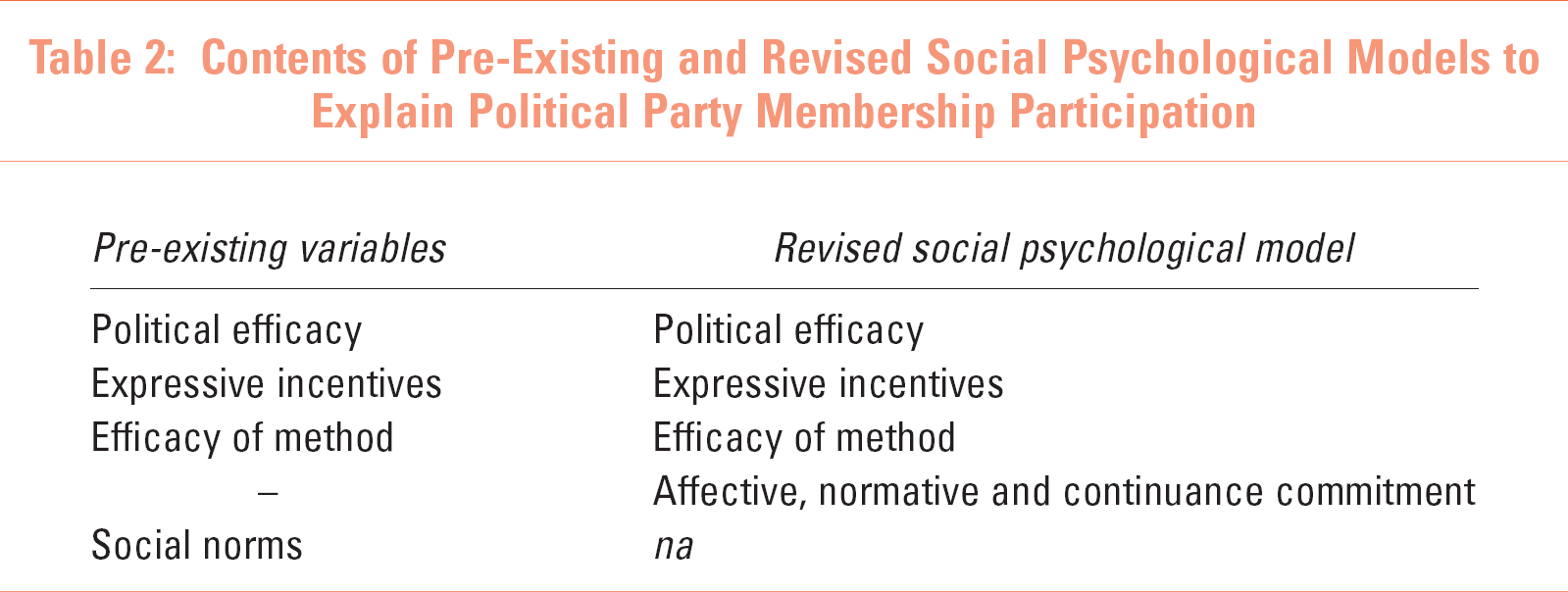
The social psychological model, it will be recalled, comprised a measure of political efficacy, social norms, expressive incentives and a measure of respondents’ perceptions that any method of participation is efficacious for their party. Whilst political efficacy could remain in this model, the theorization underlying the inclusion of a ‘social norms’ variable indicates quite clearly that this is an outcome or solidary incentive; therefore it has no place in a social psychological context. However, the social psychological model should include a measure of all three dimensions of attitudinal commitment. The inclusion of expressive incentives and efficacy of method in a social psychological model need not be affected (see Table 2).
Contents of Pre-Existing and Revised Social Psychological Models to Explain Political Party Membership Participation
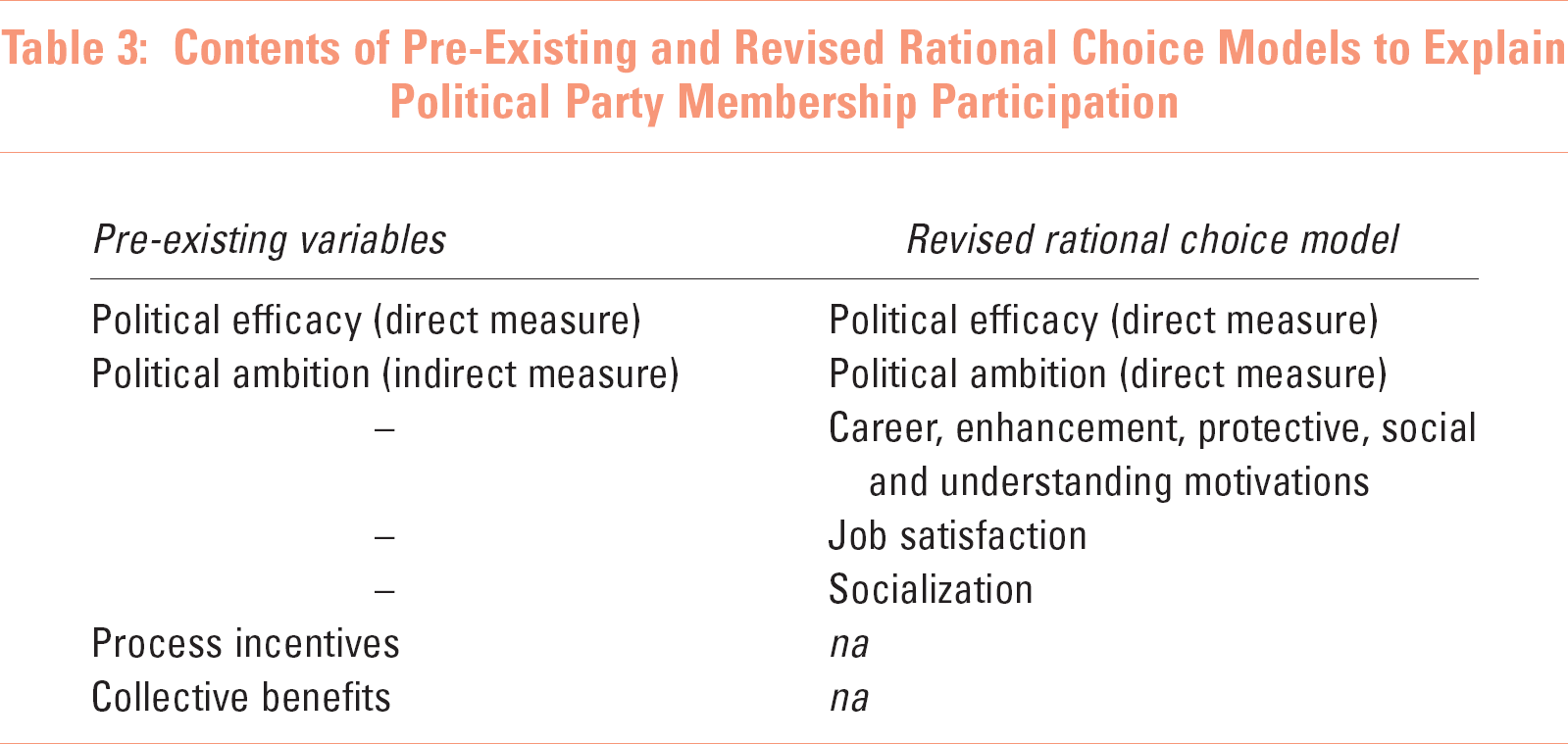
The rational choice model as it currently stands is the most problematic of all the four. This comprises the personal influence measure of ‘political efficacy’, the outcomes incentive measure intended to represent political ambition, variables measuring collective benefits and the two process or purposive incentives. Clearly, Olsonian theory dictates that collective benefits simply cannot be included in a rational choice model. Neither can the two process incentives be included for reasons discussed in full earlier in this paper. The reasoning behind the assumption that attitudes towards activism are incentives for it is fundamentally flawed, nor is it plausible that position on an ideological spectrum alone can act as an incentive for behaviour. The reader will recall that the ‘outcome incentive’ of participation was defined as the fulfilment of political ambition, but that this construct was measured in such a way as to record efficacy. The fulfilment of political ambition is undoubtedly one of many potential outcome incentives to be derived from participation, but it cannot be inferred by adding what is a second measurement of political efficacy. Indeed, the inclusion of even one political efficacy variable in this context is a little puzzling as it makes the assumption that efficacy operates as an incentive as well as a trait. Nevertheless, this assumption should not necessarily result in its exclusion from the model.
The rational choice model cannot be considered complete without the full range of outcome or solidary incentives suggested by the nonprofit and organisational behaviour literatures. This would result in the inclusion of all five solidary incentives included in the VFI – career, enhancement, protective, social and understanding motivations – together with socialization and job satisfaction. The contrasts between the old and new rational choice models is illustrated in Table 3.
Contents of Pre-Existing and Revised Rational Choice Models to Explain Political Party Membership Participation
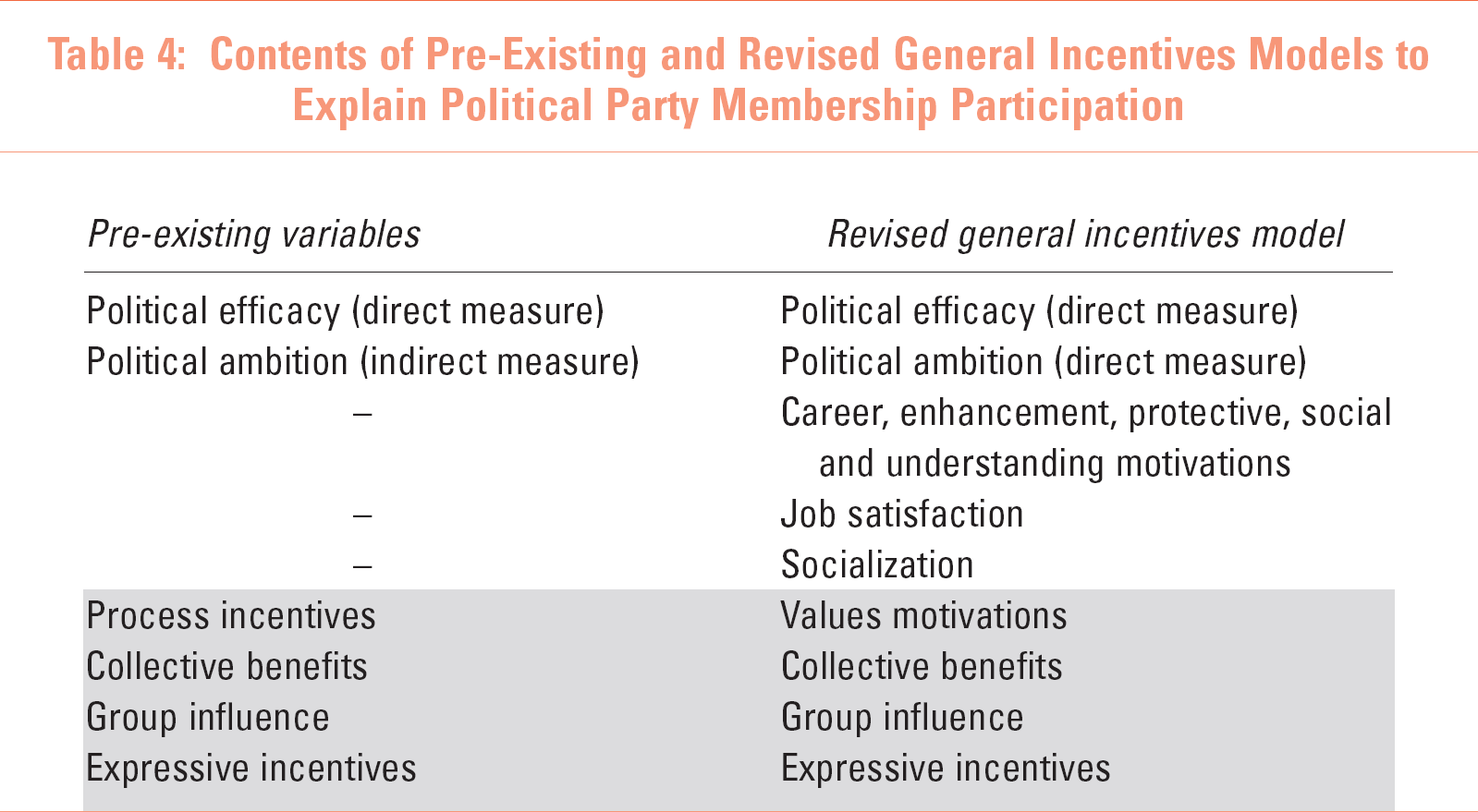
If the purpose of the general incentives model was to include measures of both purposive and solidary incentives, then this is a more appropriate vehicle in which to include variables such as collective benefits and, from the VFI, values motivations. A revised general incentives model would, therefore, contain the various elements detailed in Table 4.
Contents of Pre-Existing and Revised General Incentives Models to Explain Political Party Membership Participation
A multidisciplinary approach thus helps to clarify existing models by removing variables which are contextually inappropriate and adding the new ones suggested by an enhanced range of analytical frameworks. A number of questions, however, arise from this exercise. For example, does an enhanced multidisciplinary approach measure all antecedents of participation? Should a multidisciplinary approach be incorporated into a single model, or should the practice of competitive model testing be continued? And what are the implications for further research suggested by a multidisciplinary approach?
There is no doubt that a multidisciplinary perspective must, by definition, broaden the range of possible antecedents of participation beyond the confines of current work. But does the combination of political science, political marketing, nonprofit management and organisational behaviour provide an exhaustive list of all the variables that could precede participation? Two additional variables that are not adequately covered by any of these frameworks are particularly germane to this debate.
The first variable is whether or not individuals have the opportunity to participate in their political party of choice. This variable is hinted at in a fifth model put forward by Whiteley and Seyd (2002), but not empirically tested. A ‘mobilization model’ (p. 48) allows for participation being preceded by having adequate opportunity to do so, or by being persuaded by others to become involved. Clearly, the latter part of this model is accounted for by the social motivations component of the VFI, and, accordingly, belongs in a rational choice model. But there has been little systematic exploration into how and why opportunities for participation are reduced, and for whom such opportunities are reduced. If formulated, measures of opportunity for participation would most properly be included in a general incentives model.
The second variable is drawn from the field of personality psychology – the extent to which personality functions as an antecedent of participation. The use of personality traits as a framework for understanding behaviour is particularly credible because these traits are relatively stable over time (Costa and McCrae, 1997). Studies of volunteers (for example Horton Smith, 1966; Graziano and Eisenberg, 1997) indicate that there is a relationship between personality characteristics and volunteering, and, specifically, that there are statistically significant relationships between extraversion and both belonging to a voluntary organisation and being active in it (Bekkers, 2001). The relationship between personality traits and grassroots participation in political party activities has not been tested in Britain.
The second key question raised by a multidisciplinary approach is whether the range of variables used in such an approach should be incorporated into a single model, or should the practice of competitive model testing be continued. It was noted at the beginning of this article that the leading researchers in the field of political party membership are beginning to think in terms of an ‘optimal’ model of participation, rather than exploring the variance in participation accounted for by competing models. However, the process of constructing an optimal model has been attempted in recent work (Granik, 2003), and is subject to a number of difficulties. Some of these difficulties are technical, for example, the autocorrelation of some variables.
But the most pressing difficulty with an optimal model approach is that of defining the dependent variable – participation. The limitations of the term ‘high-intensity participation’ have previously been discussed. The formulation of an optimal model of participation must imply some coherence in the nature of the participation being measured. But, ironically, a data-driven approach towards defining participation seems to be reducing coherence rather than enhancing it. For example, the theoretically derived ‘representation dimension’ of participation used in earlier British work (Seyd and Whiteley, 1992; Whiteley, Seyd and Richardson, 1994) comprised two measures of standing for office and two measures of holding office. These are tasks requiring more directly comparable skills, duties and time commitments. At this point it is appropriate to recall that the problems in satisfactorily defining participation arise directly from the use of the term ‘activism’ to describe what party members do, rather than using the term ‘work‘. This strengthens the case for more fully incorporating appropriate frameworks from other disciplines into the study of political party members. Recourse to the literature of organisational behaviour could lead to the classification of the range of tasks undertaken by party members into meaningful groups of activity types.
Thus, there is no need to move away from the competing model testing scenario as there are few theoretical difficulties with competitive model testing per se. Problems have arisen with this approach because of the shortcomings of the models currently in use. The flaws of using variables derived from inappropriate theorization and inadequate analytical frameworks are becoming increasingly exposed as data are subjected to increasingly sophisticated methods of statistical analysis. The use of a more carefully theorized set of independent variables in each model should remove the perceived need to develop an optimal model. The acknowledgement that political party members perform work tasks on behalf of their party can lead to a more meaningful classification of different activity types, leading to more thorough explanations of the antecedents of various forms of participation.
The implication for further research suggested by a multidisciplinary approach is, simply, that use of a wider range of variables is likely to add to our understanding of the antecedents of party activism. Scholars of party membership participation should take advantage of the analytical frameworks provided by other disciplines to expand the range of enquiry into its antecedents. Specifically, the functional motivations for participation defined by the VFI, and the constructs of job satisfaction and socialization should be systematically incorporated into future studies of membership participation.
Conclusion
A multidisciplinary approach towards accounting for participation exposes some of the theoretical and analytical shortcomings in previous research into political party members, and identifies relevant factors underlying participation that merit investigation in greater detail. Fortunately, this now appears to be the view of leading researchers in the field. It is to be hoped that future research will resolve some of the inaccuracies and crucial omissions that have characterized the study of political party members to date.
However, acceptance of a multidisciplinary approach should not be conflated with endorsement of the concept of a single optimal model explaining activism. Participation comes in many forms; different activity types may have different antecedents. The incorporation of frameworks from disciplines outside political science can lead to both more efficient use of variables explaining activism, and more coherent definitions of what comprises it.
Footnotes
The research on which this paper is based was supported by a postgraduate training award (R00429934169) from the Economic and Social Research Council of Great Britain. The author is grateful to John Kelly, Margaret Scammell, Margaret Harris and three anonymous reviewers for their comments.