







Abstract
This article examines the process that led to the repeal of Israeli electoral reform (1992–2001) and compares it with that of reform adoption (1987–92). The most significant difference between the two processes is in the kinds of information that were available in them. In the politics of reform adoption, information was susceptible to manipulation and its supply was a crucial part of the struggle itself. In the politics of reform abolition, the real consequences of reform were constantly unfolding. This substantial difference resulted in other differences – not in type but in extent. First, while both were ongoing processes in which coalitions of supporters and opponents had to be built and then rebuilt several times, the cohesion of the camps throughout the struggle for reform abolition was higher than in the struggle for reform adoption. Second, while office-seeking successfully served as a basis for understanding the behavior of most parliamentary actors, the actual perceptions of its exact contextual meaning was dependent upon different available information. The two processes also had two common characteristics: power was diffused in both arenas of the politics of reform and in both instances the selection of the right timing proved to be necessary for successfully promoting the initiatives against veto players who were interested in preserving the status quo.
In the 1990s, four established democracies – New Zealand, Italy, Japan and Israel – after using the same electoral system for decades, adopted substantial electoral reforms (Norris, 1995; Shugart and Wattenberg, 2001). Among these democracies, only Israel, in less than a decade, abolished the reform and returned to use its previous system. If reform is itself a rare occurrence, and one that presents a challenging puzzle for scholars, then this sequence of reform and its repeal presents an even larger conundrum: if a majority of the elected representatives decided that reform was needed for improving the functioning of the system or to better serve their personal or partisan interests, how is it that a majority in the same forum, elected by the new – desired – system, decided to abolish it? The simple and correct answer is that this was a process of trial and error (and its correction): the reform was adopted on the basis of flawed perceptions. It was abolished when its real consequences became apparent, that is, when the politics of reform became an informed process.
The Knesset (Israeli parliament) is elected by a Proportional Representation (PR) closed-list electoral system, in which the whole nation serves as a single constituency. This system has remained almost intact since Israel attained independence (1948). In essence, the Basic Law: The Government (1992), which was adopted by the Twelfth Knesset (1988–92), reformed the government system. It created a unique combination of presidential and parliamentarian elements: the head of the executive branch, the Prime Minister (PM), was to be directly elected, yet needed the approval – and confidence – of the legislature for the government he/she established in order to hold on to his/her post (Hazan, 1996). In the elections under the new system, each voter had two votes. 1 One was used to select a candidate list for the Knesset; this vote determined seat allocation in the Knesset in exactly the same manner as before the adoption of reform. The second vote was used to select, nominally, one of the contenders for PM according to a two-round majoritarian system. The holding of both elections at the same time and the addition of the direct election of the PM ‘above’ the Knesset elections marked the establishment of a new two-ballot electoral system that replaced the former one-ballot system. This created de facto electoral reform in terms of supplying new incentives, considerations and strategies for voters, political parties and individual politicians (Diskin, 1999; Harris and Doron, 1999; Hazan and Rahat, 2000). Two distinct electoral systems, that can be seen as exact opposites, were operational simultaneously: the old, extremely proportional and partisan electoral system for the Knesset and a new, personal and majoritarian system for electing the PM (Shugart, 2001). On March 7, 2001, the Knesset passed in second and third readings the abolition of the separate elections for the PM. Israel returned to its old government and electoral system. 2
This article explains, first, the utility of the study of reform abolition for the re-examination of the theory of electoral reform. Second, it analyses the politics of reform abolition, a process that stretched over three Knesset terms (1992–2001) and demonstrates how the revelation of the real consequences of reform led to its repeal. Finally, the article compares five characteristics of the processes of reform abolition and adoption: (1) the kinds of information available in the two processes; (2) the cohesion of the camps of reform opponents and proponents throughout the processes; (3) power dispersion in the arena of the politics of reform; (4) the timing of the votes on reform abolition and adoption; and (5) the varying motivations for support and rejection of reform.
A Theoretical Perspective on the Adoption and Repeal of Electoral Reform
Scholars have offered general explanations for the electoral reform puzzle based on rational choice analysis (Benoit, 2004; Dunleavy and Margetts, 1995), the institutional approach (Shugart and Wattenberg, 2001) and historical comparisons (Norris, 1995; Sakamoto, 1999). The theoretical controversy among political scientists about the utility of the rational choice approach for studying real world phenomena (Friedman, 1995; Green and Shapiro, 1994) also occurs in the debate over the politics of reform, particularly in regard to the Israeli case of reform adoption (Bueno de Mesquita 2000; Rahat, 2004).
Rahat (2004) claims that the potential simplicity of the rational choice paradigm cannot be utilized for studying the reforms of the 1990s because these occurred in complex, unstable arenas that were loaded with uncertainty: parties were not the exclusive actors, nor were they unitary, rational actors. Interests had different values for different times, and each value was dependent upon events, subjective assessments and different sets of considerations that were, for their part, manipulated by the leading actors of the scene. Furthermore, the claim is that reformers were successful thanks to their utilization of uncertainty, instability and complexity, that is, the same circumstances that hindered the use of rational choice models.
The repeal of reform enables us to re-examine these claims. According to this approach, it can be expected that the politics of repeal would be substantially different from the politics of adoption because repeal occurs after the political consequences of reform are revealed. This difference in the kind of available information is expected to cause higher levels of cohesion in the camps of reform opponents and proponents throughout the repeal process, and higher stability in the motivations for support and rejection of reform. The two processes are expected to share common characteristics: power would be diffused in both arenas and timing would be crucial in both instances. These two elements would enable reformers and abolitionists to overcome veto players interested in preserving the status quo.
The Politics of Reform Abolition, 1992–2001
This section analyses the process of reform abolition. It starts by looking at the temporary stabilization of the new reformed system in 1992–1998, a period in which both the reformers failed to promote further reform and the opponents of reform failed to abolish the direct elections. The section continues with the first successes of the opponents of reform in 1998, when the bill to abolish direct election passed both the preliminary and the first readings. It ends with an analysis of the moves that led to the final abolition of direct elections in the years 1999–2001.
The (Temporary) Stabilization of a New Institutional Equilibrium (1992–8)
During the term of the Thirteenth Knesset (1992–6), many parties were divided on the question of the reform, which was to be implemented in the next elections. These divisions helped to freeze the institutional setting determined by the previous Knesset. While reform opponents failed to delay the implementation of reform, they succeeded in blocking reformers’ attempts to empower the directly elected PM through amending the new Basic Law: The Government (1992), and to reform the system used for electing the Knesset.
Already in 1996 it was evident that the two-ballot system encouraged the streaming of votes from the large aggregative parties to the small particularistic sectarian parties (Table 1). 3 The representation of the two large parties combined fell from 76 to 66 seats; the number of seats of the largest party (34) was lower than ever in Israel's history. Meanwhile, the sectarian parties’ representation rose by 16 seats, the highest relative share that this group had achieved since 1969. Yet, at this point, reform supporters could still argue that election results were influenced by socio-political factors, campaigning errors and political events, rather than by the new reformed system. After all, this was just the first indication of trends that would later become clearer, after conducting additional elections under the two-ballot system. Moreover, there was still hope that better governance would compensate for these changes in the distribution of representation.
Election Results for the Israeli Knesset 1992–9 by Number of Seats
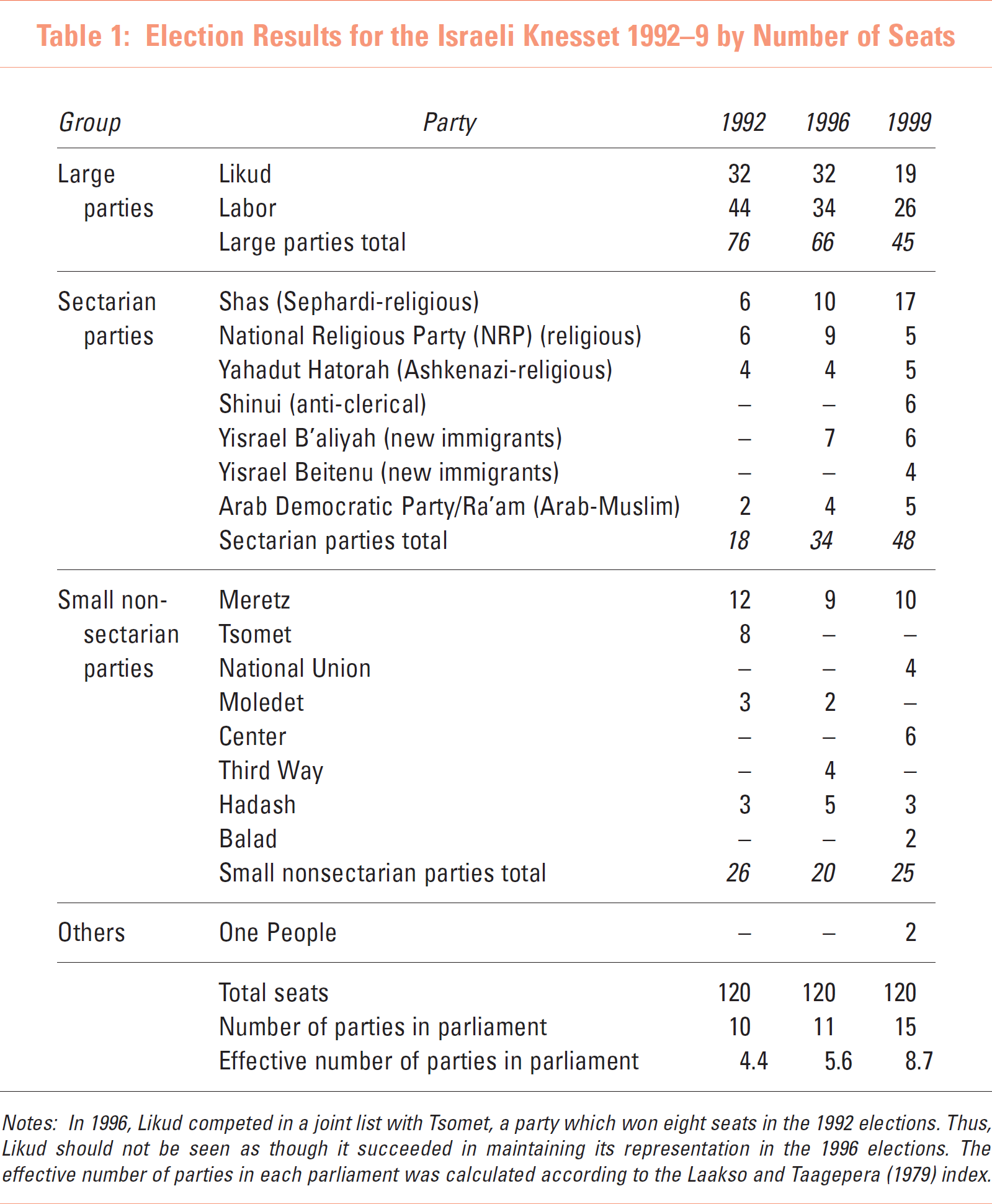
Notes: In 1996, Likud competed in a joint list with Tsomet, a party which won eight seats in the 1992 elections. Thus, Likud should not be seen as though it succeeded in maintaining its representation in the 1996 elections. The effective number of parties in each parliament was calculated according to the Laakso and Taagepera (1979) index.
An early attempt at passing a bill that called for the abolition of direct elections for the PM failed. The timing of the bill's submission was bad. Likud was still reveling in Benjamin Netanyahu's surprising victory, together with its coalition partners who were empowered in the 1996 elections. In February 1997, a private member bill that proposed the abolition of direct elections passed a preliminary reading. In March, an association whose aim was to abolish reform was established. It included senior members of both Labor and Likud, and was backed financially by Jewish American donors. It also won academic support from the Israel Democracy Institute, a think tank that had rejected reform consistently since 1989. But these developments did not yet signify that the legislative path was open for promoting a reform abolition bill. In June 1997, two additional private member bills that called for the abolition of direct elections were rejected in a preliminary reading. The government rejected the bills, and most members of the government coalition were either loyal to this stand or refrained from participating in the vote. Neither did massive support come from Labor, the major opposition party (Fifteenth Knesset Records, 9 June 1997).
Thus, in mid-1997, the chances of the abolition initiative looked bleak, especially because the leaders of both large parties, Prime Minister Netanyahu (Likud) and new Labor chairman Ehud Barak, rejected it. However, the government's continuous malfunctioning fed the claims raised by reform opponents. Intense activity inside Labor, aimed at convincing the party to adopt an official stand against reform, kept the issue on the party agenda. The lobbying activities of the pro-abolition Association for Parliamentary Democracy (APD) exposed many silent supporters of abolition and succeeded in recruiting most Labor and Likud Members of Knesset (MKs) to support its cause. The APD succeeded in puncturing the aura of popular support for reform by holding opinion polls that demonstrated that the public no longer firmly supported reform and by supplying the mass media with academic material that supported the abolition cause. These activities kept reform abolition on the political agenda, and improved the chances that later on, when the time would be right, it would not suffer another defeat.
First Successes (1998)
In late May 1998, three private member bills that suggested reform abolition were submitted for a preliminary reading. While two were rejected, the joint bill of Yossi Beilin (Labor) and Uzi Landau (Likud) passed with the support of 50 MKs and the rejection of 45. A majority of Labor MKs (22) together with a plurality of Likud MKs (10) and the smaller nonsectarian parties MKs (13) supported abolition (Table 2). Rejection in Labor and Likud came from Barak, Prime Minister Netanyahu and their close associates. A majority of MKs from sectarian parties (23) rejected abolition. Clear signs that voting was influenced by the assessment of the impact of reform on the electoral fortunes of the different kinds of parties were already apparent. Yet, significant minorities inside the large parties and the small nonsectarian parties were still willing to give the system a chance. Thus, while reform opponents chalked up a success, they still faced a more difficult hurdle. In the next readings, they would have to recruit the support of an absolute majority (61 of the 120 MKs).
Members of Knesset Voting on Abolition According to Party Affiliation: Preliminary and First Readings

Notes: Sources for preliminary reading from Knesset computer and for the first reading from Fourteenth Knesset Records, 21 December 1998. The percentage columns show the percentages of MKs out of all MKs of the party or group of parties.
Sectarian parties: Shas, NRP, Yahadut Hatorah, Yisrael B'aliya and Ra'am.
Small nonsectarian parties: Meretz, Moledet, Balad, Hadash, Third Way, Tsomet and Gesher.
The dramatic results of the November 1998 local elections supplied additional validation for abolition supporters regarding the impact of the two-ballot system on voting behavior. Since 1978, local elections in Israel have been conducted according to a system similar to that of direct elections for the PM. The head of a municipality is elected directly at the same time as council members through a PR closed-list system in which the whole municipality serves as a single district. While the large parties suffered from incremental losses in the elections of council members in the four elections between 1978–93, they still perceived the system as reasonable because the elected mayors, many of whom were affiliated with them, enjoyed stable governance. In the 1998 elections the two large parties suffered a dramatic decrease in their power in the local councils. Labor representation plummeted from about 29 percent to some 12 percent while Likud's was almost halved from about 20 percent to 11 percent. At the same time, a majority of the elected mayors stood as independents and did their best to make their partisan affiliation vague (Brichta, 2001). This strengthened the claim that split-ticket voting is a real threat to Labor and Likud's very definition as large parties. In December 1998, after recruiting additional support in return for their promise to some MKs that in the forthcoming elections the two-ballot system would still be in use, reform opponents were confident enough to test the bill in the first reading.
The abolition bill won the absolute majority needed in the first reading when 62 MKs supported it and 57 rejected it (Table 2). Voting patterns, already evident at the preliminary reading, somewhat strengthened in the first reading. While small groups of abolition opponents could still be found in both Labor and Likud, most of those who were absent from the preliminary reading joined the opponents. It seems that the local election results indeed pushed most MKs from the large parties to perceive that reform hurt their interests. The same trend was evident in the voting of MKs from the small nonsectarian parties, who were probably more convinced that reform pushed them to a secondary position vis-à-vis the small sectarian parties. The sectarian parties, which had been strengthened at the recent local elections, were almost unified in their vote against abolition.
From Freezing to a Happy End (1999–2001)
The results of the 1999 elections again bolstered the claim that ballot splitting led to a decrease in the representation of the large parties and increased that of the small sectarian parties (Table 1). The representation of the two large parties combined (45 seats) and that of the largest party (26 seats) were the lowest in Israel's history. Moreover, for the first time, the combined power of the two large parties was lower than that of the sectarian parties (45 : 48 seats). While the combined power of the small nonsectarian parties increased by five seats, from 20 to 25, the largest increase in the sectarian parties’ representation only further weakened their status as potential coalition partners. Nevertheless, in November 1999 the newly elected Prime Minister Barak, riding on an unprecedented wave of electoral support (56 percent voted for him for PM), succeeded in getting his party's agreement to delay dealing with abolition for nine months.
Coalition disagreements over Barak's policies regarding the peace negotiations with the Palestinians and Syria, and tensions over issues of state and religion quickly eroded the governing coalition. In December 2000 Barak resigned, and the legislative move was re-ignited and accelerated. The Constitution, Law and Justice Committee supported continuity, and in the plenum continuity was supported by a majority of 57 against 41 (Table 3). All Likud MKs and all Labor MKs (except for one) who attended the vote supported abolition. Sixteen MKs from the small nonsectarian parties supported abolition while only three rejected it. Rejection came almost exclusively from the empowered sectarian parties, which supplied 36 of the 41 votes against abolition. The dramatic results of the 1999 elections made it clear even to the most skeptical MKs that the two-ballot system influences election results and that those who benefit from it are the sectarian parties, at the expense of others, especially the large parties. Nor could the large parties be convinced that they would be compensated for the drop in representation by an increase in their influence through enhanced governability, as both Netanyahu and Barak's governments had malfunctioned and collapsed prematurely.
Members of Knesset Voting on Abolition According to Party Affiliation: Vote on Continuity and Third Reading
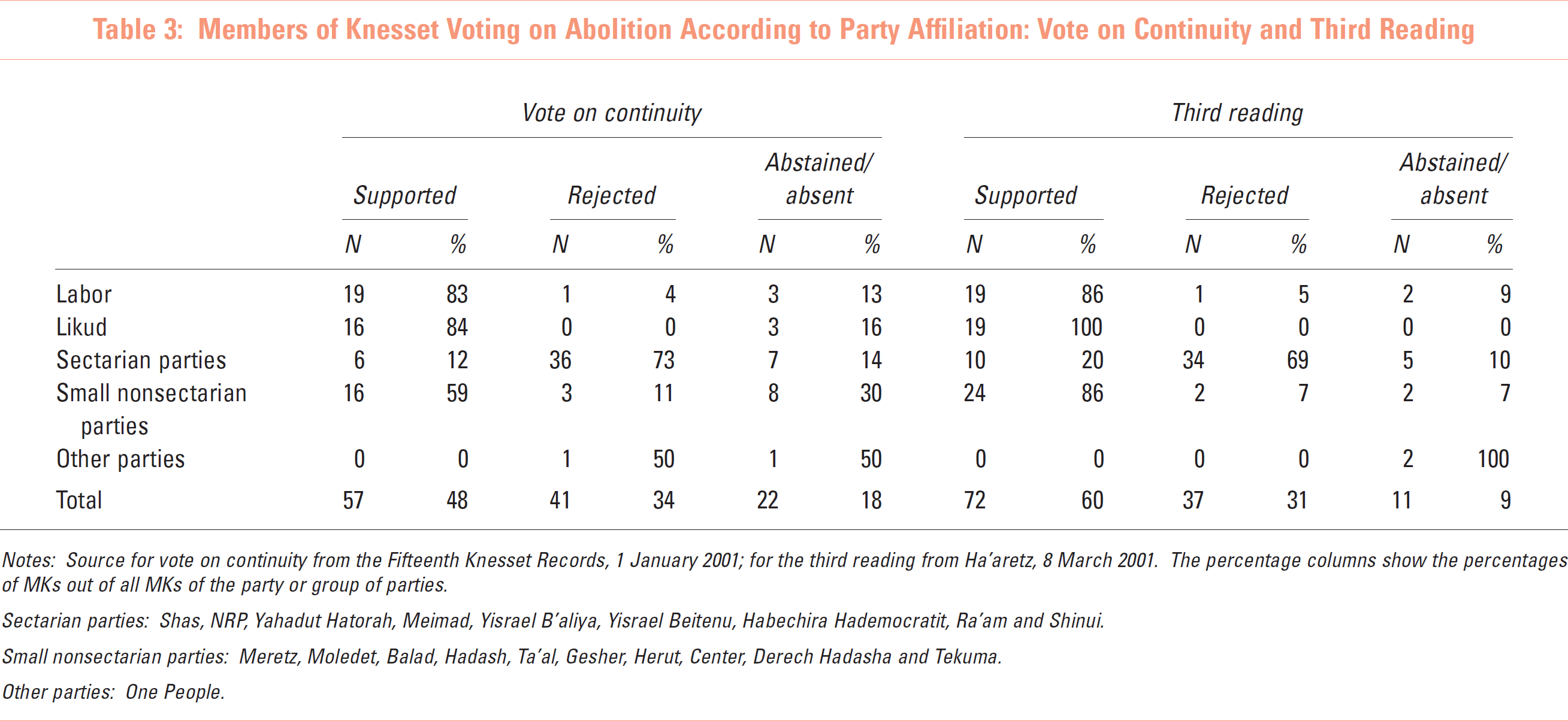
Notes: Source for vote on continuity from the Fifteenth Knesset Records, 1 January 2001; for the third reading from Ha'aretz, 8 March 2001. The percentage columns show the percentages of MKs out of all MKs of the party or group of parties.
Sectarian parties: Shas, NRP, Yahadut Hatorah, Meimad, Yisrael B'aliya, Yisrael Beitenu, Habechira Hademocratit, Ra'am and Shinui.
Small nonsectarian parties: Meretz, Moledet, Balad, Hadash, Ta'al, Gesher, Herut, Center, Derech Hadasha and Tekuma.
Other parties: One People.
In early March – about 40 days after the special elections for the PM in which Ariel Sharon defeated Barak – the Constitution, Law and Justice Committee returned the bill to the plenum for second and third readings. Once again, it needed the support of 61 MKs to pass, so abstentions and absences practically meant rejection. The vote took place just before the new Sharon national unity government was presented to the Knesset. The bill won the support of more than 60 MKs in the second reading and of 72 MKs in the third reading. Voting patterns in the third reading resembled those of the vote on continuity (Table 3). All Labor MKs (except one, who voted against the bill, and two absentees), all Likud MKs and 24 out of 28 MKs from the nonsectarian parties supported abolition. As before, most of the votes against the bill came from the sectarian parties (34 out of 37).
The Politics of Reform Adoption and the Politics of Reform Abolition: A Comparison
This section compares five characteristics of the processes of reform abolition and adoption: the kind of information available in the two processes; the level of cohesion of both camps, reform opponents and proponents, throughout the two processes; power diffusion in the politics of reform; the timing of the votes in the Knesset on the reform bill and the abolition bill; and the varying perceptions of interests that led MKs to support or reject reform.
Information
The supply of information on the anticipated political consequences of the reformed system was integral to the politics of reform adoption. Reform supporters had the upper hand because uncertainty about the consequences of the untried system enabled them to exploit their financial advantage and their action in far better market conditions (public outrage and call for change, support of MKs in key legislative positions) than their opponents. Reformers promoted a mixed system that was presented as attractive to individuals, groups and parties with different (and sometimes contradicting) interests and perceptions. The mix also created some uncertainty about the political consequences of reform, and thus enhanced the appeal of the immediate electoral rewards to be gained because of public support of the reform (Rahat, 2001).
After the implementation of direct elections there was real evidence of the working of the system. This meant that freedom in marketing of claims on the political consequences of the reformed system became more and more limited. The hard core of reform proponents continued to push their versions of the political consequences of reform and to interpret reality in ways that fitted their earlier claims. Yet, they found it increasingly difficult to market their original claims, as their systemic promises collapsed one after the other: they promised stability, but both governments collapsed prematurely; they promised an end to coalition politics, but the increase in the number of effective parties and in the power of the small sectarian parties made coalition maintenance as difficult as it was before; they thought that the popular mandate of the directly elected PM would supply him/her with political legitimacy that would improve governability, but popular legitimacy vanished very quickly. Pressured by election results and government malfunctioning, they went on the defensive: they claimed that society, rather than the system, was responsible for the fractionalization of the Knesset (MK Weiss, Fourteenth Knesset Records, 23 November 1998; MK Ramon, Constitution, Law and Justice Committee, 29 June 1998) and, moreover, that direct elections are the only anchor that allow the government to function in such conditions (Uriel Lynn, Uriel Reichman, Constitution, Law and Justice Committee, 29 June 1998); that the defective personalities of the elected PMs, rather than the system, are responsible for problems of governance (MKs Lapid, Poraz, Fifteenth Knesset Records, 7 March 2001); and that the two large parties should blame their own malfunctioning, rather than the system, for their decrease in power, (MK Liberman, Fifteenth Knesset Records, 29 November 2000; MK Naot, Fifteenth Knesset Records, 7 March 2001).
On the other hand, reform opponents, who suffered from being almost ‘public enemies’ at the height of reform promotion, enjoyed the credit for having some of their forecasts on the systemic and partisan levels validated. This credit then increased, as evidence of governmental malfunctioning and the blooming of the split-vote accumulated.
As time passed, a dwindling number of MKs was willing to be convinced by the claims of reform supporters. Promises for future achievements could no longer be sold to MKs who felt that their parties, and sometimes their own personal fate, were under immediate threat. Systemic claims were not convincing either, as the malfunctioning of government became more and more evident. The analysis of MKs’ voting behavior in the previous section, and additional evidence from the analysis below, point to a process of learning or becoming convinced by a sequence of real evidence (1996 elections; 1998 municipal elections; 1999 elections). The major lesson was that the reformed system serves the interests of sectarian parties and thus weakens the large and small nonsectarian parties. In sum, after the adoption of reform, the gap between perceptions of interests and real interests was closed through learning from real evidence.
The Cohesion of the Rival Camps throughout the Process
The politics of reform adoption in Israel has been described as an ongoing process of building and rebuilding coalitions composed of substantially different forces (Rahat, 2001). Is this description valid also for the politics of reform abolition? If so, to what extent were the two processes similar in this respect? This subsection answers these questions by comparing consistency in the voting of MKs in these two processes.
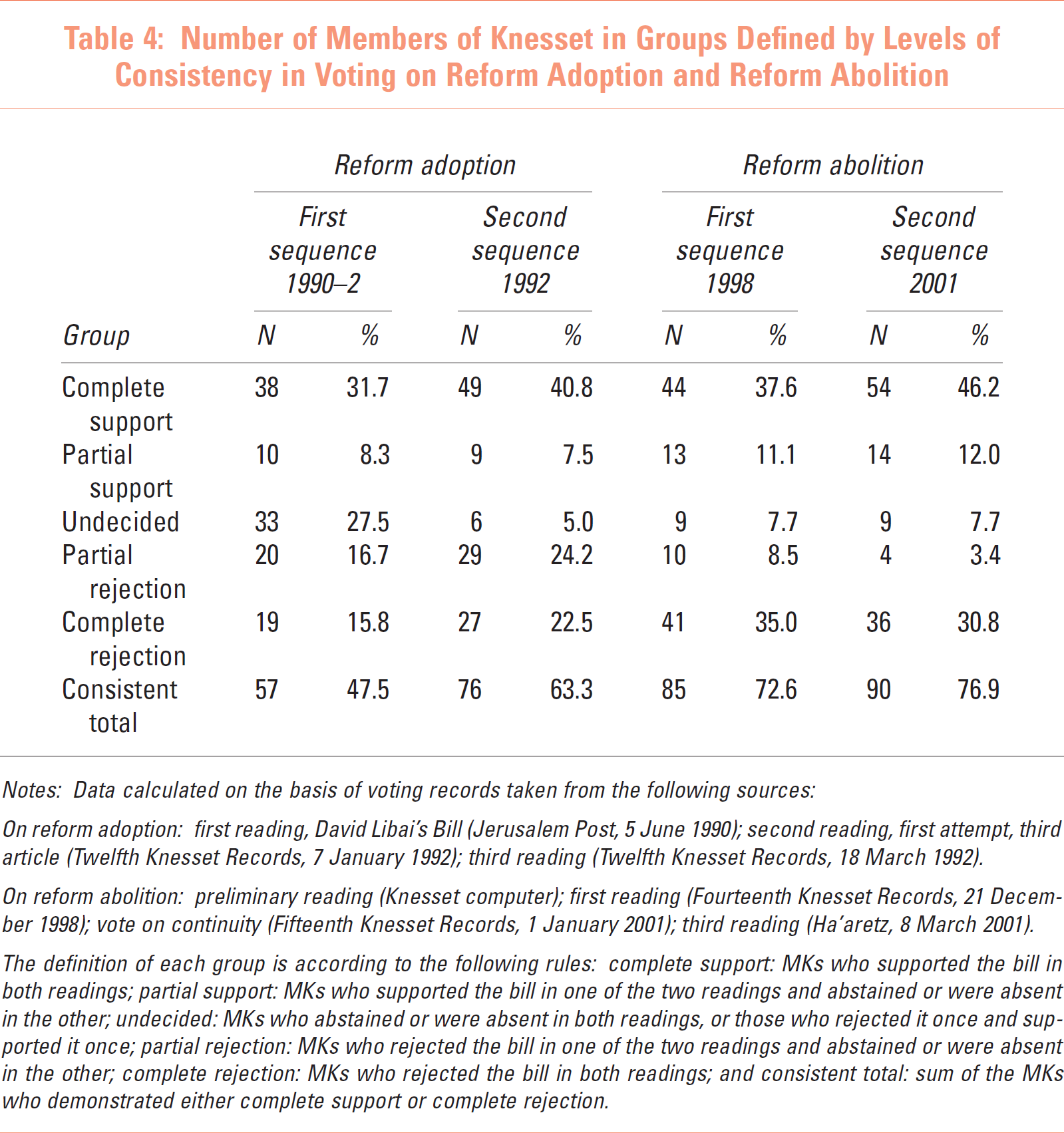
Table 4 distinguishes between five groups of MKs according to the levels of consistency they demonstrated in four sets of two consecutive readings on reform adoption or abolition. The first sequence of reform adoption (1990–2) analyzes consistency between the first and second readings; the second sequence (1992) analyzes consistency between the second and third readings. 4 The first sequence of reform abolition (1998) analyzes consistency between the preliminary and first readings; the second sequence (2001) analyzes consistency between the vote on continuity and the third reading. 5
Number of Members of Knesset in Groups Defined by Levels of Consistency in Voting on Reform Adoption and Reform Abolition
Notes: Data calculated on the basis of voting records taken from the following sources:
On reform adoption: first reading, David Libai's Bill (Jerusalem Post, 5 June 1990); second reading, first attempt, third article (Twelfth Knesset Records, 7 January 1992); third reading (Twelfth Knesset Records, 18 March 1992).
On reform abolition: preliminary reading (Knesset computer); first reading (Fourteenth Knesset Records, 21 December 1998); vote on continuity (Fifteenth Knesset Records, 1 January 2001); third reading (Ha'aretz, 8 March 2001).
The definition of each group is according to the following rules: complete support: MKs who supported the bill in both readings; partial support: MKs who supported the bill in one of the two readings and abstained or were absent in the other; undecided: MKs who abstained or were absent in both readings, or those who rejected it once and supported it once; partial rejection: MKs who rejected the bill in one of the two readings and abstained or were absent in the other; complete rejection: MKs who rejected the bill in both readings; and consistent total: sum of the MKs who demonstrated either complete support or complete rejection.
Table 4 shows that a larger percentage of MKs demonstrated absolutely consistent behavior in the case of abolition: 72.6 percent in the first sequences compared with only 47.5 percent in the case of adoption; and in the last sequences 76.9 percent against 63.3 percent in the case of adoption. Unlike the politics of reform adoption – which was characterized by significant jumping back and forth between support and opposition for reform – the process of reform adoption was largely one of increased crystallization of well-defined camps, as evident from the analysis in the former section. Yet, while behavior patterns were more stable in the case of the politics of reform abolition, it was still an ongoing process of building and rebuilding coalitions. Changing behaviors could significantly influence the fate of reform in both cases. The undecided – those characterized with inconsistent behavior – captured the pivotal position in the two sequences of voting on reform adoption, but only in the first sequence of voting on reform abolition (Table 4). Yet, this does not refute the claim that the fate of repeal was dependent upon undecided MKs. In order to reform, one must pass all barriers; defeat throws reformers back to square one. Moreover, by definition, having general elections between the first reading and the vote of continuity means that coalitions need to be rebuilt due to MK turnover and parties’ changing fortunes.
Power Diffusion
Power diffusion in the arena of the politics of reform in Israel in the early 1990s, as in other democracies that adopted electoral reforms at that time, was claimed to be a necessary condition for reformers’ success: ‘… A substantial dispersion of power could neutralise the relevant veto players. No player on its own would have the ability to block reform. Room for maneuverability might be left to build a reform coalition’ (Rahat, 2004, p. 474). Was this also the case for reform abolition?
By conducting opinion polls, and by campaigning among the public and journalists, the APD succeeded in freeing MKs from the feeling that reform was popular with the public. These actions, and other factors that will be outlined below, made the legislature the almost exclusive arena of the politics of reform abolition – unlike the case of reform adoption, in which extra-parliamentary and other governmental actors played an important part. At first glance it thus seems that the arena of the politics of abolition was characterized, at least in comparison to reform adoption, by power concentration. This would surely be the case if the reformed Israeli regime had worked as expected from a parliamentary system, that is, with high levels of partisan and coalitional cohesion and discipline.
But reform abolition was, rather, characterized by power diffusion. Paradoxically, reform resulted in a dramatic increase in power diffusion within the parliamentary arena. First, the number of effective parties in parliament (Laakso and Taagepera, 1979) grew with the adoption of reform, and after the 1999 elections reached a peak of 8.7 (Table 1), the highest ever in Israel's history and second highest of 423 elections that were conducted in 36 democracies between 1945–96 (Lijphart, 1999, pp. 76–7). Under these conditions, the veto power of small coalition partners – the sectarian parties that wanted to preserve the system they enjoyed – was less effective than in a situation when one or two parties were the exclusive holders of the pivotal position.
Second, by adopting the presidential element of direct elections of the head of the executive, reform separated the PM from the Knesset and created a diffusion of interests. The new system did not grant the PM any authority to veto legislation. So in response to his attempt at leading in the name of his popular legitimacy, the Knesset (even representatives from the PM's own party group) overruled his rejections to numerous private member bills, among them the one that suggested the abolition of reform. The abolition of reform could thus be promoted – even though party chairmen and Prime Ministers Netanyahu and Barak rejected it.
Finally, parties were more internally divided than ever. As evident from Tables 2 and 3, Labor and Likud were far from being cohesive in their voting on reform abolition. A closer look at the voting records reveals that several small parties were divided similarly on the issue (Knesset computer; Fourteenth Knesset Records, 21 December 1998; Fifteenth Knesset Records, 1 January 2001; Ha'aretz, 8 March 2001).
In sum, the dispersion of power either weakened the relevant veto players or created a diffusion of interests among formerly closely linked players (the PM and his Knesset's party group). No one player, then, has been able to block reform on his/her own. Power dispersion left room for maneuverability in building the reform abolition coalition and facilitated the abilities of individual MKs to cooperate with each other, crossing coalition-opposition and partisan lines.
It was due to this increasing dispersion of power in the Israeli regime institutions that the reform contained the seeds of its own repeal. Still, the veto players succeeded in delaying the promotion of reform abolition: Prime Minister Netanyahu was able to block early repeal attempts while Prime Minister Barak succeeded in freezing the reform abolition move for about a year. At other times, the reform abolitionists refrained from putting their initiative to a vote, lest they fail to muster the needed majorities due to pressure from potential partisan veto players. Power diffusion was thus a necessary but insufficient condition for success. This leads us to the next important element in both processes – the timing of the vote on reform.
Timing
Since the formation of the bipolar party system in the 1970s, with the two large parties (Likud and Labor) seeking support from small pivotal parties, the latter have successfully vetoed reform by threatening to help the other large party to establish a coalition government. Such a veto was effective not only in minimal winning coalitions, but also in cases where the threatening party was perceived as a crucial component of an alternative or future governing coalition (Diskin and Diskin, 1995). In the politics of reform adoption, the timing of the vote on reform bills sometimes proved to be a successful tool for overcoming this barrier. That is, reformers succeeded in recruiting majority support at times when the maintenance of the governing coalition became a less pressing issue vis-à-vis other considerations, such as the popularity of reform among the public or its long-term impact (anticipated or actual) on the representation and power of the interested parties.
The empowered sectarian parties, which benefited from reform, were crucial elements of the governing coalitions of 1996–2001. However, reform abolitionists refrained from testing their veto abilities, waiting for times when the maintenance of the governing coalition stopped being the issue. This occurred either because the cohesion of the coalition dropped to such levels that made noncohesion almost a norm or because the governing coalition had already collapsed. Thanks to government malfunctioning that resulted from reform, such opportunities were not scarce. The preliminary vote on abolition took place when Netanyahu's governing coalition started to collapse; by the first reading it was clear that this government was close to its end. The vote on continuity took place after Barak's governing coalition collapsed, and the second and third readings were conducted before Sharon's new government was presented to the Knesset.
Interest Perceptions
Table 5 refers to MKs’ voting behavior in seven instances: the three major votes on the adoption of direct elections for the PM (1990–2) and the four major votes on the abolition of this reform (1998–2001). The table presents the percentages of MKs whose behavior was consistent with four expected perceptions of interests (or rationales). These are based on the assumption that the major motivation that drives MKs’ behavior is ‘office-seeking’, that is, MKs’ interest in ensuring their survival and in improving their position in the government system. The rationales are not mere speculations about MKs’ perceptions, but are rather based on explanations that politicians gave for their stands and behaviors. 6
Percentage of Members of Knesset whose Behavior was Consistent with Expected Rationales
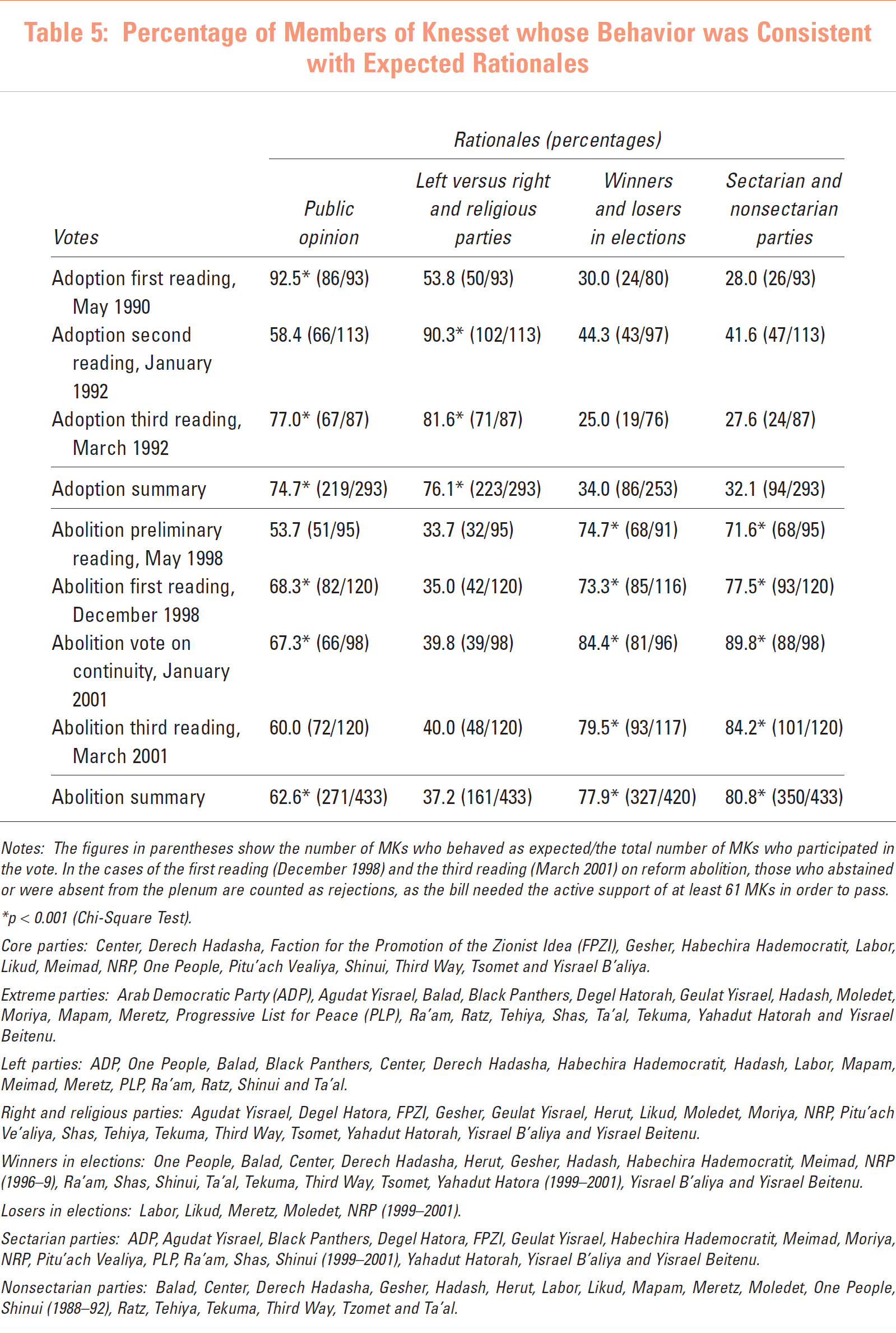
Notes: The figures in parentheses show the number of MKs who behaved as expected/the total number of MKs who participated in the vote. In the cases of the first reading (December 1998) and the third reading (March 2001) on reform abolition, those who abstained or were absent from the plenum are counted as rejections, as the bill needed the active support of at least 61 MKs in order to pass.
p < 0.001 (Chi-Square Test).
Core parties: Center, Derech Hadasha, Faction for the Promotion of the Zionist Idea (FPZI), Gesher, Habechira Hademocratit, Labor, Likud, Meimad, NRP, One People, Pitu'ach Vealiya, Shinui, Third Way, Tsomet and Yisrael B'aliya.
Extreme parties: Arab Democratic Party (ADP), Agudat Yisrael, Balad, Black Panthers, Degel Hatorah, Geulat Yisrael, Hadash, Moledet, Moriya, Mapam, Meretz, Progressive List for Peace (PLP), Ra'am, Ratz, Tehiya, Shas, Ta'al, Tekuma, Yahadut Hatorah and Yisrael Beitenu.
Left parties: ADP, One People, Balad, Black Panthers, Center, Derech Hadasha, Habechira Hademocratit, Hadash, Labor, Mapam, Meimad, Meretz, PLP, Ra'am, Ratz, Shinui and Ta'al.
Right and religious parties: Agudat Yisrael, Degel Hatora, FPZI, Gesher, Geulat Yisrael, Herut, Likud, Moledet, Moriya, NRP, Pitu'ach Ve'aliya, Shas, Tehiya, Tekuma, Third Way, Tsomet, Yahadut Hatorah, Yisrael B'aliya and Yisrael Beitenu.
Winners in elections: One People, Balad, Center, Derech Hadasha, Herut, Gesher, Hadash, Habechira Hademocratit, Meimad, NRP (1996–9), Ra'am, Shas, Shinui, Ta'al, Tekuma, Third Way, Tsomet, Yahadut Hatora (1999–2001), Yisrael B'aliya and Yisrael Beitenu.
Losers in elections: Labor, Likud, Meretz, Moledet, NRP (1999–2001).
Sectarian parties: ADP, Agudat Yisrael, Black Panthers, Degel Hatora, FPZI, Geulat Yisrael, Habechira Hademocratit, Meimad, Moriya, NRP, Pitu'ach Vealiya, PLP, Ra'am, Shas, Shinui (1999–2001), Yahadut Hatorah, Yisrael B'aliya and Yisrael Beitenu.
Nonsectarian parties: Balad, Center, Derech Hadasha, Gesher, Hadash, Herut, Labor, Likud, Mapam, Meretz, Moledet, One People, Shinui (1988–92), Ratz, Tehiya, Tekuma, Third Way, Tzomet and Ta'al.
The first possible rationale relates to MKs’ sensitivity to public opinion. The analysis distinguishes between MKs from core and extreme parties on the basis of the location of their parties in the dovish/hawkish and the clerical/anti- clerical continuums. Following the logic of Downs’ (1957) classical model, core parties are expected to support reform adoption (and, later, its abolition) because these relatively moderate parties, which are located close to the center, are assumed to be pragmatic and electorally oriented, and thus sensitive to public opinion. The more ideologically extreme parties, on the other hand, are expected to be less sensitive to the opinion of the general public and also less interested in reform. Furthermore, they are expected to reject reform out of the suspicion that any change to the status quo that is initiated and supported by the mainstream parties is likely to weaken them. Reform could be mistakenly perceived as aiming to create centripetal pressures that would hurt the extremes because it adds a majoritarian feature into an extreme PR system. After reform is adopted, these extreme parties are expected to support its preservation, again as a reaction to the mainstream behavior. Moreover, they may also see the new system as serving their interests (Bueno de Mesquita, 2000).
In the first reading on reform adoption, the highest percentage of MKs (92.5 percent) behaved according to the expectations set by the public opinion rationale (Table 5). This reflects the fact that the first reading took place after an active demonstration of public outrage toward politicians, combined with a cry for ‘change’ (Hermann, 1995). Reformers successfully channeled public protest to pressure MKs to support reform, convincing them that if they failed to demonstrate a reformist spirit, the control over reform agenda would be wrested from them and transferred to an extra-parliamentary commission. A high percentage of MKs’ behavior is also consistent with the expectations of the public opinion rationale in the third reading on reform adoption (77.0 percent). While the masses at that time no longer took part in the politics of reform, sensitivity to public opinion increased because elections were approaching. Evidently, the pro-reform pressure groups exploited skillfully this sensitivity, especially when they forced Likud to waive party discipline in the second attempt at the second and third readings.
A comparatively lower (yet significant) percentage of MKs’ behavior seems to be consistent with the expectations of the public opinion rationale in the first reading on reform abolition (68.3 percent) and the vote on its continuity (67.3 percent). However, these results are not impressive in comparison to the rationale which distinguishes between sectarian and nonsectarian parties (see below). Furthermore, these results mask the fact that most nonsectarian parties are ‘core’ parties while many sectarian parties belong to the group of ‘extreme’ parties.
Like their predecessors in the struggle over the adoption of reform, those that led the struggle for and against abolition – several MKs and leaders of a few pressure groups – conducted opinion polls and published their findings in ads aimed at convincing politicians to behave according to the opinions of the public and their voters. However, they could not take the credit, which their predecessors had created (and exploited), for the claim that the public would punish those who did not respond to public opinion. In the politics of reform adoption, the momentum created by high public participation in the protest against opportunistic behavior of politicians at the time of the ‘stinky trick’ (March—June 1990) was preserved by using opinion polls. In the politics of reform abolition, the public, disillusioned with institutional cures, showed no signs of interest in protesting against government on the basis of general constitutional demands. In addition, for almost the duration of the struggle, the public supplied both sides with ammunition to claim that it supports or rejects reform. While Arian and Shamir (2002, p. 14) present results of a series of opinion polls demonstrating that public support for direct election declined consistently over the years, during the struggle both sides used opinion polls to support their claims. Opponents used polls that showed that the public relates negative political consequences to reform while proponents used polls that demonstrated that it still prefers the reformed system over the previous one (Ha'aretz, 27 May 1998; 1 June, 1998; 29 June 1998; 4 December 1998; 6 July 2000; 24 November 2000; Ma'ariv, 10 November 2000). In contrast, when the struggle for the adoption of reform took place, public opinion polls were clearly in support of reform. The best that reform opponents could do was to demonstrate that the public also supports alternative reforms and to try to channel public outrage and calls for change toward their preferred alternative. However, this strategy proved fruitless because the only viable reform alternative was direct elections for the PM. So beyond puncturing the aura of popular support for reform, poll results could not have been expected to play a central role in the politics of reform abolition. In short, unlike the case of the politics of reform adoption, a disillusioned and less decisive public left the arena of the politics of reform abolition almost unaffected by extra- parliamentary pressures.
The second possible rationale is based on perceptions of the longer-term consequences of reform – who will benefit from reform in terms of representation and power and who is likely to be in a worse position than in the existing system? It distinguishes between left parties, on the one hand, and right and religious parties, on the other. According to this perception, the left, as a bloc that could expect only the support of a plurality of the voters, supports reform and rejects its abolition because direct elections seem to be the only way it can win elections. It can do so by drawing the support of centrist (or nonpolicy) voters (Bueno de Mesquita, 2000) and especially by making the non-Zionist Arab votes in the PM race (which concentrates on two centrist candidates put forth by Labor and Likud) relevant for the establishment of government. Therefore, the right and religious parties, holding together a majority, would defend the old system against reform and would support the abolition of the reformed system.
As can be seen in Table 5, 90.3 percent of MKs’ behavior in the second reading for the adoption of reform is consistent with the expectations of this rationale. Indeed, this was largely a vote of the governing right-religious coalition versus the center-left opposition (Rahat, 2001). Yet, this factor could not stand alone in explaining the adoption of reform, because the center-left had no majority in the Twelfth Knesset. Only the support of several MKs from the right-wing and religious parties – whose deviation from the dominant stands and behavior of their camp was possible, thanks to the popularity of reform – enabled the passage of reform. This small yet crucial group held the belief that reform would not serve the left and that it was likely to serve the interests of their parties and their own political ambitions. In the third reading on reform adoption, this rationale was weakened yet remained relevant. This reflects the fact that while most support for reform came from the left and most rejection from the right and religious parties, the increased sensitivity of the moderate right-wing Likud to public opinion (due to imminent elections) enabled its MKs freedom of vote. A plurality of its MKs chose to be absent (17/36); about a third voted against reform (13) while a few (7) supported it.
Following these findings, and speculating that the politics of reform abolition were a mere continuation of the politics of reform adoption, we could expect that once public opinion became almost irrelevant in influencing MKs’ behavior on reform, the right-wing and religious parties (that held a majority in both Fourteenth and Fifteenth Knessets) would abolish reform. However, the data that appear in the last five rows of the third column in Table 5 show that there was no linkage between affiliation to left, right or religious parties to support or rejection of reform abolition. This should be understood in the light of election results and political events that occurred under the new system. In 1996, the right won the race for PM, leaving the center-left camp deeply disillusioned, as opinion polls had given its PM candidate the lead in almost all instances. The low turnout of the Arab voters – protesting against the Israeli Defense Forces military operation in South Lebanon – disappointed Labor. Moreover, the Likud candidate succeeded in mobilizing Jewish support in response to the expected Arab support of Labor candidates, when an Australian Jewish millionaire conducted an ‘independent’ campaign on the eve of elections under the slogan, ‘Netanyahu is good for the Jews.’ If the right was in favor of the system because of its surprising victory, then the malfunctioning and early collapse of Netanyahu's government, which was followed by Barak's massive victory in the 1999 elections, disillusioned it. While the surprising defeat for the left in 1996 may have been compensated by Barak's landslide victory in 1999, the speedy collapse of his government and Sharon's huge victory in the 2001 prime ministerial elections could only disillusion it. In sum, each dramatic electoral victory was followed by an early collapse of government and electoral defeat. Thus, there were no clear indications that the new system favored either the left or the right.
The third possible rationale expects MKs from parties that won more seats in the 1996 elections than in 1992 (the last elections based on the old method) to reject the abolition of direct elections for the PM in the preliminary and first readings, and parties that won more seats in the 1999 elections than in 1992 to reject the abolition of direct elections for the PM in the vote on continuity and the third reading. Table 5 also presents data that refer to the relationship between the1996 election results and MKs’ voting behavior in 1990–2, in order to compare MKs’ expectations of parties’ electoral fortunes under the reformed system with their response to actual results.
The fourth possible rationale distinguishes between nonsectarian and sectarian parties. 7 MKs from nonsectarian parties are expected to support the abolition of the two-ballot system and MKs from sectarian parties to reject its abolition. The reason is that, having two votes, citizens expressed opinions on the major dimension by voting for one of the two forerunners for PM while their vote for the Knesset – freed from strategic calculations – was increasingly given to sectarian parties (Diskin, 1999). Indeed, many MKs presented it as a justification for their stand toward reform abolition (see, for example, Knesset Records, 10 February 1998; 23 November 1998; 6 December 2000; 7 March 2001).
The expectations set by the third and fourth rationales are similarly inconsistent with MKs’ behavior on the votes on adopting direct elections and similarly highly consistent with their behavior on the votes on abolition. The reason is that the composition of the party groups according to the two distinctions is quite similar: most of the nonsectarian parties lost representation in the 1996 and 1999 elections while most sectarian parties gained representation (Table 1). Their inconsistency with expectations regarding votes on reform adoption points to the fact that MKs failed to predict the consequences of reform. They changed their perceptions of these consequences as soon as the result became evident – after the 1996 elections. While in the three readings for reform adoption the dominant rationales changed from one reading to the next, the expectations set by a single rationale, that of core/extremes, is highly consistent with behavior in all four readings on reform abolition. Furthermore, the more evidence was supplied (1996 general elections — 1998 municipal elections — 1999 general elections), the more that behavior fitted the expectations set by these two rationales. 8
Conclusions
The analysis demonstrates that the substantial difference between the two processes is in the kinds of information available to the actors. In the process of reform adoption, uncertainty about the political consequences of reform enabled reformers, carried on the wave of public support, to successfully market their predictions. Information was susceptible to manipulation and its supply was a crucial part of the struggle itself. Those who succeeded in marketing their vision of the political consequences of reform had the upper hand, even if their merchandise was totally defective – because there was no way to validate their promises until after reform was adopted. In contrast, the process of reform abolition was characterized by an accumulation of real evidence. The freedom to market flawed visions was limited because the real consequences of reform were starting to unfold. Election results and government (mal)functioning under the reformed system revealed that the real consequences of reform were completely different from what reform proponents had anticipated.
Other differences, that are not in type but in extent, stem from this substantial distinction between the two processes: while both were ongoing processes in which coalitions of supporters and opponents had to be built and then rebuilt several times, the cohesion of the camps in the struggle for reform abolition was higher than in that for reform adoption. When real evidence accumulated and pointed in the same direction, the two camps further crystallized. While using ‘office-seeking’ motivation as the basis for explaining MKs’ behavior was found to be successful, the perception of what behavior office-seeking implied changed substantially when information on the workings of the reformed system became available. The question, ‘who will be served by reform?’– relevant in the politics of reform adoption – was replaced, in the politics of abolition, with, ‘who is being served by reform?’ Similarities between the processes were also found: power diffusion characterized the arenas of both processes; and in both instances the timing of the votes in the Knesset was found to be crucial for withstanding the power of veto players.
If rational choice can serve only as a research tool in the case of the study of the politics of reform adoption, in the case of repeal (thanks to the availability of information), it is a promising path for research, although (not surprisingly) not without a price. The availability of hard information on the politics of reform abolition makes it a better candidate for the analysis by a rational choice model, especially because assumptions concerning the perception of interests are likely to fit actual perceptions and behaviors. Yet, even in this case, the use of the model is not without considerable costs. That is, a significant development, such as the increase in cohesion in MKs’ behavior parallel to the accumulation of information, is likely to be missed. The importance of power dispersion and of timing in promoting reform legislation is likely to be overlooked.
Political actors usually believe that they support and promote alternatives that serve their interests. But real information is needed in order to behave in such a way that would be seen retrospectively as ‘rational’, as really serving the interests of the actors. Researchers should not see uncertainty as just an obstacle that can (or should) be overcome by adopting assumptions on ‘sufficient’ information, or claiming that there is no better alternative but to relate certain predicting powers to politicians. The differences – in cohesion and in kinds and stability of motivations – that arose from the comparison of the uncertain politics of reform to the informed process of reform abolition demonstrate that differences in information lead to real differences among processes.
It would seem trivial to conclude that examining the kinds of information available to relevant political actors is a key element in the analysis of a political process, or that any valid analysis of decision-making must be sensitive to levels of certainty or uncertainty that surround it. Yet, in the field of political science, as well as in other social sciences in which scholars move back and forth between theory and empirical reality, information is treated too many times as a given. This article calls for preferring to check what information is available to the relevant actors rather than presupposing it. Adopting this recommendation would help to bridge existing gaps between the world of political theory and the world of empirical research.
Footnotes
1
The Basic Law: The Government (1992) allowed, in special circumstances, the conducting of elections for only the Prime Minister (this actually occurred in 2001, following PM Ehud Barak's resignation). But elections to the Knesset were always to be conducted alongside elections for the PM.
2
The new Basic Law: The Government (2001) nevertheless contains two important elements that are different from the old Basic Law: it allows the PM to call for new elections and it determines that the Knesset can oust the government and replace it without conducting new elections only by passing a constructive vote of no confidence that would be supported by an absolute majority of its members.
3
The nonsectarian parties are characterized by self-identification based mainly on their positions on the key issues in Israeli politics since 1967, that is, issues of foreign affairs and security, and particularly the question of the fate of the territories captured in the Six-Day War. The sectarian parties, by contrast, identify themselves in terms of their position on secondary issues of relevance in Israeli politics no less than in terms of their position on questions of foreign affairs and security, and sometimes more so: religion and state, new immigrants and veteran Israelis, Arabs and Jews, Ashkenazim and Sephardim. The sectarian parties provide characteristically a clear focus of identification for specific social groups, thus largely restricting their ability to appeal to voters outside these groups.
4
The preliminary reading is not included because it does not serve the purpose of measuring consistency. Only a few Members of Knesset bothered to participate in it because at the time it was considered to be unimportant.
5
While it may have been preferable to analyze consistency between all four votes, it is impossible to do so because the first and second sequences contain votes that took place in different Knessets (Fourteenth and Fifteenth). The elections for the Fifteenth Knesset brought the replacement of about a third of the MKs and substantial changes in parties’ representation ( ).
).
6
These were found in Knesset records, daily newspapers and other preliminary resources.
7
For the distinction between sectarian and nonsectarian parties, see Note 3.
8
The slight decrease in the consistency of voting behavior in the third reading on reform abolition with the expectations set by the third and fourth rationales () results from the fact that voting was calculated more strictly due to the demand for an absolute majority. Abstentions and absences were counted as votes against abolition.