







Abstract
A large number of delegates from different institutional levels within the EU have achieved a remarkable consensus on a draft constitution. Has this consensus been made possible because the nationally predominant left–right divide was only weakly present during the deliberations of the delegates? Left–right differences have been analysed by means of a content analysis on submitted documents during the European Convention. The data analysis confirms our assumption that the left–right distinction was relevant, although not very dominant. The draft constitution did not take a mean position on left and right issues, but in fact puts more emphasis on substantial goals related to both left and right, giving an equal weight to both anti-poles. However, if we exclude the Charter of Human Rights, the draft constitution appears to be strongly tilted to the right. The analysis also shows that party family differences did affect the process of coalition building during the Convention, since more than half of all documents have been submitted together with at least one member of the same party family and/or with one family member close by. Our analysis also indicates that the process of consensus building was enhanced by the absence of many extremist and new parties during the Convention. This may have enhanced agreement on the Constitution, but later it became problematic for the domestic democratic process and for the acceptance of the Constitution in some countries, such as France and the Netherlands, especially since some of the excluded parties have actively and successfully mobilised voters to vote against the Constitution.
Since 2002 a large number of national and supranational actors have been involved in the constitution-building process of the European Convention on the future of Europe and the subsequent Intergovernmental Conference (IGC). Representatives of political parties from both national parliaments and the European Parliament (EP) were among the central players during the Convention. The main task of the Convention was to draw up a draft treaty establishing a European Constitution — an endeavour clearly constituting a landmark in the process of European integration (König and Hug, 2006).
A study of the European Convention may help us to understand the position of Europeanised political parties within an enlarged European Union (EU). While most theories on party behaviour and preferences focus on domestic political parties within national arenas, it is important to add a European component to that since parties are being increasingly Europeanised. Nowadays most established parties are players in a two-level game. The Convention offers an experimental European arena which affects the preferences and behaviour of participating political parties, which are weakly explained by factors that play an important role at home, in particular the divide between left and right. Our central research question is to what degree actual preferences of the actors can be explained by the traditional left–right cleavage in a situation where national parties are moved up to a European level, with respective repercussions on their policy preferences due to the institutional context in which they negotiate.
This study analyses the political positions and alignments during the Convention. This angle is special because EU constitution building is mostly discussed in legal and technical terms and is consequently presented as an apolitical process. By introducing an ideological dimension (left vs. right and party family differences) one can better understand why the Constitution came into being rather smoothly, while at the same time its acceptance by member states turned out to be cumbersome (at least in some cases, such as a ‘no’ vote resulting from referenda in France and the Netherlands). At the supranational level consensus has been reached, but among member states this consensus is not that easily accomplished. The analysis confirms our hypothesis that left–right differences are less important during the Convention than they normally are at the domestic level. But it also shows that these differences are relevant enough to include them in any analysis of cleavages that divide representatives while deciding on constitutional reforms.
The Set-Up of the European Convention
The Convention included all main actors that are involved in decision making in the EU: the fifteen member states and the former accession countries each with one representative of the heads of state or government, the Commission with two representatives, the European Parliament with sixteen delegates and the national parliaments each with two representatives. The accession countries did not have a voting right on the Convention's draft proposal. From all delegates and observers only 66 had the right to vote, namely one governmental and two parliamentary representatives from each member state (König et al., 2006).
The purpose of the European Convention was to find solutions for institutional arrangements of a widening and deepening EU. The Laeken Declaration specifies 57 questions regarding policy instruments, democracy, transparency and efficiency in the EU. A Praesidium, consisting of the Convention Chairman (Giscard d'Estaing) and Vice-Chairmen (Giuliano Amato and Jean-Luc Dehaene) and nine members drawn from the Convention, had specific roles in preparing draft agendas for plenary sessions and in overseeing the activities and organisation of the Forum. The two-level policy formation process from the draft proposal of the European Convention started in February 2002 and led to a document in June 2003 that was finally adopted by the IGC in October 2004. The Convention draft consolidated all previous treaties into a single agreement with four parts: the division of competences, the institutional structure, procedures and voting rules (Part 1), the Charter of Fundamental Rights (Part 2), EU policies (Part 3) and general provisions (Part 4).
The Constitution has been approved by both the Convention and the IGC, but has not yet been ratified by all member states. Although the Constitution has been shelved for the time being, it is likely that it will re-emerge on the agenda since all parliaments of member states that have voted on it are in favour of it. Country delegates and diplomats have recently discussed possibilities for reviving the Constitution. Even if these efforts do not eventually lead to a Constitution, the constitutional method used was so innovative that, from an academic perspective, it does not necessarily matter if the Constitution itself ever comes to fruition. The way in which it was drafted is a novel test case in which political parties from all member states seek to arrive at a consensus on common goals and rules in a supranational context. As the current academic debate on the Constitution demonstrates, there is a lot to learn from the European Constitutional project (Moravcsik, 2006). Here we focus on the preference-aggregation process during the Convention.
The Relevance of Left-Right for Constitutionalism
The left–right distinction has proved to be a useful device to explain party differences towards policy goals. Existing research illuminates that this distinction is not only relevant for the explanation of party differences at the national level, but also at the European level (Gabel and Hix, 2002; Hooghe et al., 2002; Marks and Wilson, 2000; Pennings, 2002). The research question we ask in this article is to what extent left–right differences have affected the preference-aggregation process during the Convention. This question incorporates two comparisons which overlap: constitutional vs. ‘normal’ politics (where left–right cleavages are likely to be more pronounced) and EU vs. national politics. This overlap is unavoidable since national parties negotiate on a European Constitution at a supranational level. The implication of this overlap is that we cannot say whether the constitutional process or the supranational (European) level has had a moderating impact on the preferences and behaviour of political parties. Both factors present at the same time are likely to reinforce each other.
When constitutional reform is related to cleavages, it often concerns differences between countries such as large vs. small, rich vs. poor, more vs. less integrationist, old vs. new (König, 2005; König et al., 2006). Differences between reform preferences of delegates are also often related to these factors. Left vs. right is another cleavage that might be relevant because it is highly influential at the national level, so that it is unlikely that this divide is completely irrelevant for the process of drafting a constitution. This brings us to the question: how relevant was left vs. right exactly? Our main hypothesis is that left–right differences do matter during the Convention, but are less important than ‘at home’. The reason is that the process of constitution building will not lead to a compromise if it is the object of a battle between the antipodes of the left and the right (Bräuninger et al., 2001; Collignon, 2003; Crum, 2004). What we do expect is that parties will take moderate positions on left–right issues and that the Convention facilitates this. The policy preferences of national parties were moderated by the institutional context in which the parties were negotiating by focusing on what they share instead of their differences, which is comparable with the process of coalition building of cabinets. We will argue that ‘epistemic consensus’, uncertainty about probability distributions and the European institutional context transform the delegates into actors with more moderate preferences than they normally assume in the context of the national political arena.
In this, we follow the reasoning of Stefan Collignon, who argues that a process of constitution formation is only possible when traditional cleavages such as left vs. right are transcended (Collignon, 2003, p. 27). It is completely rational for actors to ‘agree to disagree’ on distributive matters, as long as they agree on some higher-order choice rule. An ‘epistemic consensus’ on decision-making procedures is more fundamental than consensus regarding the evaluation of substantial and distributive issues (Collignon, 2003, p. 28). Parties located on the left and right of the political spectrum may disagree on distributional issues, but simultaneously accept the constitutional rules, as long as the probability distribution of likely policy outcomes does not favour either the left or the right.
When groups expect a zero probability of ever seeing their own preferences prevail, because the constitutional rules contain an implicit bias, it is unlikely that they would agree with the establishment of the Constitution. Hence, when actors evaluate their position towards formal rules to be incorporated into the Constitution, they do so by calculating the extent to which these will favour or hamper the realisation of their ideal policy goals, which makes the connection between left–right differences and constitutional issues an indirect one. The formal rules and procedures are evaluated by the actors using the criterion of how they affect the expected utility of future policy outcomes. For this reason, the distinction between ‘left’ and ‘right’ is important in view of the constitutional debate, since these groups can only agree on the Constitution when the constitutional tools to realise ‘left’ and ‘right’ goals, respectively, are not biased in either direction. All relevant actors evaluate formal rules by relating them to expected policy outcomes, which can be done implicitly or more explicitly during the deliberations and debates on the pros and cons of the Constitution's formal rules.
If constitutional issues and programmatic policy objectives amalgamate, this may hamper the emergence of a constitutional consensus. But simultaneously, the actors' policy goals are decisive regarding their preferences for formal rules determining the decision-making process. However, given the history of European integration, ‘left’ and ‘right’ are not on an equal basis in terms of political power and impact. The emphasis during the process of European integration on economic goals and values has put the left in a somewhat disadvantaged position compared to the right regarding the realisation of policy goals. As a consequence, left parties have traditionally been less positive about European integration than right parties, although this has been changing since the impact of the EU stretches more and more to social issues. That the EU is still biased towards economic issues was demonstrated during the Convention, for example when the Praesidium was initially unwilling to admit a Working Group on Social Policy, fearing that the integration of social goals and harmonisation might invoke vetoes against parts or even the entire draft constitutional treaty. When such a working group was finally admitted, however, it was internally divided on a number of important issues. The group recommended the inclusion in the draft constitution of social values including solidarity, social justice and equality (notably between men and women). In addition, it recommended inclusion of a large number of social objectives into Article 3 of the draft constitutional treaty. The group was divided, however, on the important topic of the decision-making rules to be applied on social policy-making (Arnold and Pennings, 2004).
The establishment of the internal market by means of ‘negative integration’ was broadly shared by the governments that were parties to the EU Treaties and by the national parliaments that ratified these agreements. Attempts to strengthen the statist functions of the EU by means of ‘positive integration’ are much more controversial and in need of explicit agreement of national governments in the Council of Ministers. Many scholars who have analysed the evolution of ‘negative’ and ‘positive’ integration have concluded that the former has been dominant and the latter only recently has become more important (Arnold and Pennings, 2004; Scharpf, 1996; Streeck and Schmitter, 1991). In the case of the Constitution, many delegates will regard ‘negative integration’ as a constitutional rule, creating ‘freedom’. By comparison, they will perceive ‘positive integration’ as a regulative rule with a stronger normative mandate, rather to be kept out of the Constitution. We expect that this reasoning is internalised and implicitly accepted by many actors, including representatives from the political ‘left’. If this assumption is correct, we can expect both leftist and rightist participants to refer frequently to economic goals such as the establishment of free markets during the Convention process. In such a situation, left and right representatives of the political spectrum do not represent anti-poles. Whereas the traditional ‘rightist’ goal of free markets is an uncontested part of the draft constitution (and all previous treaties), the question of distributive justice, important especially to the ‘left’, has to be decided by political negotiations and cannot be settled once and for all by a constitution.
The policy preferences in formal decision-making procedures during the Convention can only be properly understood if we relate them to the course of more than 40 years of European integration. Inevitably, these procedures are incorporated into existing treaties and are therefore also part of the draft constitution, which aims to integrate and renew these treaties. As a consequence, national actors can take positions in the European arena which to some extent cannot be explained by domestic policy backgrounds, since they are influenced by processes and interactions at the supranational level (Hooghe and Marks, 1999; 2001).
When we evaluate the left–right positions taken during the Convention, a number of aspects should be taken into account since it is not self-evident how this political division may affect the contents of the draft constitution. Collignon (2003) argues that the two important principles of ‘liberty’ and ‘equality’ should be addressed on an equal basis by the Constitution. This is to be achieved by incorporating constitutional means able to realise both goals, without incorporating a bias towards one of them. This is important not least because liberty — in the sense of freedom of entrepreneurship — has traditionally been the main goal of the political right, and equality — by means of, for example, employment and social protection — the main goal of the political left. However, it is contested that a constitution must give equal weight to both types of goal. Fritz Scharpf, for example, has argued that the right is systematically favoured by open markets and Europeanisation, so that the anchoring of social equality into the Constitution (at least at a minimal level) could provide a counterweight to the clearly stronger forces of the political right (Scharpf, 2003). According to this perspective, the right is able to dominate policy outcomes if liberty and equality are two equally likely outcomes of decision making on the basis of the Constitution, since the political weights of left and right are unequal.
What actually happened during the Convention was that the plea for a ‘Social Europe’ was undermined, mainly because no consensus is possible if the result is a shift from unanimity to majority decision making in this policy field (Barbier, 2003). Nonetheless, the improvement of social policy coordination, plus the adoption of the Open Method of Coordination (OMC) in fields like social exclusion and social protection, indicate that the conditions for social policy-making were enhanced, although without the explicit goal setting related to negative integration (Crum, 2003).
It is important to realise that the left–right division cannot be isolated from other political divisions, like the communitarian vs. intergovernmental distinction, in the sense that some combinations of positions are less probable. The combination of communitarian and substantive goals is especially likely to evoke resistance among citizens as well as politicians, who might perceive this in the sense of ‘Brussels dictates’. Far more acceptable to such actors would be an intergovernmental bottom-up approach by means of voluntary cooperation. This, again, underlines that although the left–right dimension is relevant to understanding and explaining policy preferences, the fact that the negotiations are conducted on a European level makes the positions taken on these dimensions less pronounced or polarised than those taken at the domestic level. Despite the inclination of political parties to represent national ideologies at the European level, they may have to adapt their preferences to the European polity, if consensus building is to be possible. The experience of adapting national policy preferences to the European level is largely an elite endeavour, and the Convention and subsequent IGC provide an interesting test case to see to what extent the process of preference aggregation differs at the national as compared to the European level.
Research Design and Data Collection
In order to determine the importance of the left–right divide for the process of European constitution building, we have extracted information from documents submitted to the Convention. We developed a dictionary-based content analysis that discriminates between the main vocabularies representing different patterns of social and economic policy-making. In total 7,379 documents are analysed. A large majority of these documents are amendments which need to be included in the analysis in order to position the actors on the basis of their contributions during the course of the Convention (with n = 6,071, or 82 per cent).
The huge amount of text puts limitations on possible types of analysis. Semi-automated or manual coding techniques are not feasible considering the number of texts, since they are clearly too time-consuming for coding thousands of documents. The inevitable choice for computerised automated analysis implies that the investigation is based on word counting. So far, no automated techniques are able to go beyond this approach (Neuendorf, 2002; Popping, 2000). Clearly, this makes it difficult, for example, to determine directional policy preferences, or to disambiguate words and phrases (e.g. Laver, 2001). However, since the analysis is limited to one basic political cleavage line that can be cross-validated with alternative sources, we believe that this limitation does not seriously affect the validity of our codings (also see Klingemann et al., 2006; Laver, 2001). Another complication is that around 25 per cent of the document submissions during the Convention were in languages other than English. Since the number of applied non-English languages was limited, however, notably not including Scandinavian or Eastern European languages, for example, it was quite feasible to translate these words into English and to code them subsequently.
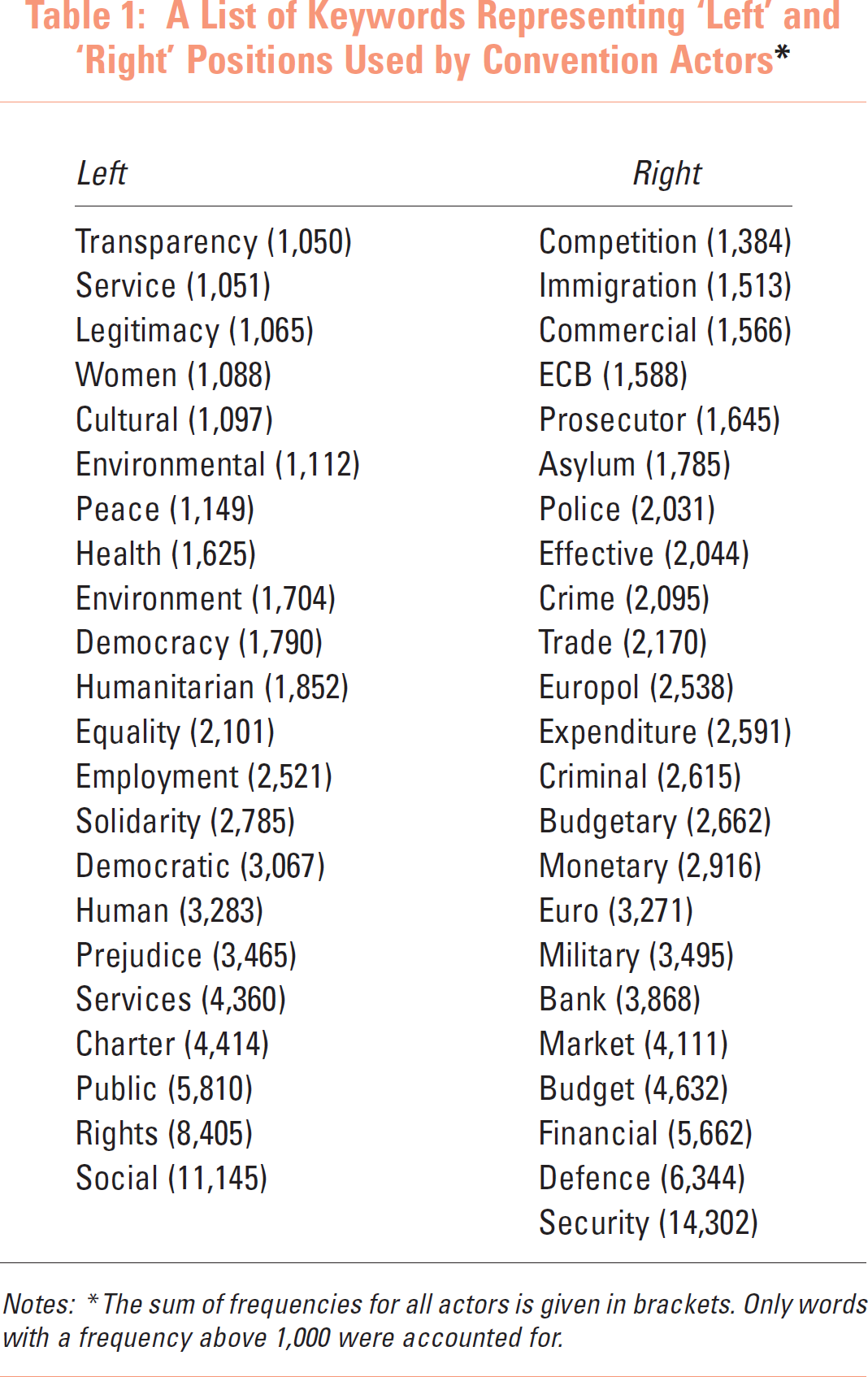
There are several ways to arrive at a classification scheme suited to code words related to left and right positions. One way would be to count which words are used mostly by either leftist or rightist political actors, but we decided against this approach due to its potentially tautological character. In order to reduce the complexity of the process of dictionary building, we did not impose a classification scheme or dictionary on the texts, but extracted one from them. This was done by the construction of frequency distributions of all words used by each actor. Subsequently, these words were classified into a category. The total number of unique words used by individual actors was 3.6 million. Hence, our categorisation scheme classified all the words contained in the documents issued at the Convention into two categories:
Left-oriented issues: represented by terms relating to social issues (including human rights). Right-oriented issues: represented by words related to market-driven activities and security.
This classification implies that the operationalisation of left and right is not restricted to economic issues, but also incorporates issues that are closely linked to the progressive–conservative divide.
A List of Keywords Representing ‘Left’ and ‘Right’ Positions Used by Convention Actors*
Notes:
*The sum of frequencies for all actors is given in brackets. Only words with a frequency above 1,000 were accounted for.
Although this may sound counter-intuitive, existing content analysis has shown that it is possible to arrive at valid results on the basis of this technique, as long as the classification scheme is kept simple (Kleinnijenhuis and Pennings, 2001; Krippendorff, 2004; Laver, 2001; Neuendorf, 2002). This is not to deny that there is an ambiguity problem, demonstrated for example by a problematic expression like ‘social security’. 1 For this reason, our results were cross-validated by comparing outcomes with external expert opinions, (indirectly) adding a directional component to our analysis.
The Impact of the Left-Right Distinction during the Convention
As stated before, we expect only a moderate impact of the left–right divide on the preferences during the Convention. We will test this assumption by relating the left–right positions we extracted from the documents issued at the Convention to the well-known expert survey on party positions on European integration (Hooghe et al., 2002; Marks et al., 2006). The goal is to analyse the political emphases during the Convention process and compare them with the positions these actors normally take at the national level. The rationale for this is that European integration puts national actors into an international context in which their room to manoeuvre is affected. The modes of competition and cooperation are different in a European context as compared with the national context.
By including (nearly) all actors and documents issued at the Convention in our analysis, it is possible to determine whether the existing knowledge of the preferences of political parties regarding different aspects of the European integration process is also applicable to the constitution-building process as a whole. However, it is a challenge to determine whether these preferences expressed during the debates on the draft constitution are indeed related to the left–right divide. Our starting hypothesis on this issue is that it is possible to position parties on this major dimension on the basis of all their contributions during the Convention. However, we expect that the differences between parties on issues to be dealt with at the European level are smaller compared to the national level, because their preferences and behaviour are affected by the European institutional context in which they are operating.
There are several reasons for this assumption. First, expert surveys have demonstrated that many national political parties have made a move during the 1990s towards a centre-right position, a development that facilitates processes of consensus building. Second, on the European level the centre-right position has become dominant during the process of European integration, where policies enhancing processes of ‘negative integration’ (i.e. market-driven policies) have received far more attention and support than policies invoking ‘positive integration’ (e.g. Arnold and Pennings, 2004). Third, the Convention appears to have been dominated by the interests of the established parties. By comparison, small and extremist parties were hardly present or influential in this process. Again, this is a factor likely to have facilitated processes of consensus formation. Finally, as will be shown below, it is only possible to arrive at a European constitutional consensus if the main national dividing line does not dominate the respective negotiations.
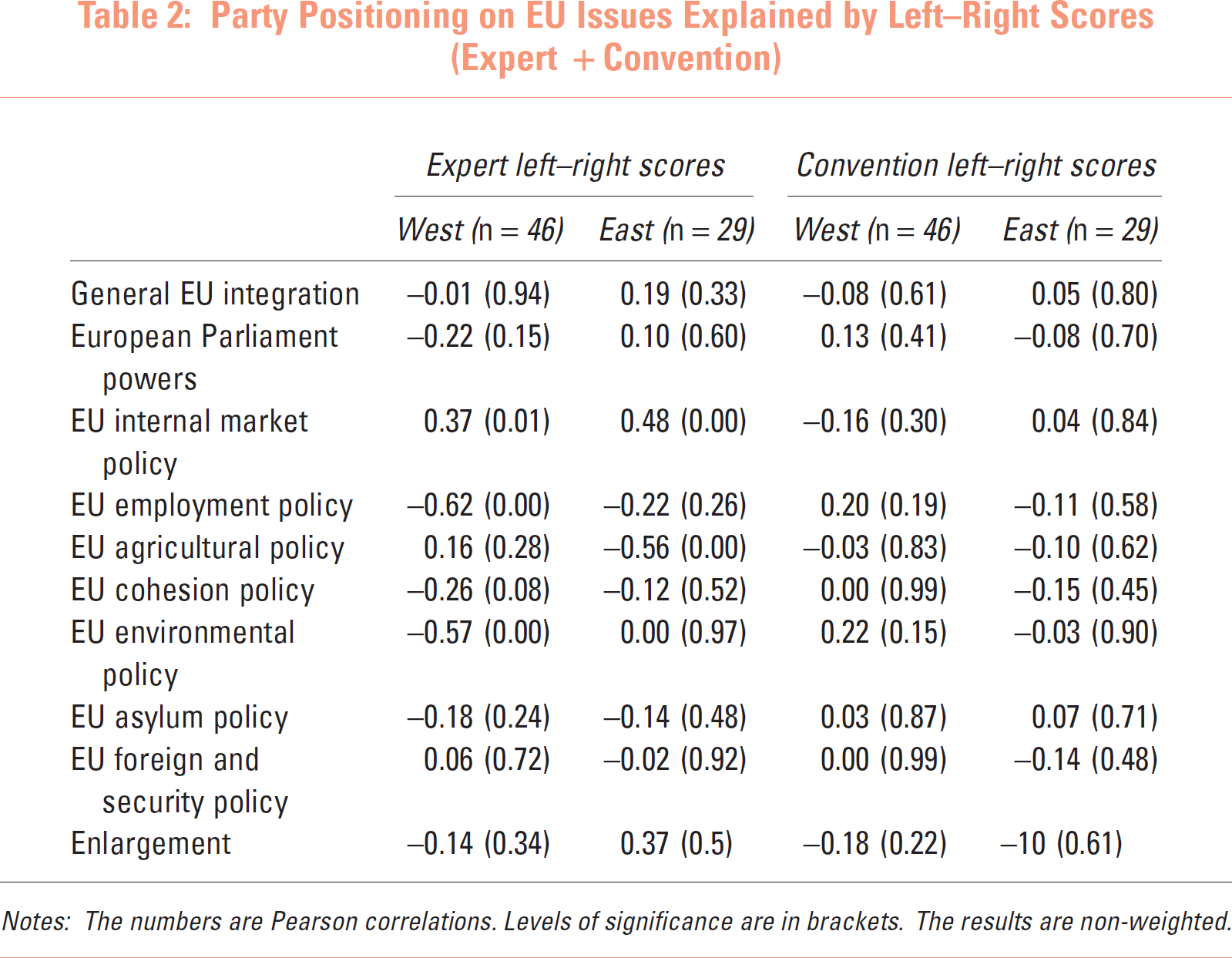
In order to cross-validate our codings of left and right, we predict the positioning of parties on EU policies by experts with our scores. We expect that we are not able to predict these positions as well as in the research conducted by Gary Marks et al. (2006). Our unit of analysis is the political party, since the actor preferences are aggregated to that level. Only those 75 parties are included on which both the expert and the Convention database have scores. The correlation between our left–right score (i.e. the means of the factor score per party) and the expert score for left–right is −0.24 (p = 0.04). Hence, the relationship is strong enough to confirm the external validity of the extracted left–right positions from the documents, but too low to expect that they can explain positioning on selected EU policies. This finding corresponds with the results of a similar recent study by Kenneth Benoit et al. (2005). They also found a weak correlation between scores extracted from the Convention documents and expert scores and refer to two alternative explanations. One is that the Convention texts concerned matters that were not systematically structured in left–right terms. The other is that the parties felt differently about left and right in the EU context. Both explanations are in line with our assumptions expressed above.
The weak relationship is also affected by an East–West divide. There appears to be a significant difference in the impact of the left–right distinction between parties from Western and Eastern Europe. In the former the relationship is moderate (r = −0.38, p = 0.01), whereas in the latter it is absent (r = −0.02, p = 0.91). This might partly be explained by the different meaning of left and right in these two types of member states and by the special position of the accession countries during the Convention (Hug and Crombez, 2005; Marks et al., 2006).
Party Positioning on EU Issues Explained by Left-Right Scores (Expert + Convention)
Notes: The numbers are Pearson correlations. Levels of significance are in brackets. The results are non-weighted.
Preference Aggregation by Party Families
As we differentiate between parties on the basis of the left–right distinction, and in addition assume that countries are non-unitary actors, we are also interested in party family differences. The clustering of party families is important in order to understand how preferences are aggregated, that is, which potential coalitions are feasible. The preferences of all representatives are summarised by the two indicators explained in Table 1. When analysing party families, we should be aware of the fact that they are unevenly distributed. A share higher than 10 per cent is taken by the social democrats (30.5 per cent), the liberals (13.4 per cent), the Christian democrats (13.4 per cent) and the conservatives (14.6 per cent). Below 10 per cent are the greens, the socialists/communists, the ethnic/nationalistic and agrarian parties.
The total selection of cases consists of the members of national and European parliaments and government representatives (n = 139). More than 80 of these actors have been identified as members of a party family. Thirty per cent belong to the social democratic party family. The number of representatives of parties at the extremes of the political spectrum is low: nearly 90 per cent of the representatives belong to the four larger party families, which are predominantly in favour of European integration (Hooghe et al., 2002). Evidently, this fact has enhanced the process of consensus building during the deliberations of the Convention. By comparison, the candidate countries were not represented by any green or agrarian parties. Hence, the political spectrum of the candidate countries is represented by a relatively small number of party families.
For this reason, in the following analysis, the agrarian, ethnic and right extremist (nationalistic) parties are merged into one category (labelledAGR) so that all party families are represented by at least seven members. This cluster analysis produces a dendrogram (Figure 1) summarising the (dis)similarity between the actors (both EU and candidate countries) on the basis of the two indicators of left and right with means calculated per party family. The dendrogram indicates that some party families cluster to the left (greens, social democrats, socialists/communists), and others to the right (liberals, agrarians and Christian democrats). The conservatives take a middle position, but are closer to the right than to the left.
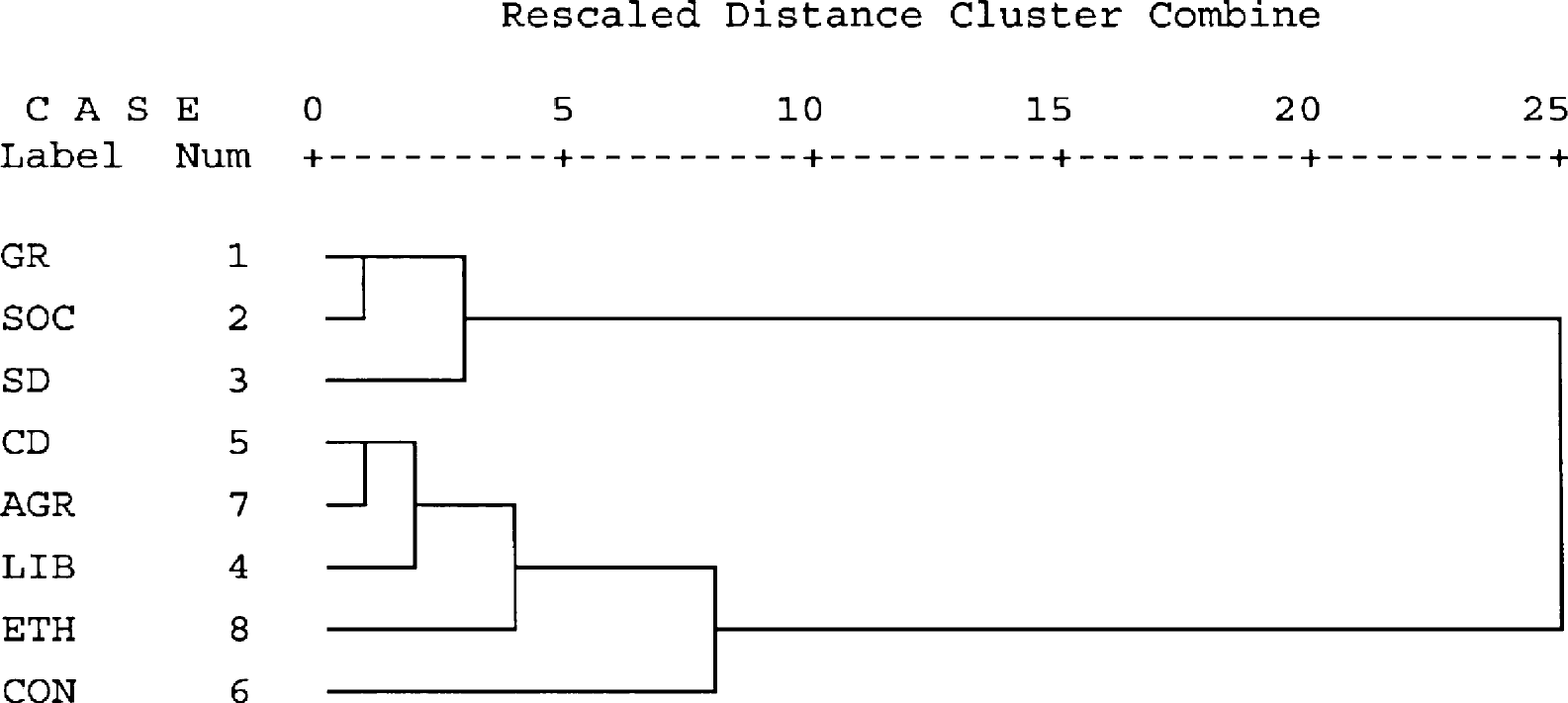
Dendrogram on Party Family Distances on the Left-Right Scale Extracted from the Documents Issued at the Convention
The dendrogram confirms the well-known hypothesis on parties and European integration, namely that the way parties react to Europe — in our case their contribution to the Convention — is affected by party family membership at the national level (Marks and Wilson, 2000). However, we should be aware that there is most likely an interaction effect of third variables which may strengthen or weaken the impact of the left vs. right division, including national differences between countries, such as large vs. small, established members vs. candidate members, rich vs. poor or EU centre vs. periphery.
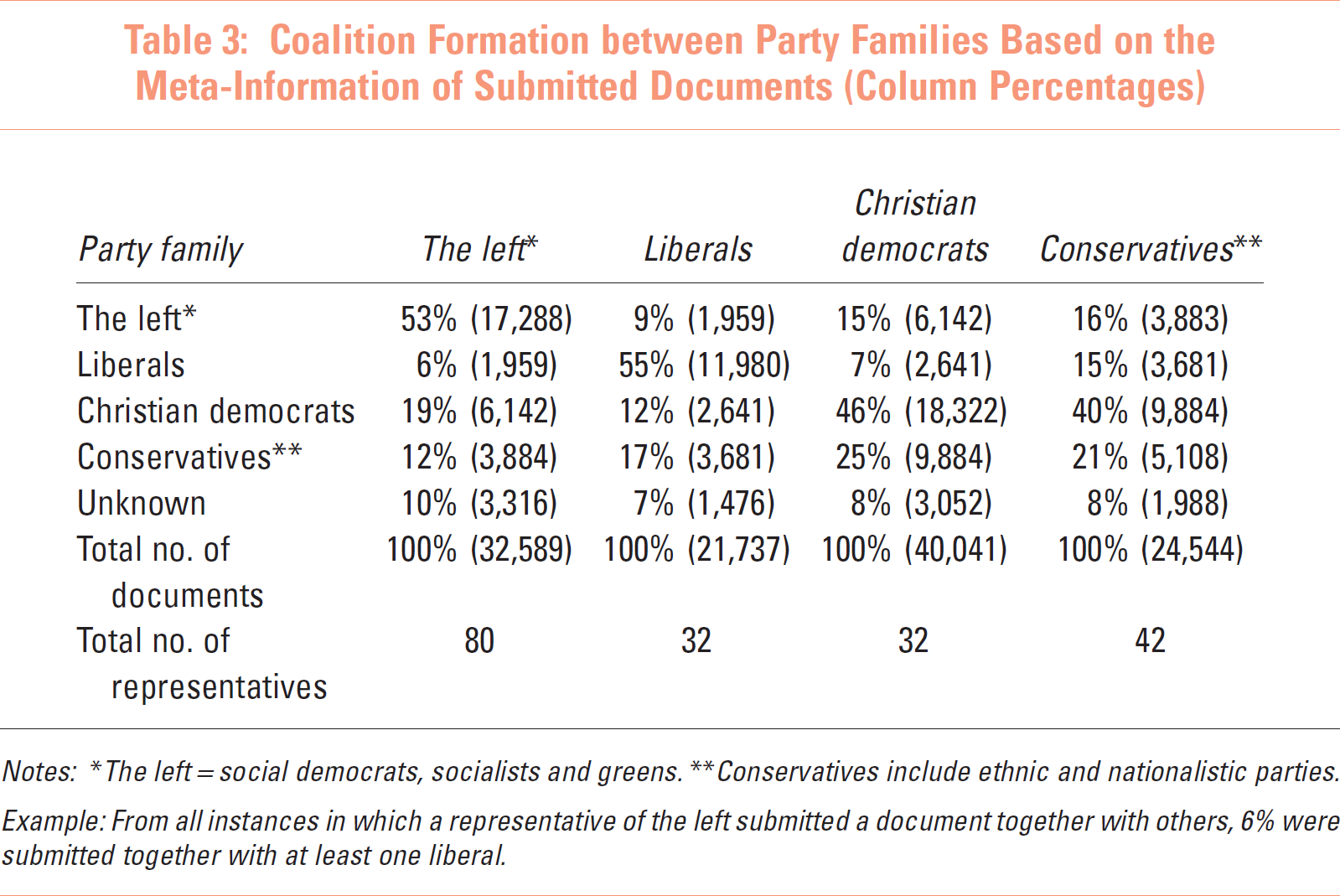
This pattern is confirmed when conducting pairwise 2 counts of how frequently members of one party family have submitted documents together with members of other party families. These counts are based on the meta-information attached to the documents on the Convention website. We have aggregated the party families into four groups, since the number of participants outside the main families is small.
Coalition Formation between Party Families Based on the Meta-Information of Submitted Documents (Column Percentages)
Notes:
*The left = social democrats, socialists and greens.
**Conservatives include ethnic and nationalistic parties.
Example: From all instances in which a representative of the left submitted a document together with others, 6% were submitted together with at least one liberal.
When the party families are plotted into a two-dimensional space, the variation on left issues turns out to be much larger than variation on right issues (Figure 2). This might be explained by the ongoing process of ‘socialisation’ during the European integration process, in which parties are familiarised with the close relation between European policy-making and market-related goals.
Scatterplot of the Mean Emphases on Left and Right Issues per Party Family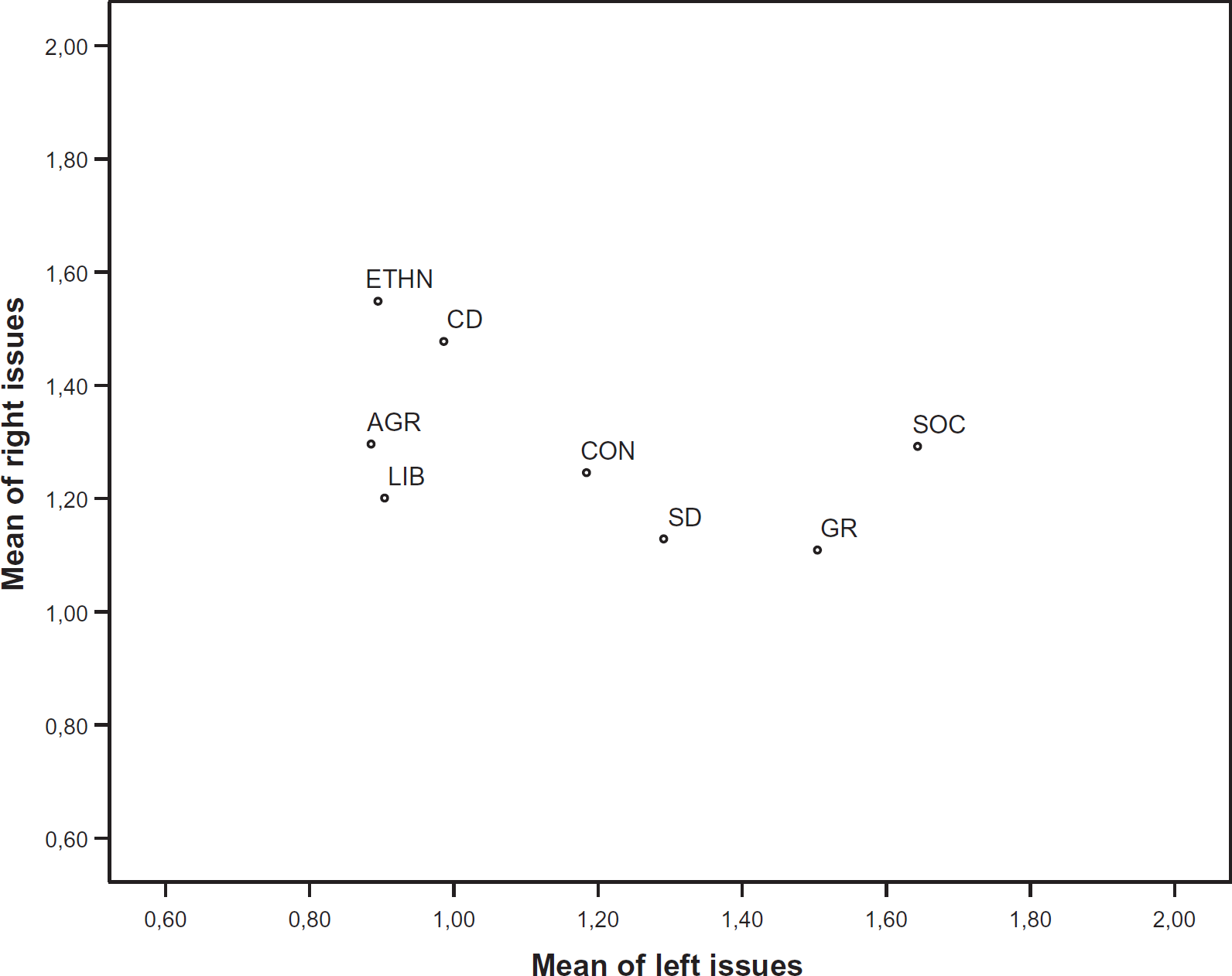
Finally, it is interesting to examine whether the draft constitution itself is closer to the preferences of some states than to others (Figure 3). The same codings are also applied to this document, and distance is measured to the constitutional actors. It turns out that the draft constitution emphasises left and right issues more than the representatives from member states do. It also puts the same weight on these policy positions whereas most aggregated scores for the member states do not. By applying an equal weight to left and right issues, both left and right parties will find references to their priorities. Hence, when leftist parties win elections and enter government, they acquire as many possibilities to use constitutional devices in order to achieve their goals as right parties gaining power.
Scatterplot of the Mean Emphases on Left and Right Issues per Country Plus the Positioning of the Draft Constitution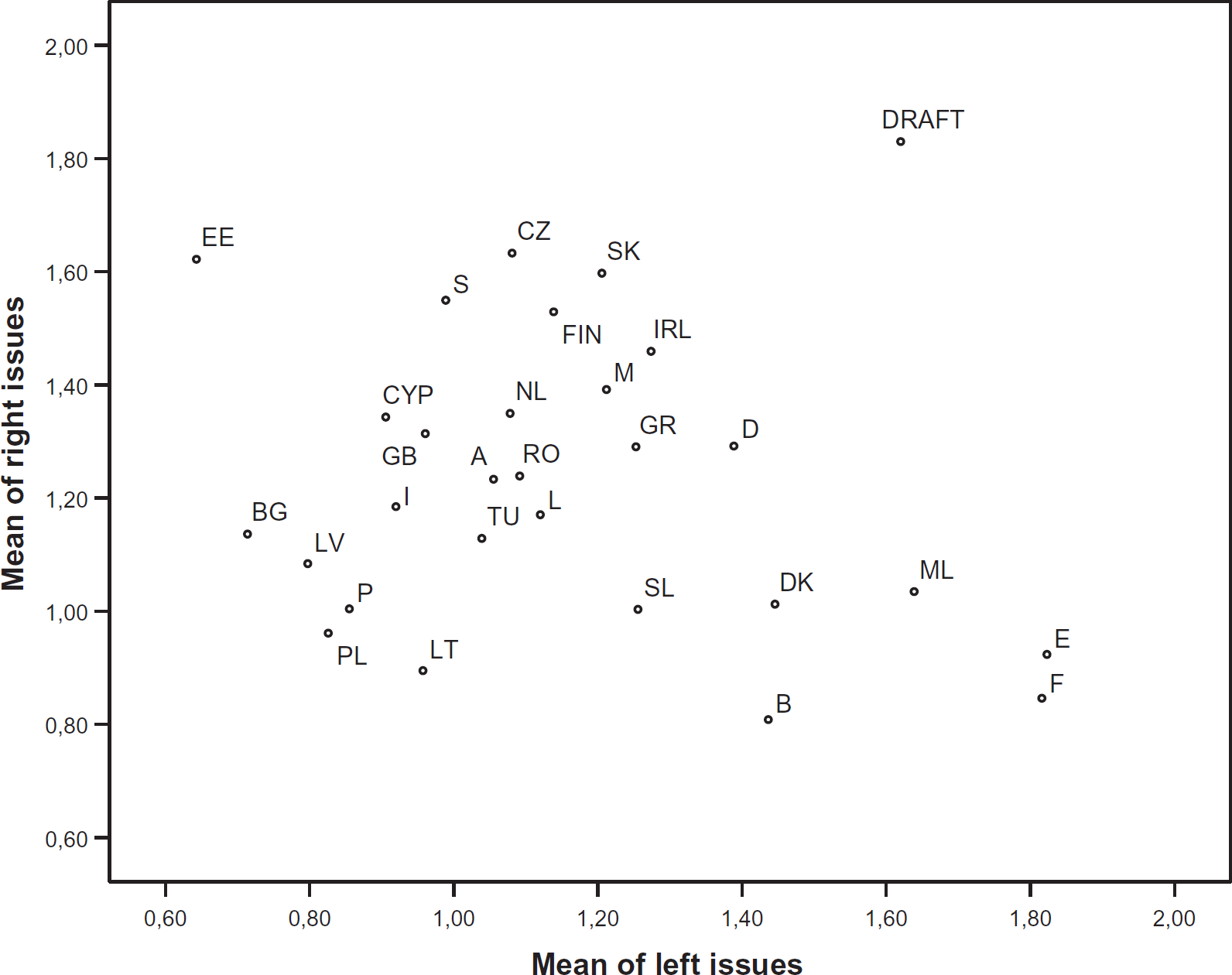
Figure 3 reveals that the draft constitution seeks to strike a balance and that there is no clear clustering of countries in terms of large vs. small, centre vs. periphery, etc. This confirms Collignon's hypothesis that consensus on a constitution is more feasible if both poles (left–right) are equally emphasised by the constitution. At the same time the figure shows that there is a small bias towards the right. The plotted positions also suggest a further specification of this assumption by showing that this equal weight is not achieved by a middle position, but by a maximised position. The strong emphasis on right issues can be explained by the fact that market-related objectives are prevailing in existing treaties that form the basis for the draft constitution. The emphasis on left issues can partly be accounted for by the inclusion of the Charter of Human Rights into the draft constitution. Without this charter, or in case of an alternative coding of words like ‘charter’ and ‘rights’, the draft constitution would be strongly tilted to the right. Also note the different distributions on the two dimensions: a large majority follows the constitution in putting the same emphasis on left and right issues. Only a small group (given in the lower right quadrant of Figure 3) puts more emphasis on left than on right issues. This is in line with what we expected at the beginning of our analysis.
Conclusion
A large number of delegates from different institutional levels within the EU have achieved a remarkable consensus on a draft constitution. Has this consensus been made possible because the nationally predominant left–right divide was only weakly present during the deliberations of the delegates? By examining to what extent left–right differences did play a role, we add an important element to the existing research on constitutionalism that often ignores this conflict dimension as it is considered to be irrelevant for constitution building.
Left–right differences have been analysed by means of a content analysis on submitted documents during the Convention. Left and right differences are measured by constructing a dictionary which discriminates between both types of issue. Although the internal validity may be affected by the way the dictionary is constructed, the outcomes have been validated externally by a significant, though moderate, correlation with expert scales if we aggregate the individual preferences to the party level.
The data analysis has confirmed our assumption that the left–right distinction was relevant, although not very dominant. It also shows that party family differences did affect the process of coalition building during the Convention. At least half of all documents have been submitted together with at least one member of the same party family and/or with one family member close by. The draft constitution did not take a mean position on left and right issues, but in fact put more emphasis on substantial goals related to left and right, giving an equal weight to both anti-poles. This confirms our hypothesis and adds a specification to it, namely that the draft constitution does not take a centre position in terms of the emphasis on left and right issues. However, if we exclude the Charter of Human Rights, the draft constitution appears to be strongly tilted to the right.
Our analysis also indicates that the process of consensus building was enhanced by the absence of many extremist and new parties during the Convention. As a consequence, we may safely assume that a large majority of all delegates were more or less pro-Europe. This may have enhanced agreement on the Constitution, but later it became problematic for the domestic democratic process and for the acceptance of the Constitution in some countries, such as France and the Netherlands, especially since some of the excluded parties have actively and successfully mobilised voters to vote against the Constitution.
Footnotes

1
However, we stress that ‘social security’ is not a commonly used phrase during the Convention so that this problem seems more threatening than it really is.
2
The pairwise count may produce biased results if the number of co-authors differs per document. In that case documents with many co-authors have more impact than documents with no or few co-authors. Since most documents are co-authored and often have a similar number of co-authors, the distribution across party families is expected to be the same.