






Abstract
The European Parliament (EP) has long been regarded as a positive force for environmental change in the EU, but there has been little detailed empirical scrutiny to determine whether its reputation as a green champion is deserved. Nor has there been any evaluation of the environmental impact of the increase in EP powers under co-decision. These oversights are rectified by an evaluation of the EP's amendments to environmental legislation using typologies that rank them in terms of their level of ecological commitment and importance. EP amendments proposed under three procedures of decision making are compared in order to determine whether recent increases in the EP's powers under the co-decision procedure have affected its ability and willingness to adopt ‘green’ amendments. It is clear that the EP has consistently tried to strengthen environmental legislation but there is some ambiguity as to whether co-decision has been good for the environment.
Environmental protection is now an important part of the modern policy agenda, with politicians routinely competing to demonstrate their green credentials. Yet, to date, there have been no empirical studies of how legislatures behave when dealing with environmental legislation. In this article we develop a new typology that ranks legislative amendments in terms of their environmental content, which allows us to test empirically the claims to ‘greenness’ made by political actors. We have chosen here to analyse the behaviour of an institution often held up as an example of a green legislature, the European Parliament (EP).
A principal reason for the focus upon the EP is the growing importance of the EU as an environmental political actor. Since the formal introduction of the environment as a field of EU policy competence in 1987, environmental legislation has become increasingly Europeanised: national executives find their domestic policies shaped by EU legislation and as part of the regulatory competition that characterises EU decision making, member states in turn seek to upload their own national models of legislation to the European level (Börzel, 2002; Jordan, 2002). A parallel process accompanying the extension of EU environmental policy has been the increase in the formal legislative power of the European Parliament. Specifically, since the introduction of the co-decision procedure in 1993, under which most environmental legislation is now adopted, the EP has become a co-legislator with the Council, which represents the interests of the EU's national governments. Therefore, if the European Parliament is an environmental champion, we can postulate that as its powers have increased it should have proposed and secured the adoption of more ‘green’ amendments. In short, co-decision should be good for the environment.
To assess whether co-decision is indeed good for the environment, we apply our new typology for classifying amendments in terms of their environmental credentials, which is used alongside existing typologies that measure influence (see Kreppel, 1999; Tsebelis and Kalandrakis, 1999; Tsebelis et al., 2001). We analyse EP amendments proposed to nine cases of environmental legislation. Our key findings are: that while the EP has not been particularly radical it has consistently sought to strengthen environmental legislation; that co-decision initially appeared to be good for the environment; but that in recent years the impact of co-decision has been more ambiguous. In short, the increases in the EP's powers have not necessarily led to greener legislative outcomes.
A key benefit of our approach is that it reveals how the EP has treated environmental legislation over time and across procedures and therefore contributes to the growing wealth of empirically informed theory about the European Parliament and EU decision making (e.g. Hix, 2002; Hix et al., 2006; König et al., 2007; Thomson et al., 2006; Tsebelis and Garrett, 2001). Moreover, while our analysis here is limited to the EP, our environmental typology could also be applied to other legislative chambers. It therefore represents an important comparative environmental tool which can be used to evaluate the environmental record of a wide range of legislatures and legislators. Hence, while this article uses the European Parliament and EU environmental policy as a case study, it has wider implications for comparative legislative and environmental research.
In the following section the literature on the EP's influence and environmental legislation is briefly reviewed and three hypotheses are developed; we then discuss the conceptual and methodological issues involved in assessing whether co-decision is good for the environment, before applying the typologies that have been developed to the nine case studies.
The European Parliament: Reputation and Powers
The European Parliament has attracted acclaim as an environmental champion largely due to the activities of its influential environment committee, which is responsible for drawing up reports on environmental policies proposed by the Commission (Burns, 2005; Judge, 1992; Weale et al., 2000). The committee is one of the largest in the EP and has shown considerable success over the years in shaping the EU's policy agenda and using its legislative powers to amend policy proposals. For example, in the 1980s the committee successfully pushed the Commission to bring forward several pieces of legislation, including directives banning the use of lead in petrol and the import of skins from seal pups, and a green paper on the urban environment (Judge, 1992). The committee has also had plenty of scope to amend legislative measures, not least because it dealt with more legislation adopted under co-decision than any other EP committee up to 2004, 1 and it seems to have responded well to the challenge, securing important compromises in relation to car emissions and consumer and health legislation (European Parliament, 1999; see also Friedrich et al., 2000).
The EP's apparent willingness to embrace the environmental agenda may in part be attributed to its institutional location – it has the opportunity to amend legislation so it is unsurprising that it chooses to strengthen standards. However, two points are pertinent here. First, there has been no empirical testing of how the Parliament behaves when dealing with environmental legislation. 2 It is important to emphasise here that the behaviour of the environment committee should not be conflated with that of the EP's plenary as a whole. As Albert Weale et al. (2000, p. 93) note, the committee's efforts at promoting a green agenda have sometimes fallen at the hurdle of achieving support from the whole EP. Second, one specific development that may have weakened the EP's environmental credentials during the 1999–2004 session was the ascendancy of the right-of-centre European People's party (EPP), which for the first time became the largest group in the EP, a position it maintained between 2004 and 2009. Studies of the EP's voting behaviour suggest that the chamber behaves ideologically, with other dimensions playing a secondary role in determining the way that MEPs vote (Hix et al., 2006). Moreover, while traditional left–right party alignments struggle to accommodate the cross-cutting environmental issue dimension, on balance left-wing parties tend to be slightly more pro-environment than their right-wing opponents (Carter, 2007; Dalton, 2006). Consequently, it is a plausible assumption that an EPP-dominated chamber will be less likely to adopt ‘greener’ amendments than a Parliament dominated by the Party of European Socialists (PES). Therefore we expect the EP to be more environmentally ambitious in the amendments that it proposed prior to 1999.
Having proposed its amendments the EP then faces the hurdle of securing their adoption by the Commission and Council and it has consistently and actively sought to expand its own powers in order to improve its legislative position relative to its institutional partners. The fact that the EP has been the main institutional beneficiary of the changes to the EU treaties since 1987 is testament to its success (e.g. see Judge and Earnshaw, 2003). The Single European Act gave the EP the power of cooperation, under which it gained a second reading of legislation and a conditional right of veto. The implementation of the Maastricht Treaty in 1993 further boosted the EP's powers through the introduction of co-decision I, which gave it another, third, reading of legislation, an unconditional veto and a right to conciliation (i.e.face-to-face negotiation) with the Council if the two sides could not agree on the EP's amendments.
The introduction of co-decision I prompted a debate about whether the new procedure had increased the EP's capacity to exercise influence (Moser, 1997; Scully, 1997a; 1997b) or weakened it (Steunenberg, 1994; Tsebelis and Garrett, 1996). The crux of the debate concerned the Council's right under co-decision to re-propose what is known as its ‘common position’ (i.e. its response to the Parliament's first-reading amendments), if and when the Council and Parliament could not agree to a joint text in conciliation. If the Council did reinstate its common position the Parliament had two choices: either to accept or reject it. George Tsebelis and Geoffrey Garrett (1996) argued that the Council was unlikely to engage in meaningful negotiations in conciliation as the member states knew they could simply revert to their original position, while the EP was unlikely to reject legislation when faced with a take-it-or-leave-it offer.
However, in practice the Council soon discovered that if it tried to reinstate its common position, the EP would reject the legislation as a matter of course. For contrary to Tsebelis and Garrett's (1996, p. 352) original assumption that each legislative bargain can be treated as a one-shot game, the EP's behaviour revealed the institution's awareness that it was engaged in a long term inter-institutional battle for power, within which individual pieces of legislation could be sacrificed to achieve larger goals (Crombez et al., 2000; Hix, 2002). The Council only tried to reinstate its common position once under co-decision, and from 1999 the rules of procedure were rewritten by the Amsterdam Treaty to remove the Council's right to reinstate its common position after conciliation, thereby creating co-decision II. This reform has led to a widely accepted consensus that co-decision has increased the EP's power relative to cooperation (e.g. see Crombez et al., 2000; Hix, 2002). However, as with co-decision I, the introduction of co-decision II has prompted a debate about whether the EP's legislative power has been strengthened (Hix, 2002; Tsebelis and Garrett, 2000) or weakened (Burns, 2006; Crombez, 2001; Kasack, 2004).
In addition, the Parliament's own more recent figures on amendments adopted under co-decision reveal a mixed picture. For example, between 1994 and 1999, 27 per cent of EP amendments discussed in conciliation were accepted by the Council and a compromise was reached on a further 51 per cent, but between 1999 and 2004 the number of amendments accepted dropped to 23 per cent while the compromise amendments agreed between the two institutions increased to 60 per cent (European Parliament, 2004, p. 14). The Parliament's Conciliation Unit argues that this increase in compromise amendments ‘illustrates the importance and positive results of direct contacts between the co-legislators in reaching compromises acceptable to both sides during the conciliation’ (European Parliament, 2004, p. 14). A less charitable interpretation is that with the massive 144 per cent rise in co-decision dossiers concluded between 1999 and 2004 the European Parliament simply became less adept at getting its own way and increasingly obliged to make compromises.
Where does this leave us in terms of how to determine whether co-decision is good for the environment? If the EP is an environmental champion then as its powers increase we can postulate that its ability to amend legislation in a green direction will improve. There seems to be a consensus that the EP is stronger under co-decision (both I and II) than under cooperation, but some observers argue that it may have been more powerful under co-decision I than under co-decision II (e.g. Burns, 2006; Crombez, 2001). Moreover, as the above discussion on the EP's reputation as an environmental champion indicates, the fact that the EP can adopt green amendments does not mean that it will and the EP may have become less environmentally ambitious since 1999. Hence, we posit the following three hypotheses:
The EP's amendments are more successful under co-decision I and II than under cooperation.
The EP's amendments are more successful under co-decision I than under co-decision II.
The EP was more environmentally ambitious pre-1999.
Measuring whether Co-decision is Good for the Environment
So how can we measure whether co-decision is good for the environment? Two issues must be addressed: how to measure the EP's legislative influence and how to judge whether an EP amendment is good for the environment. To measure legislative influence, in common with rational choice institutionalist literature in this area, we employ a relatively narrow definition of influence based upon the one-dimensional view of power. Thus we investigate ‘behaviour in the making of decisions on issues over which there is observable conflict of (subjective) interests, seen as express policy preferences, revealed by political participation’ (Lukes, 1976, p. 15). An obvious way in which to measure the EP's influence is to analyse the output of legislative processes in order to determine whether the EP (understood to be the majority of MEPs) is successful in seeing its preferences realised in the wording of the final legislative text (Nagel, 1975, pp. 29–30). Analysis of the adoption of amendments provides a key method for discovering such information. Inevitably, one drawback of using such an approach is that we cannot take into account behaviour that is not easily observable but that may nevertheless have an important impact upon policy outcomes. For example, the EP may engage in anticipatory compliance and fail to propose strong amendments, realising that it cannot succeed, or the institutions may simply share similar preferences and all agree with one another. Despite these limitations the amendment data provide a good proxy of the EP's preferences as a whole – indeed there is no equivalent measure of the Parliament's collective will. 3
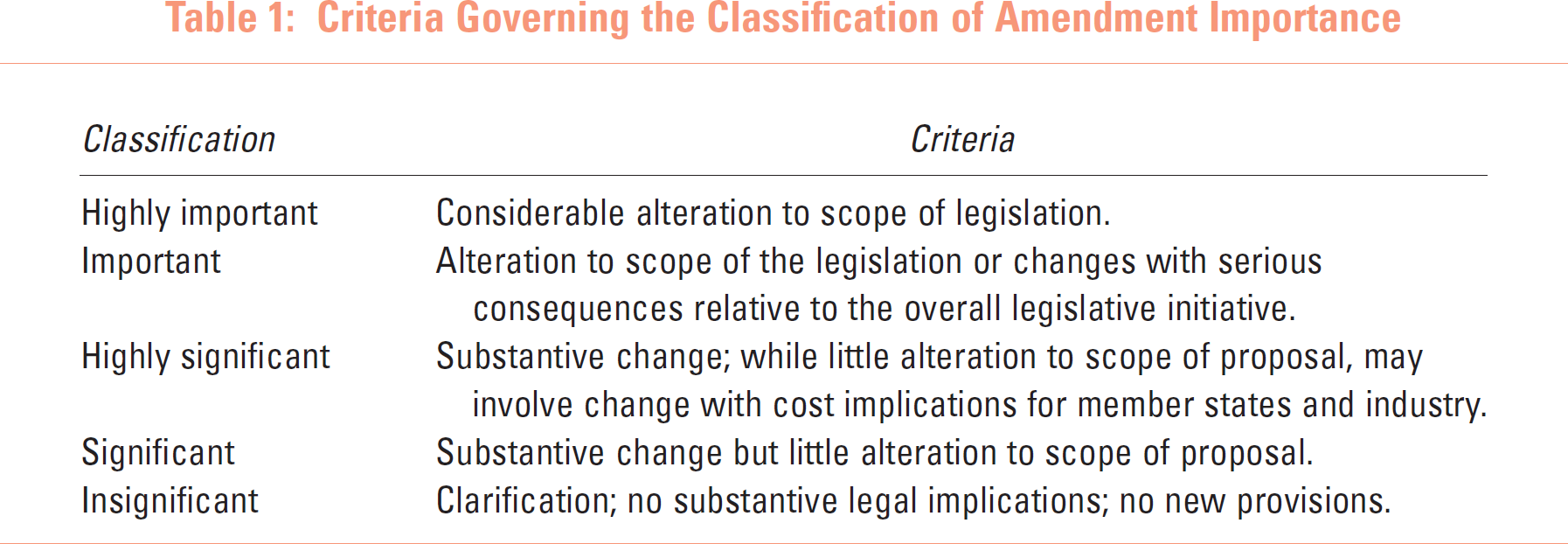
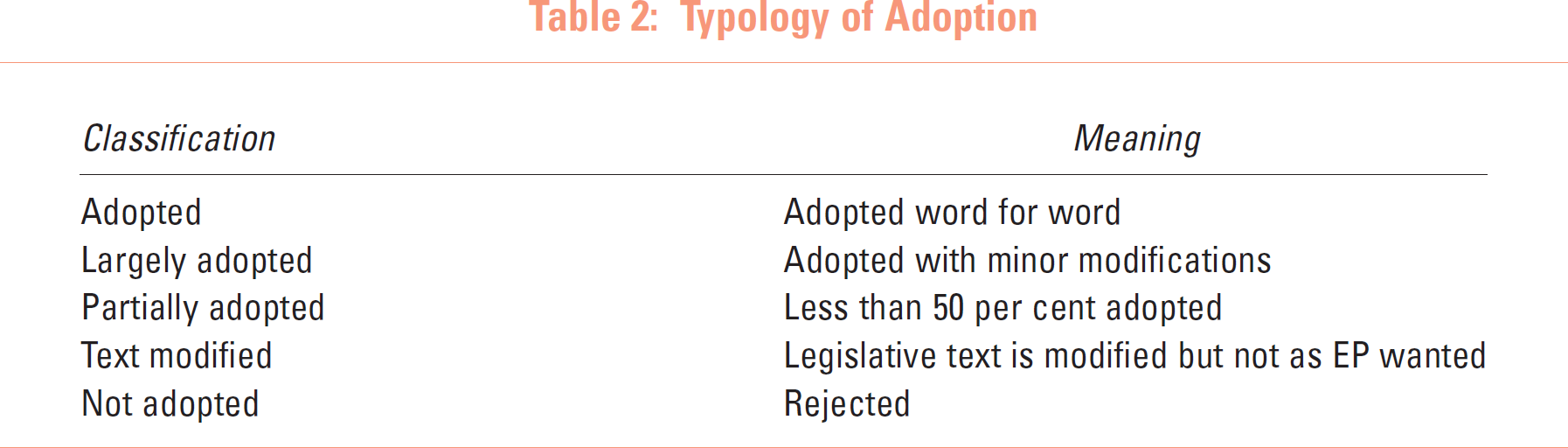
Both the Commission and Parliament publish data on the adoption of EP amendments, but the amendments are generally classified either as adopted or not adopted, with no gradation to reflect the extent to which the Commission or Council has taken on board the EP's opinion (Kreppel, 1999, p. 522). Furthermore, any analysis of the EP's legislative influence must distinguish between the types of amendment adopted, as some consist merely of grammatical improvement while others propose substantive policy change (Kreppel, 1999, p. 522). An important development in the literature has been the publication of work investigating the adoption of EP amendments by the Commission and Council (Kreppel, 1999; Tsebelis and Kalandrakis, 1999; Tsebelis et al., 2001). This work's major contribution has been the development of two typologies: one for classifying EP amendments in terms of their importance; the second for classifying their adoption using a five-fold typology ranging from ‘not adopted’ through to ‘fully adopted’ (Tsebelis and Kalandrakis, 1999; Tsebelis et al., 2001). We use versions of these typologies to interpret the treatment of amendments. A summary of the classifications is provided in Tables 1 and 2.
Criteria Governing the Classification of Amendment Importance
Typology of Adoption
To judge whether a legislative amendment is ‘good’ for the environment we developed a separate typology for classifying amendments in terms of their environmental impact. An assumption underlying this typology is the belief that it is important not to conflate the relative importance of an amendment with its potential environmental impact: while some relationship between these two variables is to be expected the EP may adopt substantively strong legislative amendments with little impact on the environment. For example, in one of our cases, the drinking water directive, we found some important amendments relating to the issue of domestic distribution systems (i.e. internal pipes in individual houses) which had important social and economic ramifications but no environmental content. Our new typology is based on the policy paradigm of ecological modernisation (EM), which is the strategy adopted by the EU to marry its economic and environmental objectives and deliver its ‘constitutional’ commitment to ‘promoting sustainable development’ (Baker, 2007; Weale et al., 2000). 4
Ecological modernisation assumes that ecological sustainability is achievable without a fundamental restructuring of the capitalist system, through the dematerialisation of production and decoupling of economic growth and resource use. It is underpinned by the belief that policy makers should adopt an anticipatory and preventative approach to environmental problems influenced by the precautionary principle, that environmental considerations should be integrated into all parts of government, and that ‘new’ policy instruments, such as eco-taxes and tradable permits, should be used to penalise environmentally damaging activities (Carter, 2007, pp. 227–9). It is possible to distinguish between ‘weak’ and ‘strong’ versions of ecological modernisation along a continuum (Christoff, 1996). In its weaker ‘techno-corporatist’ form ecological modernisation focuses narrowly on the development of technical solutions to environmental problems. Strong ecological modernisation is a broader concept which is closer to sustainable development in emphasising the interdependence between environment and development issues, and the need for an extensive democratisation of policy processes.
Since the fifth environmental action programme in the early 1990s, the EU has based its environmental policies on a strategy of ecological modernisation, which appears reasonably consistent with the wider European ‘project’ of encouraging free trade and continued economic growth. While ecological modernisation has its critics (particularly from a radical green perspective), it seems reasonable to judge the environmental credentials of the EP by the standards of the policy paradigm within which it is working. We therefore developed a five-fold typology (see Table 3) to classify EP amendments according to their impact on the environment based on the ecological modernisation policy paradigm.
Environmental Typology
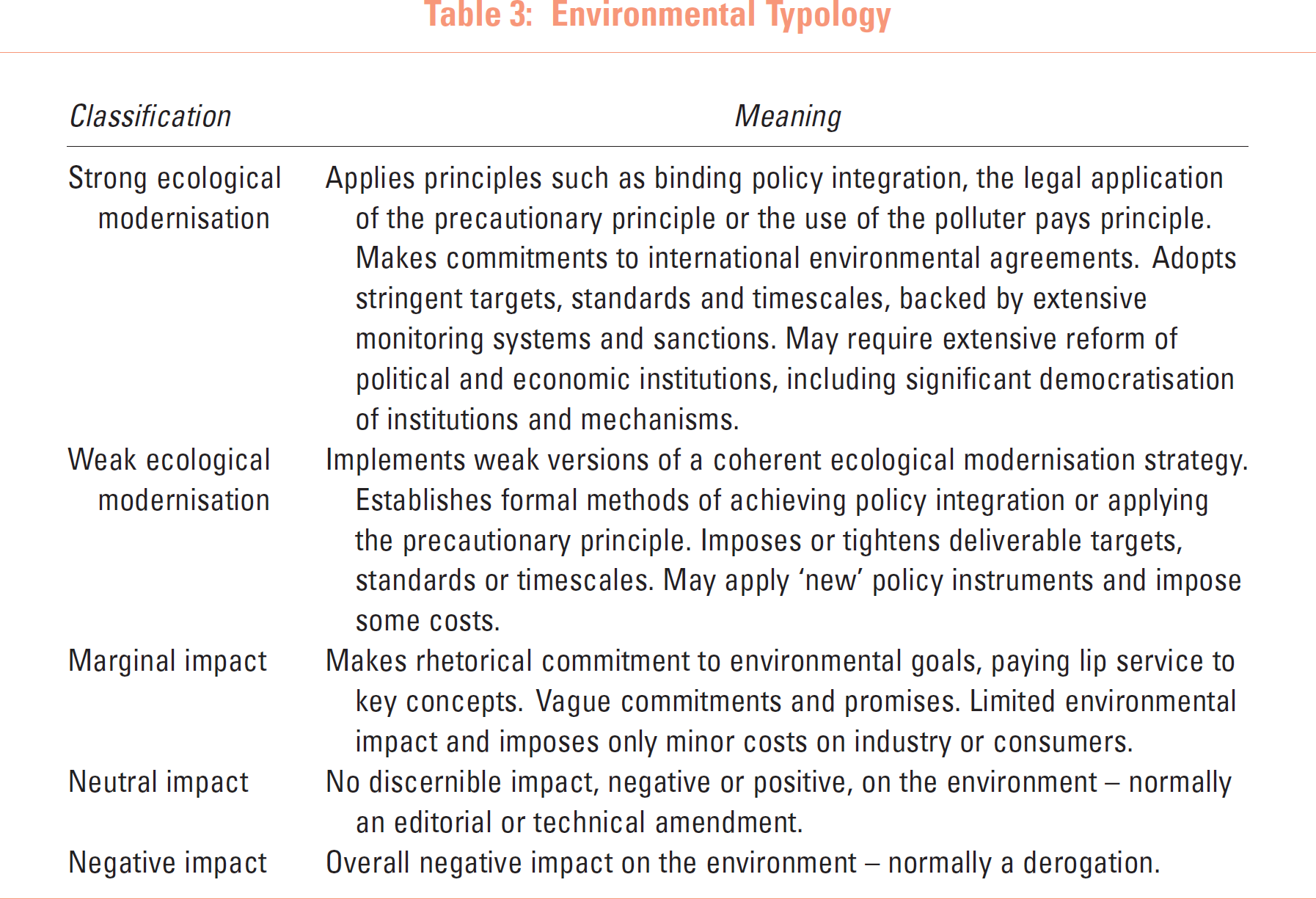
The two most positive categories, strong and weak ecological modernisation, are broadly based on the Christoff (1996) dichotomy. For example, we classified an amendment to the sixth environmental action programme requiring the ‘introduction of a binding environmental impact assessment for all decisions and legislative proposals by the Commission and publication of the results’ 5 as ‘strong EM’. By contrast, an environmentally progressive, but rather vague, amendment to ‘give technical, human and, where possible, financial aid to developing countries to make progress on sustainable development’ 6 we classified as ‘weak EM’. The third positive category, ‘marginal’ impact, refers to amendments that make a small improvement to environmental provisions. By way of example, a rather woolly amendment ‘encouraging and creating incentives for the preparation of integrated national, regional or local plans’ 7 for biodiversity protection fell into this group. The fourth category covers ‘neutral’ amendments which have no discernible impact, negative or positive, on the environment, and typically involve editorial or technical changes.
On the assumption that few EP amendments are likely to propose weakening environmental legislation, we included just one category to cover all ‘negative’ amendments no matter how significant the detrimental effect. Most negative amendments called for derogations to be granted to special interests with respect to the application of a new regulation. For example, in one of our cases vehicle manufacturers were given an extra two years to comply with new emission standards. 8
As any evaluation of the environmental impact of amendments will be inevitably subjective, in order to limit any error as far as possible we follow George Tsebelis and Anastassios Kalandrakis (1999, pp. 130–1) in erring in the direction of underestimating the environmental impact of amendments. This approach allows us to offer a conservative estimate of the EP's impact on the environment. Both authors were involved in classifying the amendments. In each case we reviewed all the legislative documents (the Commission's original, modified and amended proposals, EP committee reports and debates and the Council's statement of reasons), in order to identify the justification for each institution's position and to enable us to triangulate the perceived importance or greenness of each amendment. We classified one case together to ensure that as far as possible we were using the typologies in the same way and thereafter we each took the lead on specific cases, consulted each other on amendments that were difficult to classify and cross-checked the other person's classifications when completed.
Case Selection
Nine cases were selected to test the hypotheses using the classifications developed above. As two of the hypotheses revolve around the question of procedure, i.e. the EP's comparative effectiveness under cooperation, co-decision I and co-decision II, we chose cases adopted under all three procedures. Consequently, six cases fell within the period up to 1999 when the PES was the largest political group and three cases post-1999 when the EPP was the largest political group, thereby facilitating a limited comparison of the EP's behaviour under differing ideological balances of power.
We chose co-decision cases that went to conciliation as we were interested in making a judgement about the EP's influence and its environmental credentials and it therefore seemed appropriate to investigate cases where there was clearly disagreement between the institutions. As Jean Blondel et al. (1970) note, legislative viscosity – the degree of resistance that legislatures experience within the decision-making process – can provide an important measure or proxy for influence. A legislature that accepts legislation easily or in turn finds its own amendments readily adopted may simply be in agreement with other decision-making institutions, or it may recognise that its chances of success are limited so it engages in anticipatory compliance. Under such conditions the success rate of an institution's amendments or its ability to conclude a proposal quickly may provide little more than an indicator of agreement or compliance rather than influence. Hence to gain a genuine understanding of when and how the EP can exercise influence and potentially green the EU's legislation, it is important to analyse cases where the EP finds itself in conflict with its legislative partners (the Commission and/or Council) in order to determine the Parliament's impact in those circumstances.
A final consideration was to ensure, as far as possible within our limited sample, that the choices should reflect the heterogeneous nature of EU environmental legislation, by including examples of both technical and broader strategic legislation. Consequently, for each decision-making procedure we selected one case that could be classified as legislation that facilitates the wider strategic aims of EU environmental policy: the regulation establishing the European Environment Agency (cooperation) 9 (SYN 1997/0168); the review of the fifth environmental action programme (COD 1996/0027); and the sixth environmental action programme (co-decision II) (COD 2001/0029). For the other cases we selected technical legislation, with cost implications that were likely to be divisive. For the cooperation procedure we chose directives on small-car emissions (89/458 EC, OJL 226/1, 03/08/1989) 10 and drinking water (SYN 1995/0010). Under co-decision I we selected directives on packaging waste (COD 1994/0436) and volatile organic compounds (VOCs) (COD 1994/0425). Under co-decision II we chose the directive on waste from electrical and electronic equipment (WEEE) (COD 2000/0158) and the regulation on substances that deplete the ozone layer (COD 1998/228).
Findings
In order to address our overall question and hypotheses we organised our data analysis around two sub-questions:
Is the EP proposing green and strong amendments? Is the EP successful in securing the adoption of its amendments, particularly the greenest and strongest?
A total of 727 amendments were proposed in the nine case studies (see Table 4).
Amendments Proposed
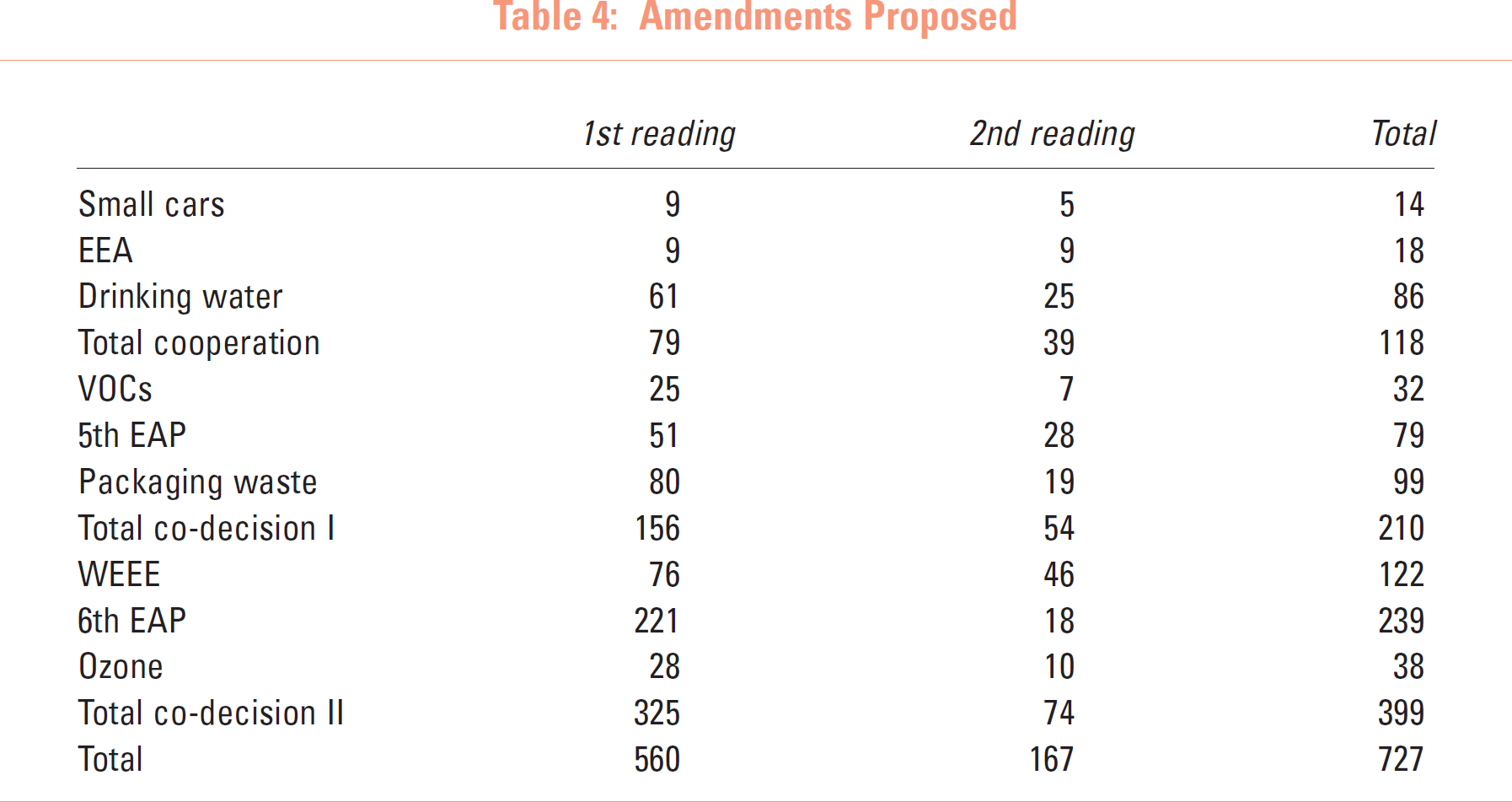
There were considerably more amendments at first reading (560) than at second reading (167), which is unsurprising given the EP's internal rule limiting second-reading amendments to those that have already been proposed but rejected by the Council at first reading, unless there are new articles (see Tsebelis et al., 2001, p. 581; Kasack, 2004). There were considerably fewer amendments proposed under cooperation (118) than under either co-decision I (210) or co-decision II (399), which is also unsurprising given the Parliament's deliberate strategy of limiting its amendments to legislation under cooperation in order to enhance its reputation as a reliable legislative partner (see Westlake, 1997, p. 245).
Is the EP Proposing Green and Strong Amendments?
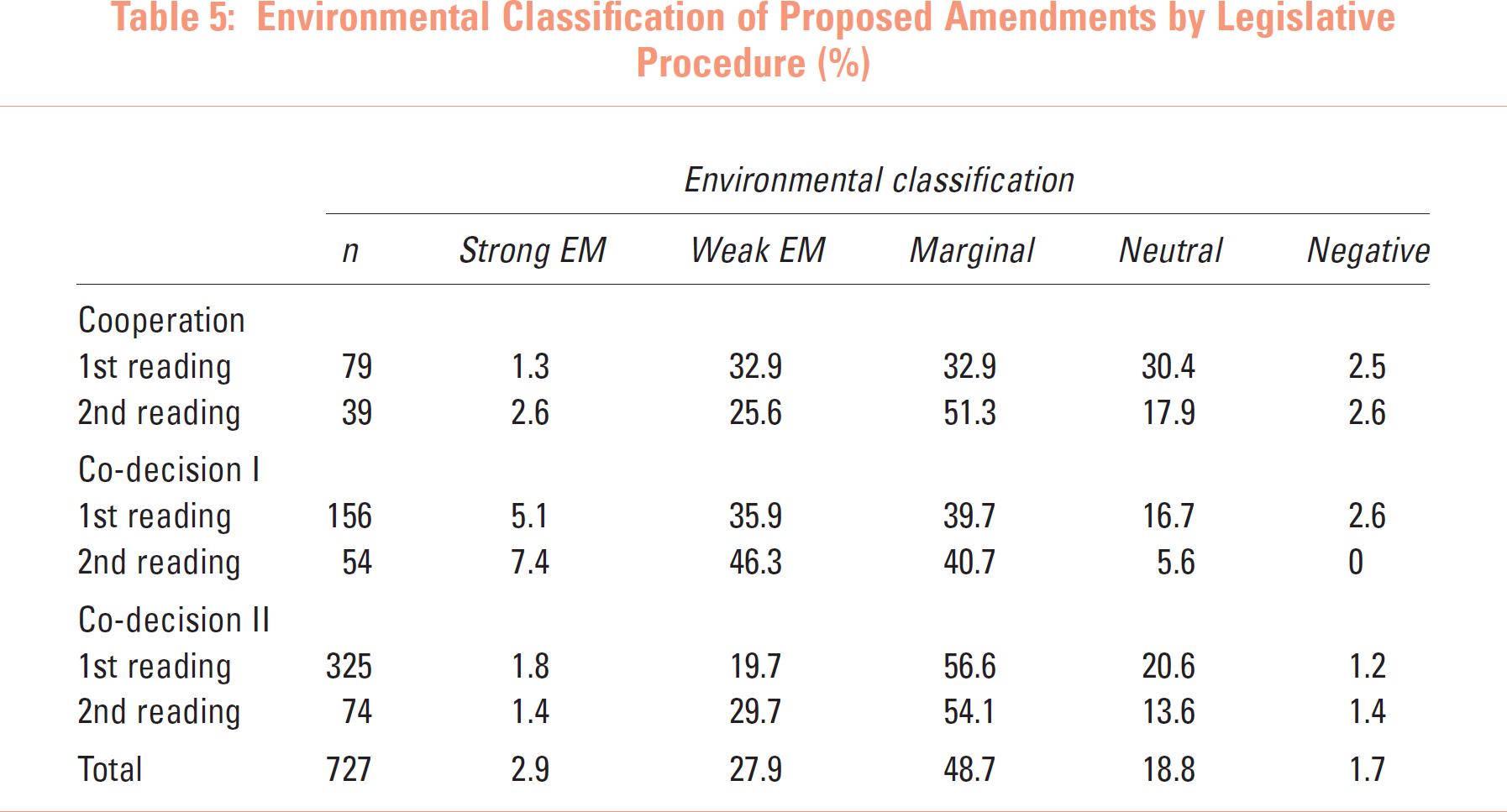
It is clear from Table 5 that the vast majority of amendments proposed by the EP were intended to strengthen environmental protection: 79.5 per cent were categorised as ‘strong EM’, ‘weak EM’ or ‘marginal’ compared to a handful of ‘negative’ amendments (1.7 per cent). While this finding is consistent with the general perception of the EP as an environmental champion, this conclusion is tempered when we delve below the headline figure to assess the quality of the amendments being proposed. For example, a clear majority of the pro-environment amendments were ‘marginal’, suggesting that the EP was often only tweaking legislative proposals to make them slightly greener, while only 2.9 per cent of the amendments were ‘strong EM’. However, if the two most stringent environmental categories are combined, then we find that 30.8 per cent of amendments were either ‘strong EM’ or ‘weak EM’ (hereafter, unless otherwise specified, the term ‘EM amendments’ will include both these categories), which indicates that the EP has pursued an ecological modernisation policy agenda. In addition, Table 5 also shows that the EP has been consistent in always proposing a tranche of EM amendments under every legislative procedure, although there was a significantly higher percentage of EM amendments at both readings under co-decision I than under either cooperation or co-decision II.
Environmental Classification of Proposed Amendments by Legislative Procedure (%)
We can assess whether this EM agenda would have a substantive impact by classifying the amendments using the typology of importance (see Table 1). The combination of ‘highly important’ and ‘important’ amendments made up 23.1 per cent of the total, 11 of which most were EM (hereafter, unless otherwise specified, the term ‘important amendments’ will include both categories of importance). Table 6 shows that the percentage of ‘important-EM’ amendments was substantially higher for cooperation and co-decision I than for co-decision II.
Important-Ecological Modernisation Amendments by Legislative Procedure (%)
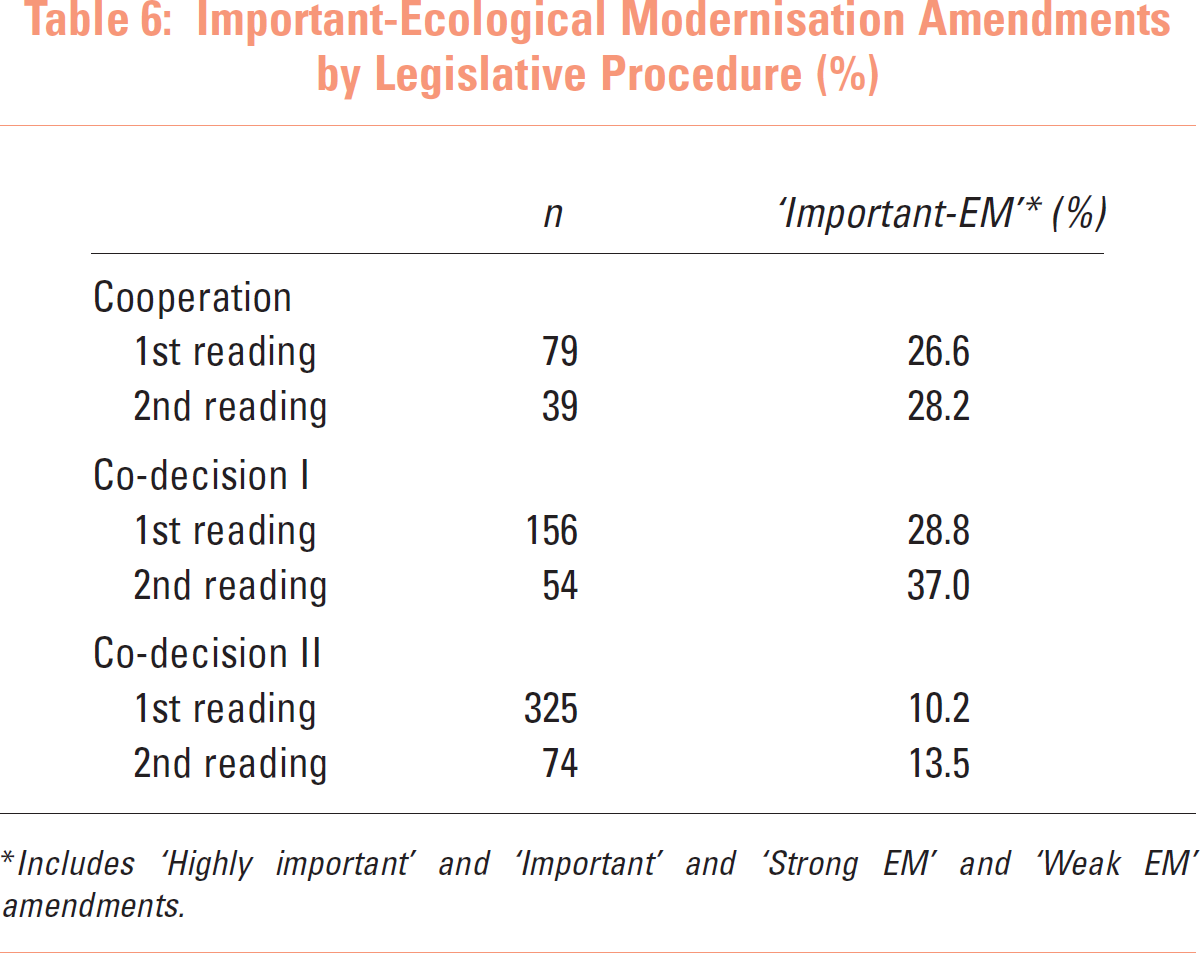
*Includes ‘Highly important’ and ‘Important’ and ‘Strong EM’ and ‘Weak EM’ amendments.
The data also suggest a positive relationship between importance and environmental classification. The ‘important’ amendments proposed by the Parliament represented 62.5 per cent of all EM amendments. Cooperation had the largest percentage at both readings (77.8 per cent at first reading and 100 per cent at second reading) compared to co-decision I (70.3 and 69 per cent) and co-decision II (47.1 and 43.5 per cent). The strong relationship between the ‘greenness’ and the importance of amendments is not unexpected because most ‘important-EM’ amendments imposed cost implications on industry and/or member states, or were part of an EP agenda-setting strategy, which usually had sufficient legislative significance to place them into the ‘important’ category.
Finally, very few ‘negative’ environmental amendments were proposed, which underlines the pro-environment nature of the EP agenda. Interestingly, no negative amendments were proposed in any of the three pieces of strategic legislation.
Thus the EP, particularly under cooperation and co-decision I, has consistently promoted a pro-environment agenda containing a block of ‘important-EM’ amendments. But for the epithet ‘environmental champion’ to have resonance, we need to establish whether the EP is successful in getting its amendments adopted.
Is the EP Successful in Securing the Adoption of its Amendments, Particularly the Greenest and Strongest?
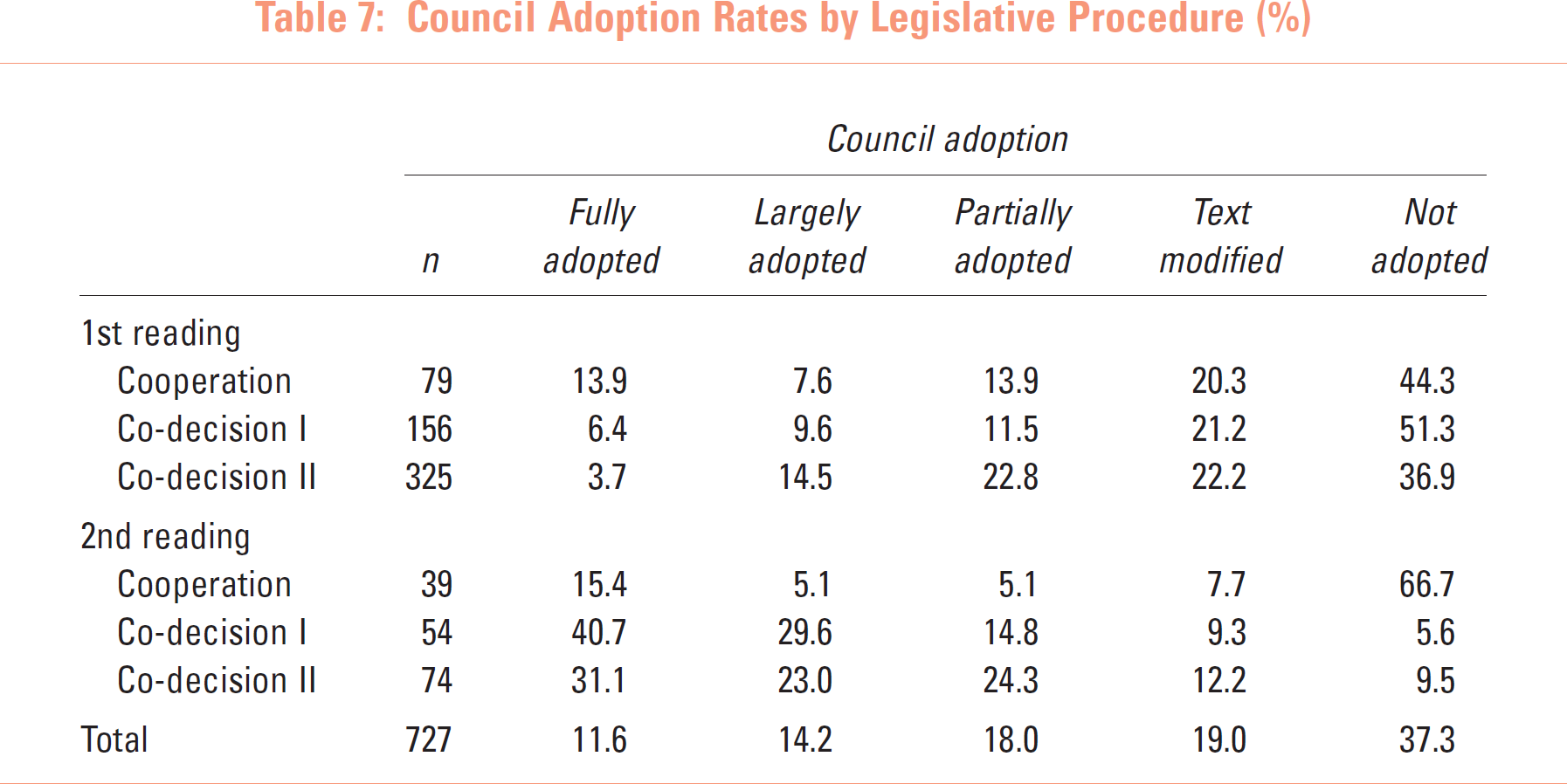
The EP secured an overall adoption rate – amendments that were either ‘fully adopted’ or ‘largely adopted’ by the Council at first or second reading – of 25.8 per cent (see Table 7) (hereafter, unless otherwise specified, the term ‘adopted amendment’ will refer to both fully and largely adopted amendments and the term ‘not adopted’ will refer to both the text modified and not adopted categories). What is most striking about these data is that at second reading, while the adoption rate under cooperation was similar to the first reading, there was a massive increase in the adoption rate under both co-decision I and co-decision II. Similarly, while the non-adoption rate at second reading increased under cooperation to 74.4 per cent, it shrank to just 14.9 and 21.7 per cent, respectively, under co-decision I and II. Thus, by getting more amendments fully or largely adopted and fewer amendments not adopted, the EP seems to have achieved greater success under both versions of co-decision than under cooperation.
Council Adoption Rates by Legislative Procedure (%)
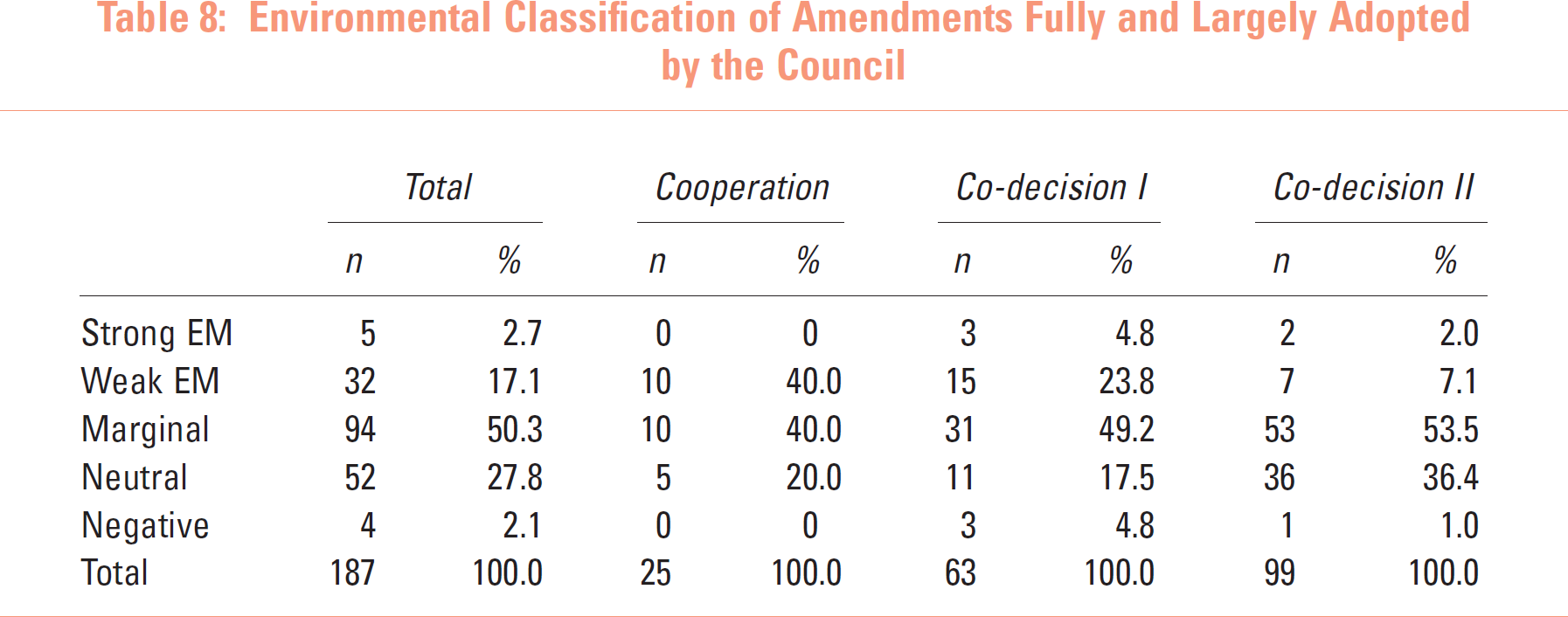
However, these data record only the quantity of legislation, not its environmental content. Put differently, how ‘green’ are these adopted amendments? We address this question by analysing the 187 adopted amendments in terms of their environmental content and legislative importance. Table 8 reveals that a clear majority (70.1 per cent) were broadly pro-environment (i.e. ‘EM’ or ‘marginal’), with EM amendments making up 19.8 per cent of the total. When analysed by legislative procedure a more complex picture emerges. In absolute terms, far more pro-environment amendments were adopted under co-decision I and II than under cooperation, but as a percentage of the total for each procedure a larger proportion of cooperation amendments adopted were pro-environment and, significantly, a bigger share were EM compared to either co-decision procedure.
Environmental Classification of Amendments Fully and Largely Adopted by the Council
A further measure of the EP's impact – the legislative importance of the amendments adopted – provides a weaker endorsement of its environmental credentials. The two most common amendments adopted were ‘significant-marginal’ (39.6 per cent of the total) and ‘insignificant-neutral’ (18.2 per cent) – thus a clear majority of amendments adopted had minimal legislative impact and little or no positive benefit for the environment. Nonetheless, there was a small but respectable tranche of ‘important-EM’ amendments (13.4 per cent) adopted that had a substantial pro-environment legislative impact. These were scattered across every case study, but with proportionally more under co-decision I and cooperation than under co-decision II. Thus the EP was able to advance its ecological modernisation agenda in every case, although it achieved relatively greater success under cooperation and co-decision I.
Another way of assessing EP influence is by comparing across legislative procedures its relative success in securing the adoption of ‘important-EM’ amendments against less important, non-EM amendments, represented here by the two most common categories: ‘significant-marginal’ and ‘insignificant-neutral’ amendments. We could expect the Council to be less resistant to these weaker amendments than to ‘important-EM’ amendments, because the environmental content is more diluted and the legislative impact less extensive and costly. Indeed, the overall adoption rate for ‘important-EM’ amendments was lower than for ‘significant-marginal’ and ‘insignificant-neutral’ amendments, but Table 9 shows considerable variation between legislative procedures and readings. Under cooperation, the adoption rate for ‘important-EM’ amendments was similar to that for ‘significant-marginal’ and ‘insignificant-neutral’ amendments. By contrast, under both versions of co-decision the overall proportion of ‘significant-marginal’ and ‘insignificant-neutral’ amendments adopted comfortably exceeded the ‘important-EM’ share.
Council Adoption Rates by Environmental Classification, Importance and EP Reading (%)
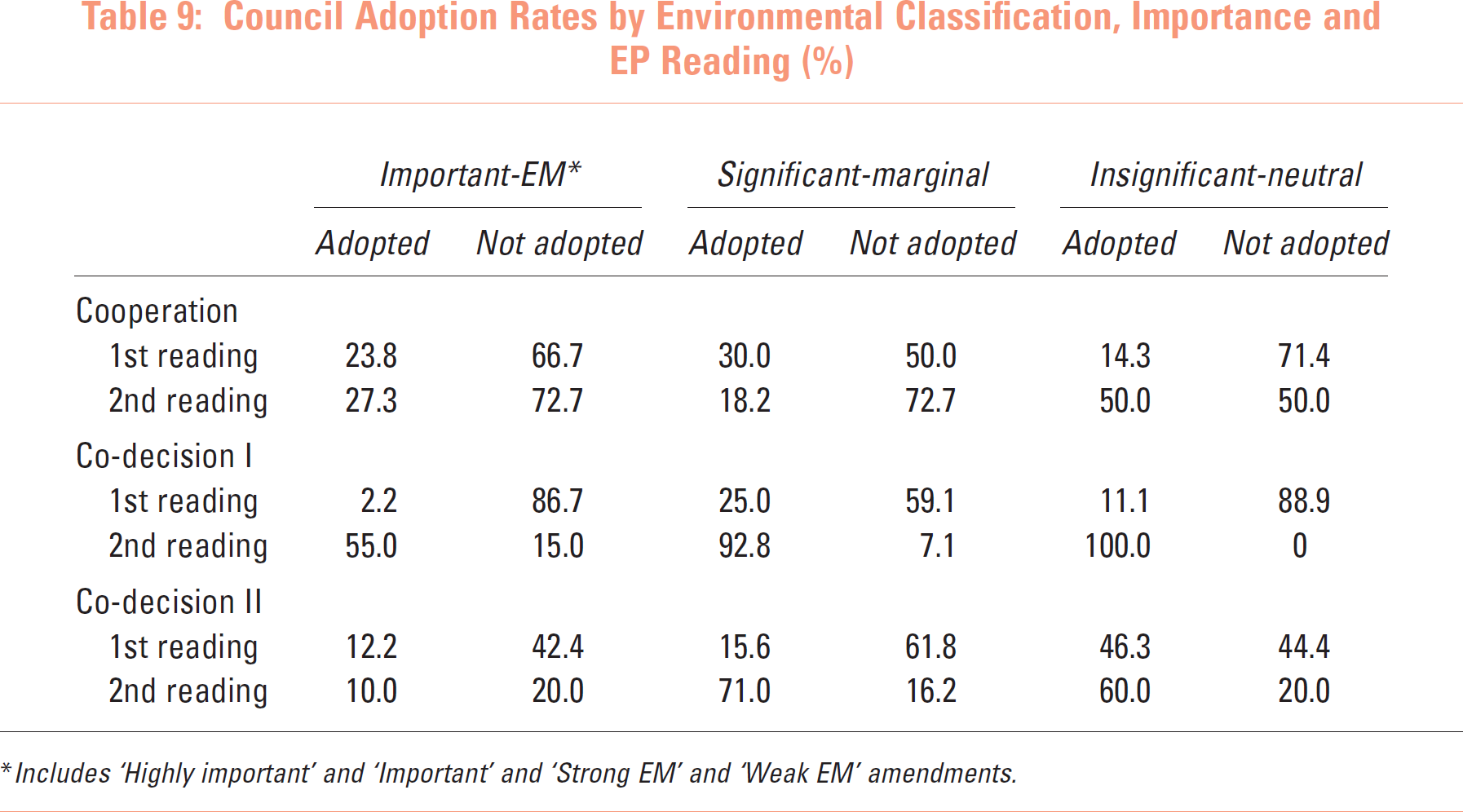
*Includes ‘Highly important’ and ‘Important’ and ‘Strong EM’ and ‘Weak EM’ amendments.
Table 9 also shows that the percentage of ‘important-EM’ amendments adopted under co-decision I increased dramatically from 2.2 per cent at first reading to 55 per cent at second reading (with similar huge increases for both ‘significant-marginal’ and ‘insignificant-neutral’ amendments). At co-decision II second reading, however, only 10 per cent of ‘important-EM’ amendments were adopted. Moreover, while the percentage of ‘important-EM’ amendments ‘not adopted’ stayed high for cooperation at second reading (at 72.7 per cent), it dropped significantly for both co-decision I (15 per cent) and co-decision II (20 per cent). Indeed, the overall proportion of amendments ‘not adopted’ at second reading plummeted under both forms of co-decision.
The broadly similar adoption rates across all three categories of amendment under cooperation suggest that without a conciliation process putting pressure on it to seek compromises, the Council could generally treat all amendments in a similar manner. In effect it could reject those amendments – the majority – that it disliked. The introduction of the conciliation procedure under co-decision increased the pressure on the Council to negotiate agreements with the EP. The openness of both institutions to compromise under co-decision is indicated by the noticeable differences between first and second reading (when the process of conciliation is likely to have most impact). So while the EP has secured the adoption of a smaller percentage of its ‘important-EM’ amendments under co-decision I and II than under cooperation, overall it has arguably been more effective under co-decision I and II because a much larger proportion of all its amendments are fully, largely or partially adopted.
Discussion and Analysis
So what do the patterns of proposal and adoption of amendments revealed by the data tell us? To recap there are five main findings to emerge from the data collected. First, the proportion of ‘important-EM’ amendments proposed by the EP under cooperation and co-decision I was higher than under co-decision II. Second, in terms of the absolute number of amendments adopted, the EP was more successful under both co-decision procedures than under cooperation. Third, a higher proportion of amendments proposed by the EP were adopted under co-decision I than under co-decision II. Fourth, the EP achieved greater success in advancing its progressive environmental agenda (getting proportionally more ‘important-EM’ amendments adopted) under cooperation and co-decision I. Interestingly, under cooperation the EP proposed fewer amendments, particularly at second reading, but of those it proposed most were strong in terms of the environmental and importance typologies. Fifth, the EP very rarely proposes negative amendments.
The hypotheses developed from our discussion of the literature were that:
The EP's amendments are more successful under co-decision I and II than under cooperation.
The EP's amendments are more successful under co-decision I than under co-decision II.
The EP was more environmentally ambitious pre-1999.
Taking these in reverse order, the findings indicate that the EP was more environmentally ambitious pre-1999 (H3). They also indicate that the EP's amendments were more successful under co-decision I than under co-decision II – the EP was both more radical and more successful in our co-decision I cases (H2). On H1 the findings are more nuanced. In quantitative terms it is certainly true that the EP's success rate under co-decision I and II was higher than under cooperation. The data starkly illustrate the impact of conciliation upon the Council, which behaved very differently in relation to a co-decision second reading compared to a cooperation second reading. Thus, under co-decision the rates of non-adoption dropped dramatically and more of the Parliament's amendments were accepted. However, in qualitative terms many of those ‘green’ amendments were relatively unimportant and a higher proportion of ‘important-EM’ amendments proposed under cooperation were adopted than with either co-decision procedure.
There are several plausible explanations for these differences between the legislative procedures. Two general trends may have contributed to the EP weakening its traditionally green stance on environmental legislation. First, as the EP's powers have increased it has attracted more attention from industrial as well as a wide range of NGO lobbyists (Smith, 2008; Watson and Shackleton, 2003). However, whether this development has had a negative impact upon legislation is open to debate. In our case studies we found some evidence of successful business lobbying producing negative amendments. For example, in response to concerted lobbying by the copper industry regarding the drinking water directive, the EP proposed moving copper from the list of chemicals to which regulatory standards were to be imposed to the list where member states/water companies were required only to monitor levels of the substance in drinking water. 12 However, the impact of lobbying is likely to vary from case to case. Second, since 2000 the EP has been increasingly influenced by the EU's general fixation with the Lisbon Agenda and the need to improve European growth and competitiveness (see Pesendorfer, 2006), which may have led to the adoption of weaker environmental amendments. Again, this kind of broad shift in attitude is difficult to pin down to a specific time and is likely to have a case-by-case impact.
More specifically, the apparently more radical behaviour of the EP pre-1999 may well be due to the ideological composition of the EP, as the PES, traditionally regarded as the slightly ‘greener’ of the two major party groupings, dominated when these cooperation and co-decision I cases were debated, whereas the EPP had won control by the time of the co-decision II cases.
An alternative and compelling, institutional, explanation for these differences over time concerns changes in the strategy adopted by the Parliament. Under cooperation and co-decision I the EP saw itself as engaged in a long-term strategic game to increase its powers (see Judge and Earnshaw, 2003). Thus under cooperation, the lower number of amendments proposed and their more environmentally ambitious content reflected the institutional/political context that led the EP to limit the number of amendments it proposed as part of its attempt to strengthen its credibility as a serious legislative player (see Westlake, 1997), and to ensure that those amendments it did propose were powerful. Similarly, under co-decision I it is clear that the EP sought to maximise its influence by adopting challenging amendments that would go to conciliation and, as indicated earlier, it was at times prepared to sacrifice legislation in order to attain its wider legislative ambitions (Hix, 2002; Shackleton, 2000). Under co-decision II the EP has found itself facing a much heavier workload and a Council willing to talk to the EP earlier in the process – indeed both sides now wish to avoid conciliation and therefore engage in wider-ranging informal dialogue from the first reading onwards (Shackleton and Raunio, 2003).
The increase in informal contacts between the EP and Council from before the first reading under co-decision II has enabled the EP to predict more effectively which amendments have a chance of success and which ones have no chance of being accepted. This new source of information has contributed to a process of anticipatory compliance by the EP, encouraging it to moderate some amendments in order to increase the chances of them being adopted – hence its apparently less radical behaviour. However, our results indicate that the EP was both more environmentally ambitious and more successful in qualitative terms under cooperation and co-decision I.
The EP's poorer success rate under co-decision II in qualitative terms may be explained by the fact that the Parliament no longer has a long-term focus in the field of legislative powers – it has won its battle for more powers in the form of co-decision and would see the procedure applied to most areas of policy under the Treaty of Lisbon (if and when it is adopted). Consequently, one interpretation of our data is that the EP is now less disciplined in controlling the number and quality of amendments that it is proposing. While the strategy of adopting more amendments may potentially give the EP more to bargain with, it does not seem to have been a very effective strategy because the EP is winning on the less important amendments under co-decision II. This finding indicates that the Council has learned lessons over time. It has become more adept at bargaining with the EP, which seems to have been fooled into playing a numbers game, forgetting that winning on a greater number of amendments does not necessarily translate into qualitatively better or stronger legislation.
Lastly, it is important to emphasise that the small number of negative amendments proposed supports our wider finding that the EP has sought to advance an environmental agenda. Significantly, the ideological composition of the EP had no discernible effect on the number of negative amendments proposed. The main patterns to emerge were that they were only found in technical (i.e. non-strategic) pieces of legislation and that most negative amendments sought to protect particular regions or industries.
Conclusion
So is co-decision good for the environment? the EP certainly seems to be seeking to advance an environmental agenda that is, in part, driven by the paradigm of ecological modernisation. This positive conclusion needs to be tempered by two observations: first, the majority of EP amendments are not particularly environmentally ambitious; second, the EP appears to have become less environmentally ambitious over time. It is clear that the introduction of co-decision has changed EP and Council behaviour and increased the EP's chances of seeing its amendments adopted in some form, but the quantitative impact of co-decision in terms of the number of amendments adopted is not always matched by environmental quality. Specifically, co-decision I does seem to have been good for the environment but it is less clear whether co-decision II has been beneficial. To put it in more general terms, we find no strong evidence that increases in the legislative power of this so-called environmental champion have resulted in greener legislative output.
The complexity of the decision-making process and the multiplicity of potential variables affecting the EP's behaviour over time mean that there are numerous potential explanations for these findings. We have highlighted those directly relevant to the EP: notably, the changing ideological composition of the Parliament; the introduction of new rules of decision making which have altered the inter-institutional dynamic between the EP, Council and Commission; and the shifting strategic context for the EP as it has achieved increases in its powers. Of these factors the change in decision-making rules and shifting strategic context are probably the most important in shaping the EP's behaviour. However, given the small number of cases studied here and our focus upon easily observable behaviour, we can only posit analytical generalisations and our claims about the EP's environmental reputation must remain relatively tentative. That said, by developing our typology for analysing the environmental content of amendments we have for the first time been able to establish a benchmark against which the environmental reputation of the EP can be measured in future work.
Our findings allow us to offer some limited support to the EP's portrayal as an environmental champion, but it may have lost its teeth in the years immediately after the introduction of co-decision II. Certainly our research begs further testing of the EP's behaviour under co-decision II to see if our findings are replicated across a wider range of cases. There are reasons to suggest that they might be: the EP has grown in size with enlargement and prior to 2004 the Council and Parliament tried to rush through legislation in anticipation of bottlenecks as the institutions all tried to deal with their newly increased size and heterogeneous composition. It would also be interesting to analyse whether enlargement has had any discernible impact upon the EP's environmental behaviour. Hence we suggest the following questions for future research. First, will the EP continue to be less environmentally ambitious and less successful under co-decision II? Second, will the enlargement of the EU bring further dips in the EP's success rate under co-decision II and see the EP being less environmentally ambitious?
The applicability of our methodology and findings are not solely limited to the European Parliament. Thus, although there are analyses of how legislatures treat legislation according to policy type (e.g. Lowi, 1964), as noted at the beginning of the article, there has been no detailed empirical analysis of how they behave in relation to environmental legislation. Our findings raise interesting research questions which could help fill this lacuna. For example, the small number of negative EP amendments lends support to the claim that the environment is a valence issue, meaning that no political party wants to be seen supporting explicitly anti-environmental measures (Carter, 2006, p. 750). Moreover, analysis of the handful of negative amendments indicates that support for them typically cuts across ideological divisions to reflect national economic interests. This finding is important in two ways. First, it seems highly likely that the number of negative amendments proposed by the EP will have increased following the 2004 and 2007 enlargements as more derogations are granted to the new entrants, providing another potential avenue for future research. Second, our environmental typology could be used to examine whether these findings hold true for national legislatures. More generally, there has long been an implementation gap between rhetoric and reality in the field of environmental policy and our typology can help academics, policy makers and NGOs to analyse the dichotomy between what policy makers claim they are doing and how they actually behave when adopting legislation.
Footnotes
This article has been long in gestation, and the final revisions were made when the authors were in receipt of an ESRC grant (RES-000-22-2304) titled ‘Is the European Parliament an Environmental Champion?’ The authors would like to thank Meg Huby, Roger Scully, Nicholas Worsfold and three anonymous referees for their advice and helpful comments on earlier drafts.
1
For example, the environment committee dealt with more co-decision legislation than any other committee up to 2004, handling 36 per cent of cases between 1993 and 1999 (European Parliament, 1999, p. 52) and 29 per cent between 1999 and 2004 (European Parliament, 2004, p. 55).
2
 analyses legislation dealt with by the environment committee, but she does not specifically deal with environmental legislation, as she also looks at consumer and health policies, and the focus of her work is solely upon the EP's relative influence under co-decision II rather than its environmental reputation.
3
An alternative approach favoured by Thomson et al.(2006) is based upon interviewing key respondents about the location of the institutions' preferences and determining where policy outcomes are situated in relation to those preferences (see also Burns, 2004). Such an approach can be helpful but was rejected here as we were interested in what the EP plenary adopted and how successful it was in securing the inclusion of its amendments into legislative texts. Analysis of EU documents such as EP reports and amendment data provides an accurate and contemporaneous record of the institutions' expressed preferences.
4
The concept of sustainable development was rejected as the basis for the typology because it is both vague and contested, offering no clear blueprint for action (Carter, 2007, ch. 8).
5
Amendment 51, T5-0302/2001, OJC 47E, 07/11/2002, p. 123.
6
Amendment 42, T5-0302/2001, OJC 47E, 07/11/2002, p. 121.
7
Amendment 151, T5-0302/2001, OJC 47E, 07/11/2002, p. 138.
8
Amendment 7, A2-0132/88, OJC 262, 10/10/1988, p. 89.
9
10
No procedure reference is available, so the document reference for the final legislative text has been provided.
11
Only 2.5 per cent of the amendments were ‘highly important’.
12
Amendment 31, A4-0146/98, OJC 167/04, 01/06/1998, pp. 192-8.