






Abstract
Neo-liberal populist parties, like Forza Italia or Lijst Pim Fortuyn, aim to reverse the trend towards big government and state intervention while at the same time defending the ‘ordinary people’ against an allegedly ‘corrupt elite’. While it is possible to distinguish neo-liberal populism from the populist radical right, it is less clear whether the causes of their electoral successes might be differentiated as well. This article attempts to explain the unexpected breakthrough of the neo-liberal populist Lijst Dedecker (LDD), a new party which gained representation in the Belgian parliament in 2007. It is argued that LDD profited from an electoral opportunity structure – that is, an ideological gap between the mainstream parties, which had converged to the centre, and the Vlaams Belang on the radical right – and the populist appeal from its charismatic leader. Both the populist radical right and neo-liberal populism seem to profit mainly from the same breeding ground.
Since the 1980s, a growing number of populist parties have managed to establish themselves permanently in the party systems of many Western democracies (Mény and Surel, 2002). Most attention has been devoted to the populist radical right, since parties like the Freiheitliche Partei Österreichs (FPÖ) in Austria or the Front National (FN) in France have been highly successful in the last two decades. Moreover, as these parties adhere not only to populism but also feature nativism and authoritarianism in their ideologies, they seem to be the most threatening for contemporary liberal democracies. Their main claim is that states should be inhabited exclusively by members of the native group and that non-native elements (persons and ideas) are fundamentally a threat to the homogeneous nation state (Mudde, 2007b, p. 19). Not all populist parties are necessarily of the radical right, however. Some, such as the Dutch Lijst Pim Fortuyn (LPF), the Danish Fremskridtspartiet (FPd), Forza Italia (FI) in Italy or Ny Demokrati (ND) in Sweden, might be more accurately labeled as neo-liberal populist parties (Mudde, 2007b, p. 47).
The FPd started as an anti-tax party in 1972 and has at times been described as a group of ‘die-hard economic liberals’ with ‘few effective spokespersons on immigration policy’ (Andersen and Bjørklund, 2000, p. 197). LPF leader Pim Fortuyn saw the Netherlands as an over-regulated country in which the market was stifled by bureaucratic limitations. ‘The solution to most problems was, in his opinion, more market and less state’ (Mudde, 2007a, p. 214). A similar neo-liberal rhetoric could be noticed in FI, which ‘promised liberalising reforms, such as labour market flexibility, cuts to state pensions, deregulation and privatisation’ (Hopkin, 2004, p. 21). The aim of these neo-liberal populist parties is primarily to alter, or if possible reverse, the trend towards big government and state intervention while at the same time defending the ‘ordinary people’ against an allegedly ‘corrupt elite’. Although some of these parties occasionally advocate anti-immigrant policies, nativism is not central to their ideology.
While it is possible to distinguish populist radical right parties from neo-liberal populist ones, it is less clear whether the causes of their electoral successes might be differentiated as well. Although the process of immigration might be less relevant for neo-liberal populist parties, some strong arguments indicate that both party families draw mainly on the same breeding ground. For instance, both groups are able to produce ‘political earthquakes’ that cannot be explained by conventional voting theories like class or religion, as for instance the LPF demonstrated in the Netherlands (Van Holsteyn and Irwin, 2003). Moreover, as they share a populist core and appear to be located at the right end of the ideological spectrum, it is possible that voters do not see much of a difference between them. Being populist, both groups might be perceived as allies of the common people that are willing to challenge the establishment. Therefore, while acknowledging that the populist radical right and neoliberal populism are different phenomena, we hypothesise that they feed mainly from the same sources. This hypothesis will be explored in Belgium as it is one of the rare countries where, since 2007, a populist radical right and neo-liberal populist party have made it into the same party system. Unlike the Netherlands or some of the Scandinavian countries, the Belgian case provides a unique opportunity to compare the successes of these two party types.
The federal elections of 2007 in Belgium were marked by the unexpected emergence of a neo-liberal populist party, Lijst Dedecker (LDD). The party was established by Jean-Marie Dedecker only five months before the elections, and while none of the major opinion polls predicted that LDD would rise above the electoral threshold, LDD succeeded in doing so in several constituencies. It received 6.4 per cent of the votes in Flanders and was the first new party to pass the electoral threshold since its introduction in 2003. Combined with the votes for the populist radical right partyVlaams Belang (VB) we identify over one-quarter of the Flemish electorate as populist, reflecting the populist zeitgeist in Western democracies (Mudde, 2004). Moreover, the regional and European elections in 2009 confirmed the success of LDD, as the party obtained 7.6 per cent of the votes for the Flemish parliament. Yet despite the burgeoning literature on populist parties, there has been little serious analysis of LDD to date (an exception is Van Aelst et al., 2007).
This article attempts to explain the electoral breakthrough of LDD, relying on the literature on populist radical right parties. The second section of the article explores the origins and ideology of the party. This seems essential to assess whether LDD is indeed a neo-liberal populist party. The main mechanisms of its electoral breakthrough will be examined in the third section. By means of a continuous comparison with the VB, moreover, it will be possible to determine whether the emergence of the populist radical right and neo-liberal populism might be explained by the same set of arguments. In the conclusion we attempt to answer this intriguing question in more detail.
The Origins and Ideology of LDD
Jean-Marie Dedecker was already a famous Belgian personality before he entered the political arena. He became well known as the national judo coach when his athletes achieved an unprecedented total of four medals at the Olympic Games in Atlanta in 1996. With the advent of the federal elections of 1999, Dedecker was approached by the liberal party Vlaamse Liberalen en Democraten (VLD) to become a candidate on their list. These elections produced a victory for both the VLD and Dedecker. The VLD achieved a remarkable victory, becoming the largest Belgian party, and Dedecker received an astonishing number of preferential votes, which enabled him to be elected to the Senate.
Even in his early years in the Senate, Dedecker played the role of a nonconformist backbencher, unafraid of breaking taboos. One of his most remarkable actions was his prison visit to the notorious paedophile Marc Dutroux in 2002, which almost led to his expulsion from the Senate. 1 As Dedecker gradually became the voice and symbol of a right-wing faction in the VLD, he became even more controversial within his own party. This became most apparent with the election of a new VLD president by the party members at the end of 2004. The two most important candidates were Bart Somers and Dedecker. While Somers was obviously the preferred candidate of the party leadership, Dedecker fought an anti-establishment campaign. He denounced the lack of internal democracy in the VLD, proposed a more liberal economic policy and argued that the cordon sanitaire2 was undemocratic. The outcome of the election was remarkable as Somers received only 50.5 per cent of the votes while Dedecker obtained 38.3 per cent. This moral victory for Dedecker demonstrated that a considerable number of party members were dissatisfied with the leadership, which was believed to be leaning too much to the left and too submissive towards other parties.
As Dedecker's provocations became more and more harmful for the party – which lost severely at the regional elections of 2004 – even his right-wing factional support among ordinary party members started to erode. In February 2006, Dedecker published his book Recht(s) voor de raap (a pun that can mean both ‘right’ as well as ‘straightforward’) in which he criticised among others the socialists, the greens, the Walloons, the monarchy and the cordon sanitaire. Despite the fact that the book became a national bestseller, it was not appreciated by his party, illustrated by the fact that only one VLD politician attended Dedecker's book presentation (in contrast to several prominent VB politicians). After another internal dispute in the aftermath of the municipal elections in 2006, party president Somers declared that Dedecker would be expelled from the VLD. Somers stated that it was due to the continual infighting that the VLD had lost the municipal elections and that he had no choice but to expel the prime troublemaker. The ‘liberated’ VLD was now described as a ‘progressive and broad party of the centre’ by Somers (Het Laatste Nieuws, 4 November 2006).
Dedecker did not stay politically homeless for long. At the end of November 2006 the small Flemish regionalist party Nieuw-Vlaamse Alliantie (N-VA) announced that Jean-Marie Dedecker would be joining it. Only one day after this announcement however, the N-VA's cartel partner (Christen-Democratisch en Vlaams [CD&V]) made it clear that it was dissatisfied with the new party member of the N-VA. 3 The incompatibility between Dedecker and the Christian Democrats was not surprising, as Dedecker defended very progressive ideas on ethical issues and had also insulted some CD&V members in the past.
CD&V claimed that the cartel could only be maintained for the 2007 elections if Dedecker left the party. The party council of the N-VA opted for continuation of the cartel and asked Dedecker to resign.
After Dedecker had been expelled from the two parties he felt closest to, he saw no other option but to join the VB or establish his own party. As he considered the VB too radical and feared political marginalisation as a consequence of the cordon sanitaire, he decided to establish his own party in January 2007. Inspired by the LPF, Dedecker chose the name ‘Lijst Dedecker’. The name enabled him to get the party well known in a short period of time, while gezond verstand (common sense) was used as its main slogan. Dedecker wanted to fill the gap on the right, positioning his party between the CD&V and the VLD on the one hand, and the VB on the other. At the launch of his new party, the question was raised whether LDD could overcome the electoral threshold since it was to a large extent a one-man party. Dedecker was nonetheless optimistic and referred to the Netherlands, where personal parties such as Pim Fortuyn's LPF and Geert Wilders' Partij voor de Vrijheid (PVV) had also succeeded. Despite its limited means, the party organised a more or less professional campaign and succeeded in passing the electoral threshold.
The ideology of LDD can be labelled as populist since the party considers society as separated into two homogeneous and antagonistic groups – ‘the pure people’ vs. ‘the corrupt elite’ – and argues that politics should be an expression of the general will of the people (Mudde, 2004, p. 543). The party is critical of the political elite, as can be seen in its denunciation of the Belgian ‘particracy’, which is said to function by means of compromises between party headquarters without the citizens having any say. The people, on the other hand, are seen as a homogeneous group. For instance, the party declaration mentions that it pursues a ‘policy of common sense’ and ‘stands up for all the people in Flanders’ (LDD, 2007a). In addition, LDD wants politics to be the expression of the general will of the people by means of citizen initiatives, a typical feature of populist parties (Canovan, 1999). The LDD party manifesto is a plea for direct democracy, in which citizens are sovereign and exercise unmediated power, while the power of parties should be weakened (LDD, 2007b, p. 23).
This ‘thin-centred’ populist ideology is attached to a neo-liberal ideology, which is ‘thicker’ as it provides a more elaborate answer as to how the world should be structured (Freeden, 1996). Neo-liberalism refers to the revival that has taken place, notably since the 1970s, of the classical liberal belief in values such as (egoistic) individualism, (negative) freedom, a minimal state and the free market (Heywood, 2003). As in the liberal tradition, LDD claims that the individual should be left unrestrained and that the government should only provide the most essential services. The LDD manifesto associates government with a burdensome bureaucracy, over-regulation, inefficiency, abuse of social insurance and financial transfers from Flanders to Wallonia. Solutions are to be found in a smaller government, privatisation, a flat tax and limited unemployment benefits. The party of Dedecker, like other neo-liberal populist parties, combines a populist ideology – denouncing consensual politics – with a neo-liberal approach to politics in general and socio-economic matters in particular (Mudde, 2007a, pp. 214–5).
Explaining the Electoral Breakthrough of LDD
In this section I examine the most important mechanisms that explain the success of LDD, relying on the literature on populist radical right parties. Such an explanation is inevitably complex and requires a thorough examination of many variables. Following Cas Mudde (2007b), we will focus first on demand-side theories, in which the breeding ground for populist parties in Belgium will be explored. A second battery of variables – the institutional context, electoral opportunity structures and the media – will be assessed to test whether external supply-side theories could account for the LDD's breakthrough. Finally, the internal supply side will be explored by means of an analysis of the role of the ideology, leadership and organisation of LDD. Each variable will also be assessed in terms of the extent to which it is relevant in explaining the success of both the VB and LDD, in order to investigate whether these parties feed from the same sources or not. As far as possible, the explanations will be substantiated by means of post-electoral research from the Institute for Social and Political Opinion research (ISPO)4 and the M2P internet panel. 5 It is important not to overstate the results of the ISPO-K.U. Leuven data as the sample of LDD voters is rather small (n = 41), while the M2P data are not representative. However, the combination of these data sets enables some interesting hypotheses to be tested.
The Politics of Resentment
Demand-side theories that account for the emergence of populist radical right parties focus mainly on broad societal changes such as modernisation (including globalisation, risk society, post-industrial society, etc.), economic crises, an erosion of political trust or mass immigration. The interplay of these processes would make voters – particularly the losers of modernisation – more susceptible to the politics of resentment as expressed by populist parties (Betz, 1990). Since it is impossible to test every hypothesis related to these demand-side theories within the limits of this study, I will focus on that which is most common in the literature, namely the importance of immigration. The single-issue thesis states that mass immigration is perceived as an economic and cultural threat to the native population, which explains the success of populist radical right parties (Eatwell, 2003). This hypothesis is an important test to investigate whether populist radical right and neo-liberal populist parties draw upon the same breeding ground because, even though neo-liberal populist parties often favour restrictive immigration policies, nativism does not lie at the heart of their ideologies.
Table 1 presents the most important motives to vote for a certain party for each electorate at the federal elections of 2007. It allows us to see whether migration and the integration of immigrants play a role in the vote for LDD. At first glance, it might appear that our initial hypothesis should be rejected. While almost 23 per cent of voters for the VB see immigration as an important motive to vote for this party, only 7 per cent of the LDD voters consider this issue significant. Two important reservations should be made, however.
First of all, immigration is not unimportant for the voters of LDD. Immigration is more important to LDD voters than to any other mainstream party in Flanders. More generally, although significant differences can be noticed, the motives of VB voters and LDD voters have a far higher correlation (0.42) than the motives of VB voters and the voters of other parties (the second highest correlation is 0.28 with the VLD electorate). The main difference lies in the fact that LDD voters consider economic issues more important than doVB voters. A second point to be raised is that Belgium is one of the rare cases where both a neo-liberal populist and populist radical right party operate in the same party system. As the VB achieved issue ownership over immigration as a consequence of its repeatedly xenophobic and racist campaigns, it is very difficult for LDD to exploit this issue electorally. In the Netherlands and Norway, however, neo-liberal populist parties have managed to attract voters who were dissatisfied with immigration policies, as they had no populist radical right alternative (Bjørklund and Andersen, 2002; Van Holsteyn et al., 2003).
Most Important Motive to Vote for a Party in the Federal Elections of 2007 for each Party (Multiple Response – Column Percentage, Weighted for Age, Sex, Education and Voting Behaviour)
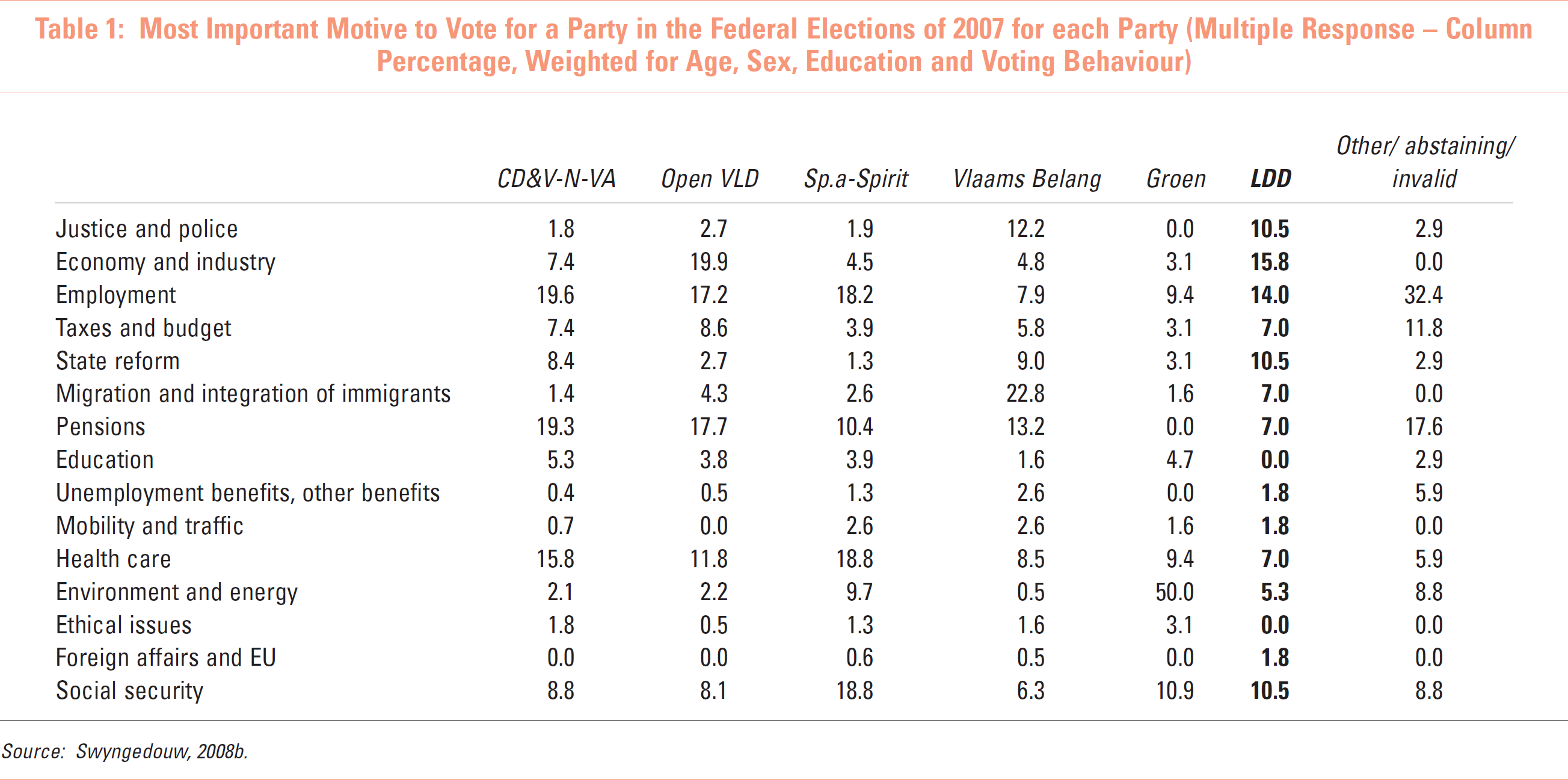
Source: Swyngedouw, 2008b.
In sum, while immigration is less important for neo-liberal populist parties, it can be exploited to a certain extent, and certainly if there is no populist radical right party in the party system. Moreover, the populism that is shared by the VB and LDD gives them a more common breeding ground to exploit as well. Two sources of resentment could be mentioned in particular: the cartelisation of politics and clientelism. Belgium has always been considered a textbook example of consensus democracy (Lijphart, 1999), which is characterised by a diffusion of power that encourages inclusiveness, bargaining and compromise between parties. First, it is important to note that the Belgian consensus democracy was only viable because citizens were hardly involved (Deschouwer, 2006, p. 897). However, the contemporary citizen is better educated and emancipated, and now no longer blindly swallows what the elites tell him (Mudde, 2004). Secondly, this tradition of inter-party cooperation and accommodation has given rise to a process of the cartelisation of politics. Cartelisation means that mainstream parties cluster together and are seen as more remote and hence potentially self-serving in the eyes of the voters. Elections fail to provide feedback to politicians and the lack of accountability provides ammunition for populists to condemn the ‘cosy’ arrangements between established parties to maintain power (Hakhverdian and Koop, 2007). A cross-national study of 35 countries confirms that, after the Germans, Belgian voters have the lowest perception of their politicians' accountability (Aarts and Thomassen, 2008, p. 13).
Another typical Belgian phenomenon is the clientelist voter–politician relationship, which was dominant until the 1970s but declined in the 1990s. This clientelist approach used to work well as a mechanism to reward voters for their electoral support, but as soon as it became burdensome in the fast-changing and globalising economy, it increasingly undermined the legitimacy of the establishment. Because clientelism is deeply rooted in the Austrian, Belgian and Italian states, Herbert Kitschelt (2002, p. 181) points out that anti-state populism in these countries should be understood from this perspective. In Antwerp, for instance, patronage-related municipal scandals created a fertile breeding ground for the VB, which presented the local party establishment as a self-serving elite that impoverished the Flemish citizens and taxpayers through public waste and fraud (Kitschelt, 2002; Swyngedouw, 2000).
The cartelisation of politics and clientelism are two issues that frequently return in the discourse of Dedecker. He claims to be ‘disappointed in the system’ as political parties are ‘making deals to continually maintain power’ (Gazet Van Antwerpen, 10 September 2005). Dedecker is also ‘disgusted’ by the Belgian ‘particracy’ in which ‘the citizen has no say’, echoing the attacks from Lega Nord politician Umberto Bossi on the partitocrazia in Italy (Eatwell, 2005, p. 107). The former socialist party president Johan Vande Lanotte has been called a ‘mafia boss’ by Dedecker, denouncing his allegedly ‘clientelist’ and ‘dictatorial’ politics at the local level (De Morgen, 17 June 2006). Processes like immigration, the cartelisation of politics and discontent with a clientelist culture are not sufficient conditions for populists to break through, but they nevertheless provide a fertile breeding ground for parties like LDD and VB. To put it in Dedecker's own words: ‘the system is corrupt, otherwise we had no reason to exist’ (De Standaard, 28 June 2008).
The Institutional Context
Another relevant variable to explore is the institutional context and in particular the electoral system. The proportional voting system in Belgium, for instance, is friendlier towards new parties than plurality systems. More important for Belgium is the fact that it is one of the rare countries that has compulsory voting. Research has demonstrated that while populist radical right voting is mainly ideological (Van der Brug et al., 2000), it is also fuelled by feelings of distrust towards the establishment (Billiet and De Witte, 2001, p. 27). The populist vote can to some extent be seen as a vote against the political elite. When voting is not compulsory, however, voters are more likely to choose the ‘exit’ option to express their dissatisfaction. Compulsory voting on the other hand encourages the ‘voicing’ of resentment by means of support for populist parties.
Table 2 supports this hypothesis, suggesting that LDD would not have passed the electoral threshold if citizens had not been obliged to attend the ballot (Swyngedouw, 2008a). When selecting only those respondents who answered that they would always vote if voting was no longer compulsory, the share of the vote for LDD decreases to 3.6 per cent, the largest relative drop of all the parties. It appears that, like the VB, LDD receives disproportional support from those voters who are most alienated from mainstream politics. We should be careful with this conclusion, however, as it is difficult to measure potential behaviour in a survey and the sample of LDD voters is small.
The Electoral Opportunity Structure
One of the most relevant factors for the electoral breakthrough of new political parties is the party system that they are trying to enter. The interactions between established parties within the system create or foreclose to a large extent the possibilities for populist parties. In order to enter the system, new parties have to be able to differentiate themselves clearly from the existing parties. This has become easier in recent decades as there is a tendency among mainstream parties to become more moderate and hence similar in ideological terms. At the same time, the cleavage voter is being replaced by the issue voter, causing a general de-alignment and electoral volatility (Ignazi, 1992). These factors combined create opportunities for new parties to emerge. Particularly when mainstream parties converge towards the centre, voters no longer see a difference among established parties and believe that politicians form a closed ‘political class’ that is only out to help itself to wealth and power at the expense of the ‘common man’ (Kitschelt, 2007; Kitschelt and McGann, 1995). Such an electoral opportunity structure for populist parties is particularly likely when the largest mainstream right-wing competitor shifts to the centre as well.
Simulation of Election Outcome Given the Different Scenarios of Electoral Participation when There was No Comp ulsory Voting in 2007 (Weighted for Age, Sex, Education and Voting Behaviour)
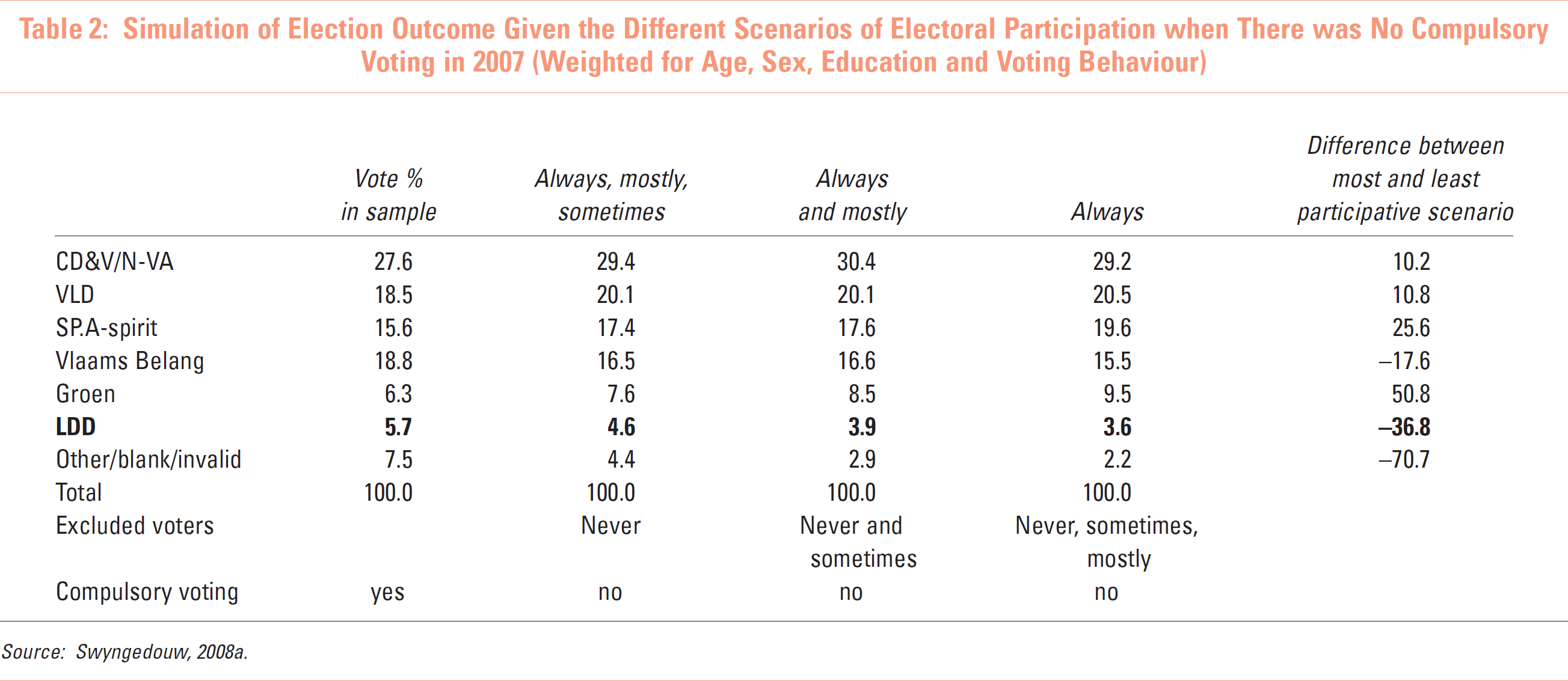
Source: Swyngedouw, 2008a.
Figure 1, drawing upon party manifesto data, demonstrates how the established Flemish parties have converged towards the centre over time. In 1981 the difference between the parties was still very clear. The PVV (nowVLD) was the party on the right; the CVP (now CD&V) was typically a party of the centre; and the socialist SP (now SP.A) defended its blue-collar electorate on the left. By 1999 this image became blurred and the three established parties were holding very similar positions on the left–right scale. This convergence opened up opportunities for new parties to enter the political system, in this case a green party on the left (Groen!) and a populist radical right party on the right (VB) (Coffé, 2005).
After the breakthrough of these new left and right parties, however, there was still enough space left in the party system for other newcomers. Figure 2 shows that particularly between the SP.A and CD&V on the one hand, and the VLD and VB on the other, there was a large ideological distance. 6 Moreover, it should be noted that these data go back to 2004 when Jean-Marie Dedecker was still in the VLD, embodying the right faction of the party. This can explain why in this expert survey the VLD was put more on the right than could be expected from its party programme. However, after Dedecker left the VLD, the party president Bart Somers explicitly stated that his party would follow a more centrist course. This shift to the centre by the main right-wing competitor opened up an electoral opportunity structure for LDD to fill the ideological space between the ‘centre right’ and the ‘radical right’.
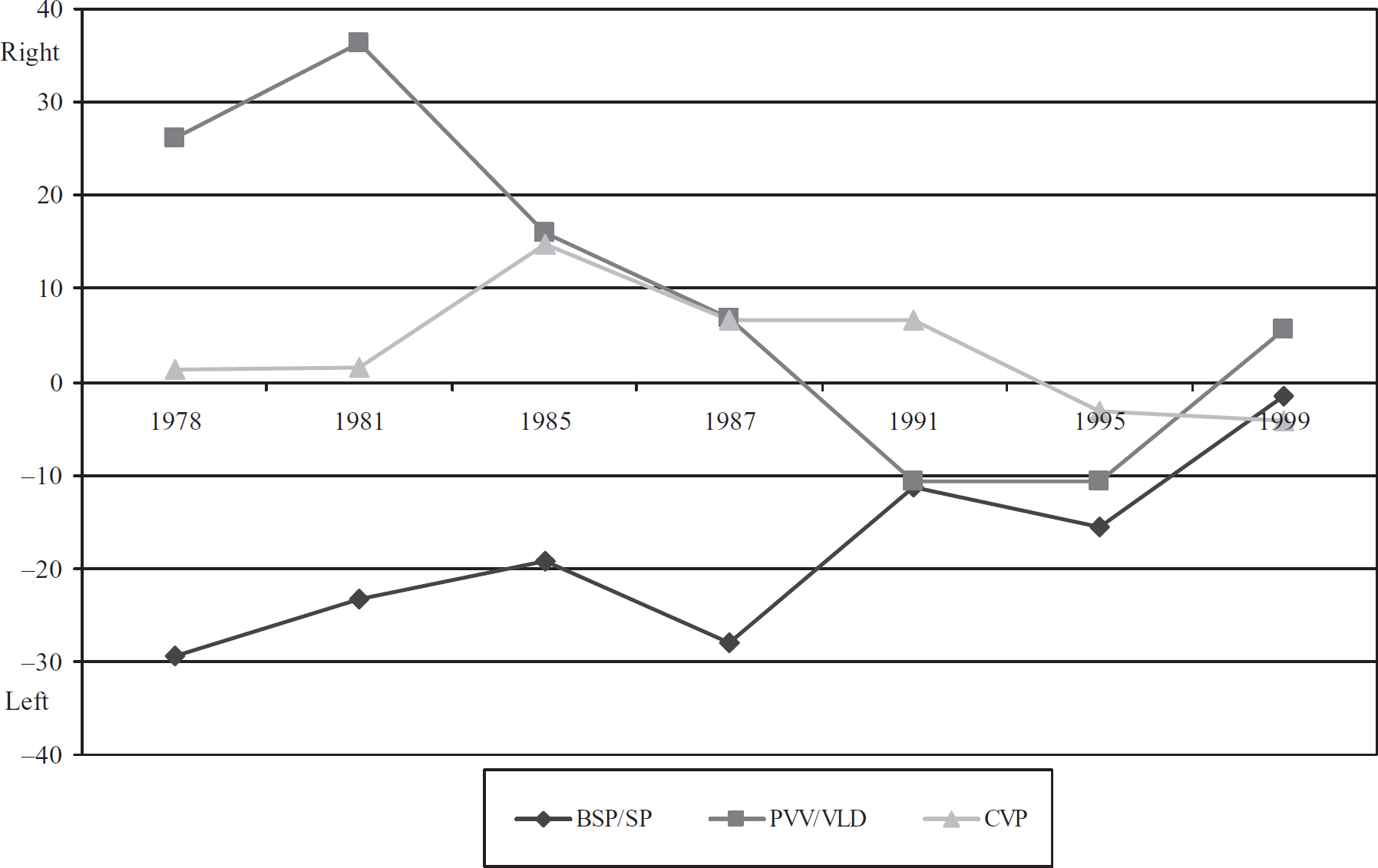
Party Positions on the Left–Right Scale for the Established Flemish Parties 1978–1999
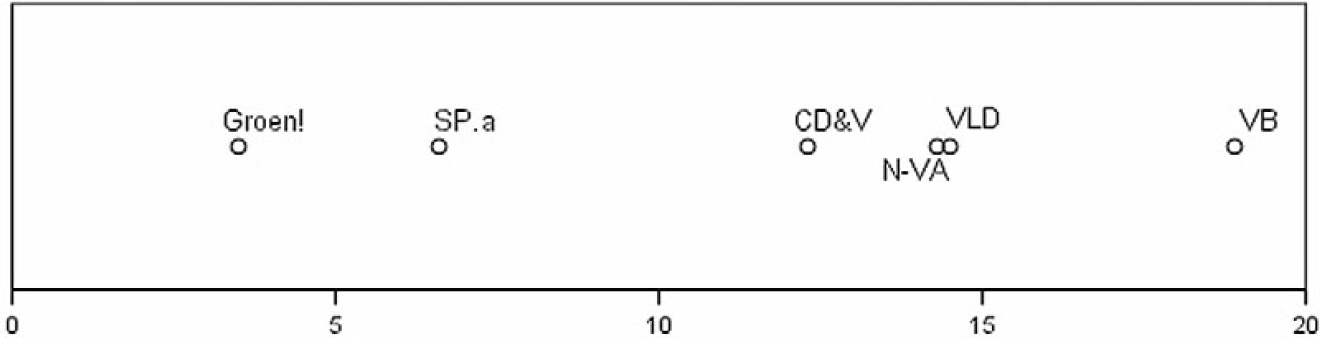
Party Positions on the Left–Right Scale for the Flemish Parties in 2004
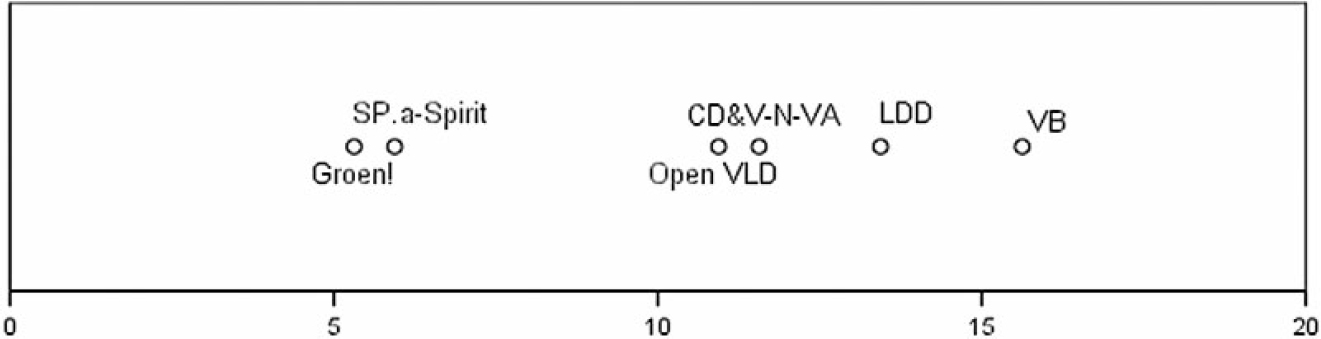
Self-Placement on a Left-Right Scale of the Different Party Electorates
The existing post-electoral research confirms that LDD made use of the electoral opportunity structure that existed between the VLD and the VB. Analysing the data of an internet panel set up by M2P, it is striking that, on the classical left–right scale shown in Figure 3, the LDD electorate positions itself precisely between the VB, on the one hand, and the CD&V/N-VA and VLD, on the other (Van Aelst et al., 2007). It is worth noting that VLD voters place themselves a little more at the centre than those of the CD&V/N-VA, which supports the hypothesis that the VLD became more centrist after Dedecker left the party.
The results of the ISPO-K.U. Leuven national election 2007 survey (Swyngedouw et al., 2008) are even more convincing as they are drawn from a representative sample of the Belgian population, unlike the data from M2P. Table 3 explores which parties have lost votes to LDD. The party did not win many votes from the CD&V and Agalev (later Groen!). Within the SP.A and the VLD electorates of 2003, however, a significant share of voters moved towards LDD in 2007. While this might seem surprising for the SP.A, one should keep in mind that 2003 was the year in which the socialist populist Steve Stevaert had much success (Mudde, 2004, p. 551), while he no longer participated in the 2007 elections.
The VB is the party that lost the most votes to LDD. Approximately 9.4 per cent of the voters who chose the VB in 2003 decided to vote for LDD in 2007, a loss of 69,000 votes. The fact that LDD is the only party that attracted a significant share of VB votes provides strong support for the hypothesis that populist radical right and neo-liberal populist parties fish in the same electoral pool. It is also worth noting that LDD did surprisingly well among new voters (18–21-year-olds). More than 14 per cent of these first-time voters chose the LDD, which means the party is the third most popular among the youngest age cohort after CD&V and the other major populist party, VB. Adding the score of VB to LDD, we come to the conclusion that 47.6 per cent of first-time voters chose a populist party (Swyngedouw, 2008a). Again, we should be careful with generalising these results as the sample of first-time voters is small (n = 64).
The Role of the Media
Especially in the phase of electoral breakthrough, the media might be a relevant factor in legitimising or delegitimising populist parties (Art, 2007). However, in general the media factor has received only little attention in the literature (Mudde, 2007b). It goes beyond the reach of this article to investigate the role of the media thoroughly, but I will point out some relevant facts briefly.
The Flemish media landscape has changed considerably over recent decades. While major newspapers in Belgium used to be part of a pillar controlled by political parties in the 1960s, most newspapers nowadays are almost completely independent (Van Aelst, 2006). The television landscape in particular became commercialised with several new private television stations now coexisting alongside public television. Although public television is still strong in Belgium, it has also had to adapt as a consequence of competition. This has had two major consequences. First, as the media have become more independent from political parties, they have become more critical towards politics. Second, because of the increasing commercialisation, the media tend to focus more on personalisation and emotions and often feature an anti-establishment attitude (Mazzoleni, 2008). This increases the opportunities for populists, who see television and newspapers as highly receptive media for transmitting their messages (Mudde, 2004). With their one-liners and sensational statements, populists like Dedecker seem better able to survive the current ‘soundbite culture’ in which Belgian politicians receive on average only twelve seconds to make their statement on television (Van Aelst, 2006).
Dedecker is a mediagenic politician who knows how to play the media with his populist discourse, or, as commentators have labelled it, ‘Dedeckerian metaphors’. He sometimes uses the media directly to receive attention from the public (e.g. with his visit to Dutroux). Conversely, the media have also used Dedecker, as his periodic stunts and statements often lead to higher circulation of newspapers or more television viewers. In the two years before the 2007 elections, Dedecker was first expelled from the VLD and then from N-VA. These events were broadly covered by the media and this media attention was still available when he established LDD, which was useful when he wanted to popularise the party in a short period of time. For most new parties it is very difficult to get attention from the media, but Dedecker was given a forum that was comparable to other small established parties in the run-up to the 2007 elections. Moreover, the advantage for LDD in comparison with the VB was that it was not perceived as radical or racist. While there is evidence that the VB was ‘silenced to death’ (De Swert, 2001), certainly in its early years, this was not the case for LDD.
Estimated Fluctuations between 2003 and 2007 in the Chamber of Representatives under Mover-Stayer Model (1). Row Percentages
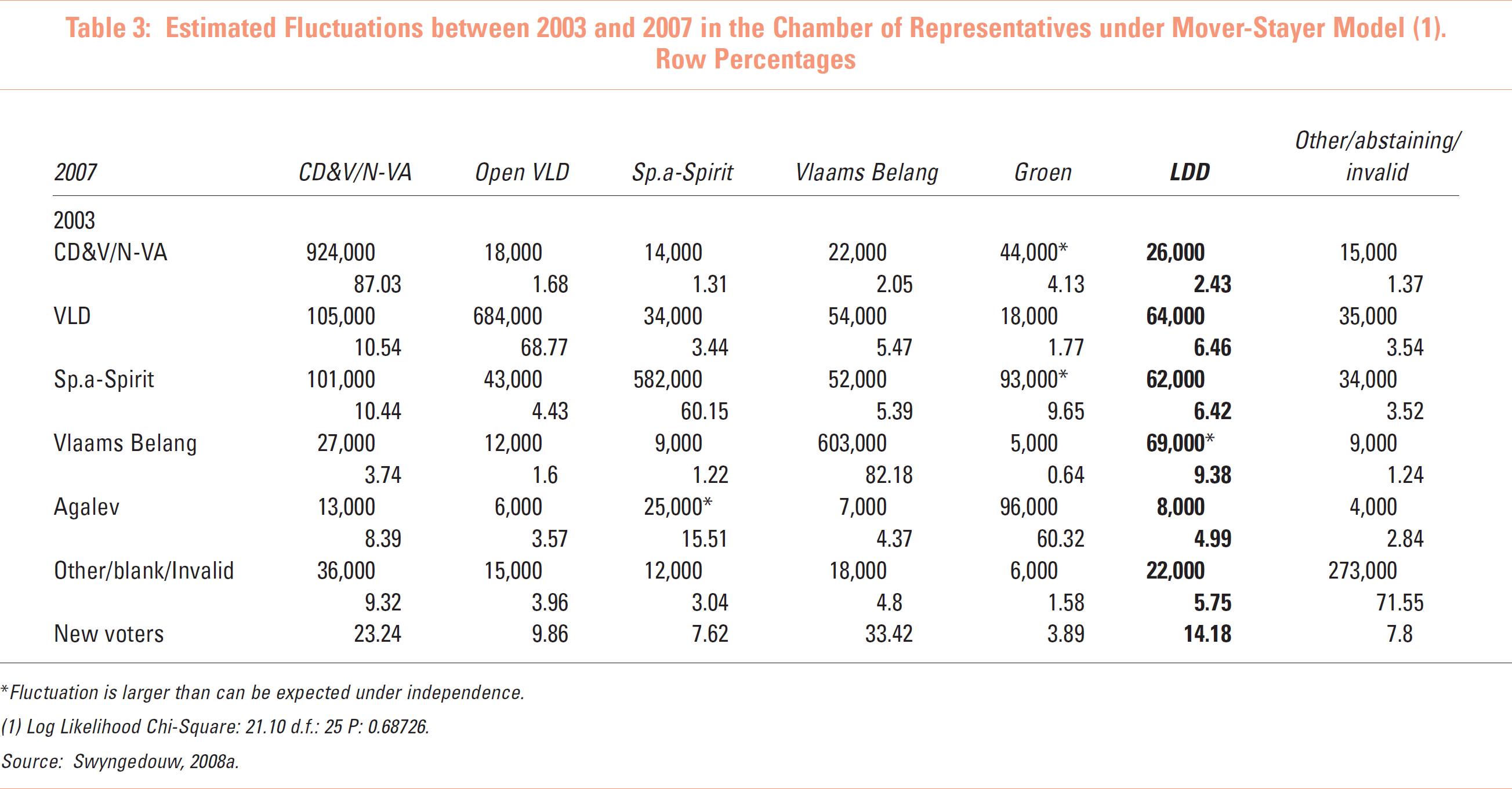
Fluctuation is larger than can be expected under independence.
(1) Log Likelihood Chi-Square: 21.10 d.f.: 25 P: 0.68726.
Source: Swyngedouw, 2008a.
In sum, the media are currently more critical towards politics and tend to focus on persons and emotions, a process that populists like Dedecker exploit. The growing influence of the media on voting behaviour also enabled LDD to make itself well known in the short time period before the elections. These media effects should not be overstated, however. First of all, it was not simply due to the media that Dedecker became popular or that LDD achieved a good electoral result. The party president elections of the VLD in 2004, for instance, showed that Dedecker was an important political force in Flanders and as a consequence he received much attention from the media, which in turn led to a good electoral result. And although the media are in general kinder towards LDD than towards VB, this is not simply the result of an independent decision by these media. Instead, this can be explained by the ideology of LDD, which is not xenophobic – in contrast to the VB. The relationship between the media and politics is thus less straightforward than is often assumed (Mazzoleni, 2008; Newton, 2006). In conclusion, we assume that the media had a catalytic effect rather than providing an independent explanation for the success of LDD. And while the media are important for both the populist radical right and neo-liberal populist parties, the latter seem to be more easily legitimised as a consequence of their milder ideology. For instance, while Dedecker is able to exploit the blurring of the line between political news and entertainment, as he often appears in late-night talk shows and popular quizzes on public television, VB politicians are still ‘uninvited’.
Ideology
The previous sections have demonstrated that different variables such as broad societal changes, the institutional setting, the party system and the media are relevant in explaining the success of populist parties. In order to exploit these opportunities, however, it is crucial that these parties have more than a few slogans and a catchy party name (Betz and Immerfall, 1998, p. 9). The most crucial variables in explaining the success of populist parties are the parties themselves. We will therefore focus on the ideology, leadership and organisation of LDD and compare them with those of the VB.
As mentioned in the previous section, the ideology of LDD is neo-liberal and populist. The party should therefore be clearly differentiated from the populist radical right. While populist radical right parties are nativist, we cannot discern any xenophobia in the LDD literature and the issue of immigration is handled in a nuanced way. Although immigration is to be restricted, it is sometimes considered as beneficial, for instance when highly educated immigrants come to strengthen the economy (LDD, 2007b, p. 21). With regard to the economic programme there is also a large difference between the populist radical right and LDD. In contrast to most radical right parties, which hold centrist positions on the state–market axis and always see the economy at the service of the nation (Mudde, 2007b), LDD considers economic progress as a core priority and is neo-liberal with great optimism about free market solutions. While LDD is not a populist radical right party, it cannot be considered to be a party just like all the others because of its populist nature. Although Belgian mainstream parties have some populist features as well (Jagers and Walgrave, 2007) – reflecting a populist zeitgeist – there is a clear difference between them and LDD, which sees the general will of the people as the only legitimisation of democracy.
The LDD ideology can be considered important for its success. On the one hand, the party has a very clear neo-liberal and populist ideology, making it easily distinguishable from mainstream parties. On the other hand, LDD is not a member of the populist radical right, which liberates the party from any historical radical right stigma and makes it more credible as a future government party in contrast with the VB. While the VB still suffers from the cordon sanitaire, and has been in opposition since its establishment in 1979, LDD might deliver politically in a few years. This makes the party increasingly interesting for voters who no longer want to ‘waste’ their vote but at the same time still want to punish the establishment.
Leadership
As Jean-Marie Dedecker is the founder and symbol of LDD, it seems essential to investigate his role in the success of the party. The importance of leadership can be demonstrated when LDD is compared with two other parties, namely the Liberal Appeal (Liberaal Appèl [LA]) and the Flemish Liberal Independent Tolerant and Transparent party (Vlaams Liberaal Onafhankelijk Tolerant Transparant [VLOTT]). In 2003 the dissatisfied politician Ward Beysen, a member of the right-wing faction of the VLD, established his own party, LA. He wanted to do exactly as Dedecker would do later, that is, exploit the ideological space between VLD and VB. However, LA lacked a charismatic leader as Beysen was a grey and frustrated personality, incapable of playing the media. This resulted in a dramatic election result in 2003 where the party received only 0.45 per cent of the votes. More or less the same happened with Hugo Coveliers, another member of the right-wing faction of the VLD, who established his own party, VLOTT, in 2005 but was only able to participate in the elections in a cartel with the VB, and no longer participated in the federal elections in 2007.
The difference between LDD and the attempts by Beysen and Coveliers is that Jean-Marie Dedecker is much more of a charismatic leader. Although the concept of charisma has been discredited lately by the scholarly community as being tautological and not measurable, it seems possible to conceptualise charisma in a meaningful way, as has been demonstrated by Roger Eatwell (2005, pp. 105–8). As a minimal criterion, charismatic leaders should have a special mission to save the people. By means of their exceptional qualities, these leaders try to convince the people that they can change the direction of fate. A second feature among charismatic leaders is their attempt to create a leader–follower identity. Although they portray themselves as the embodiment of a special mission, they also claim to belong to the ordinary people. The dominance of the leader creates obedient followers and helps to minimise internal factionalism. Another important technique of charismatics is to create friend–enemy categorisations in order to demonise the ‘other’. Enemies, like immigrants or established parties, are often accused of conspiracies. A fourth characteristic of charismatic leaders is their personal presence, such as oratorical skills and the ability to create a positive image on television (Eatwell, 2005).
The special mission of Dedecker is to establish a healthy right-wing Flanders and to bring the common sense of the people back into politics. He argues that the people in Flanders vote on the right but are being governed on the left, because of the dominance of the socialist PS in the south and the fact that the VB is condemned to permanent opposition. In order to demonstrate his exceptional abilities to achieve his mission, Dedecker often refers to his outstanding performances in the world of sport. To show his proximity to the people, Dedecker mentions that he comes from a modest blue-collar family where he was the second of seven children and had to fight hard to achieve his goals. He claims not to be a self-serving politician but instead, like all hard-working Flemings, he earns his own money through his private activities. Dedecker's enemies are notably the socialists, the greens and the monarchy, who are at times even accused of conspiring against him and jeopardising his special mission. Similarly to Silvio Berlusconi, who accuses the establishment of complotti against him, or Pim Fortuyn, who argued that he became ‘demonised’, Dedecker claimed that his expulsion from the N-VA was a plot:
The restoration of the establishment is ongoing. The church, the king, the state and the labour unions find each other. Dedecker must go. Everyone who does not function according to the system, who defends a healthy right Flanders, must go. A cordon sanitaire was already imposed upon the extreme right and now they want to impose one upon me (Het Volk, 11 December 2006).
In this sense, the expulsion of Dedecker from VLD and later N-VA might have increased the willingness of his followers to see him as a charismatic leader who has to fight against ‘the elite’. Dedecker also has more personal presence or ‘magnetism’ than, for instance Coveliers or Beysen. He is a powerful speaker, always provokes discussion and is also able to react in a sharp and humorous way. When he was being undermined in a debate by a political challenger who said that politics is more complicated than judo, Dedecker swiftly responded by arguing that it was indeed true that, in judo, one cannot attack from behind. Dedecker is not popular among all the population. In fact, he was only placed 22nd out of the most popular Flemish politicians in the month before the 2007 elections. 7 However, his charismatic leadership enables him to attract citizens who are disconnected from mainstream politics and who believe that Dedecker can change their fate by means of his simplistic solutions for complex problems. The same seems to be the case with the VB, which was largely unsuccessful until three charismatic leaders – Filip Dewinter, Gerolf Annemans and Frank Vanhecke – were able to appeal to that part of the electorate that felt disillusioned with mainstream politics (Coffé, 2005).
Organisation
When LDD participated in the 2007 elections, the organisation of the party was weak in comparison with the established parties. As a new party it could not rely on official state funds, which is by far the largest source of income for Belgian parties (Delwit, 2008). Because the party was founded so close to the election date, it also had difficulty in finding enough competent (female) candidates to participate in the elections. 8 For a party that participated in elections for the first time, however, it was relatively professional. Dedecker already had electoral experience and also claimed to fund the party with a sufficient amount of private money. Despite its limited budget, the party asked a professional advertising bureau to design a logo and a total of 2,000 billboards were spread across all five Flemish provinces to make the party known (De Ryck et al., 2008). LDD could also rely on the support of a think tank named ‘Cassandra’ led by Professor Boudewijn Bouckaert at the University of Ghent, who wrote much of the party programme. The party also benefited from the fact that some people from other parties (notably VLD and VB) ‘defected’ to LDD. This was the case with Jurgen Verstrepen and Monique Moens, two VB MPs who joined LDD less than two months before the elections. In order to attract more well-known candidates, however, LDD had to rely on less evident candidates as well. For instance, Dedecker asked former Olympic judo athlete Ulla Werbrouck to become a candidate, although she had no political experience; this did not prevent her from being elected to parliament. The party was thus a heterogeneous amalgam of different personalities gathered around its central leader, Jean-Marie Dedecker.
In general, the organisation of LDD was inevitably weak when it participated in the federal elections because of the lack of time and resources. However, weak party organisation is less important in the phase of electoral breakthrough (Betz, 2002). Although the party had a minimalist organisation, it had the advantage that it was embodied by a single well-known leader, which made it easy for voters to understand what the party stood for. The party could indeed be described as a charismatic party in which there is a complete symbiosis between its leader and its organisational identity (Panebianco, 1988, p. 145). Now that the party has achieved representation in parliament, it is able to expand in organisational terms, which in turn strengthens its electoral potential. First, the party can rely on state funds to sponsor its next election campaigns. Second, various people from other parties (notably VLD and VB) joined LDD after its impressive yet unexpected election result. The party created many new local branches across Flanders and claimed 6,284 members in June 2008, which is a considerable number for such a new party in Belgium (Reekmans, 2008, personal communication). However, such rapid expansion combined with members from very diverse backgrounds joining the party could also lead to internal division and conflict. In this respect, the VB already has a much more solid organisation, with over 20,000 members, most of whom are comfortable with a very centralised party structure and a lack of internal democracy.
Conclusion
This article began by distinguishing populist radical right parties from neo-liberal populist parties. Neo-liberal populist parties aim to reverse the trend towards big government and state intervention while at the same time defending the ‘ordinary people’ against an allegedly ‘corrupt elite’. In contrast to populist radical right parties, nativism is not central to their ideology. However, as both of these party families are populist, and located at the right end of the ideological spectrum, the article wanted to test whether the emergence of the populist radical right and the neo-liberal populist LDD might be explained by the same set of arguments.
I explored first why Jean-Marie Dedecker founded his own party. Dedecker was expelled from the VLD because he became the symbol of a right-wing faction that openly criticised and harmed the party. After he was also expelled from the N-VA he had no choice but to found his own party, Lijst Dedecker (LDD). As the LDD party programme mentions a ‘policy of common sense’ and the need for citizen initiatives, and is full of references to limited government and the free market, it qualifies as a textbook example of a neo-liberal populist party.
To understand the success of the party, several factors have to be taken into account. Societal changes such as migration, the cartelisation of politics and discontent with a clientelist culture all provide a fertile breeding ground for populist parties in Belgium. Compulsory voting is important as well, as it encourages the expression of resentment in elections. The changing role of the media is also relevant, since it increases the opportunities for populist leaders. But while all of these variables are relevant, they are considered to be facilitators rather than deciders of the success of LDD. A more crucial explanation is that LDD smartly exploited an electoral opportunity structure: there was a large ideological space between the mainstream parties, which recently converged towards the centre, and the VB on the radical right. The populist appeal of the charismatic leader Dedecker was another necessary condition of the party's success.
Studying the electoral success of neo-liberal populist parties in Scandinavia (Progress parties) Jørgen Goul Andersen and Tor Bjørklund (2000, p. 220) conclude that although these ‘parties may deviate from ideal type extreme-right parties elsewhere in Western Europe, they seem to feed from the same sources’. Cas Mudde (2002, p. 3) similarly claims that ‘though Fortuyn and his LPF are a different phenomenon than the contemporary extreme right, they do profit from the same breeding ground’. The same seems to be the case with LDD. First, it is striking that LDD was the only party that was able to steal a significant number of votes from the VB in the 2007 elections. Second, the crucial factors in explaining the emergence of populist radical right parties were also vital in understanding the breakthrough of LDD. Two differences should be mentioned, however. The first is that the milder ideology of LDD makes it easier to be legitimised by the media and more credible as a future governing party. The second difference is that LDD voters are not as preoccupied by immigration as those of the populist radical right. Nonetheless, neo-liberal populist parties might exploit this issue more exclusively when there is an absence of populist radical right parties in the party system. This has been the case in countries like the Netherlands and Norway. It therefore seems correct to conclude that largely the same factors explain the emergence of populist parties in general, be they of the radical right or neo-liberal type.
Footnotes
I would like to thank Cas Mudde, Jean-Benoit Pilet, Pascal Delwit and the three anonymous referees for their many helpful comments on earlier versions of this article. The research for this article was made possible by the generous support of the Belgian science policy (Interuniversity Attraction Pole on Participation and Representation).
1
Marc Dutroux can be considered to be one of the biggest enemies of the Belgian public as he raped and murdered several young girls in the 1980s and 1990s.
2
Unlike in other European countries with strong populist radical right parties, all Belgian parties have solemnly agreed not to cooperate with VB under any circumstances or on any political level.
3
A political cartel in Belgium is an agreement between two or more parties to go with one joint list to the voter. Cartels enable small parties like N-VA to achieve representation despite the electoral threshold.
4
The Institute for Social and Political Opinion research (ISPO) interviewed 1,084 respondents by means of face-to-face interviews between September 2007 and January 2008. The response rate can be estimated at 61 per cent. Data were weighted using the Iterative Proportional Fitting procedure. It should be noted that the number of voters for Groen! (n = 67) and LDD (n = 41) in the sample are small (Swyngedouw et al., 2008).
5
M2P is a research group of the University of Antwerp which established an internet panel in 2003. All major Flemish universities joined the internet panel in 2006 in order to attract respondents from all over Flanders. In the last wave between June and July 2007 more than 8,000 respondents filled in an online questionnaire. The data are not representative for the Flemish population, however.
6
For reasons of simplicity and comparability we used a single left–right scale. However, the data of Benoit and Laver enable a two-dimensional spacing of Belgian parties to be examined. This reveals that the VLD is rather to the right on the taxes vs. spending scale (16.4) but moderate on the progressive vs. conservative scale (7). The VB is centre-right on the taxes vs. spending scale (14.3) but extremely conservative on the other (19). The scores could range from 0 (progressive, higher public spending) to 20 (conservative, lower taxes). This spacing enabled LDD to be more to the right than the VLD on both scales (with a large margin on conservative issues), while being less conservative but more concerned with lower taxes than the VB.
7
However, Dedecker achieved the same score as the VLD party president (Somers) and a better one than the party presidents of both CD&V (Vandeurzen) and VB (Van Hecke). Coveliers and Beysen were not even included in the poll.
8
In order to have a valid candidate list in elections, Belgian parties have to reserve half of their places for women. This made it difficult for LDD to find enough motivated women in a short time period.