







Abstract
Pettit's claim that the discovery of the so-called ‘discursive paradox’ bears important implications for the normative theory of deliberative democracy has been challenged on the ground that there are substantial structural differences between the fora of democratic deliberation and the judicial context in which the paradox first emerged. In this article I defend Pettit's claim against these objections, but I also reject the implications Pettit draws from his discussion of the paradox. Specifically, I argue against one of the key assumptions on which Pettit's discussion rests: that in order to function properly as a guarantee against tyranny deliberation requires consistency. The upshot of the discussion is that the discursive paradox is, indeed, relevant for the theory of deliberative democracy. However, contrary to what Pettit's argument suggests, the discursive paradox is not relevant because it reveals a conflict between deliberation and democracy. Rather, it is relevant because it reveals a conflict between deliberative democracy and the requirement of collective consistency.
The so-called ‘discursive paradox’ has in recent years caught the attention of political philosophers and social scientists. Due to the ingenious formal treatment it has received, an important literature on its definition and the conditions of its occurrence has been developed in a relatively short time, leading to an intriguing ‘Impossibility Theorem of Judgment Aggregation’ and a series of related corollaries and generalisations that connect it to the existing knowledge on voting paradoxes. 1 What remains extremely controversial and unsettled is the scope and reach of the paradox's implications. How should we assess its relevance? To what contexts does it apply? What is its meaning and what are its implications for the normative theory of politics?
In this article I will discuss one of the most challenging answers to this set of questions, which has been advanced by Philip Pettit in a series of related papers on the topic. 2 What I want to argue is that, notwithstanding the objections to it, Pettit's claim that the discursive paradox is highly relevant for the normative theory of democracy, and notably for the theory of deliberative democracy, is essentially correct. However, I also want to show that the meaning and the normative implications of such a paradox for the theory of democracy are different from those suggested by Pettit.
In the first part of the article I will reconstruct the main traits of the discursive paradox and of Pettit's interpretation of its relevance for democratic theory. In the second part, I will defend Pettit's claim that the paradox is relevant for the theory of democracy by answering some challenging objections that have been raised against it. In the third part of the article I will dispute Pettit's interpretation of the implications of the paradox for the normative theory of democracy. Finally, I will point to an alternative interpretation, leading to a revision of commonly held assumptions about the relation between deliberative democracy and collective consistency.
The Paradox
The discursive paradox was identified for the first time, under the name ‘doctrinal paradox’, by Lewis Kornhauser and Lawrence Sager (Kornhauser and Sager, 1986; 1993) in the context of a formal analysis of the decisions of multi-member judicial courts. The nature of the paradox can be illustrated by the following example, which reproduces in a stylised way Arizona v. Fulminante, a case actually decided by the US Supreme Court in 1991. 3
Suppose a court composed of three members has to decide about the following case. A convicted criminal is appealing a death sentence on the ground that it was based on a coerced confession. But by the so-called ‘harmless error’ principle the finding of an error or vice in the conduct of a trial is not sufficient to invalidate it; the error must also have a bearing on the outcome of the trial. The court, then, has to decide the case on the following two grounds: (1) whether the confession was coerced; and (2) whether the confession affected the outcome of the trial. If, and only if, both conditions hold, the court must decide for the revision of the trial.
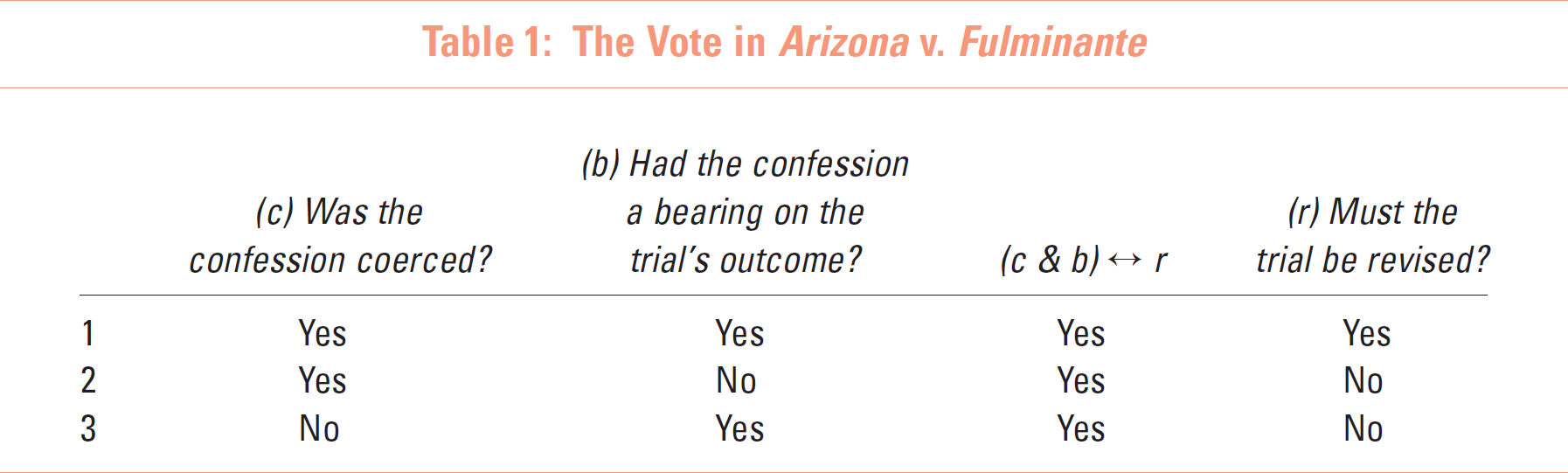
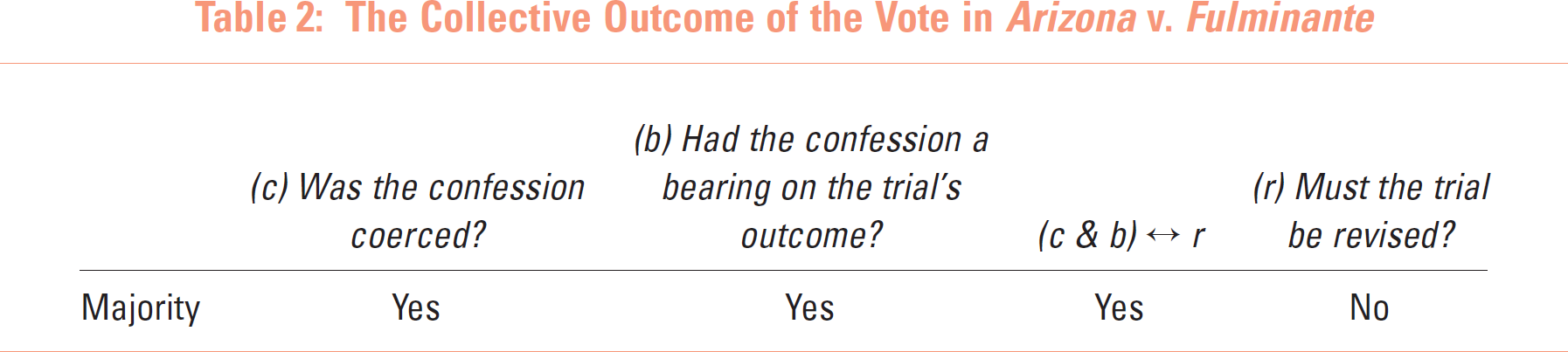
Suppose now that the three judges vote as shown in Table 1. Note that each judge is voting consistently according to the legal doctrine. Judge 1, for example, votes yes both on the first (c) and the second (b) condition, and accordingly votes in favour of the revision. Judges 2 and 3, on the other hand, vote against one of the premises c or b, and they consistently reject the conclusion r. Also note the following fact: judges 2 and 3, who constitute the majority, vote no on the conclusion, but their grounds for doing so are different. Although each of them rejects only one of the premises, judge 2 rejects the first, while judge 3 rejects the second. This arrangement of the voting pattern is what causes a ‘doctrinal’ paradox, which emerges once we look at the collective outcome displayed by Table 2. The majority of the judges vote yes on the first premise and yes on the second; accordingly, they should vote in favour of the revision. But this does not happen: the majority of them vote against it.
The Vote in Arizona v. Fulminante
The Collective Outcome of the Vote in Arizona v. Fulminante
It is important to note that the emergence of this kind of paradoxical outcome does not depend on the adoption of majority rule; the ‘Impossibility Theorem of the Aggregation of Judgments’ proven by Philip Pettit and Christian List (List and Pettit, 2002) shows that any voting procedure that fulfils some minimal democratic desiderata is likely to result in the same kind of inconsistent sets of collective decisions.
Pettit's Interpretation of the Relevance of the Paradox
How relevant is the paradox just considered? That something like a paradoxical arrangement of individual judgements of this sort can emerge in the normal course of events is a matter of fact: Kornhauser and Sager, indeed, discovered the paradox while studying the actual workings of multi-member courts. Their research seems to show not only that the paradox can occur, but that it can do so quite often, and when very important decisions must be made.
Pettit has claimed that the relevance of the paradox reaches even further than the operation of judicial courts, extending to the viability of the ideal of democratic legitimacy that has been at the centre of normative political theory over the past two decades, that is, the ideal of deliberative democracy.
Pettit's argument can be summarised as follows. Deliberative democracy requires a ‘discipline of reason’: since people's voting must be grounded in publicly redeemable reasons, each citizen must aim at consistency and must try to hold a consistent set of judgements on which to ground his or her voting. The structure of the ‘doctrinal’ paradox isolated by Kornhauser and Sager reveals that consistency at the individual level can be compatible with or even engender judgement inconsistency at the aggregate level. The paradox, then, reveals a dilemma that the normative theory of deliberative democracy must confront: whether consistency, which is assumed to be an important virtue of deliberation, should be pursued at the individual or at the collective level (Pettit, 2001a, p. 277). In line with these remarks, Pettit proposes to change the original name of the paradox into ‘discursive dilemma’, in order to highlight its independence from any established legal doctrine, and the dilemmatic nature of the issues it raises. Other authors, who have been interested more in the structure of the paradox than in the normative issues raised by Pettit, have preferred the term ‘discursive paradox’. Here I shall use the latter term, since, as will become apparent, one of the main aims of my discussion is precisely to challenge Pettit's claim that the paradox raises normative issues by revealing a dilemma between consistency at the individual and at the collective level.
Pettit's account of the relevance of the paradox is grounded on the assumption that consistency is an essential requirement of deliberative democracy. But why is consistency an essential requirement? Pettit has offered an elaborate answer to this question, which also provides a solution to the dilemma raised by the paradox. Pettit's answer revolves around the idea that there is a special connection between deliberative democracy and freedom as non-domination (Pettit, 2001a, pp. 280–5). Deliberative democracy is an effective means to protect citizens from tyranny and the exercise of arbitrary power. The requirement that all decisions must be publicly justified according to reasons that can be at least putatively accepted by all citizens is both substantively and procedurally a major guarantee against the infringement of individual rights and the abuse of power. But essential to the relationship between citizens and the political power that the deliberative ideal seeks to establish is the requirement of contestability: citizens must be able to call into question the decisions of the governmental bodies and must be able to hold the latter accountable for them. Now – the argument goes – in order to be contestable and accountable, an agent must be conversable, that is, it must be possible to engage in an argument with him or her. And this last requirement is exactly what makes consistency so central to the deliberative ideal: conversability implies integrity, that is, the capacity to act as a unified and consistent agent, since only a consistent agent can engage in a conversation. Agents who do not act or judge consistently are like lunatics: they cannot be questioned about the reasons for their deeds and cannot be asked to provide a justification for their behaviour.
Now, if this is the link between deliberative democracy and consistency, then it is obvious that deliberative democracy requires that consistency be pursued not only at the individual, but also at the collective level and that, when the two aims conflict, the latter should prevail. Since deliberation is a means to ensure that political power is not exercised in a tyrannical way, and deliberation implies consistency, where political power is held by collective bodies it is at the collective level that consistency is required.
What does this entail for the practice of deliberative democracy? According to Pettit, when a paradoxical voting pattern occurs, a choice must be made between two different ways of making the final decision: (a) the first procedure, which Pettit calls ‘conclusion-based’, consists in sticking to the decision actually voted for by the majority, even though it is inconsistent with how the majority voted on the individual premises; (b) the second procedure, which he calls ‘premise-based’, consists in making the final decision according to what correctly follows from the vote on the individual premises. The correct inference from the premises can be made by a neutral third party, such as a chairperson, who might take ‘a vote on each premise … and then let logic decide the outcome’ (Pettit, 2001a, p. 274). Alternatively, the chair could keep the conclusion as it is, and could derive the stance of the group on one or more of the premises by modus tollens from the conclusion. 4 If we follow this kind of procedure, the final decision becomes supported by the majority vote on the premises, so that a reason could be given for it; on the other hand, responsiveness to the votes on the conclusion (if the modus ponens is adopted) or to the judgements on the premises (if the modus tollens is adopted) is sacrificed.
Given the importance of having a justification for collective decisions, Pettit believes that the second kind of procedure is the one to be followed in these cases; the premise and the conclusion should be made to match at the aggregate level, by reversing some of the results of the aggregation of the individual votes. Reason, in Pettit's words, should be ‘collectivised’.
This ‘solution’ to the dilemma allegedly raised by the discursive paradox is perplexing. It seems to offend some deeply rooted democratic intuitions on at least two counts. First, Pettit's procedures for collectivising reason take the ultimate control on political decisions away from the members of the polity. The final word is given not to the majority of citizens, but to a third, neutral, party that ‘infers’ the needed decision from the majority vote on the premises. This seems to undermine what we might call the principle of democratic control, according to which the final word in political decisions should be left to the people. Furthermore, Pettit's solution, being centred on integrity and conversability as essential requirements of the deliberative conception of legitimacy, seems to target only those deliberative bodies that act like personified subjects; in this category we are unlikely to include the fora that have traditionally been seen as the most essential venues of democratic decisions, like parliamentary assemblies and large legislative fora. This might pave the way to the conclusion – advocated by Pettit himself in other contexts (Pettit, 2003c, p. 155; Pettit, 2004a; 2004b) – that the best way to fulfil the deliberative desiderata is to have political decisions made by small committees that can easily act as unified and responsible agents, rather than large and diverse assemblies. This seems to counter the democratic principle that we might call broad representation, according to which legislation should be made by large bodies in which all the different interests, opinions and perspectives are represented.
Now, these features of Pettit's discussion are certainly discomforting for those who see the principle of democratic control and the principle of broad representation as essential to the democratic ideal. Pettit himself, in order to respond to the worries of his critics, has tried in his later discussions of the subject to mitigate the potentially anti-democratic implications of the paradox, gesturing towards non-dictatorial ways of ensuring consistency at the collective level, and stating his faith in the ability to do so through large, representative bodies (Pettit, 2007, p. 300). On the other hand, the relevance of Pettit's original discussion of the discursive paradox might lie exactly in the fact that it reveals a possible conflict between the two halves of the idea of deliberative democracy, that is, democracy and deliberation: if deliberation requires consistency, and democratic voting procedures can involve inconsistency, then deliberation and democracy can be at odds. When they are, we need to decide which one to preserve. Given the importance of contestability for political legitimacy, Pettit's suggested solution is to privilege deliberation and consistency over democracy. This may be a painful choice to make, but the need to make a choice, we might argue, lies in the nature of the facts involved, and we cannot blame Pettit for it.
Why Pettit's Claim Cannot be Easily Dismissed
Given the possible unpalatable implications of Pettit's claim that the discursive paradox is relevant to deliberative democracy, it can be tempting to dismiss it from the start. 5 It might be argued that the actual operation of deliberative democracy is in many ways too complex and articulated to be reduced to the simple formal structure instantiated by the scholarly examples of the discursive paradox. I believe, though, that this conclusion would be too quick. In this section, I will consider some more detailed objections that might be advanced against Pettit's attempt to apply the formal treatment of the discursive paradox to the theory of deliberative democracy. I will then show that a convincing reply can be offered to all of them. Some of the objections I take from the literature; others I include because I believe that responding to them can help shed light on the paradox's relevance for the theory of deliberative democracy.
The first objection is that the discursive paradox is not relevant to the theory of deliberative democracy because in order for it to emerge in the context of democratic deliberation we would need to assume that a vote is cast not only on the final decision to be made, but also on the reasons for making it. This is clearly a condition that does not obtain in any of the typical venues of democratic decision-making; it is observed neither in large public referenda, nor in the legislative assemblies that are usually seen as the proper locus of democratic power.
There are several replies to this objection. A first obvious reply is that current practice need not be the standard for how deliberative democracy is meant to work at the institutional level. Many advocates of deliberative democracy call for radical changes in existing political institutions; the full realisation of the ideal might require that legislative bodies cast their votes on the principles supporting their decisions, exactly as courts do.
But there is no need to go that far down the road of political reform in order to conceive of a context in which the paradox can manifest itself in large deliberative assemblies. As List and Pettit have pointed out, a discursive paradox might emerge whenever there is a set of decisions to be voted on and there are obvious logical relations between them; the decisions need not be related qua premises and conclusions (see List and Pettit, 2005, p. 383; Pettit, 2003c, p. 143). Pettit is concerned not only with the synchronic inconsistency between a single decision and its premises, but also the diachronic one, between logically related decisions made at different times.
However, I believe that the objection can be countered with a reply that is even more basic and that explains how large democratic assemblies, even in the context of present institutional procedures, might display both types of inconsistency. Many conceptions of deliberative democracy are meant to involve not radical changes in our democratic institutions, but changes or improvements in the practice of politics. The main tenet of this ideal of reform is that democratic decisions should concern proposals that are publicly justified on grounds that can at least in principle be accepted by all participants in the deliberation. Given the fact that in a deliberative context the various parties to the political debate must explain in public the reasons for their final vote, there is no need for a formal vote on premises in order to reveal paradoxical patterns of judgement at the aggregate level. The publicity of the principles and the grounds on which people vote are an essential feature of deliberative democracy; there is no need for a formal vote on those grounds in order to make them known and to disclose to the public the existence of a discursive paradox.
The second objection is that the discursive paradox is not relevant for deliberative democracy because it derives from an anomalous combination of aggregative and deliberative procedures. Deliberation has nothing to do with the mechanical summing up of individual votes. Indeed, the deliberative ideal of democracy is grounded on the principle that legitimate decisions are only those that issue from a free and open debate aiming at consensus, rather than the mere application of the majority principle to individual preferences viewed as fixed and unchangeable. Thus, the deliberative ideal is opposed to the aggregative model from the very start.
This objection, far from revealing that the discursive paradox does not bear any relevance for the theory of deliberative democracy, highlights the paradox's effectiveness in pointing to one of the theory's most problematic features. The ultimate aim of many ideal accounts of deliberation is universal consensus; according to these views, the search for universal rational consensus is exactly what distinguishes deliberation from other kinds of linguistic interaction. Nevertheless, the advocates of deliberative democracy recognise that consensus on all the issues that undergo public deliberation is an unachievable goal; in most cases, even after thorough deliberation, there will not be a clearly and obviously right position on the issue that will be shared by all, and resorting to a democratic vote will be the only way to make a final decision that reflects the values of inclusiveness, mutual respect and equality that are embodied in the democratic ideal. The combination of deliberation (discussion and public justification aiming at consensus) and aggregation (mere adding up of votes) according to some neutral and fair procedure like majority rule is then a necessary feature of any viable theory of democratic deliberation (Cohen, 1997, p. 75; Gutmann and Thompson, 2004, p. 18; Habermas, 1996, p. 306). The discursive paradox is an excellent way to highlight the fact that such a combination, though necessary, comes at a price.
The third objection is that the discursive paradox is not relevant for deliberative democracy because democratic deliberations, as opposed to legal adjudications, cannot rely on a common pool of established reasons that are supposed to ground the decisions, nor can they rely on fixed and universally recognised logical implications between judgements (Kornhauser, 2008, p. 19; Kornhauser and Sager, 2004, p. 266). In order for a discursive paradox to emerge, the objection goes, an inconsistency between separate judgements rendered at the collective level must arise; but such an inconsistency must necessarily rely on the existence of logical relations between the separate propositions on which the group is issuing its judgements. The existence and content of such logical relations between judgements, and the existence of a set of relevant propositions on which judgements should be passed, might be a plain and uncontroversial matter in the case of legal adjudication, due to the existence of a legal doctrine and to the fact that the issues at stake come to the court already framed as discrete and punctual issues set up by prosecutors, plaintiffs or lower courts. But the same cannot hold for deliberative democracy. In fact, deliberative democracy plays an essential critical task by calling into question established and commonsensical arguments and lines of reasoning.
A Doctrinal Paradox given No Doctrinal Agreement
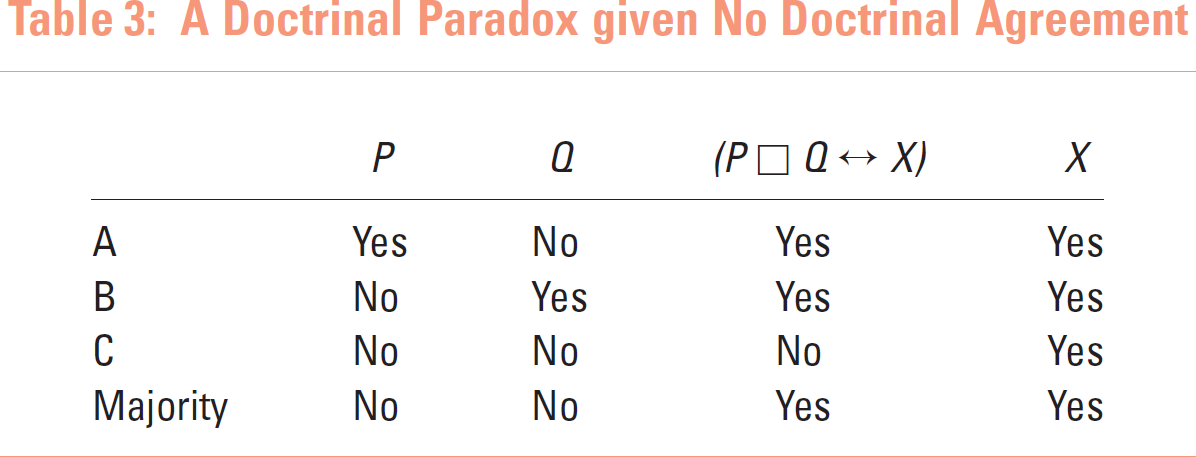
Against this, it might be insisted that where there is no universal acceptance of the logical entailments on which the final decision is to be grounded, there is no paradox; if only a majority accepts the entailments, the fact that the final vote does not reflect such entailments is no breach of logic or consistency on the part of the group as a whole. But this shifts the target of the argument, by calling into question that the vote of the majority is representative of the position of the whole group. If we assume that it is, the paradox emerges because one and the same group, through its majority, holds a set of inconsistent judgements (in the case just examined, for example, they are ~p, ~q (p □ q) ↔ x, and x). Although the entailment is neither a logical truth nor a universally recognised one, the fact remains that in this example there is inconsistency at the collective level. An agent can be inconsistent even if the logical entailments he or she assumes between his or her judgements are neither true nor universally recognised as valid.
The fourth objection is that the discursive paradox is irrelevant for deliberative democracy because there is no clear and definite group of people to whom we can turn to establish that such a paradox is occurring. In a representative democracy there are many different levels of deliberation and political decision: the constituency of an elected representative, the people at large, the elected representatives who sit in the legislative assemblies, etc. When a paradoxical voting pattern occurs at one of these levels, it is not necessarily reflected at the other levels. When it is unclear which group is the relevant one, the case for thinking that a discursive paradox is actually occurring becomes much less clear, and this marks an obvious difference from the original context in which the paradox was isolated, that is, the judicial context in which one and the same judicial body operates through time. 6
This objection makes far-reaching theoretical assumptions that only a handful of democracy advocates might be willing to accept: it implies not only the rejection of Pettit's claim that the discursive paradox can be relevant for deliberative democracy, but the rejection of the idea that in a deliberative democracy there are representative bodies that function as authoritative and legitimate sources of democratic decisions. In those countries in which the national legislative assembly has the power to make authoritative laws, in the name and as the representative of the whole people, such a body should be the relevant group for detecting a discursive paradox. In this sort of institutional setting, the electorate as such does not have any authority to make decisions (except when a referendum takes place, in which case it becomes the authoritative source of law), and the question of where to look in order to detect a paradox of democratic decision is out of place. Asking that question implies seeing the representative assembly and the electorate as competing sources of democratic decisions, which presupposes an unorthodox and controversial stance on the authoritative nature of representation.
What is Wrong with Pettit's Account of the Implications of the Paradox
Pettit's discussion of the discursive paradox revolves around the assumption that an important connection exists between the meaning and value of deliberation on the one hand, and the demand of collective consistency on the other. The link between deliberation and consistency, according to this line of reasoning, is what makes the discursive paradox particularly troublesome for the advocates of deliberative democracy, since it necessitates choosing between the demands of collective consistency, which deliberation requires, and the demands of democracy, which can engender collective inconsistency even when the individual decision makers are consistent.
Pettit's argument on the relation between agency, responsibility and integrity involves very intricate and complex issues concerning psychology, ethics, social ontology and metaphysics. In what follows, I will not engage with these issues directly. Rather, I will question Pettit's account of the relation between consistency and deliberation by appealing mostly to our common intuitions and judgements about how these concepts work in the political realm.
As we have seen, Pettit's argument for the need to collectivise reason through the restoration of consistency at the collective level is grounded on the assumption that consistency at the collective level is called for by the anti-tyrannical requirement of contestability. According to this argument, for an agent to be contestable he or she must display integrity, that is, he or she has to act as a unified entity. And integrity, as defined by Pettit for the purposes of his argument, implies a requirement of formal consistency: ‘a minimal condition for a system or subject to display “integrity” is that the different propositions it supports are consistent with each other’ (List and Pettit, 2005, p. 378). It is important to remark that the focus on formal collective consistency, in Pettit's argument, is essential to the claim that the discursive paradox is relevant to the normative theory of deliberative democracy: according to this line of reasoning, the paradox is troublesome for democracy because it shows that there can be formal inconsistency between the judgements validated by democratic majorities; this makes the ideal of contestability unfulfilled and calls for a ‘solution’ through the restoration of formal collective consistency by some ad hoc institutional device.
But once we reflect on the nature and purpose of contestability and how it could work in practice, we realise that its connection to formal collective consistency is much looser than is assumed in Pettit's argument. This becomes particularly evident if we consider that simple formal collective consistency, as a normative ideal to be followed strictly by institutions, is actually incompatible with successful contestation. The reason for this is that if contestation is to serve its purpose, which is to prevent and redress injustice and tyranny, then at least sometimes it must lead to a revision of the decisions made by those in power. Now, if this ever happens, the result must be a shift or a change in their position that involves inconsistency with their previous stance. Effective contestation, in other words, must cause a break or discontinuity in the working of political power, and this is a source of inconsistency. Conversely, an agent whose judgements were perfectly consistent through time would be resilient to contestation.
It might be replied that the above argument is not sufficient to show that contestability is not compatible with consistency. Although an already consistent political agent would be resilient to contestation if it were to remain consistent, contestation might have a role in bringing consistency into an agent's set of judgements whenever that consistency were missing. Contestation, in other words, might function primarily as a way to restore consistency when political power does not make decisions in line with previously held judgements and choices. But this is an unappealing move to make, because it leads to a quite trivialised conception of the role of contestation in a democratic polity. The role of contestation, if limited to pointing to formal inconsistencies between the judgements of the deliberating bodies through time, would be extremely impoverished and unappealing. Contestation could not address the normative principles and empirical assumptions acted upon by political power, but only the formal relations between them.
An apparently more promising qualification that we might want to articulate in order to reply to the claim that consistency and contestability may conflict is the following: the consistency that is required and implied by Pettit's argument is retrospective consistency, not consistency in the face of effective contestation. What Pettit's argument tries to capture is the idea that in order to be contested an agent must have made decisions amenable to a set of consistent judgements; this requirement is compatible with discontinuity with that set as a result of successful contestation. Such a qualification is sufficient to rebut the claim that contestability and consistency are incompatible. But the problem with this qualification, which establishes an asymmetry between prospective consistency and retrospective consistency as a requirement of conversability, is that it would be difficult to see what its rationale might be. It is plausible to assume that the reversal of previously issued decisions caused by effective contestation must have to do with new facts being brought to the attention of the deliberating body, new normative claims being taken into account or new implications of the decisions being discovered. This capacity to change one's stance when the grounds or the foreseen consequences of one's previous decisions are challenged is indeed one of the distinctive features of a conversable agent. The point is that there is no apparent reason why such a capacity must be a reaction only to contestation from other agents, rather than to any relevant changes in the circumstances of the decisions to be made. If that is the case, even an agent who has changed stance in the past can be conversable, which means that retrospective formal consistency cannot function as a plausible requirement of conversability.
The fact is that formal consistency, when defined as the logical consistency of one's judgements through time, is simply too dull a rendering of the ideal of integrity to fulfil the conversability requirement. Collective integrity is not about logical consistency; it is about making collective choices in a principled way, rather than through ad hoc compromises or provisional agreements between opposing parties. 7 And conversability implies the capacity to reverse one's judgements and change one's mind, in ways that are obviously incompatible with logical consistency through time. The latter, in a world of agents with partial knowledge, amounts to obtuse dogmatism. No legislative body, and indeed no deliberative body, could reasonably be required to hold its own past judgements as fixed and to issue only new judgements that are in line with the previous ones. Whatever the requirement of integrity is supposed to be, and however it is justified, no sensible interpretation of it can dictate formal consistency through time.
These considerations evidently count against requiring diachronic formal collective consistency, that is, logical consistency between judgements issued at different times and in different contexts, as a condition for conversability. What about synchronic formal consistency? This latter seems to be a much more reasonable requirement than diachronic consistency as an essential condition for conversability: an agent who fails to display synchronic consistency is someone whose judgements, at a given time, do not match one another; when the relevant judgements can be interpreted as premises and conclusions of the same reasoning, this mismatch amounts to the impossibility of providing sound justifications for one's judgements. The standard versions of the discursive paradox, which concern cases of synchronic inconsistency, seem to constitute paradigmatic instances of this circumstance.
It is plainly obvious that a collective entity whose judgements do not display synchronic collective consistency fails to be conversable in a relevant way. Actually, it might be argued that, although diachronic consistency cannot be assumed to be a sensible indicator for an agent's conversability and integrity, synchronic consistency must be a necessary requirement of any possible rendering of such ideals. This claim articulates a fundamental insight we might perceive behind Pettit's emphasis on consistency as a requirement of conversability in a collective agent: what is disturbing, it may be argued, is not inconsistency per se, but unreasoned inconsistency, that is, inconsistency that is the casual product of the aggregation of individual judgements, rather than a result of proper reasoning leading to a shift in the set of judgements held by the collective body. Now, it might be thought that synchronic inconsistency typically serves to reveal this kind of case. No agent who synchronically holds an inconsistent set of judgements can do so as the result of a successful reasoning process, and therefore synchronic inconsistency could be assumed to be an essential mark or indicator of the lack of conversability.
But this is not enough, yet, to prove that consistency at the collective level is required by the ideal of deliberative democracy. Recall that Pettit's argument assumes that the main problem with unconversability at the collective level is that it is prone to bringing about tyranny, or indeed that it is by itself tyrannical: collective bodies that are unconversable cannot be contested, and this amounts to exercising political power in a tyrannical way. Behind Pettit's argument lies a powerful intuition about the relation between conversability, or the ability and willingness to provide public justifications for one's decisions, and non-tyranny; I believe, though, that the argument misses its target. I contend that when a discursive paradox occurs, what makes us feel that political power is exercised in a tyrannical way is not inconsistency per se, but the existence of a dissenting political subject to whom no justification can be offered. This happens every time a divided majority is unable to justify its decision to a dissenting minority. Many instances of the discursive paradox involve this kind of problem, but the two things do not necessarily go together. In order to illustrate this point, let me consider the following two complementary cases, which will show that in a democratic context the relation between consistency at the collective level and non-tyranny is not as tight as might appear from Pettit's argument.
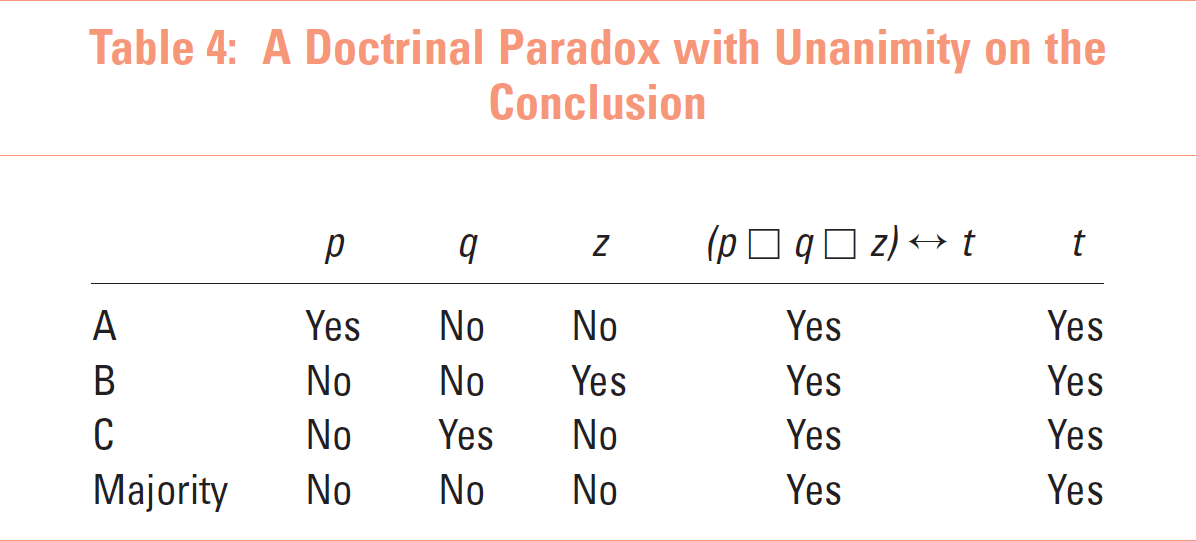
First of all, consider the case represented in Table 4. Here there are three equally sized groups of voters, A, B and C, which are divided on the three possible grounds for supporting decision t. Each group believes that a specific reason holds, while the other two do not. They all believe, though, that the final decision t should be adopted. A collective inconsistency results from this voting pattern at the aggregate level. Nevertheless, if we assume that the three groups are representative of all the people involved in the decision – say, for example, that they are political parties and that they fully and fairly represent the views of the citizens of a democratic polity – then I believe our intuition is that no tyranny is or can be involved in sticking to the decision reached, even though the unanimous representatives that support it do so for conflicting reasons. Since the final decision is unanimous, nobody can complain or feel arbitrarily affected by it; indeed it would be very hard, under the contrary view, to tell who is tyrannising whom. Of course, in real life this kind of voting pattern will be extremely rare, if not impossible; unanimity is almost never reached. Nevertheless, thinking of this abstract possibility helps us to see that inconsistency at the collective level does not necessarily involve tyranny. Notably, it does not involve tyranny in the absence of a tyrannised subject.
A Doctrinal Paradox with Unanimity on the Conclusion
Inconsistent Reasons in the Absence of a Discursive Paradox
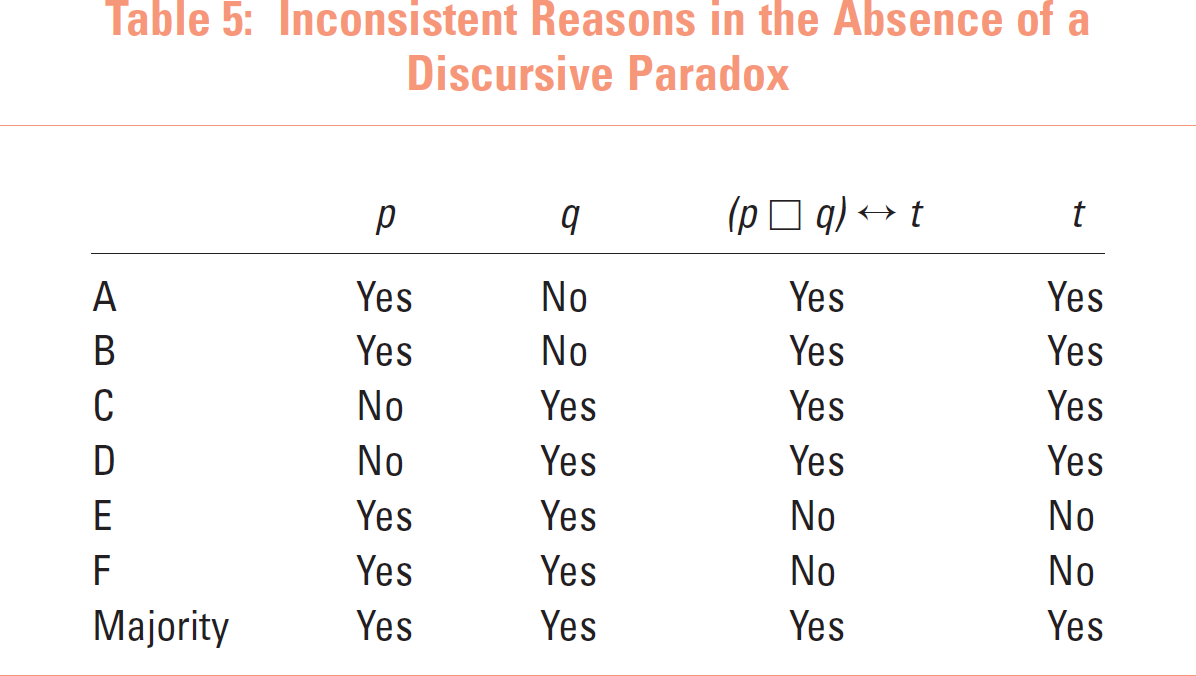
Pettit's discussion of the relevance of the discursive paradox for the theory of democracy draws on our intuitions about cases in which a restricted and homogeneous body of people makes decisions affecting a third party, as happens, typically, with multi-member courts in the original discussion of the ‘doctrinal’ paradox. But it is arguable that these intuitions cannot be assumed to extend also to legislative bodies in a democratic context, where it is to be presumed that relevant political agents are large and heterogeneous assemblies that represent all the voices within the society. In these cases the link between collective consistency and non-tyranny is much looser than the one Pettit's argument presupposes.
But the examples just discussed also illustrate a further and deeper point: in the case of a collective agent that is making decisions according to majority rule or similarly democratic procedures, the requirement of conversability, understood as the requirement that a reasoned connection exist between an agent's decisions and the grounds on which the decisions are made, fails to be fulfilled not simply when inconsistency occurs at the collective level, but every time the faction of the collective body that is actually enforcing a decision is divided on its very grounds. As Table 5 clearly illustrates, this circumstance is not distinctive of the occurrences of the discursive paradox, and it is quite independent of the collective inconsistency that is associated with it. If this is the case, Pettit's account of the relevance of the discursive paradox for the theory of democracy, even if rephrased as concerning only synchronic collective consistency as an essential requirement of non-tyranny, cannot be accepted.
The argument presented in this section can be summarised as follows: Pettit's discussion of the relevance of the discursive paradox for the theory of deliberative democracy revolves around the obvious remark that when the paradox occurs, a formal inconsistency at the collective level is produced through the aggregation of individual judgements that are perfectly consistent at the individual level. The relevance of the paradox, according to his line of reasoning, lies in the fact that inconsistency at the collective level cannot be compatible with the requirement of contestability, which is an essential condition of non-tyranny. Against this line of reasoning, I have objected that: (a) diachronic formal consistency cannot be a requirement of contestability, since prospective consistency is incompatible with contestability and retrospective consistency does not properly account for the responsiveness to reasons that is distinctive of a conversable (and contestable) agent; (b) synchronic formal consistency can be seen as a mark of unconversability, but the link between collective formal consistency and tyranny is much looser than Pettit's discussion of the discursive paradox seems to assume. In the context of deliberations that are inclusive or representative of the whole democratic public, our intuitions about the tyrannical nature of the relevant cases are best captured by focusing on the subgroups that are enforcing an unreasoned decision by the sheer force of their numbers, rather than by focusing on the whole collective body of voters.
It is important to note that, in line with the argument presented in the previous section, here I have not been calling into doubt the claim that the structural features of the discursive paradox make it relevant for the theory of democracy. Instead, I have called into question the normative assumptions made by Pettit in order to explain why the paradox is relevant for the theory of deliberative democracy, and specifically the assumption that a tight connection exists between formal collective inconsistency, uncontestability and tyranny.
Looking at the Paradox from a Different Angle
As we have seen, the link Pettit tries to establish between collective consistency on the one hand, and contestability and non-tyranny on the other, are part of a broader argument that aims at connecting formal collective consistency to deliberation. For the reasons just described, I believe that Pettit's endeavour fails. Nevertheless, the existence of a special relation between formal consistency and deliberation is usually assumed in the literature on deliberative democracy. Pettit's claim is that deliberation requires collective consistency. Many standard theories of deliberative democracy claim that democratic deliberation engenders collective consistency. What the discursive paradox shows, I will argue, is that neither claim can be met, since democratic deliberation is prone to cause collective inconsistency.
The theory of deliberative democracy has aimed, among other things, to answer social choice theory's challenge to the ‘populist view’ of democracy. The most famous example of such a challenge is perhaps the one brought by William Riker in his Liberalism against Populism. 8 As is well known, Riker's argument was built on the findings of social choice theory showing that any procedure for aggregating votes in accordance with some minimal democratic requirements is liable to lead to irrational, that is, cyclic, outcomes at the collective level. This was taken by Riker to constitute a death blow for the classical theory of democracy, or for any theory in which democratic institutions seek the common good of the citizens through the exercise of their common will. His conclusion was that democracy should be content to embrace a ‘liberal’ view, according to which voting is but a way to ensure frequent power shifts, and nothing more than that.
Riker's analysis has provoked strong reactions on the part of those who see the ‘liberal’ view as nothing but the theoretical counterpart of the apathy, mistrust and widespread disillusionment about politics experienced by the electorates of most Western democracies. In the past few years an important literature has tried to challenge Riker's empirical assumptions underlying the claim that cycles and irrational outcomes are a serious and widespread phenomenon in established democracies (see for example Mackie, 2003; Regenwetter et al., 2006). What is relevant to our present purposes is that some advocates of deliberative democracy 9 have advanced the claim that deliberation can create conditions in which the voting paradoxes discussed by social choice theory no longer emerge. In other words, deliberation is expected to engender individual orderings of preferences that do not give rise to irrational results at the aggregate level. It is important to note that according to this literature the existence of deliberation within a democratic community not only serves to guarantee the existence of individual preference orderings that are unlikely to lead to cycles and inconsistency at the aggregate level, but it does so through the exercise of reason, that is, through restrictions on the domain of the individual preference orderings that are neither casual nor heteronomously imposed, but are the result of, or can be justifiable through, the appeal to reasons that can be recognised as universally binding.
Various justifications are advanced to support this claim. In general terms, we can say that the main claim advanced to that effect is that deliberative institutions can help to transform individual views, leading to their alignment in ways that make cycles or irrational outcomes at the aggregate level impossible or very unlikely. 10 The possibility of such a transformation is due to the fact that the stuff of deliberation, so to speak, is not the brute preferences of the individual voters, as is often assumed by standard social choice theory, but their judgements. Judgements, unlike preferences, are meant to undergo intersubjective scrutiny and are liable to be justified by reasons. Indeed, an important requirement for deliberative democracy is that the positions held by political actors must be justified in public with reasons that can at least in principle be accepted by all. This requirement helps to filter out those views that cannot be advocated in public, leading to a restriction of the domain of the positions that individual actors can hold. Furthermore, exchanging reasons and arguments can lead to the creation of a common pool of data and information, which can affect individual positions on the different issues by making them more homogeneous. This does not necessarily bring about a perfect match between individual views, but in order to escape the traps of Condorcetian cycles, as is well known, a perfect alignment of individual views is not required at all. What is needed are much less demanding conditions, like ‘single-peakedness’ or ‘value restriction’ (Black, 1958; Sen, 1966) or, even less demandingly, the same conditions relative to a sufficiently large sub-set of the voters (Regenwetter et al., 2006). These conditions are automatically fulfilled when the different political actors, although holding diverse positions on the issues at stake, nevertheless classify and select them according to the same conceptual dimensions (Chapman, 1998; Dryzek and List, 2003). This is something, it has been argued, that deliberation will naturally bring about, since one of the effects of deliberation is to force political actors to refer to a common conceptual framework in order to advocate their views in public.
These contentions have been challenged at the empirical level. 11 The claim that deliberation can actually bring about such effects is indeed highly controversial and disputable. The important thing to note for our present purposes, however, is that the discursive paradox and, at a more far-reaching level, List and Pettit's ‘Impossibility Theorem on the Aggregation of Judgments’, are formidable conceptual tools to illustrate why deliberation may produce inconsistency rather than restoring consistency. What the discursive paradox shows, put concisely, is that the same kind of paradoxical outcomes that haunt the aggregation of unrestricted individual preferences in the classical version of Arrow's theorem can also occur when judgements, rather than preferences, are the object of aggregation according to procedures that fulfil some minimal democratic demands. 12 What is even worse, the paradox reveals the possibility that shifting from the aggregation of preferences to the aggregation of reasoned judgements can produce new forms of inconsistencies where none were present before deliberation.
There are essentially three main features of collective deliberation that might contribute to this effect. The first lies in the fact that, by requiring that the grounds for the proposed policies be brought to the public fore, deliberation is bound to multiply the issues on the agenda (List, 2006). This creates more opportunities for disagreement, and disagreement contributes to the emergence of inconsistencies at the collective level.
The second feature of deliberation that adds to this effect is the fact that deliberation establishes logical connections and implications between the different issues on the agenda that otherwise would have been left undisclosed. This means that the chances for inconsistencies to emerge are multiplied, too. Once the grounds for every decision are made explicit, previously unrelated issues become logically entangled, and the likelihood increases that the majority vote will lead to inconsistencies.
A third feature of deliberation that might contribute to producing inconsistencies is the fact that deliberation tends to turn all decisions into matters of principle, and this too multiplies the opportunities not only for disagreement, but also for collective inconsistency. Let me give a simple example. Suppose a new system of agricultural subsidies needs to be adopted at the national level, and suppose that the preference ordering is the following:
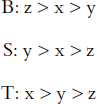
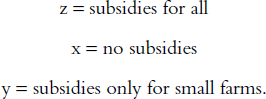
In this context, no cycle appears. By pair-wise majority voting the preferred option is obviously x, and the preference ordering is the following: x > y > z. Accordingly, x is chosen.
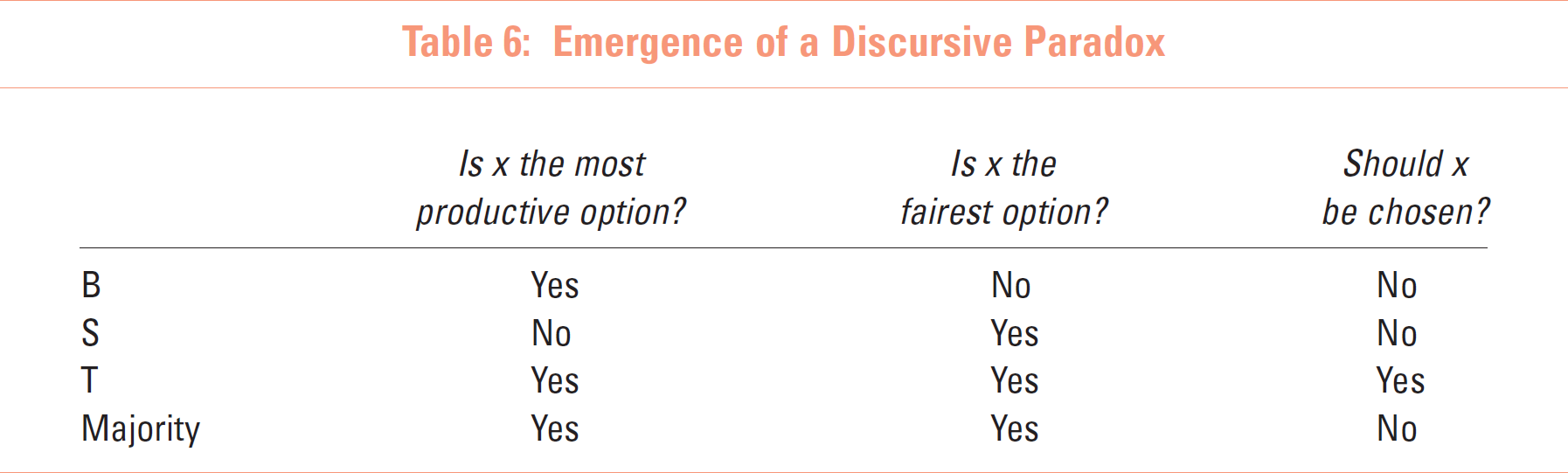
Suppose now that a public justification is required for the policy to be adopted and that by universal agreement the two dimensions according to which the decision should be made are productivity and fairness. Now the issue has been rephrased in a principled way: x will be chosen if, and only if, x is both the most productive and fairest option available. Suppose, further, that people do not agree about how to rank the different options according to those dimensions.
Table 6 represents a possible pattern of judgements that would account for the preference orderings of the three parties in terms of the chosen dimensions. Now x is rejected, and a voting paradox emerges. What happened is pretty clear: when people did not have to phrase the grounds for their vote, x could get selected although only one-third of the community (the taxpayers) was listing it as its preferred alternative; x was only a second best for the big farmers and the small farmers, but the overall pattern of preferences was sufficient to make it selected. Once the grounds for the decision need to be made explicit, though, the decision becomes a principled one, and the compromise on x is not acceptable any more.
This is actually a relatively common phenomenon in parliamentary deliberation: issues that might be resolved through a compromise in which all the parties would accept a ***second-best solution become much more difficult to solve once the need is felt to state explicitly the grounds on which the decision should be made. What is most relevant for our purposes here is not the simple fact that open deliberation can lead to deep disagreement when a compromise would otherwise be possible; rather, what is crucial is that, as our simple example shows, an embarrassing inconsistency at the collective level can emerge where no cycles were troubling the decision before deliberation took place.
Emergence of a Discursive Paradox
If we look at the issue from this angle, we also get a different perspective on Pettit's argument. Pettit argues that deliberation requires consistency, and when faced with a discursive paradox we should give up some democratic desiderata; for example, anonymity, that is, equality of influence (through the empowerment of a third party which actually makes the final decision by applying certain rules of inference) or systematicity, that is, impartiality between the different options to be voted for (though the decision to make the judgement on some of the issues on the agenda affects decisions on other related issues irrespective of the actual stance of the majority). Given the importance of consistency for deliberation, and the importance of deliberation for non-tyranny, when we need to choose between consistency and democracy it is the first that should prevail. However, contrary to the way in which Pettit originally presented the problem, we now see that the paradox can also be interpreted in a different way: the troubles highlighted by the discursive paradox arise not only because of the democratic desiderata, but also because of deliberation itself, that is, because of the deliberative requirements that lead to a proliferation and entanglement of the issues on the agenda, and the transformation of all choices into principled ones. It is not deliberation and consistency on one side, and democracy on the other, that are at odds. The conflict is between consistency on one side and deliberative democracy on the other.
What the Discursive Paradox Really Means
Of course matters of interpretation are never settled once and for all, and they are inescapably exposed to controversy and dispute. The preceding discussion, though, suggests a few points that should be taken into account in making sense of the discursive paradox.
First, the discursive paradox can mean something for the normative theory of democracy. Notwithstanding its judicial origin, and the apparent simplifications and abstractions involved in its formal treatments, the paradox can be relevant for our conception of the legislative activity in a deliberative environment, since there are no significant structural disanalogies between the legislative environment and the formal rendering of the discursive paradox.
Second, pace Pettit, the relevance of the paradox for the normative theory of deliberative democracy cannot be based on the assumption that deliberative democracy requires formal consistency as a means for non-tyranny. As I tried to show in the second section of this article, formal consistency at the collective level is neither a necessary nor a sufficient condition of non-tyranny. Of course it might well be that other arguments than Pettit's could be devised to show that deliberative democracy calls for formal consistency at the collective level. It is worth pointing out, though, that if that were the case, and if the interpretation of the discursive paradox offered in the last paragraph were correct, then deliberative democracy would turn out to be a self-defeating political ideal.
And this is because – third – according to that interpretation of the theorem, deliberation, far from being a consistency-engendering device, can indeed be a major cause of inconsistencies at the collective level.
All this points to a broader implication for the discursive paradox and Pettit's and List's ‘Impossibility Theorem’, which deserves further exploration. If the main suggestion of the paradox is that deliberation does not rescue collective decisions from formal inconsistency, then the efforts made by some advocates of deliberative democracy in order to show that deliberation could be the solution to the irrational outcomes of collective choice highlighted by social choice theory might turn out to be fruitless or ill-conceived.
This might prompt us to believe that deliberation should be used with parsimony, and that, as Cass Sunstein suggests, sometimes we should remain content with ‘incompletely theorised agreements’, especially when highly controversial matters are at stake (List, 2006, p. 365; Sunstein, 1995). But this conclusion is not the only one possible. Another suggestion we could get from the discussion of the discursive paradox is that perhaps the quest for formal consistency that some advocates of deliberative democracy have assumed as a default democratic requirement is the result of a delusion. After all, Riker and other critics, contrary to historical evidence, 14 simply assumed that ‘populist democracy’ – democracy as the search for the common good – requires consistency. The advocates of populist democracy who have tried to respond to the challenges of social choice theory have simply played along with this assumption. But there are good reasons to believe that formal consistency is just a remedial virtue, which provides some minimal forms of efficiency and non-arbitrariness when more refined kinds of instrumental rationality and moral judgement are unavailable. If deliberative democracy aims at reaching exactly these more refined forms of rationality and justice, then the guarantees provided by formal consistency may become useless or out of place.
These sorts of consideration may lead to a deep revision of the assumption that consistency at the collective level is among the aims or the conditions of successful deliberative democracy. Of course, even if this assumption failed, many of the normative issues raised by the assumption that deliberative democracy requires conversability would still need to be addressed. Notably, it would still be extremely important to explore the normative implications and remedies of the cases in which a law-making majority is divided about the reasons that support its decision. As we have seen, such circumstances are not necessarily associated with the emergence of a discursive paradox, and do not need to raise issues of collective rationality or formal consistency. Nevertheless, they evidently represent a major breach of the conversability requirement, which lies at the core of the deliberative model of democracy. These cases raise very intriguing issues about whether and to what extent individuals and political parties are responsible for the fulfilment of such a requirement. 15
Inquiring about these normative problems, however, does not imply endorsing the idea that formal consistency at the collective level is required, or presupposed, by any viable ideal of deliberative democracy. Such an assumption should be subject to a closer scrutiny than has been done so far. The discursive paradox is a good place to start.
Footnotes
I am grateful to Teresa Britton, Emanuela Ceva, Elisabetta Galeotti, Chiara Testino and three referees of Political Studies for their very useful comments on the manuscript. Special thanks go to Daniele Porello and Ian Carter for their invaluable help and suggestions.
1
2
3
The case is reported in Kornhauser and Sager, 1993, p. 14.
4
It should be noted that, although Pettit mentions the modus tollens as a way of restoring collective consistency, he seems to ignore it in much of his treatment of the dilemma. In any case, the difference between the collectivisation of reason by modus ponens (inference from the premises to the conclusion) and collectivisation by modus tollens (inference from the conclusion to the premises) is irrelevant to the present discussion.
5
Indeed, this seems to be one of the major threads of Lewis Kornhauser and Lawrence Sager's critique of Pettit's discussion (Kornhauser and Sager, 2004).
6
Here I expand on an objection phrased in Kornhauser and Sager, 2004, p. 273.
7
See Dworkin, 1986, ch. 6. On both integrity and consistency, see the brilliant discussion in Raz, 1994, pp. 261–309.
8
Riker, 1982. For a restatement, see Hardin, 1993.
9
See notably Cohen, 1986; 1997, p. 81; Manin, 1987. For a useful survey of this literature see Dryzek, 2000; Elster, 1986; Mackie, 1998.
10
Christiano, 1993; Cohen, 1986; 1997; Dryzek and List, 2003; Goodin, 1986; Miller, 1992; Pildes and Anderson, 1990.
11
Gaus, 2003, p. 149; Knight and Johnson, 1994; Sunstein, 1999; 2001, p. 56; Van Mill, 1996. For some interesting empirical evidence supporting the claim, see List et al., 2006.
12
This conclusion was anticipated by Brennan (2001), before List and Pettit's ‘Theorem in Judgment Aggregation’ formalised the necessary conditions of the emergence of the discursive paradox. For an attempt to refute this conclusion through the rejection of the systematicity requirement of List and Pettit's theorem, see  .
.
13
See for example Dietrich and List, 2007; Dokow and Holzman, 2008; List and Pettit, 2004; Mongin, 2008; Pauly, 2008; Porello, 2009.
14
Jean-Jacques Rousseau, the champion of populist democracy if ever there was one, never advocated consistency as an ideal of democracy, and famously made clear that the popular will could not be bound by its preceding decisions. This amounts to a clear endorsement of the systematicity requirement, at the possible expense of diachronic consistency.