







Abstract
This article evaluates the influence of welfare state policy on individual social volunteering. Unlike previous studies that have investigated the relationship between the welfare state and civic engagement, this contribution focuses on those areas of civil society that are most directly related to public welfare state activities. Moreover, it is assumed that welfare state policy does not uniformly affect the civic engagement of various social groups. The analyses provide support for the crowding out hypothesis: individual social volunteering is lower in extensive welfare states than it is in countries that spend less on welfare state policy. However, when group-specific welfare state effects are modelled, it is revealed that the crowding out effect of public social services does not hold for the low-income group. Additionally, extensive welfare policy reduces the negative effect of low affluence on social volunteering. Crowding out and crowding in thus go hand in hand: while state activities indeed serve as a substitute for social volunteering in some places, in others they are found to have a stimulating effect.
The interaction between civil society and welfare state policy has attracted a great deal of attention in the ongoing public and scientific debates. It is frequently claimed that globalisation and decentralisation processes as well as the retrenchment of the welfare state due to financial restrictions limit states' capacity to provide social services. For this reason, it is important to investigate whether these developments are associated with an increased importance of civil society to compensate for fewer state activities. This question is furthermore related to the debate in social capital literature on whether public provision of social and welfare services undermines or supplements a society's social capital. The most prominent hypothesis in this respect suggests a crowding out of civic engagement by extensive welfare state activities. However, empirical analyses have yet to find the expected substitution effect; some even support a positive, complementary effect of welfare state effort on civic engagement (e.g. Boje and Strandh, 2005; Curtis et al., 2001; Dahlberg, 2005; Kääriäinen and Lehtonen, 2006; Künemund and Rein, 1999; Nicolaysen, 2001; Ruiter and De Graf, 2006; Salamon and Sokolowski, 2003; Van Oorschot and Arts, 2005).
It is here that this article finds its starting point, arguing that the current state of research in this field reflects an insufficient theoretical foundation and a related imprecise operationalisation of the relationship between welfare state and civic engagement. This contribution therefore asks whether a crowding out effect can be identified when focusing specifically on those areas of civic engagement most directly linked to welfare state policy and when taking group-specific welfare state effects into account. Accordingly, the initial objective is to develop more precise hypotheses specifying the general relationships examined up to now, as well as a more accurate conceptualisation of civic engagement. In so doing, the present article goes beyond the existing research in three respects. First, unlike former studies, this contribution focuses on social volunteering, which is most directly related to welfare state activities and for which crowding out is therefore most probable. Second, as the welfare state does not affect the entire population in the same way, it is reasonable to believe that the effect welfare state policy has on civic engagement is also not uniform. In particular, a complementary effect of welfare state effort, that is, crowding in, should mainly occur among lower-class individuals who stand to benefit most from the welfare state. Group-specific welfare state effects will therefore be modelled (see Elster, 1998, p. 70). Finally, this contribution analyses a larger and broader country sample than previous studies, which were often limited to a few European countries with a generally strong focus on the Scandinavian, social democratic regimes (Van Oorschot and Arts, 2005, p. 8). By contrast, this study integrates 23 Organisation for Economic Cooperation and Development (OECD) countries.
Conceptually, the study adopts a multi-level approach. This is the most appropriate research design, as activities of civil society are first and foremost individual ones (see Hedström and Swedberg, 1996). In examining the relationship between the welfare state and civil society, we are faced with a multi-level phenomenon, for the interaction between the welfare state and individual behaviour is of interest. This furthermore corresponds to the central hypothesis of Institutional Economics (Richter and Furubotn, 1996), which claims that political institutions and public policy provide specific incentive structures, thereby influencing individual values and behaviour. Data from the European and World Values Surveys four-wave integrated data set (1999-2001) form the empirical basis of the contribution, which is complemented by context data for the 23 OECD countries. The focus on the OECD world is justified not only in terms of data availability, but also theoretically. As Michael Walzer (1992) states, it is the ‘paradox of the civil society argument’ that a democratic civil society seems to require a democratic state, while a strong civil society seems to require a strong and responsive state. The use of a broader country sample including developing countries would imply even more complex processes, which are not at the centre of this article and are therefore excluded.
The remainder of the article is organised as follows. First, the theoretical background on the relationship between the welfare state and civil society will be addressed and the hypotheses regarding individual social volunteering will be elaborated. Next, the methodological procedures and operationalisation of the variables will be described. In the fourth section, the empirical results will be presented. The article concludes with a summary of the most important findings and conclusions.
Theory and Literature Overview
It is widely accepted that civic engagement ‘is not just an individual choice or a spontaneous outburst of altruism. Rather, it is affected by larger social and institutional forces' (Salamon and Sokolowski, 2003, p. 88). This article focuses on one specific form of such forces, namely on the effect public social services have on individual social volunteering. 1 The latter includes social activities outside one's own household ‘in which time is given freely to benefit another person, group, or organization’ (Wilson, 2000, p. 15). 2
Two Classic Hypotheses: Crowding Out and Crowding In
Theoretically, the most prominent view in this respect suggests that public social services replace civic activities in general (Dahlberg, 2005, pp. 743ff.). According to this substitution theory, an extensive welfare state reduces the importance of other actors, such as voluntary organisations, and leads to a crowding out of civic engagement. In this view, the state can have a ‘serious negative impact’ on civil activities if it starts ‘to undertake activities that are better left to the private sector or to civil society’ (Fukuyama, 2001, p. 18). Formulated in a more positive way, voluntary action emanates from an unsatisfied demand for collective goods that is not met by the state (Salamon and Sokolowski, 2003, p. 78; Weisbrod, 1978). In essence, this argumentation is based on the assumption that the supply of social services is a zero-sum game, implying that there are ‘a certain number of tasks to be done and the only question is who will do them’ (Finsveen and Van Oorschot, 2007, p. 4). If the state performs these tasks, the engagement of civil society is rendered unnecessary and will consequently decrease. The decline in civic engagement will be reinforced due to the lack of responsibility and practice of civil society.
In contrast to this view, a second approach assumes that there is a complementary relationship between the welfare state and private initiative (Dahlberg, 2005, pp. 743ff.). 3 Accordingly, the state and civil society do not necessarily perform the same tasks. Extensive welfare provision should therefore not replace civic activities, but rather provide people with the financial resources and security as well as the free time needed to be involved in voluntary activities – also known as the crowding in of civic engagement. Furthermore, universal welfare states in particular decrease the perceived cultural distance between the majority and ‘the bottom’ (Larsen, 2007), thereby fostering a willingness to serve others. Along these lines, an extensive welfare state generates the structural and cultural conditions for a flourishing civil society (Hyden, 1997, pp. 13ff.; Van Oorschot and Arts, 2005, p. 6). 4 At the aggregate level this complementary relationship is furthermore consistent with a consensus or corporatist model of democracy that is based on the collaboration of the state and intermediary organisations (Lijphart, 1999; Salamon and Sokolowski, 2003, p. 79). In this context, Sweden, for example, can be characterised not only by a generous welfare state, but also by a high degree of civic engagement in various areas (e.g. Kumlin and Rothstein, 2005).
Up to now, persuasive empirical evidence for the crowding out hypothesis has been lacking (Van Oorschot and Arts, 2005, p. 7). In fact, most studies find either no effect or even a positive relationship between an extensive welfare state and civic engagement (Boje and Strandh, 2005; Curtis et al., 2001; Dahlberg, 2005; Kääriäinen and Lehtonen, 2006; Künemund and Rein, 1999; Nicolaysen, 2001; Ruiter and De Graf, 2006; Salamon and Sokolowski, 2003; Van Oorschot and Arts, 2005). Studies that reveal a negative relationship between an extensive welfare state and civil society typically focus on value-related aspects of civic engagement like informal solidarity, the willingness to donate money to the poor, and social contacts (Scheepers and Te Grotenhuis, 2005; Scheepers et al., 2002; Van Oorschot et al., 2005). The extant literature is therefore inconclusive with regard to the relationship between the welfare state and civil society, and, most interestingly, empirical analyses fail to corroborate the crowding out hypothesis of civic voluntary activities. Here I argue that this is due to an insufficient theoretical differentiation and a related imprecise operationalisation of the relationship between the welfare state and civic engagement.
First, it cannot be assumed that welfare state policy affects all forms of volunteering equally. More precisely, extensive welfare policies should substitute for civic activities that directly compete with public social policy. The effect on other types of volunteering, like voluntary activities in culture, sports, leisure or political associations, could be a very different one. While public services may crowd out civil activities in welfare state related areas, such as social action, the opposite could be true in other fields (Day and Devlin, 1996, p. 38). This assumption corresponds to Bo Rothstein's (2001, p. 217, p.229) finding for Sweden, where voluntary organisations have developed quite differently over the previous decades. While some areas of the voluntary sector such as social services, health care or elementary education have been weakened, others, such as sports, cultural or environmental organisations, have grown. Wolfgang Seibel (forthcoming) goes so far as to argue that while civil society activities may be strong, they function primarily as ‘political advocates rather than as providers on the service market’. Lester Salamon and Wojciech Sokolowski (2003, p. 87) indeed illustrate that a differentiation between the various areas of volunteering is important in some cases in order to reveal the relationship between the type of welfare state and a country's level of volunteering. Against this background, the focus of this contribution will be on social volunteering, which is most directly related to public welfare state activities. It should thus be the area where we are most likely to find a crowding out effect, since a potential trade-off between public and private services – a substitution effect – is most probable if the activities compared (of the state and civil society) can replace each other. This leads me to my first general hypothesis:
Hypothesis 1. Welfare state policy crowds out only those civic activities that directly compete with state activities, namely social volunteering.
Moreover and most importantly, group-specific hypotheses on the relationship between welfare state policy and social volunteering should be formulated (see also Elster, 1998). The assumption of a uniform welfare state impact on the population as a whole can be questioned for several reasons (Scheepers and Te Grotenhuis, 2005, p. 456): first and foremost, welfare state policy does not equally affect an entire population; its effect varies depending on individual resources, values and behaviour patterns (Schmid, 1984, p. 281). Most obviously, the upper social stratum is the main contributor to the welfare state, while lower social classes are the beneficiaries of welfare state services. 5 It must therefore be expected that the welfare state context influences various social groups of individuals differently in their propensity for social engagement. The following sections discuss the diverse effects of welfare state efforts on social volunteering for different social groups. While the central elements of both substitution and complementary theory are retained, they are somewhat refined for the purpose of class differences. More precisely and with regard to the crowding out hypothesis, the main aspect is the idea that a context of extensive welfare state policy reduces civil society's responsibility to engage voluntarily. The crucial elements of complementary theory, on the other hand, are the welfare state's redistributive consequences.
Specifying Substitution Theory: Group-Specific Crowding Out Effects
Initially, the crowding out approach implies that the provision of social services in an extensive welfare state is clearly seen as a state's responsibility, while civil society's engagement is no longer necessary. At the individual level, this generates specific incentives and conditions for social volunteering, generally involving a collective action problem: social volunteering comes at a personal cost, while individual profits are mainly of an immaterial nature. For this reason, socially disadvantaged people are rarely involved in voluntary activities. This below-average engagement is often ascribed to their lack of resources, which does not allow for voluntary involvement, or, in terms of the aforementioned collective action logic, means that they cannot afford the individual costs of volunteering. Additionally, these individuals are less sensitised for community action (Friedman, 2003, p. 15; Gaskin et al., 1996; Wilson and Musick, 1997). In other words, they are less willing to pay the individual costs of volunteering. It can therefore be argued that against the background of this generally low propensity to volunteer, crowding out cannot have a substantial impact on individuals with low levels of income and education. This population group exhibits the least advantageous preconditions for voluntary work and generally does not consider social volunteering to be its duty. Whether it is the state or civil society that bears responsibility for public social services therefore does not significantly influence their social engagement.
On the other hand, individual volunteering is more likely with increased education and income (Friedman, 2003, p.15; Gaskin et al., 1996; Wilson and Musick, 1997). Not only do these individuals have the necessary financial and human capital resources, but also they attach higher value to the immaterial gains of volunteering, such as helping others or self-confidence (Brady et al., 1995, p. 285). In an extensive welfare state, however, these individuals have a strong argument to transfer social responsibility to the state and to refrain from social engagement, as they finance the welfare state through taxes and contributions: ‘I already pay a lot for social welfare; therefore, I really don't need also to volunteer in this area’. From this perspective, it seems plausible to hypothesise that, among well-off individuals, there is indeed a withdrawal from social volunteering in an extensive welfare state, that is, crowding out. 6 In this vein, the general crowding out hypothesis needs to be specified with regard to social groups:
Hypothesis 2. While extensive welfare state policy decreases the probability that a higher-class individual volunteers socially, it does not substantially influence the probability that a lower-class individual is involved in these activities.
Specifying Complementary Theory: Group-Specific Crowding In Effects
Unlike the first responsibility-based argument, the second approach, based on complementary theory, focuses on the redistribution of resources that should have a different influence on the social voluntary behaviour of social classes. Generally speaking, lower social classes benefit most from an extensive welfare state. As less well-off individuals are the primary recipients of social services and since their level of voluntary engagement is low, due mainly to a lack of individual resources, their civic involvement is, from this point of view, most dependent on public welfare provision (Friedman, 2003, p. 6, p. 15). It can be hypothesised that an extensive welfare state provides these individuals with financial resources and security and thus eventually with the free time needed for voluntary engagement (Van Oorschot and Arts, 2005, p. 6). Moreover, extensive welfare states reduce the consciousness of belonging to the lower class (Larsen, 2007), which bolsters the probability of voluntarily serving others. A complementary effect of a generous welfare state on civic engagement can therefore be expected for individuals with low levels of income and education.
Individuals with a high socio-economic status, by contrast, are quite differently affected by welfare state redistribution. While they are important contributors to the welfare state, they tend to benefit less from public social services. Regarding the (vertical) redistribution of resources, a complementary effect therefore cannot be expected for these individuals. Moreover, as these individuals generally have the necessary resources as well as a strong propensity for volunteering, whereby the latter is based on personal motives of self-expression and development rather than on economic considerations (Wilson, 2000, pp. 219f.), their voluntary activities can be expected to be fairly independent from extensive welfare state activities. This leads to the following hypothesis:
Hypothesis 3. While extensive welfare state policy increases the probability that a lower-class individual volunteers socially, it does not substantially influence social volunteering of higher-class individuals.
As these comments demonstrate, the crowding out hypothesis is theoretically plausible for upper social strata, but less so for lower-class individuals. Moreover, the reverse applies to approaches assuming a complementary relationship between welfare state activities and social volunteering. The theoretical discussion thus illustrates the need for the modelling of group-specific effects. Moreover, these considerations show that substitution and complementary theory are not mutually exclusive; crowding out and crowding in should, rather, be relevant for different areas of volunteering and, further, depend on the population group under consideration.
Research Design, Methodological Procedures and Operationalisation
In the remainder of the article the hypotheses presented above will be empirically tested. The analyses are based on the integrated data file from the fourth wave (1999-2001) of the European and World Values Surveys. This data set contains data for the OECD countries with the exception of Australia, Korea, New Zealand, Norway and Switzerland. Furthermore, Mexico and Turkey are excluded from the analyses as comparable data on welfare state policy are lacking. The final data set thus contains responses from 24,169 individuals from 23 OECD countries.
The dependent variable is individual social volunteering. To measure the dependent variable the following question was considered: ‘Please look carefully at the following list of voluntary organisations and activities and say … for which if any, are you currently doing unpaid voluntary work?’ 7 Individuals who indicated voluntary engagement in one of the following areas were assigned the value 1: voluntary work related to social welfare service for elderly, handicapped or deprived people (a081), local community action on issues like poverty, employment, housing or racial equality (a086) or voluntary organisations concerned with health (a094). All others were allocated the value 0. It must be mentioned that other categories of unpaid work can also be socially motivated (e.g. religious activities, youth work or voluntary activities in the area of Third World development and human rights). However, these latter activities are not within the scope of national welfare states and/or include forms of unpaid work without any social orientation. They are therefore not considered for the purpose of the following analyses.
The question of which activities are part of what is considered to be civic engagement is actually one of the major disagreements in the literature (Boje and Strandh, 2005, p. 4). In the context of this article, the question from the European and World Values Surveys seems to be a reasonable means of measuring individual civic engagement. It focuses on the area in which these activities take place rather than on organisational aspects, that is, if it is formal engagement within an organisation or institution or if it is instead informal in nature. This formulation corresponds well to the present research question focusing on the subject matter of engagement. 8
For the crucial independent variable, welfare state effort, the focus is on the core areas of welfare state policy (compare Evers, 2005, p. 738). More precisely, to construct the variable based on the OECD Social Expenditure Database (SOCX), public social expenditures as a percentage of GDP in the following categories are summarised: old age, incapacity, family and unemployment related expenditures. These elements of welfare state expenditures are most directly related both to civil society's activities and to possible welfare state resource effects. Conversely, health-related expenditures – which cover mainly medical goods, while cash benefits related to sickness are recoded under incapacity-related benefits (OECD, 2007, p. 15) – as well as the categories housing and active labour market programmes are excluded, as they cover public expenditures that are much less directly connected to individual social volunteering.
Social expenditures as a percentage of GDP are the most widely used indicator of welfare effort in empirical literature. While such expenditure-based welfare state indicators have often been criticised for neglecting the various dimensions of welfare state policy and for assuming that ‘all spending counts equally’ (Esping-Andersen, 1990, p. 19), I follow Francis Castles (2008, p. 60), who has recently shown that a disaggregated expenditures approach is very useful for establishing ‘not only the variety of what welfare states do, but also the determinants and the outcomes of such interventions’. 9 Moreover, this approach corresponds quite well to the theoretical expectation of this article for it can be seen as a measure of the importance of welfare state policy relative to a country's overall resources. While almost all countries have been influenced by similar trends and challenges to the welfare state in recent years, the country-specific conceptions of the welfare state have proved to be very stable over time (and so have country differences in social expenditures).
In welfare state literature it is often recommended that cash benefits be differentiated from benefits in kind, that is, whether a welfare state is transfer heavy and service lean (or vice versa). According to complementary theory, it could indeed be assumed that cash benefits are more narrowly related to a resource effect, whereas benefits in kind are at the core of the crowding out hypothesis in terms of service provision. Nevertheless, I refrain from integrating this distinction into the analyses. On the one hand, benefits in kind typically also have a (financial) resource effect; on the other hand, the distinction is not relevant for the question of whether the state is responsible for social service provision.
Table 1 provides an overview of social volunteering as well as of welfare state effort in cross-national perspective. The ranking of the countries largely follows the expected pattern and also shows a fairly strong negative correlation between welfare state expenditures and social volunteering. 10
Aggregate Social Volunteering and Welfare State Effort in the OECD Countries
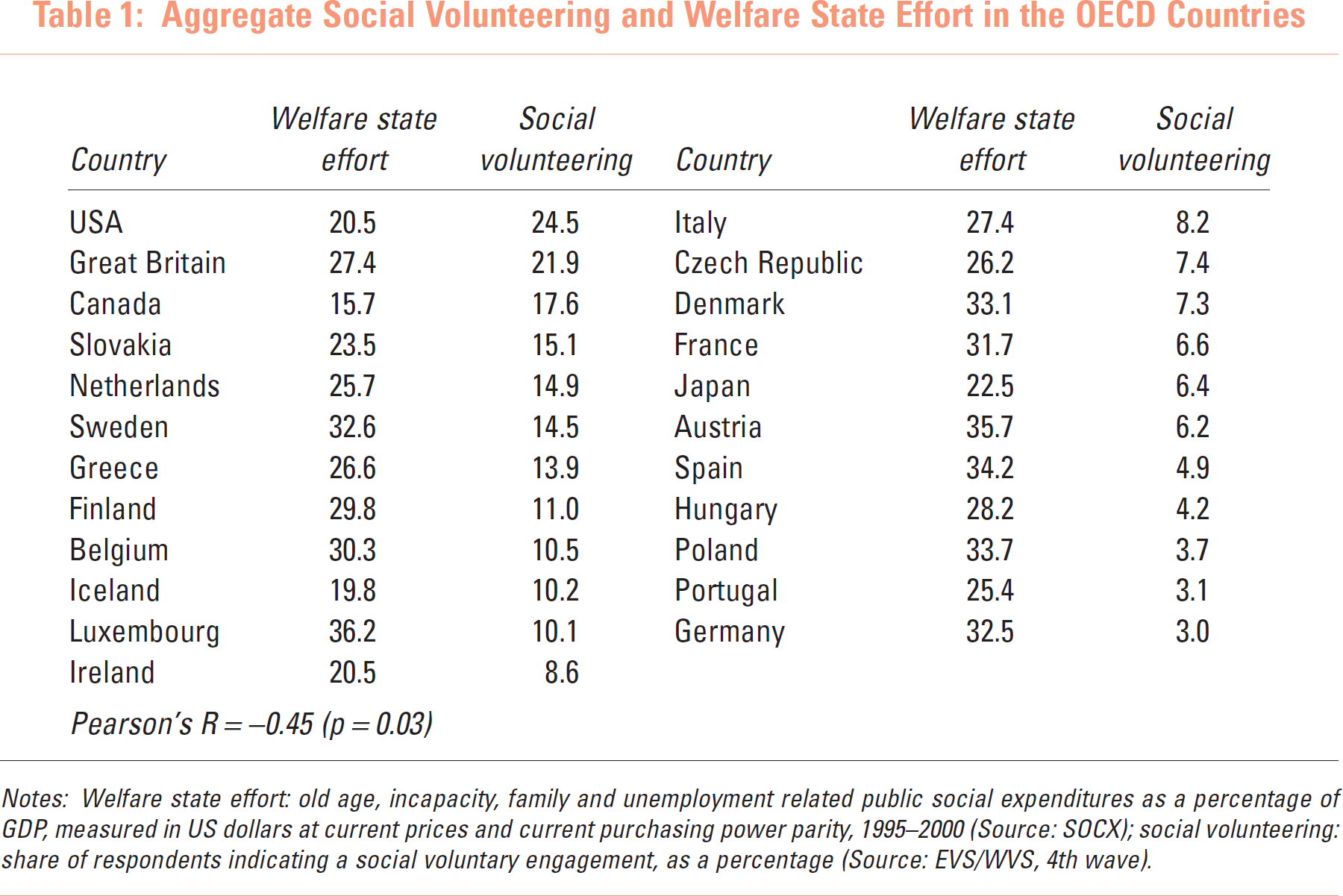
Notes: Welfare state effort: old age, incapacity, family and unemployment related public social expenditures as a percentage of GDP, measured in US dollars at current prices and current purchasing power parity, 1995–2000 (Source: SOCX); social volunteering: share of respondents indicating a social voluntary engagement, as a percentage (Source: EVS/WVS, 4th wave).
In order to explain individual (social) volunteering, several individual characteristics need to be integrated into the analysis (compare Salamon and Sokolowski, 2003, p.77; Wilson, 2000). Socio-economic status is the central individual factor and will be measured in terms of the levels of education and income. A high level of education and financial resources is related to a high propensity and probability to volunteer. I refrain from integrating an occupational variable, one that is often used to measure social class differences. In the context of (social) volunteering, which is by definition an activity outside the labour market, such a restriction would exclude respondents not integrated into the labour market and, consequently, an important group of volunteers (e.g. housewives, pensioners, students). Nevertheless, a high degree of social integration (e.g. through employment) is expected to increase the likelihood of engagement. Furthermore, socio-demographic factors such as age and gender should influence individual volunteering. Finally, religious values are incorporated into the models, which can be linked to an individual's propensity for altruistic behaviour.
At the contextual level and in addition to the central policy variable, a country's GDP is included in the models in order to control for varying degrees of economic and social development. 11 I use the values of the contextual factors measured prior to 2000. Further information on the variables (operationalisation and sources) as well as descriptive statistics can be found in the Appendix.
Keeping my research question in mind, we are faced with hierarchical data structures; that is, individuals are nested within institutional contexts that are thought to exert an influence on them. Therefore, I apply random intercept and random slope models, implying that individual behaviour and its determinants can vary between countries (Jones, 1997; Steenbergen and Jones, 2002). Additionally, such multi-level models allow for the modelling of macro-level characteristics (in the present case, the welfare state context), which explain the variance at the macro level (the variance between countries). Finally, cross-level interactions are calculated in order to model group-specific welfare state effects. As the dependent variable is dichotomous, individual social volunteering is transformed to a logit structure. Estimation, as well as interpretation of the coefficients, is similar to conventional logit analysis. The model applied takes the following form:

where πij specifies the probability that individual i in country j performs social voluntary work. This probability is explained by the overall mean (ß0), individual variables (X, their estimates ß, respectively) and characteristics of the countries (W, their estimates ɑ, respectively). As only one cross-level interaction is modelled in each model, the subscripts k and m refer to the kth individual variable that is randomised and interacted with the mth contextual variable (X*W, their estimate y, respectively). With this approach, not only are individual differences (Ɛij) modelled, but also differences between contexts (μoj), as well as differences in the effects of independent variables (μmj Xkij).
Empirical Results
In this section, a two-stage procedure to examine the influence of the welfare state context on individual social volunteering is presented. First, the overall contextual effect of extensive welfare state policy on social engagement is analysed (Table 3). In this first step, a model on non-social volunteering is also depicted in order to discuss Hypothesis 1, that is, to compare welfare state effects on social and non-social volunteering, respectively. In a second step, Hypotheses 2 and 3, which suggest varying effects of welfare state policy on social volunteering contingent on individual socio-economic status, will be tested (Table 4).
Contextual Variance of Social Volunteering
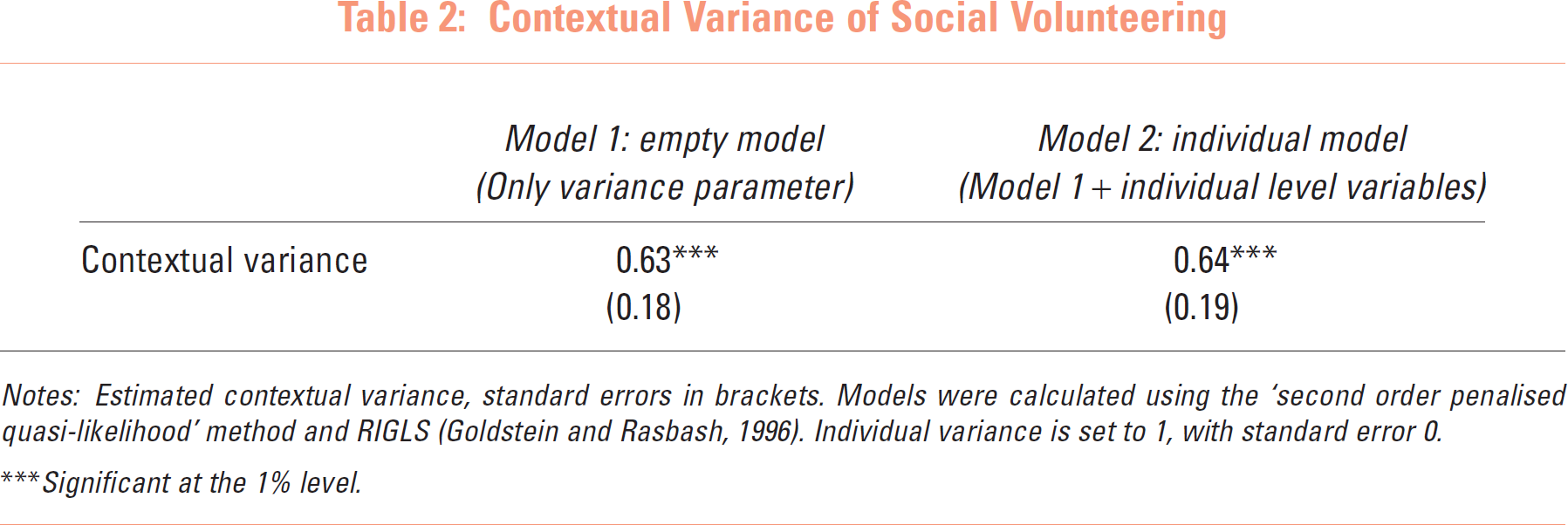
Notes: Estimated contextual variance, standard errors in brackets. Models were calculated using the ‘second order penalised quasi-likelihood’ method and RIGLS (Goldstein and Rasbash, 1996). Individual variance is set to 1, with standard error 0.
Significant at the 1% level.
Overall Context Effect of Welfare State Policy on Social Volunteering
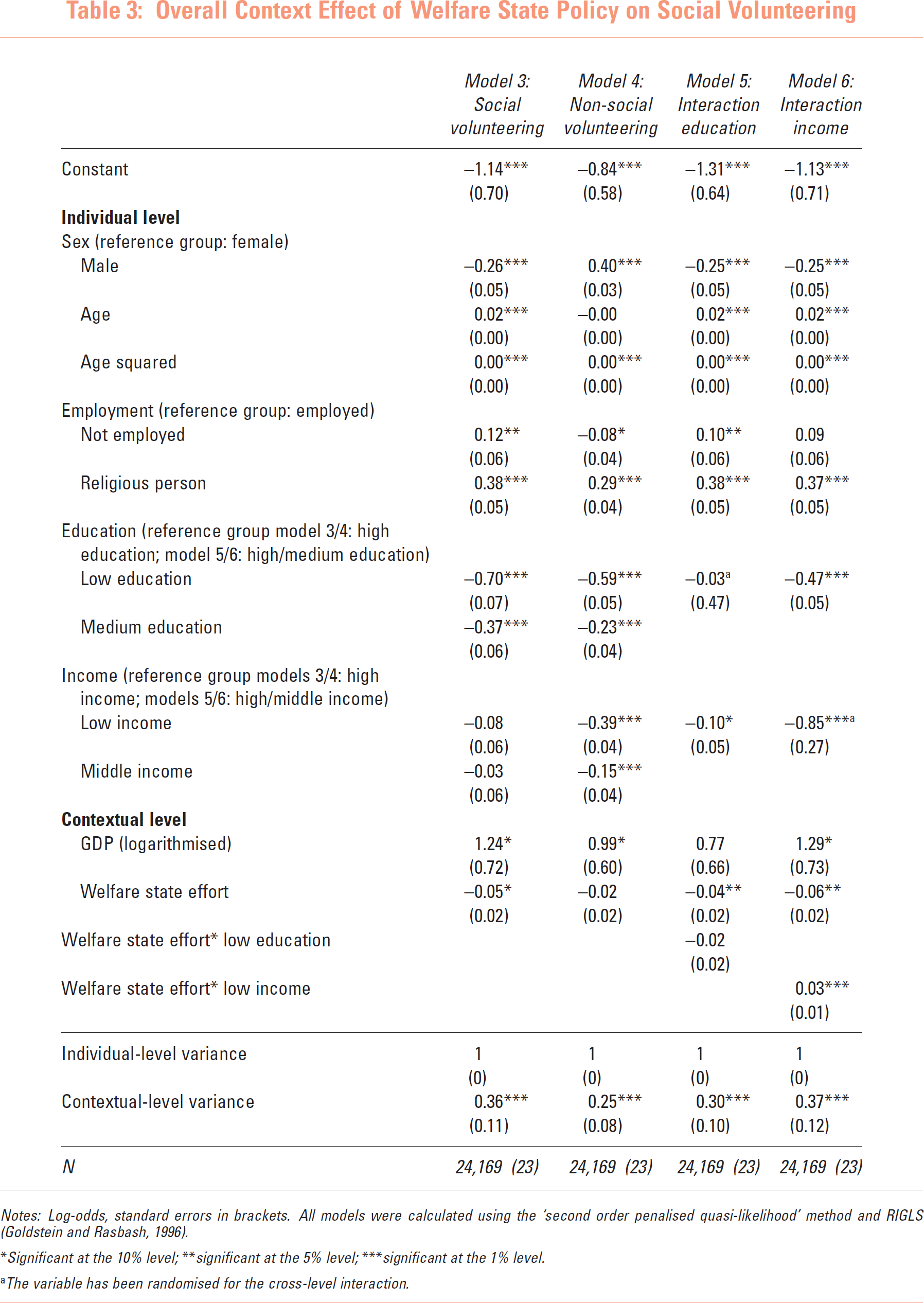
Notes: Log-odds, standard errors in brackets. All models were calculated using the ‘second order penalised quasi-likelihood’ method and RIGLS (Goldstein and Rasbash, 1996).
Significant at the 10% level; **significant at the 5% level; ***significant at the 1% level.
The variable has been randomised for the cross-level interaction.
Group-Specific Welfare State Effects
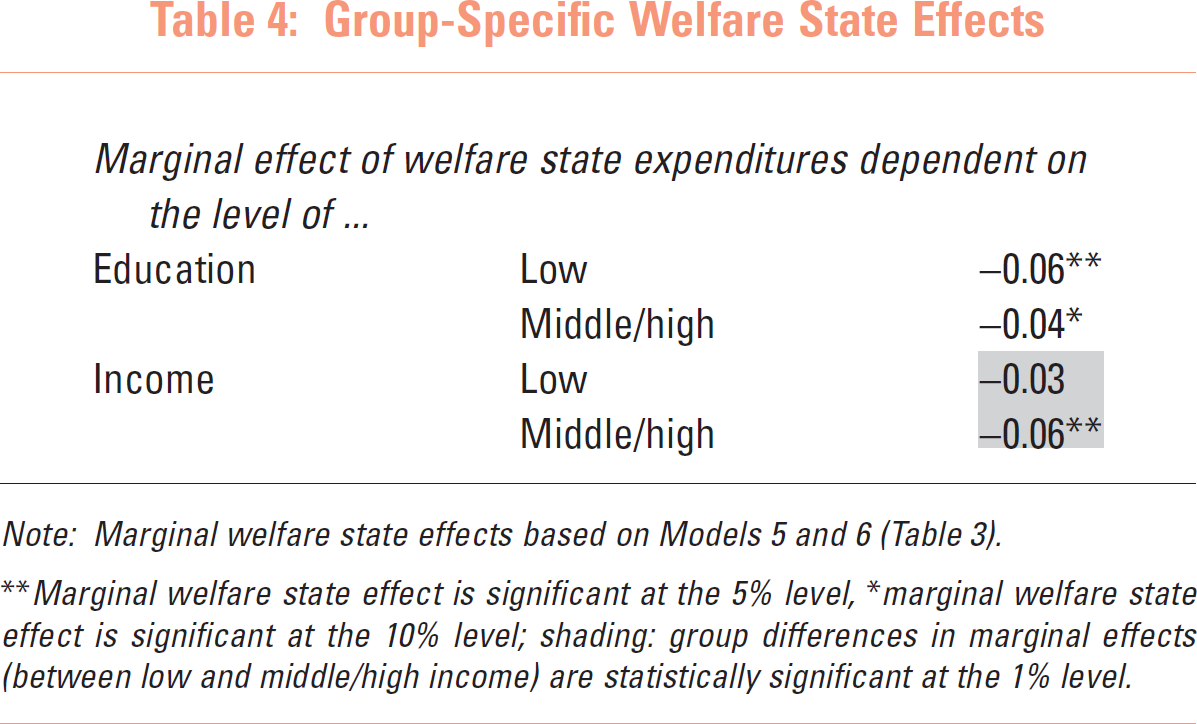
Note: Marginal welfare state effects based on Models 5 and 6 (Table 3).
Marginal welfare state effect is significant at the 5% level, *marginal welfare state effect is significant at the 10% level; shading: group differences in marginal effects (between low and middle/high income) are statistically significant at the 1% level.
Preliminary analyses demonstrate that the probability of social volunteering substantially differs among the OECD countries. As shown in Table 2, the variance coefficient at the country level is significantly different from 0 (Model 1). This continues to hold when individual characteristics are controlled for, indicating that country differences in social volunteering are not due to differences in population structure (Model 2). Basically, the statistically significant contextual variance of individual social volunteering provides support for multi-level analysis and, more specifically, for the modelling of a welfare state context.
Model 3 (Table 3) presents the overall contextual impact of welfare state policy on social volunteering. The results lend support to the crowding out hypothesis: a negative effect of social expenditures on volunteering can be expected where civil society and state activities compete against each other as service providers, which is the case concerning the provision of social services. Upon first glance, the welfare state effect seems to be small. As we have a logistic model, however, we need to look at the change in probabilities in order to evaluate effect size: in fact, the probability of individual social voluntary engagement is, ceteris paribus, twice as high in a country with a relatively limited welfare state as it is for a person with the same individual characteristics living in an extensive welfare state (see Figure 1 for an illustration of this result). The welfare state variable thereby reduces the contextual variance by one-third. 12 In contrast, no significant welfare state effect can be found for non-social volunteering. While this corroborates Hypothesis 1, crowding out can only be expected for those voluntary activities that most directly compete with welfare state services. 13
Furthermore, the following initial results can be concluded from Model 3: men have a lower probability of social volunteering than women; social volunteering tends first to increase and then decrease as an individual ages. 14 The positive and significant effect of non-employment on social volunteering can be seen against the background of the above-average engagement of housewives in this area. Religious persons exhibit a higher propensity for civic engagement. If we look at individual social status, it becomes clear that higher education primarily influences the likelihood that an individual will do unpaid social work, while the income effect, albeit in the same direction, is not statistically significant. The latter finding is somewhat surprising, but could point to the fact that the effect income has on social volunteering varies between countries. Finally, at the contextual level, the degree of economic development in terms of GDP per capita bolsters social civic engagement.
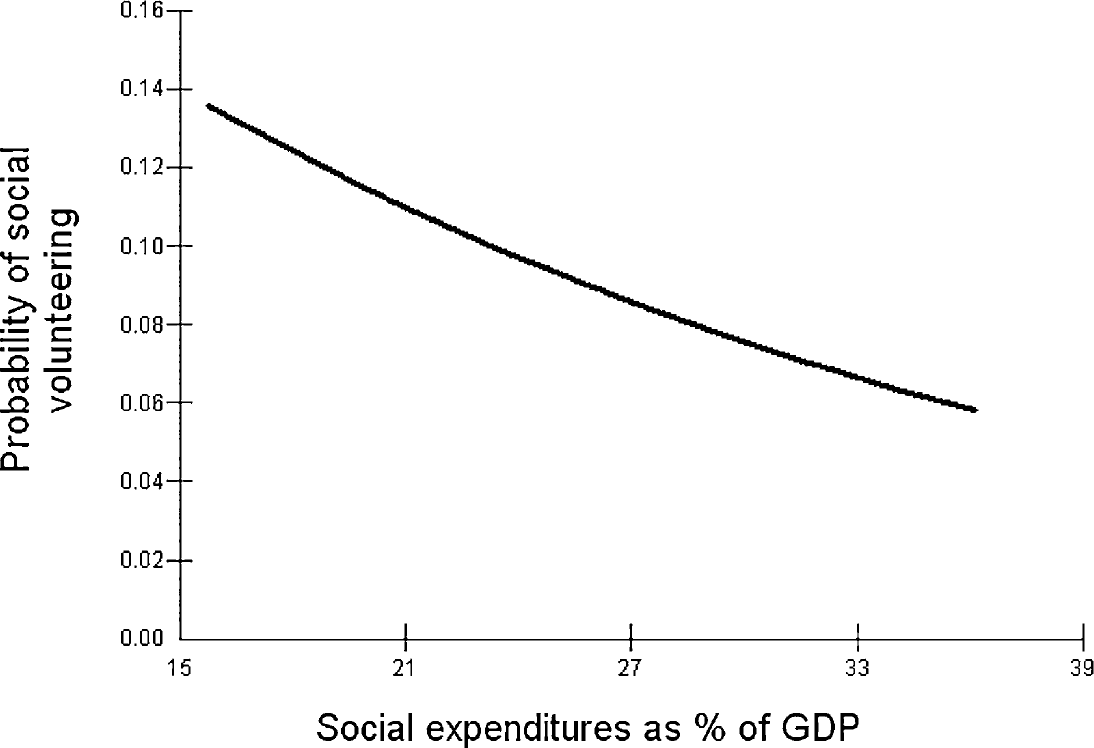
Probability of Individual Social Volunteering as the Level of Social Expenditures (% of GDP) Changes
Uniform policy effects on individual voluntary behaviour have so far been modelled. As stated in Hypotheses 2 and 3, however, it is much more plausible to assume that public provision of social services does not influence the entire population in the same way; rather, social service provision affects the various social classes in different ways. This hypothesis can be tested by modelling interaction effects in order to assess the effect of welfare state policy on different social groups. Following Christian Larsen (2007), welfare regimes generate very dissimilar living conditions, mainly at the bottom of society. Therefore, and in order to keep the model as concise as possible, two dummy variables are created that take the value of 1 if an individual belongs to the lowest respective levels of income and educational achievement. Individuals with medium or high levels of income and education, respectively, are assigned the value of 0.
Two models are estimated, one containing a cross-level interaction between low income and welfare state effort and the other including the cross-level interaction between low education and welfare state expenditures (Table 3, Models 5 and 6). When modelling interaction effects, however, the marginal effect for the different groups and whether or not it is significant cannot directly be seen from the regression table. While the main coefficient for welfare state effort stands for the impact of welfare state expenditures for individuals with medium/high income and education, respectively, the marginal effect for individuals from lower social classes amounts to the sum of this single coefficient and the interaction coefficient. For the calculation of the standard errors, the variance/covariance matrix of the coefficients must be taken into account. Table 4 presents the results of these calculations, displaying the marginal effects of the welfare state context depending on an individual's respective levels of education and income.
The results again indicate a crowding out tendency with regard to social volunteering. More importantly, the results also demonstrate that public welfare state provisions do not affect all individuals equally. Concerning higher social classes, we still find a clear crowding out tendency. In countries that spend a high share of their GDP on welfare policy, the probability of social voluntary engagement by well-off individuals is significantly lower than in small welfare states. The results are thus in favour of Hypothesis 2, proposing a crowding out effect.
With regard to the lowest social stratum, the findings depend on whether the focus is on financial or human capital resources. The impact of welfare state policy does not affect individuals with low levels of education differently from better-educated individuals. Again, a crowding out effect can be observed if welfare state policy obtains high priority in a country. However, the situation is different in view of income classes: no statistically significant crowding out effect can be found for individuals with low income. This finding is in line with Hypothesis 2, which predicts that welfare state activities will not produce a crowding out effect in those individuals who generally exhibit a very low propensity to volunteer.
Moreover, welfare state policy significantly moderates the influence of low affluence: a negative effect of low income on social volunteering can now be found in small welfare states. Figure 2 illustrates this point, depicting the marginal effect of low income for different levels of welfare state effort. In small welfare states, low income clearly and negatively influences the probability of social volunteering. However, as we move to countries with a more extensive welfare state, this negative effect of low financial resources diminishes and ultimately fails to reach statistical significance if a country spends more than 26.3 per cent of GDP on old age, incapacity, family and unemployment benefits. This applies to nearly half of the countries, including Luxembourg and the Scandinavian countries, but also the traditional continental welfare states of France, Austria, Germany and Italy. This finding not only demonstrates that the modelling of random effects reveals varying income effects among OECD countries, but also that we can speak of an indirect positive effect of high welfare state expenditures on social volunteering, which actually corresponds to Hypothesis 3. From a substantive point of view, this means that the relatively high level of social volunteering in small welfare states such as Canada, the US or Japan takes place at the expense of socially unequal civic participation.
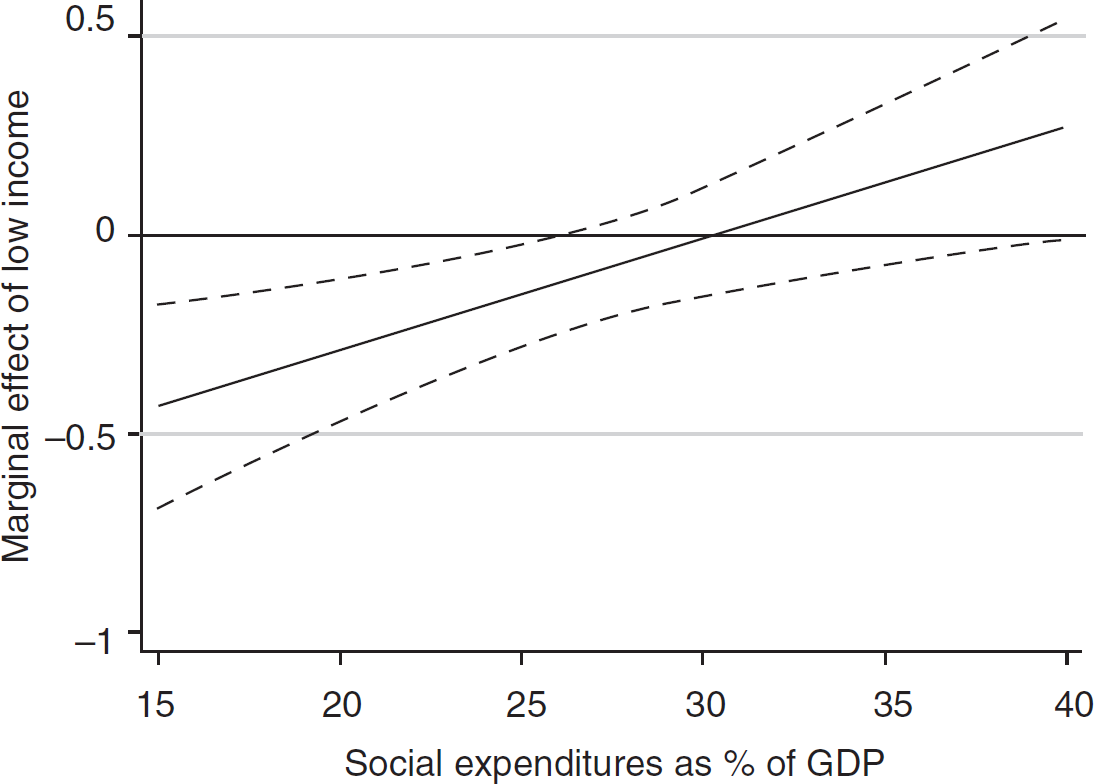
Marginal Effect of Low Income on the Probability of Social Volunteering as Welfare State Effort Changes
Considering this context, it is not surprising that these positive effects can be found for low income, but not in the presence of low education. Income is the main eligibility criterion for welfare benefits, while the individual level of education is not always a good indicator for welfare state dependency. Against this background, the different findings for education and income can be interpreted to mean that a positive welfare state effect is indeed closely linked to a resource effect.
Extensive robustness analyses have been conducted which show that the findings presented are very robust to alternative model specifications and measurements. First, alternative operationalisations of social volunteering, including or omitting categories of unpaid work (e.g. local community action, youth work), did not alter the findings. Second, slightly different measurements of welfare state effort, including or omitting particular SOCX spending categories (e.g. health), led to the same conclusions. Third, it could be argued that measuring ‘social class' by simple dummy variables is too limited. However, a different operationalisation, be it the use of three categories as in Model 3 or even a ‘metric’ variable distinguishing eight educational levels (variable x025 in the EVS/WVS data set) and ten income deciles (x047), respectively, confirms the findings presented in this contribution and even reinforces the validity of the operationalisation applied: only for the lowest income group (if income is measured with three categories), or the three lowest income deciles (if income is measured on a 1-10 scale), does the positive resource effect compensate for the crowding out effect. The simple 1/0 categorisation is thus not only reasonable with respect to the small number of cases at level 2, but also captures the essential group differences regarding welfare state effects. Fourth, further models not presented here included a number of other potential contextual controlling variables in various combinations. Indicators measuring ethnic and religious heterogeneity, income inequality, age structure, share of Catholics and Protestants, level of schooling, a dummy for former communist countries, as well as measures for democratic development and stability did not improve the explanatory power of the model, nor did they influence the reported results. Finally, a Bayesian estimation approach, 15 which is particularly suited for logistic and small-n designs, alternative link functions (e.g. complementary log–log, which assumes that a positive outcome is a rare event) as well as extensive outlier analyses, confirmed the findings presented.
Conclusion
What influence does welfare state policy have on an individual's willingness to volunteer socially? Against the background of two competing propositions, one of which assumes a fostering effect of welfare state policy on social volunteering, and the other a crowding out of civil society's social activities, the preceding analyses sought to clarify this matter. The focus on social volunteering was chosen because this type of civic engagement is theoretically most closely linked both to welfare state activities and to the crowding out hypothesis. Moreover, varying welfare state impacts on different social classes were taken into account. The findings can be summarised as follows.
If civic engagement is narrowed down to those areas most directly related to public welfare provision, empirical support is found for the crowding out hypothesis. Indeed, the probability of individual social volunteering is, ceteris paribus, higher in a country with relatively limited welfare state expenditures than it is for a person with the same individual characteristics living in an extensive welfare state. The welfare state effect is, however, not uniform across social classes. While social volunteering for the middle and upper social classes is clearly characterised by a crowding out tendency, this is less so for individuals with low income. This latter group typically comprises the main recipients of welfare state services; the welfare state provides them with resources not only for everyday life, but also for volunteering. Put differently, individuals with low income can reinvest welfare state provisions in civic activities, thereby compensating for their lack of individual resources.
In light of earlier studies that found either no effect or even a positive relationship between welfare state effort and civic engagement (e.g. Boje and Strandh, 2005; Kääriäinen and Lehtonen, 2006; Künemund and Rein, 1999; Salamon and Sokolowski, 2003), how can we go about interpreting these results? The findings presented in this article are actually not in such sharp contrast to previous results as they may initially appear. First, the crowding out effect found has been limited to that area of volunteering in which a crowding out tendency was most likely to be found. The analyses have also considered those public expenditures that are most directly related to that of which civil society is capable, within which a crowding out tendency is again most probable. The important point is, however, that it could be shown that crowding in and crowding out are parallel processes at the individual level, which may cancel each other out. Returning to the initial question of why evidence for the crowding out hypothesis has been lacking, we now have a more thorough answer: both theoretically and empirically, crowding out mainly applies to well-off population groups and is much less relevant for less affluent individuals. The latter group even profits from extensive welfare state policy in terms of equal opportunities of volunteering. Against the background of these parallel individual mechanisms, and the fact that crowding out could only be found for social volunteering, it will be difficult to find a general and overall crowding out effect of civic engagement at the country level – in fact, it is not reasonable to expect one. Put differently, a crowding out within social volunteering and for higher-class individuals is still compatible with an overall crowding in or a non-effect. Having said this, studies that do not differentiate between varying forms of volunteering and that do not take varying country and individual effects into account run the risk of overlooking what is actually going on at the individual level and fail to find a correct explanation for their (macro) results. In this respect, more research investigating welfare state effects on different areas of civic engagement continues to be necessary.
Finally, this contribution allows conclusions to be drawn both in terms of policy implications and further research. First, the finding that an extensive welfare state stimulates voluntary activities of individuals from lower social strata is of practical relevance: it means that eventually welfare states have the potential to equalise individual social participation. Given that inequality of (social and political) participation gains in importance due to increased professionalisation of civil society and the ‘Rise of the Unelected’ (Vibert, 2007), this potential must not be underestimated. Second, my results once again corroborate the notion that welfare state effort and civic engagement is not a zero-sum game (Finsveen and Van Oorschot, 2007, p. 4). As crowding out and crowding in go hand in hand, public welfare services cannot be retrenched and civil society will just ‘take over’; a stronger role of civil society may be at the expense of an increase in unequal participation. Third, and in view of future research, this article clearly illustrates the importance of Jon Elster's (1998) ‘plea for mechanism’. Only by thoroughly analysing the mechanisms between political conditions and individual behaviour can we learn more about how and when context matters for social and political outcomes.
Variables, Operationalisation and Summary Statistics
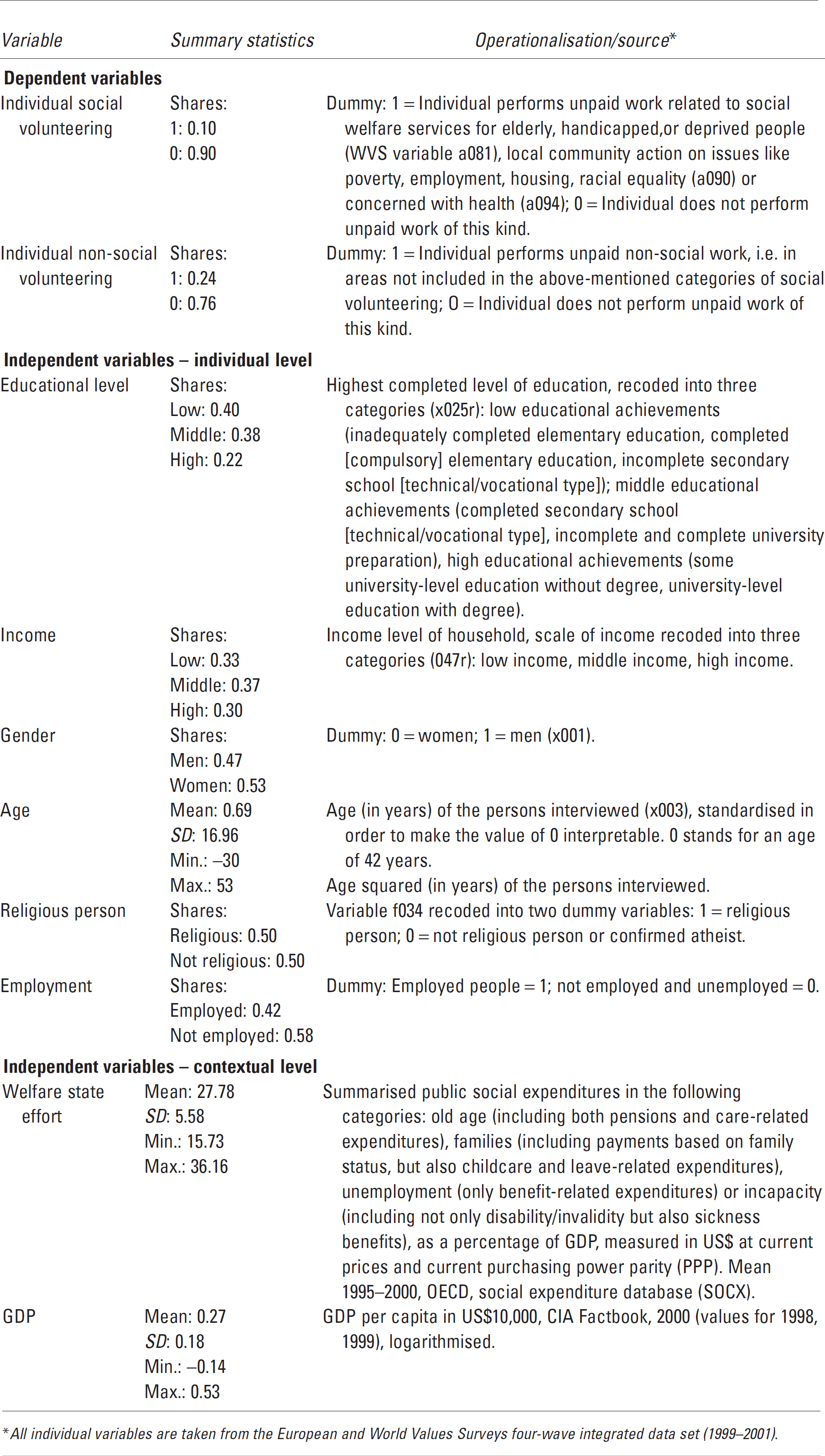
All individual variables are taken from the European and World Values Surveys four-wave integrated data set (1999-2001).
Footnotes
I am grateful to Markus Freitag, Adrienne Héritier, Richard Traunmüller and the three anonymous reviewers for helpful suggestions and Jennifer Shore for linguistic assistance. An earlier version of this article was presented to the Welfare State Working Group at the European University Institute, Florence, in November 2008. I thank the participants – in particular Martin Kohli, Sven Steinmo and Mi Ah Schøyen – for valuable comments and discussions.
1
In the following, the expressions public social services, welfare state policy and welfare state effort are used synonymously in order to refer to social service provision by the state.
2
3
 discusses a third approach – the concept of welfare pluralism. Following this point of view, social activities of the state and civil society are duplicated intentionally. This approach will not be discussed in the remainder of this study, for it is often criticised as being too vague and analytically it is not sufficiently different to the complementary relationship.
4
On the other hand, and from a more sceptical point of view, a declining (welfare) state will also lead to a declining civil society (Friedman, 2003, p. 11).
5
This is of course a rather simplified perception, and one that is unlikely to hold true for every situation. Following Korpi and Palme's (1998) paradox of redistribution, for instance, welfare states need not necessarily be redistributive. Nevertheless, various authors – among them Korpi and Palme (1998, p.676) themselves – clearly show that the more a welfare state spends, the stronger are its redistributive consequences. Moreover, at least some (vertical) redistributive effects can be found in all Western countries, implying that the position of the lower social strata is indeed improved compared to the higher ones.
6
It is worth mentioning that, from a broader point of view, this last dynamic could be seen as a complementary relationship. If social volunteering is rendered unnecessary due to substantial state activities, well-off individuals could invest their resources in other areas of civil society due to their high propensity to volunteer.
7
Respondents could indicate the following categories of civic engagement: social welfare services for elderly, handicapped or deprived people (V54); religious or church organisations (V55); education, arts, music or cultural activities (V56); labour unions (V57); political parties or groups (V58); local community actions on issues like poverty, employment, housing, racial equality (V59); Third World development or human rights (V60); conservation, environment, animal rights groups (V61); professional associations (V62); youth work (scouts, guides, youth clubs, etc.) (V63); sports and recreation (V64); women's groups (V65); peace movements (V66); and voluntary organisations concerned with health (V67).
8
The focus on unpaid work, rather than on sole membership or networks, accounts for the discussion on the activity level of civic engagement (see Rothstein, 2001, p. 218). Evers (2005, p. 746) argues that an ‘active civil society … does presuppose real experience of the delivery of public services by the citizenry’ (emphasis in original). Another approach is to focus on people's attitudes towards public social security (Van Oorschot et al., 2005, pp. 46f.). Following Rothstein (2001, pp. 220f.), however, the development of an affinity and actual support for private or public welfare provision need not necessarily go together.
9
It would nonetheless be desirable to measure these crucial aspects of welfare state policy (also) by means of eligibility criteria and actual benefits; however, such comparable data are not readily available for a large country sample. The benefit generosity index proposed by , for example, only includes eighteen OECD countries.
10
Some numbers appear somewhat surprising. In particular, Spain and Poland are generally not known for their strong welfare policies. Two comments on the welfare state measure used and on the narrow conception of welfare state policy in particular can, however, explain these cases. First, while both countries are ‘small’ welfare states with regard to family-related expenditures (as one would expect), they, like the conservative welfare states France, Germany and Italy, do spend a considerable amount on social security, particularly on pensions. At the same time, both countries exhibit a fairly low GDP in OECD comparisons, meaning that they achieve high expenditure shares with relative ease. In any case, the results presented in the following are not sensitive to these two countries.
11
Although GDP is part of the measures of social spending, the GDP variable as such is also integrated into the models for two reasons. First, a correlation analysis demonstrates that the relationship between the level of GDP (logarithmised) and social spending as a percentage of GDP is weak (Pearson's r = 0.29). This shows that GDP should still be integrated into the models in order to control for the level of economic and social development. Second, the GDP variable also accounts for a shortcoming of the social spending variable: the welfare state indicator not only depends on public social spending, but also on GDP, meaning that high values of this indicator can be derived both by substantial social spending and low GDP.
12
13
As non-social volunteering is not at the centre of our focus, it will not be discussed further. Further analyses not presented here demonstrate that the results found in Model 4 are confirmed if group-specific welfare state effects are taken into account.
14
Note that the positive coefficients for age result from the mean standardisation of the variable. When calculating the marginal effect of the quadratic age term, an inverted u-shaped curve still results.
15
290,000 iterations, burn-in 50,000, slightly informative priors (mean = 0, standard deviation 10,000).