







Abstract
Lipsky's work on ‘street-level bureaucracy’ drew attention to the significant contribution to policy making made by front-line workers. This article revisits Lipsky's seminal analysis to explore whether contemporary front-line work in local governance presents a challenge to the ‘street-level bureaucrat’ characterisation. Since Lipsky's analysis, local government has been the subject of extensive reforms which have eroded traditional structures. In order to make local governance work, front-line workers need to be entrepreneurial to innovate and work the emergent spaces of local governance. This research uses an interpretive analysis to explore how front-line workers understand and relate their everyday work through storytelling. Front-line workers articulate a series of strategies which they employ to enable them to build relationships with the community. The article concludes that the emergent spaces at the periphery of local governance require front-line work that is less like ‘street-level bureaucracy’ and more like ‘civic entrepreneurship’.
The work of Michael Lipsky (1976; 1980) on ‘street-level bureaucrats' and their discretion in the public policy process remains a key insight into the study of implementation. Lipsky argued that front-line workers contribute significantly to policy making through exercising discretion in their everyday work. This everyday work now involves a responsibility for policy delivery, and also to engage with service users and the community. In the decades since Lipsky's analysis, the perceived shift towards governance has been seen to have altered the role of the state and the process of policy making. This article revisits Lipsky's analysis and uses an interpretive approach to develop an understanding of front-line work in contemporary local governance.
The early part of the New Labour administration saw a proliferation of reforms aiming to tackle cross-cutting so-called ‘wicked’ problems and improve public services. These reforms have been framed in a narrative of change which displays an ongoing tendency towards centralisation with rhetoric around empowering front-line workers in their everyday work and in the policy process. Gerry Stoker (2004, p. 69) has argued that New Labour's policies are ‘deliberately designed to be a muddle in order both to search for the right reform formula and to create a dynamic for change by creating instability, but also space for innovation’.
During the same period, local government has undergone significant and continuing reform, becoming ‘more differentiated and devolved’ (Stoker, 2004, p. 174). As Sue Goss
(2001, p. 1) notes, local governance ‘is no longer theory[,] it has become practice’. ‘Joined-up’ government and partnership working are prominent themes within this emergent narrative of local governance along with a growing consensus of the local level as the most appropriate and effective scale for community engagement (6 et al., 1999; 2002; Goss, 2001; Stoker, 2004; Sullivan and Skelcher, 2002). Yet, Goss has powerfully argued that:
[in local governance] old ways of doing things are becoming obsolete before new ways are fully established. This means that the immediate experience for many of those participating is that of muddle and mess … it is precisely because the old ways of doing things can't work now, and can't be made to work, that new ways are opening up (Goss, 2001, p. 5).
Peter Hupe and Michael Hill (2007) have argued that front-line workers face an ‘action imperative’ and so have to work to ‘accommodate mess' in local governance (Lowndes, 1997). In dealing with the ‘muddle and mess' that has emerged in the move towards local governance, front-line workers are now charged with reconciling the emergent demands of governance – notably those from the communities they work within – with the remnants of earlier structures of local government.
This article questions whether contemporary local governance arrangements present a challenge to Lipsky's (1976; 1980) conception of front-line work as ‘street-level bureaucracy’. This article first sets out Lipsky's understanding of ‘street-level bureaucracy’ before examining the context for front-line work in contemporary UK local governance. The article will then introduce an interpretive framework and methodology for this research, which draws on front-line workers' own stories and narratives about their everyday work in a contemporary UK local governance setting. The empirical section of the article draws out the strategies that front-line workers use in their everyday work. The article concludes by arguing that front-line work at the boundaries of local governance may now be characterised by ‘civic entrepreneurship’ where practitioners work to reconcile policy priorities with community demands through community-centred strategies.
Bureaucracy and Governance at the Local Level
Donald Van Meter and Carl Van Horn (1975, p. 445) noted that ‘the implementation problem is assumed to be a series of mundane decisions and interactions’. Traditionally in political science, the interplay between politicians and administrators has been neglected and scholars have tended to view the political system in a way that reinforces the demarcation between policy and administration where the role of the administrator is to carry out policy formulated by decision makers (Parsons, 1995; Pressman and Wildavsky, 1973; Weber, 1947). Commentators have argued that this ‘top-down’ account of policy making simply does not describe how government works, and as Andrew Dunsire (1990, p. 4) bluntly notes, ‘excludes any consideration of how real people behave’.
'Top-down’ accounts underestimated the importance of negotiation with front-line staff, service users and others in the establishment of the meaning of policy and its implementation (Hill, 2003; Van Meter and Van Horn, 1975). Lipsky challenged these analyses with a so-called ‘bottom-up’ argument asserting that ‘policy making does not simply end once a policy is set out’ (Lipsky, 1980, p. x), and commenting that ‘in important ways it [public policy] is actually made in the crowded offices and daily encounters of street-level workers' (Lipsky, 1980, p. xii). Lipsky's concept of ‘street-level bureaucrats' defined front-line workers as having some responsibility for the delivery of policy and public services at the local level and engaging with the community in their day-to-day work. ‘Discretion’ is an important concept in understanding the policy-making role of street-level bureaucrats and is taken to mean choice or judgement within recognised boundaries. Lipsky (1980) views the discretion of street-level bureaucrats as necessary for several reasons: first, discretion is required to apply rules in specific cases because situations are often too complex to be reduced to programmatic formats; second, some situations require public employees to make judgements about people; and third, street-level discretion ‘promotes workers' self regard and encourages clients to believe that workers hold the key to their well being’ (Lipsky, 1980, p. 15). Finally, some public employees must operate independently of direct supervision as they carry out their tasks. Lipsky identifies a number of techniques or strategies that characterise the discretion of street-level bureaucrats. These include: ‘routinising, modifying goals, rationing their services, redefining or limiting the clientele to be served, asserting priorities and generally developing practices that permit them to process the work they are required to do in some way’, often in the context of severe limitations on personnel and organisational resources (Lipsky, 1976, p. 207). As Lipsky (1980, p. xii) asserts, ‘the decisions of street level bureaucrats, the routines they establish and the devices they invent to cope with uncertainties and work pressures effectively become the public policies they carry out’. The term ‘street-level bureaucracy’ reflects a state and a policy process characterised by discrete, hierarchical, bureaucratic silos but Lipsky acknowledges that the content of policy and its impact on those affected can be substantially modified during the implementation stage through the discretion of street-level bureaucrats. As such, the distinction between policy as political input and implementation as administrative outcome becomes blurred.
New Labour's analysis of policy making criticised the traditional ‘top-down’ nature of policy making for failing to address so-called ‘wicked’ social problems and actively sought to embrace the contribution of practitioners (Jervis and Richards, 1997). The early White Paper, ‘Modernising Government’, argued for a policy process with ‘more new ideas, more willingness to question inherited ways of doing things … [a] more creative approach to policy making’ (Cabinet Office, 1999, p. 16). The starting point for this modernisation was public sector staff themselves, who the government argued are ‘as innovative and entrepreneurial as anyone outside government’ (Cabinet Office, 1999, p. 11).
The idea of a more inclusive policy process expressed in this early New Labour policy document illustrates the emergence in the last two decades of a narrative of ‘governance’ which has become hegemonic in describing and analysing the changes that have taken place in both the national and local state (March and Olsen, 1989; Pierre and Peters, 2000). Yet Mark Bevir and Rod Rhodes (2003) have argued that the governance narrative advanced by many commentators is one-sided and does not recognise that the state is characterised by a mix of organisational mechanisms: a proliferation of forms of networks, collaboration and partnership working matched with a persistence and arguable extension of bureaucratic and market mechanisms. There is also a significant degree of iteration between ‘centralisation’ and ‘governance’. Indeed, while governance reforms have sought to empower local agencies, this has been balanced against the growing prevalence of managerialist measures including performance indicators and targets (6 and Peck, 2004; Hood, 2006). Goss argues that this context of iteration has radically reconstituted the everyday work of local governance practitioners who are now charged with ‘Working the boundaries between managerial action, professional expertise, political agendas, financial accountabilities and creating relatively safe spaces within which to act … their job is no longer, if it ever was, to follow procedure. It involves exploration, experimentation and challenge (Goss, 2001, p. 163). Goss further reflects:
The very experience of … working in the space between bureaucratic, market and network cultures, creates space for innovation. People working in these spaces learn extraordinary skills … The constant collision of different assumptions and traditions offers scope to challenge on all sides. The very messiness begins to break down old systems and procedures, which cannot function in chaos … New skills and capabilities are needed – entrepreneurial skills, the capacity to manage risk and manage legitimacy – not simply at the top but throughout public organisations (Goss, 2001, p. 5).
Vivien Lowndes (2005, p. 291) has echoed the assertions made by Goss, arguing that in local governance ‘creative spaces exist between the extremes of institutional stability and volatility’. These ‘creative spaces' are occupied by ‘institutional entrepreneurs' who exploit emergent ambiguities in the ‘rules of the game’ in order to respond to changing environments (Lowndes, 2005, p. 291). As Goss (2001, p. 201, emphasis in original) comments, ‘the new system of local governance is not either failing or working – it is being worked by the men and women within it’. Martyn Hajer (2003) has described these new governance spaces as an ‘institutional void’ where rules and working practices are not fixed but open to interpretation.
A further key element in reconstituting the policy process has been engaging the community in shaping policy and decision making on issues that affect their everyday lives (Taylor, 2003). Goss (2001, p. 4) has argued that as public sector staff ‘begin to engage more with each other and with the public, they face a series of dilemmas about the purpose of government, about the roles of citizens’. Stephen Maynard-Moody and Michael Musheno (2003, p. 20) described Lipsky's ‘street-level bureaucrat’ as a ‘state agent’ which ‘is incomplete and distorts our understanding of governing on the front-lines’. Maynard-Moody and Musheno (2000, p. 329) argue that the central tenets of this narrative – ‘hierarchy’, ‘legitimacy’, ‘implementation’ and ‘discretion’ – have little currency in the institutional culture of street-level workers and they argue further that ‘the language and terms of the dominant scholarly narrative are foreign and, for the most part, absent from the street level workers' own narratives': ‘they don't describe themselves as policy makers, decision makers or even government workers' (Maynard-Moody and Musheno, 2000, p. 347). Maynard-Moody and Musheno (2000; 2003) instead use the term ‘citizen agent’ to describe front-line workers and argue that front-line work is defined by relationships with citizens and other street-level workers. Maynard-Moody and Musheno (2000, p. 353) also give voice to a characterisation of front-line work that is more informal and that is conducted with ‘only loose guidance and constraint’. ‘Citizen agents negotiate their role through pragmatism, local knowledge or “street smarts” ‘ (Durose, 2009; Maynard-Moody and Musheno, 2000, p. 354; Yanow, 1996; 2004). In dealing with the ‘muddle and mess' that has emerged in the move towards local governance, front-line workers are now charged with reconciling the emergent demands of governance – notably those of the communities they work within – with the remnants of earlier structures of local government. Front-line workers have to interpret policy, work with communities and make choices about how to implement and deliver policy in a locally appropriate and mutually beneficial way. This reconstituted role for front-line workers requires Lipsky's notion of ‘street-level bureaucracy’ to be revisited and explored empirically in a contemporary local governance setting.
Interpreting Front-Line Work
This research contributes to a growing body of interpretive work in UK public policy (Bevir and Richards, 2009; Clarke and Gains, 2007; Durose, 2009; Richards and Smith, 2004; Sullivan, 2007). An interpretive approach allows understanding of ‘the institutions of governance by studying the various contingent meanings informing the actions of the relevant individuals' (Bevir and Rhodes, 2003, p. 62; see also Yanow, 2006). The research has sought to explore important yet mundane and often missed dynamics of front-line work. The objective of this sort of research is not to give a perspective on front-line work within local governance and neighbourhood management which is necessarily representative or generalisable, but which is embedded and reflective of its context (Yanow, 2000).
Conducting Research with Front-Line Workers
Preliminary empirical research took place over a three-month period in 2005 which involved informal meetings with front-line workers, neighbourhood managers and senior officers and attending neighbourhood events together with gathering data from a range of secondary sources. The main period of research took place over a six-month period in 2006 and involved semi-structured interviews with more than 40 front-line workers in neighbourhood teams. Front-line workers were identified for the research by working with neighbourhood managers and coordinators and the sample was ‘snowballed’ by suggestions from other front-line workers (Erlandson et al., 1993). Front-line roles of those interviewed varied from community development and youth work to health improvement and street environment work. Front-line workers detailed their specific roles: their employment and background; the neighbourhood they worked in; their perception of the neighbourhood management system; any issues they encountered in their everyday work and how they responded; recent examples of projects or initiatives they had worked on; and their perspectives on wider public sector reform.
Stories and Narratives
When asking front-line workers questions about their everyday work, their responses were often in the form of stories. The research became a collection of these everyday work stories. Story-based analysis is an interpretive research methodology, recognising as do Feldman et al. (2004, p. 147, cited in Durose, 2009, p. 41) that stories are ‘a basic tool that individuals use to communicate and create understanding with other people and for themselves’. Maynard-Moody and Musheno have also highlighted an important advantage of story-based research:
Stories give research a pungency and vitality absent from mainstream social science because they give such prominence to individual actions and motives … Stories illustrate the consequences of following, bending or ignoring rules and practices. They bring institutions to life; they provide a glimpse of what it is like to [work there] (Maynard-Moody and Musheno, 2003, p. 30, cited in Durose, 2009, p. 41).
The stories given by front-line workers were ‘at once a microscope for examining minute details and a telescope for scanning the intellectual horizon for themes and patterns' (Maynard-Moody and Musheno, 2006, p. 26). The extensive notes and recordings taken throughout the research were also transcribed. The process of transcription made a crucial contribution to developing the narrative reflecting Harry Wolcott's (1990, p. 21, emphasis in original) comment that ‘writing is thinking’. The iterative nature of this process was then further developed by sharing initial analyses both with research participants and with other researchers in the field (Erlandson et al., 1993). This process demonstrated a commitment to ‘get it right’ in terms of the lived experience of front-line workers (Schwartz-Shea, 2006, p. 105). Story-based research is complex, ambiguous, selective and subjective (Maynard-Moody and Musheno, 2003; Stake, 2000; Yanow, 2000) but it provides an important insight not given by other research methodologies into how everyday front-line work in contemporary local governance is constituted.
Local Governance and Neighbourhood Working in Salford
‘Neighbourhood’ is a contested but appealing concept in public policy and local governance which re-emerged under New Labour as a site for both policy action and governance. The ‘neighbourhood’ has been seen as a viable and appropriate level to achieve a range of policy agendas including innovation in service delivery, ‘joined-up’ governance, and to engage communities (Durose and Richardson, 2009; Lowndes and Sullivan, 2008). While acknowledging that there is no definitive size for a neighbourhood, urban neighbourhoods have been estimated at 1,000 to 2,000 households or up to 6,000 people (Power, 2004). Local authorities have often worked at a larger scale with exemplars identified in neighbourhoods of up to 30,000 residents (White et al., 2006). ‘Neighbourhoods' have widely been defined according to existing administrative and ward boundaries. Neighbourhood-based working has led to a proliferation of different structures and systems at the sub-local level (Durose and Richardson, 2009, pp. 32–3). This research draws on the case study of the neighbourhood management system developed in Salford.
Salford is a city in the North West of England marked by deprivation following the decline of heavy industry: fifteen out of twenty wards in the city are within the worst 20 per cent nationally (SEU, 2001). Salford has made a renewed commitment to neighbourhood working as part of a wider regeneration strategy for the city, building on the sustained and intensive interventions of government over the last two decades. Salford has received every round of Single Regeneration Budget funding from 1995 and since 19971 has received £53 million for a New Deal for Communities initiative along with Sure Start, Health Action and Education Action Zones funding aimed at tackling deprivation and inequality. The regeneration strategy for the city divided it into two areas: Central Salford and Salford West. The area designated Central Salford was also given Housing Market Renewal Pathfinder status in the late 1990s and an Urban Regeneration Company has since been established for the area. Central Salford is an area of intense deprivation, but it is perceived to have significant potential for economic development. This potential was acknowledged with the designation of Central Salford as the site of the BBC relocation and the development of Media City. The remainder of the city – designated as Salford West – is a more mixed picture, but still contains areas of marked deprivation. The strategy for Salford West is stabilisation as opposed to the transformational change aimed for in Salford Central (Partners IN Salford, 2003).
Salford was identified as a Neighbourhood Management Pathfinder in 1998, the evaluation of which later commented that ‘Neighbourhood management is seen … as a means of engaging effectively with local communities, meeting the needs of communities' (Meegan, 2006, p. i). In Salford, neighbourhood management was implemented across the city rather than being targeted only in areas of deprivation and disadvantage with the aim of improving neighbourhoods citywide and reducing inequalities between neighbourhoods. The local authority area of Salford was divided into eight neighbourhoods with populations ranging from 14,000 to 39,000, reflecting the pre-existing service delivery areas and political ward boundaries.
Each of the eight designated ‘neighbourhoods' across the city has been allocated a neighbourhood team convened by the local authority. Each neighbourhood has a Neighbourhood Manager who is permanently located in the neighbourhood along with the community development workers who are all employed directly by the local authority. 2 The teams also include a number of front-line workers from the local authority given responsibility for a specific neighbourhood or due to resource constraints working across two neighbourhoods. Other front-line workers included in the neighbourhood teams were employed by arm's-length management organisations responsible for providing public services such as social housing and leisure. Front-line workers in neighbourhood teams were charged with engaging with voluntary and community organisations within their neighbourhood and working with relevant city-level organisations.
The work of the neighbourhood teams is shaped by multiple drivers including central government policy, the remit of particular regeneration and policy interventions within specific neighbourhoods, the citywide regeneration strategy and Community Action Plans (CAPs). 3 Neighbourhood teams are responsible to the Community Committees along with the political executive of the local authority and the Executive Group of senior officers. Project activity is now well established across the neighbourhoods. The Neighbourhood Management Pathfinder evaluation acknowledged that the Salford model ‘already appears to be demonstrating capacity for delivery and sustainable renewal’ (Meegan, 2006, p. 12).
The diffusion of accountability and opportunities for empowerment within local governance at the front line have to be balanced against the demands of performance management and scrutiny, as one front-line worker commented: ‘I spend a lot of time reporting what I am doing … going to structures rather than getting on with it … it seems like we have too many bosses’. Front-line workers also have to work to reconcile the demands of performance management and associated work streams in their ‘day job’ along with the ‘add-on’ responsibilities, notably around working with the community in their assigned neighbourhood, as one front-line worker commented: ‘I'm there to support the [community] but not to be the face of Salford City Council so that's a concern that I have around this work and it's an ongoing tension’.
Developing Front-Line Work: Engaging with Communities
Front-line workers in local governance commented extensively on how the context of their everyday work was changing; one local governance practitioner argued that front-line workers
have more flexibility within their roles to do what is the right thing within that setting … That's quite a big change because essentially we work in a bureaucracy where people are cogs in a wheel and they do their bit and what we [in neighbourhood management] are asking them to do is to step out of that mould and make it up as they go along a bit more.
A front-line worker also reflected on the emerging flexibility in her role: ‘[I] was very excited by some of the ideas that were developing … there weren't any actual constraints or boundaries’. A further front-line worker commented on the innovative practice emerging in local governance: ‘I think that there is stuff going on with individual officers that is pioneering that … does push the boundaries’.
Front-line workers in this reconstituted space of local governance can be seen as ‘professional’ in the sense that ‘they claim that they should be trusted by their managers to use discretion to tackle their work tasks in an adaptive way’ (Hupe and Hill, 2007, p. 282). This sort of front-line professionalism relies on front-line workers' own ‘local knowledge’. Most front-line workers involved in the research were strongly embedded in the local area and exhibited high levels of ‘local knowledge’ built through their lived experience, either by working in local governance or public or voluntary sector organisations in Salford over a period or through being raised or living in the areas where they currently work (Durose, 2009).
Front-line workers are charged with engaging the community in decision making, particularly about local service delivery and in shaping the policy interventions ongoing in many urban neighbourhoods in Salford. Front-line workers are charged with making the priorities set in the Community Action Plans ‘happen’. Front-line workers network, attend numerous meetings with existing and potential partner organisations and engage with the community through the formal means of meetings such as Community Committees but also more informally through attending neighbourhood-based events and working with existing community groups. Front-line workers in the neighbourhood teams are charged with drawing in funding to support particular projects and initiatives put forward by the community. Front-line workers also have to work with local elected members who are increasingly asked to act as ‘community champions' (ODPM/Home Office, 2005). This reconstituted role is seen to present a challenge to the practice of elected members and front-line workers.
Working with the community comes with significant difficulties as often consultation about decision making is nothing new to residents in deprived areas where regeneration interventions have been sustained and repeated over an extensive period of time. Front-line workers described communities as ‘burned out’ and ‘resentful’ and argued that the community is often ‘not going to believe’ in attempts to engage with it due to the perception of previous interventions as ‘tokenistic’ and the absence of ‘a link between asking and doing’.
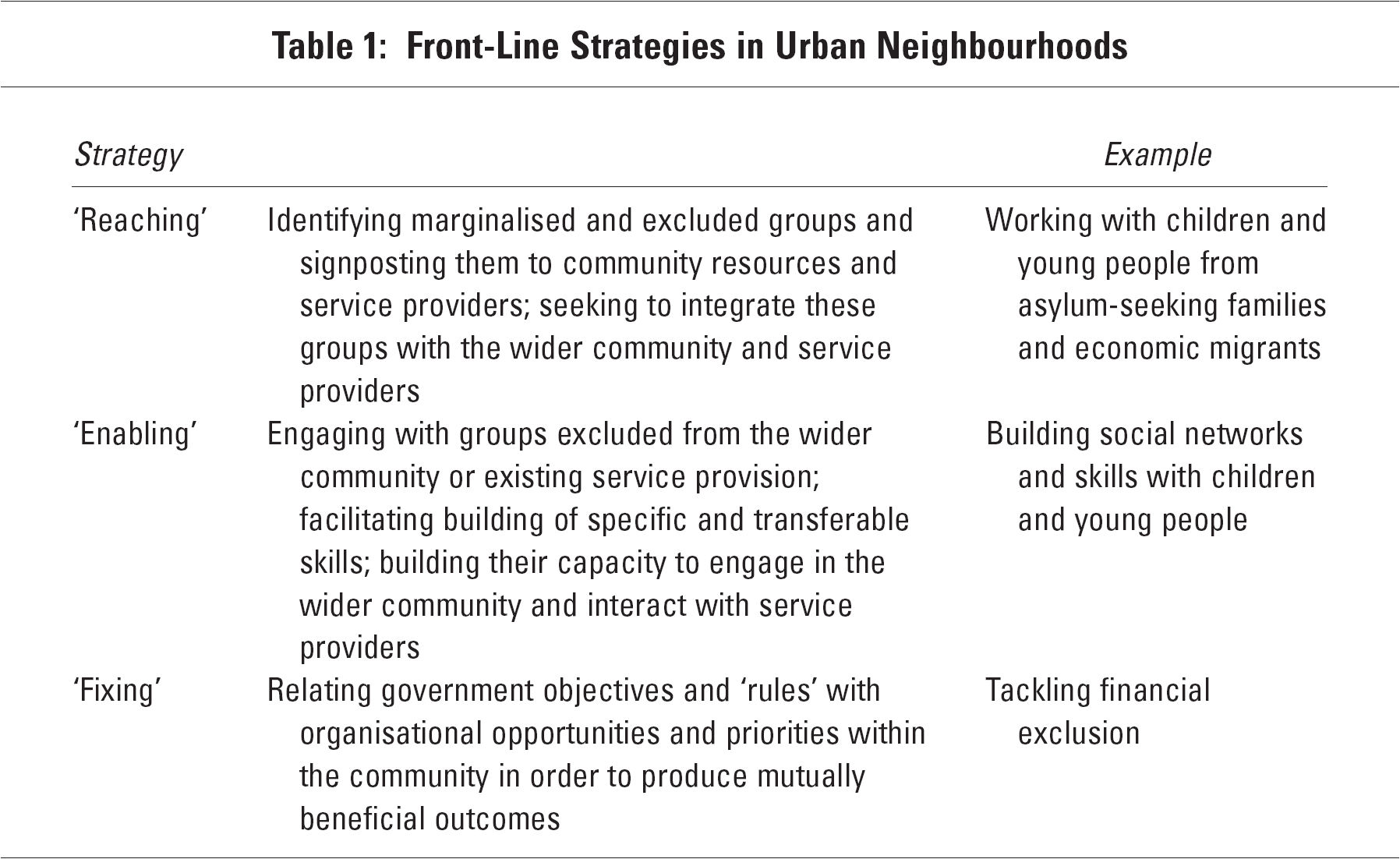
Lowndes' (2005) work on the ‘institutional entrepreneur’ in local governance identified strategies of ‘sharing’, ‘borrowing’ and ‘remembering’ used in everyday work. These strategies focused on how institutional entrepreneurs acted within and across organisations involved in service delivery to develop practice to respond to a changing environment. Front-line workers in local governance have focused their responses to the ‘muddle and mess' on developing strategies to engage with the community. From the iterative and interpretive research process outlined, three further strategies that front-line workers in local governance and neighbourhood management use in their everyday work to respond to the demands of engaging the community were identified; these strategies are ‘reaching’, ‘enabling’ and ‘fixing’.
'Reaching’: Signposting Resources for Community Groups
Front-line workers sought to ‘reach’ out to marginalised and excluded groups and signpost the resources and services available to them. This strategy was particularly used with so-called ‘new’ communities such as economic migrants from the accession countries of Central and Eastern Europe. In one of the designated neighbourhoods of Central Salford where this community is concentrated, one community development worker described another's initial approach: ‘[he] did a bit of door knocking and targeting where he knew these people would be found … and one of the quick wins he did was just offering a bit of a social event here in the centre’. The event was seen as a success, linking new groups in the community with basic service provision; the community development worker commented further: ‘I think sixty or seventy [economic migrants] turned up … it gave us an understanding of what people's needs were in the area’. The event also provided an opportunity to integrate this excluded community of economic migrants with the wider community, as the same front-line worker highlighted: ‘it was for everybody … we invited the councillors, we invited various agencies, we invited residents' groups in the area … a lot of the day was to try and make them [the economic migrants] feel part of the community’.
Another front-line worker involved in youth work sought to engage the children and young people from asylum-seeking families; she commented: ‘people come over here seeking asylum and they are dumped in the most challenging, difficult estates, so they were getting a lot of hassle from people who didn't understand why they were here’. Together with other front-line workers in this deprived neighbourhood in Salford West, she developed a programme of work to integrate these children and young people into the wider community and with public services; she described how it worked:
The group [of children and young people from asylum-seeking families] had a separate time here [at the youth centre] where they could work around a lot of basic stuff really about what kind of buses you might get, college places, how to get in school, learning a bit of English and supporting each other as a group. And in the youth centre, we did some work about dispelling the myths about asylum seekers and then we brought the two groups together and we've now got a mixed group within the youth centre.
Another children- and young people-centred project also based in a deprived area of Salford West focused on ‘reaching out’ to them to tackle their alcohol and drug use which was giving rise to antisocial behaviour; one front-line worker related the background story:
[There was] an old railway tunnel that was disused young people had claimed as their own and were meeting there and there was about 150 young people on a Friday night having a really good time … it was warm, it was dry, but they were drinking quite a lot of alcohol and [there was] suspicion of drugs being taken there … so we went on a Friday, Saturday night … Outreach work to be done on a Friday and Saturday night that was a cultural change for the youth service.
She continued, highlighting how the project led to a shift in the working practices of front-line workers and challenged the nature and scope of their role in engaging with the community:
There was four of us, working with young people, talking to them about their safety issues … talking about any kind of issues that were going on. But the issue for young people was that they wanted to drink on a Friday night, they were looking for somewhere safe and were being moved on. So, we were wrestling with not being seen to condone that behaviour, but working with young people to educate them about their health and their safety … What has resulted is negotiations with people about what our role should be … when is it an education role and when is it an enforcement role?
'Enabling’: Building Community Capacity and Skills
These ‘reaching’ strategies are for many front-line workers a starting point for further engagement with these groups and can be developed into ‘enabling’ strategies. ‘Enabling’ strategies aim to engage with so-called ‘hard-to-reach’ groups that are marginalised, excluded or neglected within the community in order to build skills, capacity and confidence.
In one neighbourhood, two projects were developed which aimed to make women, particularly mothers, feel as if they are part of a community, give them the opportunity to engage with others in similar situations and build practical and social skills. One project saw front-line workers engage with young mums through a cookery project. One neighbourhood-based health improvement worker described the group that the project was seeking to engage with and how they were identified:
Four mums at a time come along for a six week course … now, these are young mums with very young babies and they've been identified as having very little cooking skills … we're … identifying them through the health visitors … they've identified themselves as well and other services such as the youth service and teenage pregnancy.
The health improvement worker went on to outline the aims of the project: ‘They've got very little cooking skills but they want to better them and learn about food hygiene, health and safety, buying and budgeting, going to the supermarket and buying fresh food’.
Another health improvement worker in the same neighbourhood of Salford West outlines the ‘Breast Friends' project which also tries to bring mothers together:
[The group] is a breast feeding support group, they're all mums who have been trained in peer counselling and that's to counsel mums who may have a problem with breast feeding, may have a couple of questions to ask, may just want someone to talk to once a week … so it's about getting mum out of the home and … making life a little bit less isolated when you are at home with a little baby and it's also encouraging breast feeding.
The Breast Friends project gives women the opportunity to train as peer counsellors and to develop practical relevant skills for parenting or caring for a young child but also to talk and meet other women in the same situation and living in the same neighbourhood.
In other neighbourhoods, front-line workers focused on providing diversionary activities for children and young people involved or seen to be at risk of becoming involved in antisocial behaviour. The projects sought to bring together groups of young people from across different neighbourhoods and give them opportunities to engage in more constructive activities to develop resilience against becoming involved in antisocial behaviour. One such example was a Friday night football project. This project sought wide-ranging involvement from young people but also targeted individuals considered to be at risk of becoming engaged in crime and disorder. One sports development officer detailed how one young offender was targeted for the project:
I work very closely with the youth service … I've also worked with the probation service during the Friday night football project … that [project] was identified through neighbourhood management and community sector team meetings. A young man had been in a lot of trouble had spent time in a young offenders' institute but was now on the straight and narrow and the best way we thought to get him integrating with young people was football; so we starting taking him to a Friday night football project.
Through giving structured opportunities to engage in teamwork and to mix with other young people outside their immediate local area, the project aims to develop young people's social skills and to diffuse tensions. Another sports development officer describes how the project works:
This is a city wide sports development initiative, the aim of the league really was to get young lads … that are causing anti social behaviour off the streets between five and eight at night. So we pick them up from a specific area, we will pick them up from their local estate and take them to the new sports village and they take part in an activity in a league which is ran by us and then they are taken back and that's all free.
The football project was centred on young men and boys and so a further project using street dance was developed to appeal specifically to young women and girls. The project was not only about tackling antisocial behaviour but also about improving health and well-being and again providing opportunities for young people to work together in a constructive activity. A further sports development worker commented:
The street dancing project started about three years ago … and it was a [front-line] colleague who worked in this area before me and they identified a need for sport for girls particularly … it's great putting on football for lads because we know that they are going to attend, but it was about getting some alternative sports and fitness for girls and we thought the way to go about that was through dance.
The project has been successful in attracting high numbers of girls and young women. It was important in addressing an existing problem in a new and different way and engaging with a group that had not previously been specifically catered for in leisure and sports provision. The street dance sessions also provided a means of drawing in the wider community and for the participants to develop new skills and gain ‘ownership’ of the project. As one front-line worker commented,
We don't just do street dancing classes we perform in local events for example local church events, festivals, we're actually working towards performing on a big showcase with all the dance groups in Salford and they're going to be in a big show, so they are working towards something and their families can be supportive … it's really good because they are able to sit down and decide that it's their group for them. They know it's for them … and they know it's theirs, and they participate.
'Fixing’: Reinterpreting Rules to Prioritise Local Needs
Front-line workers also often engage in a strategy of ‘fixing’ which allows them to bring together the objectives of government policies with the organisational opportunities available to and the priorities and concerns articulated by the community in order to produce outcomes that satisfy these agendas. Front-line workers in one neighbourhood linked government policy drivers for public health with an opportunity to build a local partnership around issues of financial literacy and exclusion (see Durose, 2009). One community development worker commented: ‘financial literacy was something that we had been aware of as a team and there had been issues in our area from anecdotal evidence [about the] likelihood of being in debt, etc. related to ill health and mental health and physical and mental well being’.
A health development worker highlighted the instrumental importance of tackling financial exclusion:
[W]e've got high levels of poverty and debt in our areas and unless we can do something around tackling those issues we're not going to get them interested in some of the others, like eating better and getting exercise … and doing programmes around things we want them to do to improve their health.
Workers developed a cross-sectoral partnership with a range of organisations with cross-cutting agendas around tackling financial exclusion. The partnership responded in part to the agendas of individual organisations and provided a basis for accessing additional funding. The next stage was to engage the community; the first project to address financial exclusion put forward by the partnership was an open event. Individuals were referred and signposted to the event by a range of partner events, with the acknowledgement ‘that it would be very difficult to get [to] our audience’. Front-line workers have since acted to embed a focus on tackling financial exclusion in the community. One initiative, for example, has been to develop a credit union on the main social housing estate in the area, based on an example from the adjacent neighbourhood.
The strategies of ‘reaching’, ‘enabling’ and ‘fixing’ are summarised in Table 1.
Front-Line Strategies in Urban Neighbourhoods
Re-interpreting Front-Line Work in UK Local Governance
Lipsky's work provided a justification for a methodological focus on front-line workers by arguing that policy can effectively be ‘made’ as it is being implemented. Lipsky presented an empirical challenge to the normative distinction between policy as political input and implementation as administrative outcome. In early analyses of the policy process, front-line workers were seen to operate in a highly bureaucratic context where their potential contribution to policy making was derided as ‘deviant’ or ‘subversive’. Lipsky's (1980) challenge centred on the discretion of front-line workers brought about through resource constraint. These discretionary techniques can be seen as ‘coping mechanisms' or a form of rationing within bureaucratic boundaries.
The reforms introduced in local governance have created a highly contingent and variously constructed mix of organisational mechanisms which has led to an ambiguous and changing environment; these reforms along with the re-emergence of neighbourhood as a site for policy intervention have reconstituted the space in which front-line workers operate. Front-line workers are faced with an ‘action imperative’ (Hupe and Hill, 2007); in order to negotiate the ‘muddle and mess' of local governance (Goss, 2001), front-line workers are charged with stepping outside the traditional boundaries of their practice and developing entrepreneurial strategies. Lowndes (2005) identified such strategies within institutions, but front-line work also involves building relationships and working with the community. Front-line workers in local governance rely on their ‘local knowledge’ in order to engage with the community (Durose, 2009; Yanow, 1996) and develop strategies aimed at achieving community-centred or ‘civic’ ends.
The differentiated narrative of localised, community-focused and entrepreneurial work at the front line of local governance reinforces Lipsky's (1980) challenge to ‘top-down’ analyses of public policy implementation and front-line work as well as the significant contribution of ‘street-level bureaucrats' to policy making. Lipsky's (1976, p. 207) exposition of front-line discretion highlighted a number of techniques that front-line workers used in their everyday work. In the ‘muddle and mess' that has characterised the turn to governance, these ‘techniques' have been broadened out to ‘strategies' which are less about reducing front-line work to procedural bureaucratic formats and simple relationships of exchange and more about building longer-term relationships with the community. These relationships reconstitute the space for front-line workers to remake policy in their everyday work and respond to the ‘action imperative’ inherent in their jobs.
In a DEMOS publication early in the first New Labour term, Charles Leadbeater and Sue Goss (1998) coined the term ‘civic entrepreneur’ to suggest the role that public sector staff can play in the wider revitalisation of the public sector, specifically in terms of interacting with service users and the community. The stories related here about front-line workers' everyday work form a narrative which can be labelled as ‘civic entrepreneurship’. The strategies of ‘reaching’, ‘enabling’ and ‘fixing’ show how front-line workers engage with the community – particularly so-called ‘hard to reach’ groups including new communities, children and young people and the socially disadvantaged – to build relationships, capacity and skills and to reconcile different agendas and priorities. Civic entrepreneurship is more expansive than Lipsky's notion of street-level bureaucracy which is characterised by ‘discretion’ as choice or judgement within bureaucratic constraints. Table 2 outlines the thematic changes in front-line work. The front-line roles are ideal types, but do indicate a direction of transition in local governance.
Thematic Changes in Front-Line Work in Local Governance
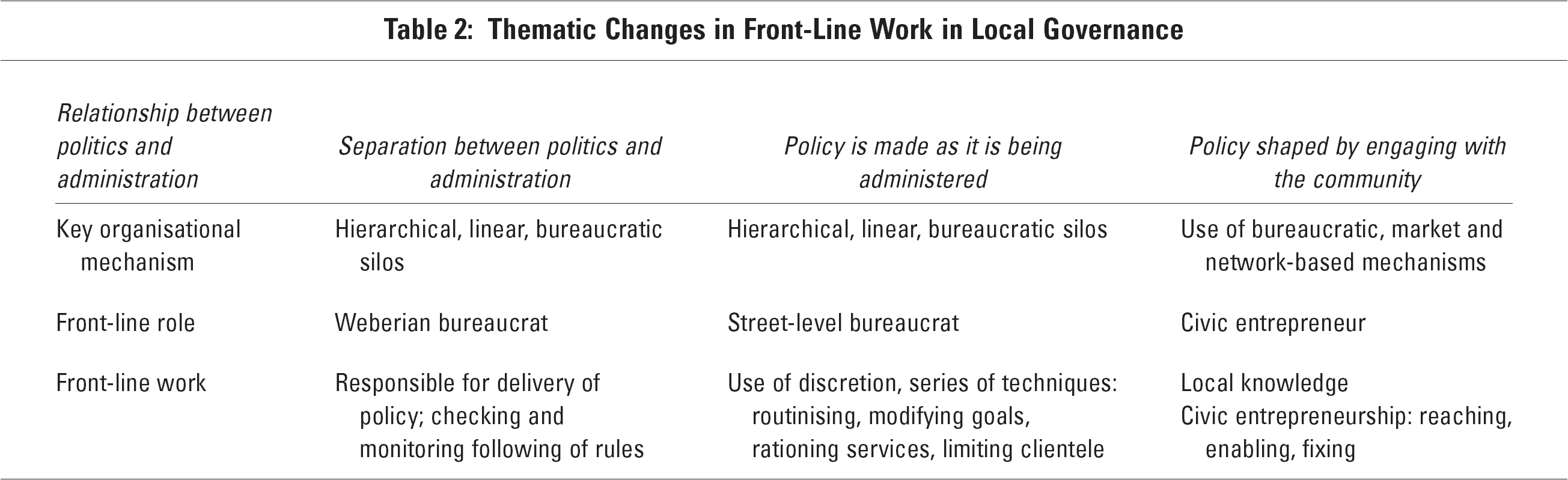
The interpretive approach taken in this research does not seek to make claims of generalisability but rather to give an embedded narrative from the front line itself. Front-line workers themselves articulate a narrative of ‘civic entrepreneurship’. ‘Civic entrepreneurship’ is a form of front-line work taking place in the spaces of local governance where traditional organisational structures are breaking down and have not yet been firmly replaced. The subsequent ambiguity creates the opportunity for innovation and entrepreneurship (Goss, 2001; Lowndes, 2005; Stoker, 2004). Civic entrepreneurialism can be found at the boundaries of local governance where new spaces are opening up, for example in urban deprived neighbourhoods, but further research is required to explore perhaps differently constituted perspectives from elsewhere in local governance and the public sector.
It is worth giving some consideration to the possible implications of this vision of local governance. On the positive side, civic entrepreneurship and networked governance give the possibility of innovation to tackle the so-called ‘wicked’ cross-cutting problems – such as antisocial behaviour, health inequalities and social exclusion – that are faced by local governance and the public sector more widely. Yet this innovation may arguably only be small scale and fragmented. Questions remain about its sustainability, particularly in the context of anticipated cuts in public sector and local government funding. Civic entrepreneurship is part of the reconstitution of local democracy that relies less on overhead democracy and more on pluralism and participation, with Michael Moore's (1996) concept of ‘building legitimacy’ with the community as the end goal. Questions remain here about transparency and accountability.
‘Civic entrepreneurship’ can be seen as part of the transition in local governance towards what Stoker (2004) has termed ‘networked community governance’. This – not yet fully realised – vision of change is a more flexible, cross-cutting and negotiated incarnation of local government. It gives emphasis to achieving community-centred objectives through pragmatic means and is characterised by a mix of organisational mechanisms and by a reliance on participation and partnership (Stoker, 2004). Civic entrepreneurship is one means of developing innovation and meaningful community engagement to realise this vision.
Footnotes
I would like to acknowledge the support of Professor Gerry Stoker (University of Southampton) and Dr Francesca Gains (University of Manchester) in shaping this research. I would also like to thank Professor Vivien Lowndes (University of Nottingham) and Dr Steven Griggs (De Montfort University) for their comments on earlier drafts of this article. An earlier version of this article was presented at the European Consortium of Political Research Joint Sessions in Rennes, 2008.
1
New Deal for Communities funding was time limited over ten years.
2
Although some posts may be funded through central government policy interventions.
3
Community Action Plans (CAPs) are determined annually by Community Committees in each neighbourhood. These committees are made up of local elected members and representatives from recognised community and tenant organisations in the neighbourhood. The committees determine priorities for action in the neighbourhood within the framework of priorities determined by the local authority including health, employment and the environment. The Community Committees also have responsibility for a limited devolved budget determined by the population size of the neighbourhood.