






Abstract
Although China is an outlier in terms of generalized trust, it has attracted little scholarly attention so far. Employing survey data from Mainland China, Hong Kong and Taiwan, this article seeks to address this gap. The article makes use of the comparative leverage provided by political and socio-cultural variation to investigate two plausible reasons for the high levels of measured trust in Mainland China: a spillover from high institutional confidence; and problems of measurement validity. The study finds a comparatively strong link between institutional confidence and trust in Mainland China, which suggests that high confidence in institutions contributes to high levels of generalized trust in this context. By situating the Chinese case in the debate on the institutional foundation of generalized trust, the article suggests a heuristic to interpret this finding and points out its theoretical implications. The findings on measurement validity are mixed. While the results do not suggest that political fear causes a significant distortion in measured trust levels, the study finds circumstantial evidence for a culturally induced response bias to the standard item in Mainland China. This would have crucial implications for comparative research on generalized trust beyond the Chinese context.
The People's Republic of China would be an unlikely candidate for inclusion in a list of countries where one would expect to find widespread generalized trust. 1 Following common assumptions about the conditions required for cultivating high trust in society, China's autocratic single-party system and its endowment with a cultural tradition that is often regarded as familistic should lead to generalized trust being a scarce resource. In addition, China is characterized by sharp income inequalities and is – in per capita terms – still economically disadvantaged. Neither of these aspects should bode well for cultivating trust.
Nonetheless, surveys using the standard instrument for measuring generalized trust (hereafter, the standard item) – the dichotomous question ‘Generally speaking, would you say that most people can be trusted or that you can't be too careful in dealing with them?’– have consistently indicated that generalized trust in Mainland China is among the highest worldwide, thus making it a notorious outlier in comparative studies (Allik and Realo, 2004; Bjørnskov, 2006; Delhey and Newton, 2005; Inglehart, 1999; Uslaner, 2002; Whiteley, 2000). However, despite its controversial nature and significance, so far, no English language study on generalized trust has been devoted to the Chinese case. 2 This article seeks to address this gap by situating the case in relevant literature on the origins of trust and investigating it in a comparative fashion with survey data from Mainland China, Hong Kong and Taiwan.
There are essentially two plausible explanations for the counter-intuitive extent of measured generalized trust in China: first, the country is not merely an outlier in terms of trust in people but also in terms of confidence in institutions. Contrary to many other authoritarian systems where survey research is possible, numerous studies have revealed that, overall, the Chinese political system is perceived in surprisingly positive terms by its citizenry (Chen, 2004; Li, 2004; Shi, 2001; Shi and Chen, 2001; Tang, 2005; Wang, 2005). Since the institutional theory of trust explains generalized trust as an outcome of institutional confidence, it seems reasonable to look for possible sources of high generalized trust in the perception of political institutions. Hence, the article addresses the effect of institutions on generalized trust in different political systems and links up with other recent scholarship on this issue (Jamal, 2007; Jamal and Nooruddin, 2010; Rothstein and Stolle, 2008). It also looks at the moderating impact of societal context on the linkage between institutions and trust and thereby contributes a case study to a rarely studied (for an exception compare Uslaner and Badescu, 2004) but probably significant question.
Second, some scholars have cautioned that the authoritarian political system or the cultural conditions in Mainland China may inflate trust survey results (Bjørnskov, 2005; 2006; Tang, 2005, p. 105; Uslaner, 2002, p. 226). These caveats should be taken seriously and, thus, the article examines specific claims about measurement validity in Mainland China. In so doing it intends to speak to an emerging strand of research concerned with the measurement validity of the standard item (Delhey et al., forthcoming; Miller and Mitamura, 2003; Reeskens and Hooghe, 2008; Sturgis and Smith, 2010). The Chinese case is not only critical to this discussion because it is arguably the most controversial one. It also has potential relevance for a number of other Asian societies – such as Japan, South Korea and Vietnam – that display high levels of survey-elicited trust even though their cultural and/or politico-economic conditions would suggest otherwise.
Additionally, the study contributes to a growing body of research that looks at the origins of generalized trust in different cultural and political contexts. So far, there have been few such studies on non-European and non-Western contexts (for exceptions, compare Freitag, 2003; Jamal, 2007; Radnitz et al., 2009). Being not only an outlier but also the most populous non-Western society, the Mainland Chinese case is crucial to this discussion.
The article will continue with a review of institutional and socio-cultural explanations of trust and derive four hypotheses. After a brief clarification of methodological questions these hypotheses will be empirically tested. The article concludes with a discussion of the empirical findings.
Theories and Hypotheses
Generalized trust is theorized as an optimistic attitude that regards interaction with others, including those that one does not know personally, as an opportunity rather than a threat (Uslaner, 2002, p. 34). Theorists agree that generalized trust necessarily widens the ‘radius of trust … to others outside of the traditional circle of family, neighborhood, and village’ (Realo et al., 2008, p. 450) and thereby transcends the boundary of intimate personal relationships. It includes ‘people at a greater social distance from the truster’ and particularly strangers (Putnam, 2000, p. 466). Hence, this attitude has been defined as a ‘“standing decision” to give most people – even those whom one does not know from direct experience – the benefit of the doubt’ (Rahn and Transue, 1998, p. 545).
Moreover, generalized trust is often distinguished from particularized trust (Putnam, 2000; Stolle, 2002; Uslaner, 2002). In contrast to the generalized variants, particularized trust is ‘extended [only] toward people the individual knows from everyday interactions’ (Freitag and Traunmüller, 2009, p. 784) and is dependent on repeated interactions (Axelrod, 1984).
Political Institutions and Trust in Three Chinese Societies
There are two major accounts of generalized trust – an institutional one and a socio-cultural one. The institutional account highlights the importance of state institutions and their perception by citizens. This approach often leans toward rationalistic conceptions of generalized trust that stress the risky aspect of trusting strangers. Accordingly, it is believed that a reliable state ‘enhances the sense of security, promotes cooperation, and evokes a willingness to take risks even among strangers or relative strangers’ (Cook et al., 2005, p. 160; also Gambetta, 1988, p. 162; Herreros and Criado, 2008; Levi, 1998; Sztompka, 1999). A more ‘moralistic’ interpretation of the institutional explanation has also been formulated. It assumes that institutions may have an ‘implied normative meaning … [and] moral plausibility … [citizens] assume it will have for others which allows [them] to trust those that are involved in the same institutions’ (Offe, 1999, p. 70). Political institutions that are widely perceived as legitimate can thus enhance a sense of community and solidarity among citizens and provide a fertile ground for the growth of generalized trust.
Both versions of the institutional explanation have been integrated into an empirically well-grounded account. It centers on perceptions of institutions that citizens experience in daily life – such as the police, the courts and the civil service – and that should ideally be implementing policies in an ‘effective, impartial, and fair’ manner (Rothstein and Stolle, 2008, p. 456). Violations of this expectation should undermine generalized trust since they affect
how citizens experience feelings of safety and protection, how they make inferences from the system and public officials to other citizens, how they observe the behavior of fellow citizens, and how they experience discrimination against themselves or those close to them (Rothstein and Stolle, 2008, p. 456).
Research indicates that countries with a long democratic record display the highest levels of trust even when various factors are controlled for (Rothstein and Stolle, 2008; Uslaner, 2002, p. 227). Hence, according to the institutional account, the superior institutional performance of these democracies leads to a positive evaluation of institutions and this in turn leads, to higher generalized trust in society. In contrast, a more negative record on the performance criteria outlined by Rothstein and Stolle is believed to diminish societal levels of trust in authoritarian regimes (Rothstein and Stolle, 2008, p. 452). In line with this supposition, Amaney Jamal's study of Arab authoritarian regimes concluded that ‘political confidence is linked to higher levels of trust regardless of regime type, … [and] those … with lower levels of political confidence in the regime … also hold lower levels of social trust’ (Jamal, 2007, p. 1337). Therefore, dissatisfaction with political institutions in Arab states contributes to low societal levels of trust in this context.
However, contrary to the default assumption for authoritarian systems, numerous studies have shown that approval rates for the political system in China are high (Chen, 2004; Shi, 2001; Shi and Chen, 2001; Tang, 2005; Wang, 2005) – albeit decreasing with the level of administration (Li, 2004). Hence, while low levels of institutional confidence in Arab and many other authoritarian states lead to low societal levels of generalized trust, the opposite could be the case in Mainland China. An indication that this mechanism is indeed at work would be to find (hypothesis 1) a strong and significant positive association between institutional confidence, measured along the lines of Bo Rothstein and Dietlind Stolle's (2008) account, and generalized trust not only in Democratic Taiwan and semi-democratic Hong Kong, but also in Mainland China.
Furthermore, the institutional theory of trust implicitly assumes that – on the individual level – political institutions affect generalized trust independently of the political context. And indeed, some empirical comparisons have found that the effect is virtually the same for individuals in authoritarian and democratic states (Jamal, 2007; Jamal and Nooruddin, 2010). However, Uslaner and Badescu found that the individual-level correlations between trust and institutional confidence (perceived corruption)vary with aggregate levels of corruption. The individual-level link is strong when the aggregate level of corruption is low and weak when corruption is widespread. Hence, they conclude:
if there is a lot of corruption in a country, people … do not make a link between corruption (the domain of the elites) and trust in people. If there is little corruption, people are more likely to see venality by the elites as part of a larger cultural problem. Those relatively few individuals who see corruption as a problem extrapolate to the meanness of people in general (Uslaner and Badescu, 2004, p. 41).
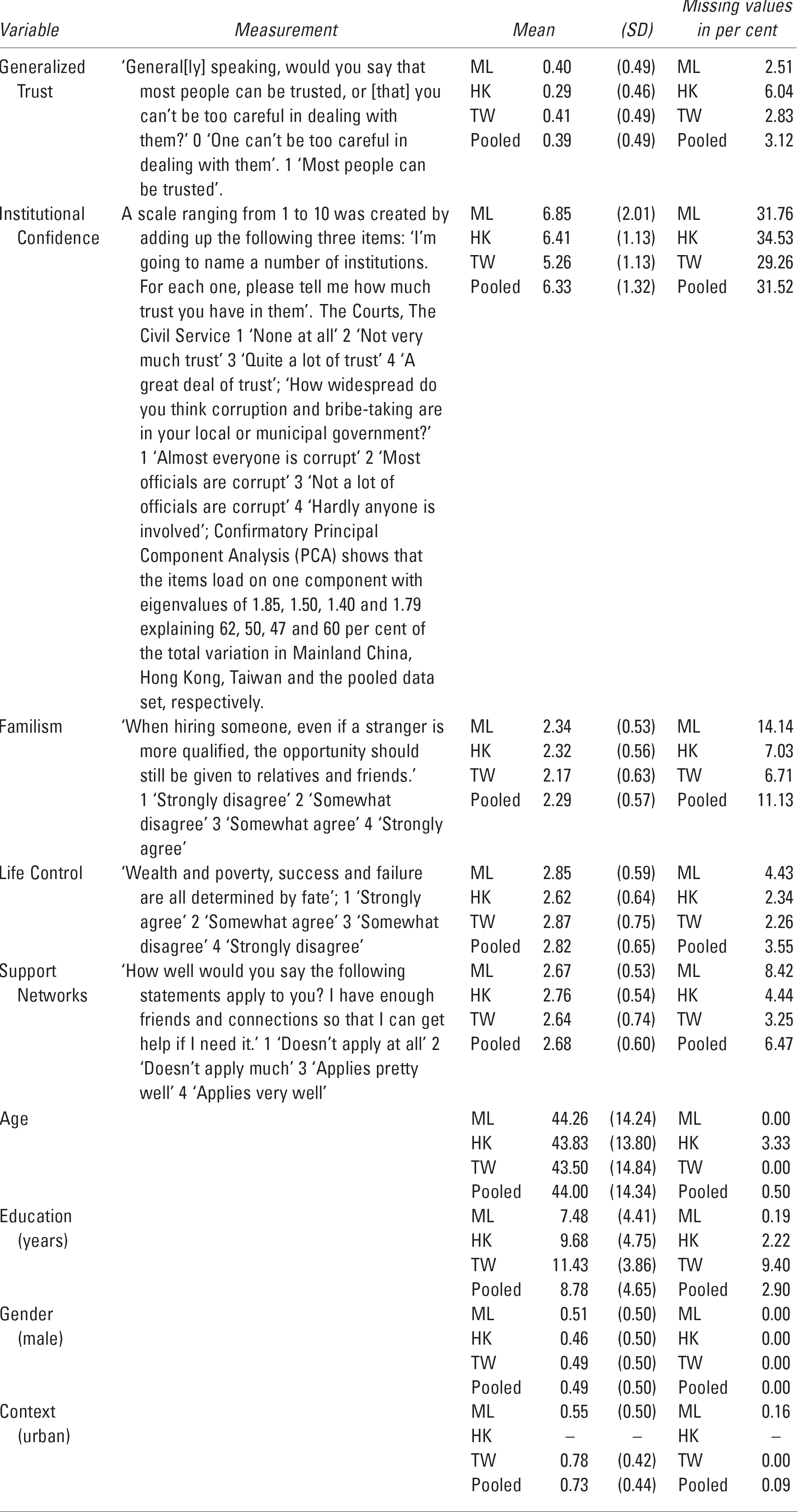
Taking the societal level of institutional confidence in these three societies into account, one finds that confidence in institutions is high in both Mainland China and Hong Kong, while it is noticeably lower in Taiwan (the relevant means on the 1–10 scale being 6.85, 6.41 and 5.26, respectively). For instance, while 81.6 per cent of Mainlanders and 82.0 per cent of Hong Kongers claim that they have ‘quite a lot’ or a ‘great deal of trust’ in their courts, only 49.8 Taiwanese say the same about their courts. However, an educated guess and the combined expert and business surveys in the Transparency International Corruption Perceptions Index (CPI) suggest a different order of institutional trustworthiness in these societies: corruption is more likely to be rampant on the Mainland, relatively widespread in Taiwan and rare in Hong Kong. 3 Hence, in Mainland China, citizens' perception is remarkably different from the presumably more objective perceptions measured in the CPI.
This leads to a dichotomous hypothesis (hypothesis 2) that assumes the following: if the objective level of institutional trustworthiness is decisive, the individual-level link between institutional confidence and trust should be strong in Hong Kong, weaker in Taiwan and weakest in Mainland China. Alternatively, if the perceived level of institutional trustworthiness is decisive, then Mainland China and Hong Kong should both display a strong association between institutional confidence and trust, while this link should be weaker in Taiwan.
The political system in Mainland China may also have another effect on measured generalized trust. Some trust scholars caution that trust measurement in China might be distorted because of its authoritarian political system. Eric Uslaner associates the survey results from China with ‘the hazards of conducting survey research in a country that Freedom House places at the bottom of its rankings in both political and civil liberties’ (Uslaner, 2002, p. 226; also Bjørnskov, 2005; 2006). This implies that the standard item in Mainland China could be subject to a trust-inflating response bias induced by an atmosphere of political fear. By comparison, the full guarantee of civil liberties would suggest that a similar response bias is very unlikely in Hong Kong and Taiwan.
Hence, Mainland Chinese respondents who think that one ‘can't be too careful in dealing’ with most people but are reluctant to reveal their opinion to the interviewer for fear of political retaliation have two choices (Shi, 2001, p. 405): they may claim that they ‘do not know’ the answer or decline to answer the question altogether. Alternatively, they may give a positive answer on the generalized trust question even though this is contrary to their true beliefs. Moreover, if such a bias exists, questions directly related to politics, such as survey items on confidence in political institutions, should also be subject to it. Although the possibility of false answers is impossible to test with available data, we can expect that (hypothesis 3) the existence of a political response bias should be discernible by a larger number of missing values for items measuring generalized trust and institutional confidence in Mainland China than for the two other societies.
Trust, Culture and the Chinese Mode of Social Association
The socio-cultural account explains generalized trust as either the outcome of societal patterns of association or the result of underlying orientations. Both aspects are often thought to be closely interrelated.
The associational theory comprises the Tocqueville school of social capital, which highlights the function of voluntary associations in the production of generalized trust (Putnam, 2000; Putnam et al., 1993) and other associational approaches that underline the function of informal networks in generating trust (Freitag and Traunmüller, 2009; Stolle, 2002; Sztompka, 1999, pp. 130 ff.). Moreover, arguing from the perspective of social psychology, some theorists argue that a stable sense of optimism and control over one's life is a necessary prerequisite for the development of trust in the generalized other (Misztal, 1996, pp. 230–1; Sztompka, 1999, pp. 125–6; Uslaner, 2002).
For the discussion on trust in China, however, the most important perspective is the culturalist account. This account holds that fundamental value orientations encourage people both to behave trustworthily and to put trust in a wider radius of others, including those they do not know personally. In particular, the universalistic moral obligations embedded in individualism are often believed to foster trust through a generalized morality and responsibility that reaches beyond the boundaries of personal acquaintance. Conversely, the emphasis on moral obligation to concrete people and the ‘unquestionable loyalty toward only one in-group’ (Allik and Realo, 2004, p. 35) that apparently characterizes cultures classified variably as collectivistic, familistic or particularistic is regarded as a major impediment to the growth of widespread generalized trust (Banfield, 1958; Fukuyama, 1995, p. 35; Hofstede, 2001; Misztal, 1996; Realo et al., 2008; Uslaner, 2002).
Beginning with Max Weber's (1968) treatise on Chinese religions, China was and still is an integral part of this discussion. Chinese cultural heritage has long been held to be the prototype of a familist and trust-discouraging tradition. 4 Some theorists believe that the Chinese pattern of social association is characterized by a narrow ‘radius of trust’ and a ‘pervasive distrust of strangers’ (Fukuyama, 1995, pp. 17–95). Others think that ‘non-trust rather than active distrust’ leading to ‘negative expectations about cooperation’ (Redding, 1990, p. 66) with strangers characterizes Chinese social interaction patterns. The strong Confucian emphasis on ritual and civility in concrete personal relationships, which is contrasted by a lack of ‘rules for impersonal dealings beyond the face-to-face level’ (Pye, 1999, p. 780), is often held responsible for this state of affairs. Similarly, Chinese sociologist Xiaotong Fei proposed that Confucian social ethics is the root of his famous ‘differential mode of association’ (chaxu geju) that is characterized by a uniquely strong emphasis on personal networks. Fei argued that moral behavior (and by extension trust) ‘makes sense only in terms of these personal connections’ (Fei, 1992, p. 70). Hence, although Chinese society is generally believed to be rich in dense networks sustained by particularized trust, it is often assumed that it lacks trust that extends beyond the realm of concrete relationships.
This theoretical account obviously leads to the high-trust notion gained in surveys coming as something of a surprise. It may therefore indicate that trust measurement using the standard item in China is characterized by ‘contextual specificity’ (Adcock and Collier, 2001, p. 534) and does not measure the concept it is supposed to measure, namely trust in those we do not know personally.
On an empirical level, however, findings produced by behavioral economists and psychologists are broadly in line with the survey results (i.e. depicting more generalized trust and trusting behavior in Mainland China than in Hong Kong and other Asian and Western societies). In contrast to results from Japan (Miller and Mitamura, 2003), these studies also indicate that Mainland Chinese subjects not only score high on the standard item but also in other ways of measuring generalized trust (Bond and Zhang, 1992; Buchan and Croson, 2004; Buchan et al., 2002; 2006). Moreover, Chinese scholars have used factor analyses to evaluate a survey item that is very close to the standard item asking about trust in ‘most people in society’ (shehui shang da duoshu ren) using data from Mainland China (Li and Liang, 2002; Wang and Liu, 2002), and have argued that the culturalist account is too pessimistic. 5
Yet while evaluations of the correlation patterns between the standard item and other trust measures in Mainland China indicate that the standard item is indeed only weakly associated with trust in close friends or family, they also show that it clusters both with trust in specific, yet more distant, categories (such as colleagues, neighbors, etc.) and with trust in generalized categories of people (strangers, foreigners, etc.) (Li and Liang, 2002; Tang, 2004; Wang and Liu, 2002). This suggests that the standard measurement instrument does indeed tap trust in strangers and generalized categories of people. However, it also indicates that common associations with ‘most people’ or even ‘most people in society’ refer, to a quite significant degree, to acquainted persons.
Wenfang Tang argues that ‘trust may mean something different in China … Chinese people live in a tightly knit network of Confucian social relations where one's inner circle of family and friends is clearly distinguished from strangers’ (Tang, 2005, p. 105). The intensity of obligation in and the dense character of these networks might make the idea of trusting outsiders appear so alien that many survey respondents simply do not include strangers in their interpretation of ‘most people’. As a result, measured generalized trust would be inflated. The significantly lower level of trust measured with survey questions directly asking about trust in strangers in China seems to lend support to this supposition (Tang, 2004; World Values Survey, 2010).
Tang's assumption implies that such a trust-inflating interpretation effect should have an impact on measurement in all three societies under consideration as they are all endowed with the same Confucian cultural heritage. Yet we can expect the strength of this effect to vary with levels of urbanization and modernization.
According to Ann Swidler's toolkit model of culture, the Chinese Confucian tradition may shape behavior not merely by determining action via ‘cultural end-values’ (Swidler, 1986, p. 284) – as the culturalist account presumes – but also by providing the socially appropriate means to achieve strategic ends. However, strategic ends vary with social context, and the same cultural umbrella may thus lead to quite different patterns of social behavior and association.
Thus, in a fast-paced urban environment where access to diverse resources and information is crucial, social relationships should be dressed in the cultural repertoire of Confucianism without actually being confined to narrow boundaries of ascribed social bonds. Students of urban Chinese social networks have indeed found that the art of networking or guanxi is used very flexibly and strategically to construct shared identities, to convert ‘outsiders into insiders’ (Lin, 2001, p. 155) and to draw ‘map[s] of social relations’ (Lui, 1998, p. 347; compare also Wong, 1996) rather than to be trapped in a fixed in-group by birth. Chinese urbanites also meet and interact with strangers on a daily basis and maintain social networks that extend the realm of kinship and often bridge wide social cleavages (Blau et al., 1991). Therefore, urban Chinese social relationships are not exclusively, and probably not even primarily, characterized by ‘cohesive in-groups, which throughout people's lifetime continue to protect them in exchange for unquestioning loyalty’ (Hofstede, 1991, cited in Allik and Realo, 2004, p. 32). Thus, in urban contexts, ‘most people’ should not be interpreted as referring only to personal associates so easily.
This may be different in the Mainland Chinese countryside. It has been argued that the enormous socio-economic cleavages between rural and urban Mainland China, which are buttressed by the strict household registration system, are accompanied by a ‘freezing [of] traditional beliefs and social structures in the rural areas, whereas the urban areas were subjected to a radical ideological transformation’ (Herrmann-Pillath, 2006, pp. 552–3). Rural dwellers in Mainland China, and particularly the elderly among them, live in a Gemeinschaft type of society and tend to think and act along the lines of kinship solidarity – a survival strategy that makes much more sense in this social environment. Moreover, the opportunities and incentives to meet, or even interact with, outsiders and strangers are much more restricted for Mainland Chinese rural dwellers. 6 Hence, one may argue that rural Mainland Chinese live in much more traditional and ‘tighter knit’ networks than people in the other contexts of the three cases. 7
Under such conditions, rural Mainlanders should be particularly inclined to interpret ‘most people’ in a narrow way and measured generalized trust in rural China should be more ‘contaminated’ with particularized trust. We can thus assume that the following set of characteristics distinguish trust as measured in the Mainland Chinese countryside from trust measured elsewhere in the three societies (hypothesis 4). First, it should be more compatible with notions of familism and less compatible with an optimistic sense of control over one's fate, as both attitudes are regarded as core indicators for distinguishing generalized from particularized forms of trust (Fukuyama, 1995; Uslaner, 2002). Moreover, education, which is normally positively associated with generalized trust (e.g. Uslaner, 2002), should have a systematically weaker effect in rural China. Finally, trust should show a positive association with age as the rural elderly – due to their life experiences – should have the strongest disposition to interpret the standard item in a narrow fashion.
Data, Measurement and Methods
The statistical analysis in this study employed the, at the time of writing, newest available data from the Asian Barometer Survey (2010). The surveys were conducted in 2001 (Taiwan and Hong Kong) and 2002 (Mainland China). The data were selected for this project because they provide a number of items (such as detailed items about corruption) that other available surveys do not include. Furthermore, the Mainland Chinese sample in this study was significantly larger than the ones used in other available surveys, which should, all else being equal, lead to a lower sampling error.
The Asian Barometer Survey requires all national research teams to comply with a common research methodology, including national probability samples, a standard questionnaire instrument, intensive training of fieldworkers, face-to-face interviews, quality controls through strict field supervision, and other quality checks. All three data sets were randomly sampled in a multi-stage process. The Mainland Chinese sample contained 3,183 individual cases. The Hong Kong and Taiwan samples contained 811 and 1,415 cases, respectively. 8
Generalized trust, the dependent variable, was tapped with the standard dichotomous item. The answer categories were ‘most people can be trusted’ and ‘one can't be too careful in dealing with them’. A positive answer was coded as 1, while the negative option was coded as 0. 40.1, 40.7 and 29.4 per cent of respondents in Mainland China, Taiwan and Hong Kong answer this question positively. 9
The independent variables of interest in this study were measured as follows. To tap the institutional account of trust, an index of institutional confidence, roughly following the index developed by Rothstein and Stolle (2008), was derived from items inquiring about confidence in the civil service and the courts and an item gauging the perceived degree of corruption in local government. Familism was measured with an item that asked whether one thinks relatives should be given priority in employment decisions even if others are more qualified. This variable should tap quite effectively what has been identified as the core trust-preventing notion in the Chinese cultural context since it exemplifies a rigid loyalty to family bonds. Finally, the notion of perceived life control was captured with a question asking whether one agrees with a statement that asserts that wealth, poverty, success or failure are decided by fate. This item should tap the sense of life control that some scholars hold to be the core of a trust-enabling optimistic outlook (Uslaner, 2002, p. 81). Also included were socio-demographic variables of interest, namely age (in years) and education (in years). I also included control variables in terms of involvement in informal support networks, which was gauged by an item asking respondents to estimate if they had ‘enough friends and connections [to] get help if [they] need it’, and gender. Finally, dummy variables were generated to measure the respondents' locations in Mainland China, Hong Kong or Taiwan, as well as urban and rural social contexts. 10
In the following analysis, regression models will be estimated to test the effect of the above independent variables on generalized trust in the three societies examined. Since the dependent variable is dichotomous, logistic regression models will be used for this purpose. In order to examine the differences in the effect strength of independent variables over different contexts, the data from the three societies will be pooled and relevant interaction terms will be introduced (Jaccard, 2001; Long and Freese, 2006, p. 423). 11 In order to address possible problems with non-response, I imputed data using the ICE module for Stata (Royston, 2005) and re-estimated the regression models. Since the main results are consistent with the original models, I assume that problems caused by missing values are not severe. The following reported statistics are based on the original data.
Data Analysis and Interpretation
This section will first explore the hypothesis regarding the effect of political institutions before examining the hypothesized impact of the rural Mainland Chinese context on trust measurement.
The Effect of Political Institutions
In a first step, logistic regression models with generalized trust as the dependent variable were estimated in the three single data sets. The results of the three regressions, depicted in Table 1, indicate that institutional confidence is positively associated with trust in all three societies and that the coefficient for Mainland China is substantially strong, positive and highly significant. This lends support to hypothesis 1 and indicates that high trust is indeed intertwined with high institutional confidence in all Chinese societies.
Logistic Regression Models
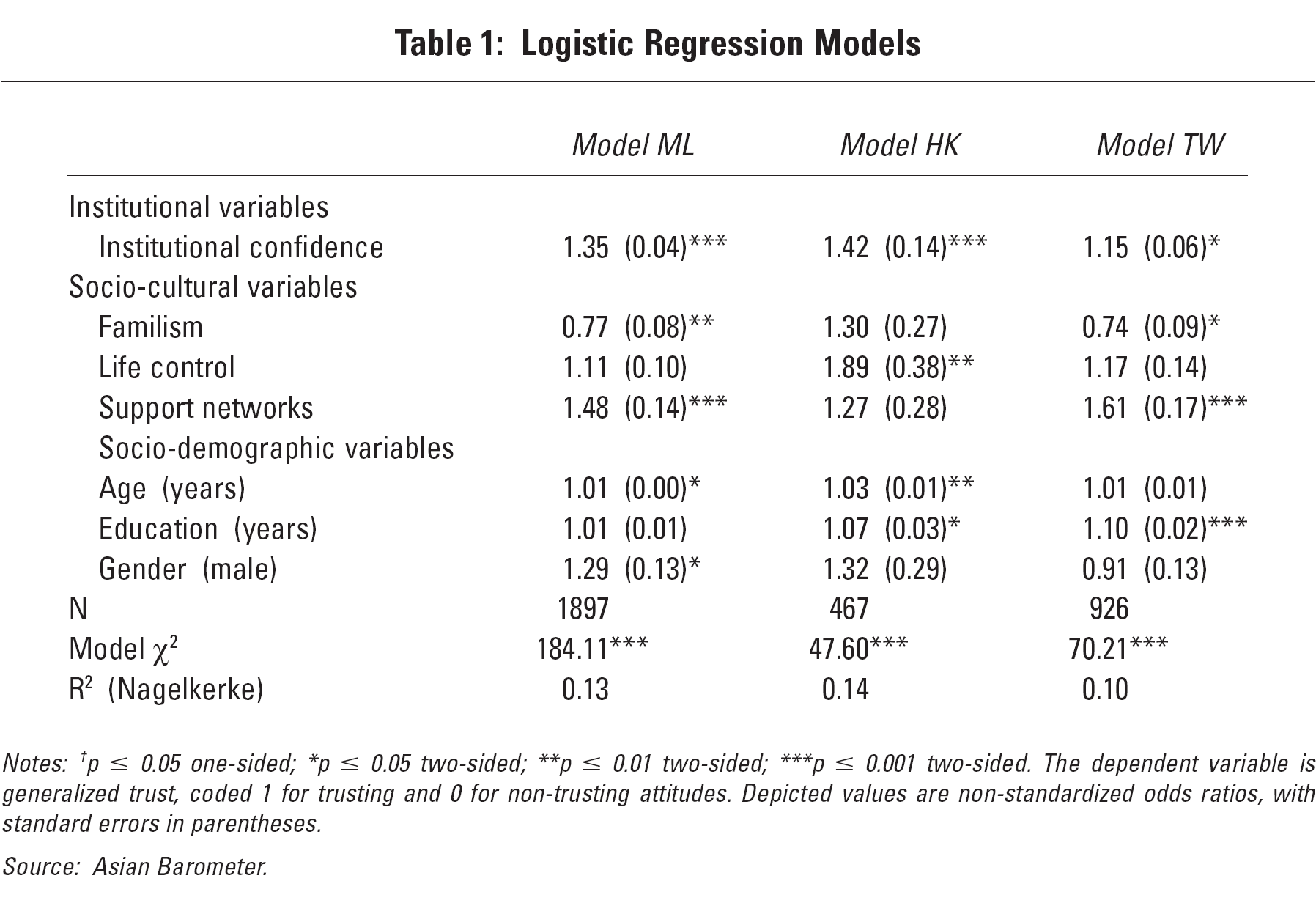
Notes: †p≤0.05 one-sided; *p ≤0.05 two-sided; **p ≤0.01 two-sided; ***p≤0.001 two-sided. The dependent variable is generalized trust, coded 1 for trusting and 0 for non-trusting attitudes. Depicted values are non-standardized odds ratios, with standard errors in parentheses.
Source: Asian Barometer.
In order to compare the effect strength directly, the analysis moves on to the pooled data. The regression models underlying Figure 1 include all previously tested predictors and relevant interaction terms in order to estimate the effect differences of institutional confidence in the three societal contexts. 12
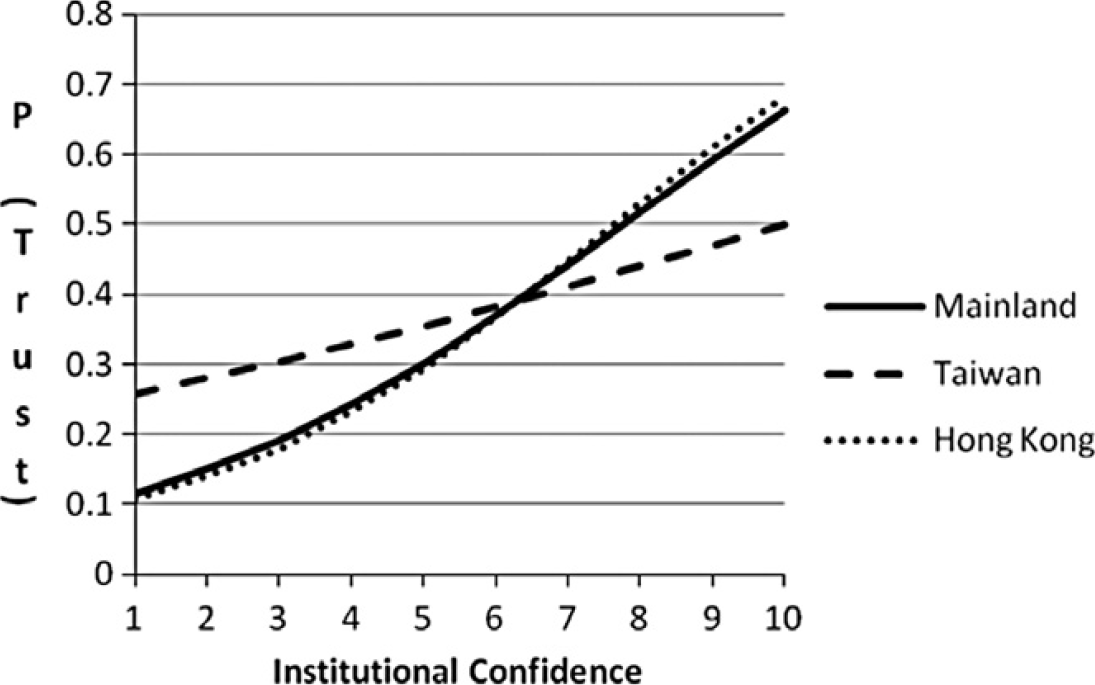
Predicted Probability of Generalized Trust by Institutional Confidence
Hypothetically raising the institutional confidence scale from 1 to 10 while all else is held at the mean leads to the probability of trusting increasing from 0.26 to 0.50 in Taiwan. 13 Yet the same change in Mainland China and Hong Kong raises the probability of trusting from 0.12 to 0.66 and from 0.11 to 0.68, respectively. Hence, the effect difference of institutional confidence on generalized trust in Taiwan, on the one hand, and in Mainland China and Hong Kong, on the other, is quite substantial and significant (compare Appendix A).
This result does not lend support to the first part of hypothesis 2, which assumed that the objective levels of corruption or institutional trustworthiness should lead to the link between institutional confidence and trust being weak in Taiwan and weaker on the Mainland. However, the result is roughly in line with the second part of hypothesis 2, which assumed that it is rather the perceived societal level of institutional trustworthiness that is decisive for determining the effect strength on the individual level. The high perceived institutional confidence in both Mainland China and Hong Kong corresponds with a strong effect of institutions on generalized trust at the individual level, while the low institutional confidence in Taiwan is associated with a substantially weaker effect of institutions on trust.
Thus, in line with many other contexts, confidence in institutions in Chinese societies is positively associated with generalized trust. However, contrary to findings from other authoritarian states where low institutional confidence diminishes generalized trust on the aggregate level, high levels of institutional confidence in Mainland China may indeed contribute significantly to high societal levels of trust.
Jamal concluded that it is the rise of critical citizenship that leads to a‘growing discontent with the existing political and social status quo’ (Jamal, 2007, p. 1334) – and correspondingly low levels of trust in institutions – and thereby diminishes aggregate levels of generalized trust in Arab societies. The analysis here would suggest that Jamal's insights on the effect from critical citizenship to institutional confidence to generalized trust is also valid in China but has the opposite effect. Discontented citizens in China may indeed also ‘find themselves outside of established … regime networks that would allow them the security and protections to be more trusting’ (Jamal, 2007, p. 1344). Yet the Communist party regime has, so far, managed to prevent the widespread rise of critical citizenship and the associated widespread institutional distrust (Wang, 2005) and may thereby also have promoted high generalized trust among its citizens. 14
Moreover, contrary to the expectation derived from Eric Uslander and Gabriel Badescu's (2004) results, the extensive corruption in Chinese political institutions does not seem to weaken the effect of institutional confidence on trust. Thus, the collective tendency to view state institutions in a positive light may seem strengthen the effect between the two factors on the individual level despite the rather questionable institutional performance.
Finally hypothesis 3 assumed that a response bias caused by political fear in Mainland China should be discernible by a larger proportion of missing values for the question on trust and institutional confidence in Mainland China compared to Hong Kong and Taiwan. However, contrary to the assumption, Mainland China has the fewest missing values among the three societies (2.5 per cent compared to 6.0 and 2.8 per cent in Hong Kong and Taiwan, respectively). Moreover, although a sizeable fraction of citizens in all three societies did not answer one of the questions on the institutional confidence index, non-response is higher in Hong Kong than on the Mainland (the respective ratios are 34.5, 31.8 and 29.3 per cent for Hong Kong, Mainland China and Taiwan). In addition, an analysis by Tianjian Shi (2001) directly tested the effect of political fear on institutional confidence in his 1993 survey data from Mainland China and Taiwan. He found that although some correlation exists, it is weak enough to be safely ignored. 15 If this is the case with regard to overtly political survey items in 1993, generalized trust data from 2002 should be even less affected by political fear. Taken together, the empirical evidence and previous scholarship imply that generalized trust measurement in Mainland China is unlikely to be inflated by political fear.
The Traditional Mode of Social Association, Trust Measurement and Rural China
Finally, hypothesis 4 assumed that the effect of a trust-inflating, culturally induced interpretation effect of the standard item should increase with a more traditional mode of social association the context of lower levels of urbanization and modernization; the interpretation effect should therefore be particularly strong in rural Mainland China and should be discernible by particular effects of relevant cultural and demographic indicators in this context.
A look at the socio-demography of trust in the three societies split further according to rural and urban contexts (Table 2) lends some support to such an assumption. Rural Mainland China is not merely the most trusting social context; 16 its socio-demography of trust is also somewhat counter-intuitive. Trust in rural Mainland China seems to be most pronounced among those sections of society that would be expected to have the strongest trust-reducing familistic attitudes and behavior patterns, namely the elderly and the less educated. 17 Rural Mainlanders aged 60 years and over are the single most trusting age group, and the trust level of Mainland rural illiterates is higher than that of university graduates in Hong Kong. The condition in rural China is most visibly contrasted by urban Taiwan, where, as one would expect, the young and the highly educated are much more trusting than the elderly and those with low levels of education.
The Socio-Demography of Trust in Chinese Societies
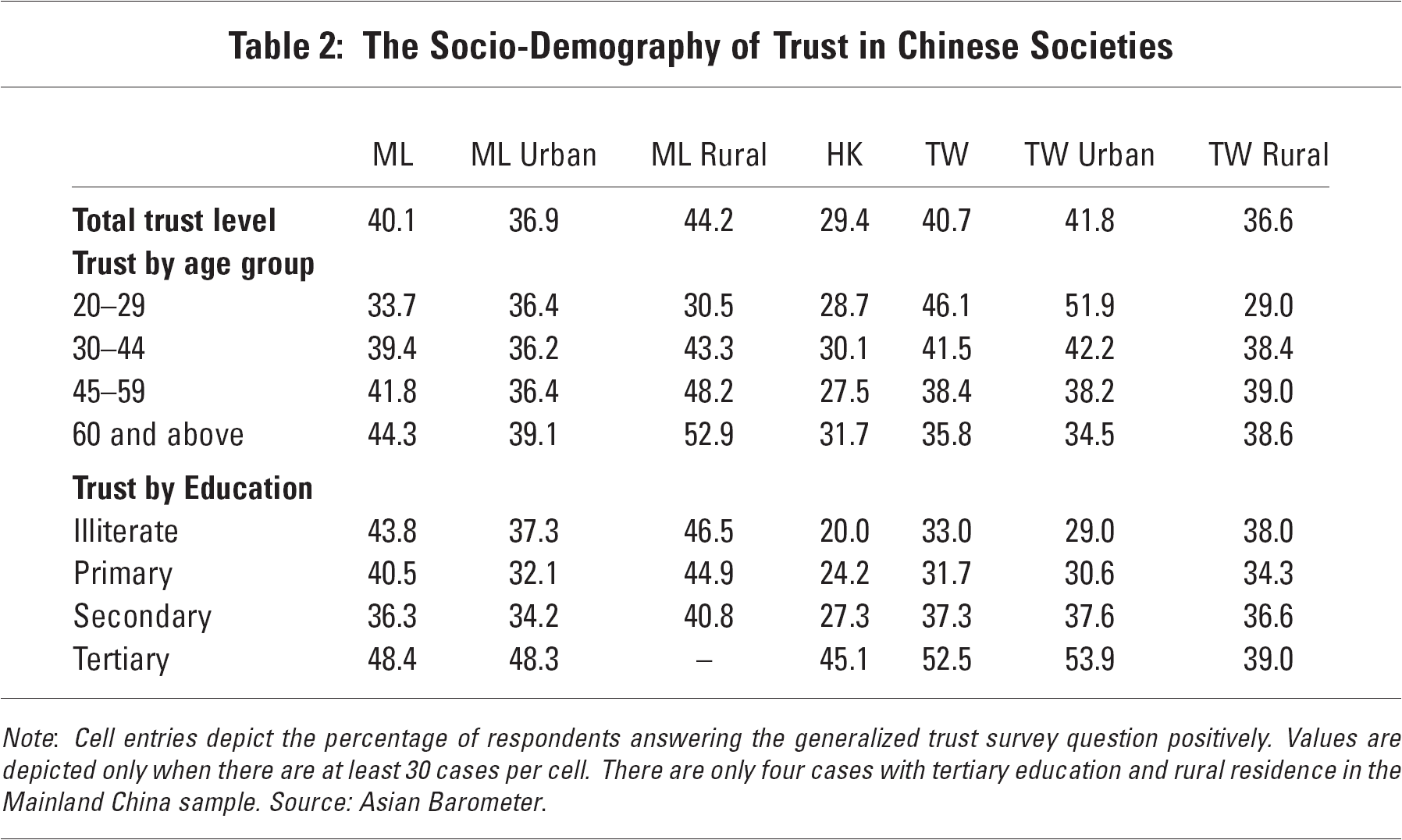
Note: Cell entries depict the percentage of respondents answering the generalized trust survey question positively. Values are depicted only when there are at least 30 cases per cell. There are only four cases with tertiary education and rural residence in the Mainland China sample. Source: Asian Barometer.
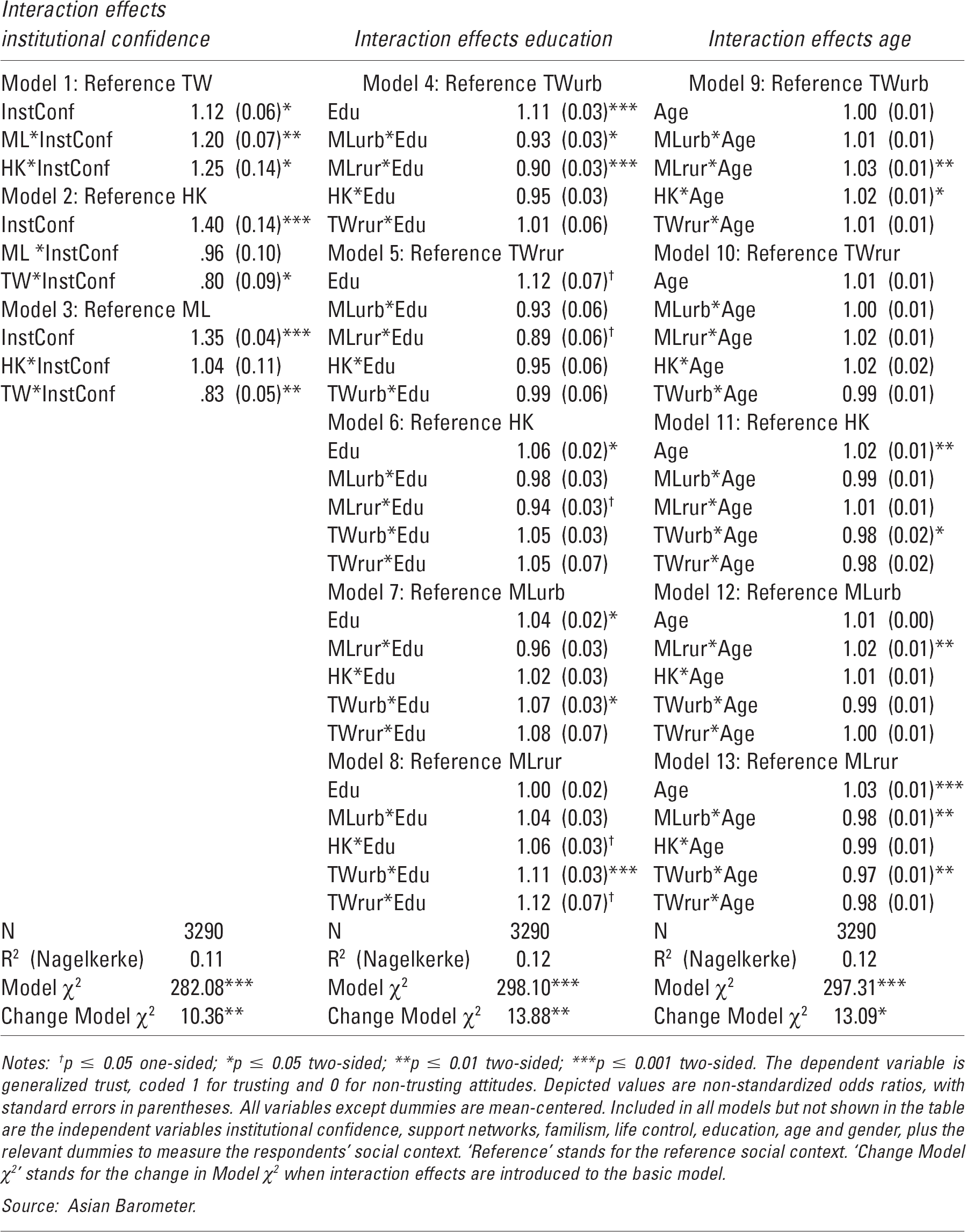
In order to test hypothesis 4, interaction effects were calculated in the pooled data set using dummy variables for the five urban and rural regions as moderators and the socio-cultural independent variables plus education and age as focal independent variables. However, judging by the change in model χ2 following the introduction of the interaction terms to the basic model, the interaction effects between context and familism, as well as those between context and life control, were insignificant (p > 0.1). 18 Therefore, only interactions between context and education and between context and age (both effects are significant at p≤ 0.05) (see Appendix A) are considered in the following.
The estimates indicate that, holding all else at its mean and raising education from 0 to 16 years (roughly equalling a first university degree), an increase in the probability of trusting from 0.19 to 0.53 is predicted for urban Taiwan (Figure 2). At the other end of the scale, the same increase in education predicts virtually no change in the probability of being a truster in rural China (the slope is even slightly negative). 19 Hence, a net effect of education on trust is non-existent in rural Mainland China. Although this result should not be over-interpreted since it certainly has something to do with the small number of rural respondents holding a university degree, it underlines the question why trust in rural areas on the Mainland can be so high even though the level of education is so strikingly low.
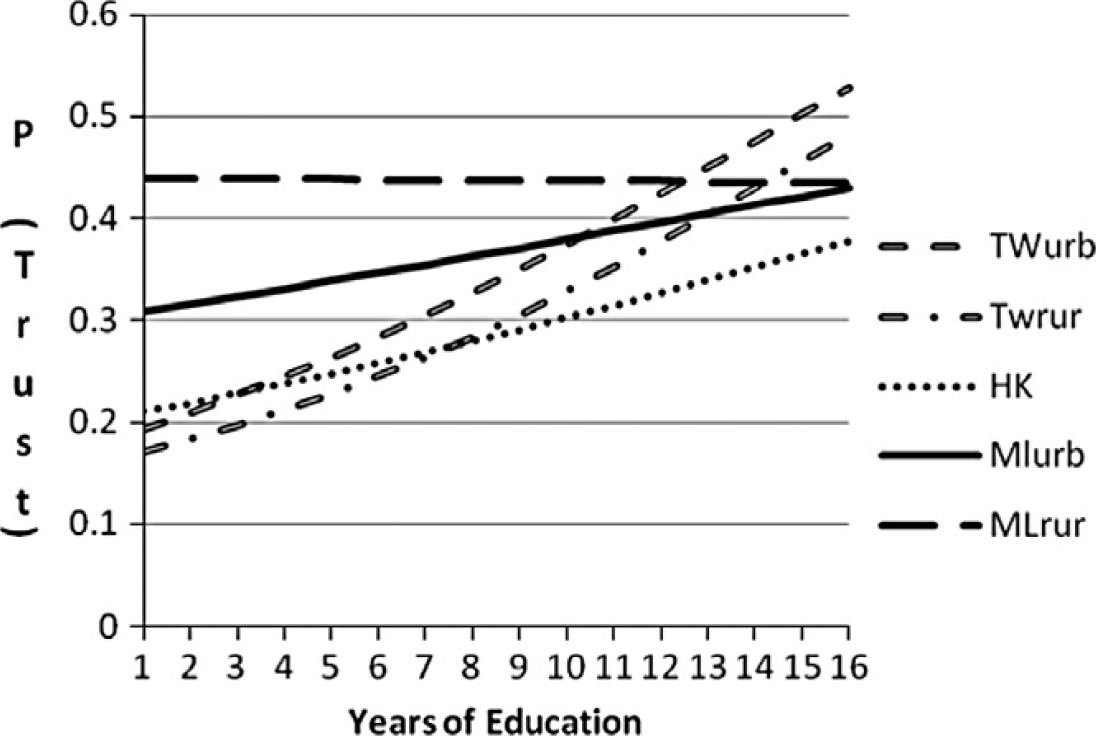
Predicted Probability of Generalized Trust by Education Level
Finally, Figure 3 compares the effect of age on trust in different social contexts. The findings suggest that the effect of age is most pronounced in rural Mainland China, although it is also strong in Hong Kong. Increasing age hypothetically from 20 to 80 years while holding all else at its mean yields an increase in the predicted probability of trusting from 0.30 to 0.69 in rural China. The same increase also induces a change in predicted probability from 0.22 to 0.52 in Hong Kong. In urban Mainland China and rural Taiwan, age effects are only very modest, while age has no independent effect on trust in urban Taiwan.
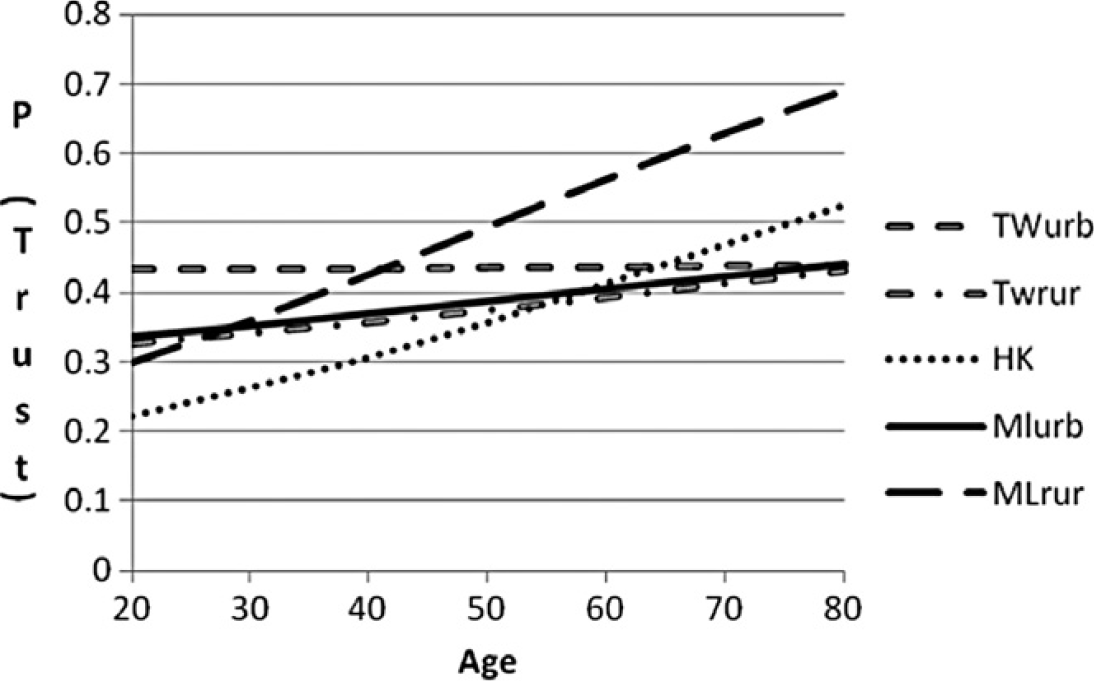
Predicted Probability of Generalized Trust by Age
Hence, rural Mainland China stands out for the non-existent effect of education and the comparatively strong effect of age on trust. The opposite effects are apparent in urban Taiwan, with the other contexts being situated between those two poles. Thus, the results lend partial support to hypothesis 4. They may indeed indicate the existence of an interpretation effect that inflates trust in rural Mainland China. However, this interpretation could not be further sustained by respective significant differences in terms of the cultural variables. More research is needed to explore the connection between trust, trust measurement and the levels of modernization and urbanization in China.
It is noteworthy in this context that the suggested ‘contamination’ of measured generalized trust with trust in particular people in China was also noticed in a recent study of UK survey data. Patrick Sturgis and Patten Smith found not only that a substantial number of British citizens ‘reported thinking of individuals who would be known to them personally’ (Sturgis and Smith, 2010, p. 89) when they answered the standard item, but also that these respondents were more likely to answer the item positively. Moreover, very recent research with measurements designed to correct for some respondents' association of the standard item with specific persons also suggests that the item may indeed significantly overestimate generalized trust levels in China and other East Asian countries. Moreover, these findings also point to significant differences between Mainland China and Taiwan in that, as the results here indicate, the ‘contamination’ of the standard item with trust in specific people is, despite a common cultural heritage, much stronger on the mainland (Delhey et al., forthcoming).
Hence, it appears that the scholarly quest on cross-national trust measurement should not be reduced to asking whether or not Chinese or other national generalized trust data are ‘contaminated’ by trust in concrete people in comparison to data from other countries. It also needs to take into account differing degrees of ‘contamination’ and inquire about how much interpretation effects vary between groups of respondents within one nation or cultural sphere.
Conclusion
This article addressed two possible explanations for the notion of high trust that surveys measure in Mainland China. First, it was found that trust is strongly affected by institutional confidence. This result is in line with results from other authoritarian contexts. The crucial difference is that institutional confidence in China is high and therefore elevates rather than diminishes societal levels of generalized trust. Moreover, it was found that high overall confidence in China seems to strengthen the link between these two factors on the individual level. Hence, high trust levels in China almost certainly have something to do with a spillover from the high levels of institutional confidence.
These results point to a caveat to the institutional theory of generalized trust. An underlying assumption of this account is that institutional performance directly translates into institutional confidence (Rothstein and Stolle, 2008). However, the notion of critical citizenship assumes that citizens’ evaluation of political institutions is dependent on subjective but shared standards that vary with time – otherwise, there could be no ‘growth of critical citizens’ (Norris, 1999) – and space. The inconsistency between the evaluation of Mainland China's political institutions by its citizens and by the presumably more objective standards of institutional trustworthiness highlights that the institutional account's assumption does not necessarily hold; the evaluation criteria that Chinese citizens have in mind are apparently neither equivalent to those of other Chinese citizens in Taiwan or Hong Kong nor to those of citizens in other contexts. 20 Therefore, institutional confidence in China can contribute to high levels of generalized trust despite rather than because of institutional performance. 21
Second, another major puzzle motivating this study was the question of whether trust measurement in Mainland China is hampered by validity problems. On this question, the study yielded mixed results. On a positive note, missing values patterns and established scholarship on political trust suggests that political fear is not to blame for possible problems in Mainland China. On a more negative note, however, a specifically narrow interpretation of the ‘most people’ part of the standard item, which is induced by the Chinese cultural heritage, needs to be seriously considered. It has been argued that such an interpretation effect should vary with the strength of a traditional pattern of social association and should therefore be most pronounced in rural Mainland China. The high ratios of trust in rural areas of the Mainland, which are combined with an unintuitive association of trust and socio-demographic indicators in this context and are somewhat contrasted by results from urban Taiwan, indirectly support such a notion and indicate that not only cross-national but also intra-Chinese differences warrant a more detailed investigation.
That being said, previous research found that measured trust in China is positively associated with affirmative attitudes on political activism, voting and a preference to cooperate with non-kin rather than with relatives in business matters (Tang, 2005, pp. 114–5). Moreover, contrary to results in Arab states (Jamal, 2007), this study found that generalized trust is positively associated with measures of social modernization such as the rejection of familistic attitudes, perceived control over one's destiny and – with a caveat for rural China – education. From these perspectives, trust in China does not appear systematically different from the trust described as a ‘civic virtue’ in the social capital literature. Thus, more research is needed to improve our understanding of the roots, effects and relative distribution of generalized trust in Chinese societies.
Footnotes
Logistic Regression Models (Pooled Samples)
| Interaction effects institutional confidence | Interaction effects education | Interaction effects age | |||
|---|---|---|---|---|---|
| Model 1: Reference TW | Model 4: Reference TWurb | Model 9: Reference TWurb | |||
| InstConf | 1.12 (0.06)* | Edu | 1.11 (0.03)*** | Age | 1.00 (0.01) |
| ML*InstConf | 1.20 (0.07)** | MLurb*Edu | 0.93 (0.03)* | MLurb*Age | 1.01 (0.01) |
| HK*InstConf | 1.25 (0.14)* | MLrur*Edu | 0.90 (0.03)*** | MLrur*Age | 1.03 (0.01)** |
| Model 2: Reference HK | HK*Edu | 0.95 (0.03) | HK*Age | 1.02 (0.01)* | |
| InstConf | 1.40 (0.14)*** | TWrur*Edu | 1.01 (0.06) | TWrur*Age | 1.01 (0.01) |
| ML *InstConf | .96 (0.10) | Model 5: Reference TWrur | Model 10: Reference TWrur | ||
| TW*InstConf | .80 (0.09)* | Edu | 1.12 (0.07) † | Age | 1.01 (0.01) |
| Model 3: Reference ML | MLurb*Edu | 0.93 (0.06) | MLurb*Age | 1.00 (0.01) | |
| InstConf | 1.35 (0.04)*** | MLrur*Edu | 0.89 (0.06) † | MLrur*Age | 1.02 (0.01) |
| HK*InstConf | 1.04 (0.11) | HK*Edu | 0.95 (0.06) | HK*Age | 1.02 (0.02) |
| TW*InstConf | .83 (0.05)** | TWurb*Edu | 0.99 (0.06) | TWurb*Age | 0.99 (0.01) |
| Model 6: Reference HK | Model 11: Reference HK | ||||
| Edu | 1.06 (0.02)* | Age | 1.02 (0.01)** | ||
| MLurb*Edu | 0.98 (0.03) | MLurb*Age | 0.99 (0.01) | ||
| MLrur*Edu | 0.94 (0.03) † | MLrur*Age | 1.01 (0.01) | ||
| TWurb*Edu | 1.05 (0.03) | TWurb*Age | 0.98 (0.02)* | ||
| TWrur*Edu | 1.05 (0.07) | TWrur*Age | 0.98 (0.02) | ||
| Model 7: Reference MLurb | Model 12: Reference MLurb | ||||
| Edu | 1.04 (0.02)* | Age | 1.01 (0.00) | ||
| MLrur*Edu | 0.96 (0.03) | MLrur*Age | 1.02 (0.01)** | ||
| HK*Edu | 1.02 (0.03) | HK*Age | 1.01 (0.01) | ||
| TWurb*Edu | 1.07 (0.03)* | TWurb*Age | 0.99 (0.01) | ||
| TWrur*Edu | 1.08 (0.07) | TWrur*Age | 1.00 (0.01) | ||
| Model 8: Reference MLrur | Model 13: Reference MLrur | ||||
| Edu | 1.00 (0.02) | Age | 1.03 (0.01)*** | ||
| MLurb*Edu | 1.04 (0.03) | MLurb*Age | 0.98 (0.01)** | ||
| HK*Edu | 1.06 (0.03) † | HK*Age | 0.99 (0.01) | ||
| TWurb*Edu | 1.11 (0.03)*** | TWurb*Age | 0.97 (0.01)** | ||
| TWrur*Edu | 1.12 (0.07) † | TWrur*Age | 0.98 (0.01) | ||
| N | 3290 | N | 3290 | N | 3290 |
| R2 (Nagelkerke) | 0.11 | R2 (Nagelkerke) | 0.12 | R2 (Nagelkerke) | 0.12 |
| Model χ2 | 282.08*** | Model χ2 | 298.10*** | Model χ2 | 297.31*** |
| Change Model χ2 | 10.36** | Change Model χ2 | 13.88** | Change Model χ2 | 13.09* |
Notes: †p≤0.05 one-sided; *p≤0.05 two-sided; **p≤0.01 two-sided; ***p≤0.001 two-sided. The dependent variable is generalized trust, coded 1 for trusting and 0 for non-trusting attitudes. Depicted values are non-standardized odds ratios, with standard errors in parentheses. All variables except dummies are mean-centered. Included in all models but not shown in the table are the independent variables institutional confidence, support networks, familism, life control, education, age and gender, plus the relevant dummies to measure the respondents' social context. ‘Reference’ stands for the reference social context. ‘Change Model χ2’ stands for the change in Model χ2 when interaction effects are introduced to the basic model.
Source: Asian Barometer.
Description of Variables
| Variable | Measurement | Mean | (SD) | Missing values in per cent | ||
|---|---|---|---|---|---|---|
| Generalized Trust | ‘General[ly] speaking, would you say that most people can be trusted, or [that] you can't be too careful in dealing with them?’ 0 ‘One can't be too careful in dealing with them’. 1 ‘Most people can be trusted’. | ML | 0.40 | (0.49) | ML | 2.51 |
| HK | 0.29 | (0.46) | HK | 6.04 | ||
| TW | 0.41 | (0.49) | TW | 2.83 | ||
| Pooled | 0.39 | (0.49) | Pooled | 3.12 | ||
| Institutional Confidence | A scale ranging from 1 to 10 was created by adding up the following three items: ‘I'm going to name a number of institutions. For each one, please tell me how much trust you have in them’. The Courts, The Civil Service 1 ‘None at all’ 2 ‘Not very much trust’ 3 ‘Quite a lot of trust’ 4 ‘A great deal of trust’; ‘How widespread do you think corruption and bribe-taking are in your local or municipal government?’ 1 ‘Almost everyone is corrupt’ 2 ‘Most officials are corrupt’ 3 ‘Not a lot of officials are corrupt’ 4 ‘Hardly anyone is involved’; Confirmatory Principal Component Analysis (PCA) shows that the items load on one component with eigenvalues of 1.85, 1.50, 1.40 and 1.79 explaining 62, 50, 47 and 60 per cent of the total variation in Mainland China, Hong Kong, Taiwan and the pooled data set, respectively. | ML | 6.85 | (2.01) | ML | 31.76 |
| HK | 6.41 | (1.13) | HK | 34.53 | ||
| TW | 5.26 | (1.13) | TW | 29.26 | ||
| Pooled | 6.33 | (1.32) | Pooled | 31.52 | ||
| Familism | ‘When hiring someone, even if a stranger is more qualified, the opportunity should still be given to relatives and friends.’ 1 ‘Strongly disagree’ 2 ‘Somewhat disagree’ 3 ‘Somewhat agree’ 4 ‘Strongly agree’ | ML | 2.34 | (0.53) | ML | 14.14 |
| HK | 2.32 | (0.56) | HK | 7.03 | ||
| TW | 2.17 | (0.63) | TW | 6.71 | ||
| Pooled | 2.29 | (0.57) | Pooled | 11.13 | ||
| Life Control | ‘Wealth and poverty, success and failure are all determined by fate’; 1 ‘Strongly agree’ 2 ‘Somewhat agree’ 3 ‘Somewhat disagree’ 4 ‘Strongly disagree’ | ML | 2.85 | (0.59) | ML | 4.43 |
| HK | 2.62 | (0.64) | HK | 2.34 | ||
| TW | 2.87 | (0.75) | TW | 2.26 | ||
| Pooled | 2.82 | (0.65) | Pooled | 3.55 | ||
| Support Networks | ‘How well would you say the following statements apply to you? I have enough friends and connections so that I can get help if I need it.’ 1 ‘Doesn't apply at all’ 2 ‘Doesn't apply much’ 3 ‘Applies pretty well’ 4 ‘Applies very well’ | ML | 2.67 | (0.53) | ML | 8.42 |
| HK | 2.76 | (0.54) | HK | 4.44 | ||
| TW | 2.64 | (0.74) | TW | 3.25 | ||
| Pooled | 2.68 | (0.60) | Pooled | 6.47 | ||
| Age | ML | 44.26 | (14.24) | ML | 0.00 | |
| HK | 43.83 | (13.80) | HK | 3.33 | ||
| TW | 43.50 | (14.84) | TW | 0.00 | ||
| Pooled | 44.00 | (14.34) | Pooled | 0.50 | ||
| Education (years) | ML | 7.48 | (4.41) | ML | 0.19 | |
| HK | 9.68 | (4.75) | HK | 2.22 | ||
| TW | 11.43 | (3.86) | TW | 9.40 | ||
| Pooled | 8.78 | (4.65) | Pooled | 2.90 | ||
| Gender (male) | ML | 0.51 | (0.50) | ML | 0.00 | |
| HK | 0.46 | (0.50) | HK | 0.00 | ||
| TW | 0.49 | (0.50) | TW | 0.00 | ||
| Pooled | 0.49 | (0.50) | Pooled | 0.00 | ||
| Context (urban) | ML | 0.55 | (0.50) | ML | 0.16 | |
| HK | – | – | HK | – | ||
| TW | 0.78 | (0.42) | TW | 0.00 | ||
| Pooled | 0.73 | (0.44) | Pooled | 0.09 | ||
For very helpful comments on previous drafts of this article I would like to thank Yihong Jiang, Lianjiang Li, Felix Weiss and three anonymous reviewers. I gratefully acknowledge financial support from the Graduate School and Department of Government and Public Administration at the Chinese University of Hong Kong, the French Centre for Research on Contemporary China, the Lion Dr Francis K. Pan Scholarship Fund and the RGC-Fulbright Hong Kong Dissertation Research Program. Also gratefully acknowledged is support from the Centre for Civil Society Studies of the Chinese University of Hong Kong.
1
Apart from generalized trust, other often-used terms for essentially the same concept are social, civic, thin and interpersonal trust. In this article, I stick to the terms trust and generalized trust and use them synonymously. I employ the terms China and Mainland China to refer to the People's Republic of China excluding the territories of Hong Kong and Macao and the quasi-independent state of Taiwan.
3
The CPI for 2002 (Transparency International, 2002) ranked Mainland China, Taiwan and Hong Kong in 59th, 29th and 14th position, respectively, out of 102 surveyed entities (a higher ranking indicates a lower perception of corruption).
4
Weber argues that Confucian personalized morality involves moral obligations only ‘toward concrete people’ and thus holds it accountable for the ‘typical distrust of the Chinese for one another’ (Weber, 1968, p. 232, p. 237).
5
6
7
Due to far less pronounced socio-economic and cultural cleavages, I do not assume that the same differences exist between rural and urban areas in Taiwan.
8
Additional information on the sampling procedures can be accessed at: http://www.asianbarometer.org/newenglish/surveys/sampling%20procedures.doc. Data analyzed in this article were collected by the East Asia Barometer Project (2000–4), which was co-directed by Profs Fu Hu and Yun-han Chu and received major funding support from Taiwan's Ministry of Education, Academia Sinica and National Taiwan University. The Asian Barometer Project Office ( ) is solely responsible for the data distribution. The author appreciates the assistance in providing data by the institutes and individuals aforementioned. The views expressed herein are the author's own.
9
Using the survey weights supplied by the Asian Barometer the relevant shares of trusters are 42.1, 38.7 and 29.4 per cent in China, Taiwan and Hong Kong. Also compare Appendix B for further details. The Chinese translation in the EAB asks: ‘Nin juede duoshu ren shi keyi xinren de, haishi yu ren jiaowang xiao xin wei miao?’ The Hong Kong and Mainland China surveys included a third middle category; respectively, 0.6 and 3.9 per cent of the respondents chose it. These answers have been included in the non-trusting category as they represent an attitude of selective trust.
10
Note that the Hong Kong data are comprised entirely of urban cases. Involvement in formal associations was not included since this variable is unavailable in Mainland China. For the detailed documentation of variable measurement, refer to Appendix B.
11
Comparing coefficients across groups using logit or probit models can be problematic when residual variance differs between groups (Allison, 1999; Hoetker, 2004). Hence, the Complogit module in Stata was used to test for this issue. All tests were negative, which implies that there are no systematic differences in residual variance between the three samples.
12
For the estimated coefficients, refer to Appendix A.
13
Predicted probabilities were estimated using Clarify (Tomz et al., 2001) in Stata. Mean values for the different contexts were calculated separately.
14
To be sure, the lower levels of generalized trust in Hong Kong show that high institutional confidence alone is not necessarily sufficient for high societal levels of trust.
15
For similar arguments on the case of institutional confidence, compare Shi and Chen (2001); .
16
Also note that the dummy for rural Mainland China remains positively significant (p≤ 0.05) even when all other control variables are introduced into the regression model estimated with the Mainland Chinese data. Significance is even higher (p≤ 0.001) when the data sets are pooled.
17
Indeed, gauged by the indicator of familism in this study, traditional attitudes are more pronounced in rural China than in any other context of the three societies. Moreover, familism is stronger among the elderly and the less educated.
18
Only two significant differences were found: trust is less negatively associated with familism in Hong Kong than in urban Taiwan, and life control is less positively associated with trust in urban Mainland China than in Hong Kong.
19
Tests with a squared educational variable to account for non-linearity found that it was neither significant nor did its inclusion change any of the results.
21
It must be noted that these conclusions remain preliminary until the problem of measurement validity in the Chinese context is resolved.