







Abstract
This article explores the diverging roles of left-wing parties and trade unions in determining active labour market programme (ALMP) spending. We argue that unions today increasingly take into account the distinct re-employability worries of their members. Rather than as a labour market outsider programme, unions now consider ALMPs, especially those sub-programmes most directly useful to their members, as their second-best or first-best feasible priority. Specifically, in countries where high job protection levels (the first-best goal) have not been achieved, more powerful unions will promote ALMP spending as an alternative way to offer their members some measure of labour market security. We test these arguments on a sample of twenty OECD countries between 1986 and 2005. Using a new measure of leftness, we find that left-wing party power has no effect on ALMP spending generally and a negative effect on job creation spending. By contrast, larger and more strike-prone unions are associated with higher ALMP spending overall, and specifically on those programmes most benefiting their members: employment assistance and labour market training. Moreover, union strategies are context dependent. More powerful unions push for more activation spending, especially in labour markets where jobs are not yet well protected.
Keywords
Whereas cutbacks in the size and generosity of social policies have largely dominated the ‘new politics' of welfare since the 1980s, skill training and active labour market policies (ALMPs) have increasingly acquired a central role in the rhetoric and policy tools of most Organisation for Economic Cooperation and Development (OECD) governments. 1 These developments have been accompanied by a renewed interest from comparative political scientists in the underlying partisan drivers of ALMP spending. In particular, David Rueda (2005; 2006; 2007) argues that re-election-seeking social democratic parties today have relatively little interest in promoting ALMPs, as they increasingly see their electoral core as labour market insiders, not the outsiders who allegedly benefit most from ALMP programmes. But the approaches of trade unions towards ALMPs have been studied less extensively. This study investigates the roles of both left-wing governments and unions in ALMP spending, and how these roles vary across institutional contexts.
Since there is still mixed evidence on the Rueda hypothesis, we provide a review of the existing empirical findings and seek to reproduce these findings using a refined measure for left-wing governments which takes into account the Cabinet power and ideological position of incumbent parties. Second, rather than considering unions as narrowly focused employment protection promoters, we argue that unions now need to be responsive towards the increasing re-employability worries of their current and future members. Unions today may therefore consider ALMPs as a second-best priority programme. Where high levels of employment protection legislation (EPL) have not been achieved (the first-best goal), more powerful unions can be expected to push for activation spending as an alternative way to offer their members some measure of labour market security.
We explore these considerations on a sample of twenty OECD countries from 1986 to 2005. Our main findings can be condensed in three statements. In contrast to old power resources theories (e.g. Korpi, 1983), but in line with recent studies in the wake of Rueda (2005; 2007), we find that governments with a stronger leftist orientation do not increase ALMP spending and in fact significantly reduce job creation programmes. Second, we point out that union members worry more than non-members about their re-employability but less than non-members about their job security. We then show that greater union power in the form of higher density rates and higher strike activity tends to increase overall ALMP spending, and specifically those sub-dimensions that most help union members: employment assistance and, especially, labour market training. Lastly, whereas the effect of left-wing values in government on ALMP spending is not influenced by the degree of EPL, both higher union density rates and higher strike rates more strongly boost ALMP spending in labour market contexts with low levels of EPL. Contradicting blanket portrayals of unions as narrow interest groups single-mindedly pushing for job protection, union strategies towards ALMPs have adapted to the new politics of welfare retrenchment and austerity by taking into account the re-employability worries of their members and by pragmatically adjusting their policy priorities according to the institutional contexts in which they operate.
Prior Evidence: Parties, Unions and ALMP Spending
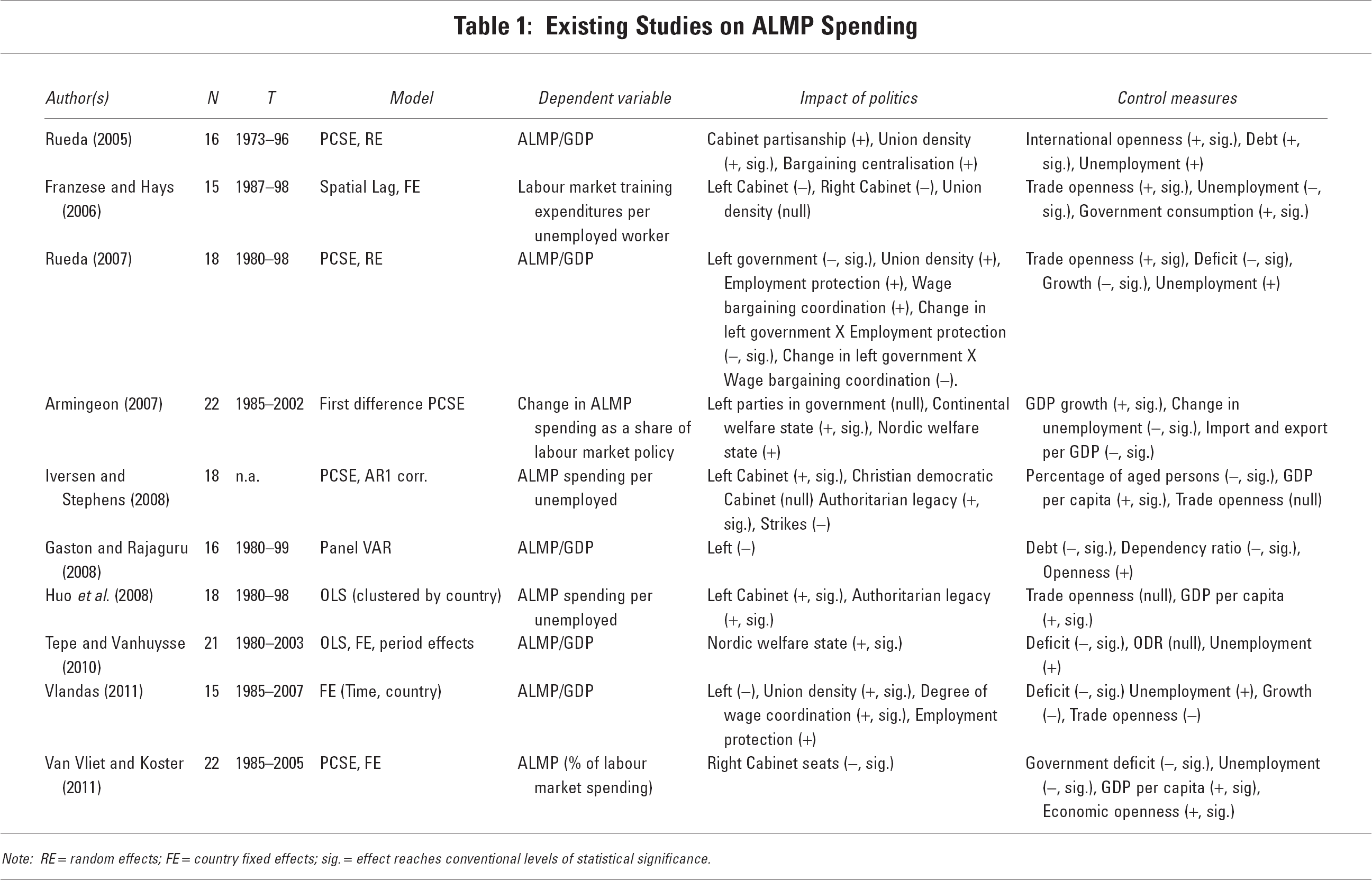
In the wake of Rueda's (2005; 2006; 2007) seminal contributions, a growing literature has emerged which explores the effect of partisanship on ALMP spending. Table 1 aims to summarise the main findings of eleven key studies published since then. Cumulatively, these studies provide mixed and inconclusive evidence on the effect of partisan power on ALMP. The majority of studies find that the ideological composition of government has no statistically significant effect on ALMP spending (Armingeon, 2007; Franzese and Hays, 2006; Gaston and Rajaguruy, 2008; Rueda, 2005; Vlandas, 2011). Rueda (2007, p. 92, p. 95) finds that lagged levels of left-wing power have no significant effect on ALMP spending and increases in left-wing power a significant and negative effect. But Torben Iversen and John Stephens (2008) and Jingjing Huo et al. (2008) report significant positive effects and Olaf van Vliet and Ferry Koster (2011) report that right-wing governments decrease ALMP spending.
Existing Studies on ALMP Spending
Note: RE = random effects; FE = country fixed effects; sig. = effect reaches conventional levels of statistical significance.
Less attention has thus far been paid to the role of trade unions in ALMP spending, even though some of these findings stand in sharp contrast to the predictions of economic insider–outsider models (Lindbeck and Snower, 1988; 2001; Saint-Paul, 2000). Of the four studies that utilised union density as a measure of union strength, two report a positive significant effect on ALMP spending (Rueda, 2005; Vlandas, 2011). Iversen and Stephens (2008) explore the effect of strike activity on ALMP spending and find a negative but non-significant relationship. A third political variable that has gained scholarly interest is welfare regime type. Klaus Armingeon (2007) and Tepe and Vanhuysse (2010) report that countries belonging to the Scandinavian welfare regime spend significantly more on
ALMPs. Robust findings have been reported on the effect of macroeconomic control measures on ALMP spending. Three exceptions notwithstanding (Franzese and Hays, 2006; Vis, 2011; Van Vliet and Koster, 2011), unemployment is generally associated with increases in ALMP spending. Even more robust evidence has been obtained with respect to government deficits: all studies that take this variable into account report a negative relationship with ALMP spending.
The literature review also reveals various issues regarding the comparability of prior evidence. First, even though the eleven studies explore different time periods and country samples, the large majority rely, like Rueda (2005; 2006; 2007), on a cross-sectional time-series (CSTS) regression setting to estimate the impact of political determinants on ALMP spending. Second, whereas the appropriate conceptualisation of the dependent variable in comparative political research has received much attention in the comparative political analysis of social expenditure, Table 2 relied on CSTS regression, the authors have chosen a very different approach to account for the panel structure of their data. We will try to address some of the methodological issues raised in this review of prior evidence in the fourth section. The next step of the analysis, however, is to make sense of the mixed evidence on the role of left parties and unions towards ALMP spending.
Types of ALMP Spending and Main Independent Variables (1986–2005)
Theoretical Background and Hypotheses
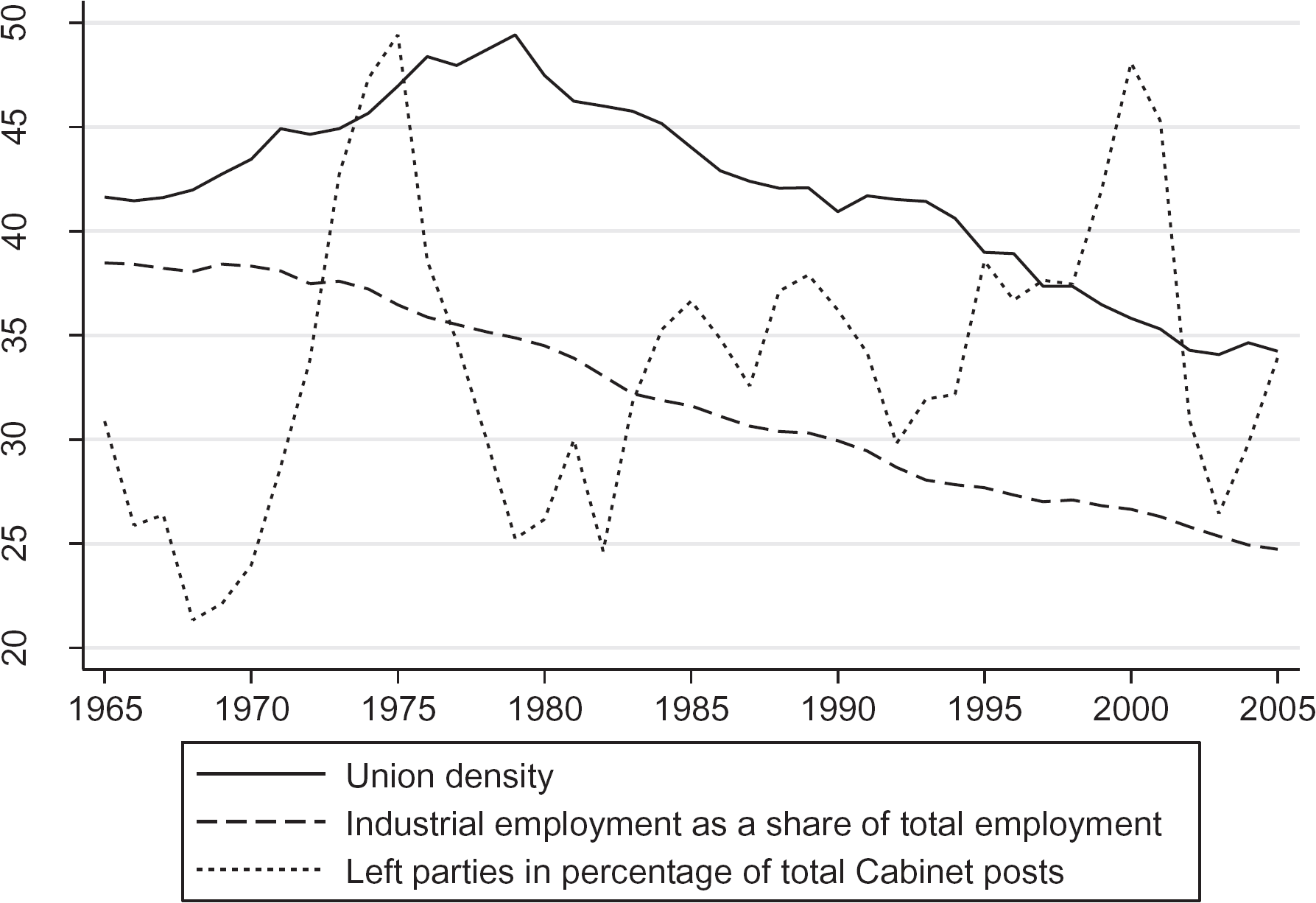
To understand why left-wing parties and unions have developed divergent strategies towards ALMP, we begin by looking at the long-term fortunes of these actors. Figure 1 depicts trends in the share of workers in the industrial sector relative to those in the agrarian and service sector, the share of Cabinet seats held by left-wing parties, and union density in the last four decades as averages for twenty OECD countries. Mainstream left-wing parties had a mixed political fate, as they suffered losses of power after the end of the welfare state's Trente Glorieuses by the mid-1970s, but returned to power towards the second part of the 1990s, often under ‘new left’ guises. To do so, left parties in the ‘post-golden era’ of the welfare state have had to pursue often very different electoral and policy strategies than in previous decades (on which more below). By contrast, Figure 1 shows that union density reached its peak in the 1980s, after which there has been a constant and near-universal decline, parallel to the decline in the industrial labour share. 2 To this loss of external power was added a loss of clout inside the traditional labour movement in some countries, as unions have had their voting power on left-wing parties' policy direction reduced considerably, especially in the Anglo-Saxon world.
Long-Term Trends in Industrial Employment, Left-Wing Cabinet Posts and Union Density
Left-wing Parties and ALMPs: The New Politics of Disinvestment?
‘Old’ power resources theories in the tradition of Walter Korpi (1983) hold that left-wing party power in government is key in the early installation and subsequent expansion of ALMPs in an effort to increase employment levels and to insure their rank and file – originally industrial workers – against job losses, to retrain and reskill them and, more generally, to de-commodify workers by making them less dependent on pure market forces (e.g. Esping-Andersen, 1990; review in Jensen, 2012). Other political science approaches less directly influenced by power resources theory similarly posit pro-expansion attitudes of left-wing parties towards ALMPs (Boix, 1998; Janoski, 1994). In an era of globalisation in which the degrees of freedom of governments to intervene in the economy through tax-and-spend approaches seem to be reduced by the likelihood of capital flight, ALMPs have acquired further importance, as they remain a key policy tool clearly at the disposal of governments. More than non-denominational right-wing parties or Christian democratic parties, left-wing parties may be more inclined to intervene directly to boost the supply side of labour markets by upgrading skills, job rates and employability (Boix, 1998; Iversen and Stephens, 2008). The traditional power resources hypothesis on partisanship would therefore still posit that left-wing party power will drive up ALMP spending.
This view has been challenged by Rueda (2005; 2006; 2007), who argues that left-wing parties have adopted a different approach to ALMPs especially in recent decades, with the rise of the service sector economy and of dual labour markets. Like insider–outsider theories in economics (Lindbeck and Snower, 1988; 2001; Saint-Paul, 2000), Rueda points out that labour is not a homogeneous block, but he adds an explicitly political dimension by unambiguously taking as his starting point the thesis that ‘the electoral goals of social democratic parties are sometimes best served by pursuing policies that benefit insiders while ignoring the interests of outsiders' (Rueda, 2007, p. 12). Left-wing parties, on this account, view only traditional labour market ‘insiders' (essentially low- to middle-income wage-earning workers with highly protected jobs) as their core voting base, which they need to favour predominantly with policies that protect employment. Rueda (2007) therefore posits a straightforward choice of left-wing parties in favour of insiders, not least because the latter tend to share relatively much more homogeneous interests and to be organised in unions. By contrast, left-wing parties see increasingly less electoral need to spend on ALMPs that tend to favour labour market ‘outsiders' – primarily the unemployed and atypical workers such as part-time, flexitime and temporary workers. Left parties may even want to reduce ALMP spending in times of macro-fiscal austerity. 3
In addition, to win elections by capturing middle-class voters beyond the shrinking base of industrial workers, left-wing parties in recent decades have shifted their ideological positions towards more centrist welfare positions and towards emphasising different (often explicitly women-friendly) social programmes such as human capital investment, family policies and childcare (e.g. Bonoli and Reber, 2010; Esping-Andersen, 2009; Jensen, 2012). For instance, election manifestos, party and policy programmes and parliamentary debates show that on key social policy decisions, continental European left-wing parties have increasingly converged towards mainstream Christian democratic parties (Seeleib-Kaiser et al., 2009). Promoting family and childcare policies, for instance, made left-wing parties more attractive for (and distinct to) female voters at a time when their traditional electoral base was rapidly eroding because of deindustrialisation, and when women increasingly expected state support for combining employment with motherhood (Bonoli and Reber, 2010; Esping-Andersen, 2009). Such strategies have become increasingly viable electorally as the democratisation of higher education access and the expansion of service sector employment have created simultaneously a wider and more heterogeneous base of middle-class voters (Häusermann and Schwander, 2009).
In light of both sets of arguments, a ‘new left’ partisan hypothesis therefore posits that left-wing values power in government (which we take to include both the ideological position of the government on an ideological left–right scale and the share of seats in the Cabinet held by left-wing parties)4 will not or will negatively affect activation spending:
H1. Left party disinvestment thesis: left-wing values power in government has no effect (weak version) or a negative effect (strong version) on ALMP spending.
Unions and ALMPs: Context-Dependent Advocacy, Driven by Members' Worries?
Whereas Rueda (2005; 2006; 2007) provides new theoretical perspectives on the evolving position of left-wing parties, no coherent political-theoretical framework has been developed to understand unions' approaches towards ALMPs in times of continued loss of members (Figure 1). Yet especially when it comes to social policies, these two sets of actors do not necessarily pursue identical goals, nor do they have identical constituencies (Jensen, 2012). The organisational success of left-wing parties depends primarily on their ability to win office by maximising votes, increasingly from women and middle-class voters. The success of unions, by contrast, depends primarily on their ability to gain or consolidate membership through their effectiveness in representing the labour market interests of their members.
To be sure, women-friendly policies and higher education democratisation have also been promoted at times by more progressive unions in an effort to assist their women members. And many outsider-type workers in low EPL labour markets with large proportions of part-time and casual workers tend to be women and are not necessarily middle-class voters. But even today the membership core of unions still lies predominantly with industrial workers (Ebbinghaus et al., 2011; Palier and Thelen, 2010). Demand-side gender divergence can further explain party–union policy divergence. Female voting turnout rates do not differ significantly from male rates, further making women-friendly party platforms electorally viable. But due to gender-typical employment patterns, women do record lower – often much lower – union membership rates than men in almost all advanced economies outside Nordic and Baltic Europe. 5 Unions may therefore be less able than left-wing parties to shift towards ‘modernising’ social policy positions (Upchurch et al., 2009). There is growing evidence of such party–union divergence, both as regards other social policy programmes (Häusermann, 2010; Jensen, 2012) and as regards general social spending (Kwon and Pontusson, 2010). 6 Even in the present times of general union decline, labour market policies remain one of the core areas for unions, in terms of both policy influence (Davidsson and Emmenegger, 2012) and goal prioritisation (Jensen, 2012). This is undoubtedly because labour market policies reflect the key concerns of the unions' rank and file, who are generally considered to be labour market insiders. But how do unions approach ALMPs, which have been commonly viewed as benefiting outsiders?
Standard political economy accounts assume that unions pursue the interests of insiders – primarily wages and job protection – often with little regard for society or even workers at large (Lindbeck and Snower, 1988; 2001; Saint-Paul, 2000; more refined predictions from similar assumptions are Calmfors and Driffill, 1988; Olson, 1981). Rueda (2007, p. 28) similarly argues that unions, ‘in a more significant way than social democratic parties (since upscale groups are of no importance to unions that depend primarily on insiders), have strong incentives to defend the interests of insiders' (emphasis added). Such a view would posit that greater union power following from a larger membership or stronger strike capacity will lead unions to push for insider protection exclusively (such as EPL), even at the expense of alleged outsider programmes (such as ALMPs).
However, in the wake of liberalised labour markets (even in coordinated market economies), growing international competition and increasingly punctuated working careers, the interests of union members today are not the same as during past times of welfare state expansion. To be sure, members are as likely as ever to demand continued job security protection from their leadership – indeed even labour market outsiders desire such protection ideally (Emmenegger, 2009). But in addition, especially since union members are likely to be more exposed to international competition and to feel threatened by further industrial decline, union leaders today also need to ensure workers' re-employability chances. Citizens generally see labour market policies as more important for providing them with a sense of employment security in crisis times than job protection policies such as EPL (Chung and Van Oorschot, 2011). Already by 1997, workers across fifteen OECD
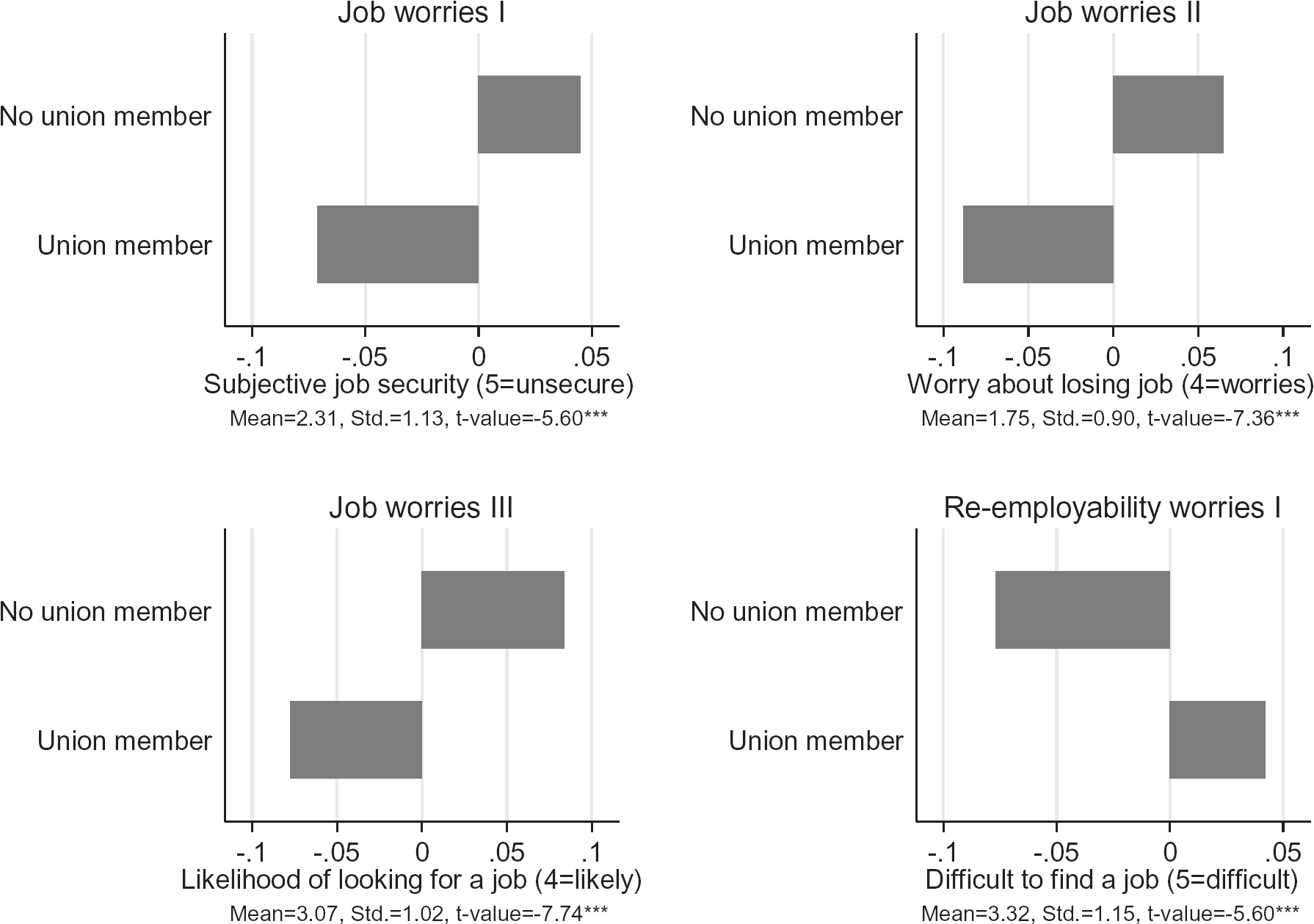
countries perceived ALMPs as boosting their re-employment chances; general levels of ALMP spending had no effect on workers' job insecurity (‘job worries’) but significantly reduced workers' re-employment insecurity in case of job loss (‘re-employability worries’) (Anderson and Pontusson, 2007). Interestingly, union membership itself was simultaneously associated with lower perceived job insecurity and with higher subjective re-employability insecurity (Anderson and Pontusson, 2007, pp. 220–1). In Figure 2 we have computed updated evidence from almost one decade later – the International Social Survey Programme (ISSP) 2005/6 wave – on the same two variables: job worries and re-employability worries.
On average, union members across the OECD are significantly less worried than non-members about the security of their current job. This is consistently the case across three different conceptions of ‘job worries’. But when it comes to their re-employability in the event of job loss, union members are actually significantly more worried than non-members. In fact, members are more worried nearly everywhere – in sixteen out of seventeen OECD countries (not shown). Especially in hard times of falling union membership, these re-employability worries are likely to feed back to union leaders and be heard by them, leading them to use their political clout to push for higher ALMP spending for reasons of organisational self-interest. Admittedly, unions, especially national union movements, are not unitary actors. Environments with many smaller unions potentially produce different strategic interactions and policy outcomes than environments with few medium-sized or still fewer large unions (Brandl and Traxler, 2010; Calmfors and Driffill, 1988; Olson, 1981; Traxler and Brandl, 2010; Vanhuysse, 2002). Moreover, the leaders and members of unions are subject to similar principal–agent problems as those that characterise the relationship between voters and politicians, or employers and employees (Golden, 1992; Vanhuysse, 2006; Vanhuysse and Sulitzeanu-Kenan, 2009). But we nevertheless assume that union leaders in hard times will generally have strong incentives to promote the distinct and clearly expressed interests of their mainstream members. For the same reason, we expect union leaders to seek to increase ALMP spending, particularly on those sub-dimensions that are most likely to help their own members. 7 Thus they are likely to be relatively less interested in promoting job creation programmes, which mainly benefit (non-unionised) labour market outsiders. But by the same token, union leaders can be expected to use their political power strongly to promote employment assistance and, especially, labour market training, which is the ALMP sub-dimension that is most likely to benefit (potential) union members. This leads us to hypothesise:
H2. Self-interested advocacy thesis: larger and more strike-prone trade unions have a positive effect on ALMP spending generally, and on employment assistance and labour market training specifically.
But in addition, the ALMP strategies of unions are likely to be context dependent. In particular, the labour market laws and institutions under which unions operate can be expected to condition their ALMP stances. Given the remaining importance of job security for union members, employment protection legislation is likely to be a key variable in this respect. 8 At the micro level, high levels of employment protection levels can be assumed to be a dominant social policy interest of labour market insiders, and to constitute their prime demand towards the parties and unions representing them. Indeed, greater levels of subjective job insecurity tend to be systematically correlated with less member satisfaction with unions, less identification with unions and a stronger desire to leave unions (Näswall et al., 2004). At the macro level, high contemporary EPL levels can be viewed a major acquis social and a proxy of past successes of the traditional labour movement (old left-wing parties and trade unions). Levels of employment protection differ according to the larger macro-political economy models to which countries belong, with coordinated market economies recording higher levels than liberal market economies (Iversen, 2005; Palier and Thelen, 2010). But once implemented, these levels are remarkably sticky at least for workers on regular contracts, indicating small and incremental rather than radical changes in past decades. Hence, contemporary EPL levels can be viewed not only as the result of contemporary expansion drives for higher standards in protecting labour market insiders but also as the institutional context within which unions operate.
On the part of union members, support for ALMPs appears to decrease where unemployment (and thus job competition) is high but to increase where job protection is low (Nelson, 2009). On the part of union leaders, the awareness of their members' increasing re-employability worries shown in Figure 2 can similarly be expected to be context-dependent. It is likely to be especially salient in low-EPL labour markets, given that industrial job loss is more likely in these more liberalised higher-turnover and shorter-tenure contexts (Iversen, 2005). Hence, we expect union leaders to be especially eager to push for policies that boost workers' re-employment chances and help to countervail re-employability worries in such low-EPL contexts. 9 This leads us to hypothesise:
Job Worries and Re-employability Worries among Union Members and Non-members (2005)
H3. Context-dependent advocacy thesis: lower levels of EPL will be associated with a stronger positive effect of union density and of strike rates on ALMP spending.
In other words, where and when high EPL has already been achieved (the first-order goal), unions are expected to focus their political clout mainly on defending and consolidating these past successes. But when and where high EPL levels have historically not been achieved for a variety of political economy reasons, more powerful unions can be expected to promote ALMP spending more strongly (the second-best, or first-best feasible goal), as an alternative way to offer their membership some measure of desired labour market security, in the form of state help towards their potential re-employability.
Data and Method
Focusing on cross-sectional differences in the level of ALMP spending we divide the OECD sample into four welfare regime types (on variables, see Table S1). 10 In line with Gøsta Esping-Andersen (1990) and others, we expect both the ingrained institutional logics and the historical timing of active social spending to lead Nordic welfare regimes to spend significantly more, and Southern European regimes to spend significantly less on ALMPs. The political power of left-wing parties is almost invariably operationalised as the percentage of Cabinet seats held by left-wing parties (see the critical review in Jensen, 2012). This approach increasingly ignores the ideological position of contemporary left-wing parties. Since modernised and distinctly pro-market social democratic parties won office under various labels in the 1990s in some countries (e.g. the ‘Neue Mitte’ SPD in Germany, ‘New Labour’ in the UK) but not in others (e.g. the PS in France and in francophone Belgium, the SPÖ in Austria), there is little doubt that left-wing parties in government can differ significantly in their ideological beliefs. The Comparative Manifesto Project (Budge et al., 2001; Klingemann et al., 2006) has coded government declarations in order to describe the ideological (rather than nominal) positions of governments with a left-to-right measure ranging from −100 (extreme left) to +100 (extreme right). This clearly shows that left-wing governments in Britain have become more centrist over time. Upon their launch in 1976, 1997 and 2001, the Callaghan, Blair-I and Blair-II governments had left-to-right values of, respectively, −27.5, +8.07 and +5.58. Similarly Germany's Schmidt government in 1976 was significantly left wing (–18.44), whereas the next left-led government, Schröder-I in 1998, was essentially centrist (–2.11). We use the left-to-right measure provided by the
Comparative Manifesto Project to account for changes in the left-wing ideology of parties in government. 11
However, a pure measure of the ideological position of a government on the right–left scale would ignore the vote share of left parties in the Cabinet, and thereby the share of ‘leftness' that can be accounted to social democratic parties in government. Hence, we constructed a measure of left-wing values power in government, which takes into account both the ideological position of the government on the left–right scale and the share of seats in the Cabinet held by left-wing parties.
Left-wing values power = sqrt (Left ideology × Left Cabinet seats) (1)
Before the original Comparative Manifesto Project left-to-right variable is entered into (1), it has been subject to the following transformations. First, the variable has been reversed so that −100 stands for extreme right and +100 for extreme left-leaning governments. Second, we have rescaled the new variables within each country so that the lowest value on the scale gets the value 1 (extreme right). Hence, theoretically the highest value on the reversed and rescaled variable measuring governments' ideological position is 201 (extreme left). Empirically the country-specific right-to-left measure for governments' ideological position ranges from 1 (extreme right) to 64.4 (extreme left). Third, we have chosen to measure the ideological position of governments relative to the most right-leaning government in each country during the observation period as Comparative Manifesto Database measures are most valuable in capturing positional changes within rather than between countries.
Left Cabinet seats are measured as a share of total seats and range from 0 to 100. We took the square root of the product of the two measures since we assume that an increase in left values power matters more in governments where the left-wing coalition partners have little influence than in governments that are already dominated by the left-wing parties. The advantage of this measure is that it takes into account changes in the ideological position of left governments over time.
To account for the political strength of unions in determining ALMP spending, we distinguish two dimensions of the political clout of unions, namely the size and the ‘aggressiveness' of unions. The size and potential impact of unions is measured as union density, in line with prior studies (Table 1), defined as net union membership as a proportion of wage and salary earners in employment (Armingeon et al., 2011). Unions can have much political influence through strikes in low-density countries (e.g. France) or alternatively may be socially non-disruptive in high-density countries (e.g. Nordic Europe). Strike aggressiveness is therefore a politically distinct dimension of trade unionism. It is measured by the logarithm of the index of strike activity. The strike activity index is defined as the number of working days lost divided by the number of civilian employees multiplied by 1,000.
In order to account for the context effect of employment protection legislation we use the measure provided by the OECD, which refers to all types of employment protection measure, whether grounded primarily in legislation, court rulings, collectively bargained conditions of employment or customary practice. 12 The OECD index of EPL is classified in three main areas: employment protection of regular workers; specific requirements for collective dismissals; and employment protection of temporary workers. Employment protection legislation is measured via the unweighted average of the OECD's version 1 sub-indicator for regular contracts (EPR_v1) and temporary contracts (EPT_v1).
Each model includes a set of four control variables, which aim to capture long-term macroeconomic developments. The selection of these control measures is based on the prior evidence summarised in Table 1. General macroeconomic developments are captured with the GDP growth rate. The fiscal resources of governments are measured in terms of government deficits as a share of GDP. In general we expect that higher deficits will lead governments to cut first and foremost smaller programmes with high levels of spending discretion such as ALMPs. The opposite effect should be observed with respect to the unemployment rate, as higher levels of unemployment should lead governments to react by spending more on all forms of ALMP, especially since the 1990s when ALMPs became more fashionable and better promoted also at EU levels. In fact, unemployment should be the most important time-varying determinant for ALMP spending. Here, the more challenging question is whether unemployment has the same effect on different types of AMLP spending. Finally, international economic integration is measured in terms of trade openness. Table S1 presents the definition and source of the variables employed in the regression analysis. Table S2 shows the summary statistics of the z-standardised variables.
Estimation Strategy
Since we are interested in structural changes and long-term contextual effects of labour market institutions on ALMP spending, rather than annual fluctuations, we have grouped annual observations into five-year averages. The variables for each country are calculated as averages of, respectively, the periods 1986–90, 1991–5, 1996–2000 and 2001–5. It has been argued that the 1990s mark a significant increase in the centrality of ALMPs as a policy tool (e.g. Bonoli, 2010; Weishaupt, 2011). The breakdown of time periods is not only a way for taking into account the fact that electoral and social changes often need time to materialise into public policy efforts but also allows us to explore the existence of potential ‘sea changes' in the size of ALMP spending. The averaging procedure makes a balanced sample of 80 observations (T = 4, N = 20). 13 Given the data set's panel structure, a key question is whether the country effects should be treated as random or fixed (see Table 1). The random-effect estimator is heavily influenced by cross-sectional variance and depends on the assumption that unobserved heterogeneity is mean independent of the causal variable (Halaby, 2004, p. 511). This assumption would be defensible under randomised assignment but less so in a sample consisting of twenty OECD countries, where each unit has a distinct set of social security institutions. The fixed-effects estimator, which exploits within-unit variation as a means of purging unit heterogeneity, offers to dispense the random-effects assumption and still obtains unbiased and consistent estimates when unit effects are arbitrarily correlated with explanatory variables (Halaby, 2004, p. 516). To separate within-unit and between-unit effects, we apply two different models: one focusing on change over time within countries (FE), and one focusing on variance over time between countries (BE), as mixing up within-unit and between-unit effects would hamper a clear interpretation of our estimated coefficients (Breusch et al., 2011). In order to obtain easily interpretable estimation coefficients all metric variables have been z-transferred (mean = 0, sd = 1). To compare the model fit for different specifications we report the adjusted R-square, the AIC and BIC. 14
Results
Descriptive Analysis
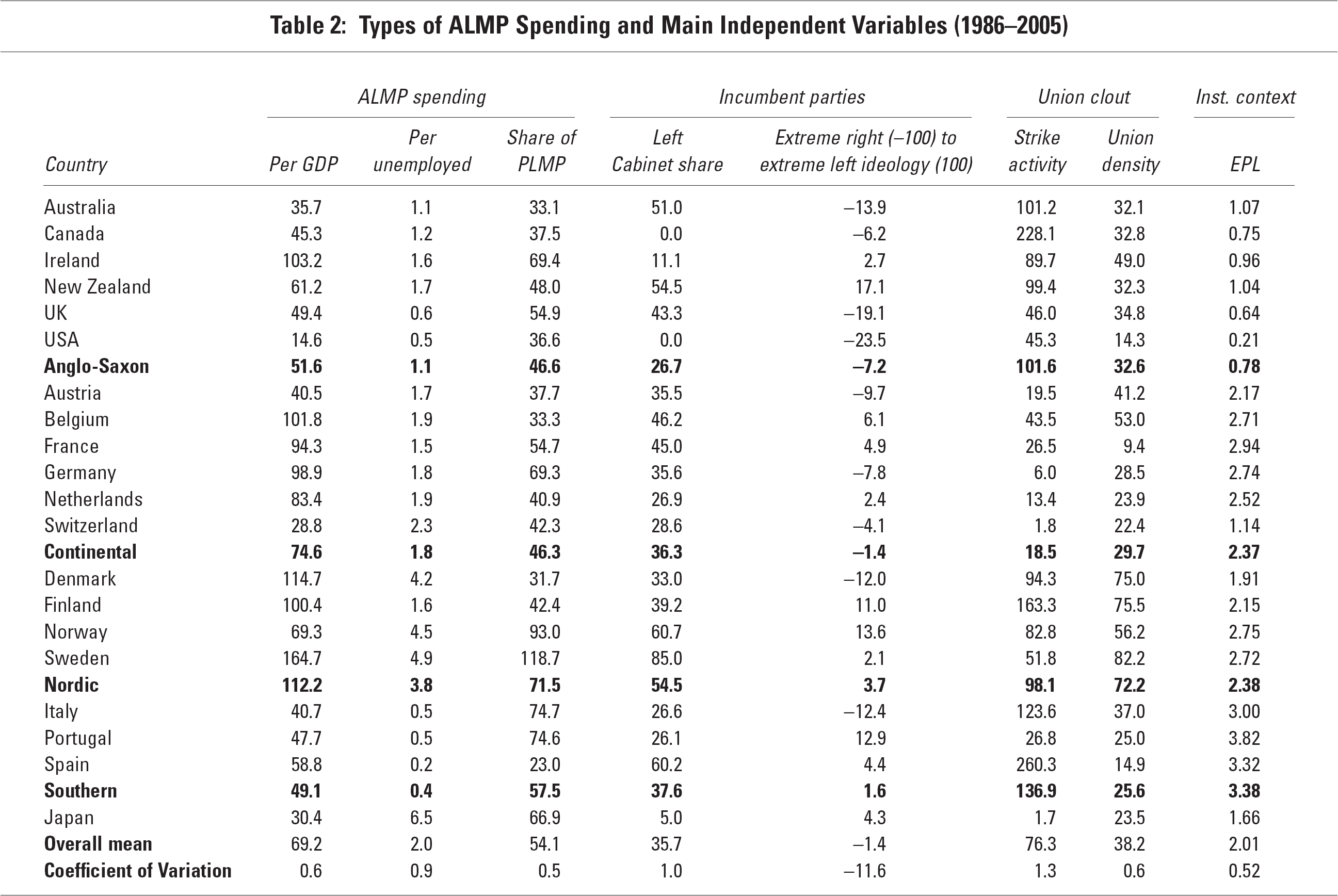
In line with prior research, Table 2 shows that, on all three measures of ALMP spending, Scandinavian countries have spent most, followed by continental European and Anglo-American countries. Southern European countries have devoted the fewest resources to ALMPs measured in terms of spending per GDP and spending per unemployed, followed by Anglo-Saxon countries. The strength of left-wing parties is represented in the fourth and fifth column. Measured by Cabinet seats, since 1985 left-wing parties have been strong in the Scandinavian countries (55 per cent of seats) and weak in the Anglo-American countries (27 per cent), whereas their average seat share in continental and in Southern European countries was almost identical (36–38 per cent).
If we take into account the ideological positions of governments we observe a number of interesting deviations that point out the importance of an adequate operationalisation of theoretical constructs. Left-wing Cabinet power and left-wing ideology are clearly two different things. There are a number of cases, such as Portugal, where over the twenty-year period considered successive governments had a low share of left party seats (26 per cent of seats) despite holding rather left-leaning ideological positions (thirteen on the −100 to +100 scale), or vice versa, as in the case of Spain and Sweden (respectively, 60 and 85 per cent of government seats, but essentially centrist). Intra-regime variance is large as well, especially within the Anglo-Saxon regime, where there is more variance in institutional (e.g. such as proportional representation [PR] vs. majoritarian) regimes. For instance, New Zealand and the UK had widely diverging degrees of government leftness (respectively, +17 and −19) despite (roughly) similar levels of left-wing seats. By contrast, the US experienced equally right-wing governments (–23.5) as the UK, despite having zero (as opposed to 43) per cent of left Cabinet seats, while Canada experienced much less right-wing governments (–6.2) than the US with the same share (zero) of left-wing Cabinet seats. In sum, differentiating between the Cabinet power of left-wing parties and the actual left ideological positions of governments can provide richly differentiated information.
A similar conclusion can be drawn from the cross-national comparison of the two measures for union clout. Strike activity and union density clearly capture qualitative differences in the type of union power. Moderate levels of union density are paired with low levels of strike activity in continental Europe but with high levels of strikes in the Anglo-Saxon world, especially in Canada. The Nordic regime tends to combine moderate to high strike activity with high union density. The Southern regime in turn combines the lowest union density levels with the highest strike activity levels, especially in Spain. The last column of Table 2 shows that EPL is particularly strong in the Southern countries, followed by the Nordic and continental European countries and, at a distance, the Anglo-Saxon countries.
Regression Analysis
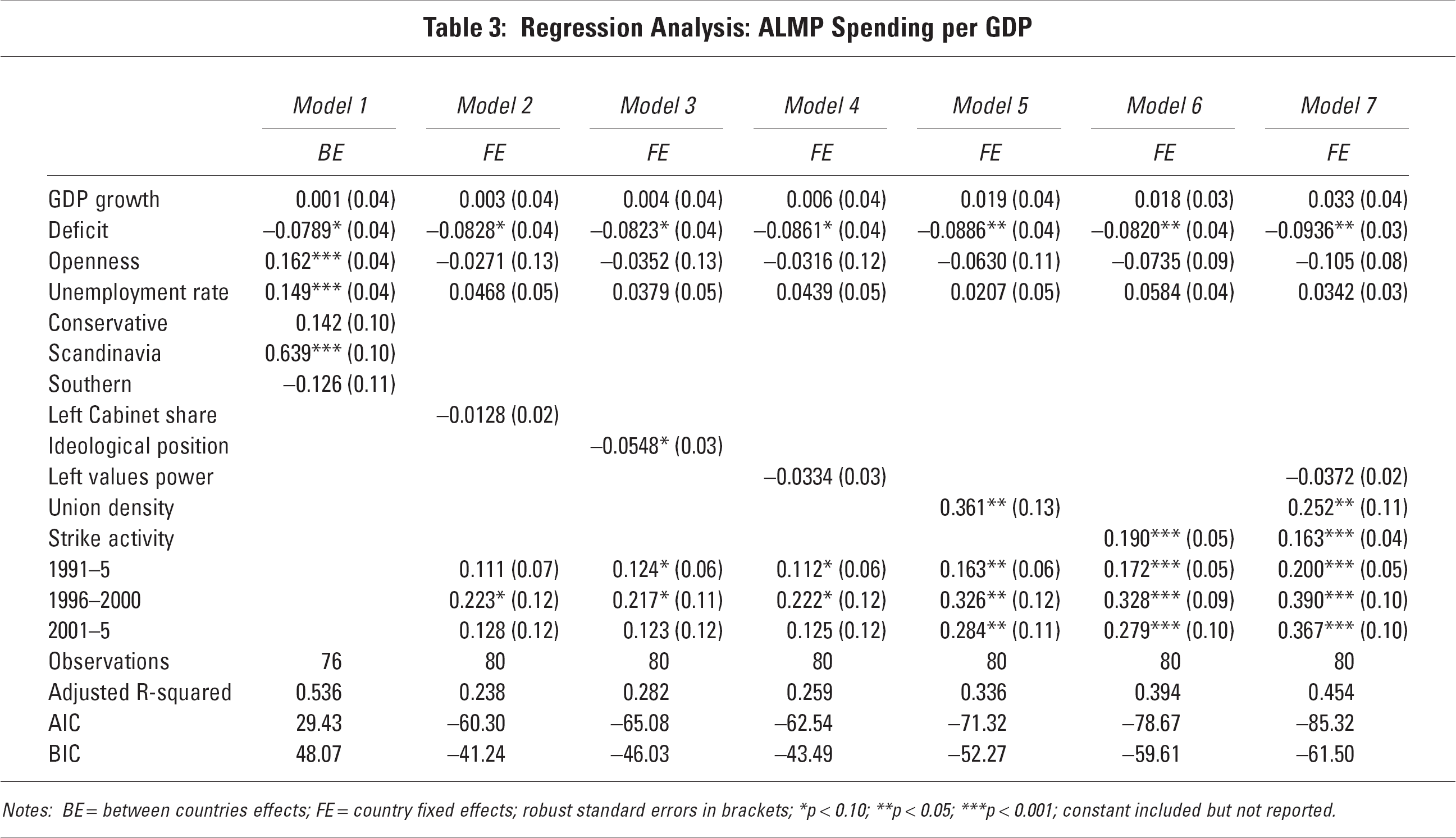
Table 3 presents findings from the analyses of continuous long-term change in total ALMP spending measured as a share of GDP. Model 1 focuses on overall cross-national variance. For this purpose we rely on the between-effects specification (employing country averages), which is most suitable to account for time-invariant independent variables such as welfare regime affiliation, whereby the liberal regime served as the reference category. Cross-sectionally, countries with larger deficits spend significantly less on ALMPs, whereas more open countries, countries with higher unemployment levels and Nordic welfare countries spend significantly more. The regime type findings are of course in line with much prior evidence (e.g. Bonoli, 2010; Iversen and Stephens, 2008; Tepe and Vanhuysse, 2010).
Regression Analysis: ALMP Spending per GDP
Notes: BE = between countries effects; FE = country fixed effects; robust standard errors in brackets; *p < 0.10; **p < 0.05; ***p < 0.001; constant included but not reported.
Models 2 to 7 in Table 3. This might be because this relatively small and relatively new social programme suffers from a last-in-first-out effect at times when macro-fiscal savings are needed or, conversely, because lower ALMP spending leads to higher inactivity and welfare dependency rates and hence to larger budget deficits. The latter interpretation is consistent with the original rationale of ALMPs in Nordic countries, as espoused also at the EU level today: ALMPs help to increase activity rates and thus to reduce unemployment levels and budget deficits.
Turning to our political variables, Models 2 to 7 investigate the effects of left-wing values power and union power. The left party Cabinet share variable most often used in research on partisanship shows no significant effect (Model 2), but the Comparative Manifesto Database's ideology variable indicates that more left-wing governments significantly reduce ALMP spending (Model 3). Our own combined variable, ‘left values power’, also indicates a negative relationship (Models 4 and 7). Although both estimates narrowly fail to reach conventional statistical significance levels (Model 6, p-values 0.102), the observed relationship lends some measure of support for (a weak version of) the left party disinvestment thesis (H1). Interestingly, both measures of union clout are systematically associated with significantly higher levels of ALMP spending (Models 5, 6 and 7). Even after controlling for macroeconomic and partisan-political variables, both larger unions and more aggressive unions appear to push for higher spending for labour market outsiders, corroborating the self-interested union advocacy thesis (H2).
How do these findings change if we use ALMP spending per unemployed and ALMP spending as a share of passive labour market policy spending as the dependent variable (Table S3)? Whereas ALMP spending per GDP measures the absolute size of these programmes, ALMP spending per unemployed seeks to take into account relative programme generosity and ALMP spending as a share of passive labour market programme spending (PLMP) indicates the trade-off between these two programmes. Regarding our main political variables, we find that the effect of strike activity (but not union density) on ALMP spending both per unemployed person and as a share of PLMP spending remains positive and statistically significant (Table S3). 16 In other words, strike activity is positively associated with all three measures of ALMP spending.
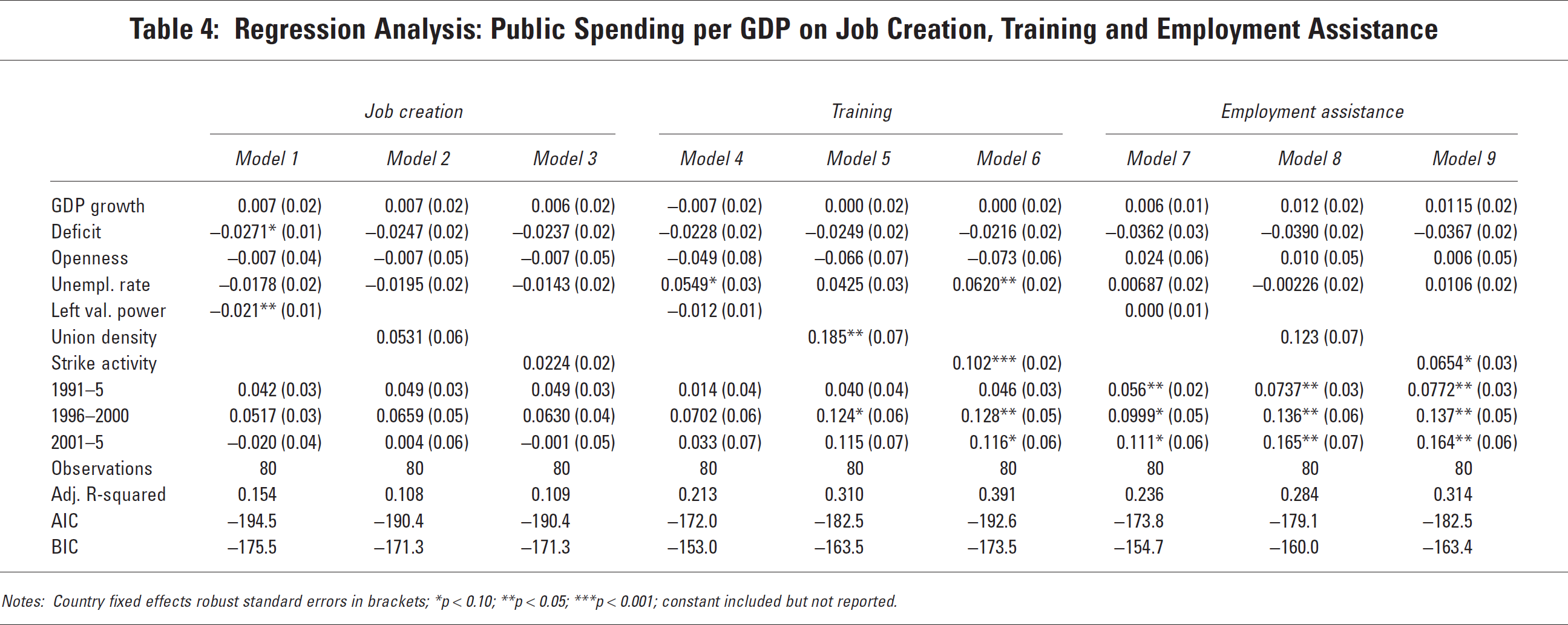
Table 3, the main differences here are that left-wing values power negatively affects job creation programme spending specifically. As this is the ALMP sub-programme that most directly benefits outsiders, this finding provides support for a stronger version of the left party disinvestment thesis (H1). The very opposite is true for union power. The coefficients for union density rates and strike rates show that stronger unions push for higher spending on those ALMP sub-programmes that most directly help their own members: employment assistance and, especially, job training. Together with the absence of a similar effect on job creation programmes, this provides further and more specific support for the self-interested advocacy thesis (H2). Powerful unions may appear to act (or pose) as ALMP promoters generally, but they tend to make sure they benefit their own rank and file first and foremost.
Context-Dependent Union Strategies
While we have found above that both larger unions and more aggressive unions appear to push for higher ALMP spending, we also hypothesise that union (but not party) strategies towards such spending depend on whether or not labour market insiders are already highly protected in their jobs (H3). To explore this argument we introduce stepwise three multiplicative interaction terms into our sets of three regression models (interacting EPL with left values power, union density and strike activity). With three political variables of theoretical interest and three different conceptualisations of the dependent variables we get nine conditional effect models (Table S5). Even though EPL is a time-varying measure, it changes only very gradually within countries over time. This might cause multicollinearity. To explore this potential issue in further detail we checked changes in the variance inflation factor (VIF), which reports unproblematic values (min. 2.15) and we test the exclusion of the full set of country dummies using a series of Wald tests. Test results indicate that the full set of country dummies needed to be kept in the conditional effect models.
Regression Analysis: Public Spending per GDP on Job Creation, Training and Employment Assistance
Notes: Country fixed effects robust standard errors in brackets; *p < 0.10; **p < 0.05; ***p < 0.001; constant included but not reported.
Figure 3 represents the conditional effect of EPL on the effect of union density on our three measures of ALMP spending when EPL is, respectively, at its minimum level (equivalent to 0.21, the US value throughout 1986–2005) and at its maximum level (4.15, the Portugal value in 1985–8). To interpret the conditional effect of EPL on the effect of the three political variables we use conditional effect plots as suggested by Cindy Kam and Robert Franzese (2007). Each of the resulting nine plots shows the effect of the political variable on the predicted level of ALMP spending when the political variable ranges from its minimum to its maximum value, in the context of maximum EPL (grey dots) and minimum EPL (black dots). Each point estimate comes with a 90 per cent confidence interval, whereas overlapping intervals indicate insignificant interaction effects. 17
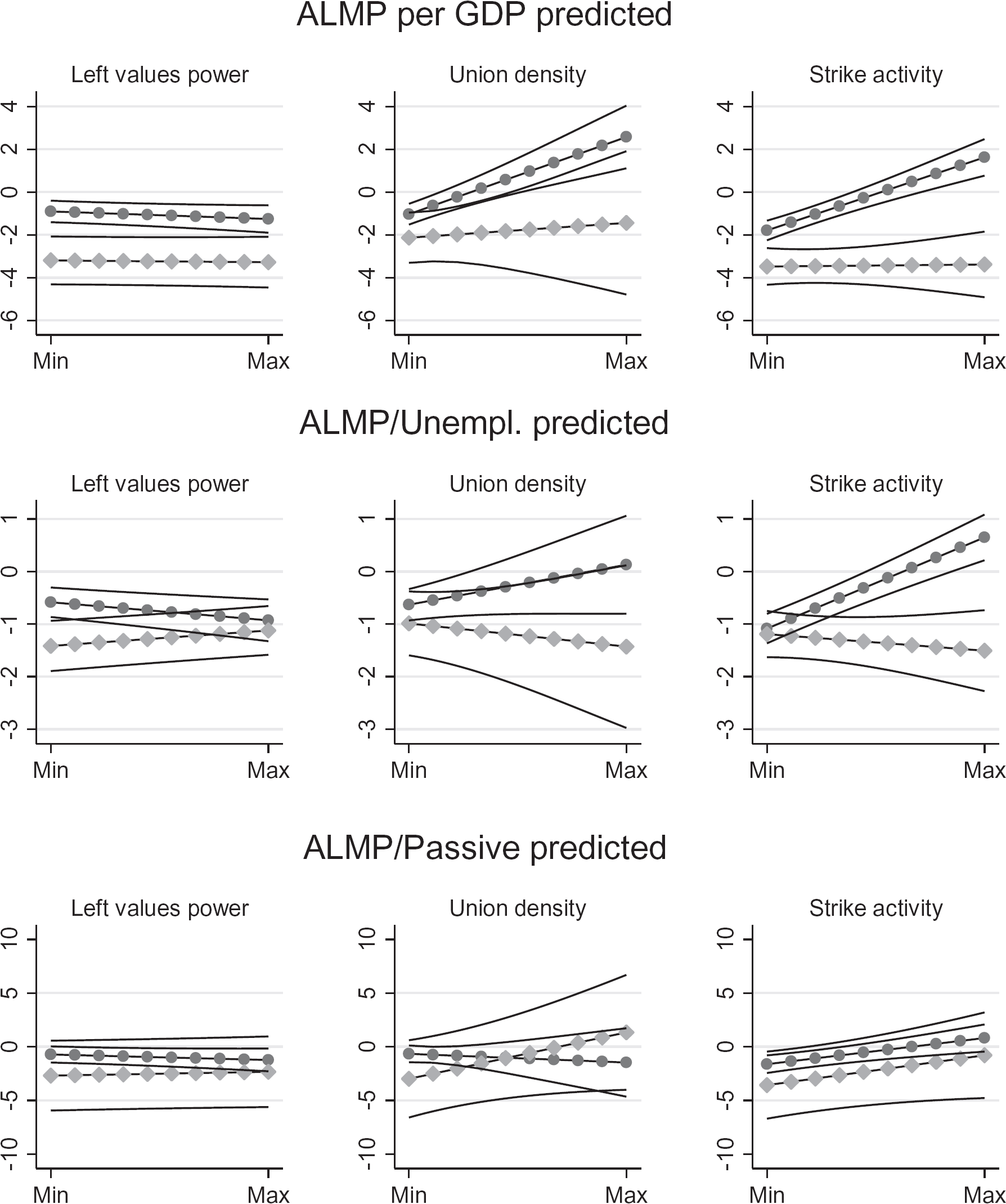
Effect of Left Values Power and Union Power on ALMP Spending, as Conditioned by EPL
The first column in Figure 3 shows the predicted effect of left values power on the three measures of ALMP spending. In all three cases the high-EPL and low-EPL lines are almost identical and the 90 per cent confidence intervals are almost perfectly overlapping. Hence, there is no evidence that the effect of left values power on ALMP spending is in any way conditioned by EPL. The second column shows the predicted effect of union density on the three measures of ALMP spending in high- and low-EPL contexts. Here a scissor-shaped pattern emerges. Concerning ALMP spending per GDP and per unemployed, union density leads to strong increases in both measures where EPL is low. Where EPL is high, increases in union density still increase ALMP spending, but the positive effect is rather moderate. Taking into account the 90 per cent confidence intervals, however, reveals that none of the three conditional effects is statistically significant. In contexts with very high levels of EPL (as in contemporary continental and Southern Europe), higher union density has a negative effect on ALMP spending. However, where EPL is very low (as in Anglo-Saxon liberal market economies), higher union density leads to large increases in the predicted level of ALMP spending.
Labour conflict is similarly likely to result from strategic union choice as embedded in specific economic and institutional contexts (Brandl and Traxler, 2010). Not surprisingly, therefore, a similar scissor-shaped pattern is also evident when investigating how EPL mediates the effect of strike rates on ALMP spending. Now the conditional effect reaches conventional levels of statistical significance in the cases of ALMP spending per GDP and per unemployed. More assertive unions have a weak and negative effect on total ALMP spending as a share of GDP in highly protected labour markets, but have a stronger and positive effect on ALMP spending on weakly protected labour markets.
These findings provide some evidence for the context-dependent advocacy thesis (H3). Unions with more political clout might push more strongly for ALMP spending mainly when and where regular workers are not yet well protected. This may be because in contexts where high EPL levels have never become a key part of the larger macro-political economy model, ALMPs have become the first-best feasible union priority, as they offer workers support for reskilling and retraining and can simultaneously be presented as a clearly market-conforming or market-strengthening policy. In other words, unions today appear to consider ALMPs as a second-best goal, EPL being their first priority. 18
Conclusions
This study has explored the role of left-wing governments and trade unions in determining ALMP spending and has proposed an explanation for why left-wing governments and trade unions today appear to pursue divergent strategies in this regard. Our findings can be condensed into three statements. First, left values power does not tend to increase ALMP spending (corroborating H1, weak version), and actually decreases spending on job creation programmes, which are most likely to benefit outsiders (H1, strong version). Both findings are consistent with Rueda's (2005; 2006; 2007) pioneering thesis that left-wing parties care relatively little for outsider spending. Second, in line with the idea that unions' ALMP strategies increasingly need to take into account the growing re-employability worries of their members, larger and more strike-prone unions are found to increase ALMP spending (corroborating H2), and specifically to increase those sub-dimensions that help union members, such as employment assistance and, especially, training. Third, unions' ALMP strategies are conditioned by the level of employment protection legislation: more powerful unions push up ALMP spending especially in those labour markets where jobs are not well protected (H3).
Cumulative evidence shows that union members across the OECD are especially worried about their re-employability chances in the event of job loss in the 1990s (Anderson and Pontusson, 2007) and in the 2000s (Figure 2). Moreover, members' support for ALMPs tends to increase where job protection levels are low (Nelson, 2009). We have argued that union leaders, aware of the worries of their membership in case of job loss, are more likely today to use their clout to push for policies that boost workers' re-employment chances in low-EPL labour markets, where job turnover is high and firing and dismissal are easier. In such liberal and liberalising market economies, ALMPs may simply turn into the first-best feasible union goal, as they are valued by their members as a form of re-employability security, yet can be framed as a market-strengthening policy tool.
As this article focuses on long-term structural changes, we have considered EPL as the exogenously given context in which left-wing governments and unions operate. EPL, however, can also be considered as a dependent variable – the result of strategic efforts by these actors to expand or consolidate insider protection. In this respect further research might fruitfully investigate how union support for employment protection varies across the types of employment. Long-term trends of employment protection legislation for regular contracts (which largely correspond with insider jobs) and temporary contracts (outsider jobs) show a scissor-shaped pattern of a different kind from 1996 onwards. Regular contracts have enjoyed a remarkable status quo in protection levels, whereas temporary job contracts have suffered from reductions of protection levels. 19 These findings are in line with Richard Clayton and Jonas Pontusson's (1998) argument that unions (unlike left-wing parties) in globalised times are increasingly willing to condone or even support social spending cutbacks if this is likely to safeguard the status quo in terms of their labour market policy interests (see also Jensen, 2012). Similarly, Davidsson and Emmenegger (2012) show that when it comes to job security legislation, unions tend to protect permanent contracts (which safeguard their members' interests) while simultaneously consenting to sometimes far-reaching further deregulation of temporary employment, which hurts labour market outsiders (see also Palier and Thelen, 2010). In sum, we suggest that, unlike left-wing parties, unions today must still be viewed as primarily concerned with protecting labour market insider interests: through EPL when they can, but through ALMP spending when they must.
Footnotes
A previous version of this article was presented at the ECPR Joint Session in Sankt Gallen in April 2011 and at the European Centre's General Assembly Meeting at the UN in Vienna in September 2011. For comments we are grateful to the participants, especially Johan Bo Davidsson, Bernd Marin, Pedro Ramos Pinto, Ricardo Rodrigues, Hans Steiner and Barbara Vis, and to Patrick Emmenegger. The data set and Stata command files are available for replication.
1
See, e.g., Armingeon, 2007; Bonoli, 2010; Weishaupt, 2011. For a review of the new political economy of skill formation, see  .
.
2
The partial exceptions (until the late 1990s) to this are ‘Ghent system countries’, where unions are involved in social insurance administration, e.g. Nordic countries and Belgium (Ebbinghaus et al., 2011). In the new democracies of Central and Eastern Europe, union decline was, if anything, more pronounced than in advanced Western democracies, but due to entirely different dynamics (Vanhuysse, 2007; ).
3
See Rueda, 2007, pp. 14–5. The reason is that the social policy interests of insiders and outsiders are essentially opposed under tight fiscal conditions. Insiders want to improve or consolidate job protection and have few incentives to finance social programmes that allow outsiders to find insider jobs and thus compete with them for jobs and wages.
4
As discussed below, we define ‘left values power’ as: sqrt(Left ideology × Left Cabinet seats).
5
Outside Nordic and Baltic Europe, women form the minority of union members in twelve out of fourteen European nations. Women form a roughly equal portion of union members in a thirteenth European nation (Slovenia) (Eurofound, 2009, p. 19) and also in Canada, but only since the 2000s (Akyeampong, 2004, p. 6). Note, however, that greater ‘women power’ measured by economic participation and parliamentary representation levels does not appear to affect either family spending or ALMP spending (Tepe and Vanhuysse, 2010).
6
For instance, coding 1972–2003 pension reform policy positions, finds that unions attach a lower importance to post-industrial modernisation than do left-wing parties. As a result, the unions–left-wing party distance increases and new ‘modernising compromises' tend to divide the left and to marginalise unions.
7
The ‘signs of the times’, in the form of widespread acceptance of the activation paradigm from the 1990s onwards, as well as continuing interaction of unions with modernising left-wing parties may further contribute to refocus unions on those ALMP programmes that at least serve their ‘mainstream’ members (those [self-]interested in re-employability protection), thereby perhaps diluting the influence of more left-leaning and/or ideologically motivated members. We thank a reviewer for urging us to clarify this.
9
Here too we expect a divergence between unions and left-wing parties. Left-wing parties in most OECD countries today have become more market enhancing (less anti-liberal) than unions in their labour market policies, and they have widened or diversified their policy stances to cater for a more heterogeneous middle class. These parties' stance towards ALMPs is therefore not likely to be much affected by the degree to which insiders are protected already by EPL.
10
Note that Japan is not affiliated to any of these four regimes.
11
Franzmann and , p. 165) show that the ideological left–right scale is among the most important dimensions of the political space. It is understood as a compound scale, measuring economic perceptions (pro-market liberalism vs. state protectionism) and non-economic issues such as culture, crime prevention, education, women's rights or integration of immigrants, and so on.
13
While the use of cross-sectional time-series data has become paramount in macro-comparative research on the welfare state (e.g. Table 1), such data are flawed by a multitude of methodological issues. Substantive issues like learning and policy feedback impact on the possibility to make inferential statements, whereas technical issues like non-stationarity and serial correlation limit the ability to interpret estimates obtained from regression models (Kittel, 2008, p. 29). We thus note that our statistical models cannot be understood as causal models in the strict sense, but rather as an exploration of the statistical associations derived from a heuristic framework of hypotheses.
14
Before the independent variables enter the statistical models they have been tested for multicollinearity using the variance inflation factor, whose mean value for the full set of variables is 1.65, with a maximum of 2.06 and a minimum of 1.04, all of which are considered as unproblematic values.
15
See, e.g., Bonoli, 2010; Weishaupt, 2011; Armingeon, 2007. In the case of Anglo-Saxon countries such as the UK, Australia and the US, this was combined with a greater emphasis on workfare programmes from the late 1990s.
16
In order to make sure that these findings are not driven by the cross-sectional composition of the panel data set we run a Jackknife test on Model 7 from Table 3, and on Model 5 and 10 in Table S3. The results (Table S4) confirm that the size of the effect of strike activity and of left values power varies with the cross-sectional composition of the panel data set. More importantly, the direction of these effects is robust. To conduct the panel Jackknife test we use the xtjack command in Stata programmed by .
17
To prepare marginal effect plots we use the margeff command in Stata (Kittel, 2006).
18
This finding simultaneously casts some doubt on the view that ALMPs are an unambiguous labour market outsider programme, as much of the literature in economics and political science generally assumes (Iversen, 2005; Lindbeck and Snower, 1988; 2001; Rueda, 2005; 2006; 2007; Saint-Paul, 2000).
19
OECD data (not shown, available on request).
Supporting Information
Additional Supporting Information may be found in the online version of this article:
Definition and Source of Variables Descriptive Statistics Regression Analysis: ALMP Spending per Unemployed and as a Share of PLMP Spending Panel Jackknife Omitting One Cross-Section at a Time Conditional Effect of EPL on Types of ALMP Spending