






Abstract
This article maps out the state of affairs of the academic literature which uses procedural spatial voting models to explain legislative decision-making in the European Union. Employing Tsebelis's (1994) article in which the author models the Union's co-operation procedure and using it as a reference point, I show that there is no clarity yet as to which of the several existing procedural model specifications yields the most convincing results. I conclude by suggesting how the current situation could be improved, and that procedural modelling might be integrated with other rational choice theory for a better understanding of the ongoing evolution of the policymaking instruments in the European Union.
1. Procedural models of European Union legislative decision-making
How can the outcome of European Union (EU) legislative decision-making best be explained? Rational choice institutionalism departs from the assumption that, in order to analyse how EU secondary legislation is created, decision-making power as laid down in the Treaty Establishing the European Community and the Treaty on European Union has to be taken into consideration. 1 The political debates in the French city of Nice, which surrounded the recent intergovernmental negotiations that were supposed to prepare the Union for further treaty revision and to redesign important aspects of the Union's institutional setting, might be considered as preliminary evidence for the importance of formal rules in the European Union's decision-making process. In December 2000, the intergovernmental conference was terminated, culminating in a new European treaty. Its main objectives are to redefine the existing treaties to provide for greater efficiency in the light of EU Eastern enlargement. The debates resulted in a more frequent use of the codecision procedure, in a reweighing of the Member States' formal voting shares, and in reorganising the structure of the European Commission (Cottrell, 1999; The Economist, 2000). The most prominent of the European Union's current primary legislative instruments are the so-called consultation procedure, the assent procedure, the co-operation procedure, and the codecision procedure. In fact, there exist several more of these rules, but social scientists by and large chose to focus their attention on the ones mentioned above. The reason for this is supposedly the fact that the vast majority of secondary legislation in the EU is generated via the use of the procedures mentioned above. 2
In order to understand exactly how these institutional arrangements might affect the EU legislative process, procedural spatial voting models have been put forward which focus on a stylised representation of the policy process in the European Union. These models try to conceptualise the different legislative arrangements by integrating rational choice theory with an interpretation of the structure of decision-making as influenced by the treaties of the EU. The treaties represent the Union's primary legislation. They in detail attribute certain roles to institutional actors in the process which generates European secondary legislation, such as EU regulations, directives and decisions. One of the first papers to employ procedural modelling in trying to explain EU legislative decision-making was put forward by George Tsebelis (1994). The aim of the paper was to assess the European Parliament's legislative powers under the co-operation procedure. In his article, Tsebelis attributes substantial powers to Parliament which – under certain conditions – he considers to be able to submit a take-it-or-leave-it proposal to the Council of the European Union and thus to exercise substantial influence in the area of law-making. Concluding, the author regards Parliament to be a conditional agenda setter in the European Union legislative process.
Tsebelis's article presents a model which essentially focuses on the last stage of the co-operation procedure. The procedure, which was established by the Single European Act of 1987, was intended to strengthen the role of Parliament in its interaction with the Union's other institutional actors, the Commission and the Council, to produce new legislation. An important characteristic of the model is that the author does not present a formal account of the preceding stages of co-operation. For the last stage, he assumes that Parliament offers to the Council a legislative proposal which this body can either accept or reject with a qualified majority (62 out of 87 votes), or amend it with unanimity. Over the last few years, all of the major decision-making procedures of the EU were subject to being modelled with the help of the procedural model approach. Figure 1 presents an overview of the different models.
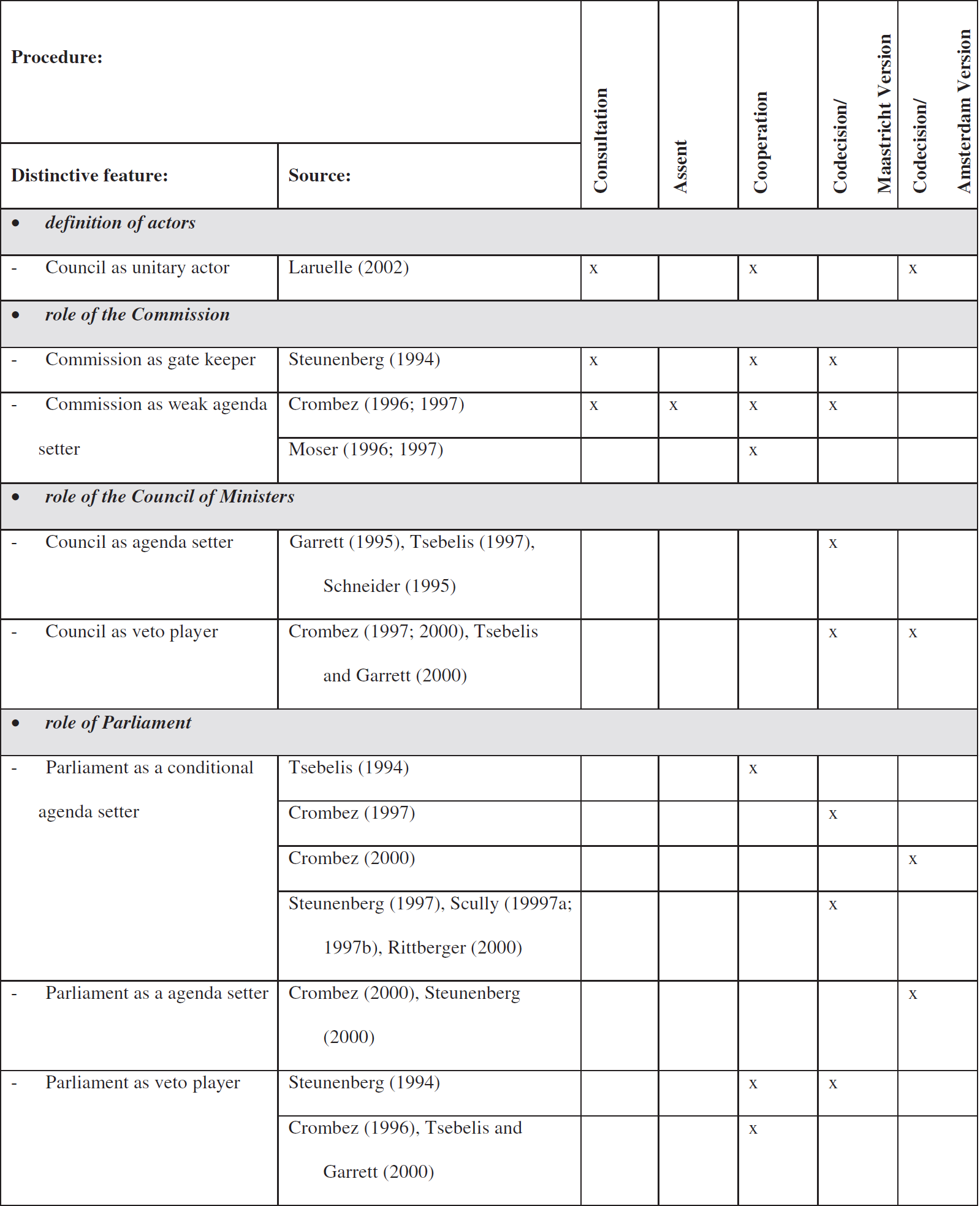
Procedural models of EU legislative decision-making
The consultation procedure was analysed by Bernard Steunenberg (1994) and Christophe Crombez (1996). The difference between the two models is that, while Crombez assumes that the Commission has to submit a proposal if the Council asks it to do so (agenda setting power), Steunenberg assumes additionally that the Commission has the power to withhold bills (gate keeping power). Annick Laruelle (2002) presents a unique theoretical account of this procedure by integrating both legislative versions, qualified majority and unanimity, into one model. She assumes that the Council acts as a unitary actor, thus regarding decision-making in the European Union as an inter-institutional rather than an intra-institutional process. Only one model exists for the assent procedure. It was put forward by Crombez (1996) and focuses solely on the unanimity version. Assent's qualified majority version so far has not received any attention from procedural modellers. Apart from Tsebelis (1994), several other models were designed which focus on the co-operation procedure. These are the ones by Steunenberg (1994), Crombez (1996), Peter Moser (1996 and 1997) and Laruelle (2002). The main difference in assumptions concerning these analyses is that, whereas Tsebelis focuses on the last stage of the process, the other theorists also focus on the preceding parts of co-operation. The different designs result in attributing substantial power to the European Commission, whereas in Tsebelis's model the Commission is by definition powerless. For the codecision procedure, there exist two legislative versions. The first or Maastricht version was replaced by the second one with the enactment of the Treaty of Amsterdam. The first version received attention from Steunenberg (1994 and 1997), Geoffrey Garrett (1995), Tsebelis (1997), Gerald Schneider (1995), Crombez (1997), Roger Scully (1997a and 1997b) and Berthold Rittberger (2000). As for the second version of the codecision procedure, there exist analyses by Laruelle (2002), Steunenberg (2000), Crombez (2000) and Tsebelis and Garrett (2000). Although the differences in modelling for the new version of codecison are less pronounced than for the co-operation procedure, distinctions remain. Laruelle again assumes the Council to be a unitary actor, Crombez considers the Commission to be obliged to propose legislation as the Council demands it to do so, and Rittberger adds actor impatience and a higher dimensionality of the issue space.
2. Competing approaches
Each of the existing procedural models of European Union legislative decision-making represents an attempt to explain the legislative outcome. So how do we know whether one model is better than some other model? 3 In order to find out, a starting point is to distinguish between formal and non-formal theory. Formal theory in this context is represented by rational choice models that are accompanied by an analytical solution. Let us focus on Tsebelis's (1994) model in order to clarify the point. The author offers a model of complete and perfect information for the final legislative reading, including a solution. The model factors are the ideal positions of the EU Member States, of Parliament and of the Commission, and the position of the status quo, i.e. the current situation at the time that the negotiations start. With the help of the model, for any given legislative proposal that is negotiated under the co-operation procedure, access to information on the players' ideal positions and to the position of the status quo would suffice to predict a legislative outcome to the game. Therefore, if one were to possess information for a real-world legislative decision situation in the EU, it would be possible to calculate the predicted outcome.
Currently, three other formal procedural models of the co-operation procedure exist. These models were advanced by Steunenberg (1994), Crombez (1996) and Laruelle (2002). For these models, granted that one would know the policy positions and status quo, it should also be possible to predict an outcome. There is further the model advanced by Moser (1996 and 1997). Although it does not have a solution, regarding its assumptions this model is comparable with the work advanced by Tsebelis and by the other authors since it builds on the same set of input factors. Solving these models analytically or numerically would therefore be equally possible. Apart from advancing new models that compete with Tsebelis's work, the literature also offers direct criticisms against the conditional agenda setter model and more generally against Tsebelis's theoretical approach. Moser (1996 and 1997) and Claudia Hubschmid and Moser (1997) suggest that, since the model of the co-operation procedure exclusively focuses on the last stage, it represents an inadequate characterisation of this process. They claim that Tsebelis's account is invalid because it leaves out the Commission's power to turn down parliamentary amendments. Richard Corbett (2000, p. 377) in particular criticises Tsebelis's (1997) assertion that the European Parliament's influence is more limited under the codecision procedure than under co-operation. He claims that Tsebelis disregards empirical information that was gained from the workings of the different procedures over the years. Rittberger (2000) directs his criticism not so much against the model of the co-operation procedure but rather against the overall theoretical framework of which the 1994 model constitutes but one account. In his view, another issue dimension of European Union legislative decision-making should be added to Tsebelis's analyses, resulting in three dimensions of political conflict rather than two. Furthermore, he suggests that actors' impatience – the desire to get a quick deal and the resulting necessity to compromise – is of crucial importance for understanding European Union legislative decision-making.
3. Getting the record straight
To judge which kind of theory explains a class of empirical phenomena best, competing models' predictions should be judged in the light of empirical evidence (Achen, 2002). For the existing models of the co-operation procedure, a test of the predictive power of the models against each other would be technically feasible. 4 What about the other concerns regarding Tsebelis's theory?
As for Moser (1996 and 1997) and Hubschmid and Moser (1997), it should be pointed out that leaving out the Commission's part in the modelling is not necessarily problematic. Modellers always choose to highlight certain features and to leave out others which are deemed less important. Take for example Parliament's formal say in the consultation procedure. Although the EP has the right of being consulted and might possibly use this power to delay legislative negotiations, procedural modellers chose to overlook this part of the decision-making process. A similar argument could be constructed for Garrett's (1995) model of the codecision procedure which assumes that the Council submits the final proposal to Parliament. Since the treaties do not specify that the right to draft legislation lies solely with the Council presidency or any other Member State but with the Council as a whole, modellers have to make choices about how to conceptualise the process. Modelling the process of deliberation in the European Union in one particular way and thereby specifying the model's game sequence naturally varies over the models. Sticking too closely to the words of the treaties, on the other hand, might not guarantee accuracy in theorising.
As outlined above, a distinction can be made between formal and non-formal procedural models of European Union politics. Generally speaking, the advantages of formalising a model lie in an increased ability to detect inconsistencies in assumptions and in deriving stable equilibria which represent analytical solutions to games. For Moser's (1996 and 1997) model of the co-operation procedure, we might expect solutions that are quite close to the ones which would be predicted by Steunenberg (1994) and Crombez (1996). Due to the models' similarities in assumptions, it should be possible to compare the models either via comparative statics or with the use of computer simulation in order to assess how different they are in terms of their predicted outcomes. 5
Rittberger (2000) suggests that actor impatience is of major importance for explaining European Union decision-making. Although this proposition might be correct, there exists no solution to his model. Therefore, predicting an outcome and comparing it with the predictions of the other procedural models and with some real-world decision outcome is not possible. Furthermore, even if we should find that Rittberger's theoretical account of EU decision-making yields better results than the approach advanced by Tsebelis, his model comes with the cost of added model complexity due to a larger number of input factors. For quantitative applications, this problem is well known and evaluated with methods such as comparing nested models. 6 But although the problem of model comparison is as important for game theory as it is for statistical models, it has so far not received much attention. 7
Corbett (2000) advances the argument that Tsebelis's work can be considered to be refuted by empirical evidence. Quoting several statistically oriented studies on the performance of the European Union's legislative procedures, he concludes that the assertion which states that under the co-operation procedure Parliament has substantial powers at its disposal – Tsebelis's dictum of the ‘conditional agenda setter’ – is wrong. Tsebelis's own empirical testing, in which the author analyses about 5,000 parliamentary amendments in order to validate his findings, does not convince Corbett of the model's validity (Tsebelis et al., 2001). And neither should it. One problem with this testing strategy is that it rests on the contention that the dependent variable for testing these models should be the likelihood of adoption of a Parliamentary amendment into new legislative measures. Spatial theory, on which the procedural models rest, is based on an n-dimensional issue space, inside which by definition the outcome of a social choice process – if it can be identified – will be located (Hinich and Munger, 1997). Models which have an analytical solution might therefore be better tested by using quantitative data that corresponds closely to the original model design. This, however, implies that an indicator for an actor's political success in shaping the legislative bargain is not whether an amendment passes, but how close the final policy outcome is to the ideal position of that player (Bueno de Mesquita and Stokman, 1994).
A final thought should be spent on the dimensionality of the issue space of the procedural models. Some of them were designed for one-dimensional issue spaces (Steunenberg, 1994; Crombez, 1996; Laruelle, 2002), and some for two-dimensional spaces (Tsebelis, 1994 and 1997; Tsebelis and Garrett, 2000). Rittberger (2000) argues that three dimensions would be appropriate. An important task for developing testing strategies is to find out about the dimensionality of the ‘real’ decision space of European Union politics. 8 This triggers the problem of how to measure ‘space’ empirically to be able to confront it with theory. Most of these questions have already been addressed in theoretical terms, but have not yet sufficiently been put to the test by employing a model-guided empirical research strategy.
4. Conclusion: future challenges
Remedying the shortcomings of existing model testing, three domains of the research process can be identified, all of which have to be taken into consideration in order to further progress in understanding European Union legislative decision-making. These domains are: theory comparison, data collection and theory testing.
To compare theory, the models themselves have to be comparable and should be evaluated regarding both their assumptions as well as their predictions. This is only possible if the input factors for the models are not too divergent from each other. Model comparison could be facilitated by comparative statics and by computer simulation techniques.
To collect data, analysts have to specify what exactly politically contentious issues are in the context of European Union legislative decision-making and how they might be measured. The required variables for the models are actors' policy positions and the position of the status quo rather than the likelihood for amendments to survive the legislative negotiation process.
To test theory, the models' predicted outcome over a sufficiently large number of cases should be compared with a measure for the real policy outcome. Complex models should be expected to perform better than simple ones. Therefore, to judge model performance, the greater predictive power of complex models has to be weighted against greater parsimony of simple models.
For future research, it might also be desirable to integrate procedural models with other models that are based on the rational actor approach, such as bargaining models. 9 Such a testing design might present a more complete picture of the European policy process by comparing the effects of formal decision-making structures with the effects of other salient features, such as logrolling. Further, a more accurate procedural modelling of the codecision procedure's increasingly important conciliation committee might present avenues for future research.
To be able to demonstrate that one particular model of European Union policymaking is better than some other model, analysts should focus more on the methodological aspects of testing theories of decision-making. Only then will it be possible to show whether certain aspects of the more recent EU literature are superior to others. Currently, there exists no model for which it could legitimately be claimed that it represents a better characterisation of the European Union's legislative process than some other model does. Integrating theory with quantitative applications is a promising way to get ahead in evaluating the strengths and weaknesses of the procedural approach for European Union legislative decision-making.
Footnotes
I would like to thank Bernard Steunenberg and two anonymous reviewers for useful comments. I recognise financial support from the Netherlands Organisation for Scientific Research (NWO).
1
See Shepsle and Bonchek (1997) for an introduction to analytical institutionalist theory, and  for an account of how rules might affect legislative decision-making.
2
For an overview of all the procedures, see Kapteyn et al. (1998) and .
3
This article assumes that a comparison of different models regarding their explanatory power is a primary objective of social science research (King et al., 1994, pp. 19–23; Van Evera, 1997, pp. 17–21).
4
The only paper which advances a comparative testing design for procedural models has been put forward by König and Pöter (2001). Focusing on four legislative proposals negotiated under the co-operation procedure, the authors find that the models proposed by Steunenberg (1994), Crombez (1996) and Moser (1996 and 1997) predict marginally better than the one by . Currently, a group around Robert Thomson and Frans Stokman from the University of Gronigen is collecting micro-level information to test models of EU legislative decision-making on the basis of a higher number of cases.
5
Comparative statics provides general statements about the equilibrium outcome to a game-theoretic model. On the use of computer simulation in the area of procedural modelling, see Steunenberg et al. (1999). For an application to EU legislative politics, see Steunenberg (2001). For an introduction to the technique, see .
6
Comparing nested models answers the question which one of two statistical models is preferable: a certain model A which predicts better than another model B but relies on more independent variables, or model B whose predictive power is more limited than model A's, but is more parsimonious. In order to judge which model is better, tests ‘punish’ the more complex model A by calculating a trade-off between the benefit of A's greater explained variance on the one hand and the disadvantage of a greater number of independent variables on the other (Kennedy, 1998, pp. 78–93).
8
Note that the dimensionality for model testing purposes should follow deductively from the formal model, e.g. by assuming logrolling or package deals (Buchanan and Tullock, 1962), and not inductively from regularities in data. For the use of inductive applications such as dimension-reducing techniques, see Mattila and Lane (2001) and .
9
Potential candidates might be Bueno de Mesquita's and Stokman's (1994) bargaining models which have already been empirically applied in the area of EU legislative decision-making.