






Abstract
This article explores the issues around the role of collaboration as an essential mechanism in developing strategies for Citywide and Local Strategic partnerships. This is examined in the context of urban regeneration flowing from policy initiatives that have been introduced over recent years. The article sets the scene for collaboration and its characteristics emphasising the attributes of collaborative advantage. Focusing on the latter it then identifies the impact of collaboration on specific strategy areas. Following this the article examines the applicability of collaboration through a case study of a Citywide partnership superseded by a Local Strategic partnership in Leicester. It argues that there is significant evidence of the impact of collaboration on the selected areas of the particular partnership working, although recognising that significant dysfunctional elements exist at the operational and implementation level.
Introduction
Partnership has been a ‘buzzword’ in British public policy during the last decade or so. Many policies implemented at local level during the last few years have had as a prerequisite the application of partnership work. Additionally, resource dependency issues, the dramatic increase in the number of agencies shaping and delivering public policy and the rise of complex issues facing local government have created the conditions for the development of multi-organisational partnerships. In the light of this, multi-organisational partnerships have emerged in urban regeneration as arrangements involving public, private, community and voluntary interests (Lowndes and Skelcher, 1998).
This article attempts to identify and analyse the role of collaboration as a mechanism for developing strategy for multi-organisational partnerships. It first sets the scene for collaboration and its characteristics, emphasising the attributes of collaborative advantage. It then attempts to examine the role of collaboration through two particular types of multi-organisational partnerships, the Citywide and Local Strategic partnerships. In doing so it forms a framework of attributes of collaboration that impact on specific strategic areas of multi-organisational working (selection of partners, partnership vision and mission, partnership organisational structure and delivery of partnership plans). At the empirical level, the value of the framework mentioned above is examined in the case of two multi-organisational partnerships, the Leicester Partnership for the Future and the Leicester Partnership. Interviewing, observation and collection of secondary data were used as research methods.
The role of collaboration in developing strategy for multi-organisational partnerships
The main concern in this section is to identify and analyse the role of collaboration as a vehicle for developing strategy 1 for multi-organisational partnerships. 2 For this reason, it is necessary first to define collaboration and distinguish its meaning from partnership. According to Arthur Himmelman, collaboration is defined as the function of exchanging information, altering activities, sharing resources and developing the capacity of another organisation or individual for mutual benefit in order to achieve a common aim (1996, p. 28). As might be expected this function is closely related to the tendency of organisations to establish common action if they share a common purpose as can happen with the case of multi-organisational partnership arrangements. In addition, rather like many similar terms, there is no agreement around the definition of the terms collaboration and partnership. According to the Oxford Advanced Learner's Dictionary collaboration constitutes ‘the act of working with another person or group of people to create or produce something’ (Hornby, 2000, p. 231). In contrast partnership is concerned with ‘the state of being a partner in business’ or ‘a relationship between two people, organisations, etc.’ (ibid., p. 923).
A notion that can contribute to the role of collaboration – as an efficient mechanism for assisting multi-organisational partnerships to function – is that of collaborative advantage. 3 Chris Huxham (1996a) points out that collaborative advantage is concerned with the creation of synergy between collaborating organisations. She suggests that ‘collaborative advantage will be achieved when something unusually creative is produced – perhaps an objective is met – that no organisation could have produced on its own and when each organisation, through collaboration, is able to achieve its own objectives better than it could alone’ (Huxham, 1993, cited by Huxham, 1996a, p. 14). In this respect she identifies collaborative advantage as an output of collaboration. However, as she argues later, ‘the term alone can … be a powerful driver of the collaborative process’ (Huxham, 1996a, p. 15), giving in this sense a utility of the term as a means of the main input of the collaborative process. In addition, David Sink (1996, cited by Huxham, 1996a, p. 16) describes collaborative advantage as ‘the process of transforming power relations’ and Himmelman (1996, cited by Huxham, 1996a, p. 16) describes it as ‘elements of collaborative process’. The latter meaning – that collaborative advantage is the vital input of the collaboration process – is the one accepted in this article. Therefore, it could be argued that collaborative advantage contributes to the involvement of multiple participating actors moving towards common purposes and targets that aim to bring desirable policy outcomes. Furthermore, according to Wilson and Charlton (1997), we can identify the application of the term as well in other fields such as strategic alliances and joint ventures in business.
Based on the considerations above, the issue that arises is to identify and analyse the role of collaboration in expanding the strategic horizons of multi-organisational partnerships after developing their collaborative advantage. Huxham argues that in collaborative arrangements stakeholders develop a meta strategy, which is jointly owned by the organisations involved and which is superordinate to the strategies of the collaborating organisations (1993). Considering that collaborative advantage can maximise the value gained when collaborating, four main strategy areas are considered in this article in order to examine whether or not collaboration contributes to developing strategy for multi-organisational partnership functioning. These are: selection of partners, partnership vision, partnership organisational structure and delivery of partnership plan (see Table 1). These areas were selected as reflecting the main phases, which cover the life cycle of a partnership – apart perhaps from termination – i.e. pre-construction, construction and post-construction.
Attributes of collaboration in developing strategy of Leicester Partnership for the Future and Leicester Partnership
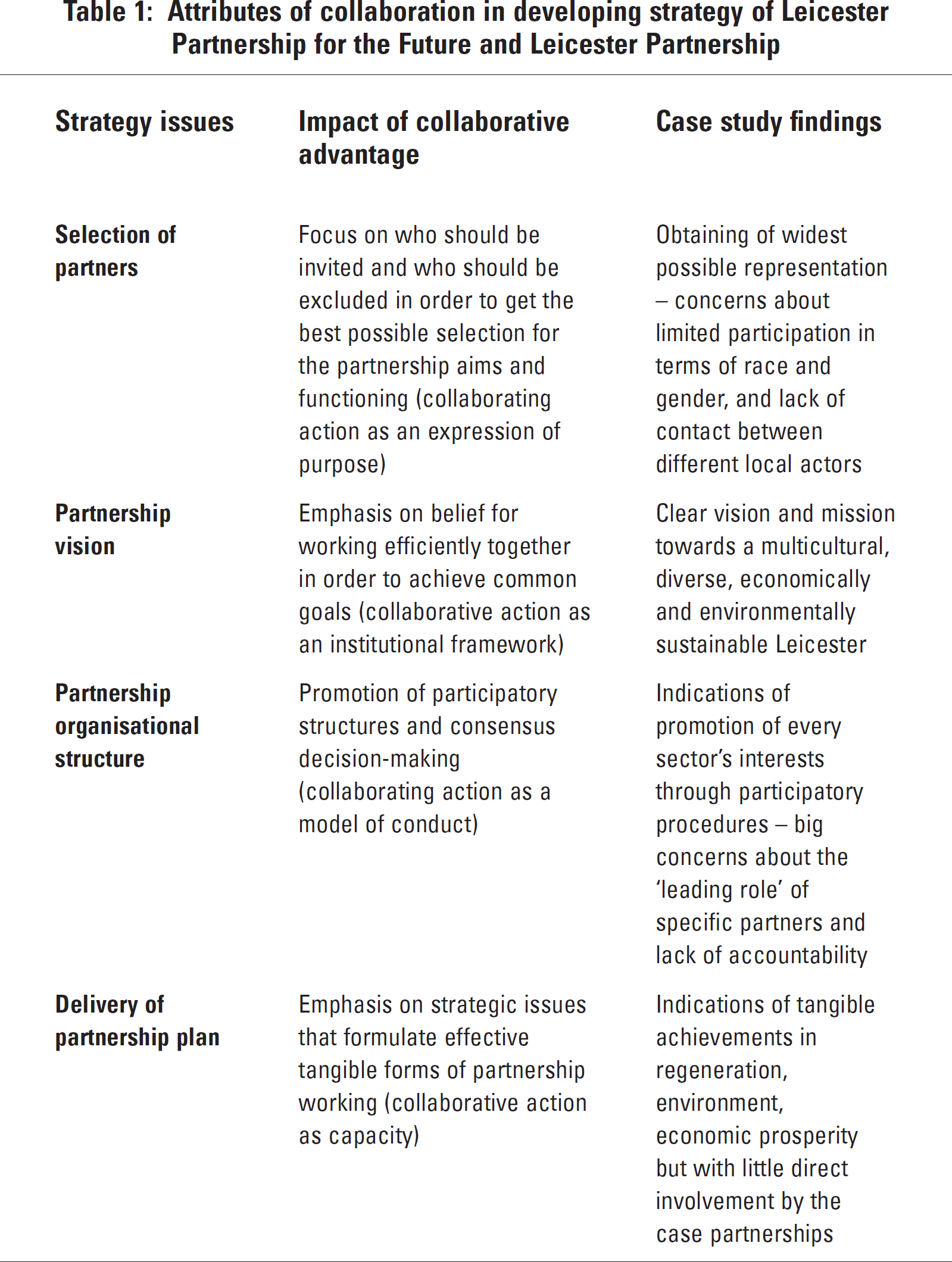
Firstly, in relation to identification and selection of the participating members, collaboration can create a sufficient focus on who should be invited to the partnership and who should be excluded. This is because having an appropriate cross-section of members is a factor affecting success in collaboration (Huxham, 1996b). Secondly, with regard to the development of a shared vision and mission, Barbara Gray (1989, cited by Greer, 2001) suggests that it is because of collaboration that partners believe they should work together to achieve common goals. She emphasises the belief that the recognition by partners that their desired outcomes are inextricably linked to actions of other partners is the fundamental basis of collaborating. However, differences in size, power, resources, ability and reasons for joining by the participating members can restrict effective collaboration (Greer, 2001). Thirdly, as to the setting up of a specific organisational structure, application of collaboration can promote participatory structures and consensus decision-making. This is because it encourages a common approach and guards against individual partners who might lead the partnership into conflict (Greer, 2001). Fourthly, in relation to delivery of the partnership action plan, collaboration contributes to the identification of the common issues required for implementing a policy. In the light of this, developing a strategy at the outset is important, not only for arriving at a common definition of a problem, but also in organising, participating and solving the problem (Wilson and Charlton, 1997). It is argued that a strategy is needed, which can be formulated into tasks of a tangible and not a grandiose form (Greer, 2001).
Consequently, collaboration can be considered as an important mechanism for strategy development in multi-organisational partnerships as it can be used to build confidence in long-term planning, to streamline decision-making and to maintain strategies beyond normal political or budgetary horizons (Bailey, 1994). It could be argued, then, that the framework with the attributes of collaboration for multi-organisational partnership, functioning as presented in Table 1, helps to distinguish the difference between various other formations of strategy development in partnerships that do not need the application of collaboration in order to get sufficient outcomes, including for example a short-term project for seeking primary funding.
Citywide and local strategic partnerships in urban regeneration: can collaboration take things forward?
The main concern in this part of the article is to identify and analyse the role of collaboration in urban regeneration based on empirical evidence of the working of a specific Citywide partnership, which has been superseded by a Local Strategic one, after following government guidance. These partnerships are: a) the Leicester Partnership for the Future (LPF), and b) its successor, the Leicester Partnership (LP). However, it is first necessary to identify Citywide and Local Strategic partnerships as types of multi-organisational partnerships at the local level.
In the early to mid-1990s projects such as the City Challenge and Single Regeneration Budget Challenge Funds appeared to build upon the involvement of all sectors in partnerships that had a wider focus on urban regeneration issues (Foley and Martin, 2000). After 1997, the Labour government placed an emphasis on area-based programmes, combining them with inter-organisational collaboration in order to address sizeable issues such as employment, environmental sustainability and community safety (Clarke et al., 1999, cited by Foley and Martin, 2000). However, none of these partnership programmes included the function of a wider strategic responsibility. This did not occur until the first Citywide partnerships came to the fore. The development of Citywide partnerships came during the second half of the 1990s with the evolution of a citywide perspective on regeneration (Carley et al., 2000). In this sense, Citywide partnerships had an overall strategic responsibility for certain issues of urban regeneration and development (on issues such as social inclusion, community safety, environment and employment). Those partnerships are not the only type of this entity though. The Department of the Environment, Transport and the Regions (DETR) introduced from 2000 Local Strategic partnerships (LSPs) whose focus is to operate at a level that enables strategic decisions to be taken, and is close to individual neighbourhoods in order to allow actions to be exercised at community level. In certain cases LSPs have superseded previously established Citywide partnerships (DETR, 2001). In these circumstances, it could be argued that both Citywide and Local Strategic partnerships are examples of multi-organisational partnerships.
Given the scope of this research, interviewing was considered the appropriate primary method of data collection. The interviews, (15 in number), were semi-structured and based on an interview schedule. Interviewees were selected because of their expertise. In addition, observation and secondary data were employed as complementary methods of data collection. The places of observation were the meetings of the partnership boards and assemblies. In this light, 11 meetings of the Leicester Partnership (LP) and its forerunner, the Leicester Partnership for the Future (LPF), were attended.
The Leicester Partnership for the Future was established in May 1999 following the launch of the ‘Vision for Leicester’ (a move towards the improvement of quality of life in Leicester) in May 1998. Its work programme was focused on seven main activities of which regeneration was one of great importance. Twenty organisations participated in the strategic co-ordinators group of the LPF (LPF, Report on the LPF, 21 January 2000).
In 2001, following the government guidance on Local Strategic partnerships, the need to establish an overarching strategic partnership in Leicester ‘became apparent’. In addition to LPF activities this successor partnership could play a central role in promoting the community planning of Leicester as well as specific initiatives, for example Local Public Service Agreements, Neighbourhood Renewal and Neighbourhood Management. On this basis, the Leicester Partnership was established in June 2001, replacing the Leicester Partnership for the Future. As identified by its members (LP, Minutes, 31 October 2001), the key strength of the LP is ‘its links to a whole range of networks, including connections at all levels – national, regional, community and neighbourhood’. The primary focus of the research programme conducted between May 2000 and April 2003, as part of the author's Ph.D. research, was the role of collaboration in influencing the strategic character and working of the LPF and LP. In addition, it was concerned with understanding the contributions of these partnerships towards urban regeneration in the city of Leicester.
The role of collaboration in the activities of the LPF and LP is seen in relation to the strategy areas that have been identified in the section about collaboration and collaborative advantage above. The main dimensions of these strategy areas are being used as criteria against the actual research findings (see Table 1). In this respect clear indications can be given in relation to the progress the case partnerships have made up to date.
Beginning with the selection of partners it could be argued that both partnerships have attempted to be as inclusive as possible. Specifically regarding the Leicester Partnership, priority has being given to obtaining the widest possible representation, believing that this strategy can maximise the value of its activities. In the light of this, collaboration has had a significant impact in obtaining the best possible results regarding the range of partnership membership (Leicester Partnership, Minutes, 27 June 2001).
However, an interviewee from the Leicestershire Centre for Integrated Living stressed the need for the LP to be more representative in terms of race and gender. She contended that, despite the existence of an agreement that each sector (public, business, community and voluntary) should be represented on the partnership board with three members, there is only one representative from each of the six core theme partnerships in the city (diversity, environment, education, health, crime and disorder and regeneration). Her view was supported by a report on ‘Taking Forward Community Cohesion in Leicester’, which described lack of contact between the city's different communities that led to competition over scarce mainstream and regeneration resources (IDEA, 2003). In addition, another interviewee from the private sector stressed the need for local businesses to connect partnership activity with tangible benefits which the private sector could gain by participation in the partnership, emphasising that ‘we do not have the luxury to waste our time and money’. Therefore, while partnerships in Leicester seem in the first instance to use their collaborative advantage for selecting partners, the multicultural and diverse character of the city can still result in the creation of pockets of resistance to partnership culture.
With regard to partnership vision, whilst there is concern about lack of clarity of purpose for the LPF and especially for the LP, there is general agreement about what the partnership vision ‘should’ be. According to the Review of Leicester's Strategic Partnerships the vision of the Leicester Partnership is ‘to provide long-term (20+ years) strategic vision, direction and priorities for the city of Leicester as a context for other agencies and partnerships with a strategic role in the city to operate in’ (2002, Paper B, p. 4). With regard to a potential regeneration strategy for the city, it has been stated through partnership documentation that there is belief in a ‘sustainable and comprehensive approach to regenerating Leicester’, and acknowledgement that this requires ‘a long-term commitment’ and ‘mainstream resources to achieve’ (Leicester Regeneration Agency, 2000).
Consequently, with respect to translating the vision into tangible objectives it has been envisaged that there are four ways of doing so: by building regeneration based on specific area programmes; by combining regeneration activities with mainstream programmes of services; by learning from the pathfinder programmes; and by strengthening community involvement (Leicester Regeneration Agency, 2000). Additionally, interviewees, when asked, pointed out that the two vehicles for promoting the strategic vision of the city are its multicultural diverse character and its economic and environmental sustainability.
Applying then the theoretical approach on partnership vision to the case in Leicester – based on observational research as well – it could be argued that the desire exists between participating actors for creating a shared vision for Leicester. This is based on the belief that working efficiently together they can achieve common goals. In this way a belief in partnership working is created that sees collaborative action as an institution of functioning together.
There have been arguments in relation to the role of the partnership's leadership and, consequently, to the role of human and financial resources. According to interviewees from other groups apart from the local council there are two emerging issues with regard to the organisational structure of the partnerships: a) lack of accountability, and b) existence of ‘leading’ partners. Considering the issue of accountability, the representative of the health sector emphasised the point that out of the partnership board members there is only one who is answerable to the electorate: the leader of the council. In this way, the issue of accountability may be connected to the existence of ‘leading’ partners, for example interviewees not belonging to the local council pointed out the role of the council as a major ‘player’ in terms of power and resource allocation. These accusations, if proved, would certainly damage the atmosphere of reciprocity developed within the partnership, thus weakening its collaborative advantage.
However, as other interviewees also emphasised, the ‘leading’ role of the council is in many instances inevitable, as it is privileged in relation to other partners regarding administrative facilities and financial resources. This also has become apparent based on observation of the partnership meetings where the local council seems to play an important role in the partnership's functioning. For example, the council was the only partner who offered to fund the recruitment of appropriate managerial staff for the partnership whereas the vast majority of the other participating bodies could not afford to make a similar offer (Leicester Partnership, Minutes, 30 November 2001). Replying to the question of whether the existence of leading partners creates a problem of leadership, interviewees outside the public sector pointed out that this may be the case after the ‘milk and honey’ period has passed. In contrast, the representative of the local police argued that for his organisation the answer was ‘what matters is what works’ because of the nature of the police's activities. In this respect, he would like to see more ‘practical solutions’ and efficiency, which are preferable to a ‘just talking and doing nothing’ approach, rather than inclusiveness. It is not clear which direction the issues of leadership and inclusiveness will take within the Leicester partnerships. It could be argued that the latest decision (LP, 2003) to create a more effective core decision-making group constituted from the 11 most ‘important’ partners within the partnership board aims to balance the power issues within the Leicester Partnership. In this way it is envisaged that the collaborative advantage as a vehicle for decision-making and power balance would not be abolished. The whole experiment needs perhaps more time to evaluate its potential.
Finally, the role of both partnerships in achieving sustainability in regeneration and generally contributing to the improvement of local people's lives can be seriously questioned. The desire to enhance local residents' well-being through, amongst other things, achievements in social and economic regeneration has been identified from the very beginning of their operation since mid-1999. Consequently, what has been guaranteed is an opportunity for non-executive and non-powerful interest groups of the city, especially from the voluntary and community sectors and minorities, to work for the best interests of the area via the partnership work. Moreover the council, the police, even the church in the city have favoured different roles for both partnerships according to the meeting observations. The fact that there has been – at least until the last local elections – a Labour majority in the Leicester City council has kept open, perhaps, the option of having easier access to funding.
The issue arising is related to the capacity of the partnerships under consideration to deliver policies that would be of benefit for the people of Leicester. At least this is the requirement of creating collaborative advantage in this area of partnership strategy (see Table 1). Experience has shown that the two partnerships (especially the Leicester Partnership) constitute umbrella partnerships, which promote a framework for delivering policies such as the new Leicester's Community Plan and Neighbourhood Renewal Strategy in March 2003. However, there is little evidence of direct implementation of policies, either those decided in the partnership meetings or those required by government legislation. This is not to be considered a problem as long as the partnerships under consideration can support external mechanisms for delivering policies such as the core theme Citywide partnerships in the city (for example the Crime and Disorder or the Health partnership). Observational research has shown that this is the case with regard to the action taken by core theme partnerships such as the Environment partnership or special partnership arrangements such as the Leicester Regeneration Company on physical regeneration.
Concluding remarks
Based on the theoretical considerations and empirical evidence discussed above, it can be concluded that there are indications that collaboration can have a significant impact on multi-organisational partnerships working in Leicester – specifically with regard to the activities of the Leicester Partnership for the Future and its successor the Leicester Partnership. This is possible via the contribution of collaborative advantage, which can be identified as the mechanism for moving the collaborative process into the direction of producing significant policy outcomes for the partnerships. The reason for this is that local participating actors seem to have understood that working together with an appropriate use of collaborative advantage can be for the city's social and economic prosperity. This is indicated by the tendency for the partnerships to be inclusive, despite the existence of issues favouring efficiency at the expense of inclusiveness and signs of resistance to partnership culture. In terms of vision the partnerships seem to have obtained the sense of working towards shared aims. However, at a purely organisational and implementation level, empirical evidence has shown the existence of dysfunctional elements such as leading partners, inability to promote inclusiveness and a fair system of accountability, and weaknesses at the policy delivery level. Nevertheless, these elements of inadequacy in partnership functioning can also galvanise the utility of collaborative advantage, even from a negative point of view. Perhaps these indications, given above, are not only symptoms of the case partnerships 4 but also symptoms which can be found in the case of other partnerships. In this capacity such symptoms can be useful because they show which possible integrating steps partnerships have to take or avoid towards their future development.
Footnotes
1
Strategy in this context is perceived as a notion that describes the action of partnerships as unitary bodies and not as the sum of strategies of different participating groups. In this light (see Johnson and Scholes, 1997, p. 5), strategy can be seen as the ‘matching of the activities of an organisation to the environment in which it operates’.
2
There has been a series of names given to describe partnership arrangements regarding for example the selection of members such as public-private partnerships or the policy focus such as community safety partnerships. According to Mayo (1997, cited by Byrne, 2001, p. 244) policymakers imply with partnership something like symbiosis in which the result is ‘a multiplicative rather than additive outcome’.
3
Collaborative advantage has its origins as the opposite force to ‘competitive advantage’, defined by M. Porter in the 1980s referring to the competitive edge of corporate organisations. In this respect whatever the duration and objectives of alliances, being a good partner is considered as a key corporate asset (Kanter, 1994).
4
I would like to give my many thanks to Allan Helliwell, Angela Sutaria and Angie Hill of the Leicester Partnership Development Team for their continuing help during the conduct of this research.