






Abstract
The breakdown of Mexico's hegemonic party system raises questions about the nature of the new system and of the prospects of consolidating Mexican democracy. The concern addressed in this article is that, at the very same time that democratisation has made Mexicans' electoral choices more significant, frequently changing party allegiances among candidates and even elected officials renders these choices less meaningful. Since parties ‘matter’ in a democratic polity, party switching may prove an impediment to the development of a liberal and stable democracy. Partisan shifts within the state congress of Morelos illustrate this point.
In contrast to the constitutions of most democracies, the Mexican Constitution, written in the revolutionary context of 1917, explicitly discusses political parties. It states that they are of public interest and are intended to promote the people's participation in democratic life, to contribute to national representation and to make it possible for the people to gain access to the exercise of public power – all in accordance with the principles and programmes that the parties postulate. Parties did not fulfil these roles immediately after the Revolution, nor under the seven-decade-long, semi-authoritarian rule of the Institutional Revolutionary party (PRI). The dominant-party system under the PRI, the longest-lasting party in Latin America (Smith, 2005), elided the state and the ‘official’ or ‘ruling’ party, rendering the state and party the only avenues to political power. That era is now in full eclipse, such that declaring the PRI's demise has become a popular indoor sport.
Today, the PRI is weakened but far from dead, and Mexico is the latest Latin American country to undergo a democratic transition. It has undergone an unusually gradual transition from authoritarianism to electoral democracy (Camp, 2007; Levy and Bruhn, 2006), and its politics and political institutions are undergoing profound transformations. Former opposition parties – especially the two largest, the National Action party (PAN) and the Democratic Revolutionary party (PRD) – have tallied impressive strings of victories in local, state and national elections, transforming the political role of parties and creating a far more competitive and pluralistic system. Whereas before the system had been defined by a party that claimed to institutionalise the Mexican Revolution, now party politics is becoming more institutionalised (Wallis, 2003).
Democratisation typically proceeds through a two-stage process. The first stage entails the breakdown of the authoritarian regime and movement to a democratically elected government. Mexico's protracted transition to democracy has involved a virtuous circle of electoral competition and electoral reform. Although the subnational transition has been uneven, the recent record of free and fair elections suggests that Mexico is poised for the second stage, consolidation. If consolidation means that democratic rules for political life are institutionalised such that all major actors accept democracy as the only legitimate form of government (see Munck, 1994), then Mexico is not yet there. Mexican elites have bought into the idea that elections will determine who governs (Wallis, 2003), but the citizenry is less sure. The 2006 Latinobarómetro survey reveals that, while 68 per cent of Mexicans agree that ‘Democracy may have problems but it is the best system of government’, the remainder are not completely sold on democracy. Surveys also show that many question the legitimacy of elections and parties. Accordingly, Mexican democracy remains somewhat fragile, and successful consolidation cannot be taken for granted (Camp, 2007; Meyer, 2005).
Political parties have played a vital role in the transition to democracy in Mexico, and, as elsewhere in Latin America, parties are critical components of democratic consolidation. This study is in accord with the school of thought that institutions ‘matter’, that political parties are ‘crucial to democracy's success’ (Camp, 2007, p. 74) and that parties may become an even more important institutional variable as countries advance towards democratic consolidation (Wallis, 2003, p. 16). Enrique Krauze (2006, p. 56) takes this idea a step further, arguing that whether ‘democracy advances or is cast aside’ in Mexico depends a great deal on the three main political parties.
The concern addressed in this article is that, at the very same time that democratisation has made Mexicans' electoral choices more significant, frequently changing party allegiances even among elected officials renders these choices less meaningful. Electoral choices have become more significant as means of conferring legitimacy and transferring political power. If, however, it is true that political parties ‘matter’ to democratisation and democratic politics, then the ‘increasing desertion of established parties’ (Wallis, 2003, p. 21) may prove an impediment to the development of a stable and liberal democracy. Party switching weakens the link between politicians, the electorate and parties. Further, signs of political opportunism may erode already low levels of trust in political parties.
Given that the political arena has changed more in the past 15 years than it had in the previous 50 (Peschard, 2006), various aspects of Mexican politics are new and understudied. This article appears to be the first sustained analysis of party switching in a state legislature. Some sources do, however, make passing reference to this phenomenon as occurring across Mexico (see Levy and Bruhn, 2006; Wallis, 2003), suggesting that what is happening in Morelos is indicative of a broader trend.
The next two sections briefly set the scene. In Section III, partisan shifts within the state congress of Morelos illustrate the party-switching trend. Sections IV and V offer explanations for this trend and discuss why it is troubling.
I
In 2006, eight parties registered with the Federal Electoral Institute, enabling them to field candidates for national elections and to tap into generous public funding. Since the late 1980s, three of these parties have won the vast majority of the races in Mexico's three-tiered federal system: the centre-right, business-friendly, pro-Catholic PAN; the centre-left, economically nationalist PRD; and the ‘ideological chameleon’ (Krauze, 2006) known as the PRI. The Mexican Green Ecological party (PVEM), the Labour party (PT) and the decade-old Convergence for Democracy (Convergencia or PC) are among the most important of the Lilliputians, as indicated by their recent inclusion in national electoral alliances. In addition to these six parties, two newcomers also won seats in the federal legislature. In recent elections at the state level, on average five parties gained representation in each legislature. In addition to the ‘big three’, most included one or more members of the little three; some also included local parties. Many analysts therefore refer to a ‘multi-party system’, though others call it a ‘three-party system’ (Langston, 2007).
II
Political parties are essential actors in Western democracies. In representative democracies, they typically play the roles of aggregating and articulating societal interests, structuring the vote as well as political conflict, recruiting members and candidates, mobilising the electorate and developing and implementing public policy (Heywood, 2002). They bring people together behind political agendas and candidates, thus reducing political fragmentation. Like mass media and interest groups, political parties help to connect the government to the governed. For these reasons, political scientists typically deem parties a crucial component of democratic politics.
As new parties sprout up on all sides of the once hegemonic party, Mexico is experiencing a tremendous expansion of political pluralism and opportunities. Voters now have many more options – as do would-be candidates. Whereas for six decades the PRI offered aspiring politicians across Mexico the only real avenue to elected office, today ‘some disappointed candidates leave the PRI’ (Levy and Bruhn, 2006, p. 91). To some extent, it is to be expected that ambitious politicians whose aspirations are frustrated in one party will switch to another. The PRI previously spanned the political elite (Levy and Bruhn, 2006) and during its long history has occupied a variety of ideological positions, making it particularly easy for its defectors to jump to parties at various points along the political spectrum. Yet the evidence suggests that other parties are also serving as political trampolines.
What is troubling about the current trends is that desertion has become more common in Mexico (Wallis, 2003), with candidates and even elected officials often willing to make multiple switches. These switches are sometimes to parties with very different ideological touchstones. It is worrisome when ‘parties appear as organizations emptied of ideological content’ (Espinoza Toledo, 2006, p. 6) – a trend common to Latin American countries (Sabatini, 2002) – and politicians and parties appear to preference power and opportunism over long-term ideological commitments. These trends lessen parties’ capacity to provide coherent and unified alternatives, while calling into question parties’ and legislators’ ability to serve their representative functions.
III
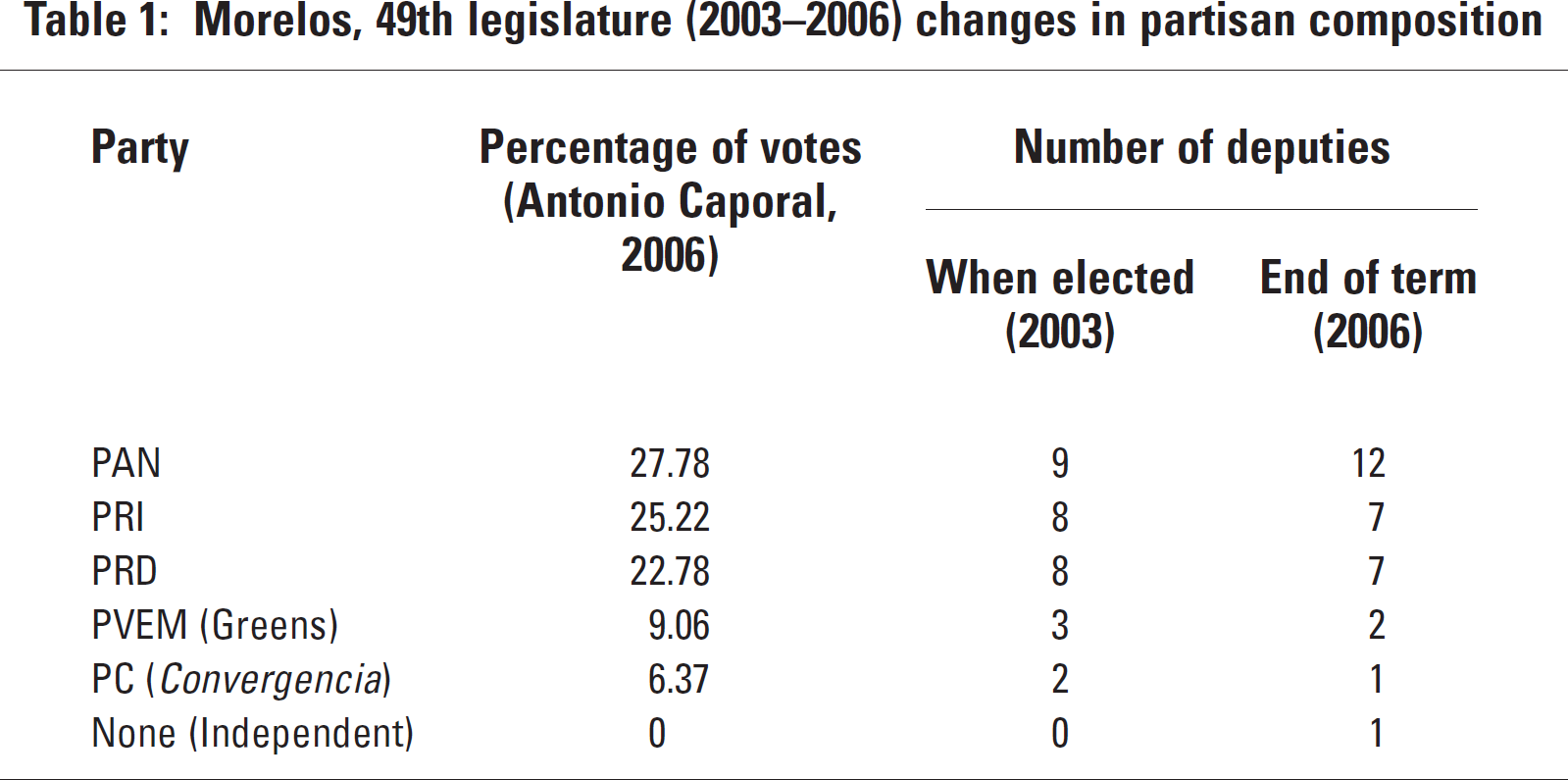
The examples presented here come from the state congress of Morelos, located in the central region of Mexico. The legislative assembly of Morelos, as in all of Mexico's 31 states as well as the Federal District, is unicameral and has a mixed electoral system. Eighteen of Morelos's representatives are elected on the basis of single-member district plurality (uninominal seats) and twelve through proportional representation (plurinominal seats). When Morelos's 49th Legislature was elected and installed in 2003, it included delegations from the three largest parties and two minor parties, PVEM and Convergencia. By the time their terms ended in 2006, a surprising number of members had changed their party affiliation, some more than once. This resulted in significant changes in what one deputy calls the ‘correlation of forces’ within the congress (see Table 1). The following three cases are particularly striking.
Morelos, 49th legislature (2003–2006) changes in partisan composition
Raúl Iragorri Montoya is the poster child of party switching (see Figure 1). Early in his political career, he was a PRI militant, serving two terms in the state congress (1976–1979 and 1985–1988). Until 1976, seven deputies represented the people of Morelos in the state legislature. From the PRI's founding until Morelos introduced closed-list proportional representation in 1979, all deputies were members of the ruling party. At the time of Iragorri's second election to the state congress, it had expanded to include 15 representatives, the PRI held all 12 of the uninominal seats and each of the three plurinominal seats was held by a different opposition party. During the 1990s, opposition inroads began to threaten PRI hegemony. Iragorri began his practice of party switching.
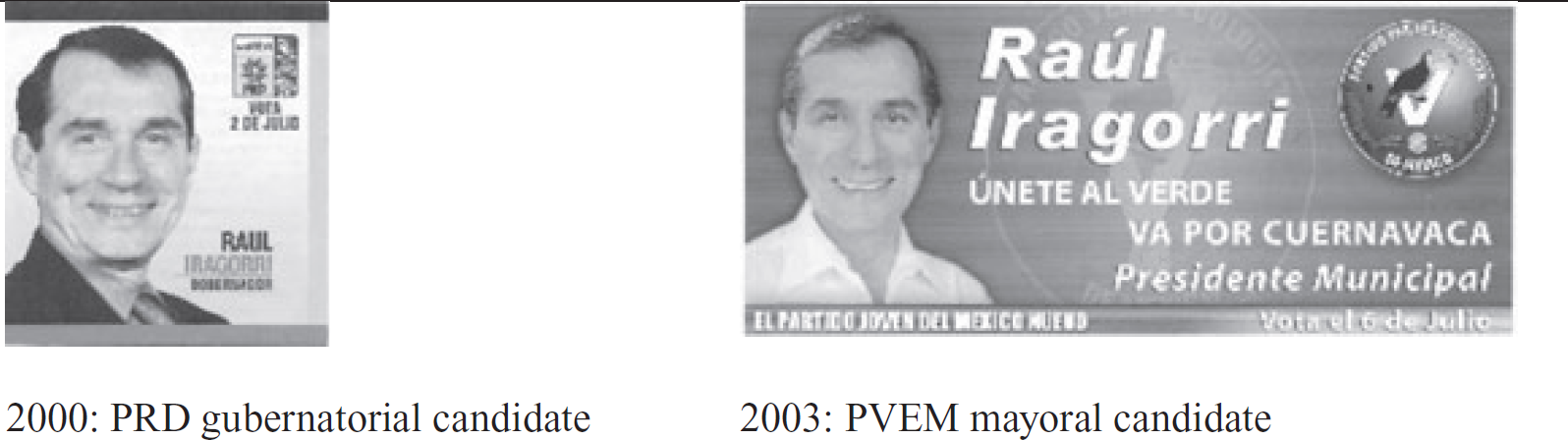
Changing party colours: Raúl Iragorri as a PRD gubernatorial candidate in 2000 and a PVEM mayoral candidate in 2003
In 2000, Iragorri ran for governor of Morelos. His campaign bore the trademark yellow of the PRD, making him one of many priístas in the country who have defected to the leftist party. He spent much of his gubernatorial campaign harshly criticising the PRI, saying, for instance, that the country's great problems were because the PRI's rule was long and not always honest or transparent. In the event, Iragorri lost to the PAN contender.
In 2003, it was not clear which party's ballot his name would grace. The Democratic Union for Morelos, a temporary electoral alliance of three small parties, considered putting forth Iragorri as their candidate for mayor of Cuernavaca, the state capital (Rocío Preciado, 2003). Instead, he chose to compete against Fernando Martínez Cué – a federal deputy who had been elected on the PAN ticket in 2000, then renounced the ‘blue and white’ in 2002 and became an independent (Gómez Guerra, 2003) – for the PRD's nomination for the mayoralty. Failing to win the PRD's endorsement, Iragorri left the party to campaign under the green banner of the PVEM. Iragorri won a plurinominal seat in the Morelos legislature, forming part of the Green party's congressional delegation – until 2004.
In 2004, Iragorri's party affiliation changed and changed again. He forsook the Green party and declared himself an independent. Later that same year, during congressional deliberations concerning the PAN governor's alleged misdeeds, Iragorri joined the PRI's delegation (Vega Giles, 2005). (Also during those deliberations another deputy left and then rejoined the PRI, temporarily making the PRI the second largest parliamentary group.) In 2005, Iragorri rejoined the PRD. All told, during one three-year term, Iragorri spent time affiliated with three different parties and as an independent.
Yet another twist remains. In the spring of 2006, Iragorri sought leave from the congress to pursue his bid for mayor as a candidate for the ‘party of the Aztec sun’ (PRD) and its junior partners. In Morelos, as is common in Mexican states, each deputy (proprietario) is elected with a replacement or alternative (suplente) to fill the seat in the event it is vacated. In Iragorri's case, both were elected on the Green party ticket. Thus, Iragorri's exit again changed the partisan balance, this time by returning the seat to the PVEM fold.
The second case concerns Kenia Lugo Delgado, who was elected to a plurinominal seat on the Convergencia ballot in 2003. Towards the end of her term, she intended to run on the PRD-PT-Convergencia ballot (‘Alliance for the Good of All’) for the lower house of the federal congress. In spring 2006 her plans changed. She joined the PAN delegation and did not run for another public office. An ex-priísta took her spot on the Convergencia ballot, while her orange office walls were quickly painted PAN blue. In the context of Morelos state politics, Lugo Delgado's move made sense in that the PC's small delegation typically voted with the PAN's far larger one in the state congress. However, PAN is a centre-right party. Convergencia emerged in the late 1990s as a self-described social democratic party. In national elections, Convergencia has joined electoral alliances anchored by the centre-left PRD.
Due to the switch made by Deputy Lugo Delgado, the PAN's parliamentary delegation grew while the PC's was reduced to one. In Morelos, an official parliamentary group must include at least two members, so the Convergencia group disappeared (technically, it was reduced to a fraction), along with the formal benefits that come with official recognition by the congress's directive body. These benefits include resources and being represented by ‘voice and vote’ in the Political Co-ordination Group.
Rosalio González Nájera serves as the third example. Like Raúl Iragorri, he was a Green party candidate and, like both Iragorri and Lugo Delgado, he was elected in 2003 on the basis of proportional representation. Earlier that year, González Nájera had stepped up as the replacement for Fernando Martínez Cué, who, as mentioned above, was a party-switching federal deputy. When González Nájera assumed Martínez Cué's seat in the federal Chamber of Deputies, he chose to affiliate with the PVEM. Three years later, González Nájera was the proprietario seeking leave to pursue another elected office. Hence, his replacement assumed his seat in the Morelos legislature. According to a local newspaper, the PAN courted the replacement. If the replacement changed parties, not only would she thereby change the legislature's political equilibrium, but, as happened with Convergencia, the Green parliamentary group would disappear (Monje, 2006). To avoid this, the PVEM's national leaders ordered Rosalio González to return to his congressional seat (Unomásuno-Morelos, 4 April 2006). He did return, causing his replacement to step aside and, more importantly, suggesting that parties can exert influence over their standard-bearers.
IV
These examples raise several concerns. One concern is that Raúl Iragorri Montoya, Rosalio González Nájera and Kenia Lugo Salgado won their legislative seats through party lists. Under this type of electoral system, parties are clearly integral to political representation. Voters' choices are expressions of sympathy for particular parties' ideals and policy positions and not simply for candidates. Moreover, since party leaders draw up the lists of candidates, they should be able to act as gatekeepers. The party list system and no-re-election clause strengthen the hand of central party committees (Bruhn and Greene, 2007) and this, presumably, encourages party loyalty. In the examples discussed above, such loyalty was in evidence only in the last case.
Encouraging party loyalty may not be the best tactic, especially for small parties with few party faithful. Parties may want to court better-known candidates who are nomination-shopping. Offering appealing candidates boosts parties' electability which, in turn, affects their potential to advance their legislative platforms. As a practical matter, it also affects parties' ability to maintain their registration and to receive public funding. On the other hand, when party switching leads to the loss of popular candidates or even the elimination of a small parliamentary grouping, parties may bemoan the drift towards political promiscuity.
Another concern touches on one of modern political parties' main functions: structuring political identity and the vote. ‘Structuring’ means imposing an order – based on party platform, ideology and image – that enables voters to choose candidates according to party labels. Ideally, knowing little or nothing about a particular race, a voter can make meaningful distinctions among candidates based on their party affiliations. For this to work, parties must be firmly established and organised along ideological lines and politicians must treat party labels as meaningful. Otherwise, a multi-party system is not offering voters a palette of political options – yellow for PRD, green for PVEM, blue for PAN, orange for Convergencia, the national colours for PRI – but hard-to-distinguish shades of muddy brown.
Even if such party functions as structuring and interest aggregation are found much more in the literature than in practice, ‘parties are still the agencies that put up candidates and participate in elections’ (Wiarda, 1993, p. 149). This is a requirement in Mexico, where the electoral rules stipulate that aspirants for public office must present themselves as candidates for a registered party; independent candidacies are not allowed. In addition, parties must have a programme and set out basic documents that express their ideology and principles. This pushes parties to develop alternative visions and programmatic identities that distinguish them from their competitors. It also means that they control nomination for public office; to appear on a ballot in Mexico, a candidate must adopt a party label. Yet, once elected, officials may peel off their party label and declare themselves independent. In fact, on the eve of the 2006 elections, almost one third of the state legislatures had one or more independent members.
Finally, Mexico's constitutional prohibition on consecutive re-election renders it all the more difficult for voters to hold elected officials to account, which is crucial in a democracy. Voters can neither reward nor punish a politician at the ballot box because, even if the official is running again, it is for another office, so the electorate is different. Combined with the system of proportional representation, the link between the voters and their representatives becomes quite attenuated.
V
A number of factors are contributing to this situation of party switching among politicians. One is simply that the Mexican political system remains in flux. The rules of the electoral game have undergone several major reforms, which has affected the nature of political competition. As electoral competition has ramped up, the ideological distance among the major parties has narrowed (Klesner, 2005). The balance of partisan forces has changed as has the ‘balance of uninominal and plurinominal representation’ (Wallis, 2003) and the relation among the branches and tiers of government. Parties and voters are still sorting out the ramifications of the breakdown of the old system, which took place over a number of years, and Vicente Fox's presidency, which failed to live up to people's hopes for change.
Another factor is that Mexico, much like advanced industrial democracies, is experiencing a decline in party identification (Levy and Bruhn, 2006), perhaps even de-alignment (Crow, 2005; Wallis, 2003). Voters, too, switch parties. Many defect from the PRI without gaining new party loyalties (Crow, 2005), despite the fact that the PRI has the deepest roots in society. Many others switch between the PAN and the PRD, despite the parties' ideological differences. As with politicians, voters may switch parties for strategic reasons.
A third factor is Mexico's mixed electoral system. Changes initiated in the 1970s opened up electoral competition and initiated the process of political liberalisation. Previously, with ‘plurality-winner contests, simple arithmetic favored the ruling party’ (Lawson, 2004, p. 4). When the plurinominal deputy system was instituted three decades ago, it encouraged the creation of new parties and appeared to create an opening through which opposition parties could accede to political power. Instead, this was a facet of the party-state's electoral engineering, which contributed to the facade of a democratic system. The consequent proliferation of small parties merely ‘enhanced the illusion of plural democratic competition’ (Shirk, 2005, p. 23). The reality is that some of these small parties simply divided the opposition vote, while the PRI co-opted others. Given the fierce competition within the official party, some priístas sought nominations from PRI ‘satellite’ parties. Political opportunism is thus not new, though it is more troubling in a pluralistic polity than when one party dominates the political scene.
Proportional representation lends itself to the entrance of small parties and the creation of a multi-party system. At their best, multi-party systems offer more choices than two-party systems, with greater ideological specialisation and clearer distinctions among parties. Further, since they facilitate minor party representation in state and federal legislatures, they help to ensure that small but important slices of the electorate are represented. At their worst, multi-party systems splinter the vote by creating ‘niche parties’ (Sabatini, 2002).
In Mexico, parties must achieve 2 per cent of the national vote to maintain their official registration. Consequently, while Mexico's mixed electoral system encourages the entry of new parties, the existence of a threshold purges some of them and temporarily purifies the party system. According to Joy Langston (2007), the electoral rules work to ensure that a weak third party – now the PRI – exists alongside two stronger parties. Overall, the number of political parties remains fairly stable.
Conclusion
In the process of strengthening and consolidating democracy, parties matter and the nature of the party–citizenry link matters. For Mexican democracy to advance, it is necessary that elected officials respect voters' expressed partisan preferences and that parties not only run candidates for election but work to ensure that party labels are meaningful. While party-switching politicians may serve parties' short-term interests, in the longer term party switching may further erode citizens' confidence in these important institutions.
Footnotes
Funding for this research was provided by the Associated Colleges of the Midwest (ACM) Faculty Career Enhancement Project, funded by the Andrew W. Mellon Foundation.