






Abstract
This article analyses the significance of the 2008 general election for the prospects of an early conclusion to Italy's transition from a First to a Second Republic. The election saw not only the return of Berlusconi to power, but also a radical simplification of Italian politics, with a considerable reduction in the number of parliamentary groups and the emergence of much more straightforward and clear-cut governing and opposition roles. The likelihood of a successful conclusion to the transition was increased by the agreement of governing and opposition forces in the immediate aftermath of the campaign to search actively for mutually acceptable institutional reforms.
Introduction
Since the early 1990s, Italy has been viewed as in transition between a First and a Second Republic. On the one hand, party-system transformation has led the country to acquire more of the features of a ‘normal majoritarian democracy’: electoral coalitions enable voters to choose the prime minister directly; governments, through greater recourse to legislative decrees, have a stronger role in parliament (Pappalardo, 2006; Vassallo, 2007). On the other hand, these changes have fuelled ambitions for further institutional change designed to complete the transition. However, efforts to secure such agreement and embody it in major constitutional reform have hitherto been stymied by the interlocking vetoes of political actors in a fragmented party system (Bull and Newell, 2009). The prospects of a conclusion to the transition seem improved by the outcome of the general election of 13 and 14 April 2008. This saw not only the return of Berlusconi to power, but also a radical simplification of Italian politics, with a considerable reduction in party-system fragmentation, and the emergence of much more clear-cut governing and opposition roles – performed by just two parties, one large and one small, in each case. The likelihood of a successful conclusion to the transition was further increased by the post-election agreement of governing and opposition forces actively to seek mutually acceptable institutional reforms.
This article first sets the general context of Italy's transition since the end of the First Republic. It then analyses the campaign that preceded the election before examining the election outcome and discussing the challenges that the new Berlusconi Cabinet faces in the area of institutional reform.
The transition and the run-up
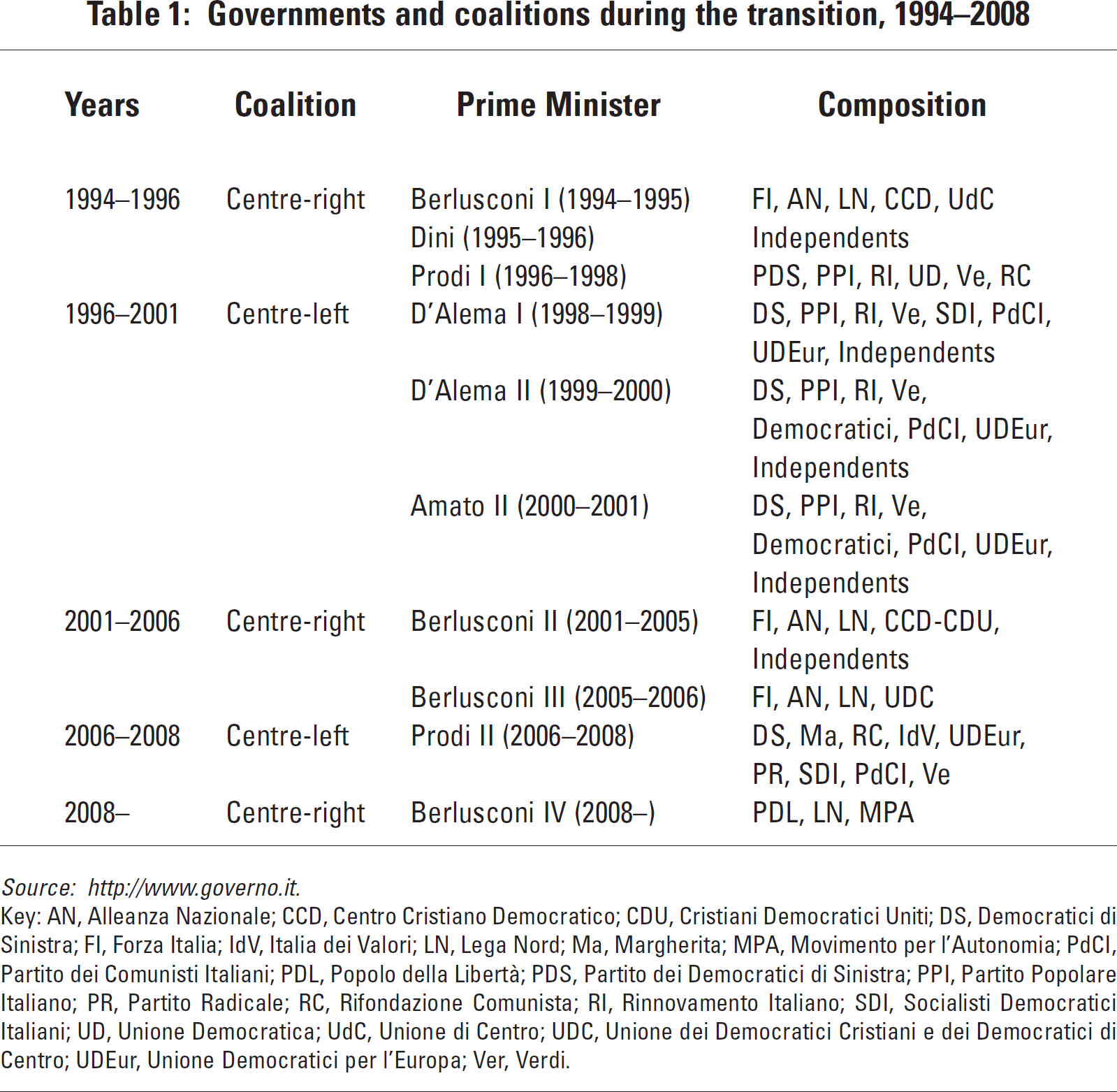
The 2008 election took place against the background of a series of long-term political changes. In essence, the collapse of the Berlin Wall in 1989, the organisational disintegration of the then governing parties under the weight of a major corruption scandal (Tangentopoli) and the change of electoral system in 1993 had brought a party-system transformation away from the traditional ‘polarised pluralist’ (Sartori, 1976) pattern. This had been based on the permanence in office of the centre-placed Christian Democrats as the mainstay of every conceivable governing coalition, and continuous exclusion from office of both the right and the main opposition party of the left (the Communist party), something that had rendered alternation in government impossible. The 1989 events had undermined the assumptions on which this system had been based by bringing with them a transformation of the Communist party into a non-communist party with a new name. Furthermore, consequential upon the Tangentopoli inquiries, most of the parties that had ruled throughout the post-war period had disappeared. The end of the First Republic was eventually sanctioned by the introduction of a mainly single-member, simple plurality system, which was meant to bring an improvement in the quality of Italian government by facilitating the emergence of two coalitions competing for overall majorities of seats. Although such coalitions did emerge, fragmented bipolarity became the predominant feature of the party system (see Table 1).
Governments and coalitions during the transition, 1994–2008
Source: http://www.governo.it.
Key: AN, Alleanza Nazionale; CCD, Centro Cristiano Democratico; CDU, Cristiani Democratici Uniti; DS, Democratici di Sinistra; FI, Forza Italia; IdV, Italia dei Valori; LN, Lega Nord; Ma, Margherita; MPA, Movimento per l'Autonomia; PdCI, Partito dei Comunisti Italiani; PDL, Popolo della Libertà; PDS, Partito dei Democratici di Sinistra; PPI, Partito Popolare Italiano; PR, Partito Radicale; RC, Rifondazione Comunista; RI, Rinnovamento Italiano; SDI, Socialisti Democratici Italiani; UD, Unione Democratica; UdC, Unione di Centro; UDC, Unione dei Democratici Cristiani e dei Democratici di Centro; UDEur, Unione Democratici per l'Europa; Ver, Verdi.
One of these coalitions was led by the media magnate, Silvio Berlusconi, who had made his debut as a professional politician in 1994 with the launch of a party, Forza Italia (FI), designed to further his personal political ambitions by bringing together the parties of the centre right. FI did two things. First, its appeal was sufficiently great to enable it, because of its relative size, to impose a degree of cohesion on allies. Second, however, since FI's image was inseparable from the charismatic qualities of Berlusconi himself, its ability to play this role was heavily dependent on the entrepreneur's own popularity (Pasquino, 2007). Otherwise, there was little to help the coalition cohere, its components – the secessionist Northern League, former Christian Democrats (UDC) and former fascists in the National Alliance (AN), besides FI itself – being united by little more than opposition to the centre-left. Consequently, whenever Berlusconi's popularity weakened, the diversity of the parties' ideologies, sizes, geographical strongholds and the interests they sought to represent had encouraged them to break ranks. Moreover, having embraced the ‘personalisation’ of politics, they had multiplied the tensions within and between themselves by transforming what were once contests between parties into face-offs between individual leaders (Diamanti and Lello, 2005, pp. 9–12).
Many of the same features were at work within the coalition of the centre-left, with the added factor of instability that its leader lacked a party. Essentially, the coalition had come together around the economics professor Romano Prodi, whose leadership, from the mid–1990s, had always been at the mercy of the constituent parties' interlocking vetoes. This became even more firmly established after the fall of his first government and the advent of the subsequent centre-left governments under Massimo D'Alema and Giuliano Amato in 1998 and 2000, respectively. Francesco Rutelli, Prodi's successor during the period of the professor's stint as President of the European Commission, found that, his position having been legitimated not by any bottom-up process of selection, but by means of an agreement in 2000 by the coalition's leaders as to who should be Berlusconi's competitor, he necessarily remained ‘exposed to the leaders’ changing and conflicting views as to the value of his stewardship’ (Newell, 2003, p. 80). Primary elections in October 2005 strengthened the position of Prodi, back from the Commission, by demonstrating the sheer weight of the popular support he was able to mobilise – thus considerably strengthening the project for coalition unity that he represented. However, they were unable fully to make up for the lack of bargaining power that came from lack of a party, ensuring that, in coalition negotiations leading to the 2006 election and beyond, Prodi's role as leader would never rise above that of mediator.
It was not very surprising, then, that incisive constitutional reform was so difficult to achieve and that precisely for this reason its debate became an intimate part of the substantive struggle for political power (Bull and Newell, 2009). Nor was it surprising that the 2008 elections were caused by the fall of a centre-left government whose demise, having been widely seen as imminent almost from the start of its period of office two years previously, was precipitated by yet another failed effort of institutional reform. Four factors were in fact responsible. First is the government's sheer fragmentation: it had consisted of nine parties, every one of which had been indispensable to the maintenance of the two-seat majority in the Senate. From left to right (roughly speaking) they were: Communist Refoundation (RC), the Party of Italian Communists (PdCI), the Greens, the Left Democrats (DS), the Socialists, the Radicals, Italy of Values (IdV), the Margherita (the ‘Daisy’) and the Democratic Union for Europe (UDEur). Second, instability had been considerably enhanced by the reformed electoral law, combining proportional representation with a majority premium for the party or coalition of parties with most votes, which had been pushed through parliament in December 2005 (without the agreement of the opposition) by the outgoing centre-right government in anticipation of its electoral defeat the following year (see Floridia, 2008). 1 Third, the sheer narrowness of its popular vote majority in the Chamber – just 24,755 – provided the opposition with a powerful weapon with which to erode the government's popularity by constantly questioning its legitimacy. Fourth, Justice Minister Clemente Mastella's decision in January 2008 to abandon the coalition, which precipitated its fall, was undoubtedly heavily influenced by the awareness that, as the leader of a very small party, he potentially had much to lose from the outcome of an electoral law referendum that was due to be held in the spring. 2
Clearly driven by the intention of putting pressure on the parties in parliament to introduce incisive reform as the price of avoiding the referendum, the referendum ultimately destroyed the government. On the one hand, it was clear that a reform designed to reduce fragmentation could only come through a cross-coalition agreement between the larger forces of centre-left and centre-right in parliament to the detriment of their respective smaller allies. On the other hand, it was clear that a refusal to grasp this nettle also threatened government survival by virtue of the incentive it gave to the smaller parties to avoid the potential implications of the referendum initiative by provoking the dissolution of parliament, which would automatically suspend the referendum for at least a year after the resulting elections.
The campaign
In the initial stages of the campaign, attention focused almost exclusively on the process of coalition formation – especially as the alliances that took shape were very different from those formed for the vote held just two years previously. In 2006, relative uncertainty about the outcome, together with the majority premium, encouraged the formation of the broadest possible coalitions. The circumstances of 2008 created the opposite pressures. The outcome was widely thought to be a foregone conclusion with Berlusconi and the centre-right the clear favourites to win. Fighting the elections on the basis of the coalition that had presented itself in 2006 and, therefore, having to defend a deeply unpopular government was not a winning proposition. Under these circumstances, it was rational for the principal party of the centre-left – the Partito Democratico (PD), formed the previous year as the result of a merger between the Left Democrats and the Margherita – to focus on the implications of its alliance decisions, not for the outcome of the 2008 election (given that this seemed to be certain anyway) but for the outcome of future elections. In particular, if – as it in fact did – it announced an intention to run alone, then it would achieve two things: (1) as a relatively large party, it would acquire considerable bargaining power vis-à-vis smaller potential allies, which would be faced with the stark choice of coalescing on the PD's terms or risking electoral annihilation because of the vote thresholds; (2) by this means PD leader, Walter Veltroni, could hope to bring about a reduction in party-system fragmentation, for voters considering supporting a minor party would be forced to decide between a vote for their most preferred choice and a voto utile for the party alliance most likely to defeat the prospect of their least preferred outcome. On this basis, the PD rejected coalition with parties to its left and with the Socialists, agreeing to run in coalition only with former prosecutor Antonio di Pietro's IdV. This seemed likely to bring with it the support of those voters driven above all else by the anti-political sentiments widespread in the Italian electorate (Vecchi, 2008).
Veltroni's initial move helped to colour the strategic context in which the leaders of the other parties had to make their alliance decisions. The first reaction was the confirmation of the previous year's alliance between the parties of the Sinistra Arcobaleno (SA), consisting of a breakaway from the DS – the Sinistra Democratica (SD), the Greens, the PdCI and RC. RC was actually prepared to run independently, needing, like the PD, to make a break with the experience of the outgoing coalition and believing, on the basis of its past performances, that it could surmount the vote thresholds on its own. The remaining three parties were not in this fortunate position. This put RC in a position of power, enabling it to reject a coalition, insisting instead on a single list that would, of course, be drawn up on its terms.
On the centre-right, it swiftly became apparent to Berlusconi's advisers that if Veltroni was going to fight the election as the leader of a new formation, then the entrepreneur could hardly counter this by himself cobbling together a coalition of several lists. However, once fresh elections had been announced, the belief that the probable winner would be Berlusconi put the entrepreneur in a rather strong position vis-à-vis his own potential allies. Only the Northern League had a reservoir of support that was sufficiently geographically concentrated to enable it to obtain a coalition agreement. Other formations had either to accept the invitation to renounce their separate identities within a single list (fielded under the name ‘Popolo della libertà’ (PDL)) or else run alone, as for example did the UDC. 3
The outcome
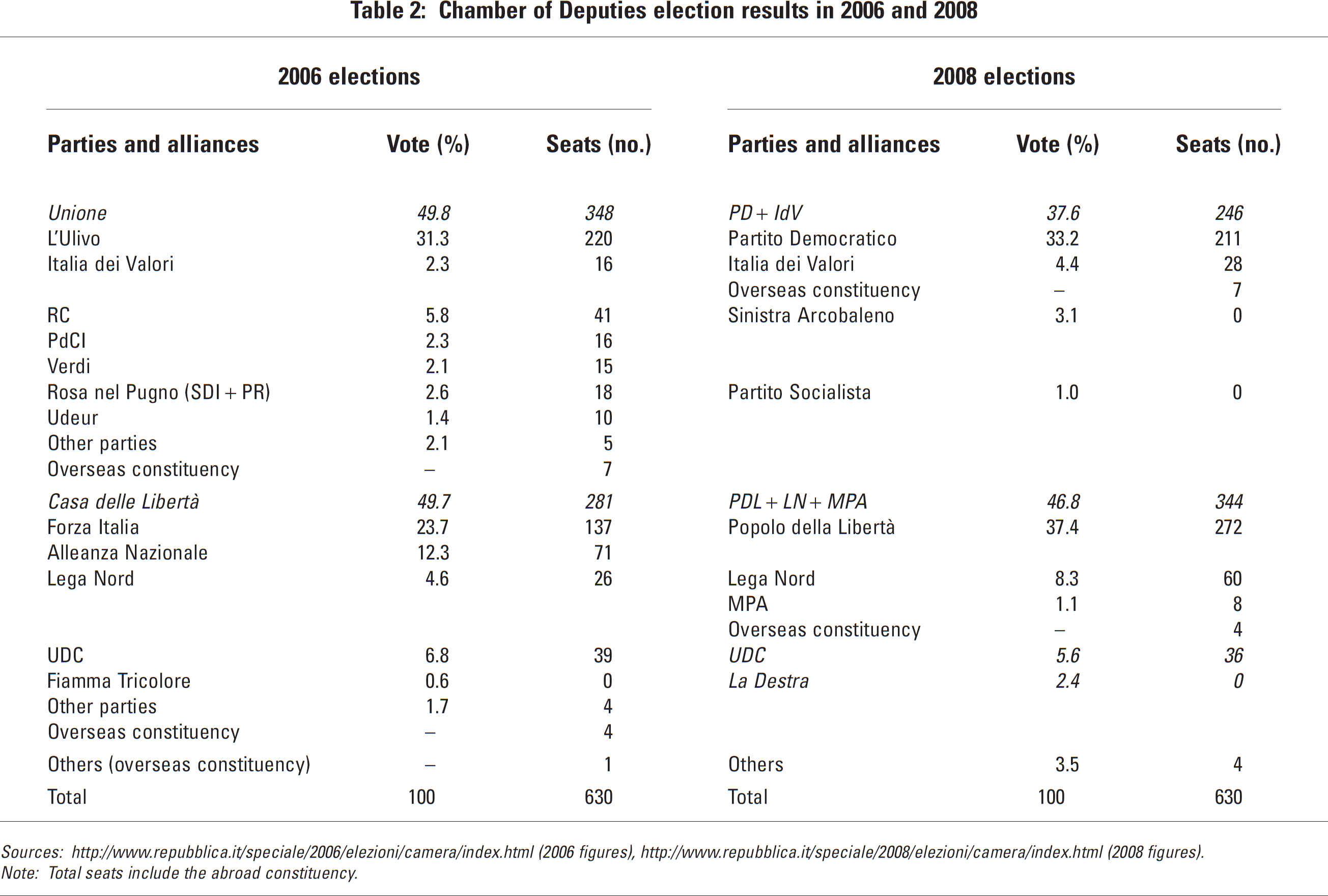
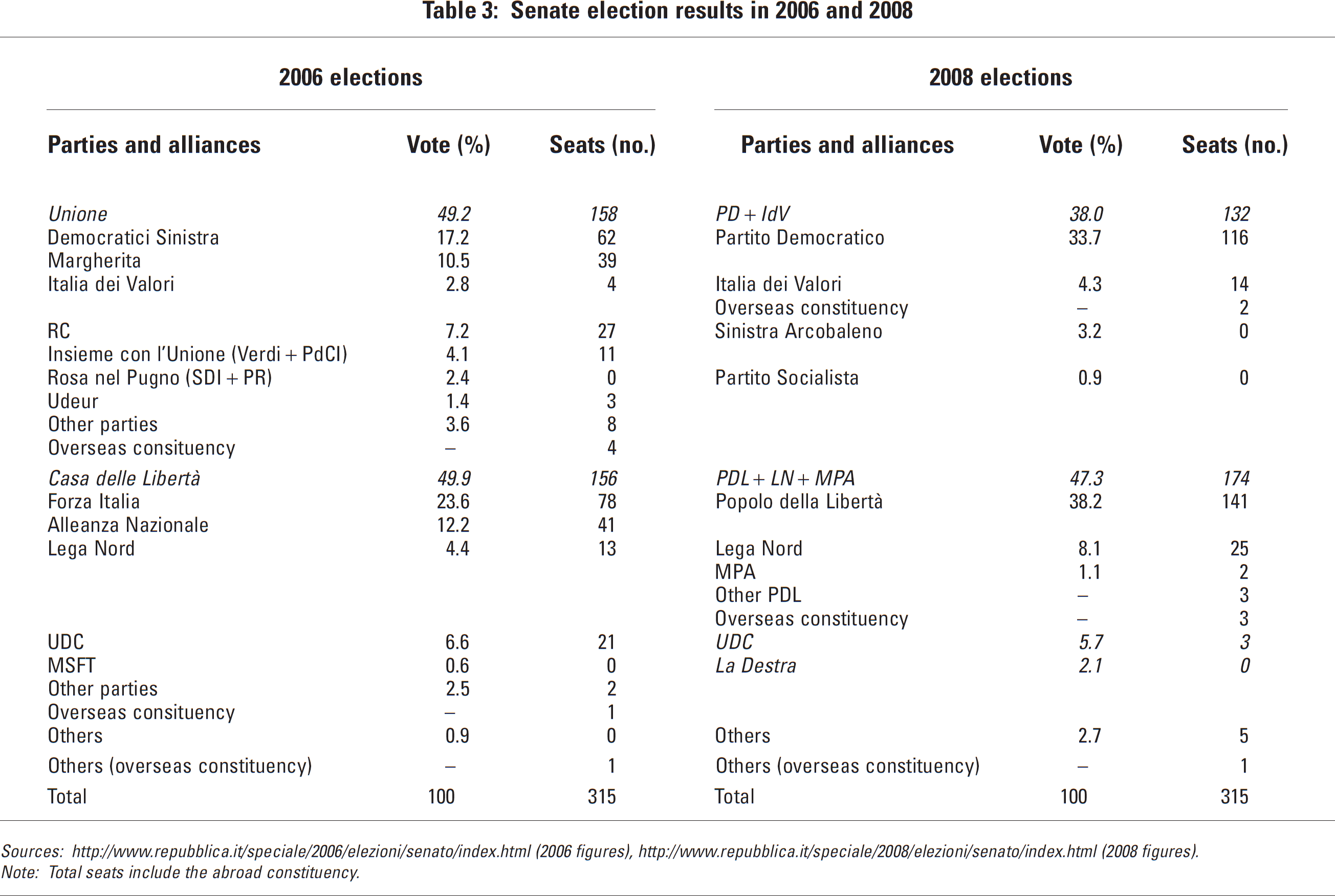
The turnout, at 80.5 per cent, was three points lower than in 2006. Prior to the election, it had been suggested that popular dissatisfaction with the cronyism of Italian politics might be reflected in widespread desertion of the polls. So the fact that there was a decline, combined with the fact that it was not large, was interpreted as providing confirmation – but only partial confirmation – of the preelection suggestions. Another way in which dissatisfaction might have been expressed was by widespread voting for fringe and protest parties. However, not only did the main centre-right coalition gain a solid majority in the Chamber of Deputies but, against most predictions, it also did so in the Senate, and more than 70 per cent of the seats were won by the two main lists. The most surprising features of the outcome, however, were the rout of the SA – for the first time since 1948 there is no socialist or communist representation in parliament – and the success of the Northern League – which more than doubled its seats, becoming the third largest party in parliament (see Tables 2 and 3).
Chamber of Deputies election results in 2006 and 2008
Sources: http://www.repubblica.it/speciale/2006/elezioni/camera/index.html (2006 figures), http://www.repubblica.it/speciale/2008/elezioni/camera/index.html (2008 figures). Note: Total seats include the abroad constituency.
Senate election results in 2006 and 2008
Sources: http://www.repubblica.it/speciale/2006/elezioni/senato/index.html (2006 figures), http://www.repubblica.it/speciale/2008/elezioni/senato/index.html (2008 figures). Note: Total seats include the abroad constituency.
The triumph of the centre-right is most plausibly explained by perceptions of poor economic performance by the outgoing centre-left government. Of course, Berlusconi's personal leadership and qualities cannot be disregarded. This time he campaigned on a small number of issues and, aside from his promises to relaunch development and improve security and justice, he made less spectacular claims than he had in past contests. If this was to place less emphasis on his charisma than in 2006, when he was obliged to do everything to counteract the negative effects of the poor performance of the then outgoing centre-right government, it was an approach that clearly worked better. Finally, Veltroni's decision to contest the elections alone meant for many automatically to consign Italy to the centre-right. In reality, his party did better than the combined result of the PD's constituent forces in 2006 – especially in the Senate, obtaining 38 per cent as against 27.7 per cent – so that some even argued that he won the election campaign. Analysis of the flow of the vote, however, suggests that the PD managed to attract a net inflow of votes only from the radical left, failing to do so in the case of the moderate centre (Buzzanca, 2008; Mannheimer, 2008a).
The SA was thus partially squeezed out by the PD – about half of those who had supported its constituent parties in 2006 apparently heeding the call to cast a voto utile against Berlusconi, others seeing it as having sacrificed its principles during the Prodi government and so moved to vote for one or other extreme-left parties (Buzzanca, 2008). This was in direct contrast to the case of the UDC, which found that being obliged to fight a war on two fronts was actually beneficial. On its right flank, it benefited from perceptions that without it, Berlusconi's coalition was skewed too far to the right and, on its left flank, from those dissatisfied with Prodi's government, but unwilling to cross the Rubicon by supporting Berlusconi. Thus the UDC was able, despite everything, to retain the bulk of its following with 5.6 per cent and 36 Chamber seats (as opposed to 6.8 per cent and 39 seats two years previously).
Analysis of the flow of the vote also helps to explain the extraordinary success of the Northern League. Of all the lists, it had the greatest success in retaining those who had voted for it in 2006 (Mannheimer, 2008a). This suggests that the League is more successful than other parties in winning long-term loyalty by inculcating in its supporters a territorially based political identity expressive of the country's long-standing regional economic disparities. In addition, more than half the League's support came from those who had voted for other parties in 2006 (Consortium, 2008, p. 3). This may be because it gives voice to fears and anxieties arising from processes of globalisation and this may have had a particular appeal to the one-third of its voters who had supported other centre-right parties in 2006. A smaller, but not insignificant proportion of the League's vote – possibly as much as 8 per cent (Mannheimer, 2008a) – came from the search by former supporters of parties of the left for an alternative radicalism – the left's collapse having also played a significant role in the success of the other clear winner, the IdV.
The concomitance of the IdV's advance with that of the League points to the significance of anti-political sentiments in the 2008 elections and suggests that it may have been thanks to these two parties that the decline in turnout was less than expected. At any rate, these parties' performances had the significant systemic effect of accentuating the importance of the ‘radical’ component within each coalition (Mannheimer, 2008b). In the case of the IdV, electoral success accentuated the party's importance in another way. It had apparently agreed, as part of the deal underpinning its alliance with the PD, that after the vote it would merge its forces with the latter party in a single parliamentary group. Its success enabled it to withstand this pressure and instead to establish its own group.
Consequences of the election for transition and institutional reform
Berlusconi appointed his Cabinet in early May 2008. His own party acquired an absolute majority in Cabinet, while the other winner in construction of the executive was the Northern League, which obtained the interior ministry along with other key posts of direct relevance to the issue of institutional reform. In this way, Berlusconi appeared to reinforce his alliance with a party on whose support the maintenance of his parliamentary majority depends. This added to the sense that the durability of the government seemed not to be in question this time – a feature that is of crucial importance for the prospects of institutional reform and a successful end to the transition.
Discussion of institutional reform has centred around a package of proposals – e.g. further devolution of power to the regions; strengthening of the role of the prime minister; transformation of the upper house into a Federal Senate; and reform of the electoral law – which, proposed by the previous Berlusconi government, was passed by parliament but failed in a constitutional referendum in June 2006 (Bull and Pasquino, 2007). More delicate is the issue of fiscal federalism, because of the geographical contrasts in the distribution of support for the coalition's various forces: if this induces the Northern League to push for fiscal federalism as a means of keeping more resources in the north, the remainder of the coalition requires a ‘solidarity federalism’ as a way of adjusting imbalances between rich and poor regions (Panebianco, 2008).
Of equal importance for the prospects of a successful conclusion to the transition is likely to be a range of issues seemingly unrelated to institutional reform – for these will provide a test of the capacity of the majority to remain united in the face of major problems, particularly the stagnating economy. Italy has in recent years been experiencing virtually zero growth; its industries suffer from low productivity and a lack of competitiveness; its public debt is very high; its labour market is one of the most inflexible in Europe; its pension system needs to be reformed. Holding together the coalition while addressing these issues will be challenging: both the Northern League and the National Alliance component of the PDL are protectionist, which may compromise Berlusconi's ability to push through a number of the liberal reforms these problems appear to require.
Prospects for reform will also be heavily influenced by developments within the Opposition. Veltroni's early declarations concerning the need for an opposition that was ‘constructive’ seem to augur well – for in contrast, governments and oppositions have, ever since the beginnings of the upheavals of the early 1990s, traditionally competed by demonising each other through reciprocal denials of the claims of the other to legitimacy. And if this style of competition had contributed significantly to rendering institutional reform intractable, it had also been self-reinforcing – so much so that for IdV and some parts of the PD the theme of the unfitness of Berlusconi to govern has become an article of faith that may lead them to resist dialogue across the governing/opposition divide.
The self-reinforcing nature of styles of competition (combined with the fact that such styles may suddenly change in the face of events such as the 2008 election outcome) seemed to lie at the heart of what was a palpable change in the tone of public debate in the initial weeks following the election. Then, Veltroni's declarations to the effect that regular meetings between prime minister and leader of the opposition were a normal feature of ‘advanced’ democracies were swiftly reciprocated by Berlusconi's insistence that the two meet at the earliest opportunity to initiate ongoing dialogue, especially with a view to finding mutually acceptable institutional reforms. In effect, both men had clear incentives to render their 16 May meeting the start of a process leading to success; for the systemic consequences of the election meant that they were well placed to seek for themselves a place in Italian political history as the fathers of a new constitutional settlement. Especially for the ageing Berlusconi, reputed to want to crown his career at the end of his term as prime minister with election to the presidency, it seemed likely that this would be an overriding imperative.
Conclusion
This article has sought to analyse the significance of the 2008 election for the prospects of an early conclusion to the so-called Italian transition through agreed changes to the rules of the game (that is, changes to the electoral system and to aspects of the constitution governing the relationship between legislature and executive and the distribution of power and authority between national and subnational tiers of government). The systemic consequences of the vote, especially the reduction in party-system fragmentation and the emergence of relatively cohesive governing and opposition formations under strong leaders keen to talk to each other, have rendered these prospects rather good. In such circumstances – an absolute novelty in Italian politics – looking back tends to give the impression of a sequence of events unfolding, in path-dependent style, with this outcome as the almost inevitable consequence. In reality, this outcome was not inevitable. The impression that it was results from our effort, in this short article, to reconstruct the strategic choices facing actors at each critical juncture and thus to render intelligible the decisions they actually made. Of course, when events are inevitable, outcomes are easily predictable; so, given the notorious difficulty of making predictions about Italian politics, impressions of inevitability are a trap of which analysts need to be especially wary. Notwithstanding this, the prediction that the transition will now be concluded relatively soon seems less hazardous than it would have done just a few months ago.
Footnotes
1
For elections to the Chamber, parties present lists of candidates in each of 26 multi-member constituencies, voters being required to make a single choice among the lists with which they are presented. Parties can either field lists independently or as part of a coalition with other parties. Seats are distributed between the parties proportionally except that, to be eligible to participate in such distribution, parties must obtain at least 4 per cent of the national total of valid votes cast if they are running independently or as part of a coalition whose combined total turns out to be less than 10 per cent. If they are part of a coalition whose combined total is 10 per cent or more, then they must obtain at least 2 per cent of the national valid vote total or be the largest party below this threshold. If an initial proportional distribution of seats results in the largest party or coalition receiving less than 340 seats, then it is assigned as many seats as are necessary to bring it up to that figure, this so-called premio di maggioranza (or majority premium) thus ensuring, for the party or coalition concerned, an overall majority in the 630-seat Chamber. The remaining seats are distributed proportionally among the other parties and coalitions. Arrangements for the Senate are very similar, the most important difference being that seats are assigned to regions (in accordance with their populations) with assignment of seats, including the premio di maggioranza, taking place region by region (that is, seat assignment depends on parties' and coalitions' regional, not their national, totals).
2
The referendum proposed to abolish parts of the electoral law whose effects would be to remove the option available to parties to field lists as part of a coalition with other parties, and to strike down those clauses allowing attribution of the majority premium to the largest coalition. The result would be to reserve the premium to the largest single list, and automatically to raise the vote thresholds for all lists to 4 per cent in the Chamber and 8 per cent in the Senate. The promoters' expectations were thus that the reform would drive party actors to pursue the formation of single large groupings, bringing disappearance of the distinction between coalitions and their constituent parties, in effect reducing fragmentation by considerably raising the political costs of defection for both parties and voters (Bull and Newell, forthcoming).
3
Once the coalitions had been set in place, the remainder of the campaign was somewhat lacklustre and certainly much more subdued than the contest that had taken place two years earlier. As was to be expected, it focused heavily on the two main prime ministerial candidates, Veltroni and Berlusconi. On the one hand, Veltroni sought to mark the contrast with Berlusconi, and the novelty of what he was proposing, by adopting a studied posture of moderation and reasonableness. This involved a refusal to demonise his opponent or to question the legitimacy of his claim to office on grounds of the conflict of interests arising from Berlusconi's media empire. On the other hand, Berlusconi, as the elder of the two candidates, faced with an opponent having a greater claim than his to be offering a political novelty, sought, not unnaturally, to associate Veltroni with the previous two years of government (which Veltroni resisted by distancing his party from the government's record), but did so with less of the fiery rhetoric and colourful language of 2006.