






Abstract
Since the mid-2000s it has become common, although far from universal, to characterise the world as ‘multipolar’. There has, however, been scant attention to how the key protagonists view the changing distribution of power. This article sets the stage for this special issue of POLITICS, which begins to address that lacuna. It introduces the significance of a change in the global balance of power and explores how power in the international context is understood and assessed. It then makes the case for which actors are the key protagonists in the current global distribution of power and contextualises the subsequent articles by providing comparative indicators of power across a range of dimensions. Drawing on the contributions, this article concludes that while the ‘rules of the game’ of international politics probably will change, they are unlikely to do so beyond all recognition.
With the ‘rise’ of Brazil, China and India and the renewed assertiveness of Russia it has become common to characterise the international system as ‘multipolar’, although a number of scholars continue to emphasise the predominance of the United States in a ‘unipolar’ world. While there has been some discussion of what these changes mean for the functioning of the institutions of global governance, there has been scant attention to how the key protagonists view the changing distribution of power. This special issue of POLITICS begins to address that lacuna by inviting experts on the leading protagonists to reflect on the following questions. What power resources do the key protagonists have? In which contexts do they and will they seek to exercise power? And to what ends do/will they seek to wield this power? The particular focus of the issue is on the implications for international norms and institutions; the ‘rules of the game’ or, more colloquially, ‘global governance’.
This article sets the stage for the other contributions to this special issue. It begins by exploring characterisations of the contemporary distribution of power and introducing the significance of changes in the global distribution of power. It then considers how power in the international context is understood and assessed; makes the case for which actors are the key protagonists in the current global distribution of power; and contextualises the subsequent articles by providing comparative indicators of power across a range of dimensions. The article concludes by introducing the individual contributions and drawing out some core implications from them.
Of poles and (great) powers
In the wake of the collapse of the Soviet Union in 1991, the United States was left as the world's only superpower. The US's enduring preponderance across the range of key power resources – military, economic and technological – has led many to characterise the contemporary international system, based on the distribution (or balance) of power among states, as ‘unipolar’ (Brooks and Wohlforth, 2008, p. 12; Ikenberry, Mastanduno and Wohlforth, 2009, p. 11; Krauthammer, 1990/91 and 2002/03). By the latter part of the 2000s, however, the US's struggles in Iraq and Afghanistan and the increased economic importance and greater assertiveness of China, Russia, India and Brazil prompted a rival characterisation of the international system as ‘multipolar’ (Drezner, 2007; NIC, 2008). 1 In this characterisation there are a number of states wielding substantial power in the international system; there are a number of ‘great powers’.
This article contends that these apparently rival depictions of the international system reflect different emphases. Those who depict the world as unipolar emphasise the preponderance of the US across the whole range of power resources, while those who depict the world as multipolar emphasise the rapid and projected economic development of a number of ‘middle-ranked great powers’. 2 The depiction of the world as unipolar thus employs the ‘lump’ concept of power, which has been criticised for assuming that aggregate power is equally useful in all situations (Baldwin, 2002, p. 188; Guzzini, 2000, p. 54; Mastanduno, 2009, p. 123). 3 To the extent that aggregate power is not fungible, which power resources matter is ‘relational’, depending on who is trying to get whom to do what (Baldwin, 2002, p. 179). Crucially, with regard to some key power resources the US is not that much better endowed than some of the other great powers (Ikenberry, Mastanduno and Wohlforth, 2009, p. 1; and see below). Thus rather than a single balance of power it might be worth thinking of multiple distributions of power.
The second difference of emphasis concerns the referent object. The authors who view the world as unipolar focus on the power of the US relative to other great powers and the implications for its ability to realise its objectives (Brooks and Wohlforth, 2008, p. 3; Ikenberry, Mastanduno and Wohlforth, 2009). This focus, however, masks changes in the distribution of power among the middle-ranked great powers. Those that characterise the world as multipolar are more sensitive to changes in the relative power of the middle-ranked great powers, although they tend not to focus on it. This volume helps to draw attention to the shifts in the balance of power among the great powers and not just with reference to the US.
The significance of the distribution of power
However many ‘poles’ there are in the world, the distribution of power has changed in the twenty-first century in significant ways that have important implications for global governance. Theories of international relations suggest several, not always complementary, reasons why the distribution of power, and its fluctuations, matter. According to neo-realism, a state's position in the international balance of power ‘strongly shapes’ its behaviour (Mearsheimer, 2001, p. 10), and international institutions faithfully reflect the international balance of power. Bargaining theories also emphasise the importance of power in shaping the outcome of international negotiations (Ikenberry, 2001, p. 258; Keohane and Nye, 2001, p. 9; see Moravcsik, 1998, pp. 60–67), although such theories tend to emphasise issue-specific rather than aggregate power. Neoliberal institutionalism, while viewing international institutions as imperfectly responsive to the underlying distribution of power, recognises that a profound disjuncture between the balance of power and existing institutions can prompt reform or replacement of those institutions (Stein, 2008, p. 215). Constructivism also suggests that changes in the distribution of power matter, particularly to the extent that great powers advocate, endorse or oppose the development of new international norms (Price, 1998, p. 635). Thus from a number of different theoretical perspectives there are reasons to expect changes in the global distribution of power to have wide-ranging implications for international politics.
In particular, there is an expectation that the emerging changes to the distribution of power will pose challenges to existing international institutions, most of which were established within the bipolar, Cold War system under US leadership (Drezner, 2007; Ikenberry, 2001; Zürn and Stephen, 2010, in this issue). Some of these implications for global governance are already evident. There have been calls – not least from Brazil, China and India – for reform of formal institutions, such as the United Nations Security Council (UNSC) and the International Monetary Fund (IMF) (see Breslin, 2010; Sotero, 2010; Wagner, 2010; Zürn and Stephen, 2010, all in this issue). While there have been reforms to quotas and votes in the IMF (IMF, 2008), the granting of permanent seats (without a veto) on the UNSC for Brazil, India, Japan and possibly South Africa, however, has been stymied – particularly by disagreements among the middle-ranked great powers (Ikenberry and Wright, 2008, p. 14). A number of more informal changes have also taken place, such as in the composition of the core negotiating group in the World Trade Organization (WTO), with Brazil and India joining the US and the EU in the inner circle at the expense of Canada and Japan. The 2008 financial crisis also saw the rise to prominence of the G20, composed of a much wider range of states and threatening the standing of some established ‘middle-ranked great powers’ (see Dobson, 2010, in this issue). In addition, new international institutions have emerged without the support of the US, with the International Criminal Court the most notable example. Thus, despite the persistence of a unipolar distribution of power in the international system, international institutions have changed.
Thus a focus on US preponderance is not sufficient for understanding the development of global governance. Even those who emphasise US predominance accept that the preferences of middle-ranked great powers affect the US's ability to translate its power resources into outcomes (Ikenberry, Mastanduno and Wohlforth, 2009, p. 16). This issue concentrates on where the established and emerging great powers see themselves in the distribution of power and what they want from the existing structures of global governance.
Power resources and protagonists
Although scholars are ultimately interested in power over outcomes, analyses tend to focus on the material power resources or capabilities that different actors possess (Baldwin, 2002, p. 182; Brooks and Wohlforth, 2008, p. 2; Guzzini, 2000, p. 53; Mearsheimer, 2001, p. 57). The material resources that are most commonly seen as important are: economic size; technological sophistication; and military strength (see, for example, Mearsheimer, 2001, p. 55; Waltz, 1979, p. 131). It is the US's preponderance in these ‘hard power’ resources, which can be used to coerce or induce specific actors, that is invoked to justify the characterisation of the current international system as unipolar (Brooks and Wohlforth, 2008, p. 2; Ikenberry Mastanduno and Wohlforth, 2009, p. 1).
Other scholars, however, contend that some actors can influence others through less direct means. A state might thus indirectly affect the behaviour of many others by shaping formal international institutions (Barnett and Duvall's (2005, p. 51) ‘institutional’ power). Influence may also stem from the ability to shape ideas and influence identities, thus controlling agendas and affecting preferences (Nye's (1990) ‘soft power’; Barnett and Duvall's (2005, pp. 52, 55) ‘structural’ and ‘productive’ power; Strange's (1988, p. 31) ‘knowledge, beliefs and ideas’; and neo-Gramscian ‘hegemony’ (e.g. Cox, 1986)). The key take-away for our purposes, however, is that the literature recognises a wide variety of potential power resources.
In the light of the variety of power resources and reflecting the relational understanding of power discussed earlier, the contributions to this special issue focus on the questions:
Which actors have (or will soon have) which power resources?
In which contexts do/will they seek to wield them?
To what ends do/will they seek to wield them?
With what implications for existing governance structures?
The cases for the key protagonists
Kenneth Waltz (1979, p. 131) observed that whatever the challenges of precisely ranking the power of states there is usually a common-sense consensus about which actors are great powers. This is the approach that we have primarily adopted in identifying the actors to include in this issue. There is a broad consensus that the state actors that ‘matter’ in contemporary world politics are Brazil, China, India, Japan, Russia and the United States (Haass, 2008; Ikenberry and Wright, 2008; NIC, 2008).
Two of the actors that we include – the European Union and South Africa – warrant further justification, albeit for contrasting reasons. A number of accounts identify the EU qua the EU as a great power (Buzan, 2004; Haass, 2008; NIC, 2008), although, as Richard Whitman (2010) discusses in this issue, there are serious questions about the EU's capacity to act collectively across the breadth of international politics and harness the power resources of its constituent Member States. Nonetheless, the EU in its own right or through the co-ordination of Member State policies has become an important player in myriad international forums.
The case for South Africa is rather different. It is absent from most contemporary accounts of the changing distribution of power and when it does appear it is only as a regional or middle power (Haass, 2008; Manning, 2010). We decided it was worthy of inclusion because we wanted a broad perspective and wanted at least one power from each continent. South Africa stands out for three principle reasons: first, it has made a clear claim to continental leadership (see Jordaan, 2010, in this issue); second, it is the only African country in the G20; and third, there is formal co-ordination among India, Brazil and South Africa (IBSA), as rising powers that are also democracies (Sotero, 2009; Zürn and Stephen, 2010, in this issue). These are far from equal actors, as the following section will underline, but they increasingly appear to be the key protagonists in shaping global governance.
Protagonists' power resources 4
The purpose of this section is to put our key protagonists in context by providing comparative information about their various power resources. The objective here is not to aggregate or rank different forms of power; rather it is to provide comparative information in order to help to situate our protagonists within multiple balances of power. Where it has been possible to find comparable time series data, I have provided them in order to illustrate changes in power capabilities since the end of the Cold War.
Economic size is a power resource in its own right – such as by denying actors access to one's market through the imposition of sanctions – but also because it can be converted into other power resources, notably military might. Economic power is most commonly measured by gross domestic product (GDP), which captures the entire overall output of an economy (see Figure 1). On this indicator the growth of China, India and, to a lesser extent Brazil, is clear, while so is the decline of Japan, and to a small degree the US.
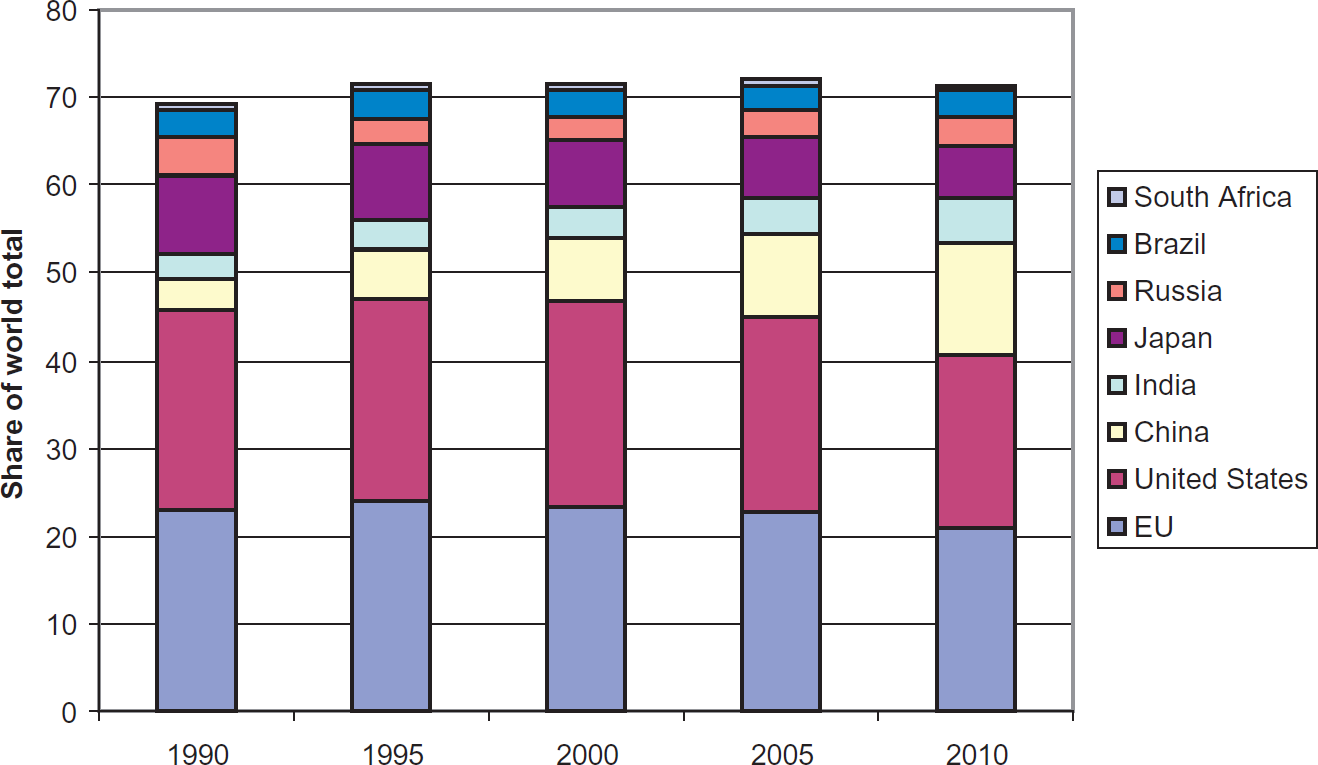
Economic size: shares of global GDP (purchasing power parities)
Particularly if one is interested in the capacity to translate economic power into military might, a state needs money and technology to create and maintain its armed forces and to be able to wage war (Mearsheimer, 2001, p. 61). Thus I also include measures for GDP per capita (Figure 2) as a proxy for wealth and on patent filings (Figure 3) as an indicator of technological sophistication (note that this is also a relevant aspect of Susan Strange's ‘structural power’). The established powers – the US, EU and Japan – hold up much better relative to the emerging powers on these measures.
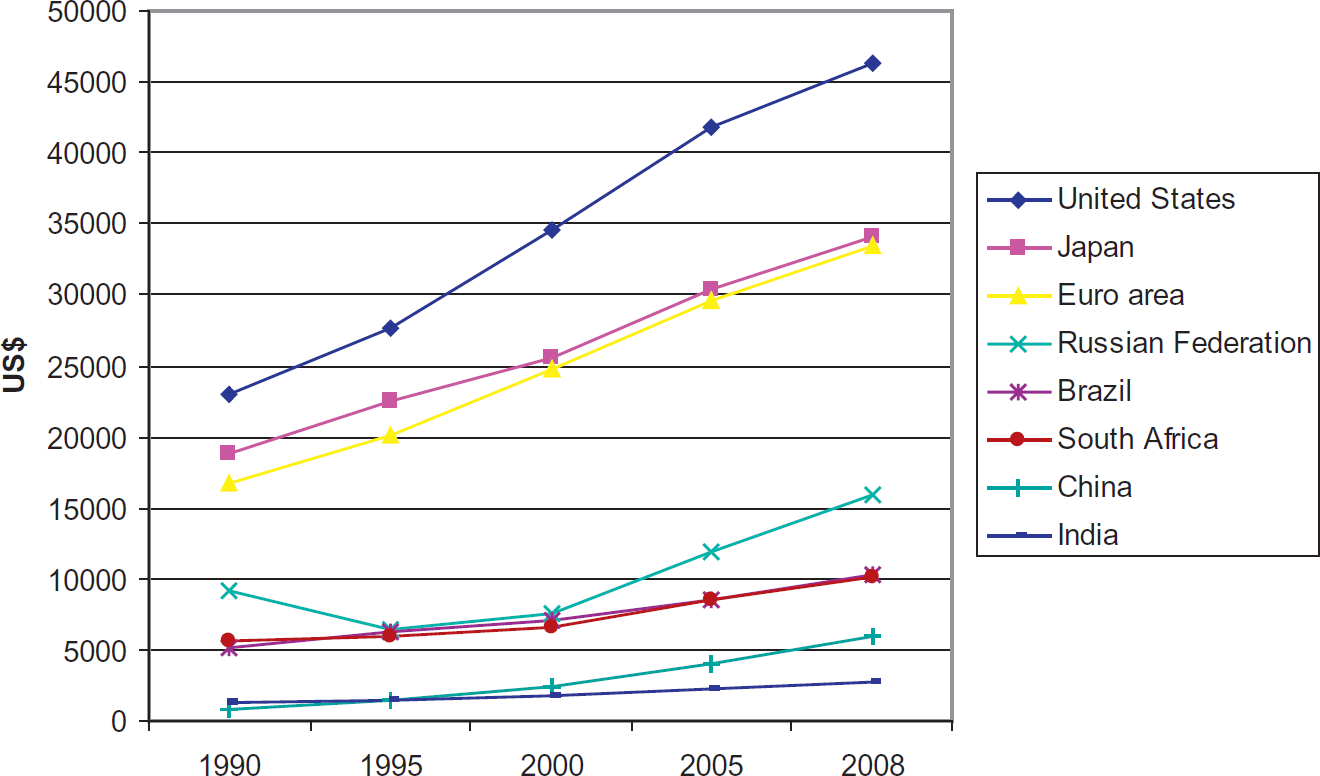
Relative wealth: GDP per capita (purchasing power parities)
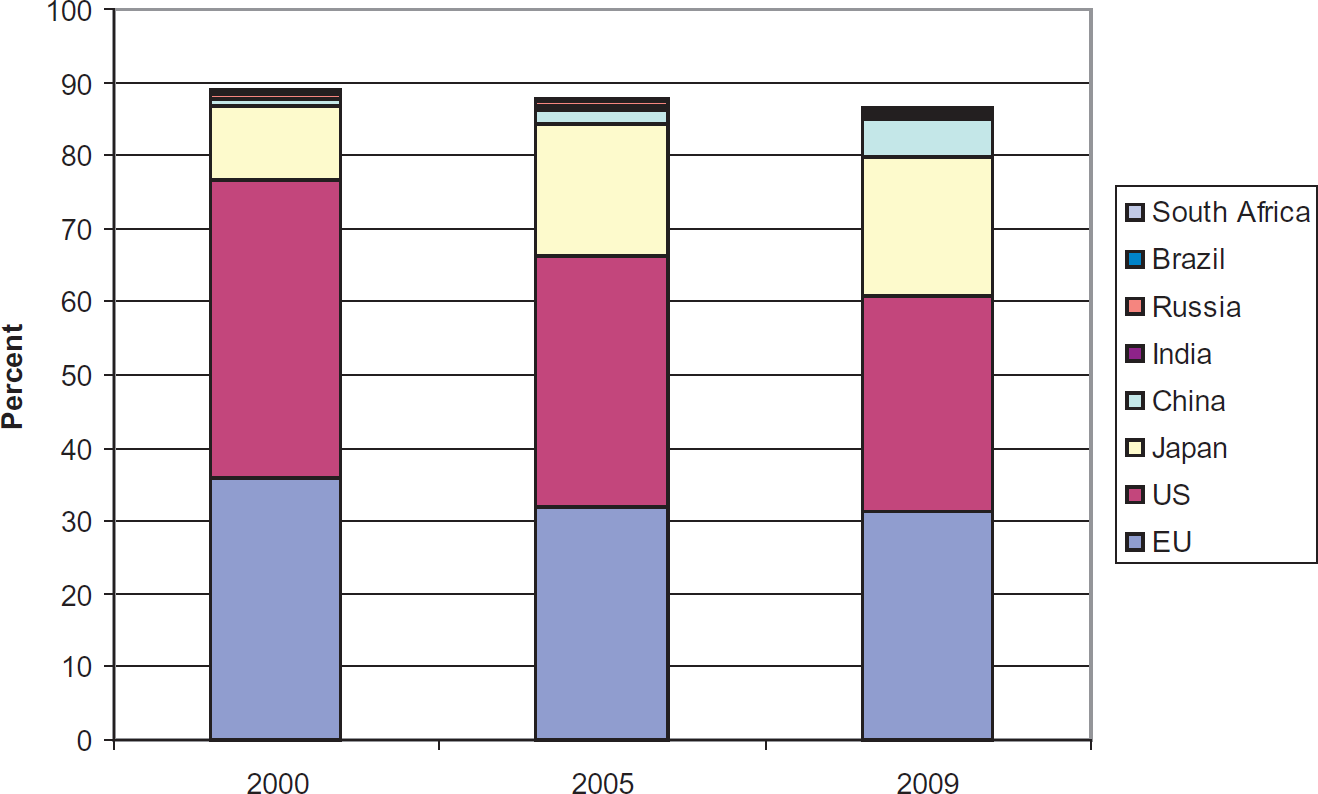
Knowledge creation: shares of filings under the Patent Co-operation Treaty
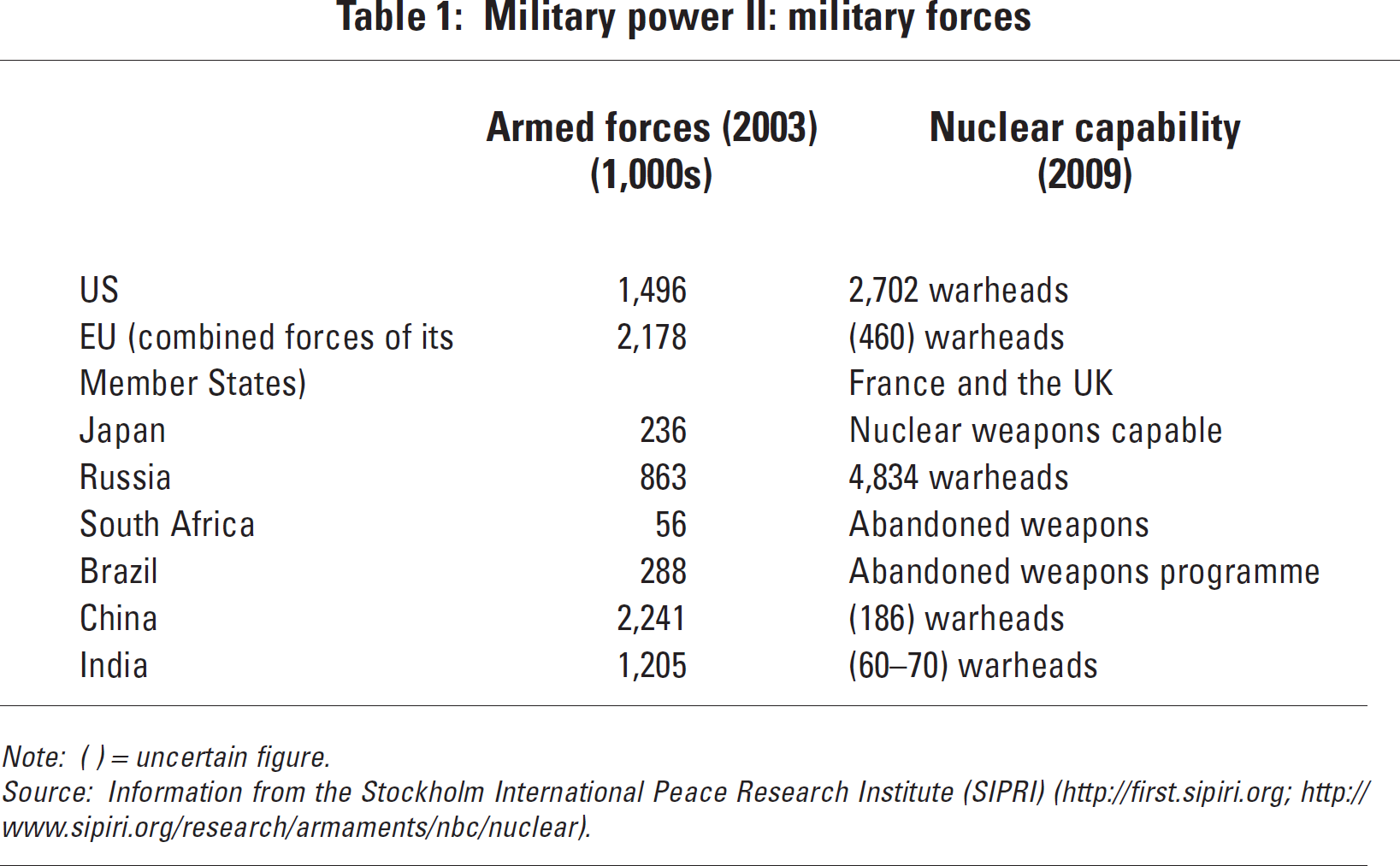
Many scholars, not only realists, emphasise the importance of military power resources (see, for example, Cooper, 2003, p. 162; Keohane and Nye, 2001, p. 14; Strange, 1988, p. 32). Military power resources are usually captured through military expenditure (Figure 4) and armed forces, including nuclear weapons capabilities (Table 1). Since the end of the Cold War the US has actually increased its military spending, although the figures for 2005 and 2008 are somewhat misleading in terms of military power as they reflect the costs of waging wars in Afghanistan and Iraq. The EU's Member States and Japan have largely maintained their levels of military spending over this period, while China has significantly increased its spending, albeit from a low base. Russian military spending has also recovered slightly after the sharp fall in the wake of the end of the Cold War.
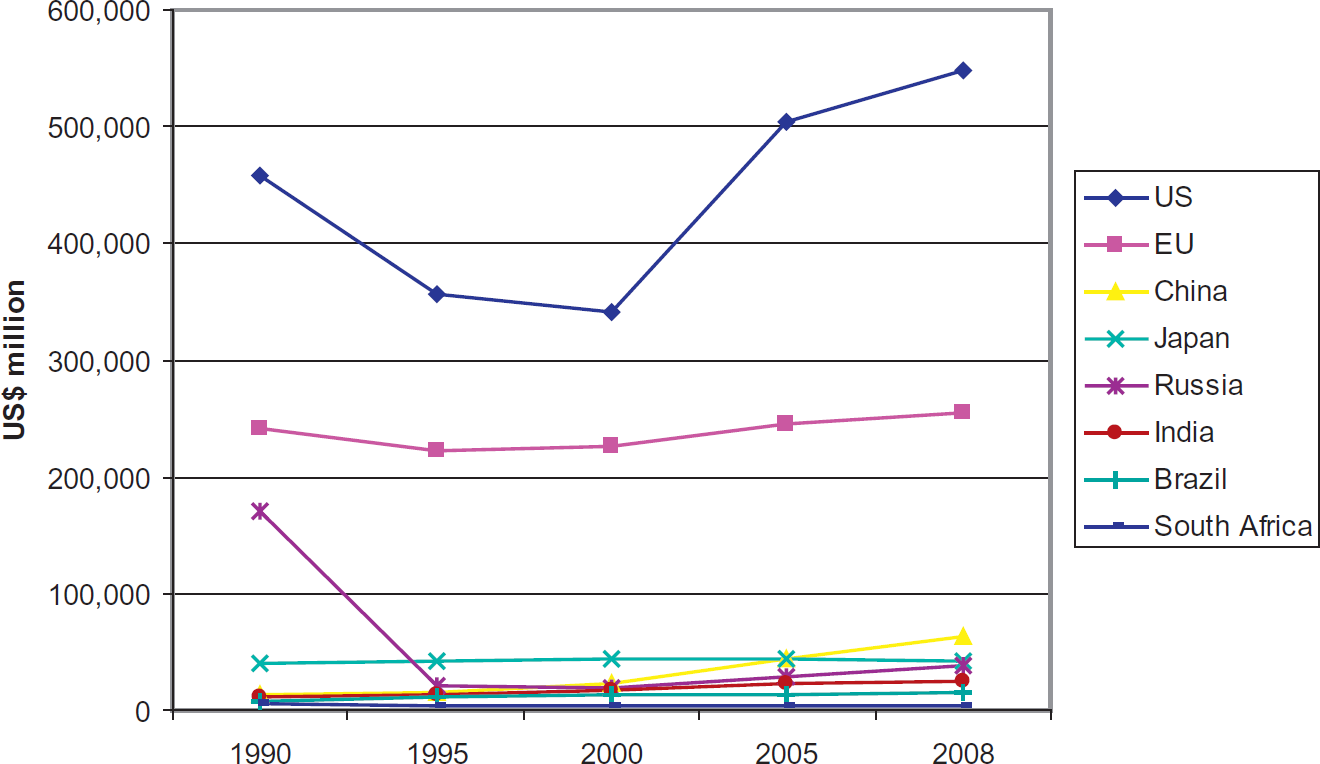
Military power I: military expenditure (expenditure in constant (2005) US dollars)
Military power II: military forces
Note: () = uncertain figure.
Source: Information from the Stockholm International Peace Research Institute (SIPRI) (http://first.sipiri.org; http://www.sipiri.org/research/armaments/nbc/nuclear).
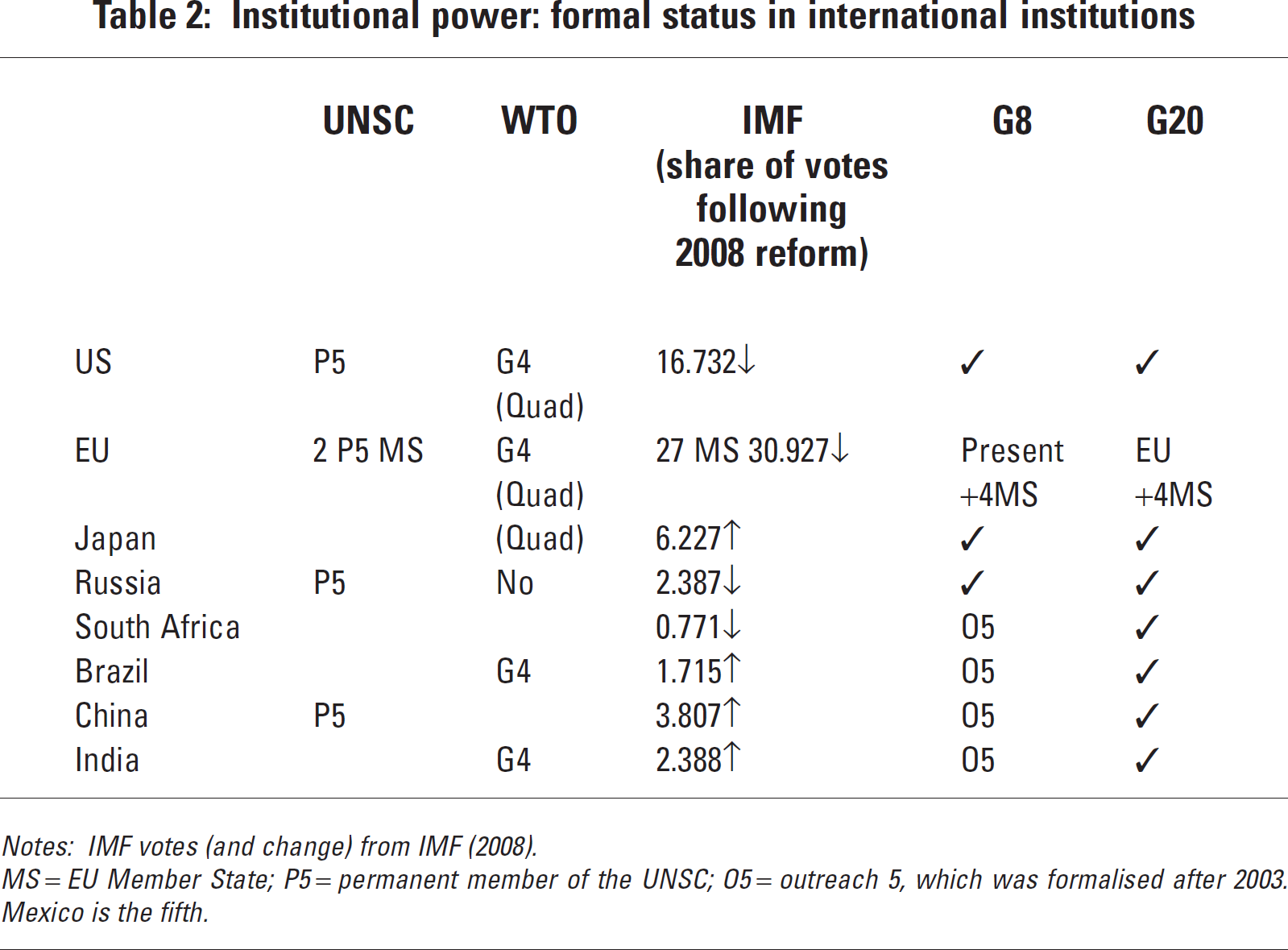
Particularly given our interest in the implications of the changing distribution of power for global governance, the status of the key actors within existing institutions is important (see Table 2). It matters not least because that status affects their ability to reform (or oppose reform of) existing institutions.
Institutional power: formal status in international institutions
Notes: IMF votes (and change) from IMF (2008).
MS = EU Member State; P5 = permanent member of the UNSC; O5 = outreach 5, which was formalised after 2003.
Mexico is the fifth.
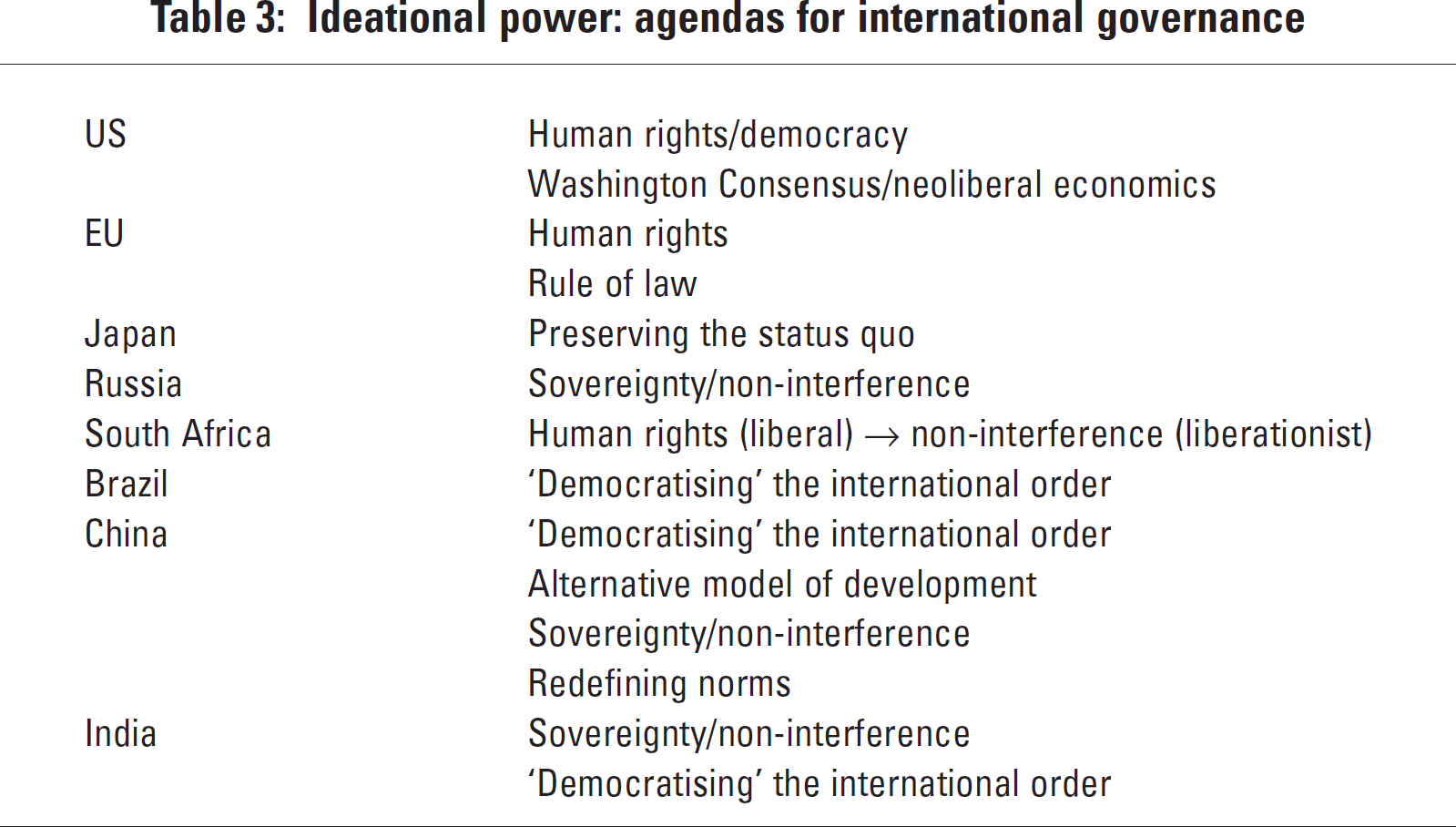
As the earlier discussion of indirect forms of influence suggested, some scholars see the ability of actors, including states, to shape the international agenda (what ideas and options are considered) and even to affect the identities and thus the preferences of other actors, as a profound if often subtle form of power. Consequently, informed by our contributors, I have sketched the core ideological agendas of our protagonists (see Table 3). These are ideas and norms that are sometimes formally articulated by the protagonists, although not necessarily consistently or constantly over time. In some cases the idea or norm is promoted more by example than by design, such as the apparent success of China's economic model, although it is sometimes presented as a coherent intellectual vision, the ‘Beijing Consensus’. China has also actively sought to redefine established international norms in a distinctive way more compatible with its preferences; thus human rights are about group and socio-economic rights and democracy is about democracy among countries (see Breslin, 2010, in this issue). Several actors call for the ‘democratisation’ of international institutions, by which they mean that they would like to have a greater say. These ideational agendas translate into influence only in so far as they shape the international agenda or influence the preferences of others; articulating or exemplifying an idea or norm is necessary but not sufficient for influence.
Ideational power: agendas for international governance
In terms of the implications for global governance, an understanding of the distribution of power resources is necessary, but hardly sufficient. The ends to which the protagonists want to use their power resources are also crucial.
Introduction to the contributions
The objectives of the protagonists are the primary focus of the subsequent articles in this issue. We begin with the longer-standing powers – the US, the EU, Japan and Russia – before turning to those that are rising – China, India, Brazil and South Africa. The final contribution considers the implications of the changing distribution of power for the institutions of global governance.
John Dumbrell, while recognising that the US remains the world's ‘sole superpower’, points to internal weaknesses and the ‘rise of the rest’ as challenges to US primacy in the longer run and explores whether the Obama administration has developed a foreign policy appropriate for the contemporary international context.
Richard Whitman argues that the EU's distinctive character as an international organisation and an international actor means that it has trouble translating the collective material power resources of its Member States into international influence, either within multilateral organisations or in bilateral relations with other great powers. The reforms adopted in the 2009 Treaty of Lisbon, while addressing some problems, are not, he contends, sufficient to address the fundamental impediments to the EU's effective engagement in the world.
Hugo Dobson examines Japan's changing place in the changing global distribution of power through the prism of the rise of the G20 as the focus for global economic governance. He argues that although Japan is concerned about the dilution of its influence that this change reflects, it has not felt able to resist it. Rather it has sought to make a success of the G20 while seeking to preserve a central place within a leading core.
Russia's power resources, Andrei Tsygankov observes, have recovered significantly since the start of the twenty-first century and with that recovery Russia has become more assertive in pursuing its regional great power ambitions, in part through global engagement.
Shaun Breslin depicts China as a ‘dissatisfied responsible great power’, which is at once important and operating within a global order that is not of its making, but which it does not seek to overthrow. He concludes that while China has not (yet) acquired sufficient power to dictate changes to the global order, it is sufficiently powerful to impede them.
Christian Wagner explores how India has had much greater success achieving great power recognition since the end of the Cold War. He argues that rapid economic growth after 1991 and the end of the bipolar system have improved India's international position. The growing convergence of ideas and interests with the great powers have promoted India's gradual rise in institutions of global governance and to great power status.
Paulo Sotero argues that the return of civilian rule in the mid-1980s and the stabilisation of the economy in the mid-1990s laid the foundations for Brazil to press its ambitions to be a great power. He highlights the challenges Brazil has faced and will continue to face in calibrating its global ambitions to its place in the global distribution of power.
Eduard Jordaan argues that South Africa's ability to realise its desire to be a leader in and of Africa is constrained by its power capabilities and challenged by China's greater engagement in Africa, and that it has responded in part by shifting away from a liberal foreign policy toward a more liberationist one.
Michael Zürn and Matthew Stephen provide a different perspective from the other contributions. In the light of the growing importance of international institutions and the problematic nature of legitimacy beyond the state, they consider the demands of the rising powers for changes to global governance. Zürn and Stephen observe that the rising powers do not want to replace the existing order, but to make participation within it more equitable. They see the potential in this change, coupled with an unrelated push by transnational civil society for greater public participation, to enhance the legitimacy of international institutions.
Core inferences
The contributions in this issue prompt three cautionary reminders and suggest one core conclusion. The first reminder is not to get too carried away with predicting a dramatic change in the distribution of power. Criticising those writing about multipolarity in the 1970s Waltz (1979, p. 130) complained of a tendency to project ‘the future into the present’. To an extent, contemporary views of the world as multipolar reflect such projections (see most explicitly NIC, 2008). Moreover, as Dumbrell (2010, in this issue) reminds us, the decline of the US was a source of great domestic concern in the mid-1980s, only to be followed by resurgence in the 1990s. Thus there are dangers about extrapolating too strongly from current trends, particularly given the US's preponderance with regard to many power resources.
The second cautionary reminder is that many of the rising powers, not least China (Breslin, 2010, in this issue) and Russia (Tsygankov, 2010, in this issue), confront serious internal tensions. As Whitman (2010, in this issue) underlines, the EU faces particular challenges in translating its power resources into influence, but this is also an issue for other powers. Thus even if trends in capabilities persist, they may not translate into commensurate changes in influence.
The third cautionary note is that the collapse of the Soviet Union profoundly altered the global balance of power without prompting fundamental changes to the structures of global governance. Thus changes in the underlying distribution of power do not necessarily translate into changes in governance structures. The contemporary shifts in the distribution of power, however, might be expected to have more profound implications for global governance, not least because the end of the Cold War reinforced the relative power of the proponents of the status quo, while the current changes reflect the empowerment of aspiring powers.
This is where the core conclusion of the contributions has bearing. The rising powers are not revisionist powers. They are not primarily interested in replacing the institutions of global governance, but in having greater say within them. Thus while the ‘rules of the game’ of international politics probably will change, they are unlikely to do so beyond all recognition. Thus what changes there are will likely occur within a broader trend of continuity.
Footnotes
This article benefited greatly from my supervising Megan Dee's master's dissertation and working with her on her PhD thesis. I am grateful to Megan Dee, Hugo Dobson, Jane Duckett, Paul Graham, Cian O'Driscoll, Andrei Tsygankov and Christian Wagner for their comments on earlier versions of this article.
1
Richard Haass (2008, p. 44) has argued that, although the world may appear multipolar with several powerful states, the world is actually ‘non-polar’ in that there are ‘numerous centers of meaningful power’, ‘quite a few’ of which are not states, including international organisations, militias, nongovernmental organisations and corporations. While not denying that such non-state actors have become increasingly prominent in international politics, this volume takes the view that states, and particularly the ‘great powers’, are still the pre-eminent actors in international politics (Barnett and Sikkink, 2008, p. 62; Lake, 2008, p. 41).

3
This aggregating approach has also been used to project a multipolar world in the future (see NIC, 2008, p. 28).
4
Population is often identified as an important power resource, but I do not address it separately as it is reflected in the size of armed forces and in overall economic activity (see also Mearsheimer, 2001, p. 61).