






Abstract
There has been a notable surge in research on the shift from elected government to appointed governance. As the work of public bodies and the decisions made by their board members can impact upon the everyday lives of citizens, the extent to which their boards are both representative and diverse is of great salience. Focusing on the boards of public bodies in the UK, this article explores whether the Labour government's ambition to improve diversity in public appointments was achieved over its three terms of office, and seeks to explain why public boards have remained ‘male, pale and stale’.
While academic attention towards diversity and issues of representation has burgeoned over the past few decades (see Childs, 2004; Phillips, 1995), this literature has concentrated almost exclusively upon elected political institutions despite the ‘rise of the unelected’ (Vibert, 2007) across the British state, including a vast flotilla of public bodies. Public bodies are an established form of delegated governance in the UK which are created by but operate at arm's length from the government (Hooghe and Marks, 2003; Pollitt and Talbot, 2004; Van Thiel, 2001). They perform a range of functions that affect people's lives, for example by influencing policy, delivering essential services or providing independent regulation.
As the work of public bodies and the decisions made by their board members can impact upon the everyday lives of citizens, the extent to which their boards are both representative and diverse is of great salience. This has led to a proliferation of attention on the growing role of appointed bodies in the context of wider debates concerning governance and democracy (Keane, 2009; Vibert, 2007). More specifically, in June 1998 the Labour government pledged a future target for a '50:50 ratio of women and men for public appointments and a pro rata representation of members of the ethnic minorities' (Hansard, 29 June 1998, vol. 315, col. 75). Furthermore, while appointment on merit is the cornerstone of the public appointments process, the Commissioner for Public Appointment's (CPA) Code of Practice recommends that departments should maintain equal opportunities principles. Yet, despite such rhetoric, the second CPA, Dame Rennie Fritchie, stated that public boards were overwhelmingly ‘male, pale and stale’ in character, an evaluation supported by a number of relevant individuals and organisations (HC 165–1, 2002/03).
In order to explore the diversity of public appointments and any factors that may have affected the degree of representativeness, this article is divided into three sections. The first section provides a statistical overview of diversity in public appointments (and reappointments) between 1997 and 2010. The second section draws upon over 150 semi-structured interviews with former and serving ministers, MPs, appointees, recruitment consultants and Appointments Commission staff between 2008 and 2011 in order to shed light upon the main structural and cultural impediments to appointing individuals from a broader range of social backgrounds. Finally, the article broadens its focus to assess how diversity on public sector boards compares to private sector boards, and how the coalition government can ensure the continued promotion of diversity.
Diversity in public appointments
Official data on public appointments, which provides information on some of the key social characteristics of ministerial appointees to the boards of public bodies, demonstrates that boards remained ‘male, pale and stale’ throughout the Labour government's tenure.
The proportion of female public appointees peaked at 39.0 per cent between 1997–1998 and 2002–2003, and fell to a nadir of 32.6 per cent in 2007–2008 (Table 1). Latest figures show that women comprised 34.7 per cent of public appointments (whereas women comprise 52 per cent of the population). In 1996–1997 4.7 per cent of appointees were from an ethnic minority. By 2006–2007 this proportion had almost doubled to 9.2 per cent, although the most recent figures indicate a slight fall to 7.0 per cent (in 2010 ethnic minorities constituted approximately 12 per cent of the UK population). The representation of people with disabilities on the boards of public bodies has improved. Whereas less than 3 per cent of public appointments were held by people with disabilities between 2001 and 2003, the proportion doubled to over 6 per cent in 2006–2007. However, last year only 3.9 per cent of public appointments were made to people with disabilities (approximately one-fifth of the population have a disability). There is also a notable age bias in public appointments and since 1998 over two-thirds of public appointments have been held by people aged 46–65. Conversely, people aged 35 and under hold less than 5 per cent of public appointments.
Diversity in annual ministerial appointments and reappointments, 1996–2010
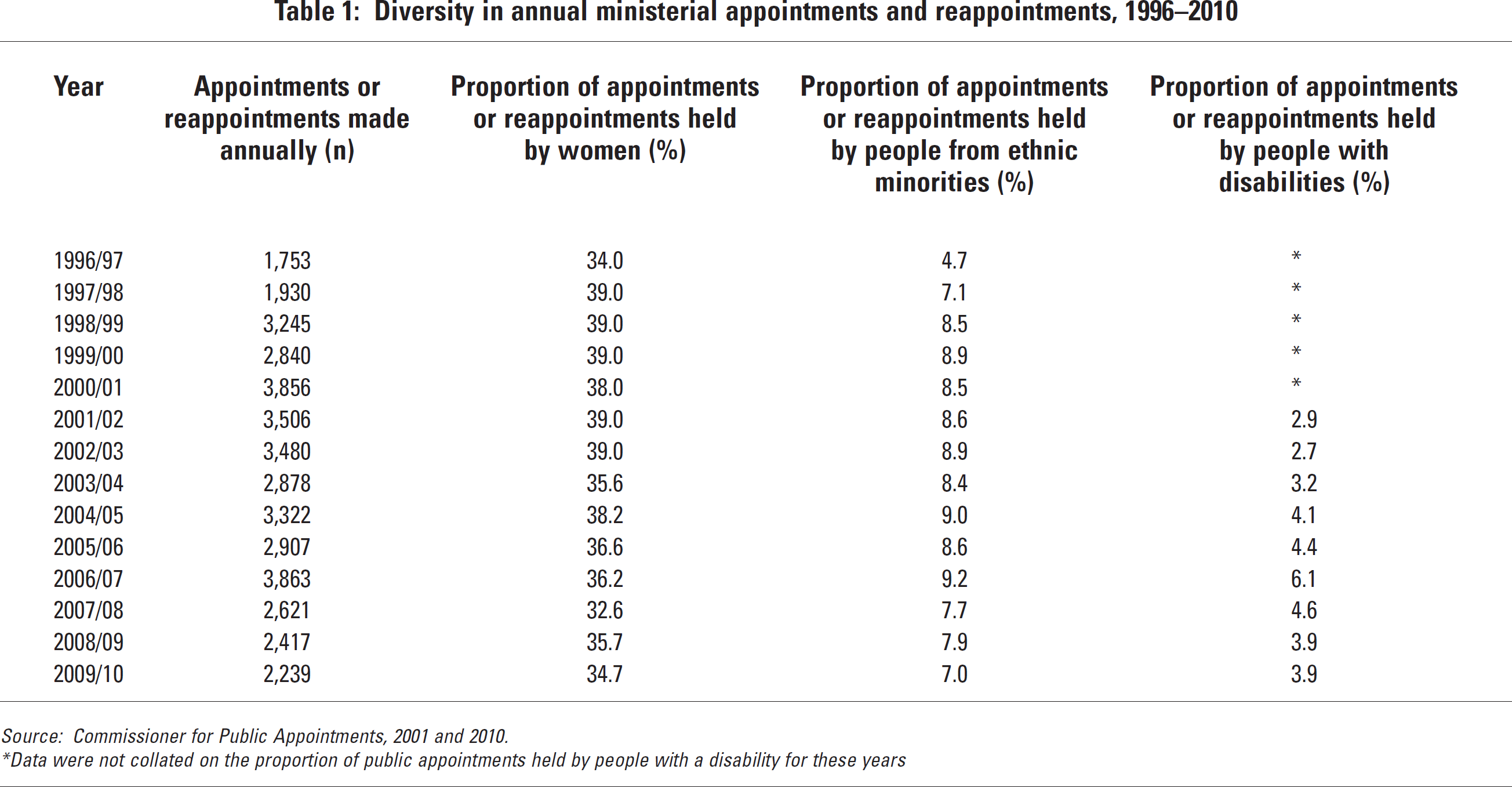
Source: Commissioner for Public Appointments, 2001 and 2010.
Data were not collated on the proportion of public appointments held by people with a disability for these years
A further way of assessing diversity in public appointments is to focus on the chair of a public body board. The chair provides a critical linkage between the organisation and its sponsor department/minister, and often has discretion in determining the pace and direction of the organisation within the general policy framework set by ministers. The diversity of chair appointments and reappointments is set out in Table 2. Women are further underrepresented as public body chairs. Whereas women held at least 30 per cent of chair appointments between 1998–2002 and 2004–2007, this has receded significantly in recent years. In 1996–1997 not one person from an ethnic minority was appointed as a chair, although there have been clear incremental advances and fluctuations. This is also true for people with disabilities, where the proportion of chairs with a disability has exceeded 3 per cent for the last five years.
Diversity in the annual appointment/reappointment of chairs, 1996–2010
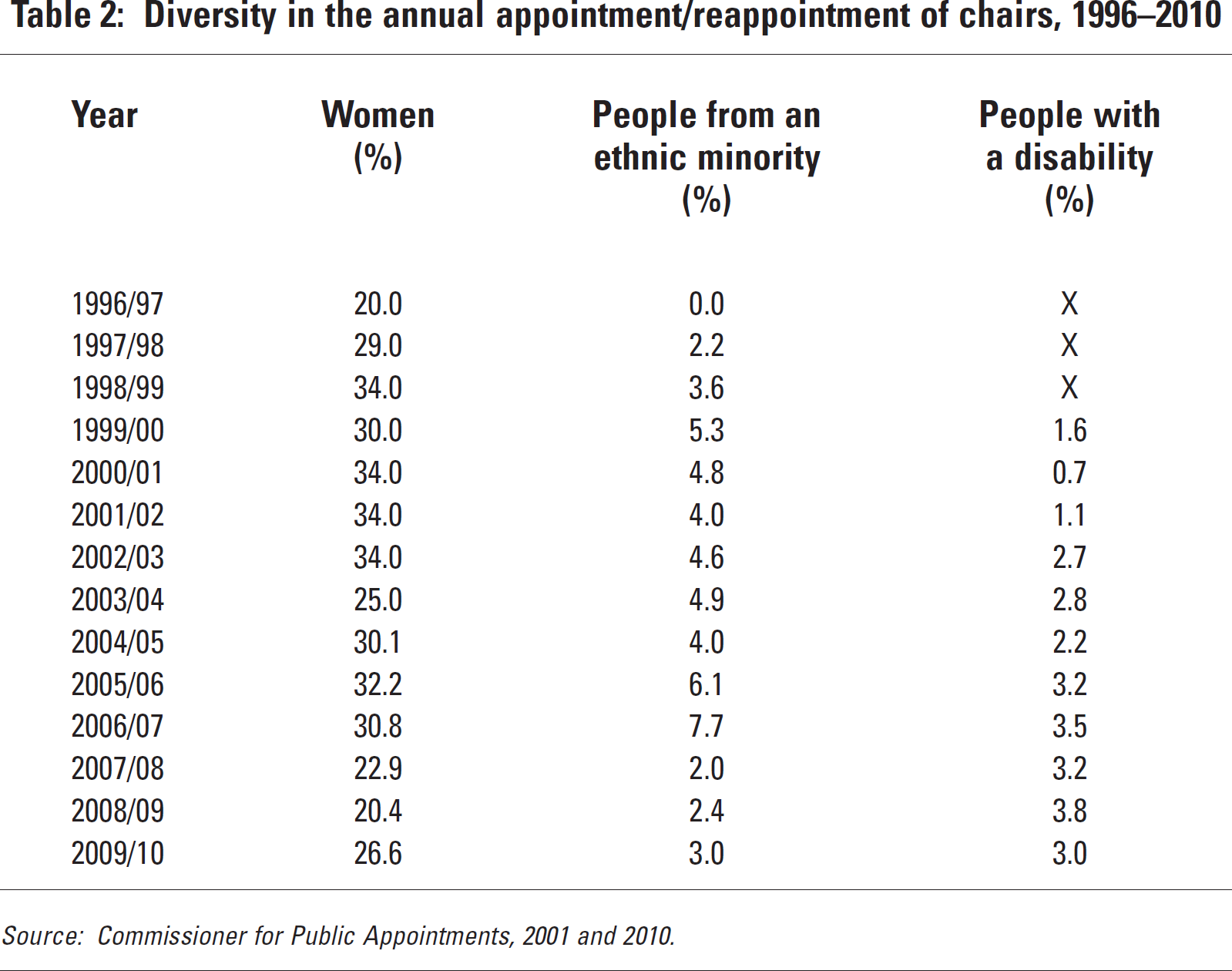
Source: Commissioner for Public Appointments, 2001 and 2010.
Finally, diversity in public appointments varies significantly across sponsor departments. Table 3 reveals that women's representation is highest (80.0 per cent) on the boards of bodies sponsored by the Government Equalities Office (GEO), as it is for people from an ethnic minority (23.3 per cent). However, the scale of the GEO's patronage is small, making 30 public appointments across two public bodies, one of which, the Women's National Commission (WNC), was abolished in 2010 as part of the coalition government's quango cuts. The Department for Work and Pensions has the highest proportion of people with disabilities on its public body boards (28.8 per cent). The Department for Environment, Farming and Rural Affairs (DEFRA) has the worst diversity record for its public bodies. Of its 1,325 public appointments, just 12.8 per cent are women, 0.8 per cent are from ethnic minorities and 0.4 per cent have a disability. Thus, as this section has shown, the Labour government's ambition to increase social diversity on the boards of public bodies has remained unrealised.
Diversity in public appointments by sponsor department, 2009
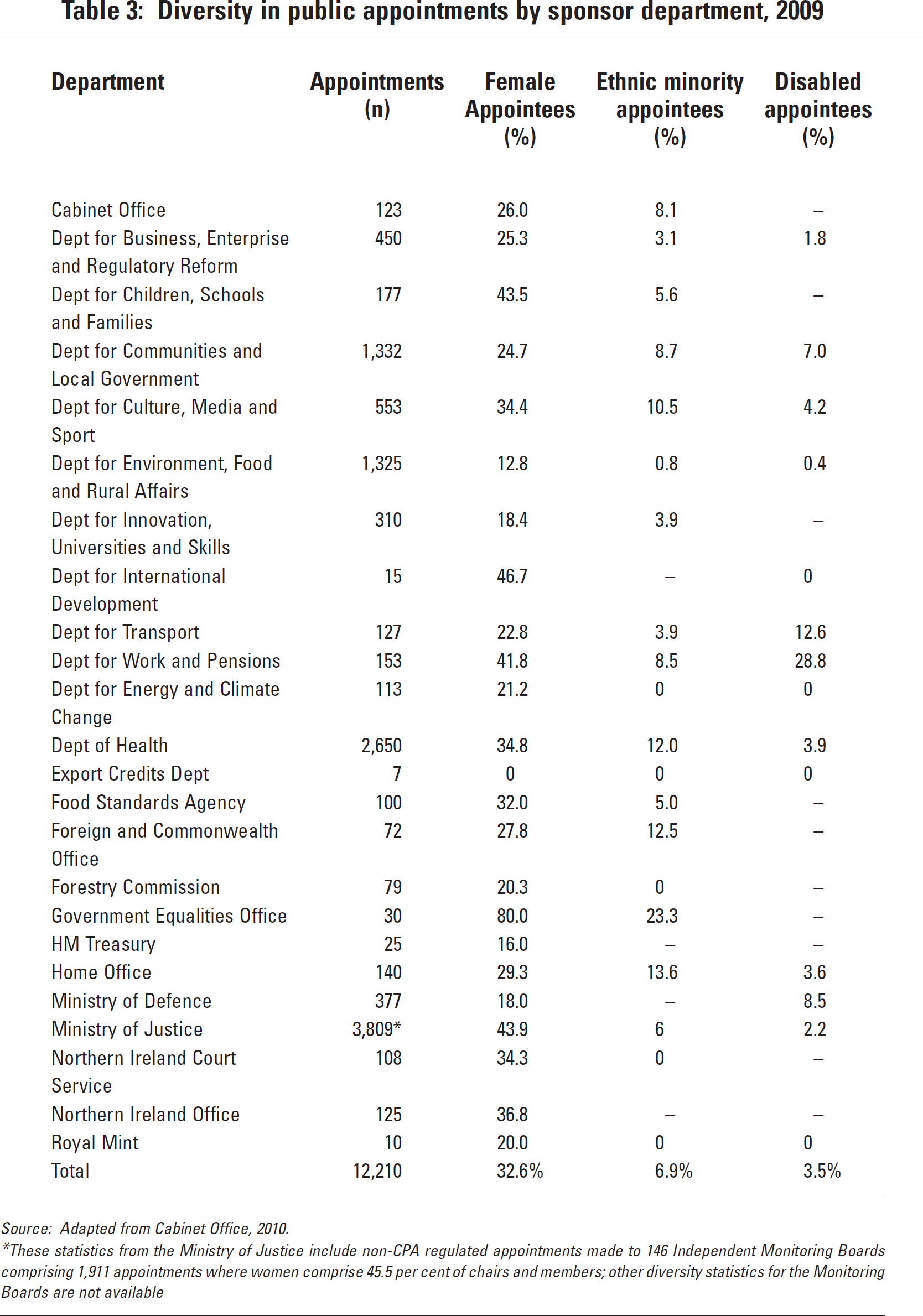
Source: Adapted from Cabinet Office, 2010.
These statistics from the Ministry of Justice include non-CPA regulated appointments made to 146 Independent Monitoring Boards comprising 1,911 appointments where women comprise 45.5 per cent of chairs and members; other diversity statistics for the Monitoring Boards are not available
Barriers to achieving diversity in public appointments
It is clear that increasing the social diversity of boards remained challenging for the Labour government, and our research suggests that barriers to diversity include supply-side, demand-side and procedural factors. Despite public boards exercising an increasing range of policy responsibilities, there is a lack of basic public knowledge about the opportunities offered by public appointments, how appointment decisions are made and how those interested can apply. The GEO, for example, found that less than one-third of adults surveyed understood what a public appointment actually was (Cameron and Skinner, 2010). Such absence of knowledge, combined with a print media that is always ‘desperately seeking scandal’, means that depictions of public appointments as being ‘jobs for the boys’ dominate (Doig, McIvor and Moran, 1999). Research conducted by MORI on behalf of the CPA found that ‘There is a widespread assumption that the process is based on personal connections … it is who you know “at the golf club”, rather than a proven track record that is most influential’ (MORI, 2000, p. 4).
Some organisations are actively attempting to promote opportunities among specific societal groups. These include recent projects by the Appointments Commission (notably their ‘Ladder of Participation’ project), the GEO (the recruitment of 180 Public Appointments Ambassadors), the CPA (like the ‘Targeting Talent’ and mentoring initiatives), the WNC (networking breakfasts and regional workshops) and the ‘Get on Board’ project run by Belfast Metropolitan College. This latter initiative was a 10-week evening class that provided training and support for individuals from a range of backgrounds; and of the 208 people who attended the course, 37 went on to secure a public appointment within six months, the majority being women. Such success demonstrates how public appointments have the potential to act as a critical tool of political revitalisation, re-engaging sections of the community that have little interest in conventional adversarial party politics but would welcome the opportunity to undertake a less partisan role in public life.
Yet, despite such initiatives, negative perceptions of public appointees remain. Reflecting Domonic Bearfield's (2008) observation of the ‘demonisation’ of public appointees in the USA, negative portrayals of public appointees in the UK as parasitical ‘fat cats’, being paid too much money for too little work, may also limit those willing to put themselves forward. In reality less than 5 per cent of ministerial appointees receive any payment, and as one appointee noted: ‘the board of a public body is the last place you want to go if you want to make money’ (interview, June 2009). Even when a ministerial appointment is remunerated (usually only in relation to chair appointments to large executive bodies) salaries are low compared to the private sector. Indeed, as the head of the Civil Service, Sir Gus O'Donnell (2010a) noted, most public appointments are taken on a pro bono basis as a contribution to the general public good, and there is a tacit assumption that senior salaried appointments involve ‘part-time pay, full-time work’. Some interviewees suggested that this lack of remuneration dissuaded potential applicants, as this Independent Public Appointments Assessor explained:
‘I think payment of remuneration is probably the biggest unsung discussion that people don't have. It's a major diversity issue … What it means is that people who go for public appointments … are generally — and I'm making a vast general comment here — white, middle-aged, middle class and have an independent means of income. An age of forty-five onwards. So unless the payment of public appointments is addressed, it's a very, very difficult challenge to try and address diversity properly’ (interview, June 2008).
Dovetailing with issues of remuneration, time constraints were highlighted as a barrier to serving on a public board by 21 per cent of respondents in the GEO's recent research (Cameron and Skinner, 2010). According to one executive body chair, time issues explain the high presence of older people holding a public appointment:
‘Remuneration I think is the biggest [issue]. Some public sector jobs are remunerated at such ludicrously low rates that only the professionally orientated retirees can do it. It's also a problem for young people, because actually they can't take on a part-time appointment as they're developing their careers. It's harder to get people who are young into quite a lot of these appointments’ (interview, June 2008).
Moreover time and remuneration factors have gendered implications as women tend to be paid less and take on the bulk of caring and domestic responsibilities (Childs, Lovenduski and Campbell, 2005; Durose et al., 2011), which could explain why fewer women hold a public appointment.
Having addressed the barriers to diversity in terms of supply-side factors such as knowledge, time and remuneration, the social demography of public boards of specific professions needs to be addressed and should also be considered in terms of whether potential candidates have requisite skills and experience — whether diversity is being impeded by demand-side factors. Duncan McTavish and Robert Pyper (2007, p. 228) equate the selection of board members for the enterprise sector as ‘fishing in a male dominated pool’. As one official from DEFRA, the lowest performing department in terms of diversity (see Table 3) explained, there were a handful of flood defence experts in some parts of the country who were all ‘white blokes with beards’ (interview, February 2010). Such problems are compounded by the way in which senior civil servants often appear to apply a very narrow understanding of ‘relevant expertise or experience’ (see Gatenby Sanderson, 2009). Many interviewees suggested that selection panels equated ‘relevant expertise or experience’ with needing prior board-level experience. One official from the Appointments Commission noted: ‘If you go back to the person spec and you're asking for senior/board level experience in a large organisation, the reality is that women aren't round those board tables and it's a big issue’ (interview, September 2009). A recruitment consultant echoed these sentiments by highlighting the lack of dynamism in interpreting skills:
‘Ministers tell me not to go back to the “same old suspects” but when I go out and find new people they tend to be rejected at the first sift by departmental officials who apply a very narrow and risk-averse definition of merit. This is not only embarrassing for me but it hardly encourages those people to consider other opportunities when they come up in the future’ (interview, June 2009).
Such evidence suggests that a degree of caution has permeated the appointments process. As ministers remain formally responsible for all public appointments, and therefore for upholding the principle of appointment on merit, it is understandable that civil servants may seek to put forward potential appointees who are safe and have traditional skills and experience so that they will not potentially embarrass a minister. Yet, such caution may have inadvertently created a degree of inflexibility in the appointments process, sometimes rendering it difficult for the twin aims of appointment on merit and the achievement of diversity to be reconciled.
Some interviewees suggested that the inclusion of lay members on boards was one way to circumnavigate the expertise requirement, especially for some of the technical or scientific boards. One former public body chair spoke of their experience as a lay member on a scientific board charged with investigating hip replacements:
‘It's completely possible to have lay people appointed to some of these scientific bodies and to play a full part … I know nothing about hip prostheses however on that panel were a great many people who did — orthopaedic surgeons, medical devices agents, etc. I chaired that as a lay person and I was able to cut through some of the stuff and say “Well hang on a minute, how is the family feeling right now?”’ (interview, May 2011)
Similarly a civil servant from DEFRA said: ‘We could improve diversity on some boards by including members of communities who have been affected by issues … such as those affected by flooding’ (interview, February 2011). These examples demonstrate the potential value of incorporating lay members on to boards where the natural pool of ‘technical’ talent may be homogeneous. In this way, involving lay members can augment the activities and outcomes of a board.
There is also evidence that the procedures governing the appointments process have impeded the social diversity of public appointments. Linking back to public awareness, the majority of interviewees suggested that advertising strategies lacked creativity by not reaching out to underrepresented social groups. A public body chair admitted: ‘[w]e haven't yet cracked how to really access these people. They never look at the traditional places where adverts are placed. You've got to go into the magazines and things that they read, and that's quite a difficult task’ (interview, June 2008). Karen Miller's (2006) research suggested using free newspapers to access a broader readership. Moreover the Appointments Commission, which will be abolished in 2012 and its functions transferred to the Department of Health, has also used targeted advertising campaigns: ‘We use Good Housekeeping, ethnic media, a range of publications to try and dispel any myths that there are’ (interview, September 2009).
Many interviewees suggested that the composition of the selection panel also played a critical role, sometimes acting as an unintentional barrier to diversity. During sifting, for example, selection panels tended to ‘stick to type’ by recommending individuals who ‘cloned’ existing board members. According to a former board member, ‘people are much more short-sighted about appointing the person who appears best to fit the bill at any given moment, and that's often the same kind of person that did it before’ (interview, September 2009). This also helps to explain the high prevalence of recycling that tends to occur within the appointments process: ‘I would say that more of an issue is that people get appointed if they've already had appointments. I think there is a coterie of people who get these appointments and once you've got one, it's easier to get the next one’ (interview, board member, July 2009). During 2009–2010, for example, 45 per cent of all ministerial appointments were reappointments and some individuals hold as many as three or four public appointments concurrently.
Finally, it was also widely suggested that formalised pre-appointment hearings for a range of specific posts, which enables select committees to scrutinise the minister's preferred candidate, might dissuade individuals from applying. Janet Gaymer, the CPA during 2005–2010, and Sir Gus O'Donnell have both expressed their unease about adding a legislative stage to a regulatory framework that has already been criticised for being too dense (see HC 152, 2007/08; O'Donnell, 2010b). This concern resonated with interviewees: ‘I know for a fact that a lot of people will not apply if there is a risk they might have to appear before a select committee’. A former chair noted: ‘Of course it is going to have an effect. People know what select committees are like and how they operate. They have seen what happened to the Children's Commissioner and they understand how it might affect their credibility and future prospects’ (interview, September 2010). This legislative involvement may have an unintended consequence of exacerbating many of the challenges detailed above, as only individuals with experience of Whitehall and Westminster would feel confident in applying where a pre-appointment hearing was likely.
Conclusion
This article has focused on the topic of political recruitment beyond elections, finding that despite the Labour government's aim of increasing the diversity of public boards, ‘quangocrats’ remain ‘pale, male and stale’. Diversity has been impeded by broad societal issues such as deficient knowledge and awareness of opportunities, and the underrepresentation of some social groups in some areas of professional life. Furthermore, some aspects of the public appointments process have served to entrench narrow ideas of who could take on a public appointment, while other aspects such as increased parliamentary involvement have acted as a deterrent.
However, when assessing diversity across public sector boards in juxtaposition to other appointed spheres, it is apparent that UK public bodies outperform private sector boards. In 2010 women held just 12.5 per cent of FTSE 100 directorships (Davies, 2011) compared to over one-third of public appointments (see Table 1). In 2005/2006, people from ethnic minorities held just over 5 per cent of all public appointments but just 2.4 per cent of directorships of corporate boards in the UK (Cabinet Office, 2006; Singh, 2007). Finally a GEO report found no data or academic research on disability on private sector boards (Sealy, Doldor and Vinnicombe, 2009). This lack of evidence hints that the representation of people with disabilities on private sector boards has yet to be problematised. Thus, while progress on diversity in public appointments has stalled in recent years, the private sector could learn lessons from strategies implemented across the public appointments landscape. Indeed, an independent review by Lord Davies into the lack of gender diversity on corporate boards recommended a series of business-led initiatives including a target for women to occupy one-quarter of directorships by 2015, improved recruitment processes and the implementation of explicit diversity policies (Davies, 2011) — strategies that have already been used for public appointments to varying degrees of success.
Yet, despite the relative success of public boards vis-à-vis private sector boards in promoting diversity, it remains crucial to ensure that the levels achieved to date do not slip back in the wake of the recent change of government. Despite its ‘Bonfire of the Quangos’ that abolished approximately 200 public bodies, the coalition government has an ‘aspiration’ for women to comprise half of all new appointments to public boards by the end of the parliament (see HM Government, 2010). However, the coalition has failed to set targets for other diversity strands such as ethnicity and disability, and the coalition's apparently narrow understanding of diversity may impact negatively upon current diversity levels. Nonetheless, as the coalition seeks to re-engage and empower local communities under the banner of the ‘Big Society’, public appointments can act as a critical tool in drawing in and giving a voice to previously disenfranchised social groups, and therefore represent a pertinent opportunity to move power away from Whitehall into the hands of the public.