







Abstract
Executive function is recognized as a critical component of children's cognitive and social development. In two studies, a measure of executive function that had been used in research with chimpanzees was adapted for preschoolers. On this task, called Less Is More, children must point to a smaller reward (two candies) to receive a larger reward (five candies). In Study 1 (N = 101), performance was significantly related to age (3 vs. 4), verbal ability, and established measures of executive function. In Study 2 (N = 128), symbolic representations substituted for real candies in this task. Three-year-olds' performance improved significantly as afunction of symbolic distancing. This research has implications for the role of symbol systems in the development of executive control over thought and action.
Executive functioning (EF) refers to processes serving to monitor and control thought and action, including attention regulation and response inhibition (Zelazo, Carter, Reznick, & Frye, 1997). There is a resurgence of interest in the role that EF plays in typical and atypical cognitive and social development (e.g., Blair, 2002; Carlson & Moses, 2001; Dempster, 1992; Diamond, Kirkham, & Amso, 2002; Harnishfeger & Bjorklund, 1993; Kochanska, Murray, Jacques, Koenig, & Vandegeest, 1996; Zelazo & Müller, 2002). Development can be thought of as the progressive acquisition of knowledge or skills, but also enhanced inhibition of responses that mask these abilities (Diamond, 1990). Thus, inhibitory control, defined as the capacity to inhibit thought processes or actions that are not relevant to the goal or task at hand, is a key component of EF (Rothbart & Posner, 1985).
Two categories of tasks have been used to assess inhibitory control in preschoolers (Carlson & Moses, 2001). The first includes measures of children's ability to delay a dominant response. For example, in the Gift Delay task, children are told not to peek while an experimenter noisily wraps a present (Kochanska et al., 1996). The second category includes measures requiring children to suppress a dominant response and initiate a conflicting response. For example, in the Day/Night task (Gerstadt, Hong, & Diamond, 1994), children must say “night” in response to sun cards and “day” in response to moon cards. Performance on these two tasks and similar tasks improves from age 3 to 6. Conflict and delay tasks reflect separable aspects of EF in preschoolers (Carlson & Moses, 2001). Although both kinds of tasks involve inhibition, working memory demands are greater in conflict tasks (e.g., Carlson, Moses, & Breton, 2002; Diamond et al., 2002). Behavioral evidence for the development of inhibitory control dovetails with research on brain maturation in childhood, particularly the development of prefrontal cortex (e.g., Thatcher, 1992).
SYMBOLIC REPRESENTATION AND EXECUTIVE CONTROL
A key requirement for successful inhibition is to direct attention away from the salient perceptual or representational features of a stimulus that tend to elicit a prepotent response. For example, in Day/Night (Gerstadt et al., 1994), seeing a picture of the sun activates an association with “day,” which must be replaced by a subdominant response, “night.” What makes mental disengagement possible? Several theorists have proposed that symbolic representation is central to this capacity (e.g., Dewey, 1931/1985; Hobson, 2000; Olson, 1991; Sigel, 1993; Singer, 1961; Vygotsky, 1967; Werner & Kaplan, 1963). According to these views, abstract symbols provide distance from “the bondage of direct sense perception” that enables self-reflection and adaptive behavior (Singer, 1961, p. 397). Sigel (1970) referred to psychological distancing more broadly as behaviors or events that separate one cognitively from the immediate behavioral environment.
Despite the rich theoretical history of this concept, empirical research on psychological distancing in children is sparse. However, some researchers have shown that children's performance improves when a self-control task is placed in a symbolic context (e.g., Singer, 1961). Mischel and his colleagues have conducted the most extensive research program on the facilitative effects of distancing, using the delay-of-gratification paradigm (Mischel & Ebbeson, 1970). For example, Mischel and Baker (1975) reported that children waited longer to receive a larger reward (two marshmallows vs. one) when it was suggested they cognitively transform the reward (“imagine the marshmallows are white fluffy clouds”) than when they were told to imagine its delicious taste. These findings suggest that the attentional focus of the image is crucial. The taste condition highlighted the consummatory properties of the reward, whereas the cloud condition led attention away from those properties.
Metcalfe and Mischel (1999) postulated a neural network model in which self-control occurs through an interaction between a hot, affective, “go” system and a cool, cognitive, “know” system. The hot system develops early and is under stimulus control. The cool system develops later and is under self-control. According to this model, directing attention away from hot reward properties of a stimulus and instead activating the cool system results in greater impulse control. We propose that abstract symbols serve this function by producing psychological distance that enables children to withhold a dominant response.
The goal of the present research was to determine whether symbols enhance young children's performance on a conflict inhibition task. Evidence from comparative psychology provided a starting point. Boysen and Berntson (1995; Boysen, Berntson, Hannan, & Cacioppo, 1996) gave chimpanzees trained in counting and numerical skills a conflict task in which they selected between a large and a small array of candy. Each time a chimp pointed to an array, that candy was given to an observer animal, and the chimp received the candy in the other, nonselected tray. Boysen et al. found that, over 400 trials, chimpanzees chose the larger array 65 to 70% of the time and did not show learning. However, when the number of treats was instead represented by Arabic numerals (e.g., “2” and “5”), they immediately selected the smaller, symbolic reward (“2”) to obtain the larger, real reward (five treats). The authors concluded that symbolic representations enable subjects to respond adaptively on the basis of a knowledge structure (cool system) while minimizing interference from lower-level reward mechanisms (hot system).
Although Boysen's task has not been tested in children, it is known that preschoolers make perseverative, imprudent decisions of this kind when the rewards are real. For example, the ability to wait for a larger reward improves from age 3 to 4 (Thompson, Barresi, & Moore, 1997). Similarly, Russell, Mauthner, Sharpe, and Tidswell (1991) found that 3-year-olds repeatedly gave away the location of hidden candy to a competitor, whereas 4-year-olds were able to conceal its location (see also Carlson, Moses, & Hix, 1998; Peskin, 1992).
We propose that reframing a self-control task in a symbolic context should influence children's performance in a systematic fashion; specifically, performance should improve with increasingly distant symbolic stimuli. To test this proposal, we designed a task analogous to the one employed by Boysen et al. (1996). Our research had two goals: (a) to examine 3- and 4-year-olds' performance on our task, which we call Less Is More, and (b) to investigate the effects of symbolic distancing on task performance.
STUDY 1
We tested 3- and 4-year-olds on Less Is More to determine if task performance is related to age, sex, verbal ability, and established measures of EF.
Method
Participants
Participants were 101 typically developing preschoolers, including forty-six 3-year-olds (mean age = 43 months, SD= 2.31, range = 39 to 47; 27 boys and 19 girls) and fifty-five 4-year-olds (mean age = 52 months, SD= 3.38, range = 48 to 60; 27 boys and 28 girls).
Procedure
Each child was tested in a laboratory playroom in two sessions. The same female experimenter conducted all sessions, which were videotaped and about 45 min long.
Less Is More is a reverse-reward contingency task in which subjects need to point to a smaller amount of treats to receive a larger amount. First, the experimenter presented a choice between two different kinds of uniformly colored treats (e.g., jelly beans vs. chocolate chips), and the treat chosen was then used throughout the experiment for that child. She then presented a five-treat array and a two-treat array and asked children which amount they preferred. (All indicated the larger.) The experimenter introduced a puppet and explained, “This is a naughty monkey, and his name is Chris. He likes to get all the treats for himself. That's why he's naughty.” Next, the experimenter placed a clear cup next to the child and another next to Chris (on the child's right), so the child could see the accumulation of treats. The experimenter explained, “Every time you point to a tray, Chris gets the jelly beans 1 in that tray, and they'll go into his cup, and you'll get the jelly beans in the other tray, and they'll go into your cup.” For practice, the experimenter pushed the two trays forward and equidistant from the child and said, “Point to a tray.” After the child made his or her selection, the experimenter pulled back both trays, removed the treats from the selected tray and placed them in the puppet's cup, and then placed the treats from the nonselected tray in the child's cup, saying, “See, Chris gets this many jelly beans, and you get this many jelly beans.” A verbal rule check followed: “So when you pick a tray, who gets those treats? Does Chris get them or do you get them?” The experimenter gave feedback and repeated the question as needed (up to three times).
Each child received 16 test trials. Between trials, the experimenter reloaded the trays from a supply bin containing prepared sets of two and five treats (left/right position counterbalanced). After 8 trials, regardless of performance, she gave a verbal rule reminder and moved Chris and his cup to the child's left to control for side biases. The children received no feedback during test trials. (However, they received implicit feedback by watching Chris receive the selected treats.) Each child's final score was the proportion of trials on which the child chose the (optimal) smaller amount of the treat.
We also administered the Peabody Picture Vocabulary Test (PPVT-3; Dunn & Dunn, 1997) and eight established measures of EF: Dimensional Change Card Sort (Frye, Zelazo, & Palfai, 1995; Zelazo, Müller, Frye, & Marcovitch, 2003); Grass/Snow (Carlson & Moses, 2001); Bear/Dragon (Reed, Pien, & Rothbart, 1984); Forward and Backward Digit Span (Davis & Pratt, 1996); Delay of Gratification (Shoda, Mischel, & Peake, 1990); Tower (Kochanska et al., 1996); and Gift Delay (Kochanska et al., 1996). Protocols are available from the first author. Standard scoring procedures were followed.
Results and Discussion
Rule Check
Most children (90.2%) said the puppet would get the treats they pointed to. All answered correctly after feedback.
Age Differences
We analyzed the probability of an optimal (“correct”) response. Means (standard errors in parentheses) were .49 (.08), .61 (.06), .73 (.05), and .78 (.07), for 3-, 3.5-, 4-, and 4.5-year-olds, respectively. The age effect was significant, F(3, 100) = 3.52, p= .018, η2= .10, and indicated young 3-year-olds differed from 4- and 4.5-year-olds, Tukey's HSD ps < .05. No other paired comparisons were significant. Four-year-olds (but not 3-year-olds) performed significantly above chance (.50), p≤ .001. The performance of 3-year-olds was bimodal, as shown in Figure 1. Three-year-olds performing in the top quartile did not differ significantly in age from those in the bottom quartile, but they did have significantly greater verbal scores (p= .001).
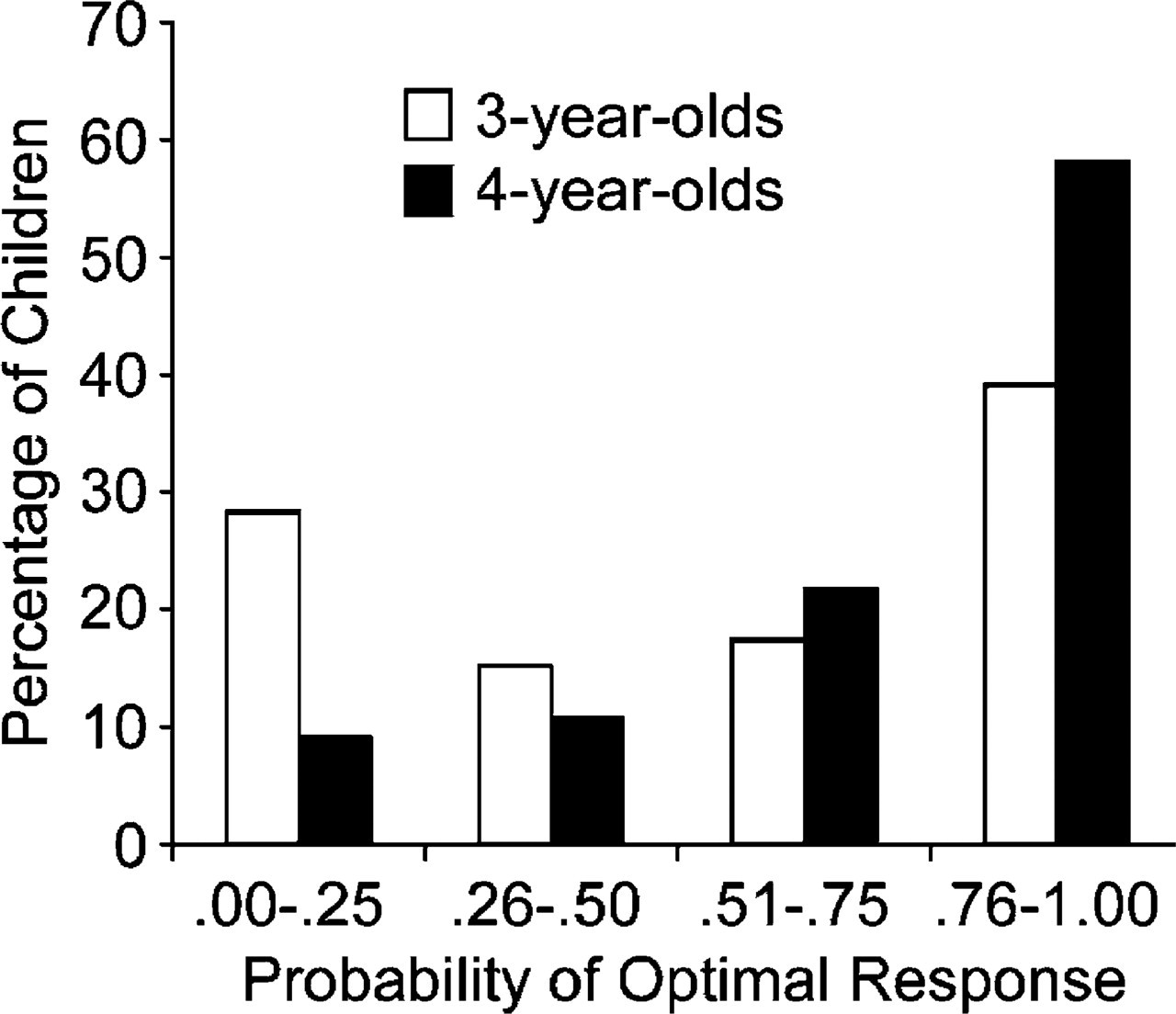
Distribution of scores on the Less Is More task as a function of age in Study 1.
Next, we examined learning across trials (see Fig. 2, top panel). Three-year-olds did not show learning, but there was a significant linear trend for 4-year-olds, F(14) = 7.03, p= .019. These data are consistent with results obtained using numerous other EF measures, which have shown development from age 3 to age 4 (e.g., Dimensional Change Card Sort; Zelazo et al., 2003) and lack of improvement across trials in 3-year-olds (Russell et al., 1991).
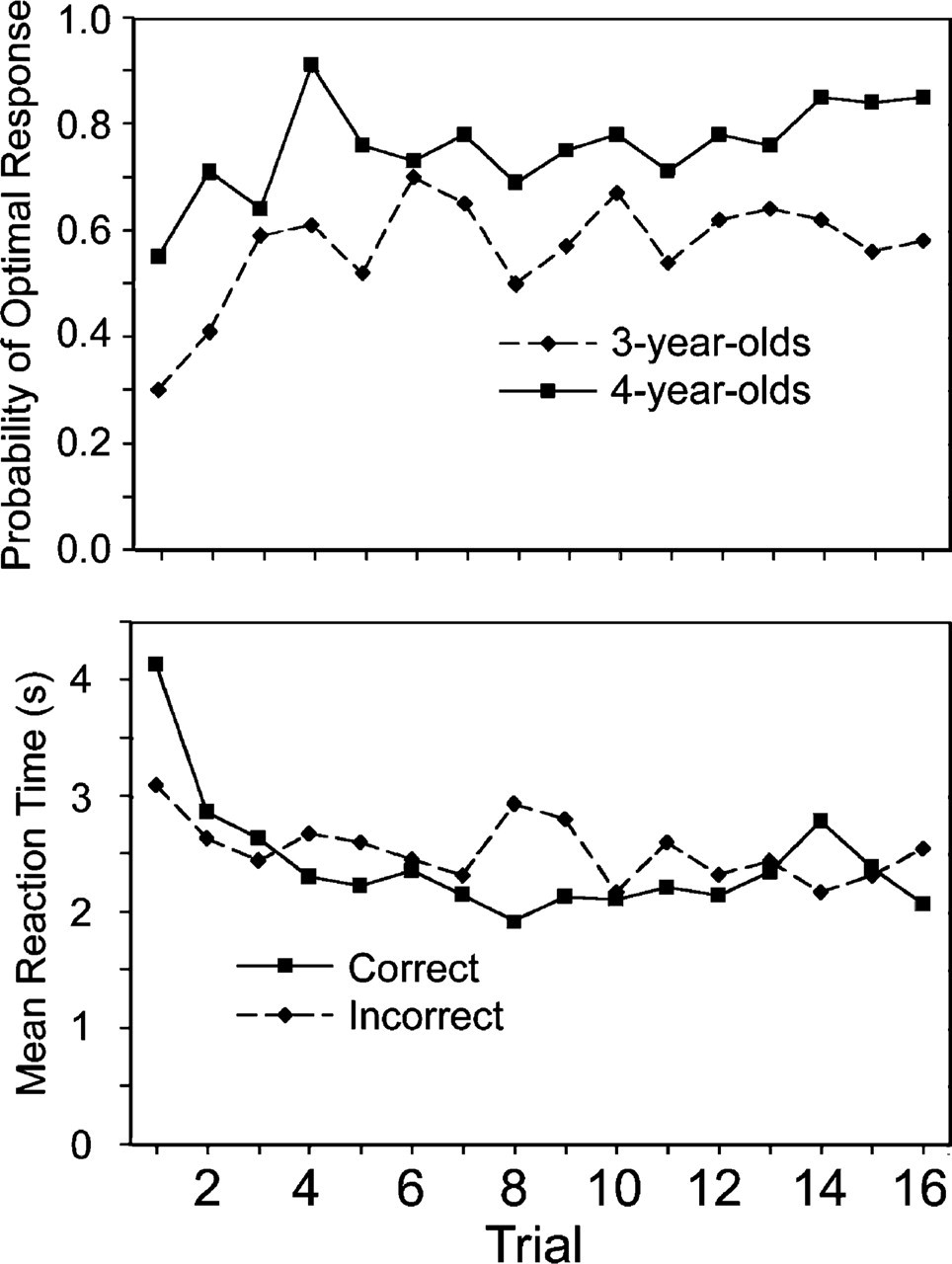
Accuracy (top) and reaction time (bottom) on the Less Is More task across trials in Study 1.
Reaction Time
Reaction time (RT) was measured from when the experimenter began pushing the stimuli forward until children pointed their finger. RT was unrelated to age. Children responded significantly faster on correct (M= 2.38 s, SE= 0.08) than on incorrect (M= 2.70 s, SE= 0.11) trials, F(1, 75) = 13.55, p= .000, η2= .15. However, correct responses took significantly longer than incorrect responses on Trial 1, t(98) = 3.16, p= .002 (see Fig. 2, bottom panel). This pattern suggests that on the first trial, incorrect responses were impulsive, but that on later trials, they were accompanied by doubt, reflecting the dissociation between knowledge and action.
Relation to Sex and Verbal Ability
There were no sex differences. Performance was significantly related to PPVT-3 score, r(101) = .44, p= .000, a finding consistent with other research showing relations between EF and verbal ability (e.g., Carlson & Moses, 2001).
Relation to Other EF Measures
Finally, we analyzed the extent to which Less Is More cohered with established EF measures. As shown in Table 1, performance was significantly related to aggregate scores across the other eight EF tasks. Table 1 further illustrates that the new task was more strongly related to other conflict tasks than to delay or working memory tasks. A hierarchical multiple regression predicting Less Is More scores from age, PPVT-3 scores, delay EF, working memory, and conflict EF showed that conflict EF significantly predicted performance over and above all other variables entered (β= .37, p= .002). The model was significant, R= .54, R 2= .29, p < .01. These data suggest Less Is More has good internal validity and relates most strongly to other measures calling for a combination of inhibition and working memory.
Correlations Between Performance on Less Is More and Other Measures of Executive Function
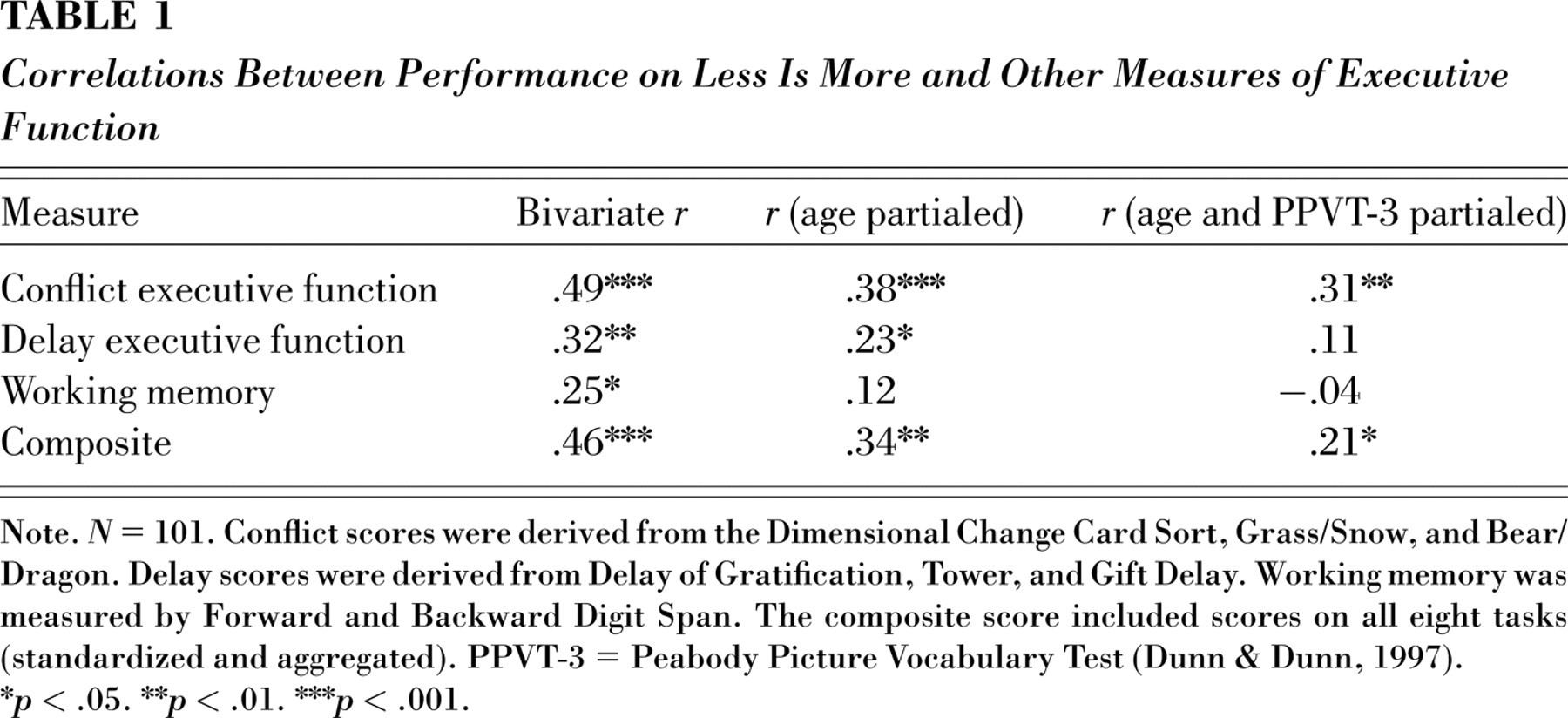
Note. N= 101. Conflict scores were derived from the Dimensional Change Card Sort, Grass/Snow, and Bear/Dragon. Delay scores were derived from Delay of Gratification, Tower, and Gift Delay. Working memory was measured by Forward and Backward Digit Span. The composite score included scores on all eight tasks (standardized and aggregated). PPVT-3 = Peabody Picture Vocabulary Test (Dunn & Dunn, 1997).
p < .05.
p < .01.
p < .001.
STUDY 2
Study 1 established that Less Is More is a valid measure of EF in preschoolers. In Study 2, we investigated whether using symbolic substitutes for real candies would result in better performance among 3-year-olds. Boysen et al. (1996) tested chimpanzees using arrays of rocks to represent the candy. This change improved performance slightly but not significantly (from .35 to .45 probability of choosing the optimal response). When Arabic numerals were used, however, the probability rose to .66. Given this, we hypothesized that children's performance on Less Is More might improve as symbolic distance from the real reward increased.
Method
Participants
Participants were 128 typically developing 3-year-olds (mean age = 43 months, SD= 3.02, range = 35 to 49; 64 boys and 64 girls).
Procedure
A female experimenter tested children individually in a laboratory or child-care center. Sessions were videotaped and lasted 15 to 30 min. We randomly assigned children to one of four conditions: real treat (2 vs. 5 candies), rocks (2 vs. 5 rocks), dots (40 vs. 100 dots inside a circle), and mouse versus elephant (see Fig. 3 for an illustration of the arrays). (We did not use Arabic numerals because 3-year-olds would have varying familiarity with numeric symbols.) A subset of children tested in the lab (n= 45) also were given the PPVT-3 (Dunn & Dunn, 1997).
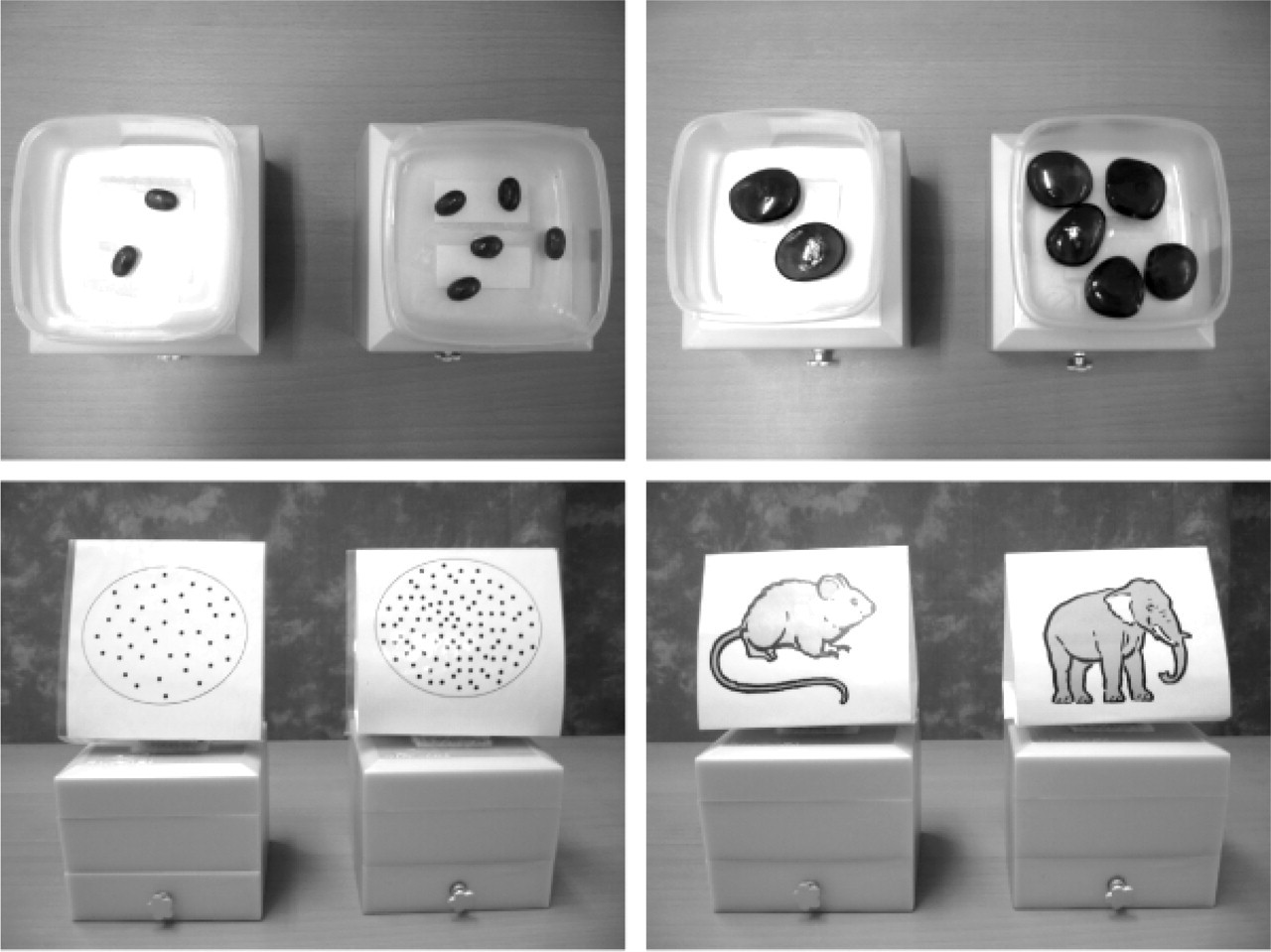
Stimuli for the Less Is More task in Study 2. Moving clockwise from the top left, the stimuli shown were used in the real-treat, rocks, mouse-versus-elephant, and dots conditions.
In all conditions, we used two boxes, each with a drawer containing two or five treats, corresponding to the amount of candies or the quantity symbols placed on top. Otherwise, the real-treat condition was conducted in the same way as in Study 1. In the three symbol conditions, the experimenter first ensured the child understood the relation between the treats and symbols. For example, for the rocks condition, a one-to-one correspondence was established: “See, one rock is the same as one jelly bean.” Next, the experimenter showed the child the two trays of treats (five and two) and asked, “Which tray of jelly beans is the same as lots of rocks?” On this and all training questions, the experimenter gave feedback and repeated the question as needed (up to three times). Then she asked the child to help her place five rocks next to the five treats. A parallel question and matching procedure followed for the tray containing two treats. The same training method applied to the dots condition, except that we introduced the link as “lots of jelly beans” are the same as “lots of dots” and “just a few jelly beans” are the same as “just a few dots.”
For the mouse-versus-elephant condition, the experimenter introduced a stuffed toy elephant and explained, “Elephants are really big, and they have really big tummies. Their tummies are big and can hold lots of treats. See, the elephant can fit lots of jelly beans in his big tummy.” She presented five treats and inserted them into a pouch sewn onto the front of the elephant. An analogous training procedure followed, with a small stuffed toy mouse (“tiny tummy”) and two treats. Next, the experimenter presented two arrays of treats (five and two). She presented the stuffed elephant and asked, “Which jelly beans go into the big elephant's tummy?” Next, the experimenter invited the child to help “feed” the elephant by inserting treats into its tummy. After removing the elephant, she followed an analogous procedure with the mouse. Finally, the experimenter produced laminated drawings of an elephant and a mouse (5 × 5 in.; images were equal in size) and labeled them for later use in the test trials.
In all conditions, after the initial training, the experimenter introduced the two boxes containing drawers: “On top of this box is lots of jelly beans/lots of rocks/ lots of dots/an elephant, so this box has lots of jelly beans inside” (pointing to the top and then opening the drawer to reveal the corresponding number of treats). A parallel procedure was followed for the box containing “just a few” treats. The experimenter then asked, “Here's the box with lots of jelly beans/lots of rocks/lots of dots/an elephant again. It has lots of jelly beans/lots of rocks/lots of dots/an elephant on top, so is it the same as lots of jelly beans or just a few jelly beans?” An analogous procedure followed for the box containing two treats.
A size-preference trial, a rule check, and 16 test trials followed in the same manner as in Study 1. In the symbol conditions, the experimenter conducted a final association check at the end of the session to ensure the child had retained the link between the symbols and their associated quantities. No feedback was given.
Results and Discussion
Preliminary Analyses
Conditions did not differ according to age, sex, or PPVT-3 scores. Children in all conditions understood that the treats or symbols on top of the boxes corresponded to the treats inside the drawers (88–100% correct spontaneously; all correct following feedback). They also preferred the larger quantity or symbol immediately in all conditions.
As in Study 1, most children passed the verbal rule check immediately (81–84%, no condition differences). All succeeded following feedback.
Condition Differences
We next examined the probability of optimal responses in the four conditions. The mean probabilities (standard errors in parentheses) were .49 (.04), .57 (.04), .61 (.04), and .69 (.03) for the real-treat, rocks, dots, and mouse-versus-elephant conditions, respectively. There was a significant effect of condition, F(3, 127) = 5.12, p= .002, η2= .11. Tukey's HSD tests indicated children performed significantly better in the mouse-versus-elephant condition than in the real-treat condition, p= .001. No other paired comparison reached significance. However, the probability of correct responding increased significantly as a function of condition, Spearman r(128) = .31, p= .000. Scores in the dots and mouse-versus-elephant conditions were significantly above chance (.50), ts(31) = 2.80 and 6.47, ps = .009 and .000, respectively. Scores in the real-treat and rocks conditions did not differ from chance. We conclude that the degree of symbolic distancing from real treats had a systematic effect on children's ability to choose the smaller reward. In the most abstract condition (mouse vs. elephant), 3-year-olds performed close to the level of 4-year-olds in Study 1, which used real treats.
There was evidence of learning in all conditions, linear trend Fs(14) = 12.78, 9.37, 4.85, and 31.44, for the real-treat, rocks, dots, and mouse-versus-elephant conditions, respectively, ps < .05. Even children in the real-treat condition showed learning, whereas the 3-year-olds in Study 1 had not. The reason for this discrepancy is not clear, although the overall difference in performance between studies might be due to testing location (day-care center vs. lab).
Final Association Check
Children in all the symbol conditions correctly recalled the symbol-referent link at the end of the game (93–100% accuracy). Thus, performance differences between conditions were not attributable to children in some conditions forgetting the association.
GENERAL DISCUSSION
We investigated the link between EF and symbolic representation. Less Is More, adapted from a task used to measure self-control in chimpanzees, is a feasible new measure of EF in preschool children that showed predicted associations with age, verbal ability, and other measures of EF. In partial correlations controlling for both age and verbal ability, individual differences on Less Is More were significantly related to performance on conflict tasks, but not on simple delay or working memory tasks. This pattern is consistent with inhibition-plus-working-memory (Carlson et al., 2002; Diamond et al., 2002) and cognitive-complexity-and-control (Zelazo et al., 2003) accounts of EF.
Direct comparison with the research of Boysen et al. (1996) is difficult because they tested all possible quantity disparities between one and six, whereas we tested only two versus five, and they administered 400 trials, whereas we included only 16. Nonetheless, there are some striking similarities in the findings. First, when faced with real candy, a substantial number of 3-year-olds in our studies had difficulty pointing to the smaller array, much like the chimpanzees in Boysen's work. Second, we too found that abstract quantity symbols significantly increased the probability of an optimal response (.66 for chimpanzees when numerals were used, .69 for 3-year-olds when mouse and elephant symbols were used). Finally, our results are consistent with those of Boysen et al. in that replacing candy with rocks having a one-to-one correspondence with real treats did not significantly improve performance.
There were also notable differences between our findings and those of Boysen et al. (1996). First, a subset of 3-year-olds was successful on Less Is More, even with real treats. Study 1 suggested that the performance distribution among 3-year-olds was bimodal and was significantly correlated with verbal ability. Furthermore, we discovered performance was associated with age (3 vs. 4 years) and experience with the task. In contrast, there was not an age threshold or evidence of learning in chimpanzees. Finally, unlike in the studies with chimpanzees, we were able to ask children about their understanding of the task. As in other EF research in preschoolers, there was evidence of a dissociation between children's knowledge of the rule contingencies and their ability to act on them (e.g., Frye et al., 1995).
These results are consistent with recent theoretical approaches that draw a distinction between hot and cool executive processes. To extend Metcalfe and Mischel's (1999) neural network model to Less Is More, salient features of a tempting stimulus activate a “hot spot” that leads to an imprudent “go” response in 3-year-olds, and particularly those with poorer verbal ability than their peers. In contrast, reframing the stimulus with a quantity symbol activates a “cool node” that enables self-reflective control over the response. However, when a symbol is closely associated with the enticing stimulus (e.g., rocks having a one-to-one correspondence with candies), the cool node primes the hot spot, thus leading to a counterproductive response. Children have trouble representing the symbol as a symbol when it so closely evokes the hot properties of the reward (DeLoache, 2000). Breaking one-to-one correspondence (dots condition) enhanced performance (so that it was significantly above chance), but there was still the pull of visible differences in numerosity. Finally, a singular abstract quantity symbol (mouse vs. elephant) was least evocative of the real reward and resulted in the best performance. Our findings suggest symbols work to “cool” hot properties of a conflict EF task, and they appear to do so systematically as a function of psychological distancing (cf. Sigel, 1993).
Similarly, Zelazo and Müller (2002) described differences in the neural architecture underlying cool and hot executive processes. Damage to dorsolateral prefrontal cortex is associated with EF deficits involving problem solving in relatively cool (nonaffective) contexts, whereas damage to orbitofrontal cortex, which has close connections with the limbic system, often results in inappropriate social-emotional behavior. These cool and hot aspects of EF are believed to interact as part of a single coordinated system. Nevertheless, some tasks may emphasize one aspect over the other. Most research to date has focused on cool EF measures, such as the Dimensional Change Card Sort (Zelazo et al., 2003), in which there is little affective significance to the stimuli, dimensions, or even successful performance. In contrast, hot EF requires flexible representation of the reinforcement value of stimuli. For example, the Children's Gambling Task (Kerr & Zelazo, 2004; based on Bechara, Damasio, Damasio, & Anderson, 1994) is hot in that enticing rewards need to be reframed inductively in terms of long-term versus short-term gains. Less Is More has similarities with the gambling task and could be characterized as a relatively hot EF task. Versions of the Dimensional Change Card Sort and the gambling task have been linked to function of the dorsolateral prefrontal cortex and orbitofrontal cortex, respectively, in adults, but not yet in children. Performance might prove to be underpinned by orbitofrontal function when the rewards are palpable, but not with symbolic stimuli.
Our findings suggest there is a gradient of symbolic representation corresponding to greater control over thought and action. Development of symbolic functioning might serve preschool children's growing EF skills by inducing psychological distance. Although we have not tested all possible symbolic relations, there are likely to be costs associated with symbols that are too abstract. At some point, the demands of maintaining the association in working memory might outweigh any advantage of distancing. Also, developmental increases in the ability to interpret a symbol in terms of what it stands for may be necessary before children can utilize abstract symbols (Bialystok, 2000; DeLoache, 2000). Finally, extensive experience may cause even abstract symbols to become so closely associated with a referent that they activate a hot spot rather than a cool node. Our research using the Less Is More task is one step toward fully understanding the effect of symbols on children's EF.
Footnotes
1In the quotations from the experimental procedure for both Study 1 and Study 2, we use “jelly beans” to stand for the various treats that were used for different children.
Acknowledgements
Grant RO3-041473-02 (National Institute of Child Health and Human Development) to S.M.C. supported this research. We thank the families and child-care centers for participating; Walter Mischel, Yuichi Shoda, and Marjorie Taylor for helpful suggestions; and Melissa Riley and Suzanna Ramirez for assisting in data collection.