






Abstract
Adults (N = 336) 18 to 54 years old watched a television program containing violence, sex, both violence and sex, or no violence and sex. Programs were shown in a comfortable room containing padded chairs and tasty snacks. Each program contained the same 12 ads. Embedding an ad in a program containing violence or sex reduced (a) viewers' likelihood of remembering the advertised brand, (b) their interest in buying that brand, and (c) their likelihood of selecting a coupon for that brand. These effects occurred for males and females of all ages, regardless of whether they liked programs containing violence and sex. These results show that violence and sex in television programs do not sell products in advertisements.
The number one priority in television is not to transmit quality programming to viewers, but to deliver consumers to advertisers.
—Jeff Sagansky, former CBS programming chief (quoted in Kim, 1994, p. 1434)
Most network and cable television companies are 100% supported by ad revenue. Advertisers are willing to pay a lot of money for airtime. For example, advertisers paid $2.3 million for a single 30-s ad airing during Super Bowl XXXVIII (Sutel, 2004). The goal of advertising is to present goods or services in an effective manner so individuals will purchase them. Television is an ideal medium to advertise goods or services because so many people own TV sets. In the United States, there are more TV sets than there are toilets (American Psychological Association, 1993). Television reaches more of an advertiser's potential customers than does any other medium, and adults spend significantly more time with television than with any other medium (Television Bureau of Advertising, 2003).
It is commonly assumed that televised violence and sex sell products. Although TV programs with violence and sex do attract younger viewers, overall they attract fewer viewers than programs without violence and sex (Hamilton, 1998; Parents Television Council, 2003). The smaller audience size reduces the potential impact of an advertisement. This impact would be further reduced if TV viewers cannot remember the product being advertised. Research has already shown that televised violence and sex impair memory for advertised products. A meta-analysis of 16 studies involving 2,474 participants found that memory for advertised brands was 27% lower if ads were embedded in a violent program than if the same ads were embedded in a nonviolent program (Bushman, 2003; see also Bushman & Phillips, 2001). Televised sex also may impair memory for advertised brands (Bushman & Bonacci, 2002).
A plausible cause of this memory impairment is that individuals have a limited amount of attention to direct toward television programs (Lang, Newhagen, & Reeves, 1996). Research suggests that individuals pay more attention to violent media than to nonviolent media (Furnham & Gunter, 1987; Lang et al., 1996; Williamson, Kosmitzki, & Kibler, 1995). Individuals also pay more attention to sexual media than to nonsexual media (e.g., Geer, Judice, & Jackson, 1994; Geer & McGlone, 1990). From an evolutionary perspective, this makes sense. Our ancestors who paid attention to violent and sexual cues were more likely to survive and pass on their genes than were those who ignored violent and sexual cues. The more attention viewers pay to sexual or violent programs, the less attention they have available for the commercials embedded in those programs. Even though commercials occur during breaks in a program, viewers may still be devoting cognitive resources to thinking about the program that attracted their attention so strongly.
The present study provides an important extension over previous studies because it tested whether televised violence and sex also influence buying intentions and consumer behaviors. This research is important for theoretical and practical reasons. In the theory of reasoned action, behavioral intentions are viewed as an important mediator of behavior (e.g., Ajzen & Fishbein, 1977). The present study included a measure of buying intentions, which are related to consumer behaviors (e.g., Bagozzi, Baumgartner, & Yi, 1991, 1992; Shimp & Kavas, 1984).
Specifically, this study tested whether buying intentions mediate the effect of violence and sex in a TV program on the choice of a coupon for an advertised product. In 2000, more than 77% of Americans used coupons, which saved them more than $3.6 billion (Coupon Usage Statistics, 2000). Of course, the value of the goods they purchased was much greater than the face value of the coupons they used. Although coupon choices are not technically consumer behaviors (i.e., the consumer has to redeem the coupon), numerous studies have shown that coupons increase product sales (e.g., Ailawadi, Lehmann, & Neslin, 2001; Bawa & Shoemaker, 1989; Lam, Vandenbosch, Hulland, & Pearce, 2001; Schindler, 1992). Coupon redeemers are also over 7 times more likely to make repeat purchases than are nonredeemers (Taylor, 2001).
In summary, the present study tested whether televised violence and sex reduce memory for an advertised product, intentions to buy that product, and the likelihood of choosing a coupon for that product. It also tested whether memory for brands is related to buying intentions and coupon choices. Televised violence and sex were expected to have an indirect effect on coupon choices, with brand memory and buying intentions serving as important mediators.
METHOD
Participants
Participants were 336 adults 18 to 54 years old. Their age distribution was representative of the age distribution of 18- to 54-year-old U.S. adults who live in households with TV (i.e., 17% ages 18–24, 12% ages 25–29, 14% ages 30–34, 15% ages 35–39, 16% ages 40–44, 14% ages 45–49, and 13% ages 50–54; Nielsen Media Research, 2000). These age groups are the most important to advertisers (Hamilton, 1988).
Participants were recruited using newspaper advertisements in central Iowa (e.g., Des Moines, Ames). They were warned that some of the TV programs contained violence and sex. Participants received $20 in exchange for their voluntary participation.
Procedure
Participants were tested in small groups, but each worked independently. They were told that the researchers were studying attitudes toward TV programs. The sessions were conducted in a comfortable setting. Participants were seated in padded chairs and were given soft drinks and snacks (e.g., potato chips, pretzels, cookies).
After giving their informed consent, participants were randomly assigned to watch a TV program that contained violence, sex, violence and sex, or no violence and sex. There were 84 participants (42 men, 42 women) in each of the four groups. So that the four types of programs would be adequately sampled, six exemplars of each were used (Wells & Windschitl, 1999). A die was rolled to determine what program to show. The six violent programs were “24,”“Cops,”“Protect and Serve,”“Terror on the Job,”“Tour of Duty,” and “X-Files.” All of these programs had a violent (V) content code; none had a sex (S) content code. The six sexually explicit programs were “Ally McBeal,”“Howard Stern,”“Man Show,”“Sex in the City,”“Wild on E,” and “Will and Grace.” All of these programs had a sex (S) content code; none had a violent (V) content code. The six violent and sexual programs were “Angel,”“Buffy the Vampire Slayer,”“CSI Miami,”“NYPD Blue,”“South Park,” and “World Wrestling Entertainment RAW.” All of these programs had violent (V) and sex (S) content codes. The six neutral programs were “A Dating Story,”“America's Funniest Animals,”“Hollywood Beyond the Stars,”“It's a Miracle,”“Miracle Pets,” and “Trading Spaces.” None of these programs had violent (V) or sex (S) content codes. All of the programs containing violence or sex were rated TV-14 (Parents Strongly Cautioned). All of the neutral programs were rated TV-G (General Audience).
The ads originally embedded in the programs were edited out, and the same 12 (30-s) ads were embedded in each program. Because consumers are quite loyal to brands (e.g., Chaudhuri, 2001), we used ads for relatively unfamiliar brands (i.e., Body Fantasies, Dermoplast, Ferraro Raffaello Chocolates, Jose Ole, Libman Nitty Gritty Roller Mop, Mederma, Natra Taste, New Skin, Nutra Nails, Proheart 6, Senokot Natural Vegetable Laxative, and Sudden Change Undereye Lift). There were three commercial breaks at approximately 12 min, 24 min, and 36 min into each program. Four ads were presented in each break. Two random orders of ads were used.
Immediately after viewing the TV program, participants rated how exciting, boring, involving, humorous, violent, and sexually arousing they thought it was, using a scale ranging from 1 (not at all) to 10 (extremely). The violence and sexual arousal ratings were used as manipulation checks for the program content codes. The other ratings were used as covariates to control for differences among TV programs other than differences in violent and sexual content.
After rating the TV program, participants received surprise memory tests. First, they listed as many brand names as they could recall. Second, they received a list of products. For each type of product (e.g., sugar substitute), four brands were listed—the advertised brand (e.g., Natra Taste) and three foil brands (e.g., Sugar Twin, Sweet Deal, Sweet'n'Smart). As with the actual brands, foil brands that would be relatively unfamiliar to most participants were selected. For each kind of product, participants circled the brand that was advertised.
Next, participants reported their buying intentions using the same list. For each type of product, they circled the brand they “would be most likely to buy.”
The number of coupons selected for advertised products was used as a measure of consumer behavior. Coupons for all 40 brands on the list were available, and participants could choose 10. Because inadequate face values on coupons can reduce their effectiveness (Chakraborty & Cole, 1991; Cheong, 2003), all of the coupons offered participants $1 off the listed price—a substantial savings for the products used in this study, and about 30 cents higher than the average coupon face value (Promotion Marketing Association, 2000). Professionally printed (bogus) coupons were available for the advertised and foil brands.
Next, participants reported their demographics (i.e., age, gender, ethnic background) and their television viewing habits (i.e., the number of hours each week they spent watching TV and the percentage of time they spent watching violent and sexual programs). The latter measures were used to control for habitual exposure to televised violence and sex. Participants also reported if they had seen the assigned program before (that episode or any episodes), if they had seen any of the ads before, and if they had heard of any of the advertised products before. These responses were used to control for previous exposure to the TV programs and ads.
Finally, participants were fully debriefed. Because the coupons were bogus, we gave participants the face value of the coupons instead (i.e., $10). Thus, each participant received $30 ($20 for participating in the study and $10 for the bogus coupons).
RESULTS
Preliminary Analyses and Manipulation Checks
Violence Ratings
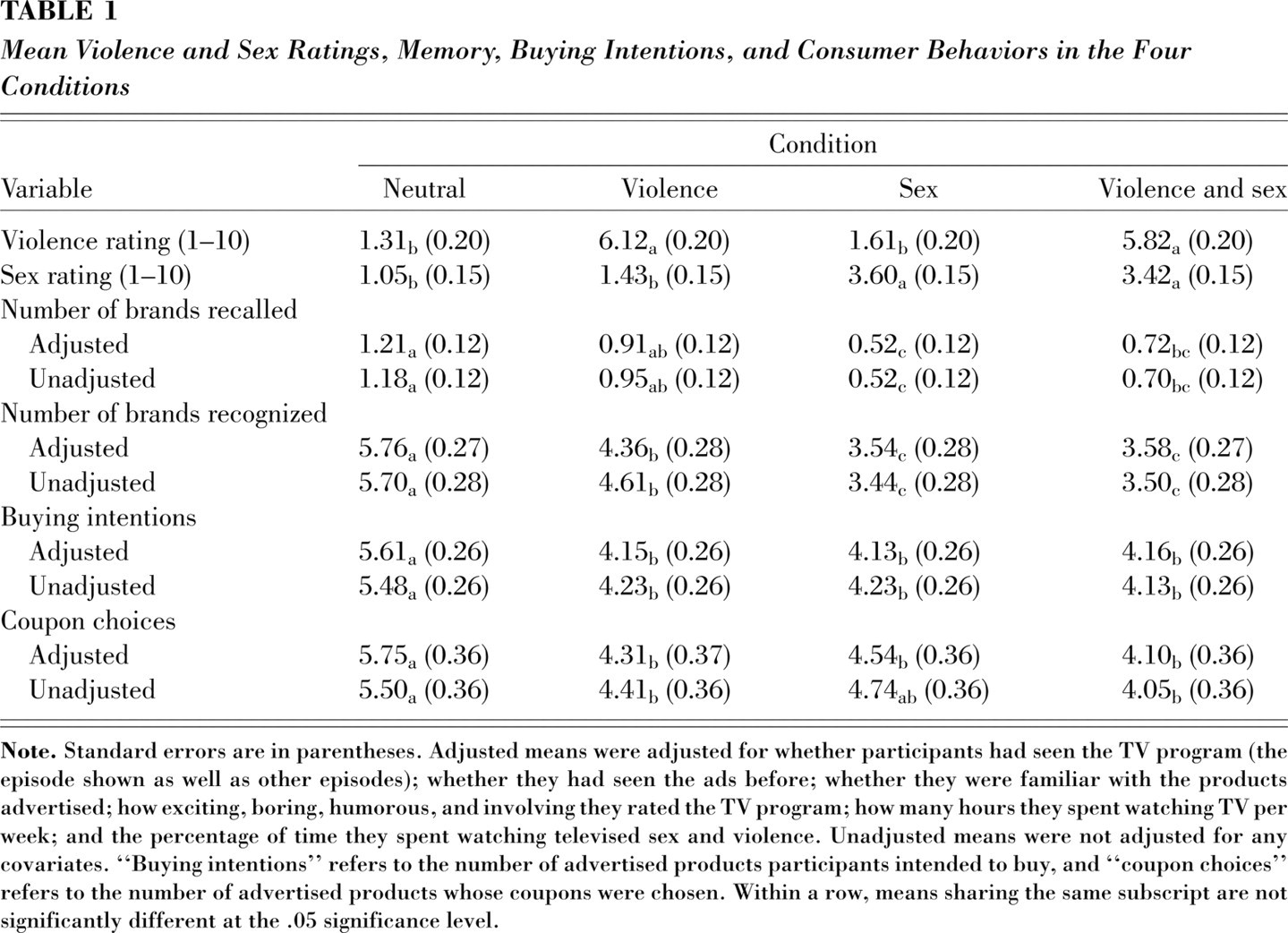
Type of TV program had a significant effect on violence ratings, F(3, 332) = 173.56, p < .0001. As expected, violence ratings were higher for violent and violent sexual programs than for neutral and sexual programs (see Table 1).
Mean Violence and Sex Ratings, Memory, Buying Intentions, and Consumer Behaviors in the Four Conditions
Sexual Arousal Ratings
Type of TV program had a significant effect on sexual arousal ratings, F(3, 332) = 78.31, p < .0001. As expected, sexual arousal ratings were higher for sexual and violent sexual programs than for neutral and violent programs (see Table 1).
Exemplars of Programs
There were no significant differences among the six neutral programs, among the six violent programs, among the six sexual programs, and among the six violent and sexual programs on any of the outcome measures (i.e., recall, recognition, buying intentions, coupon choices), ps > .05. Thus, the data were collapsed across exemplars of program types for subsequent analyses.
Demographic Data
The demographic variables (i.e., sex, age, ethnic background) had no main effects on any of the outcome measures and were not involved in any significant interactions, ps > .05. Thus, the data were collapsed across demographic groups for subsequent analyses.
Random Orders of Ads
Two different random orders of ads were used. Because randomization order did not affect any of the outcome measures (ps > .05), the data were collapsed across the two orders of ads.
Familiarity With Ads and Brands
As expected, most participants had not seen the ads before and were not familiar with the advertised brands (mean number of ads seen before = 1.61, SE= 0.13; mean number of familiar brands = 1.93, SE= 0.15).
Primary Analyses
Analysis of covariance (ANCOVA) was used to test the effects of televised violence and sex on the outcome measures. Covariates included whether participants had seen the TV program (the episode shown as well as other episodes); whether they had seen the ads before; whether they were familiar with the advertised brands; how exciting, boring, humorous, and involving they rated the TV program; how many hours they spent watching TV per week; and the percentage of time they spent watching televised violence and sex. The results, however, were similar when no covariates were included in the analyses (see Table 1).
If a significant effect was found for type of TV program, a planned contrast was performed to test whether participants who saw a program without violence and sex responded differently from participants who saw a program with violence or sex. On the basis of previous research, no differences between violent and sexual programming were predicted (Bushman & Bonacci, 2002). Thus, the respective contrast weights for the neutral, violent, sexual, and violent sexual programs were −3, +1, +1, and +1. Post hoc t tests were also conducted to explore possible differences between violent and sexual programming (see Table 1).
Coupon Choices
Type of TV program significantly influenced whether participants selected coupons for advertised brands, F(3, 320) = 4.16, p < .007 (see Table 1). Participants who watched a program without violence and sex selected 33% more coupons for advertised brands than did participants who watched a program with violence or sex, F(1, 320) = 11.05, p < .001, r pb= .14. 1 Post hoc comparisons showed similar effects for violent and sexual programming on coupon choices (see Table 1). Only one covariate was significant. The more television participants watched, the more likely they were to choose coupons for advertised brands, F(1, 320) = 4.20, p < .05, r= .16.
Buying Intentions
For each type of product, participants indicated the brand they were most likely to buy. Type of TV program significantly influenced buying intentions, F(3, 320) = 8.00, p < .0001 (see Table 1). Participants who watched a program without violence and sex selected 35% more of the advertised brands than did participants who watched a program with violence or sex, F(1, 320) = 23.35, p < .0001, r pb= .23. Post hoc comparisons showed similar effects for violent and sexual programming on buying intentions (see Table 1). None of the covariates were significant.
Recall
Type of TV program significantly influenced brand recall, F(3, 320) = 6.51, p < .0003 (see Table 1). Brand recall was 68% higher for people who saw a program without violence and sex than for people who saw a program with violence or sex, F(1, 320) = 13.98, p < .0002, r pb= .18. The recall impairment tended to be larger for sexual programming than for violent programming (see Table 1). Only one covariate was significant. Brand recall was positively correlated with the number of advertised products participants were familiar with, F(1, 320) = 6.94, p < .009, r= .27.
Recognition
Type of TV program significantly influenced brand recognition, F(3, 320) = 14.25, p < .0001 (see Table 1). Brand recognition was 51% higher for participants who saw a program without violence and sex than for participants who saw a program with violence or sex, F(1, 320) = 36.62, p < .0001, r pb= .29. The recognition impairment tended to be larger for sexual programming than for violent programming (see Table 1). Brand recognition was also positively correlated with the number of products participants were familiar with, F(1, 320) = 13.71, p < .0003, r= .31.
The Role of Memory and Buying Intentions in Coupon Choices
Structural equation models were computed with AMOS using maximum likelihood estimation (Arbuckle, 1999). The hypothesized model was that brand memory and buying intentions mediate the effect of TV violence and sex on coupon choices. In specifying the model, a dummy variable was used to represent TV violence and sex (violent or sexual program = 1, neutral program = 0). Brand memory was treated as a latent variable, measured using brand recall and recognition. The variance-covariance matrix used for the analyses is given in Table 2. The hypothesized mediation model fit the data extremely well, χ2(5, N= 336) = 4.76, p < .45, GFI (goodness-of-fit index) = .995, CFI (comparative fit index) = 1, RMSEA (root mean square error of approximation) = .005. As can be seen in Figure 1, TV violence and sex impaired brand memory. Brand memory and buying intentions were important mediators. People intended to buy brands they could remember, and they chose coupons for brands they intended to buy.
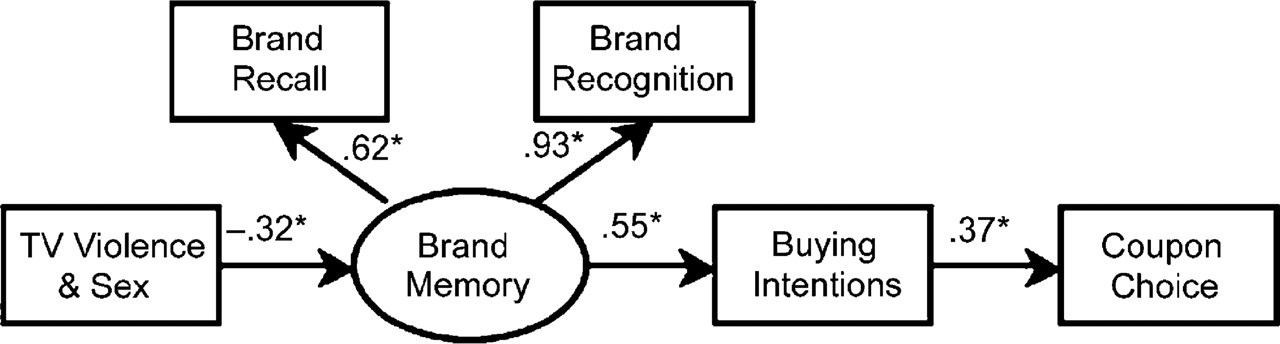
Effect of television violence and sex on viewers' consumer behavior (i.e., choosing coupons for advertised brands). The analysis depicted here tested brand memory and buying intentions as mediators of the effect. Asterisks indicate significant path coefficients, ∗ p < .05. Standardized estimates are shown.
Variance-Covariance Matrix for the Structural Equation Analyses
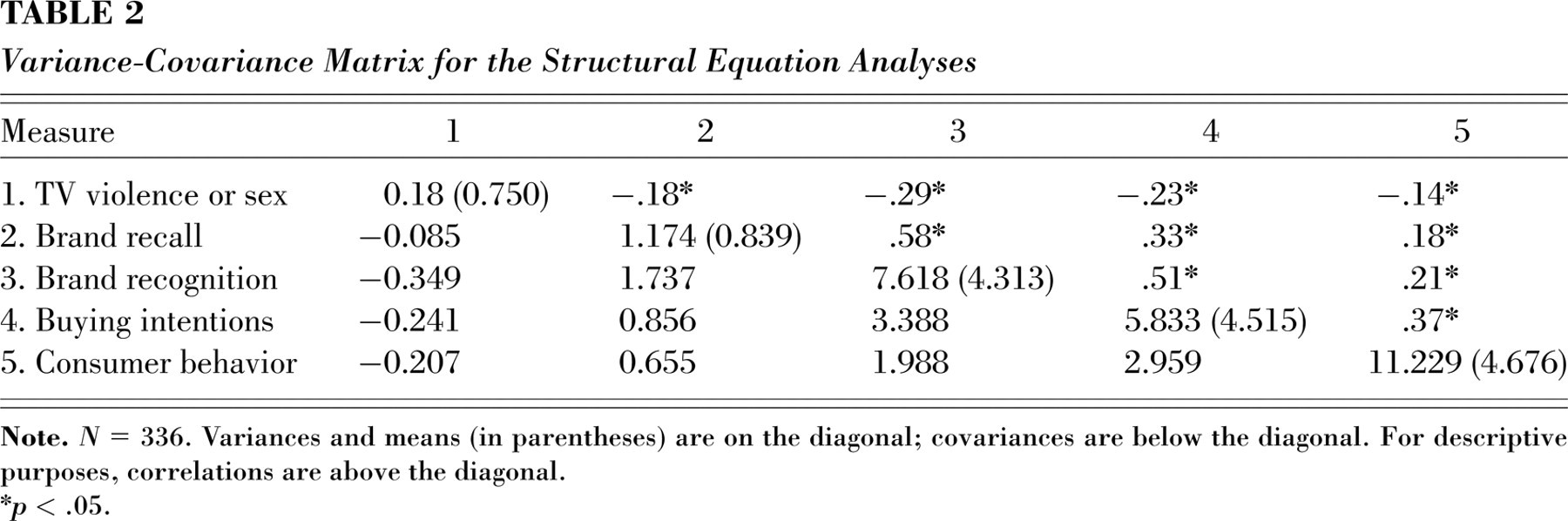
∗ p < .05.
An alternative model included direct paths from TV violence and sex to buying intentions and to coupon choice. Because the mediation model is nested within this alternative model, a chi-square difference test can be used to compare the two models. The difference test was nonsignificant, χ2(3, N= 336) = 3.68, p < .30. Thus, TV violence and sex did not have a direct effect on buying intentions or coupon choice. The effects of TV violence and sex on coupon choice were indirect, through brand memory and buying intentions. Similar analyses were performed to test the separate effects of violence and sex on brand memory, buying intentions, and coupon choices. These analyses found similar effects for TV violence and sex (see the appendix).
DISCUSSION
It is commonly assumed that violence and sex sell products, but they might actually have the opposite effect. The present study replicates previous studies showing that televised violence and sex impair memory for advertised products. Because televised violence and sex had similar effects on recall and recognition, the memory failure is probably due to encoding rather than retrieval. Televised violence and sex also decreased intentions to buy the advertised brands and reduced the number of advertised brands whose coupons participants chose. Memory is an important outcome measure, because it is positively related to buying intentions and coupon choices.
It is true that violent and sexy programs attract young viewers, and this age group is highly desirable to advertisers. However, the effects in the present research held for men and women of all ages, regardless of whether they liked to watch violent or sexual programs.
The obtained results are consistent with the theory of reasoned action (e.g., Ajzen & Fishbein, 1977), which posits that behavioral intentions mediate the effect of a persuasive message on behavior. In the present study, buying intentions mediated the effect of televised violence and sex on coupon choices.
The present study has important practical implications for society. If advertisers refused to sponsor violent and sexual TV programs, such programs would become extinct. About 60% of TV programs contain violence or sex (Kunkel et al., 1999; National Television Violence Study, 1998). TV violence and sex can have a negative impact on society. Research from hundreds of studies conducted over several decades has shown that televised violence increases societal violence (e.g., Anderson & Bushman, 2002). Sexually explicit media promote sexual callousness, cynical attitudes about love and marriage, and perceptions that promiscuity is the norm (e.g., Allen, Emmers, & Gebhardt, 1995; Zillmann, 2000). Moreover, media in which sex is combined with violence may have particularly pernicious effects (e.g., Allen, D'Alessio, & Brezgel, 1995; Linz, Donnerstein, & Penrod, 1988). Thus, sponsoring violent and sexual programs might be bad for society and bad for business.
Footnotes
1The comparative percentages reported here and later in Results were calculated by summing the values for the participants who watched violent programming, sexual programming, and violent sexual programming; dividing by 3; and then dividing the result into the value for the participants who watched neutral programming: neutral/[(violence + sex + violence and sex)/3]. For example, using the data in  , one can see that the number of advertised brands whose coupons were chosen was 33% higher for participants who saw a neutral program than for the other groups: 5.75/[(4.31 + 4.54 + 4.10)/3] = 1.33, or 33% higher.
Acknowledgements
This research was funded in part by a research grant from Iowa State University. I would like to thank Rebecca Marzen and Laura Valenziano for their help recording the programs, Nicole Oswalt for her help testing participants, and Mike Gillespie for his help with the structural equation analyses. I also would like to thank Rowell Huesmann for his helpful feedback on a draft of this manuscript.
Separate Effects Of Tv Violence And Sex
In the analysis of the separate effects of violent programming, a dummy variable was used to represent TV violence (violent program = 1, neutral program = 0). The hypothesized mediation model fit the data extremely well, χ2(5, N= 168) = 5.27, p < .49, GFI= .988, CFI= .998, RMSEA= .018. The direct-effects model did not improve the fit, χ2(2, N= 168) = 0.76, p < .69.
Similarly, in the analysis of the separate effects of sexual programming, a dummy variable was used to represent TV sex (sexual program = 1, neutral program = 0). The hypothesized mediation model fit the data extremely well, χ2(5, N= 168) = 6.67, p < .25, GFI= .985, CFI= .991, RMSEA= .045. The direct-effects model did not improve the fit, χ2(2, N= 168) = 1.00, p < .61.
Similar results were obtained for the effects of programming that was both violent and sexual. A dummy variable was used to represent TV violence and sex (violent and sexual program = 1, neutral program = 0). The hypothesized mediation model fit the data extremely well, χ2(5, N= 168) = 3.61, p < .61, GFI= .992, CFI= 1, RMSEA= 0. The direct-effects model did not improve the fit, χ2(2, N= 168) = 0.76, p < .68.
Two additional mediation models compared differences between violent and sexual programming. For these models, scores for brand recall and brand recognition were standardized and summed to create a composite variable for brand memory. The direct-effects models had 0 degrees of freedom (i.e., saturated models) and are not presented here because they should not be interpreted. One model compared programs with violence and sex to programs with only violence. A dummy variable was used to represent TV sex (violent and sexual program = 1, violent program = 0). The hypothesized mediation model fit the data well, χ2(3, N= 168) = 3.39, p < .34, GFI= .99, CFI= .99, RMSEA= .028. However, the standardized regression coefficient for the path between the indicator variable and the memory variable was nonsignificant (coefficient = .07, p= .853). Thus, sex did not add anything above the effect of violence.
The other model compared programs with violence and sex to programs with only sex. A dummy variable was used to represent TV violence (violent and sexual program = 1, sexual program = 0). The hypothesized mediation model fit the data well, χ2(3, N= 168) = 1.20, p < .75, GFI= .996, CFI= 1, RMSEA= 0. However, the standardized regression coefficient for the path between the indicator variable and the memory variable was nonsignificant (coefficient =−.17, p= .814). Thus, violence did not add anything above the effect of sex.