






Abstract
Highly hypnotizable participants were given a posthypnotic suggestion to feel a flash of disgust whenever they read an arbitrary word. They were then asked to rate moral transgressions described in vignettes that either did or did not include the disgust-inducing word. Two studies show that moral judgments can be made more severe by the presence of a flash of disgust. These findings suggest that moral judgments may be grounded in affectively laden moral intuitions.
Morality is often thought to come from a revered source—from God or reason. But might morality be grounded more in the body than in the soul? An enormous experimental literature suggests that people use their bodily reactions as guides when forming judgments (e.g., moods—Schwarz & Clore, 1983; physiological arousal—Dutton & Aron, 1974; Schachter & Singer, 1962; Zillman, 1978). We sought to test whether an arbitrarily induced gut-level response (disgust) would be used as information for moral judgment, as predicted by the social intuitionist model of moral judgment (Haidt, 2001) and the somatic-marker hypothesis (Damasio, 1994).
It is difficult to manipulate moral intuitions directly without altering any fact about the action being judged, but hypnosis offers this level of control. Despite a controversial history, hypnosis has been used effectively to induce moods (Bower, Gilligan, & Monteiro, 1981; MacCallum, McConkey, Bryant, & Barnier, 2000), inhibit emotional responses (Bryant & Kourch, 2001), and modulate the neural correlates of cognitive processes (e.g., color perception—Kosslyn, Thompson, Costantini-Ferrando, Alpert, & Spiegel, 2000; Stroop interference—Raz, Shapiro, Fan, & Posner, 2002; and the experience of pain—Rainville, Duncan, Price, Carrier, & Bushnell, 1997). We took advantage of the recently validated power of hypnosis to implant posthypnotic suggestions to feel disgust in response to one of two arbitrary words. We then embedded these words into moral-judgment vignettes. We predicted that the brief flash of disgust induced by the posthypnotic suggestion would be interpreted by participants as a kind of information, specifically, as an intuition that the action in question was morally wrong.
EXPERIMENT 1
Method
Sixty-four highly hypnotizable participants (19 male) took part in small group-hypnosis sessions 1 that included a posthypnotic suggestion to experience “a brief pang of disgust … a sickening feeling in your stomach” when reading a particular word, but to have no memory for this instruction until cued to remember. Half of the groups were instructed to feel disgust when reading the word often; half were instructed to feel disgust when reading the word take. After participants were brought out of the hypnotic state, they were given a packet of vignettes, ostensibly as part of an unrelated study.
Each vignette described a moral transgression and was followed by two rating scales, one for rating “how morally wrong” and the second for rating “how disgusting” the behavior was. Ratings were indicated by making a slash mark along a 14-cm line anchored by the endpoints not at all morally wrong and extremely morally wrong or not at all disgusting and extremely disgusting. Slash marks were later converted to a scale from 0 to 100. After making their ratings, participants were asked to briefly explain their morality ratings.
Six experimental vignettes were designed to test the hypothesis that disgust contributes to moral judgment. These vignettes were about second cousins who had a sexual relationship, a man who ate his already dead dog, a congressman who took bribes, an ambulance-chasing lawyer, a shoplifter, and a student who stole library books. Each vignette was written in two versions that differed by a few words but were semantically identical; one version included the word take, and the other the word often. For example, the bribery vignette read as follows:
Congressman Arnold Paxton frequently gives speeches condemning corruption and arguing for campaign finance reform. But he is just trying to cover up the fact that he himself [will take bribes from/is often bribed by] the tobacco lobby, and other special interests, to promote their legislation.
Half of the participants read three experimental vignettes in the take version, followed by three buffer vignettes that were about non-disgust-related infractions (e.g., speeding) and included neither hypnotic word, followed by three experimental vignettes in the often version. The remaining participants read three often vignettes, followed by three buffer vignettes, followed by three take vignettes. The ordering of vignettes was randomized across participants and condition (take vs. often).
After all participants had completed their ratings, the experimenter announced that they would be offered cookies because the session was conducted over the dinner hour. Two research assistants, blind to the hypotheses and to the hypnotic word used, entered carrying bags of cookies and offered them to each participant while saying, “Would you like to take a cookie?” and “Take as many as you want.” We predicted that disgust would inhibit appetite for participants in the take condition.
Finally, participants were given 4 min to recall everything they could from the hypnosis session and to write this information down. They were then given the cue to remember and 2 min to write down anything they had not remembered previously. Participants were thoroughly debriefed and briefly rehypnotized to eliminate the posthypnotic suggestion.
Results
All 64 participants passed at least two of the three tests of hypnotic depth, indicating that they were in a hypnotic state during the posthypnotic suggestion. Forty-five participants (11 male) were amnesic for the instructions until cued to remember at the end of the experiment. We limited our analyses to these participants, as their lack of conscious memory for the true cause of their disgust affords the most stringent test of whether disgust informs moral judgment. The cookie task provided a rough indication of the suggestion's effectiveness: Participants in the take condition took significantly fewer cookies (M= 0.53) than participants in the often condition (M= 1.16), t(38) = 2.86, p < .01, r= .42 (Rosenthal, 1991). 2
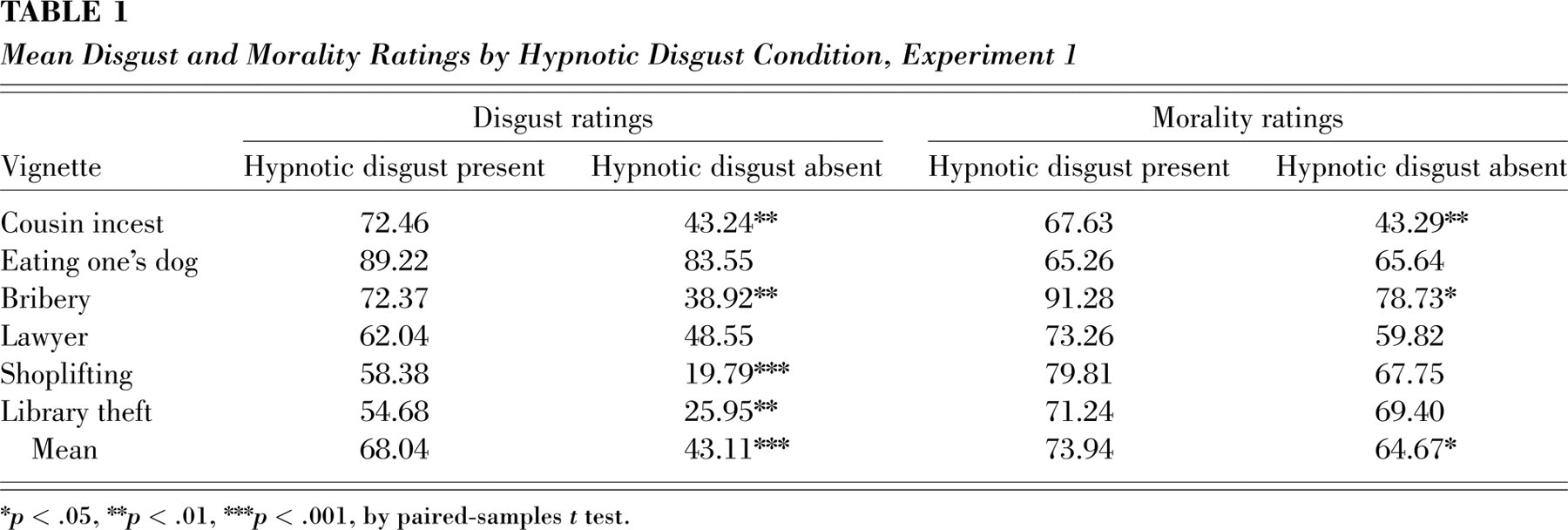
The main results are presented in Table 1. For each participant, we calculated the average of the disgust ratings for the three stories that included the hypnotic disgust word and the average of the disgust ratings for the three stories with no hypnotic disgust word. As predicted, participants rated the vignettes as more disgusting when the hypnotic disgust word was present (M= 68.0) than when the word was absent (M= 43.1), t(44) = 5.78, p < .001, r= .66. More important, participants rated vignettes as being more morally wrong when the hypnotic disgust word was present (M= 73.9) than when the word was absent (M= 64.7), t(44) = 2.41, p < .05, r= .34.
Mean Disgust and Morality Ratings by Hypnotic Disgust Condition, Experiment 1
∗ p < .05
∗∗ p < .01
∗∗∗ p < .001, by paired-samples t test.
Discussion
Participants found moral transgressions to be more disgusting when their hypnotic disgust word was embedded within the vignettes than when this word was absent. Moreover, the disgust word caused participants to rate transgressions as more morally wrong. Apparently, participants used their feelings of disgust (attached only to a word, not to the act in question) as information about the wrongness of the act. This finding indicates that gut feelings can indeed influence moral judgments (Damasio, 1994; Haidt, 2001).
EXPERIMENT 2
Experiment 1 left a few questions unanswered. First, although the suggestion to “feel a sickening feeling” made moral judgments more severe, it is possible that a negative affective state would make any rating more negative. To address this possibility, we asked participants in Experiment 2 to make a third rating for each vignette; these ratings related to the stories but not the transgressions (e.g., after the shoplifting story: “How much do you approve/disapprove of indoor shopping malls?”). If the results in Experiment 1 were due to the hypnotic word creating a generally negative or unpleasant state, such a state would be expected to bias these ratings as well. Additional improvements included a more sensitive manipulation check and the inclusion of a new story to test the limiting case in which disgust is induced in the absence of any possible moral violation. We predicted that in this case, participants would override their gut feelings and would not allow their moral judgments to be affected.
Method
Ninety-four highly hypnotizable participants (37 males) took part in hypnosis sessions conducted identically to those in Experiment 1. The vignettes and rating scales were identical to those in Experiment 1 with the following changes. First, the story about a man eating his dead dog was replaced by a story less likely to yield a disgust ceiling effect: a story about a woman who littered. Second, the “Student Council” story was added to provide a story with no violation of any kind: “Dan is a student council representative at his school. This semester he is in charge of scheduling discussions about academic issues. He [tries to take/often picks] topics that appeal to both professors and students in order to stimulate discussion.” Third, after rating each transgression for moral wrongness and disgust, participants rated how much they approved or disapproved of something related to the story, but not the transgression itself.
Following the vignettes, participants filled out a manipulation check: a one-page questionnaire asking them to rate (on a scale from 1 to 7) how much they would like to do 12 activities. Four of the items contained the word take (e.g., “take a neighbor's child to see Harry Potter”), 4 contained the word often (e.g., “spend an evening in a coffee shop that often has live music”), and 4 contained neither take nor often.
Results
Sixty-three participants (26 male) were amnesic for the instructions and passed two or all three tests of hypnotic depth. There were no significant sex differences on any comparisons of interest. The manipulation check showed that activities were less liked (M= 4.7) when they contained the participants' hypnotic disgust word than when they contained the other word (M= 5.4), t(62) = 4.02, p < .001, r= .45. This finding suggests that the manipulation endured to the end of the experiment and that the disgust reactions were brief and confined to the items containing the disgust word (i.e., the disgust did not bleed over to affect judgments of subsequent items). For each participant, we calculated a hypnotic-bias score by subtracting the average liking for activities that included the hypnotic disgust word from the average liking for activities that included the other word. For any given participant, we could not be sure that a positive score indicated that the posthypnotic suggestion was effective, but on average we expected larger main effects from participants with larger hypnotic-bias scores.
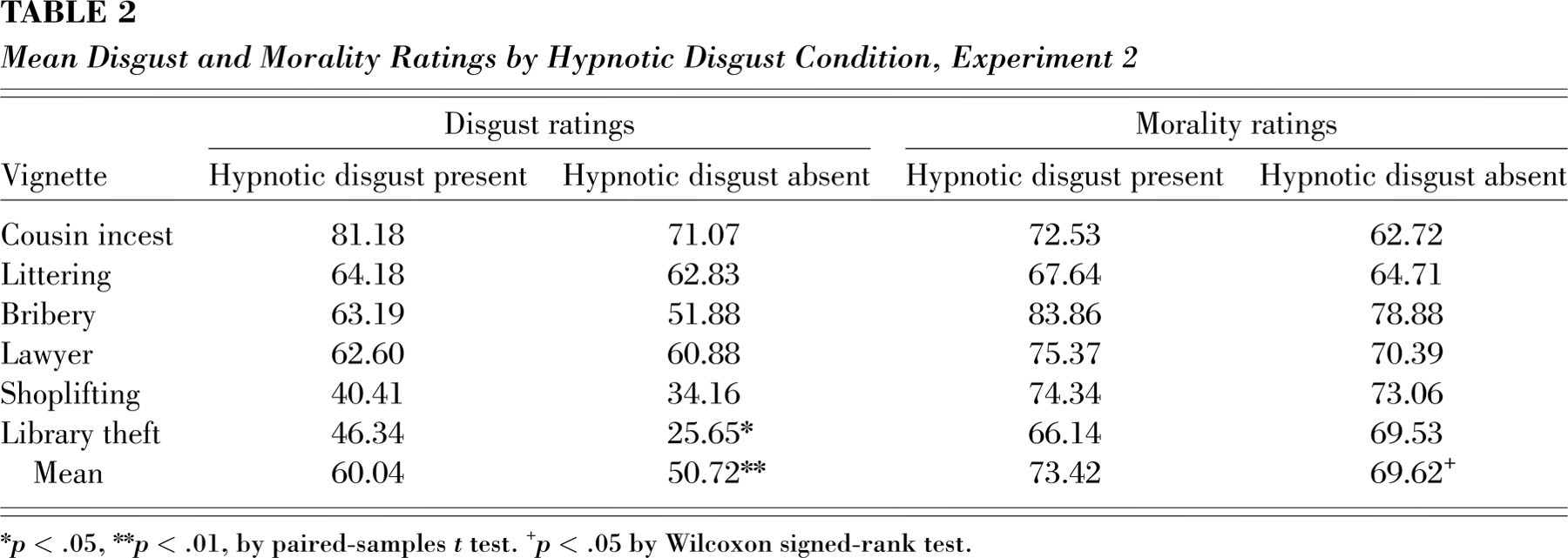
The main results are shown in Table 2. Participants judged actions to be more disgusting when their hypnotic word was present (M= 60.0) than when it was absent (M= 50.7), t(62) = 3.04, p < .005, r= .36. For the morality ratings, there were substantially more outliers (in both directions) than in Experiment 1 or for the other ratings in this experiment. As the paired-samples t test loses power in the presence of outliers, we used its nonparametric analogue, the Wilcoxon signed-rank test, as well (Hollander & Wolfe, 1999). Participants judged the actions to be more morally wrong when their hypnotic word was present (M= 73.4) than when it was absent (M= 69.6), t(62) = 1.74, p= .09; Wilcoxon Z= 2.18, p < .05, r= .27. Participants were not significantly more approving of non-transgression-related items (e.g., shopping malls) when the hypnotic word was present (M= 45.6) than when it was absent (M= 42.1), t(62) = 1.23, n.s., r= .15.
Mean Disgust and Morality Ratings by Hypnotic Disgust Condition, Experiment 2
∗ p < .05
∗∗ p < .01, by paired-samples t test.
+ p < .05 by Wilcoxon signed-rank test.
In the absence of the hypnotic word, the Student Council story was rated as not at all disgusting (M= 2.3) and not at all morally wrong (M= 2.7). The presence of the hypnotic word, however, elevated ratings of disgust (M= 20.9), t(61) = 3.73, p= .001, r= .43, and moral wrongness (M= 14.0), t(61) = 3.32, p < .005, r= .39. The effects of hypnotic disgust were limited to Dan's action and did not increase disapproval of university tuition rates (the non-transgression-related rating), t(61) = 1.53, n.s., r= .19.
Hypnotic-bias scores, which were rough indications of the “dosage” of hypnosis participants had received, predicted the “response” shown by their judgments. For both disgust and morality ratings, hypnotic-bias scores correlated with the difference between participants' average rating when the hypnotic word was present and average rating when it was absent: disgust r(63) = .35, p < .01; morality r(63) = .27, p < .05. However, for non-transgression-related ratings, there was no correlation, r(63) = .09, n.s.
GENERAL DISCUSSION
In two studies, participants listened to their gut feelings of disgust when judging moral transgressions. It is important to note that we did not hypnotize participants to feel disgust toward the actions in question. Rather, we hypnotized participants to feel a flash of disgust whenever they saw an arbitrary word, and this flash, in the context of a surrounding story, made moral judgments of the story more severe. Study 2 found that the effect was specific to the act being judged; it did not affect unrelated judgments made immediately afterward. And contrary to predicted limitations of this effect, some participants continued to follow their gut feelings and condemned Dan in the Student Council story, even though his only crime was trying to foster good discussions.
Participants sometimes experienced puzzlement as they watched themselves make severe judgments. Asked for comments at the end of the study, one participant wrote: “When ‘often’ appeared I felt confused in my head, yet there was turmoil in my stomach. It was as if something was telling me that there was a problem with the story yet I didn't know why.” One nonamnesic participant commented: “I knew about ‘the word’ but it still disgusted me anyway and affected my ratings. I would wonder why and then make up a reason to be disgusted.”
The post hoc nature of moral reasoning was most dramatically illustrated by the Student Council story. Rather than overrule their feelings about Dan, some participants launched an even more desperate search for external justification. One participant wrote: “It just seems like he's up to something.” Another confided that the story evoked bad high school memories, making him view Dan as a “popularity-seeking snob.” Even when such tenuous justifications could not be found, several participants clung to their repugnance, choosing to abandon explanation altogether, writing: “It just seems so weird and disgusting” and “I don't know [why it's wrong], it just is.”
CONCLUSION
We have provided the first demonstration that experimentally augmenting feelings of disgust through hypnosis can increase the severity of moral judgments, as predicted by Damasio (1994) and Haidt (2001). We have not yet demonstrated a unique relationship between disgust and morality, because we did not show that other negative feelings (e.g., sadness, anger, or headache) do not have the same effects. Nonetheless, our findings illustrate the philosopher Hume's (1739/1969) famous statement that “reason is … the slave of the passions, and can pretend to no other office than to serve and obey them” (p. 462). In these experiments, we augmented the passions, or created them from scratch, and in some cases reason struggled valiantly to serve.
Footnotes
1To determine hypnotic susceptibility, we used two abbreviated versions of the Harvard Group Scale of Hypnotic Susceptibility, Form A (Shor & Orne, 1962). Participants were selected via screening sessions run in several large psychology classes. The screening used the eye-closure induction, two tests (finger lock and hands moving together), and the posthypnotic suggestion to touch one's left ankle. For the experiment, we used the same induction and three different tests (hand lowering, arm immobilization, and arm rigidity), and we modified the posthypnotic suggestion for disgust.
2Participants were asked at the end of the experiment to write down the number of cookies they took; 5 participants did not.
Acknowledgements
We thank Bobbie Spellman, Dan Wegner, Dan Willingham, Tim Wilson, Mark Zanna, and three reviewers whose suggestions greatly improved this report. This work was supported by National Institute on Drug Abuse Grant 1-RO3-DA12606-01 and by the John Templeton Foundation.