







Abstract
Case studies of individuals reporting recovered memories of childhood sexual abuse suggest that some overestimate their prior forgetting of the abuse. People reporting recovered or continuous memories of childhood sexual abuse and control subjects reporting no history of abuse participated in two experiments examining this “forgot it all along” phenomenon. Participants in Experiment 1 were more likely to forget that they had previously recalled a studied item if they were cued to think of it differently on two recall tests than if they were cued to think of it in the same way on the two tests. This effect was stronger for recovered-memory participants than for continuous-memory and control participants. In Experiment 2, participants recalled autobiographical events three times over a period of 4 months. Much as in Experiment 1, they underestimated prior remembering when the events had been recalled in a different emotional frame (positive vs. negative) on the previous occasion. This underestimation was more pronounced for recovered-memory participants than for continuous-memory and control participants.
Are individuals able to recall long-forgotten episodes of childhood sexual abuse (CSA)? Over the past 15 years, this issue has given rise to one of the most intense controversies in psychiatry and psychology (e.g., Loftus, 1997; McNally, 2003; Schacter, 1995). Perspectives in the early years of this debate were highly polarized. For example, many practitioners claimed that amnesia for trauma and subsequent recovery of traumatic memories had been amply demonstrated in clinical populations (e.g., Brown, Scheflin, & Whitfield, 1999). Conversely, many experimental psychologists raised doubts about the accuracy of such memories and challenged concepts such as “repression” (e.g., Kihlstrom, 2004; Loftus, 2003). For example, McNally (2004) noted that traumatic-amnesia theorists (e.g., Brown et al., 1999) often misinterpret various memory problems (e.g., everyday forgetfulness) as amnesia for the trauma itself. Moreover, CSA episodes are not always experienced as terrifying at the time they occur, thereby falling short of traditional conceptions of a traumatic stressor. Also, not thinking about something (e.g., CSA) for a long period of time cannot be considered forgetting.
Over the years, the vehemence of what has been termed the “memory wars” gradually subsided, and authors involved in the debate increasingly emphasized points of consensus (see Lindsay & Read, 2001). Partly with the aim of fostering this middle-ground perspective, Schooler and his coworkers (e.g., Schooler, Ambadar, & Bendiksen, 1997; Shobe & Schooler, 2001) described several case studies of individuals who experienced the “discovery” of apparently long-forgotten memories of abuse. Of particular interest in the current context are two cases in which the partners of the women who reported full-blown recovered-memory experiences said that the women had talked about the abuse before they had the memory-recovery experience. In both cases, the women seemed to be surprised to hear that they had talked about the abuse prior to their recovered-memory experiences. Schooler et al. proposed that these cases illustrated a “forgot it all along” (FIA) phenomenon, which at its core entails the underestimation of prior recollections of past events.
Arnold and Lindsay (2002, 2005) developed a laboratory analogue that captured some aspects of the FIA mechanism by requiring participants to recall material in qualitatively different ways on two occasions (for other experimental demonstrations of FIA, see Joslyn, Loftus, McNoughton, & Powers, 2001; Merckelbach et al., 2006; Padilla-Walker & Poole, 2002; Parks, 1999). They argued that if the retrieval of CSA memories in qualitatively different ways can lead to the underestimation of previous CSA recollections, then this mechanism should transfer into the lab. In their basic procedure, participants studied a list of homographic target words, each preceded by a biasing context word (e.g., hand-palm). In Test 1, participants were tested on a subset of the study list, with some of the target items being cued with the previously studied context word (e.g., hand-p∗∗m) and the rest of the items being cued with another context word (e.g., tree-p∗∗m). In Test 2, participants were tested on all of the studied items, and the studied-context cues were always given as recall prompts. Additionally, after recalling each word, participants were required to judge whether they had recalled that word on the first test. The key result was that participants forgot their prior recall of target words more often when the words had been cued with the other-context cues than when they had been cued with the studied-context cues on the first test. These results provided compelling evidence that remembering a past event in a different way can result in a failure to remember a prior instance of recalling that event.
The finding that people forget an instance of past remembering more often if it differs from their current recollections than if it matches their current recollections may be relevant to ongoing discussions about the authenticity of recovered CSA memories. For instance, it is possible that some victims of abuse underestimate their prior recollections of the abuse when they recall the abuse in a qualitatively different manner than they did previously, leading to a false impression of having had repressed memories.
There is evidence that individuals reporting recovered memories are more prone to memory distortions than other individuals are (e.g., Clancy, Schacter, McNally, & Pitman 2000; Geraerts, Smeets, Jelicic, van Heerden, & Merckelbach, 2005; McNally, Clancy, Barrett, & Parker, 2005; for an exception, see Clancy, McNally, & Schacter, 1999). Moreover, Melchert (1999) reported an association between reporting recovered memories and tendencies toward dissociation, which in turn appear to be related to susceptibility to memory errors (e.g., Porter, Birt, Yuille, & Lehman, 2000). These findings led us to predict that the underestimation of prior remembering (i.e., the FIA phenomenon) would be greater for individuals reporting previously repressed CSA memories, compared with individuals with no history of abuse and individuals with continuous memories of their abuse. Experiment 1 addressed this question using semantic material, whereas autobiographical events were used in Experiment 2.
EXPERIMENT 1
Method
Participants
As part of an ongoing research project on recovered memories (e.g., Geraerts, Smeets, Jelicic, Merckelbach, & van Heerden, 2006), we recruited participants with recovered and continuous CSA memories, as well as people reporting no history of abuse, through advertisements in local newspapers. Participants were told that the research pertained to CSA and memory. CSA was defined as physical sexual contact, ranging from fondling to penetrative acts, until the age of 12.
A semistructured memory interview was conducted to classify participants into one of the three groups. The recovered-memory group consisted of 57 participants (48 women; mean age = 42.6 years, SD = 10.8) who claimed that they had previously forgotten and then subsequently recalled memories of CSA. The continuous-memory group comprised 69 participants (57 women; mean age = 41.4 years, SD = 11.6) who said that they had never forgotten their abuse. The control group consisted of 68 participants (47 women; mean age = 38.9 years, SD = 12.4) with no history of abuse, either as children or as adults.
Materials
A set of 107 homographs with two dominant meanings (e.g., palm in the part-of-hand sense and in the type-of-tree sense) was composed; 4 of these items were used as primacy buffers, and 4 were used as recency buffers. The remaining 99 target words were randomly divided into three test lists of 33 words (test-list factor). Across participants, each list appeared equally often in the three different conditions of Test 1 (i.e., with the studied-context cues, with the other-context cues, and not tested). Each target word was assigned two context words, representing the two different meanings of that target word (e.g., hand and tree for the target palm). Further, two study lists were constructed (study-list factor) to counterbalance which context word was studied with each target word. Finally, for the study phase, a sentence was constructed for each context-target word pair; in this sentence, the context word was spelled out in full, and a row of asterisks represented the target word.
Procedure
Participants were told that for each study trial, a context word and target word would be displayed on a computer screen for 2 s, and that they were to repeat the words out loud in preparation for a memory test. Immediately after the word pair was removed from the screen, the study sentence for that pair was presented for 3.5 s, and participants were instructed to read the sentence aloud, filling in the target. Finally, the target word appeared above the sentence for 1 s. Each word pair was studied once.
The study phase was followed immediately by the first cued-recall test (Test 1), in which participants were told that they would be tested on a subset of the targets (cues were presented for two thirds of the studied targets). On each trial, a context word was presented with the first and last letters of a target word. Participants were told that for half of the trials, the context words would correspond to those presented with the targets during the study phase, whereas for the other half of the trials, the context words would not be the same as during the study phase (but would be related to the targets). Participants were warned to respond only with targets that they remembered from the study phase, and that they should say “pass” if they were unable to remember an answer.
The second cued-recall test (Test 2) occurred immediately after the first test. All of the target words were tested, and participants were informed that all of the context words on Test 2 corresponded to those presented with the targets during the study phase. On each trial, participants were given a context word with the first and last letters of the target word and asked to recall the target word from the study phase. If a participant gave an incorrect answer or said “pass,” the experimenter supplied the correct target. Next, participants were required to judge whether they remembered recalling the target word during Test 1. Participants were reminded that many of the items had not been presented on Test 1, and therefore could not have been recalled on that test.
Results and Discussion
We describe recall performance on Test 1 and Test 2 before presenting the data for judgments of prior remembering. All analyses are collapsed over the counterbalancing factors of test list and study list because initial omnibus analyses of variance (ANOVAs) showed no reliable effects of these factors (all Fs < 1); p rep, the probability of replicating the results (Killeen, 2005), is reported.
Recall Performance
The proportion of targets recalled on Test 1 was significantly higher for items cued with studied-context words (M = .90, SD = .08) than for items cued with other-context words (M = .75, SD = .06), t(192) = 8.31, p rep > .99, Cohen's d = 1.19.
An ANOVA was performed on the proportion of target words recalled on Test 2; participant group (recovered memory vs. continuous memory vs. control) was a between-subjects factor, and context on Test 1 (studied context vs. other context vs. not tested) was a within-subjects factor. As expected, recall performance was near ceiling (M = .93, SD = .07), and there were no significant main effects or interactions (all Fs < 1).
Judgments of Previous Recollection
Table 1 shows the proportion of items judged on Test 2 as having been recalled on Test 1. The analyses reported here were performed on judgment data for items correctly recalled on both tests (shown in boldface in Table 1), although a similar pattern was found when analyses were restricted to items recalled on Test 1. An ANOVA was performed on the proportion of correct “yes” judgments on Test 2, with participant group as a between-subjects factor and context on Test 1 (studied-context cue vs. other-context cue) as a within-subjects factor. Results replicated the findings from Arnold and Lindsay (2002, 2005): Participants were significantly more likely to forget that they had recalled an item on Test 1 if it had been cued with the other-context word on Test 1 than if it had been cued with the studied-context word, F(1, 190) = 381.56, p rep > .99, η2 = .64. As expected, there was a significant difference among the three groups, F(2, 190) = 3.97, p rep = .93, η2 = .041, and the critical interaction between group and context was significant, F(2, 190) = 7.98, p rep > .99, η2 = .080.
Mean Proportion of Items Judged as Recalled as a Function of Recall Status on Test 1 and Test 2: Experiment 1
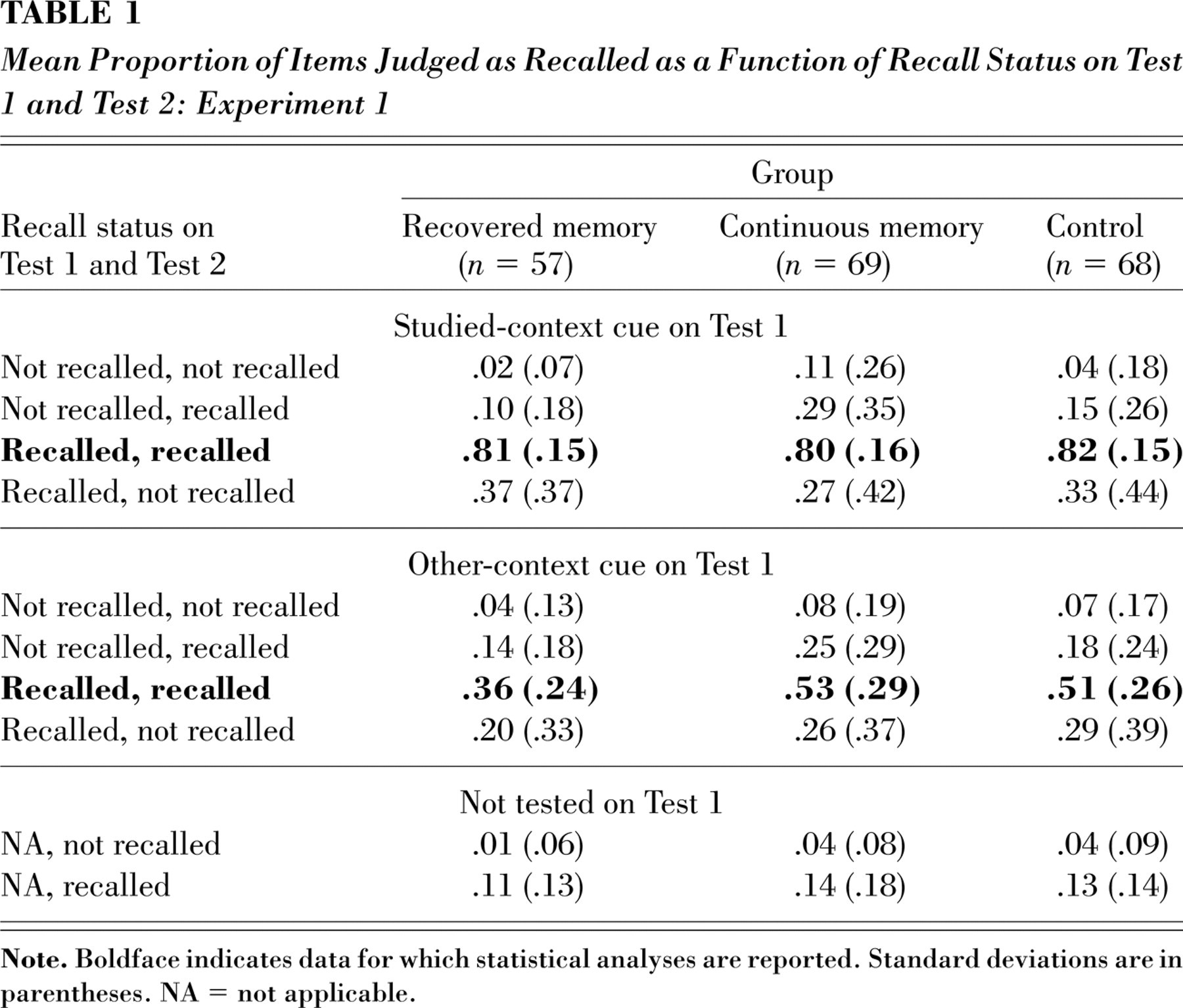
Univariate ANOVAs performed to explore further the group differences in prior-remembering judgments followed similar patterns for studied-context items and other-context items. The groups did not differ on the proportion of correct “yes” judgments for the studied-context items, F(2, 190) < 1. However, a similar ANOVA performed on the proportion of correct “yes” judgments for the other-context items indicated a significant difference among the three groups, F(2, 190) = 6.88, p rep = .99, η2 = .07. Post hoc analyses (Fisher's least significant difference) indicated that compared with both participants in the continuous-memory group and control participants, participants in the recovered-memory group were significantly more likely to forget that they had recalled other-context words on Test 1, t(123) = 3.36, p rep = .99, d = 0.61, and t(122) = 3.27, p rep > .99, d = 0.59, respectively. The tendency of recovered-memory participants to underestimate prior remembering cannot be explained by a general bias to respond “no,” because they did not differ significantly from the other two groups in correctly saying “no” to not-tested items, Fs < 2.05, p reps ≤ .79.
Experiment 1 replicated the typical FIA effect (Arnold & Lindsay, 2002). More important, participants who reported recovered CSA memories were more prone than other participants to forget that they had previously recalled a studied item when they had been cued to think of it differently on the two recall tests. This FIA phenomenon may operate in real-life cases; that is, people reporting recovered CSA memories may underestimate their prior recollections of abuse. However, one could counter that a tendency to underestimate prior remembering of neutral words does not necessarily indicate a tendency to underestimate prior remembering of autobiographical material, and therefore the results from Experiment 1 may not generalize to recovered-memory experiences. Experiment 2 tested for a FIA effect with memories of autobiographical events.
EXPERIMENT 2
Experiment 2 was designed to assess whether people reporting recovered memories of CSA would also show a tendency to underestimate prior remembering of autobiographical material. Participants were requested to recall autobiographical events in an emotionally negative or positive framing, in three test sessions over a period of 4 months.
Method
Participants
Participants with recovered and continuous memories of CSA and control participants were recruited through advertisements in local newspapers. The recovered-memory group consisted of 55 participants (46 women; mean age = 42.2 years, SD = 10.0). The continuous-memory group included 65 participants (53 women; mean age = 41.5 years, SD = 10.3). The control group comprised 65 participants (43 women; mean age = 39.2 years, SD = 11.2).
Materials
Twenty-five cue phrases referring to common childhood experiences (e.g., being home alone, visiting the dentist) were selected. Participants were asked to recall aloud an autobiographical target event related to each cue, in an emotionally positive or negative frame. For example, a participant assigned a positive framing for the event cue “being home alone as a child” might recall enjoying the feeling of freedom of having the house to him- or herself; the same participant, if subsequently assigned a negative framing for that event, might reminisce about feeling lonely after a while. For each event, participants were asked to make an open-ended report. When a report was vague, the experimenter asked the participant to be more specific.
The target events were randomly divided into three test lists (two with eight events and one with nine events; test-list factor). Across participants, each list appeared equally often in the three different conditions of Test 1 (i.e., same-frame, other-frame, and not-tested conditions). Additionally, two study lists were constructed (study-list factor) to counterbalance the framings of the autobiographical events across participants (i.e., during Test 0, half the participants recalled being home alone as a child in a negative frame, and half recalled this event in a positive frame).
Procedure
All participants were tested three times, with 2 months between sessions. During Test 0 (i.e., first recall of autobiographical events), participants were instructed to recall 25 childhood events, each in response to a cue such as “being home alone as a child.” Participants were asked to concentrate on affectively positive aspects of some of the events and on affectively negative aspects of other events (i.e., we manipulated the emotional framing of events within subjects). If a participant could not remember an autobiographical event related to the selected cue, the test proceeded with the next event cue.
After 2 months, participants were required to recall 16 of the autobiographical target events for a second time (Test 1). They were instructed that for half of the events, the emotional framing of the event would correspond to the framing used with that event during Test 0, whereas for the remaining events, the framing would be the opposite of that used in Test 0 (i.e., positive framing if the framing on Test 0 had been negative, and vice versa). The experimenter emphasized to participants that their task was to recall the same events that they had recalled in Test 0, regardless of whether the emotional framing was the same as or different from that used in Test 0.
All of the target events were tested on Test 2, which occurred 2 months after Test 1. Participants were informed that the requested framing on Test 2 corresponded to the framing presented with the targets during Test 0. As in Test 1, participants were asked to recall the same autobiographical events that they had described in Test 0. Following each recall attempt, participants were required to judge if they remembered recalling the target event during Test 1.
Results and Discussion
Recall Performance
Raters were given typed transcripts of the memory reports each subject had produced for each event (e.g., being home alone as a child) and assessed whether or not the subject had recalled the same event on each of the occasions. Ratings were made using a 3-point scale, developed by Neisser and Harsch (1992), that evaluates consistency regarding the people, location, and activities described in memory reports. Interrater agreement was .92; disagreements were resolved by discussion. In total, 3% of events were judged to have changed across occasions; in such cases, the item was treated as a missing value. 1
The proportion correctly recalled on Test 1 was near ceiling and not significantly higher for events recalled in the same-framing condition (M = .93, SD = .09) than for events recalled in the other-framing condition (M = .90, SD = .07), t(184) = 1.18, p rep = .69, d = 0.17.
An ANOVA was performed on the proportion of targets correctly recalled on Test 2; participant group (recovered memory vs. continuous memory vs. control) was a between-subjects factor, and framing on Test 1 (same framing vs. other framing vs. not tested) was a within-subjects factor. As expected, recall performance was near ceiling (M = .91, SD = .11), and there were no significant main effects or interactions (all Fs < 1).
Judgments of Previous Recollection
Table 2 shows the proportion of events judged on Test 2 as having been recalled on Test 1. The analyses reported here were performed on the judgment data for events correctly recalled on both tests (shown in boldface in Table 2). An ANOVA was performed on the proportion of correct “yes” judgments, with the three participant groups as a between-subjects factor and framing on Test 1 (same frame vs. other frame) as a within-subjects factor. Participants were significantly more likely to forget that they had recalled an event on Test 1 if it had been recalled in another framing on Test 1 than if it had been recalled in the same framing, F(1, 182) = 411.51, p rep > .99, η2 = .693. Additionally, there was a significant difference among the three groups, F(2, 182) = 7.92, p rep = .99, η2 = .080, as well as an interaction between group and framing, F(2, 182) = 6.20, p rep > .99, η2 = .064.
Mean Proportion of Items Judged as Recalled as a Function of Recall Status on Test 1 and Test 2: Experiment 2
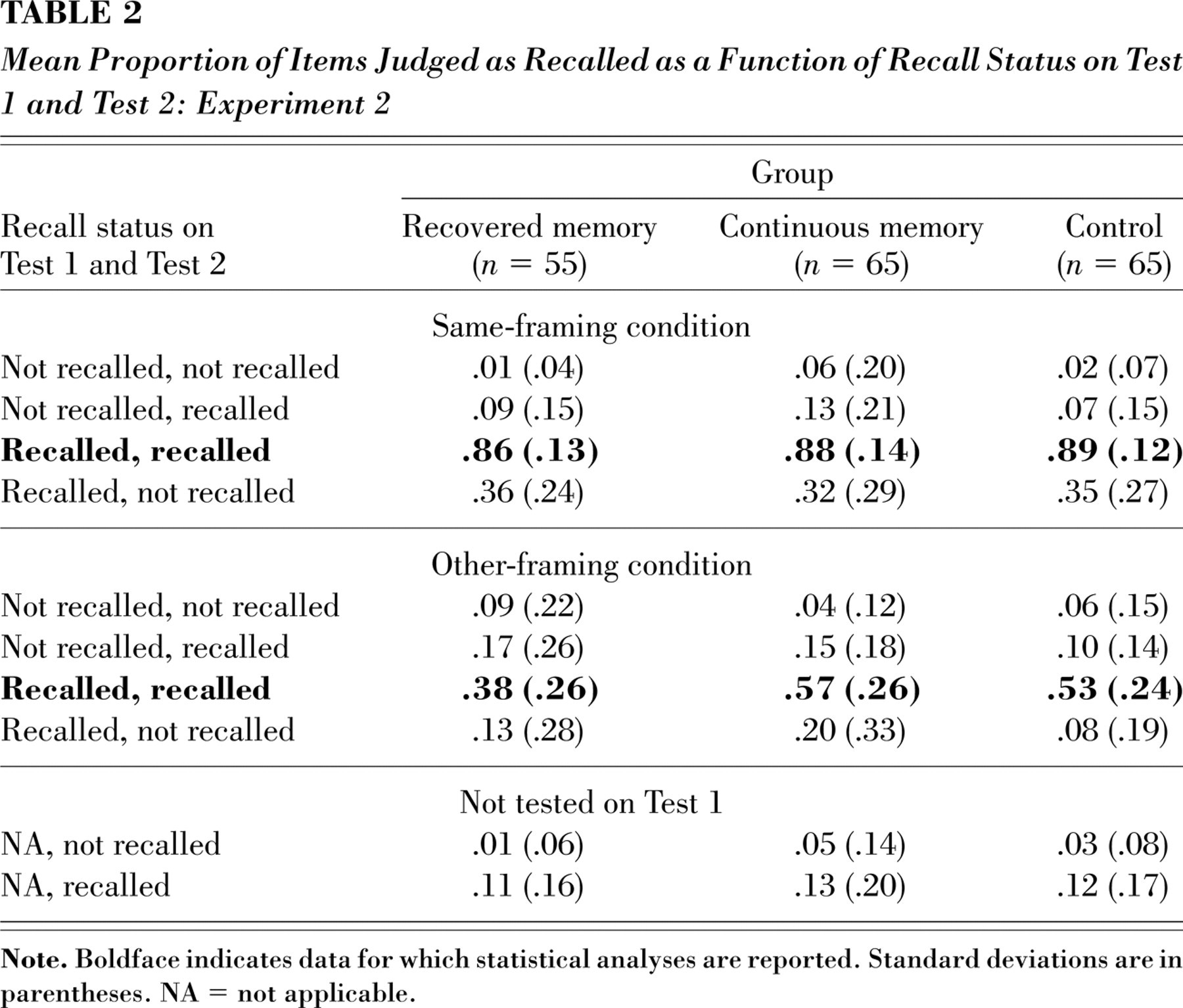
Univariate ANOVAs were performed to inspect group differences in judgments of prior remembering for the two framing conditions. Results for the same-framing events indicated that there were no differences among the groups, F(2, 182) < 1. However, for the other-framing events, there was a significant difference among the three groups, F(2, 182) = 8.87, p rep > .99, η2 = .089. Post hoc analyses (Fisher's least significant difference) showed that compared with continuous-memory and control participants, recovered-memory participants were significantly more likely to forget that they had recalled an event on Test 1 if it had been cued in the other-framing context, t(118) = 3.90, p rep > .99, d = 0.72, and t(118) = 3.34, p rep = .99, d = 0.61, respectively.
As in Experiment 1, the tendency of recovered-memory participants to underestimate prior remembering cannot be explained by a general bias toward saying “no,” because they did not differ from the other two groups in correctly saying “no” to not-tested items, Fs < 1.96, p reps ≤ .78.
Experiment 2 replicated the findings from Experiment 1, but more important, the results demonstrated that the enhanced FIA effect for recovered-memory participants was not restricted to neutral word stimuli. That is, people reporting recovered CSA memories showed an enhanced FIA effect even when mildly emotional autobiographical material was used over a time period of 4 months—conditions that more closely mirror everyday life (if not memories of trauma) than the conditions (i.e., neutral material) in Experiment 1.
GENERAL DISCUSSION
Compared with persons reporting continuous memories of CSA and those reporting no history of CSA, individuals who reported having recovered long-forgotten memories of CSA were especially likely to forget that they had previously recalled words or autobiographical events when they were cued to think about those words or events differently on the different occasions of recall. Hence, our studies provide indirect support for Schooler's (1999) idea that the FIA effect might explain why some individuals reporting recovered CSA memories have the erroneous impression that there was a period in their life during which they were amnesic for the abuse.
The mechanisms that drive forgetting of prior episodes of recalling words or innocuous childhood events are not necessarily the same as those involved in forgetting prior episodes of recalling CSA. For example, when participants in our experiments were judging their prior recollections, they likely did not experience the emotional surprise that is associated with real-world recovered-memory experiences such as those reported by Schooler (2001). Nonetheless, the fact that both of our experiments yielded evidence that persons reporting recovered CSA memories show particularly large FIA effects is consistent with Schooler's (2001) hypothesis that changes in the way an event is thought about on different occasions can contribute to the forgetting of prior episodes of recollection.
Our findings do not imply that the CSA memories reported by our participants are false. To the contrary, one possibility is that these memories are fundamentally accurate, but that their prior accessibility was underestimated by some of our recovered-memory participants because of a FIA mechanism. Alternatively, the large FIA effect in the recovered-memory group may be a manifestation of a source-monitoring problem that makes some people particularly susceptible to pseudomemories and to the FIA effect (Johnson, Hashtroudi, & Lindsay, 1993). From a source-monitoring perspective, the FIA procedure requires participants to differentiate, during the final test, between mental evidence of recalling the target during Test 1 and mental evidence of thinking about the target during Test 1. If individuals with recovered memories tend to have difficulty with source monitoring, that deficit could lead to a particularly large FIA effect (just as it could lead to particular susceptibility to various memory illusions; e.g., Clancy et al., 2000; Geraerts et al., 2005). Of course, it may well be that our recovered-memory participants were accurate both with regard to the abuse and to their prior nonremembering of it, but the strong association between reporting recovered memories and showing a large FIA effect suggests that some individuals reporting recovered memories of CSA have forgotten their prior recollections of the abuse.
Footnotes
Acknowledgements
We thank J. Don Read for comments on a draft of this article. We thank Danny Kostons and Kim Hamers for help with testing.
1At first glance, this small proportion may seem at odds with prior evidence of inconsistency in autobiographical memory reports across widely separated occasions (e.g., Neisser & Harsch, 1992; Talarico & Rubin, 2003). We speculate that this apparent discrepancy is largely a matter of grain size (Goldsmith, Koriat, & Weinberg-Eliezer, 2002): In our study, participants merely had to talk about the same event, not report the same details, for the reports to be counted as consistent. Also, the stability of the context across recall occasions, and the fact that the intertest interval was no more than 4 months, may have supported consistency (see Rubin, Schrauf, & Greenberg, 2004, for a similar observation).