







Abstract

Paintings and drawings are both symbolic representations and material objects—da Vinci's Mona Lisa is at the same time a woman with an enigmatic smile and a canvas covered with strokes of paint. This duality, long recognized and studied by philosophers, psychologists, and artists (Bloom & Markson, 1998; Gombrich, 1960; Ittelson, 1996), may be difficult for children to understand. Young children naturally “see through” pictures. If they see a line drawing of a whisk, for instance, and hear it named (“This is a whisk”), they later extend the name to real-world whisks, not to other drawings (Preissler & Carey, 2004). However, they may not appreciate, as adults do, that the drawing is itself an object, a vehicle through which a whisk is represented. Indeed, young children sometimes treat a representation as if it were the represented object, as when trying to shake a picture of a rattle or step into a picture of a shoe (DeLoache, Pierroutsakos, Uttal, Rosengren, & Gottlieb, 1998; Perner, 1991).
In the studies reported here, we explored whether, when presented with a suitably simplified task, 2-year-olds can flexibly see pictures both as representational and as objects in their own right. In our first study, we tested thirty 2-year-old children (mean age = 30 months). Each trial involved four items—an unfamiliar object, a line drawing of that object, a second unfamiliar object, and a line drawing of this second object. In one condition, the experimenter pointed to one of the drawings, described it with a novel word, and asked subjects to generalize the word: for example, “This is a wug. Can you show me another one?” In another condition, the experimenter asked the same question without using a new label: “Look at this. Can you show me another one?”
For adults, common nouns refer to kinds of objects (see Bloom, 2000), and so the “wug” question should be taken as applying not to the picture, but to what the picture depicts, and hence should be extended to the corresponding object. In contrast, the “look at this” question is more likely to be taken as simply referring to the picture itself, and is therefore more likely to be extended to the other picture. These were the children's intuitions as well. When asked to show another “wug,” they chose the corresponding object 90% (27/30) of the time; when not given a word, they chose the corresponding object only 30% of the time (9/30), a significant difference between conditions indicating reliable, opposite effects (27/30, z = 3.45, p rep = .985; 9/30, z = −2.36, p rep = .875). This effect of a novel word is consistent with other findings concerning the role of language in facilitating categorization by young children (Waxman & Booth, 2003; Xu, 2002).
In a second study, we used a simpler design to test twenty 2-year-olds (mean age = 30 months), by showing them a line drawing depicting a novel object and making a statement about the drawing: (a) “This is a dax,” (b) “My sister has this in her house,” (c) “This is really neat,” (d) “This is my favorite,” or (e) “My brother keeps this in his wallet.” The first two statements were intended to apply to the object that the picture represented, the last was intended to apply better to the picture itself, and the remaining two applied well to both the object and the picture.
After the statement was presented, the experimenter brought out the object that the drawing depicted, placed it next to the drawing, and asked which item (items) the property in the statement applied to (e.g., “Can you show me the one my sister has in her house?”)—the drawing, the object, or both. We also tested 20 adults with the same design, telling them that we were validating a paradigm used with children.
The results are shown in Figure 1. Note first that we replicated the finding of the first study: When a picture is named, children (and adults) assume the label refers to a represented object. Both groups associated the “dax” and “house” statements mostly with objects, the “wallet” statement mostly with pictures, and the other two statements both with pictures and with objects. For children, the difference between the average score of the “dax” and “house” trials and the average score of the “wallet” trial was significant, paired two-tailed t test, t(19) = 2.90, p rep = .96, d = 1.33, as it was for adults, paired two-tailed t test, t(19) = 3.76, p rep = .99, d = 1.72. A between-subjects analysis of variance indicated there was no significant difference between the difference scores of children and of adults, F(1, 38) = 0.017, p rep = .192, η2 < .001. This suggests that children, like adults, understand that labels refer to depicted objects, whereas other property statements (specifically, the “wallet” statement) can be more applicable to pictures. Additional analyses comparing all trials separately confirmed that other property statements (in this case, the “neat” and “favorite” statements) can flexibly be applied to pictures or to objects.
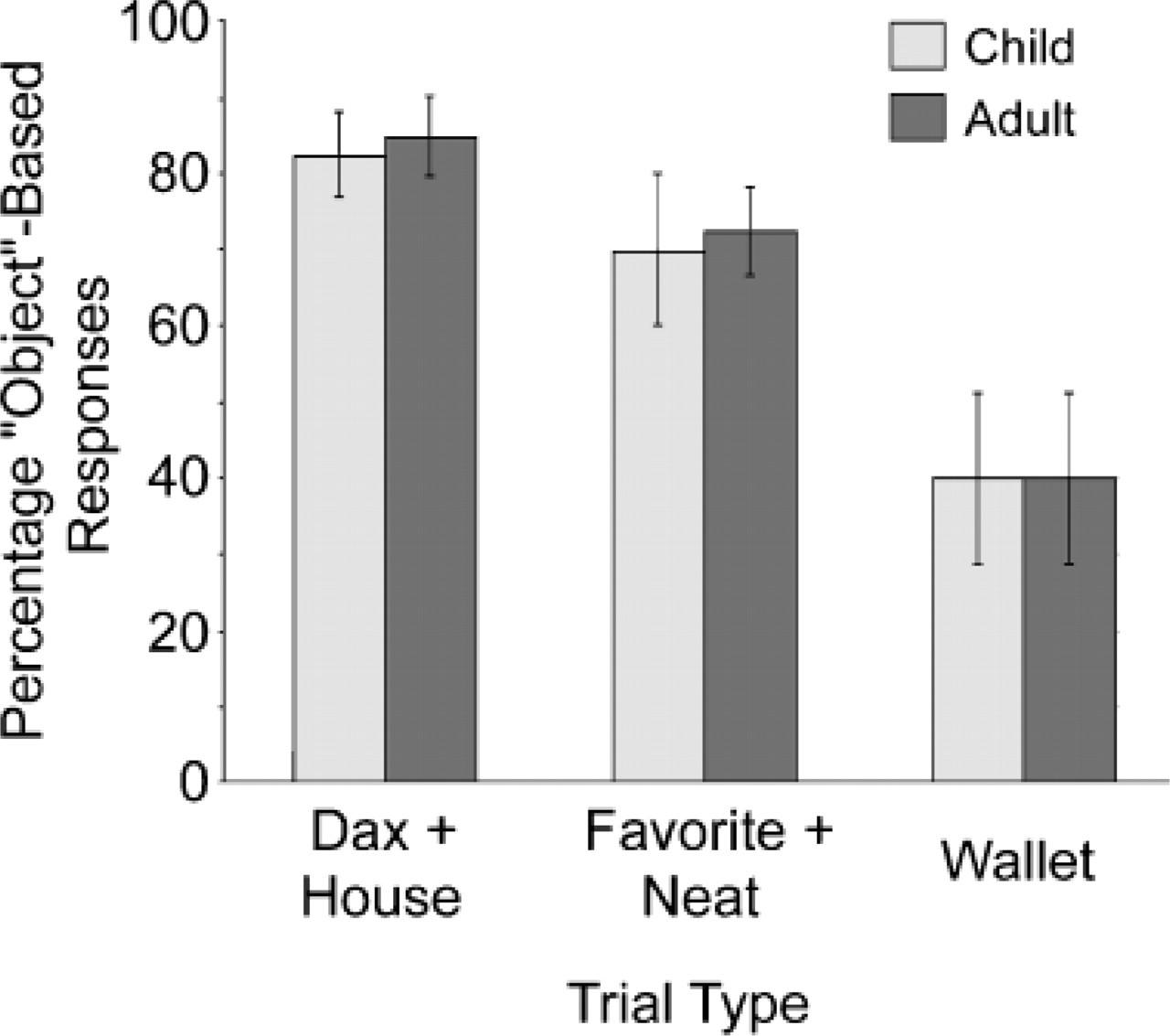
Percentage of “object” (as opposed to “picture”) attributions for three kinds of statements: “This is a dax” and “My sister has this in her house” (averaged together), “This is really neat” and “This is my favorite” (averaged together), and “My brother keeps this in his wallet.” Results are shown separately for 2-year-olds and adults.
Children who are considerably younger than those tested in these studies are capable of using and understanding symbolic representations—even 12-month-olds can use and understand words. This is the first demonstration, however, that young children can appreciate the dual nature of visual representations.
Footnotes
Acknowledgements
We thank Shevaun Lewis and Sarah Kliff for their kind assistance with this project.