







Abstract
Language development is characterized by predictable shifts in the words children produce and the complexity of their utterances. Because acquisition typically occurs simultaneously with maturation and cognitive development, it is difficult to determine the causes of these shifts. We explored how acquisition proceeds in the absence of possible cognitive or maturational roadblocks, by examining the acquisition of English in internationally adopted preschoolers. Like infants, and unlike other second-language learners, these children acquire language from child-directed speech, without access to bilingual informants. Parental reports and speech samples were collected from 27 preschoolers, 3 to 18 months after they were adopted from China. These children showed the same developmental patterns in language production as monolingual infants (matched for vocabulary size). Early on, their vocabularies were dominated by nouns, their utterances were short, and grammatical morphemes were generally omitted. Children at later stages had more diverse vocabularies and produced longer utterances with more grammatical morphemes.
Language development is marked by a series of qualitative shifts. Infants speak in single-word utterances for several months before beginning to combine words. Young children learn a disproportionate number of nouns before acquiring a balanced complement of verbs, adjectives, and prepositions. Young English speakers typically omit function morphemes from their early word combinations, and then gradually begin to add these morphemes in. A central question in language acquisition is what causes children to move through these phases (Bloom, 1973; Gleitman & Newport, 1995; Lenneberg, 1967; Wexler, 1998). Are the early stages reflections of cognitive immaturity, or do they represent necessary steps in decoding the target language? Is the emergence of new linguistic abilities driven by maturation or by the child's growing knowledge of the language? These questions are difficult to answer because language acquisition is confounded with cognitive development and maturation in typically developing children.
However, much of what researchers know about typical language development comes from studies of atypical populations. Research on aphasics suggested there might be a critical period for language acquisition (Lenneberg, 1967), a hypothesis confirmed by studying adults deprived of linguistic experience in childhood (Newport, 1990). Research on blind children (Landau & Gleitman, 1985), linguistic isolates (Goldin-Meadow & Feldman, 1977), and children with limited language models (Singleton & Newport, 2004) has been central in demonstrating the resilience of children's linguistic abilities. These natural experiments allow researchers to explore the effects of factors that are impossible or unethical to manipulate.
International adoption provides the opportunity for just such a natural experiment. More than 20,000 internationally adopted children enter the United States each year (U.S. Department of State, 2005). Although most are infants or toddlers, thousands of older children are also adopted. Typically, these children lose their birth language rapidly (Glennen & Masters, 2002). By adulthood, they fail to distinguish speech in their birth language from speech in an unfamiliar language (Pallier et al., 2003). Most of these children are adopted when they are well within the sensitive period for language acquisition (Newport, 1990) and become fluent speakers of their new language (Pallier et al., 2003). But almost nothing is known about how they achieve this. Recent studies show that internationally adopted infants make rapid progress in acquiring English (Glennen & Masters, 2002), but there are no existing data on older adoptees.
The learning problem faced by these children is broadly similar to that of infants learning their first language: They are exposed to child-directed speech in the context of daily routines; they must learn the new language to communicate with their families; they have little access to text or bilingual informants; and they lack many of the metalinguistic abilities available to older children and adults. However, these children are more cognitively and physically mature than their infant counterparts and have already started to learn one language.
In the current study, we compared language acquisition in internationally adopted preschoolers and monolingual infants. Our goal was to explore the role that cognitive development and maturation play in shaping the course of first-language acquisition by examining how acquisition proceeds when the possible developmental and maturational roadblocks have been removed. By doing this, we hoped to distinguish between two broad classes of hypotheses about qualitative changes during language acquisition:
Developmental hypotheses: Theories of this kind attribute the order of acquisition or the emergence of new abilities to changes in learners that are independent of their experience with a given language. According to this view, immaturity constrains language acquisition, limiting the kinds of words that children can learn, the kinds of representations they can create, or the kinds of utterances they can produce. When these roadblocks are removed, either by biological maturation or by cognitive development, children can acquire new linguistic abilities.
Contingent-acquisition hypotheses: These theories attribute qualitative shifts during acquisition to the interdependence of different linguistic representations or processes. On this view, the emergence of new abilities is driven by the child's growing knowledge of the language. If knowledge of form A is necessary for acquiring form B, then the acquisition of B will have to await the acquisition of A. 1
Critically, this distinction between developmental and contingent-acquisition hypotheses is orthogonal to the nativist/empiricist and domain-specific/domain-general dichotomies that organize theoretical discourse on language development. Thus, there are developmental hypotheses that invoke the maturation of language-specific innate abilities, such as Wexler's optional infinitive hypothesis (1998), and others that invoke domain-general changes in memory and representational abilities (see, e.g., Shore, 1986). Likewise, there are contingent-acquisition hypotheses that are grounded in innate domain-specific knowledge of language (Snedeker & Gleitman, 2004), and others that rely on domain-general learning mechanisms (Bates & Goodman, 1997).
The popularity of theories linking language development to cognitive development has waned with the erosion of Piagetian dominance in developmental psychology. The failure to find robust correlations between linguistic milestones and Piagetian tasks led some observers to conclude that general cognitive factors are unlikely to account for broad changes in language development (for discussion, see Gopnik & Meltzoff, 1997). However, we know of no conclusive evidence against developmental hypotheses. The rise of domain-specific accounts of cognitive development merely increases the number of possible cognitive precursors to linguistic skills. Patterns of association and disassociation do not bear directly on developmental accounts that are domain-specific and maturational. Furthermore, recent examinations of acquisition in children with developmental disorders suggest that language and cognitive development may be closely associated during early childhood (see Thomas & Karmiloff-Smith, 2005, for review).
In this article, we explore two patterns in early language development that could be explained by either developmental hypotheses or contingent acquisition. We begin by describing these patterns and discussing how they could be explained under each theory. Then we briefly examine why prior research on second-language acquisition has not resolved these issues.
CHANGES IN VOCABULARY COMPOSITION
Children's early vocabularies are dominated by nouns that refer to people, animals, and movable objects. Although adults speak to children in full sentences, complete with verbs and function words, these elements are massively underrepresented in children's early vocabularies (Bates, Dale, & Thal, 1995; Gentner, 1982). This is true not only in English, but also in languages like Mandarin and Korean, in which verbs frequently occur in perceptually salient positions (for review, see Gentner & Boroditsky, 2001). This input-output disparity can be plausibly attributed to the conceptual limitations of young children (Huttenlocher, Smiley, & Ratner, 1983; Macnamara, 1972). Perhaps the relative dearth of verbs and adjectives in early speech is attributable to the infant's inability to conceive of relations, states, or actions, and the overabundance of nouns is attributable to the conceptual primacy of object categories.
Alternatively, the changing composition of children's lexicons could reflect linguistic rather than conceptual growth (Gillette, Gleitman, Gleitman, & Lederer, 1999; Snedeker & Gleitman, 2004). An infant who is just breaking into language has to learn the meaning of a word by observing the situational contexts in which it is used. Older children, who have already acquired sizable vocabularies, can also use the sentence in which the word appears. To simulate the effects of linguistic development in the absence of cognitive limitations, Gleitman and her colleagues asked adults to identify words from different representations of the contexts in which they occurred in child-directed speech (Gillette et al., 1999; Snedeker & Gleitman, 2004). When the adults were limited to situational cues, they could identify only the concrete nouns. But when given information about the linguistic context, they were able to learn the verbs as well.
These human simulations demonstrate that changes in vocabulary composition are not necessarily attributable to changes in the learner's conceptual repertoire. But there are several differences between this experimental paradigm and the experiences of young language learners that might limit the validity of the simulations. In contrast, the task and input of internationally adopted children appear to closely parallel those of infant learners. Like infants, adopted children get prolonged exposure to their new language in the context of meaningful social interactions. Like infants, they must simultaneously isolate the words and determine what they mean. However, like the adults in Gleitman's simulations, adopted children are more cognitively mature than infants. If shifts in vocabulary composition primarily reflect the changing cognitive capacities of the learner, then newly adopted children should acquire words from a variety of categories, much like their monolingual age-mates. However, if vocabulary composition is largely a function of the learner's linguistic knowledge, and its effects on his or her representation of the input, then adopted children should initially be restricted to the types of words learned by infants.
EARLY GRAMMATICAL DEVELOPMENT
Similar questions have been raised about the role of maturation and cognitive development in children's early combinatorial speech. For months after they begin speaking, infants are typically limited to one-word utterances. The appearance of word combinations, at around 17 to 22 months, has been attributed to linguistic maturation or cognitive development, as well as to the accumulation of linguistic knowledge (Bates et al., 1995; Bloom, 1973; Shore, 1986). At around 24 to 30 months of age, children show a second burst of syntactic activity, adding determiners, auxiliaries, and inflectional markers to their formerly sparse utterances (Brown, 1973).
Studies in several languages have demonstrated that these shifts are strongly correlated with the size of the child's expressive vocabulary (Bates & Goodman, 1997; Caselli, Casadio, & Bates, 1999; Thordardottir, Weismer, & Evans, 2002), raising the intriguing possibility that lexical growth is causally related to syntactic development. In research supporting this hypothesis, Bates and her colleagues demonstrated that these correlations hold up in atypical populations such as early talkers, late talkers, and children with Williams syndrome (Bates & Goodman, 1997). However, these studies cannot rule out the possibility that both lexical and syntactic acquisition depend on the development of some other cognitive ability, one that is accelerated for early talkers, delayed for late talkers, and selectively spared in Williams syndrome (e.g., auditory memory). One can test this hypothesis by examining the relation between lexical development and grammatical development in adopted preschoolers. If they are causally linked, then the relation should persist in maturationally advanced learners. In contrast, if the correlation is created by rate-limiting development in another domain, then it should be possible to find disassociations in older learners.
COMPARING FIRST- AND SECOND-LANGUAGE ACQUISITION
Many researchers have explored the parallels between first- and second-language acquisition, finding both similarities and discrepancies (Ellis, 1994; Freeman & Freeman, 2001). But none of this work addresses the questions that motivated our study. Research on second-language acquisition typically focuses on the development of specific syntactic constructions that appear later in first-language development than the qualitative shifts explored in this article. There is little work on the composition of the lexicon in second-language learners or the relation between early lexical and grammatical development (but see Marchman, Martínez-Sussmann, & Dale, 2004). Furthermore, the most commonly studied populations, students receiving formal language instruction or immigrants learning a language in the workplace or on the playground, are in language environments that are radically different from those of infants, making it unclear whether differences in first- and second-language acquisition are due to maturity or to differences in the learners' input and motivations.
Finally, most studies of second-language acquisition have examined adults or children over age 6. Our goal was to find out whether cognitive changes occurring between 16 and 30 months of age shape early language acquisition. When one compares infants with adults, one cannot isolate the effects of these early developmental changes from age-related changes that occur during middle childhood and adolescence. Because these later changes are known to alter language acquisition (Johnson & Newport, 1989), we chose to limit our study to children who began acquiring English before age 6.
METHOD
Twenty-seven families with children adopted from China participated. The children were adopted between ages 2 years 7 months and 5 years 6 months (M = 4 years 0 months). At the first session, length of residence in the United States was 3 to 16 months (M = 7.7). Parents were invited to participate every 3 months until their child had been in the United States for 18 months. Thus, each child participated in one to five sessions (M = 2.6), and a total of 69 data points was collected. Children were excluded from participation if they had sensory, motor, or developmental disorders that might affect language acquisition or production.
For each session, materials were mailed to the parents, who completed the MacArthur-Bates Communicative Development Inventory 2 (CDI-2; Fenson et al., 1993) and recorded a language sample in their home. The CDI-2 is a parental report of early language production. It includes a 680-item vocabulary checklist and a 37-item forced-choice sentence-complexity measure, which asks about the child's use of inflectional morphemes. The CDI-2 is normed for children ages 16 through 30 months, but has also been used with older children with limited language skills (Berglund, Eriksson, & Johansson, 2001). The language sample consisted of an hour-long recording of the parent and child playing with a standard toy set.
Parental reports for the adopted preschoolers were compared with those of monolingual infants. Each CDI-2 from an adopted child was matched to one from an infant with the same reported vocabulary size (± 7%). The control infants ranged in age from 1 year 6 months to 2 years 9 months (M = 2 years 2 months). No speech samples were recorded for the control children because the CDI-2 has been extensively validated in this population (see Fenson et al., 1993).
RESULTS
Children's Spontaneous Speech
To validate the use of the CDI-2 in internationally adopted preschoolers, we transcribed the speech sample from the first session (available for 23 participants) and analyzed the first 100 intelligible utterances using the CLAN program (MacWhinney, 2000). The number of word types in the sample was highly correlated with CDI-2 vocabulary size, r = .74, F(1, 21) = 26.19, p rep > .99. Parental reports also accurately reflected the syntactic complexity of the children's speech. The child's mean length of utterance in morphemes (MLU) was correlated with his or her score on the sentence-complexity metric, r = .63, F(1, 21) = 13.99, p rep > .98. These correlations are comparable to those observed in typically developing infants. For example, Beeghley, Jernberg, and Burrows (1989) found a correlation of .79 between the number of word types and vocabulary size on a similar checklist at 25 months of age, and Dale (1991) found a correlation of .76 between MLU and sentence-complexity scores at 24 months.
Rate of Acquisition
Because the number of sessions varied across participants, we conducted simple regressions using the first data point contributed by each child and constructed hierarchical linear models (Bryk & Raudenbush, 1992) for the full data set (with observation as the random variable at Level 1 and child as the random variable at Level 2). 2
As Figure 1 suggests, the children's vocabulary grew rapidly in the 1st year, resulting in a robust linear relation between time and vocabulary size for observations made in the first 12 months after arrival. This finding was reliable in both the simple regression, R 2 = .43, F(1, 21) = 16.10, p rep > .98, and the hierarchical regression, R 2 y,y = .38, t(22) = 11.24, p rep > .99. There was no effect of time on vocabulary size for observations made after 12 months (Fs < 1, n.s.), suggesting that many children reached ceiling on the CDI-2 by this time. The child's age at the time of arrival (AoA) was also a reliable predictor of vocabulary size in both the simple regression, R 2 = .15, F(1, 20) = 7.23, p rep > .93, and the hierarchical regression, R 2 y,y = .17, t(21) = 2.64, p rep > .95. Older adoptees had larger vocabularies. However, there was no interaction between time and AoA in either the simple regression, R 2 = .01, F(1, 19) < 1, n.s., or the hierarchical regression, R 2 y,y = .01, t(21) < 1, n.s., which suggests that AoA had its effect in the first 3 months after arrival.
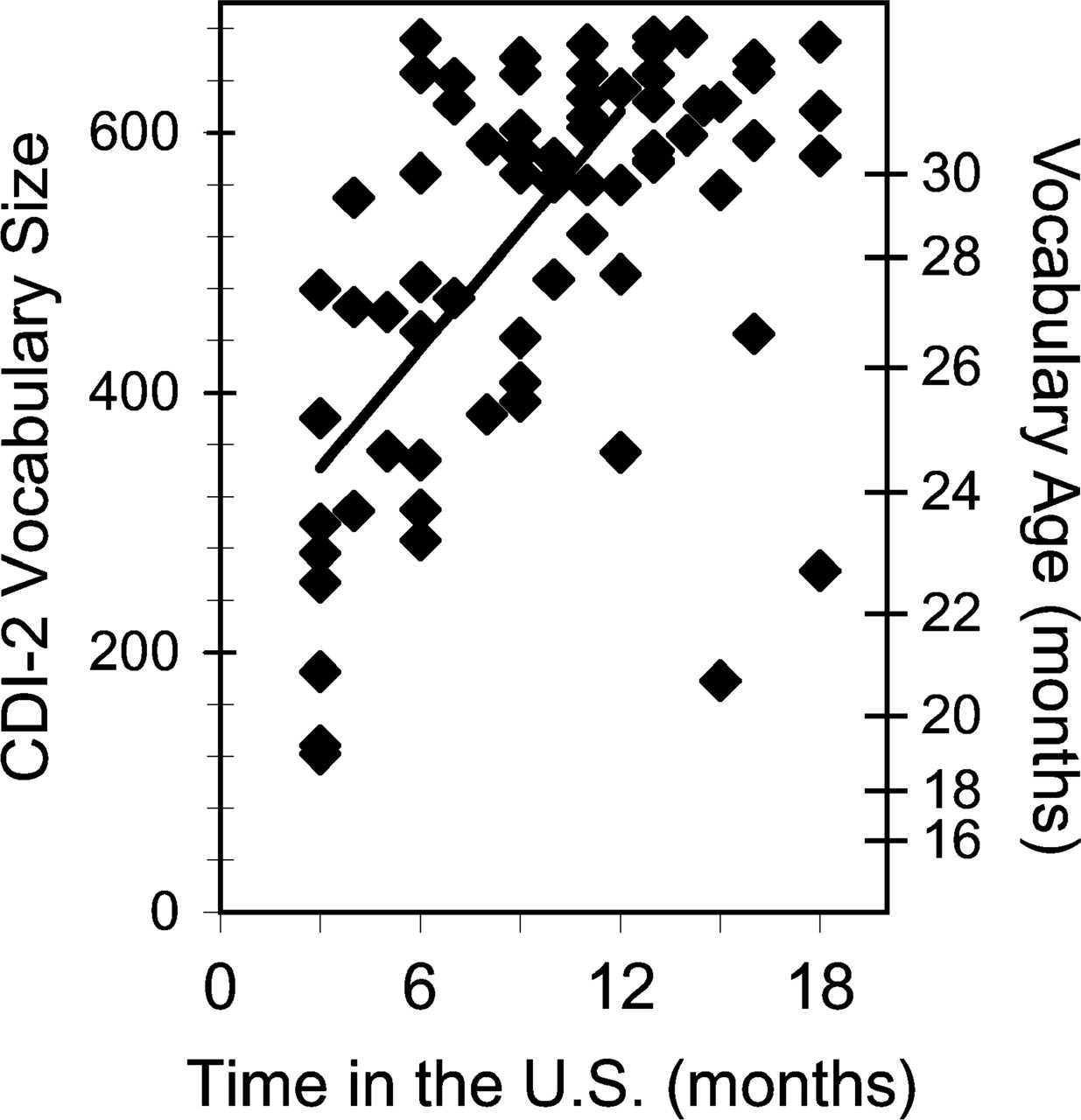
Vocabulary growth in the internationally adopted preschoolers as a function of time in the United States. The secondary y-axis plots the mean vocabulary size of infants of different ages in the norming sample for the Communicative Development Inventory 2 (CDI-2; Fenson et al., 1993), providing age-equivalence scores for the adopted children.
The secondary y-axis of Figure 1 makes it possible to compare vocabulary size in the adopted children with the CDI-2 norms for infant learners (Fenson et al., 1993). After 3 months in the United States, adopted preschoolers had vocabularies that rivaled those of 24-month-olds, who have been speaking for about a year. Thus, internationally adopted preschoolers initially acquire words at roughly 4 times the rate of infants. This suggests that development or prior experience with a language can accelerate the pace of early word learning.
Vocabulary Composition
When children are near the ceiling of the CDI-2, our measures of vocabulary composition will necessarily reflect the composition of the checklist. We therefore removed from our analyses observations in which the child had acquired more than 90% of the words on the CDI-2. The remaining sample included 48 observations from 22 participants. We counted the number of words that each child produced and calculated the proportion of those words that were nouns, the proportion that were verbs, and the proportion that were closed-class items (noun, verb, and closed-class proportion, respectively). For each of these lexical categories, we performed a simple stepwise regression using the first observation from each child and a hierarchical stepwise analysis on the full data set. Vocabulary size, AoA, and the interaction between AoA and vocabulary size were entered as predictors.
The adopted preschoolers showed the same shifts in vocabulary composition as the infant learners (Fig. 2). The proportion of nouns decreased as the children's vocabularies grew, while the proportions of verbs and closed-class items increased (see Table 1). 3 Neither AoA nor the AoA-by-vocabulary-size interaction entered the regressions. We compared the data from each adoptee's first observation with the data from the control infant for that session by conducting paired t tests and stepwise regressions (see Table 2). 4 For all three lexical classes, there was no reliable difference between the groups in the t tests. In the stepwise analyses, there were robust effects of vocabulary size, but group (adoptee vs. control) and the group-by-vocabulary-size interaction did not enter any of these regressions. Thus, although older children learn words more rapidly than infants, they show similar shifts in vocabulary composition as their lexicon grows.
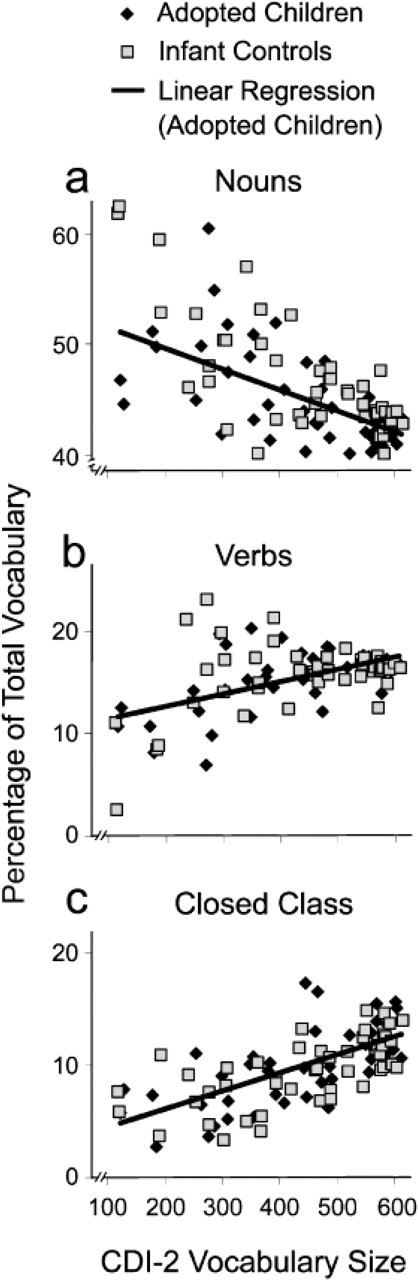
Vocabulary composition as a function of expressive vocabulary size on the Communicative Development Inventory 2 (CDI-2). The proportion of known words that were (a) nouns, (b) verbs, and (c) closed-class items is graphed for the adopted preschoolers and the vocabulary-matched control infants, along with the regression line for the adoptees.
Results of the Stepwise Regressions for Internationally Adopted Preschoolers
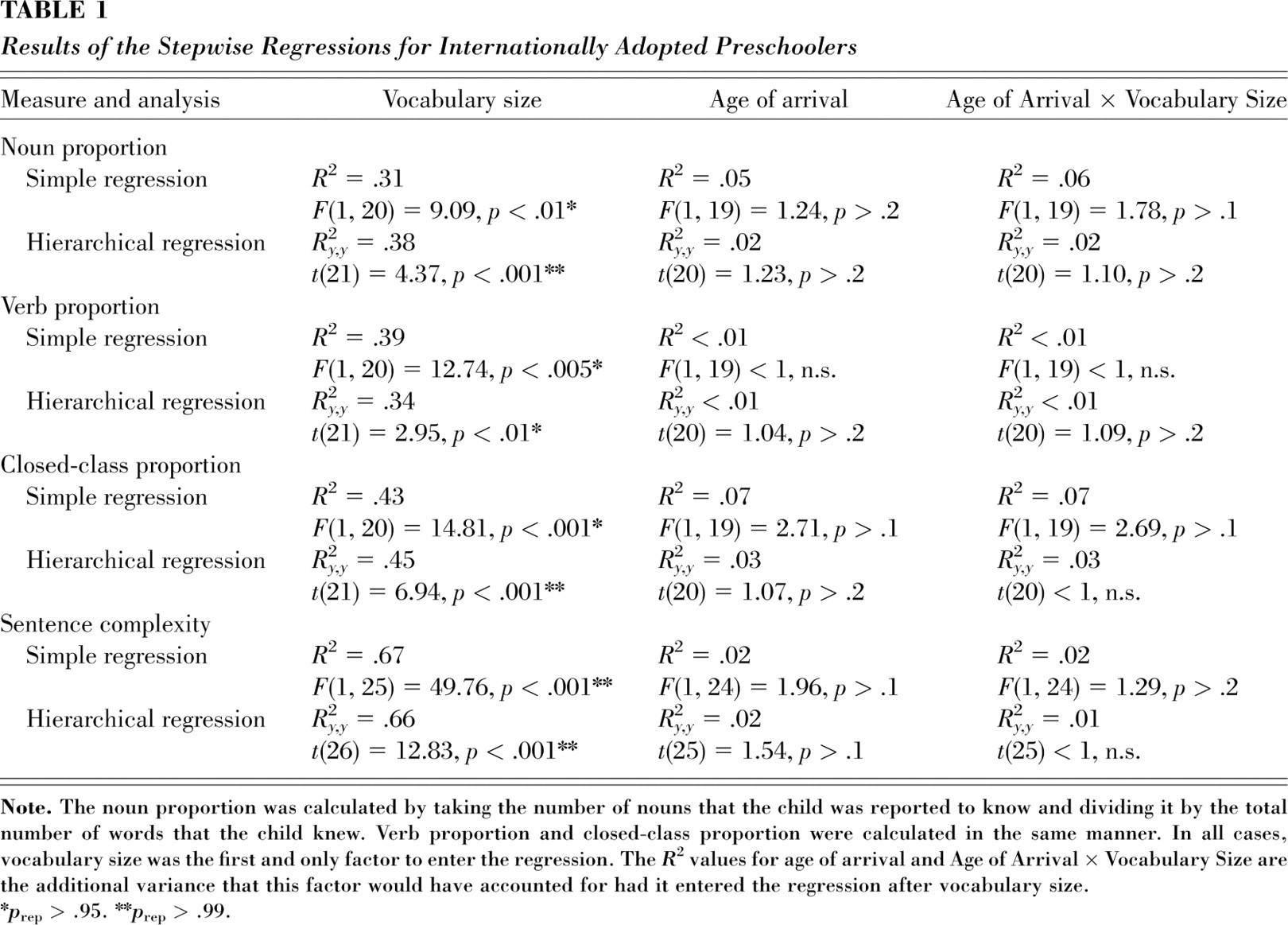
p rep > .95.
p rep > .99.
Results of the t Tests and Stepwise Regressions Comparing Internationally Adopted Preschoolers and Infant Learners
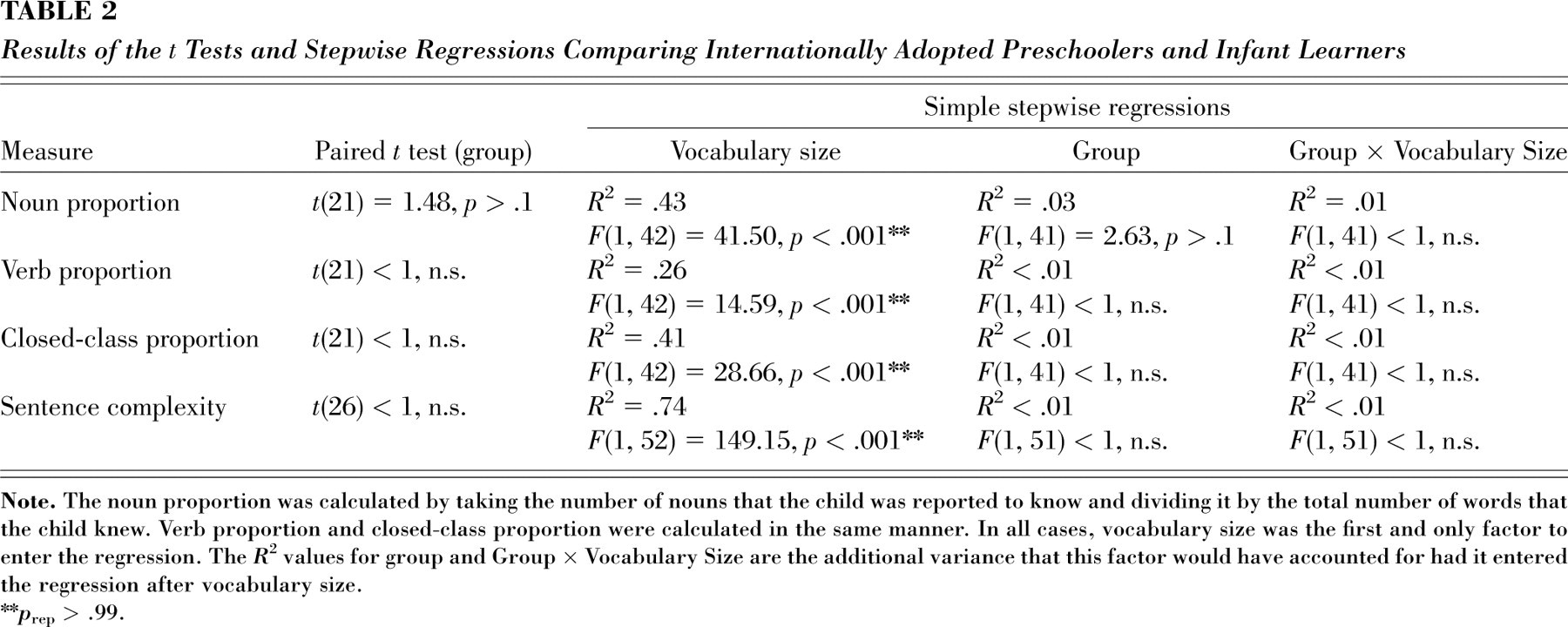
p rep > .99.
Although we cannot conclude that there were no qualitative differences between the vocabularies of the adoptees and control infants, we can infer that any such effects were much smaller than the observed effects of vocabulary size. The regressions summarized in Table 2 had the power to detect effects of this size with virtual certainty (λ = .94 −.98 for η2 = .25) and to detect much smaller effects approximately half the time (λ = .50 −.58 for η2 = .08).
Some researchers have suggested that the early noun advantage on the CDI-2 could be an artifact of the checklist's composition (because more nouns than verbs or closed-class words are included). Were this true, the dominance of nouns should have disappeared when we recoded the data as the proportion of the listed words within each category that the child knew (e.g., nouns known/total CDI-2 nouns), but the differences persisted. Children produced a greater proportion of the listed nouns and verbs than the listed closed-class items, ts(21) > 5, p rep> .99. When vocabulary was under 500 words, children also produced a greater proportion of the nouns than the verbs—a pattern that reversed in vocabularies over 500 words, ts > 2.3, p rep > .90.
Grammatical Development
Infants typically begin combining words when they have a vocabulary of 50 to 200 words (Bates & Goodman, 1997). The 4 adoptees and 5 control infants whose parents said that they were not combining words frequently at the first observation session all had vocabularies under 300 words. Thus, vocabulary size was a marginal predictor of frequent combinations in a logistic regression on the adoptees' data set, R 2 = .70, χ(1, N = 27) = 3.67, p = .055, p rep > .87, and a reliable predictor in a logistic regression on the combined data set, R 2 = .78, χ(1, N = 54) = 6.13, p rep > .94. Participant group was not a reliable predictor in the combined data set, R 2 = .01, χ(1, N = 54) < 1, n.s. As Figure 3 illustrates, sentence-complexity scores were also robustly correlated with vocabulary size in the adopted children and the control infants (Table 1), mirroring previous results in typically developing infants (Bates & Goodman, 1997). AoA and its interaction with vocabulary size were not significant predictors of sentence complexity (Table 1), and the adoptees and control infants did not differ reliably on this measure (Table 2).
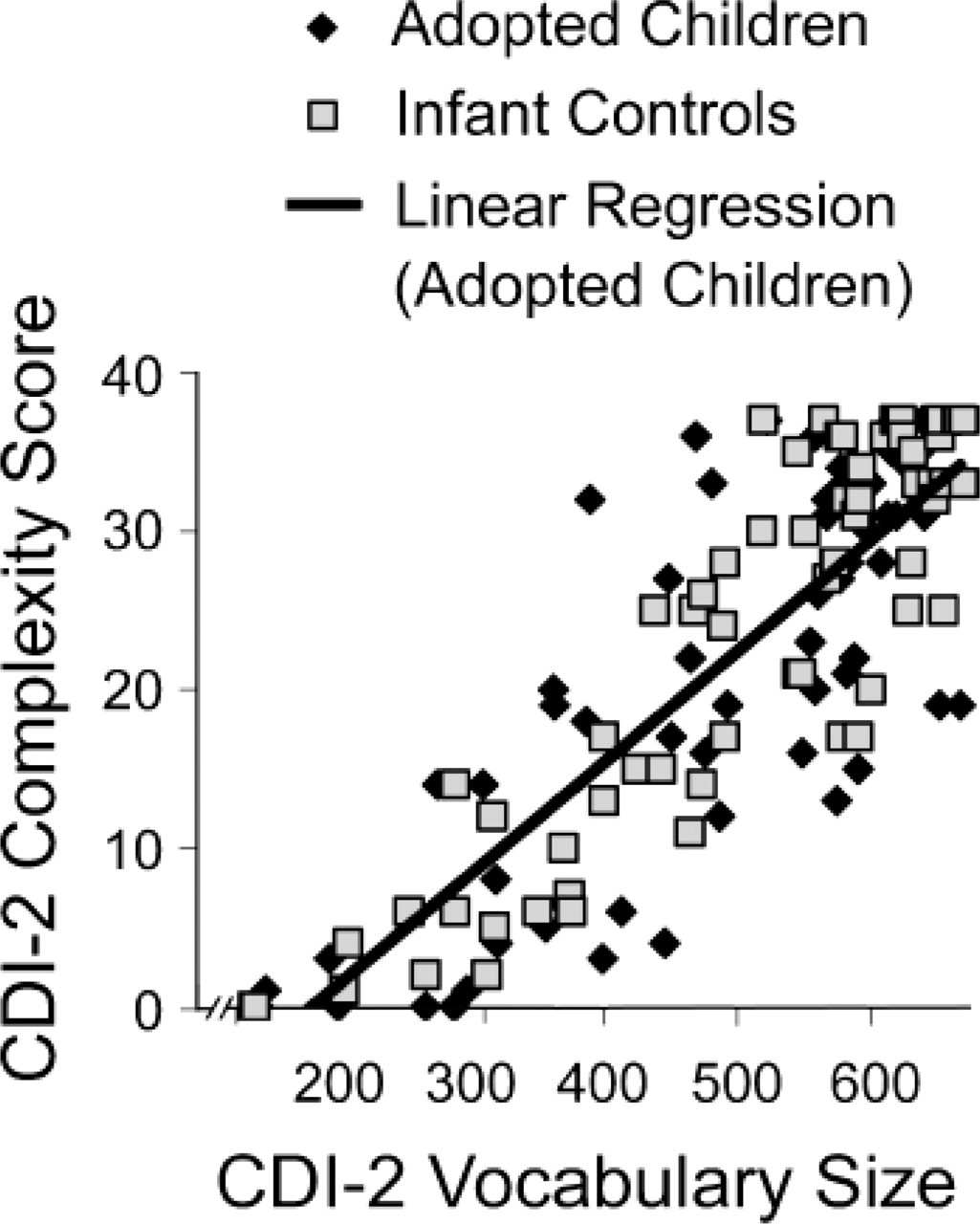
Sentence complexity as a function of expressive vocabulary size on the Communicative Development Inventory 2 (CDI-2). Results for the adopted preschoolers and the vocabulary-matched control infants are graphed, along with the regression line for the adoptees.
DISCUSSION
The internationally adopted preschoolers went through the same shifts in early language development as typically developing infants. Like infants, they initially learned a disproportionate number of nouns, developing a more balanced lexicon over time. Like infants, they initially produced utterances that lacked inflectional morphemes and closed-class words, which were gradually added as vocabulary grew. In infants, these shifts might be credited to general cognitive or maturational changes. However, these adoptees were substantially older; presumably they had already acquired any possible cognitive and maturational prerequisites for early language development. 5 Thus, our results strongly suggest that these features of early language production are due to the nature of the learning problem rather than the limitations of infant learners.
Like any natural experiment, ours had unavoidable confounds. Had we found qualitative differences between the infants and adoptees, we would not have known whether they were attributable to maturation, prior linguistic experience, or early deprivation. Because we found no reliable qualitative differences, we can infer that none of these variables had reliable effects or that two or more did so but tidily canceled each other out. We consider the latter possibility unlikely.
There is, however, one way in which the preschoolers differed from infant learners. Whereas infants initially learn words quite slowly, the adoptees hit the ground running, going through the same stages as infants but more quickly. Thus, although we found no influence of maturational status on the qualitative features of early language acquisition, the speed of acquisition was clearly affected. Few existing proposals can account for the uniformity of this acceleration. Perhaps it reflects the development of domain-general processes affecting learning rate. Older children might require fewer exposures to link a word and concept, or they might be more likely to encode the input or better able to retain it. Improvements in these processes during infancy could play a role in the acceleration of lexical development that typically occurs during the 2nd and 3rd years of life.
Research on early vocabulary composition has centered on Gentner's (1982) noun-dominance hypothesis. The relation between our data and this hypothesis depends on how it is formulated. Many readers have interpreted it as a developmental hypothesis. For example, Hoff (2001) stated: “According to Gentner the relational meanings encoded in verbs are less available to young children through nonlinguistic experience. Thus, children acquire nouns before verbs because the concepts encoded by nouns are earlier cognitive developments than the concepts encoded by verbs” (p. 157). Our results clearly weigh against this interpretation of the hypothesis. If vocabulary shifts are driven by conceptual development, then these shifts should not have occurred in the adopted preschoolers, because they presumably developed the relevant concepts as toddlers.
In subsequent writings, however, Gentner has rejected this developmental account, arguing instead that the vocabulary shift is caused by children's growing knowledge of how their language packages event components into words (Gentner & Boroditsky, 2001). For example, whereas English typically encodes manner of motion in the verb (walk) and path in the preposition (up), Spanish prefers to encode path in the verb (ascender; see Talmy, 1975). Although this version of noun dominance is a contingent-acquisition hypothesis, it is not clear what predictions it makes for early second-language acquisition. On the one hand, if children simply attempt to map second-language labels onto the conceptual conflations provided in their first language, then we would expect precocious verb learning to the degree that verb semantics in the two languages are aligned. We found no evidence of this in the adoptees, despite the fact that many common verbs in English and the Chinese languages have similar meanings (Snedeker, Li, & Yuan, 2003). On the other hand, if children attempt to map second-language labels directly to prelinguistic representations of event components, then the noun-dominance hypothesis would predict that second-language verb learning, like first-language verb learning, should initially be slow and effortful, accelerating as the child learns language-specific conflation patterns. Our data are consistent with this reading of the noun-dominance hypothesis, as well as with Gleitman's information-change hypothesis (Gillette et al., 1999; Snedeker & Gleitman, 2004).
Our claims are fairly modest and easily misconstrued. We are not suggesting that there are no cognitive prerequisites of early language development. To learn a language, a child must be able to perceive linguistic input, store it, analyze it, recall linguistic elements, and recombine them. Nor are we claiming that the time course of language acquisition is unaffected by maturation. For example, our data are consistent with theories in which the onset of word production depends on some prior maturational event.
We are merely arguing that two characteristic features of early language production—developmental shifts in vocabulary composition and the synchrony between lexical and grammatical development—need not be attributed to maturation or cognitive development. Maturation may explain why 15-month-olds produce words and 5-month-olds do not. But there is no need to invoke immaturity to explain why 1-year-olds learn few verbs or fail to use grammatical morphemes. Older and wiser learners show similar lapses when they are placed in the same epistemic situation as infants.
Footnotes
Acknowledgements
We thank Laura Ax, Isabel Martin, Caroline Whiting, and Nicole Gavel for their assistance; Lila and Henry Gleitman for inspiration and conversation; and the families who participated for their altruism. This research was supported by the Roger Brown Fund and the National Science Foundation (BCS-0418423) and was presented at the 27th annual conference of the Cognitive Science Society (July 2005; Stressa, Italy) and the 29th annual Boston University Conference on Language Development (November 2004; Boston). The clinical implications of this study are discussed in Geren, Snedeker, and Ax (2005).
1The contingent-acquisition hypotheses we consider make the weaker claim that one type of knowledge is needed for efficient acquisition or utilization of another type. This is desirable because the phenomena under consideration are strong but violable (e.g., children do learn some verbs early on).

3If we had restricted our analyses to participants producing less than 75% of the words on the CDI-2, these effects would have persisted in the hierarchical analyses for nouns, t(14) = 2.24, p rep > .88; for verbs, t(14) = 3.54, p rep > .96; and for closed-class items, t(14) = 3.08, p rep > .95.
4Hierarchical analyses were not conducted because the control children contributed just one observation each.
5We confirmed this by having parents assess their children's performance on developmental milestones that typically coincide with early acquisition. The internationally adopted preschoolers (n = 20) passed 89% of these milestones, whereas the vocabulary-matched infants (n = 20) passed only 53%.