







Abstract
Adults can use pictorial depth cues to infer three-dimensional structure in two-dimensional depictions of objects. The age at which infants respond to the same kinds of visual information has not been determined, and theories about the underlying developmental mechanisms remain controversial. In this study, we used a visual habituation/novelty-preference procedure to assess the ability of 4-month-old infants to discriminate between two-dimensional depictions of structurally possible and impossible objects. Results indicate that young infants are sensitive to junction structures and interposition cues associated with pictorial depth and can detect inconsistent relationships among these cues that render an object impossible. Our results provide important insights into the development of mechanisms for processing pictorial depth cues that allow adults to extract three-dimensional structure from pictures of objects.
Perceiving objects as globally coherent in three-dimensional space is a fundamental accomplishment of the visual system. Adult observers readily classify simple line drawings as depicting three-dimensionally coherent or incoherent objects (Biederman, 1987; Hochberg, 1964; Schacter, Cooper, & Delaney, 1990; Williams & Tarr, 1997), showing that the visual system is well equipped to rapidly determine whether or not an image represents a view of a structurally possible three-dimensional object. The mature visual system uses several types of pictorial depth information (e.g., linear perspective, texture, shadows, junctions) to facilitate the integration of image fragments into spatially coherent object representations (Enns & Rensink, 1991; Hochberg, 1964), but researchers have yet to determine precisely how and when during development these perceptual abilities emerge. The goal of the present study was to investigate whether 4-month-old infants can use certain types of pictorial depth information to differentiate between images of three-dimensionally possible and impossible objects.
During the first several months of postnatal life, infants demonstrate increasing abilities to detect perceptual similarities and regularities in spatial relations and features of novel objects (Bomba & Siqueland, 1983; Quinn, Slater, Brown, & Hayes, 2001) and show a growing conceptual understanding of the physical and spatial properties of continuous solid objects (Piaget, 1954). By 4 to 6 months of age, infants perceive completion of continuous surfaces and trajectories despite occlusion (Johnson, 2004; Johnson et al., 2003), perceive illusory contours (Ghim, 1990; Johnson & Mason, 2002), recognize real objects after exposure to two-dimensional depictions of them (DeLoache, Strauss, & Maynard, 1979), and discriminate between physically possible and impossible events involving solid objects (Baillargeon, 1987).
Yet much remains to be discovered about the development of the perceptual mechanisms and the pictorial information that infants utilize in performing these tasks. Early studies using manual reaching measures suggested that infants younger than 6 to 7 months of age cannot use pictorial cues to infer depth in object displays (Yonas, Elieff, & Arterberry, 2002; Yonas & Granrud, 1985). Some researchers have argued that motion is a primary cue to relative depth (Kellman & Spelke, 1983) and global three-dimensional form perception (Kellman & Short, 1987) during early development; such arguments have led to the hypothesis that sensitivity to pictorial depth cues develops from learned associations with motion and binocular cues (Sen, Yonas, & Knill, 2001). Experiments that recorded infants' visual attention toward discrepant targets in multielement displays, however, showed that 3-month-olds detect combinations of line-junction and shading cues that are critical for adult perception of three-dimensional objects in static two-dimensional images (Bertin & Bhatt, 2006; Bhatt & Bertin, 2001), calling into question the notion that depth from motion and binocular information serves as a foundation for development of sensitivity to pictorial cues. Neither body of evidence, however, provides insights into how infants utilize pictorial depth information to perceive object coherence.
In the study reported here, we examined the capacity of young infants to discriminate between pictures of possible and impossible objects. Our goal was to determine whether 4-month-olds are sensitive to inconsistencies in the structural information provided in a two-dimensional image of a structurally impossible object. Because the images were two-dimensional, successful performance in this task inherently required sensitivity to junctions, edges, and interposition cues that define the structural configuration of a globally coherent object. Distinguishing possible from impossible figures also entailed the integration of local spatial geometry and detection of structural violations associated with inconsistencies in local relative depth of critical surfaces or junctions.
METHOD
Subjects
The final sample comprised thirty 4-month-old infants (mean age = 122.4 days, SD = 9.8; 12 girls, 18 boys). An additional 4 infants were observed but not included in the sample because of excessive fussiness (2), lack of attention (1), or parental interference (1). Ten infants participated in each of the three experiments. All infants were full term and had no known developmental difficulties. Infants were selected from a public database of new parents and were recruited by letters and telephone calls.
Stimuli
Cube stimuli were animated using Flash (Macromedia Studio MX) and presented as QuickTime movies on a Macintosh G4 computer with a 76-cm color monitor. The cube stimuli in all three experiments subtended 21° visual angle in height and width. Between trials, an “attention getter” (a ball that expanded and contracted in time with a repetitive beeping sound) was shown to return the infants' gaze to the screen.
Procedure
All three experiments investigated whether 4-month-olds could discriminate between structurally coherent (three-dimensionally possible) and structurally incoherent (three-dimensionally impossible) cubes. In the first two experiments, we used a standard visual habituation procedure, presenting a cube with its critical junction occluded. The critical junction was the location where the depth order of overlapping bars of the cube made its global three-dimensional structure either possible or impossible. The habituation phase was followed by a test phase consisting of alternating presentations of unoccluded possible and impossible cubes (Fig. 1). Given that infants generally prefer novel stimuli following a period of habituation (Fantz, 1964), we reasoned that if infants perceived completion of the occluded parts of the cube and the process of completion yielded the perception of a structurally coherent figure, then the infants would exhibit a preference for the impossible cube at test. In the third experiment, we tested whether infants would show a spontaneous preference for one of the display types. Infants viewed the test stimuli used in Experiment 2 without a prior habituation phase.
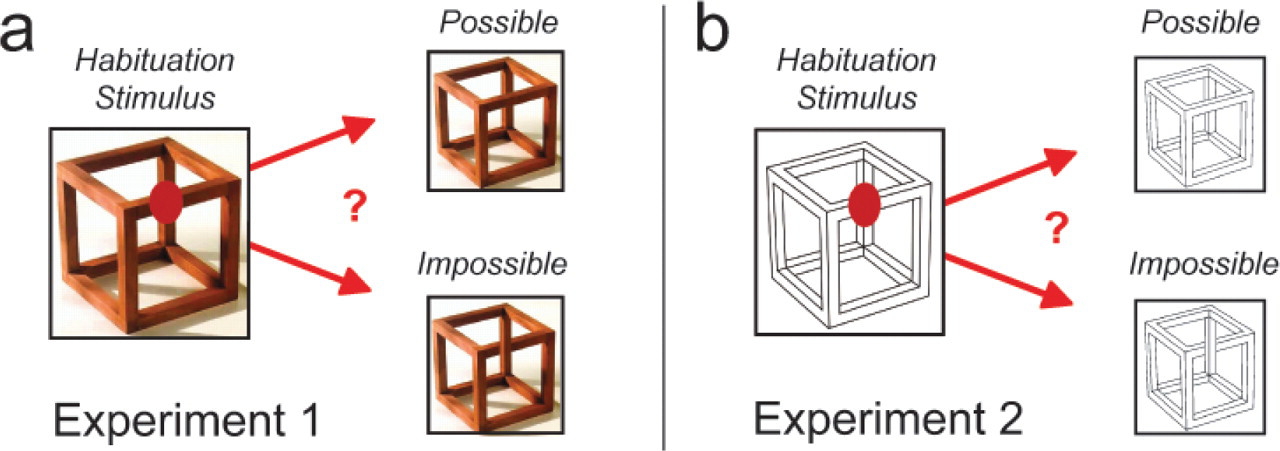
Schematic diagram of the habituation and test stimuli. Experiments 1 (a) and 2 (b) used a standard visual habituation procedure followed by a novelty-preference test. In Experiment 3, the test stimuli used in Experiment 2 were presented without a habituation phase.
In each session, the infant sat in a testing chamber approximately 100 cm away from the visual display. An observer, who could not see the stimulus presentation screen at any time, viewed only the infant on a separate video monitor. The observer pressed a key when the infant looked toward the stimulus and released the key when the infant looked away. The computer presented the stimuli and stored the observed looking times. In Experiments 1 and 2, the computer determined when the habituation criterion had been met (i.e., when total looking time across 4 consecutive trials was less than half the total looking time summed across the first 4 trials) and then the test trials began. Infants viewed a minimum of 5 and a maximum of 12 habituation trials, in which the partly occluded stimulus was presented. We used an infant-controlled habituation procedure in which each trial (habituation or test) ended when the infant looked away from the display for more than 2 s or when the infant had looked at the display for 60 s, whichever came first. Each infant viewed six test displays in alternating sequence. Half the infants tested viewed the possible cube first, and the other half viewed the impossible cube first. Order of test presentation (possible vs. impossible cube first) was counterbalanced in each experiment, and there were no reliable effects of stimulus presentation order in preliminary statistical analyses.
The primary dependent measure was the total amount of time spent looking at each type of object display in test trials. We also calculated mean looking times for each type of test display, as well as the proportion of looking at the impossible cube (novelty-preference score). All tests of statistical significance used an alpha level of .05, and all t tests were two-tailed.
EXPERIMENT 1
The first experiment investigated whether 4-month-olds could discriminate between two-dimensional depictions of structurally possible and impossible cubes. The stimuli resembled photographs and were rich in pictorial depth cues (shading, shadows, texture, color, luminance, and interposition).
Method
The subjects were ten 4-month-old infants (mean age = 125.5 days, SD = 10.1; 2 girls, 8 boys). They were habituated to a photograph-like display of a colored cube in which the critical junction was concealed by a vertically oriented red occluder (Fig. 1a). The occluder used during habituation trials subtended 5.5° × 4° visual angle.
Results and Discussion
At test, the infants looked reliably longer at the impossible than at the possible cube, t(9) = 3.71, p < .01, p rep > .95, d = 1.13, and the proportion of time spent looking at the impossible cube (mean novelty-preference score = .70) differed reliably from chance, t(9) = 6.74, p < .001, p rep > .95, d = 3.03. A summary of the results appears in Table 1.
Mean Looking Times and Novelty-Preference Scores
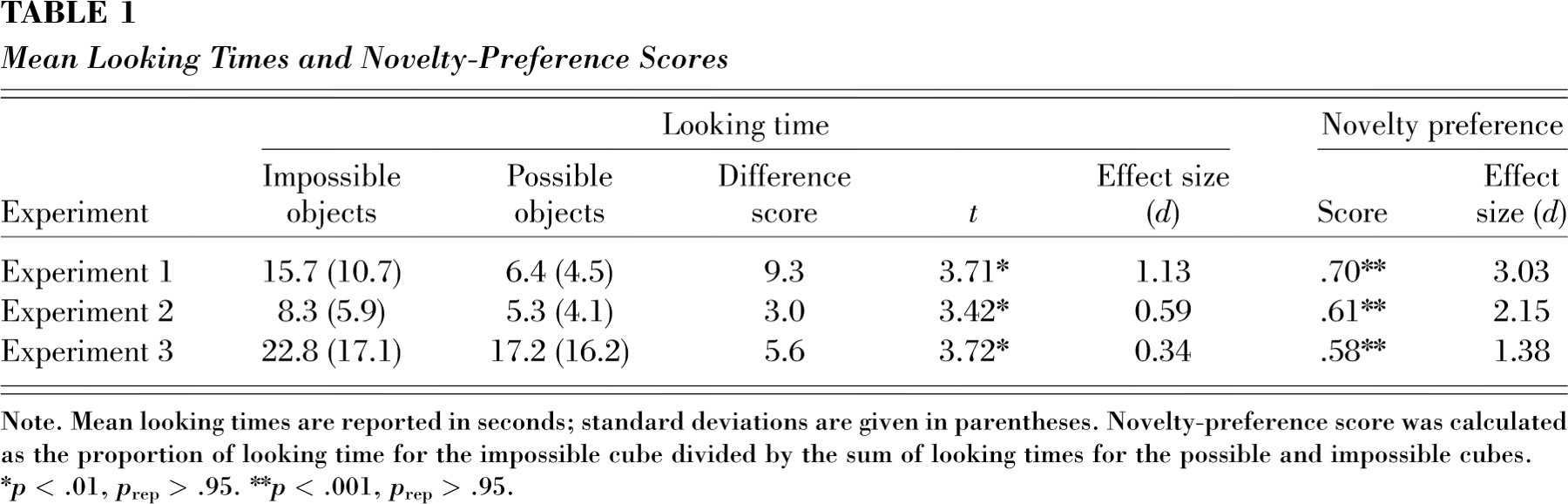
Note. Mean looking times are reported in seconds; standard deviations are given in parentheses. Novelty-preference score was calculated as the proportion of looking time for the impossible cube divided by the sum of looking times for the possible and impossible cubes.
p < .01, p rep > .95.
p < .001, p rep > .95.
The results of Experiment 1 suggest that young infants can detect structural impossibility following habituation to a cube rich in pictorial depth cues; that is, the infants may have completed the cube shown during habituation as a possible cube.
EXPERIMENT 2
We next investigated whether infants would succeed at our task if the pictorial depth cues were based on contour geometry alone. In Experiments 2 and 3, the possible and impossible cubes were represented as line drawings lacking gradients in color, texture, and shading, which provide salient indications of object shape for adult (Sinha & Poggio, 1996) and infant (Granrud, Yonas, & Opland, 1985; Needham, 1998) observers.
Method
The subjects were ten 4-month-old infants (mean age = 120.4 days, SD = 10.4; 3 girls, 7 boys). They were habituated to a display containing a line drawing of a cube with the critical junction occluded by a vertically oriented solid-colored oval (Fig. 1b). The occluder used during habituation trials subtended 5.5° × 4° visual angle.
Results and Discussion
Again, at test, looking time was significantly longer for the impossible than for the possible cube, t(9) = 3.42, p < .01, p rep > .95, d = 0.59, and a greater proportion of time was spent looking at the impossible than at the possible cube (mean novelty-preference score = .61), t(9) = 4.81, p < .001, p rep > .95, d = 2.15.
The results of Experiment 2 show that the outcome of Experiment 1 can be obtained with outline drawings. Sensitivity to interposition and vertex shape alone, therefore, is sufficient for the perception of coherent three-dimensional structure and for discriminating between pictures of possible and impossible objects; the rich pictorial depth cues present in Experiment 1 (shading, shadows, texture, and color) are unnecessary.
EXPERIMENT 3
In the third experiment, we investigated whether habituation to the partly occluded cube was necessary for the infants to discriminate between the line-drawn possible and impossible cubes shown at test in Experiment 2.
Method
The subjects were ten 4-month-old infants (mean age = 121.2 days, SD = 9.2; 7 girls, 3 boys). They viewed, in alternating sequence, the possible and impossible line drawings used in the test phase of Experiment 2. The procedure for testing infants in this experiment was identical to the novelty-preference test phase of the previous experiments. The infants in Experiment 3 viewed only the cube stimuli in the test displays, without prior habituation.
Results and Discussion
Even without habituation to the cube with the occluded critical junction, infants exhibited longer looking times for the impossible than for the possible cube, t(9) = 3.72, p < .01, p rep > .95, d = 0.34, and spent a greater proportion of time looking at the impossible than at the possible cube (mean novelty-preference score = .58), t(9) = 3.10, p = .01, p rep > .95, d = 1.38.
The results of Experiment 3 show that even if the infants did complete the cubes behind the occluders during habituation in Experiments 1 and 2, this did not enhance their ability to discriminate between the possible and impossible cubes. Overall, the experiments show that 4-month-old infants are sensitive to interposition and other junction cues that differentiate possible from impossible cubes.
GENERAL DISCUSSION
These experiments reveal that 4-month-olds are able to discriminate between possible and impossible cubes, and that this ability does not depend on prior experience with the stimulus. Our finding of a reliable preference for the impossible cube suggests that young infants are, in general, sensitive to pictorial information present in two-dimensional images and depictions of three-dimensional objects. The young infant's visual system apparently makes use of the appropriate visual cues provided in a two-dimensional depiction so as to render a geometrically consistent interpretation of the referent object and can detect spatial inconsistencies in the rendered configuration.
To our knowledge, these experiments are the first to document the ability of young infants to discriminate between possible and impossible objects, and the first to demonstrate sensitivity to the junction cues used by adults to construct a three-dimensional object representation from static two-dimensional information. It is not clear why previous experiments have consistently found that pictorial depth information does not guide reaching behavior appropriately until age 7 months (Yonas et al., 2002; Yonas & Granrud, 1985). It may be that this limitation stems from difficulties coordinating visual information and action planning in infants whose manual reaching skills are not yet entirely proficient (Bertenthal, 1996; Munakata, McClelland, Johnson, & Siegler, 1997; Thelen, Schöner, Scheier, & Smith, 2001), or that 4-month-olds are sensitive to pictorial depth cues but do not perceive reliable depth per se from them.
Early in postnatal development, the human visual system is equipped with mechanisms for responding to perceptual cues that facilitate the extraction of information about depth and spatial relations in objects. In situations of occlusion, these mechanisms allow infants to perceive completion of continuous surfaces and parts of shapes (Johnson, 2004). Our results suggest, in addition, that young infants make use of shape and vertex information, as well as interposition cues, to detect global inconsistencies in object structure.
The precise nature of the higher-level computations involved in accomplishing this kind of object discrimination task are not yet well understood, and research has yet to determine the contributions of low-level visual processes, learning, selective attention, working memory, and cortical maturation to the formation of object representations and successful discrimination of possible and impossible objects in infancy. The mature visual system extracts three-dimensional structural information present in two-dimensional images (e.g., spatial relations among surfaces, junctions, and parts) when analyzing the projected three-dimensional configuration (Biederman, 1987; Nakayama, He, & Shimojo, 1995; Williams & Tarr, 1997). For example, studies with adult observers indicate that providing isometric information rich in pictorial cues facilitates the mental reconstruction of three-dimensional objects and enhances performance on tasks of visual search (Enns & Rensink, 1991) and object recognition (Cooper, 1990). Our results advance knowledge of the development of these perceptual mechanisms and suggest that the visual system is sensitive from an early age to at least some pictorial depth information, as well as motion and binocular cues, and is able to distinguish between three-dimensionally coherent and incoherent objects depicted in rich images, as well as in line drawings.
Footnotes
Acknowledgements
This research was supported by National Institutes of Health Grants R01-HD40432 and R01-HD048733 and by National Science Foundation Grant BCS-0418103. We thank Judy DeLoache, Erich Graf, Gregory Murphy, Paul Quinn, Nava Rubin, and Albert Yonas for helpful comments; Les Cohen for Habit software; and Juliet Davidow, Michael Frank, and Melissa Rozon for assistance with scheduling and testing infants. We are especially grateful for the contributions of the parents and infants to the research.