







Abstract

The Trends in International Mathematics and Science Study found that even though children from all East Asian countries outperformed American children, American students reported higher self-evaluation of their math and science abilities than did students from East Asian countries such as China, Korea, and Japan (Mullis, Martin, Gonzalez, & Chrostowski, 2004). Such cross-cultural differences in self-appraisal fit the stereotype of the modest East Asian and contribute to the received view that East Asians have less positive self-concepts than Americans. This view was summarized recently by Heine, Lehman, Markus, and Kitayama (1999) as follows: “The need for positive self-regard, as it is currently conceptualized, is not a universal, but rather is rooted in significant aspects of North American culture” (p. 766; but cf. Sedikides, Gaertner, & Vevea, 2005).
IMPLICIT SELF-ESTEEM
A different perspective is offered by findings from some recent studies that included measures of implicit self-esteem (ISE). These suggest that East Asians may be just as positive in ISE as are Americans (Cai, 2003; Hetts, Sakuma, & Pelham, 1999; Kitayama & Karasawa, 1997; Kitayama & Uchida, 2003; Kobayashi & Greenwald, 2003; Yamaguchi & Murakami, 2000). To provide a strong basis for determining whether East Asians and Americans are similar in ISE, we report the first research directly comparing East Asian and U.S. samples, using the same established and easily replicable procedures for measuring ISE in all groups.
The self-esteem Implicit Association Test (IAT; Greenwald & Farnham, 2000; Greenwald, McGhee, & Schwartz, 1998) measures valence associated with self relative to unspecified others (e.g., Bosson, Swann, & Pennebaker, 2000; Greenwald et al., 2002). In this test, when self is shown to be associated with positive valence more than other is, one cannot assert confidently that the valence of self is affectively positive because of the uncertain affective value of the comparison category (Karpinski, 2004; but cf. Pinter & Greenwald, 2005). For this reason, we chose categories consensually regarded as positive—specifically, best friend and in-group—as the contrast categories for the IATs in the present study. This allowed a stringent test of positivity of self-esteem.
STUDENT SAMPLES IN THREE COUNTRIES
Data were obtained from 505 subjects in three countries (Japan, China, and the United States). Samples were recruited from seven universities, to enhance generalizability: the University of Tokyo (40), Osaka University (34), and Shinshu University (57) in Japan; East China Normal University (60) and Northwest Normal University (106) in China; and the University of Washington (111) and Harvard University (97) in the United States. The ISE/friend IAT measured strength of associations of self and best friend with pleasant and unpleasant attributes, using four idiographic items for both self and best friend: family name, first name, hometown, and birthday. The ISE/in-group IAT measured strength of associations of self (I, me, mine, myself) and in-group (we, our, us, ours) with pleasant and unpleasant attributes. We also included five measures of explicit self-esteem (ESE): the Rosenberg Scale (Rosenberg, 1965), the Self-Liking and Self-Competence Scale (Tafarodi & Swann, 2001), feeling thermometers, and semantic-differential items. Usable data were obtained from 471 subjects for ISE and 477 subjects for ESE.
The mean IAT D measure (Greenwald, Nosek, & Banaji, 2003) was subjected to analysis by hierarchical linear modeling (Raudenbush & Bryk, 2002), separately for each IAT, with subjects nested within universities. Multilevel models allowed improved estimation of effects for this design. Analyses confirmed that both ISE/friend and ISE/in-group measures were affectively positive in all three countries, ts(5) > 5.81, ps < .003 (see Fig. 1). 1 In addition, ISE/friend means for East Asians (n = 276) were not significantly different from those for Americans (n = 195), χ2(1) = 0.21. Surprisingly, Japanese (n = 131) were higher than both Chinese (n = 145) and Americans (n = 195) on the ISE/in-group measure, χ2s(1) > 25.62, ps < .001, ds > 0.58.
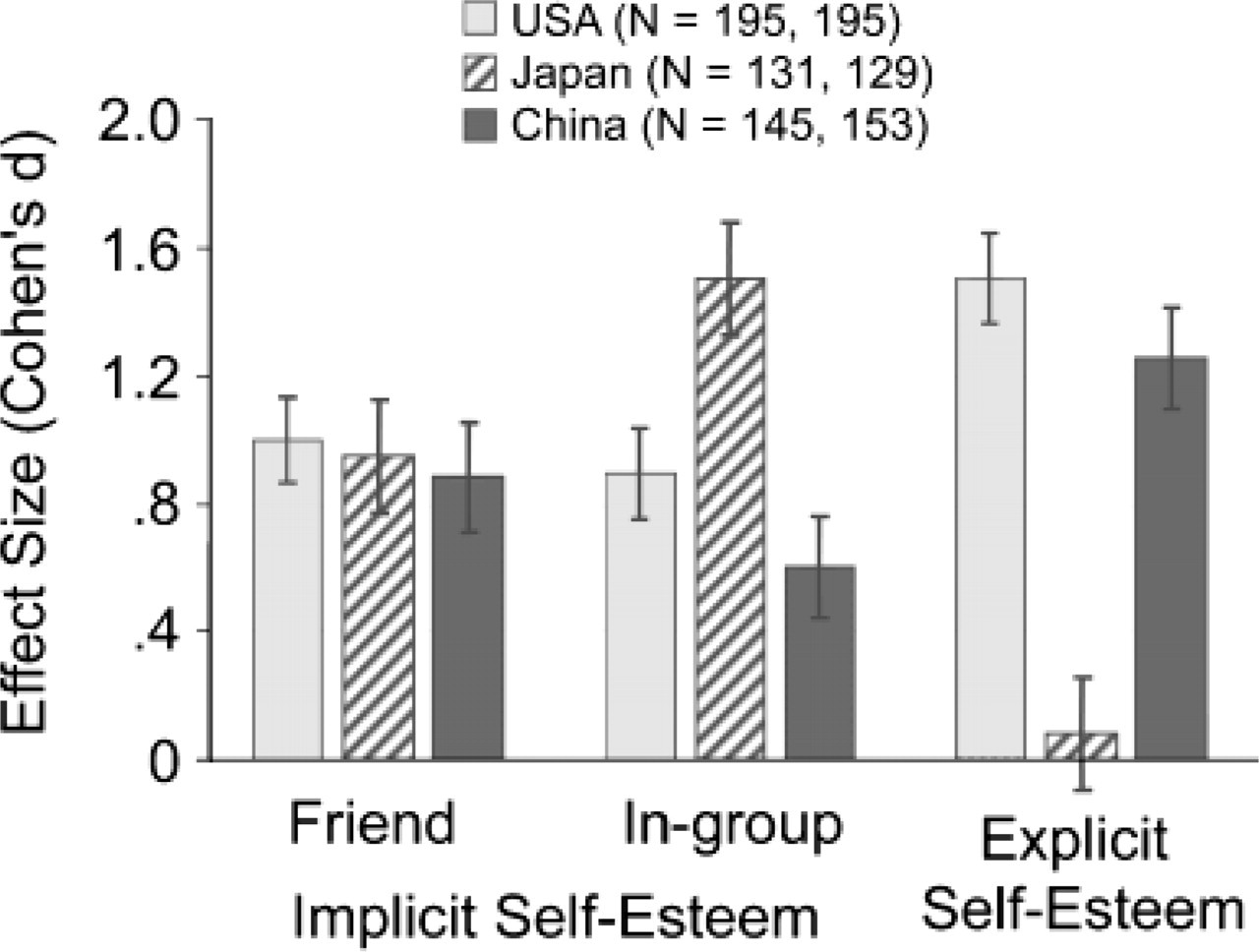
Effect sizes (Cohen's d) for implicit self-esteem (friend and in-group) and explicit self-esteem in the United States, Japan, and China. On the y-axis, 0 indicates neutral self-esteem. Error bars show 95% confidence intervals. In the legend, the first value of n is for the two measures of implicit self-esteem, and the second is for the composite measure of explicit self-esteem.
The parallel HLM analysis of a composite measure of ESE (sum of standardized scores on the five ESE measures) replicated previous findings (Schmitt & Allik, 2005): ESE was higher among U.S. subjects (n = 195) than among East Asian subjects (n = 282), χ2(1) = 29.25, p < .001, d = 0.83 (see Fig. 1). Also, ESE was higher in Chinese (n = 153) than in Japanese (n = 129) subjects, χ2(1) = 10.86, p = .001, d = 0.78. ESE was positively displaced from zero in the United States and China, ts(5) > 5.02, ps < .004, but not in Japan, t(5) = 0.78, n.s. Within-country correlations between ISE and ESE were near zero (−.09 < rs < .15); this finding is consistent with previous observations of weak positive correlations between ISE and ESE (e.g., Bosson, Brown, Zeigler-Hill, & Swann, 2003; Greenwald & Farnham, 2000).
POSITIVE IMPLICIT SELF-ESTEEM IN ALL SAMPLES
In all three countries, ISE was highly positive. This result suggests that positive implicit self-attitude is both universal and robust. Research on cross-cultural differences in cognition has shown most impressively that the culture shapes both the content of what one thinks and how one thinks. Our work provides a related perspective, while also indicating that one important aspect of self-relevant cognition is similar across cultures.
The similarity in ISE across cultures may arise from cross-cultural similarities in child-rearing practices. Perhaps in all cultures, including East Asian and American cultures, parents and other adults provide unconditional love to infants and praise young children (Caudill & Schooler, 1973; Mizuta, Zahn-Waxler, Cole, & Hiruma, 1996; Tobin, Wu, & Davidson, 1989). Such early experiences may foster implicit self-positivity among Japanese and Chinese children as much as among North American children. Other researchers have offered explanations for the difference between Americans and Japanese in ESE (Markus & Kitayama, 1991). Additionally, our findings that Chinese ESE is higher than Japanese ESE and that the ISE/in-group measure is lower among Chinese than among Japanese reinforce other observations that East Asian cultures are not necessarily homogeneous in self-concept (see Oyserman, Coon, & Kemmelmeier, 2002).
Our finding that ISE measures reveal self-positivity in East Asians suggests that positive ISE may be a cultural universal and, therefore, that positive ISE may have beneficial functions exceeding those of positive ESE. The previously received wisdom that self-esteem is not a cultural universal may be more appropriately confined to explicit measures of self-esteem.
Footnotes
1For all the significant ps reported in this article, p rep > .979.
Acknowledgements
This research was partly supported by Grant-in-Aid for Scientific Research (c)(16530397) from the Japanese Society for the Promotion of Science.