







Abstract

Nearly half a century ago, psychiatrist John Bowlby proposed that the instinctual behavioral system that underpins an infant's attachment to his or her mother is accompanied by “internal working models” of the social world—models based on the infant's own experience with his or her caregiver (Bowlby, 1958, 1969/1982). These mental models were thought to mediate, in part, the ability of an infant to use the caregiver as a buffer against the stresses of life, as well as the later development of important self-regulatory and social skills.
Hundreds of studies now testify to the impact of caregivers' behavior on infants' behavior and development: Infants who most easily seek and accept support from their parents are considered secure in their attachments and are more likely to have received sensitive and responsive caregiving than insecure infants; over time, they display a variety of socioemotional advantages over insecure infants (Cassidy & Shaver, 1999). Research has also shown that, at least in older children and adults, individual differences in the security of attachment are indeed related to the individual's representations of social relations (Bretherton & Munholland, 1999). Yet no study has ever directly assessed internal working models of attachment in infancy. In the present study, we sought to do so.
METHOD
Using a visual habituation technique, we tested expectations of caregivers' responsiveness in 10 securely and 11 insecurely attached 12- to 16-month-old infants (mean age = 403 days; 13 females). Attachment security was measured in the lab using the Strange Situation (Ainsworth, Blehar, Waters, & Wall, 1978).
Following Bowlby (1958, 1969/1982) and Ainsworth (Ainsworth et al., 1978), we predicted that different experiences with their own primary caregivers would lead infants to construct different internal working models, including different expectations of caregivers' responsiveness. Thus, we expected that secure infants, compared with insecure infants, would look longer at a display of an unresponsive caregiver (relatively unexpected) relative to a display of a responsive caregiver (relatively expected).
Given recent demonstrations of the abstractness and generality of infants' reasoning about agents (Gergely, Nádasdy, Csibra, & Bíró, 1995; Johnson, 2003; Kuhlmeier, Wynn, & Bloom, 2003), we chose to test infants' expectations with displays of animated geometric characters, rather than actual people. Infants were habituated to a video of two animated ellipses enacting a separation event. The large “mother” and small “child” appeared together at the bottom of a steep incline, and then the mother traveled halfway up the incline to a small plateau. As the mother came to rest there, the child below began to cry, an event depicted by a slight pulsation and bouncing and an actual human infant cry. The animation then paused, allowing the participant to look at the scene as long as he or she desired. Once the participant looked away, the sequence was repeated until his or her visual attention to the event declined to half of its initial amount, as measured by the duration of the participant's looks. When an infant reached this criterion of habituation, each of two test outcomes was shown twice. Each test outcome opened with the mother still positioned halfway up the incline, as the child continued to cry. In the responsive outcome, the mother returned to the child. In the unresponsive outcome, the mother continued up the slope, away from the child. The order in which the outcomes were presented was counterbalanced. Interest in each outcome was measured by looking time.
The Strange Situation sessions of all 21 infants were blind-coded by the third author after training at the Institute of Child Development's Attachment Workshop. A second blind coder, the first author, scored 10 randomly selected sessions. The coders' agreement was 90%, and kappa was .83.
The visual looking times of all infants were coded on-line by an observer blind to attachment status and test event. A second blind observer, also on-line, coded the looking times of 13 of the infants, achieving 93% agreement and a kappa of .82.
RESULTS
Mean looking times for the last three trials of habituation and each outcome were calculated for each infant (see Fig. 1). Securely attached infants looked for 5.9 s (SD = 4.1) at the last three habituation events, 10.2 s (SD = 8.9) at the unresponsive-caregiver outcome, and 7.3 s (SD = 7.0) at the responsive-caregiver outcome. The comparable times in insecurely attached infants were 5.4 s (SD = 2.9), 6.6 s (SD = 3.5), and 8.0 s (SD = 5.4). Preliminary analyses showed no effect of gender or order of presentation on looking times in the outcome trials.
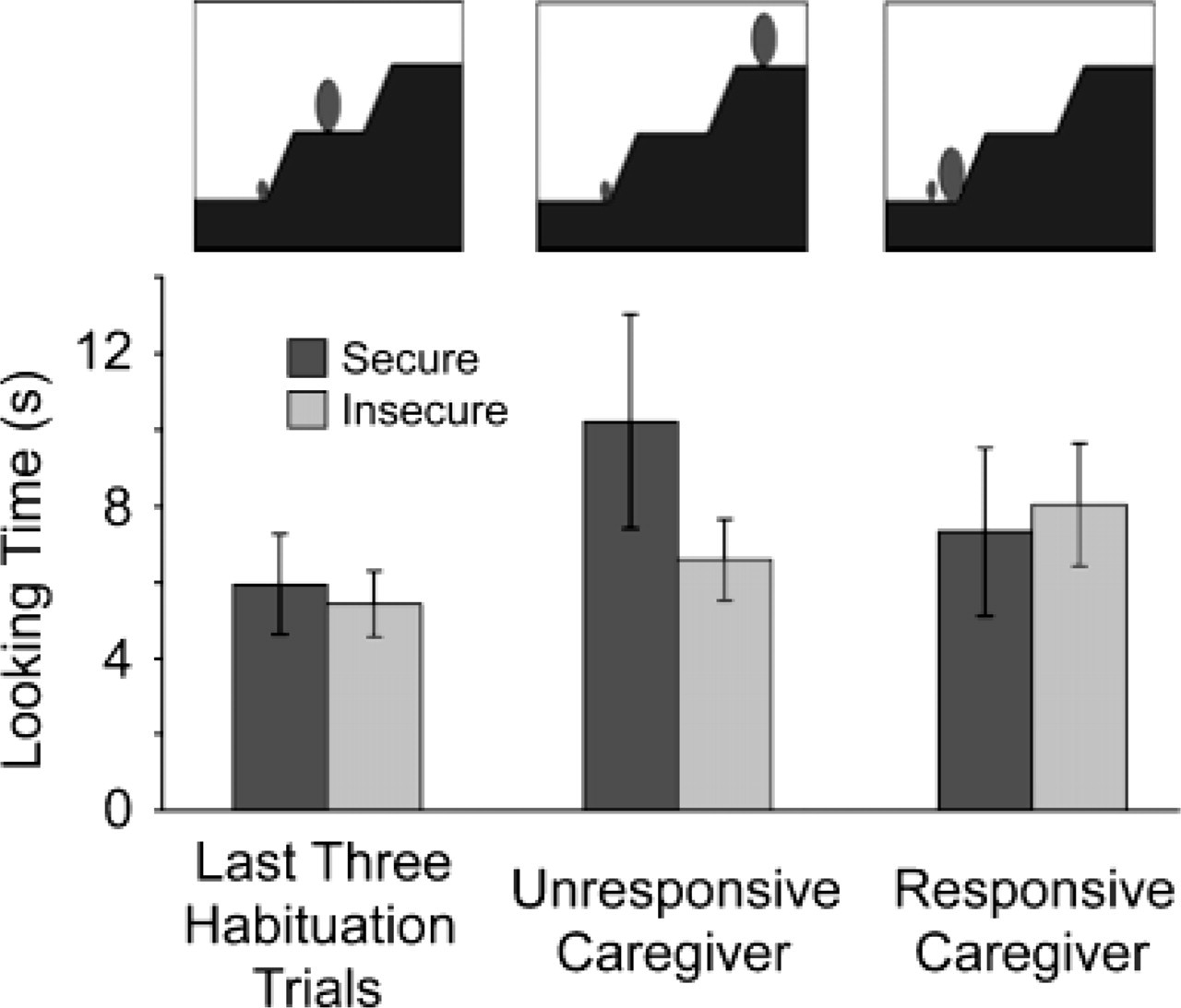
Mean looking times (in seconds) to habituation and test events among secure and insecure infants. Standard error bars are shown. Each illustration depicts the final scene in the video corresponding to the graph below. The large oval represents the “mother,” and the small oval represents the “child.”
A mixed analysis of variance with attachment status (secure, insecure) and outcome (responsive, unresponsive) as variables revealed no differences between secure and insecure infants in the overall amount of time that they looked at the test displays, F(1, 19) = 0.31, n.s., and no differences between the overall looking times (secure and insecure infants combined) to responsive versus unresponsive outcomes, F(1, 19) = 0.48, n.s. However, as predicted, infants' relative interest in the two outcomes did vary by group. Secure infants looked relatively longer at the unresponsive outcome than the responsive outcome compared with the insecure infants, F(1, 19) = 4.76, p = .042. 1 These results constitute direct positive evidence that infants' own personal attachment experiences are reflected in abstract mental representations of social interactions.
The current method opens a new window onto the nature of internal working models of attachment. In addition, these representations can now be traced as they emerge, well before existing behavioral measures of attachment can be employed. The literature on attachment has shown the profound impact of early experience. The method used in the present study provides a means of looking into the mind upon which that experience has left its imprint.
Footnotes
1Results of additional analyses converged. One-tailed, pair-wise comparisons revealed a significant effect of outcome within the secure group, t(9) = 1.99, p < .04, but not the insecure group. Also, 7 of the 10 secure infants looked longer at the unresponsive than at the responsive outcome, whereas 7 of the 11 insecure infants showed the opposite result, p < .07, Mann-Whitney test. The looking behaviors of the two subtypes of insecure infants (6 avoidant, 5 resistant) did not differ.
Acknowledgements
We thank C. Lai, P. Romera, C. Titchenal, and L. Weitzel for assistance.