







Abstract
People possess an innate need to belong that drives social interactions. Aberrations in the need to belong, such as social anhedonia and social anxiety, provide a point of entry for examining this need. The current study used experience-sampling methodology to explore deviations in the need to belong in the daily lives of 245 undergraduates. Eight times daily for a week, personal digital assistants signaled subjects to complete questionnaires regarding affect, thoughts, and behaviors. As predicted, higher levels of social anhedonia were associated with increased time alone, greater preference for solitude, and lower positive affect. Higher social anxiety, in contrast, was associated with higher negative affect and was not associated with increased time alone. Furthermore, greater social anxiety was associated with greater self-consciousness and preference to be alone while interacting with unfamiliar people. Thus, deviations in the need to belong affect social functioning differently depending on whether this need is absent or thwarted.
Human beings are fundamentally social organisms, and human development and functioning occur within a social context. Baumeister and Leary (1995) proposed that people possess an innate need to belong that compels them to pursue frequent and meaningful social encounters. According to this theory, people experience a sense of well-being and enhanced functioning when the need to belong is fulfilled. For example, people with a stronger drive for social intimacy experience greater subjective well-being (McAdams & Bryant, 1987), and social interactions increase positive affect (e.g., Fleeson, Malanos, & Achille, 2002; Watson, 2000). Conversely, disruptions in social needs and connectedness result in negative affect and impairment in functioning.
One way to examine the influence of the need to belong on social functioning is to study deviations in this need, such as social anxiety and social anhedonia. Social anxiety occurs when the need to belong is present but thwarted. Socially anxious people desire interactions, but are less likely than other people to pursue them (and to be successful) because they fear humiliation or rejection (Beidel & Turner, 1998). Social anhedonia is characterized by social disinterest, withdrawal, and a lack of pleasure from social contact, indicating a deficit in the need to belong. Social anhedonia has primarily been studied as a characteristic of schizotypy and schizophrenia. Kwapil (1998) reported that 24% of socially anhedonic subjects in a 10-year longitudinal study developed schizophrenia-spectrum illnesses, compared with 1% of control subjects. Socially anhedonic subjects reported marked disinterest in social contact, preference to be alone, and decreased rates of marriage and dating. Social anhedonia not only has clinical implications, but also appears to be an identifiable personality trait that characterizes many people without diagnosable psychological disorders. Social anhedonia overlaps with introversion—especially with facets of introversion that indicate decreased desire to be with other people and diminished positive affect (Ross, Lutz, & Bailley, 2002). Nevertheless, introversion is often characterized by the need to belong (Baumeister & Leary, 1995), whereas social anhedonia is characterized by disinterest in relationships and a lack of reward from social contact (low need to belong).
Both social anxiety and social anhedonia involve disruptions in the need to belong and result in impairment in social functioning. Social anxiety can be understood as a conflict between competing motives to approach and to avoid social situations (Asendorpf, 1990), whereas social anhedonia is characterized by a diminished approach drive. A study examining the relation between social anxiety and social anhedonia in 364 young adults found a modest association between them, suggesting that social anhedonia and social anxiety are separate, albeit related, constructs (Brown, Silvia, Myin-Germeys, Lewandowski, & Kwapil, 2006). However, no studies have simultaneously examined their impact on functioning. The present study used experience-sampling methodology (ESM) to examine the expression of social anhedonia and social anxiety in daily life.
ESM is a within-day, self-assessment technique in which subjects are prompted at random intervals to report about their current experiences. Researchers in clinical, social, and health psychology have increasingly employed ESM to examine the expression of psychological phenomena in daily life (e.g., Scollon, Kim-Prieto, & Diener, 2003). ESM offers several advantages over traditional data-collection procedures (e.g., Csikszentmihalyi & Larson, 1987; Reis & Gable, 2000). Specifically, ESM (a) repeatedly assesses subjects in their normal daily environment, thereby enhancing ecological validity; (b) assesses subjects' experiences in the moment, thereby minimizing retrospective bias; (c) allows for an examination of the context of experiences; and (d) allows the use of sophisticated multilevel analyses.
Unlike previous investigations, the present study simultaneously examined the expression of social anhedonia and social anxiety in daily life. Given that socially anxious people often experience social situations as distressing, and given that socially anhedonic people have a low interest in socializing, we expected that both characteristics would be associated with a decrease in time spent with other people. We predicted that social anhedonia, but not social anxiety, would be associated with an increased preference for being alone when with others and a reduced desire to be with others when alone. We also predicted that social anhedonia would be associated with increased social distance during social interactions. We hypothesized that social anxiety, but not social anhedonia, would be associated with increased negative affect. We also predicted that both deviations in belongingness would be associated with decreased positive affect (Kashdan & Steger, 2006; Kwapil et al., 2006). Finally, we predicted that social anxiety would moderate the relation between the closeness of social contacts and measures of distress and preference to be alone. Given the findings of Vittengl and Holt (1998), we predicted that social anxiety would be associated with distress and greater preference to be alone when subjects were with people with whom they did not feel close.
METHOD
Subjects
The sample included 245 college undergraduates (184 females and 61 males) enrolled in psychology courses at the University of North Carolina at Greensboro. The sample was 73% Caucasian and 27% African American, and the mean age was 19.5 years (SD = 2.6 years); these values are consistent with the university's demographics. The results did not differ by sex or ethnicity; therefore, we present findings for the total sample.
Materials and Procedure
Subjects completed a brief demographic questionnaire, the Social Phobia Scale (SPS; Mattick & Clarke, 1998) and the Revised Social Anhedonia Scale (RSAS; Chapman, Chapman, & Raulin, 1976) as part of group testing. The 20-item SPS assesses socially anxious concerns of being scrutinized or judged during routine activities. Coefficient alpha was .95 for the SPS in the present sample. The RSAS contains 40 items that tap asociality and disinterest in social contact. Recent studies (e.g., Lewandowski et al., 2006) suggest that some of the RSAS items tap aspects of affective dysregulation. Therefore, on the basis of an a priori analysis of item content, we selected a subset of 15 homogeneous items that specifically tap social disinterest. The correlation between the abbreviated scale and the original scale was .86 in the present sample and .85 in a sample of 7,651 college students, indicating that most of the replicable variance in the scales is shared. The abbreviated scale had a coefficient alpha of .79 in the present sample, which is consistent with the reliability of the original RSAS (despite the considerable shortening of the scale). The abbreviated RSAS was modestly correlated with the SPS, r = .12 (in contrast, the correlation between the full RSAS and SPS is .30).
ESM data were collected on personal digital assistants (PDAs; Palm Pilot Zire model; Palm, Sunnyvale, CA) using iESP software (Intel, 2004). The 36-item ESM questionnaire inquired about affect, social contact, cognitions, and activities at the time of the signal. Sample items include, “I feel happy right now” (positive affect), “I feel guilty right now” (negative affect), and “Right now I would prefer to be alone” (social distance). 1
Subjects attended an information session in which experimenters provided PDAs and described the procedures. The PDAs signaled the subjects, administered the questionnaires, and time-stamped and recorded responses. Subjects were signaled to complete the ESM questionnaire eight times between noon and midnight for 7 days. Subjects had 5 min to initiate their responses following the signal and 3 min to complete each subsequent question. The ESM questionnaire required about 2 min to complete. Subjects met with experimenters twice to download their data. This minimized data loss and facilitated completion of the protocols. Subjects completed an average of 41 questionnaires (SD = 11).
RESULTS
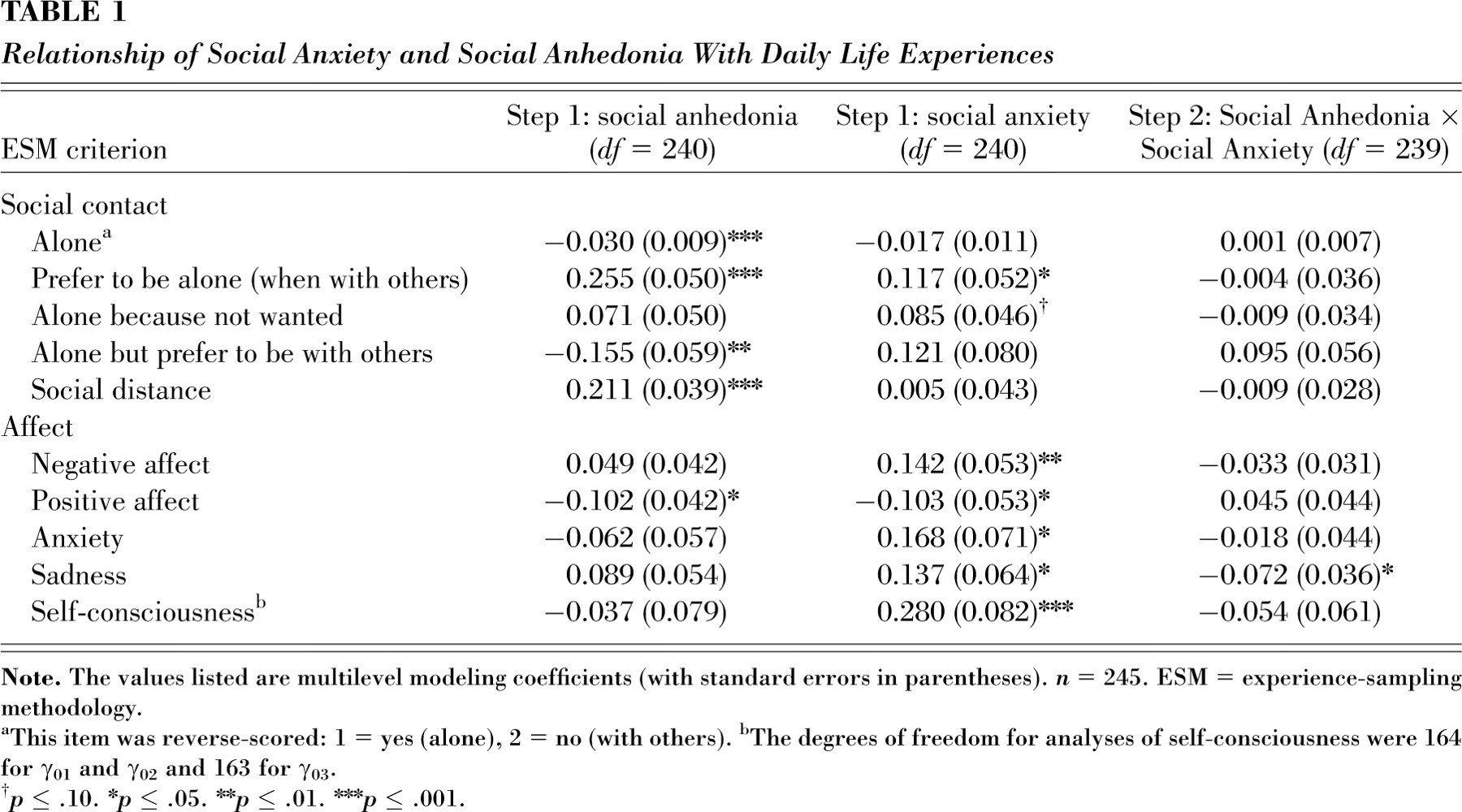
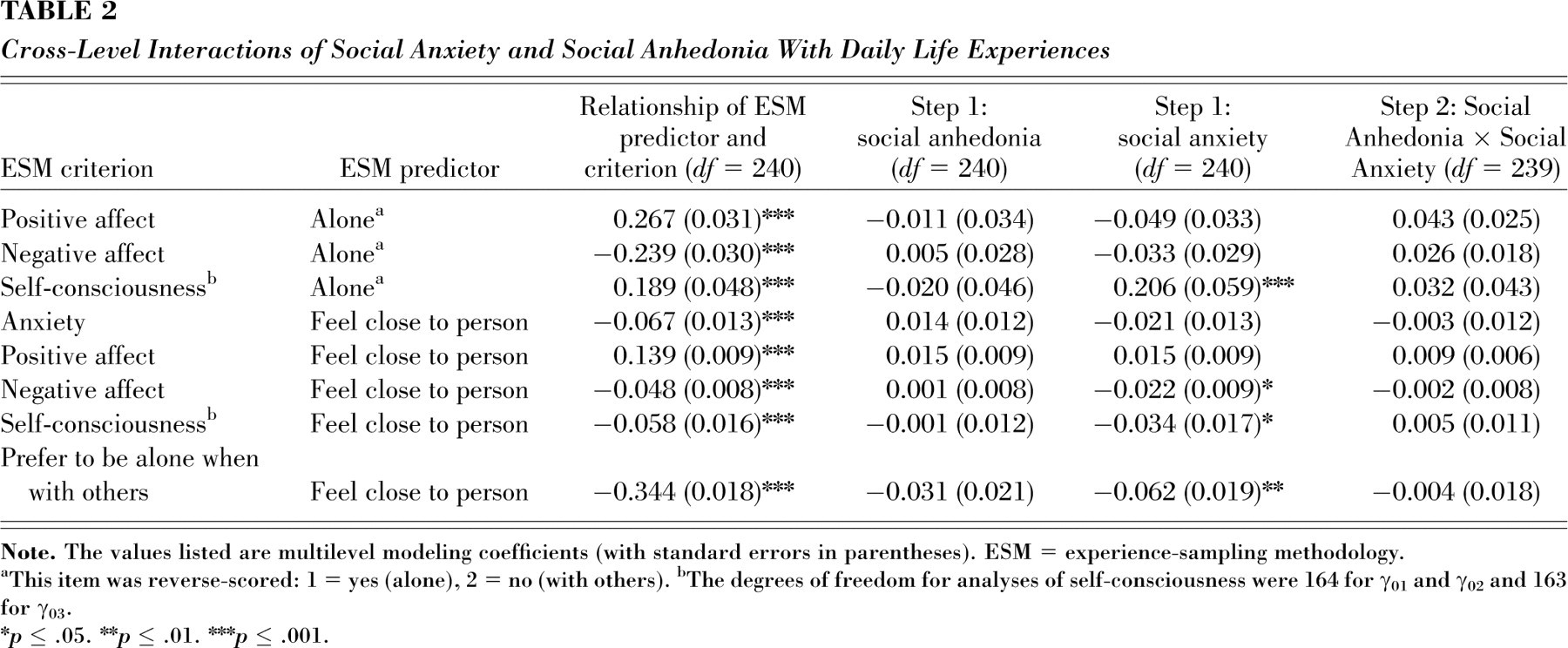
ESM data have a hierarchical structure in which ratings made in daily life are nested within subjects. Two types of analyses were computed. First, the direct relations between social anxiety and experiences in daily life and between social anhedonia and experiences in daily life were assessed (see Table 1). Second, cross-level interactions (Nezlek, 2001) examined the extent to which relationships among ESM variables (e.g., social contact and positive affect) varied across levels of social anhedonia and social anxiety (see Table 2). The multilevel data were analyzed with HLM 6 (Raudenbush, Bryk, & Congdon, 2004). For all analyses, social anxiety and social anhedonia were entered simultaneously into the multilevel equations, followed by their interaction term at the second step. Following the recommendations of Cohen, Cohen, and West (2003) and Luke (2004), we grand-mean-centered the scores for social anhedonia and social anxiety. ESM predictors were group mean (within-person) centered. The data departed from normality, so parameter estimates were calculated using robust standard errors (Hox, 2002).
Relationship of Social Anxiety and Social Anhedonia With Daily Life Experiences
aThis item was reverse-scored: 1 = yes (alone), 2 = no (with others).
bThe degrees of freedom for analyses of self-consciousness were 164 for γ01 and γ02 and 163 for γ03.
† p ≤ .10.
∗ p ≤ .05.
∗∗ p ≤ .01.
∗∗∗ p ≤ .001.
Cross-Level Interactions of Social Anxiety and Social Anhedonia With Daily Life Experiences
aThis item was reverse-scored: 1 = yes (alone), 2 = no (with others).
bThe degrees of freedom for analyses of self-consciousness were 164 for γ01 and γ02 and 163 for γ03.
∗ p ≤ .05.
∗∗ p ≤ .01.
∗∗∗ p ≤ .001.
We examined the relationship of social anxiety and social anhedonia with social functioning in daily life (see Table 1). Social anhedonia—but not social anxiety—was associated with more time spent alone. As hypothesized, social anhedonia was positively associated with preference to be alone when with others and was negatively associated with the preference to be with others when alone. In other words, social anhedonia was associated with a desire to be alone and to remain alone. Contrary to predictions, social anxiety was also associated with preference to be alone when with others; however, it was not associated with a lower desire to be with others when alone. As expected, social anhedonia, but not social anxiety, was positively associated with reports of disengagement during interactions. In other words, social anhedonia was associated with a lack of interest and engagement in social situations. Furthermore, there was a marginal positive association between social anxiety and subjects' attribution that they were alone because others did not want to be with them; such feelings of rejection were not associated with anhedonia.
We also examined whether social interest changed on the basis of the closeness of interactions (see Table 2). As expected, there was a negative relation between closeness and preference to be alone, and social anxiety—but not social anhedonia—moderated this relation. In other words, socially anxious subjects had an especially heightened preference to be alone when they were with other people with whom they were not close.
We next examined whether social anxiety and social anhedonia were associated with affect in daily life (see Table 1). As predicted, social anhedonia was associated with lower positive affect, but not with higher negative affect. In contrast, social anxiety was associated with lower positive affect and higher negative affect, including self-consciousness, sadness, and anxiety. We also found a negative relationship between the Anxiety × Anhedonia interaction term and sadness; this result suggests that the positive relation between social anxiety and sadness is seen only at low levels of social anhedonia.
We next examined whether affective responding differed depending on whether subjects were alone or with others (see Tables 1 and 2). Negative affect was inversely associated—and positive affect was directly associated—with social contact. In other words, people generally reported more positive and less negative affect during social encounters than when they were alone. The cross-level interactions of this relationship were not significant, indicating that social contact per se did not affect affective responding. In other words, the relation between social anhedonia and lower positive affect and the relation between social anxiety and higher negative and lower positive affect were independent of whether or not subjects were alone.
However, the experience of self-consciousness by subjects high in social anxiety was moderated by social contact. Specifically, socially anxious subjects experienced more self-consciousness when with others, relative to when they were alone. As expected, there was no significant cross-level interaction with social anhedonia. In other words, the relation between self-consciousness and social contact found for subjects high in social anxiety was not observed for subjects with social anhedonia.
Although social anxiety and social anhedonia did not moderate affective responses to social situations, affective responding did differ depending on how close subjects felt to the people with whom they were interacting. In general, subjects reported more negative affect, more self-consciousness, and lower positive affect the less close they felt to the people they were with. These relationships did not change across levels of social anhedonia. Negative cross-level interactions for social anxiety, in contrast, indicated that the increase in negative affect and self-consciousness experienced when interacting with people who were not close companions was intensified the more social anxiety subjects reported.
DISCUSSION
The present study supports the view that the need to belong is central to human social functioning and can be disrupted in at least two ways. Specifically, the drive to belong can be diminished, as in the case of social anhedonia, and thwarted, as in the case of social anxiety. The present findings indicate that social anxiety and social anhedonia are associated with markedly different patterns of responses in daily life.
As hypothesized, increased levels of social anhedonia were associated with lower positive affect, but not higher negative affect, in daily life. Furthermore, subjects higher in social anhedonia interacted with other people less frequently, but did not endorse doing so because they felt unwanted. They endorsed the preference to be alone when they were with others and reported less desire for social interactions when they were alone, compared with subjects lower in social anhedonia. Higher social anhedonia was also associated with greater disengagement and distance during social contacts. Overall, it appears that people high in social anhedonia prefer solitude and are not as compelled as others to pursue social interactions.
As noted earlier, the construct of social anhedonia has been studied primarily within the context of schizotypy and schizophrenia research. The daily experiences of subjects high in social anhedonia appear consistent with schizoidal adjustment and negative symptoms of schizophrenia. However, the subjects in the present study were sampled from a college-student population—not a clinical population—so the results suggest that social anhedonia is a disruption in the need to belong that can be readily identified in the general population.
As hypothesized, people higher in social anxiety experienced more negative affect across situations. Consistent with results of recent diary studies by Kashdan and Steger (2006), the present findings indicate that greater social anxiety is also associated with lower positive affect. Contrary to predictions, social anxiety was associated with the preference to be alone when with other people; however, it was not associated with the preference to remain alone. Socially anxious individuals' desire to be alone was driven by the closeness of the relationship: Specifically, they wanted to be alone more when they were with less familiar and trusted individuals than when they were with close companions. Likewise, negative affect and self-consciousness were substantially higher when socially anxious individuals were with others to whom they did not report feeling close than when they were with close companions. These findings indicate that who a socially anxious person is with plays an essential role in his or her distress and desire for solitude.
The present findings support the idea that socially anxious individuals want social contact (unlike socially anhedonic individuals), but feel anxious and uncomfortable when with people outside their trusted circle of acquaintances. Previous empirical studies suggest that socially anxious individuals may have small networks of close friends with whom they have relatively nondistressed social interactions (e.g., Davila & Beck, 2002), and thus the context of social interactions may determine socially anxious individuals' subjective reports of affect. Social anhedonia, in contrast, does not appear to vary depending on the situation, a finding that is consistent with our understanding of social anhedonia as a traitlike construct involving global deficits in affect and interest. Future work examining deviations in the need to belong must more carefully attempt to parse situational differences by examining the exact nature of subjects' relationships with their interaction partners and the specific types of social situations they encounter.
Footnotes
1The complete ESM protocol and administration manual can be obtained by e-mailing the first author.
Acknowledgements
This research was supported in part by a National Science Foundation graduate fellowship awarded to Leslie Brown. We thank Eve Lewandowski for her thoughtful comments and A.J. Anderson, Gena Barbee, Ben Cline, and Sarah Coates for assistance in data collection.