







Abstract
Research on racial attitudes indicates that acceptance of the principle of racial equality is frequently offset by opposition to policies designed to eliminate injustice. At the same time, research on the contact hypothesis indicates that positive interaction between groups erodes various kinds of prejudiced attitudes. Integrating these two traditions of research, this study examined whether or not interracial contact reduces the principle-implementation gap in racial attitudes. The study comprised a random-digit-dialing survey of the attitudes and contact experiences of White and Black South Africans (N = 1,917). The results suggest that among Whites, there remains a stubborn core of resistance to policies designed to rectify the injustices of apartheid. The results also indicate that interracial contact has differential, and somewhat paradoxical, effects on the attitudes of Whites and Blacks toward practices aimed at achieving racial justice.
Research on prejudice has increasingly demonstrated that racial attitudes need not assume a singular or fixed form. Not only may their nature vary over time and across different contexts and communities, but also they may assume disparate expressions within the same individual. Ironically, recognition of the variability of racial attitudes has clarified why prejudice is resistant to change, even in societies where overt bigotry has become unacceptable. Precisely because it is multidimensional and fluid, prejudice can operate in contextually adaptive ways, an idea captured by distinctions between symbolic and old-fashioned prejudice (Kinder & Sears, 1981), subtle and blatant prejudice (Pettigrew & Meertens, 1995), and implicit and explicit prejudice (Greenwald & Banaji, 1995). Dovidio and Gaertner (1998) likened prejudice to “a virus that has mutated and … evolved into different forms that are more difficult not only to recognize but also to combat” (p. 25).
THE PRINCIPLE-IMPLEMENTATION GAP
The evolutionary and multifarious nature of prejudice is illustrated by research on the principle-implementation gap, which diagnoses a contradiction in modern racial attitudes (Durrheim & Dixon, 2004). On the one hand, survey research has provided evidence for a sharp historical decline in support for the principle of racial inequality in many societies. In the United States, for example, few Whites now endorse the principle of segregation in the spheres of employment, residence, and education (Taylor, Sheatsley, & Greeley, 1978). On the other hand, resistance to the implementation of concrete policies of racial equality remains relatively high. Many White Americans, for example, reject interventions designed to accomplish racial integration (e.g., busing) and prefer residential environments where African Americans remain in the minority (Ihlanfeldt & Scafidi, 2004).
The principle-implementation gap is most starkly evident in evaluations of policies that are race preferential (e.g., affirmative action), as opposed to merely race compensatory (e.g., programs to reduce skills deficits; Tuch & Hughes, 1996). This may be because preferential policies are perceived as threatening proprietary claims over resources and undermining dominant groups' sense of positioning within a racial hierarchy (cf. Blumer, 1958). Other explanations have focused on the role of factors such as perceived realistic competition, stratification beliefs, and symbolic racism (Sears, Van Laar, Carrillo, & Kosterman, 1997; Tuch & Hughes, 1996), and there is not yet a consensus about the nature and causes of the principle-implementation gap. Even so, a recurring theme in several traditions of attitude research is that Whites oppose race-targeted policies designed to reduce inequality (Schuman, Steeh, Bobo, & Krysan, 1997).
THE CONTACT HYPOTHESIS
If research on the principle-implementation gap has underlined the tenacity of prejudice, research on interracial contact has emphasized its corrigibility. The contact hypothesis (Allport, 1954) suggests that even deep-seated antipathies toward another group may be improved by regular interactions with members of that group. Ideally, such contact should be devoid of competition and arranged to achieve superordinate goals (i.e., goals that require coordination between groups in order to achieve a mutually beneficial outcome). Furthermore, it should involve intimate communication between parties who are of equal status, as opposed to superficial or hierarchical exchanges. Especially when such circumstances prevail, contact can improve prejudice; recent reviews of the literature demonstrate that intergroup contact has a consistent effect on emotional reactions and stereotypes (Pettigrew & Tropp, 2006).
Although the contact hypothesis is now established as “one of psychology's most effective strategies for improving intergroup relations” (Dovidio, Gaertner, & Kawakami, 2003, p. 5), several commentators have voiced misgivings about its underlying model of social change (e.g., Dixon, Durrheim, & Tredoux, 2005). They accept that contact may transform interpersonal attitudes and stereotypes, but caution that it may leave unaltered the ideological beliefs that sustain systems of racial discrimination. Jackman and Crane (1986), for instance, questioned the concept of prejudice that underpins the contact hypothesis, which treats attitudes primarily as “emotionally based outgrowths of the ignorance that accompanies the physical separation of blacks and whites” (p. 479). What this concept ignores, they argued, is the political origins of attitudes as a means of justifying privilege, even in contexts where emotional acceptance of other groups has increased. Thus, in their analysis of U.S. survey data, Jackman and Crane found that friendly contact and acquaintanceship predicted Whites' scores on measures of racial affect but had limited association with their support for programs to combat inequality in housing, jobs, and education (except among a small group of respondents who had Black friends of higher socioeconomic status than themselves). In other words, contact left largely intact a stubborn core of policy attitudes.
Although Jackman and Crane's (1986) call for a more nuanced conception of prejudice in contact research is apt, their work is now dated, and to our knowledge, their central thesis has not been systematically explored by other research. Moreover, like much research on prejudice, their work concentrated on Whites' policy attitudes, leaving open the question of how contact shapes Blacks' attitudes. In light of these limitations, it is premature to dismiss the possibility that contact sometimes generates support for race-targeted interventions. In contexts where it increases Whites' knowledge of racial discrimination and their empathy with its victims, for example, contact may encourage a moderation of the principle-implementation gap.
Effects of contact on minority groups' attitudes toward race-targeted policies are more difficult to predict. On the one hand, regular interaction with members of historically advantaged groups may cue social comparison processes, increasing minority members' awareness of injustice (Poore et al., 2002) and thus their support for race-targeted interventions. On the other hand, contact may lead members of minority groups to sympathize with out-group members as potential victims of race-preferential policies, or to appreciate more fully the practical obstacles to implementation, and thus may decrease their support for such policies.
THE PRESENT STUDY
The present study integrated two traditions of research that have developed in comparative isolation: work on the principle-implementation gap in racial attitudes and work on the contact hypothesis. The study was located in the instructive context of the changing landscape of South Africa, where for the past decade the government has implemented a wide-ranging program of reforms that seems to be improving some aspects of race relations (e.g., Gibson, 2004). As part of a national survey of attitudes toward change in postapartheid society, it addressed two questions: (a) Do South African attitudes reproduce the principle-implementation gap documented in other societies, and (b) how does interracial contact influence Black and White South Africans' support for race-targeted policies of equality?
METHOD
The study consisted of a random-digit-dialing telephone survey, which measured respondents' perceptions of their interracial contacts and their attitudes toward various principles and policies of racial equality.
Subjects
Adult (>18 years old) South Africans (N = 2,090) were recruited via a random, nationwide sampling of cellular telephone numbers. We focus here on the responses of Black (n = 1,556) and White (n = 361) respondents.
A note on this sampling protocol is required. Although cellular technology has spread rapidly in postapartheid South Africa, with more than 50% of the population now owning a cellular phone, this method of recruitment may underrepresent the poorest segments of the society, who overwhelmingly belong to the Black group. An analysis of household income, however, confirmed that our sample adequately represented the poorest Black Africans, as more than 40% of the Black respondents reported an annual income of R6,000 (about $800) or less. If anything, this figure suggests a greater degree of poverty than the national average (e.g., see estimates presented by Roberts, 2005, p. 487). At the same time, analysis of educational indicators suggested that our Black sample had higher levels of education than the general Black population, 1 a fact that qualifies the external validity of our research.
Questionnaire
The survey instrument comprised two sets of items, which were translated into six languages (English, Afrikaans, Zulu, Xhosa, Sepedi, and SeSotho). The first set (n = 4) tapped dimensions of interaction between White and Black people that have been featured widely in research on contact (e.g., Islam & Hewstone, 1993). Two of these items gauged the amount of interracial contact in terms of rates of casual conversation and interactions with friends. For example, the question “How often have you had conversations with White people in the past week?” offered the response options “not at all,” “once or twice,” and “three times or more.” Prior to analysis, these two quantity-of-contact items were combined to form a single measure. Specifically, we transformed scores on measures of the frequency of casual and friendly contact into an ordinal variable with three degrees of contact between Blacks and Whites: no contact, casual contact only, and both casual contact and friendly contact. The other two items measured contact in terms of its perceived cooperativeness and equality. For example, the question “When you come into contact with White people, is your contact with them friendly and cooperative?” offered the response options “most of the time,” “sometimes,” and “hardly ever.” In our subsequent analyses, these two items were used as individual measures of the perceived quality of contact.
The second set of measures (n = 12) tapped (a) in-principle attitudes toward racial equality in South Africa and (b) attitudes toward race-targeted policies in the context of employment, education, and land. Based on items used in research in the United States (e.g., Schuman et al., 1997), these measures were adapted for the South African context. In the sphere of employment, for example, respondents evaluated both the ideal of racial equality and the policies of affirmative action and race-targeted skills training.
Procedure
The study employed a telephone survey protocol. Drawing on a database of randomly generated cellular telephone numbers, a team of trained, multilingual research assistants interviewed respondents in their preferred language. Interviews lasted between 15 and 30 min and were collected over 3 months. Participants' verbal responses were captured using an electronic questionnaire and then written to a database.
RESULTS
Attitudes Toward the Principle and Practice of Racial Equality
We anticipated differences between levels of support for the principle of racial equality and levels of support for policies aimed at achieving this equality. Given that race-targeted policies in postapartheid South Africa are designed to address the problem of Black poverty and disadvantage, we also anticipated that this principle-implementation gap would be smaller for Black than for White respondents. To test for these differences, we calculated the proportion of respondents in each race group who were opposed to (a) the ideal of justice in each of three domains (education, employment, and land ownership) and (b) policies aimed at achieving this justice in each domain. We also computed the average proportion of opposition to the ideal across the three domains and the average proportion of opposition to policies across the domains. Confidence intervals around these estimated proportions were calculated, and nonoverlapping intervals indicate statistically significant differences between proportions (α = .01).
Figure 1 displays these results graphically for White and Black respondents. The figure shows that few White respondents opposed the principle of equality, but a significant number opposed some of the compensatory and preferential practices aimed at achieving this principle in each domain. 2 Further, opposition to preferential practices was greater than opposition to compensatory practices in the domains of land, education, and employment. The overall principle-implementation gap—a composite of the three principle items and the six practice items, respectively—was statistically significant and very large (d = 1.88, calculated over mean differences rather than percentages): The difference in levels of opposition was about 27%. The probability of replicating an effect of this size (Killeen, 2005) is very high, p rep > .99 (assuming a realization variance of .08).
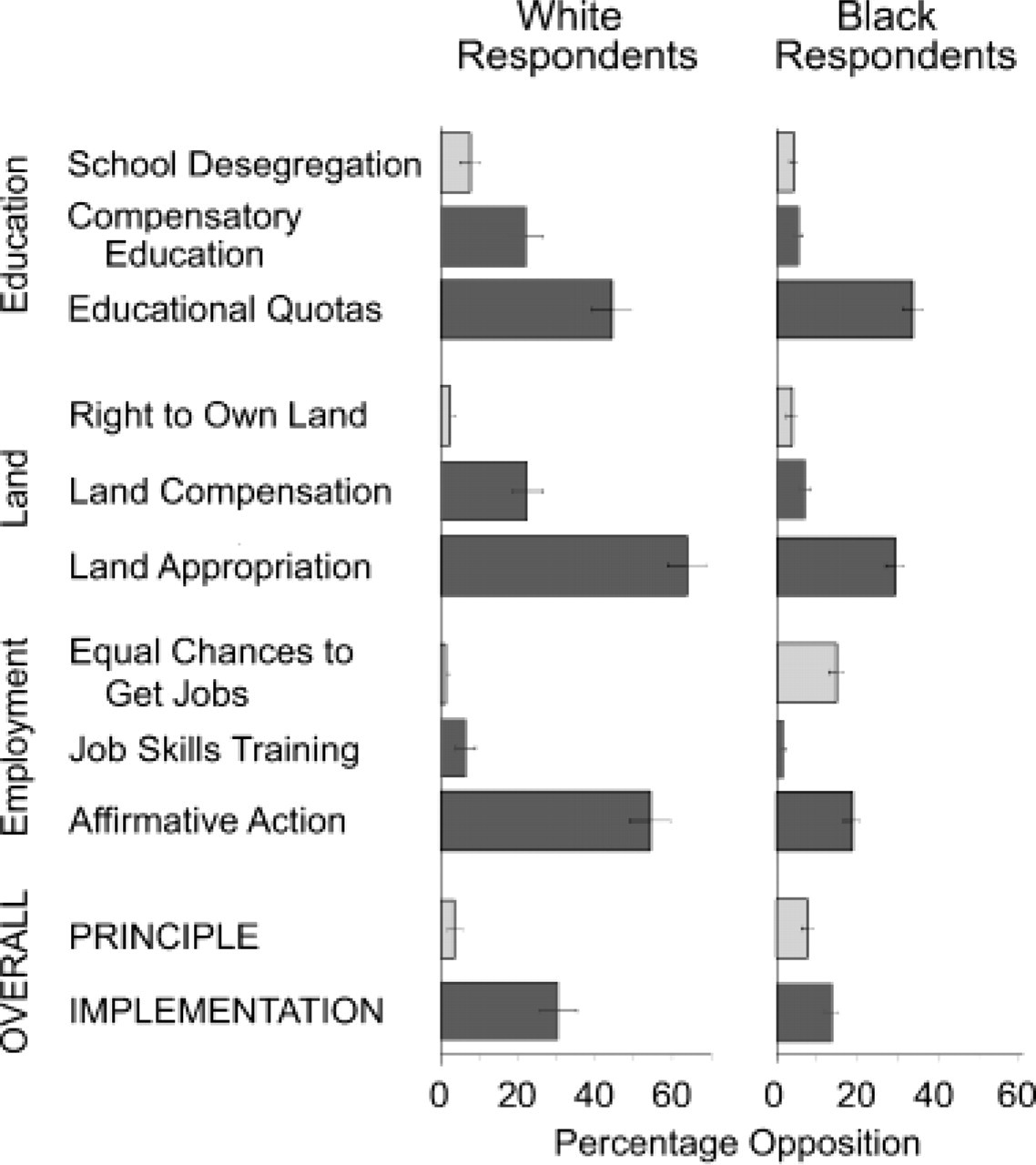
Percentage of Whites (left) and Blacks (right) opposing principles and practices of racial equality, shown with 99% confidence intervals. Nonoverlapping intervals indicate statistically significant differences (α = .01). In each column, the top three graphs present results separated by domain, and the bottom graph presents results averaged across domains. From top to bottom within each domain, results are presented for a principle of equality, a compensatory practice, and a preferential practice (e.g., for education, school desegregation is the principle, compensatory education is the compensatory practice, and educational quotas is the preferential practice).
A similar analysis for Black respondents yielded a somewhat different pattern. Opposition to the principle of equality was again low in each of the domains. However, in this group, opposition to compensatory practices was not significantly higher than in-principle opposition. Opposition to preferential practices was higher than opposition to the principle of equality, but lower than that shown by White respondents. Although statistically significant, the overall principle-implementation gap was small for Black respondents: a difference of about 6% (d = 0.66; p rep > .91, assuming a realization variance of .08). The difference between the principle-implementation gaps of White and Black respondents was thus quite large (21%), and statistically significant, t(1915) = 17.89, p < .001, d = 1.05 (p rep > .99, assuming a realization variance of .08).
Contact and Levels of Support for Race-Targeted Policies
Research on the contact hypothesis has shown that contact reduces prejudice; however, this effect is generally stronger and more consistent for majority-group members than for minority-group members (Tropp & Pettigrew, 2005). Accordingly, we explored the relation between contact and opposition to compensatory and preferential practices separately for each race. In order to do so, we treated support/opposition to practices as a dichotomous dependent variable and the composite quantity-of-contact variable as a continuous independent variable. For each racial group, we conducted a logistic regression analysis of the relation between support/opposition and quantity of contact.
Table 1 reports the resulting unstandardized coefficients (b) and corresponding tests of statistical significance. For White respondents, four of the relations were significant and in the expected direction; that is, more contact led to less opposition to the practices. Three of the relations were significant for Black respondents, but these relations were in the direction opposite to that observed for the White respondents; that is, more contact led to more opposition to the practices. This difference between Blacks and Whites is underscored by the fact that the signs of the coefficients reported in Table 1 are uniformly negative for the White sample and uniformly positive for the Black sample. Measures of effect strength were moderately low, and this finding is in keeping with the average effect (r = .21) reported in Pettigrew and Tropp's (2006) recent meta-analysis.
Results of the Logistic Regression Analysis Testing the Relation Between Quantity of Interracial Contact and Opposition to Compensatory and Preferential Practices
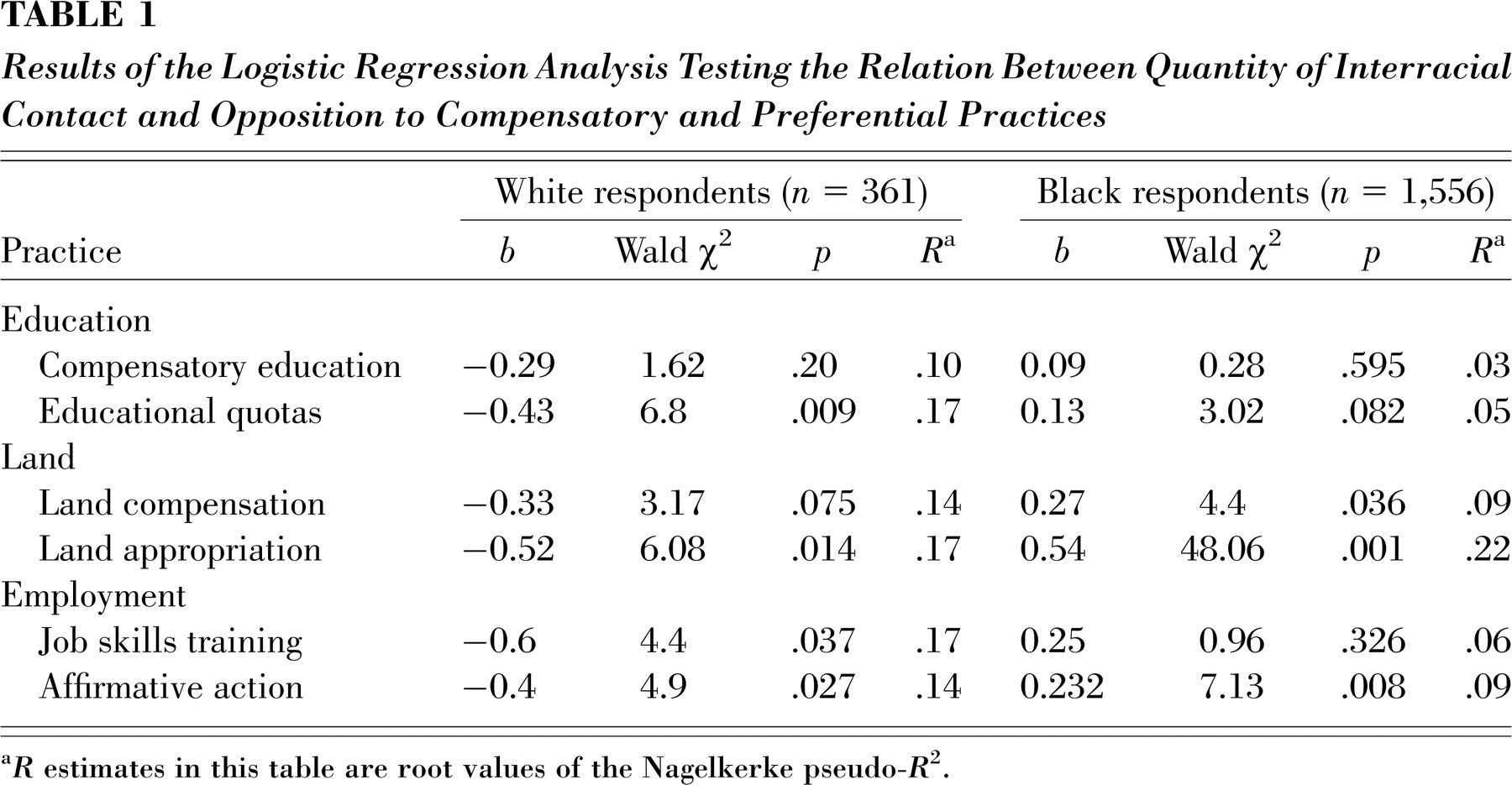
a R estimates in this table are root values of the Nagelkerke pseudo-R 2.
In cases in which quantity of contact significantly predicted opposition to race-targeted policies, we also entered the quality-of-contact variables (cooperation and equality of status) as a second step in a hierarchical regression model. This approach is consistent with the widespread assumption that the positive impact of the frequency of contact on prejudice is augmented when the contact is cooperative and involves parties of equal status. In the present analysis, however, these variables did not improve model fit. For instance, adding the two quality-of-contact indicators did not significantly improve the models predicting Whites' opposition to land appropriation, χ2(2) = 3.6, p > .17, or affirmative action, χ2(2) = 4.3, p > .12.
As a final step, we explored the intuitive hypothesis that the relation between contact and opposition to compensatory and preferential policies among Black respondents is dependent on socioeconomic status. Hierarchical logistic regression analyses were conducted for each statistically significant relation shown for the Black sample in Table 1. In each analysis, an indicator of socioeconomic status, average household income, was entered as the first step, followed by the quantity-of-contact variable and then the interaction between contact and income. In all analyses, the only step in which the associated chi-square test of model change was significant was that containing the contact variable. Steps entering income, the Income × Contact interaction, or both were never statistically significant. This form of modeling was repeated for a second indicator of socioeconomic status, level of education, with similar results.
DISCUSSION
When de jure segregation ended in the early 1990s in South Africa, it took the form of a sudden reversal. Within a short period, the legal edifice of apartheid was dismantled, and practices of segregation that had been enforced for centuries were outlawed. In place of the policy of separate development, the new government established a program of restitution, designed to achieve a redistribution of wealth and opportunity.
Our results suggest that there remains a stubborn kernel of opposition to this program among White South Africans, perhaps because they reject a (further) erosion of group privileges. Although they rarely oppose the principles of equality in employment, education, and land ownership, White South Africans evaluate interventions such as affirmative action, educational quotas, and land restitution considerably less favorably. In effect, their attitudes reproduce the principle-implementation gap that has led social scientists to acknowledge the complexity and intransigence of prejudice in other societies (e.g., Kinder, 1986).
On a more optimistic note, our results suggest that interracial contact improves Whites' attitudes toward practices aimed at achieving racial justice. Specifically, the more contact Whites have with Blacks, the greater their support for policies of restitution. Evaluating this finding, one must bear in mind that Whites' overall support for race-targeted interventions is much lower than Blacks' support of such programs and that the effects of contact are modest in size. Even so, our data suggest that interracial contact per se may reduce the principle-implementation gap in Whites' attitudes. Moreover, they suggest that this effect generalizes across the domains of education, land ownership, and employment.
The association between contact and Blacks' support for race-targeted policies seems to work in the opposite direction, however; that is, the more contact with Whites that Blacks report, the lower their support for race-targeted policies of restitution. Again, this effect is small in magnitude and must be interpreted in the context of Blacks' stronger overall support for race-targeted policies. Nevertheless, these data confirm that researchers cannot presuppose that the effects of contact on the attitudes of historically advantaged and disadvantaged groups are isomorphic (cf. Tropp & Pettigrew, 2005).
A wider implication of this study is that future research should incorporate a more nuanced conception of the consequences of interracial contact—a conception that acknowledges the impact of contact on political and policy-related, as well as cognitive and emotional, dimensions of race attitudes. This conceptual shift is likely to introduce new dilemmas of interpretation to the field and to raise complex questions about the model of social change that underlies the contact hypothesis. How, for example, should one explain the relation between contact and policy attitudes in the case of Black South Africans? A positive interpretation of this relation is that contact nurtures cross-race solidarity among Blacks and thus increases their opposition toward policies that disadvantage Whites in the “new” South Africa. From this perspective, which we suspect the majority of contact researchers would endorse, our findings show that as social integration increases, Whites' and Blacks' policy attitudes move into closer alignment. Another, very different, interpretation is that contact weakens Blacks' political activism regarding race-targeted initiatives. From this perspective, our findings could be read in a less straightforward way. One could conjecture that even if contact is successful in promoting interpersonal liking, it may sometimes reduce the likelihood that members of disadvantaged groups collectively support the struggle for racial justice.
Footnotes
1This was particularly true for levels of tertiary education. About 20% of our Black respondents had completed some form of higher education (vs. 47% of Whites), whereas other surveys have estimated that around 10% of the Black population has received some tertiary education.
2A breakdown of the results by respondents' preferred language revealed that the principle-implementation gap was somewhat wider for Afrikaans-speaking than for English-speaking Whites on some dimensions. However, in the present context, the more important (if unsurprising) finding is that members of both groups expressed substantially greater opposition to policy initiatives than did members of the Black sample.
Acknowledgements
This research was funded by grants awarded to the first author by the Economic and Social Research Council in the United Kingdom and to the second author by the National Research Foundation in South Africa. The authors also acknowledge the assistance of Ask Afrika, a market research company that generated and supplied the randomized list of cellular telephone numbers used in our survey.