







Abstract
We examined the prospective association between general intelligence (g) at age 10 and liberal and antitraditional social attitudes at age 30 in a large (N = 7,070), representative sample of the British population born in 1970. Statistical analyses identified a general latent trait underlying attitudes that are antiracist, proworking women, socially liberal, and trusting in the democratic political system. There was a strong association between higher g at age 10 and more liberal and antitraditional attitudes at age 30; this association was mediated partly via educational qualifications, but not at all via occupational social class. Very similar results were obtained for men and women. People in less professional occupations—and whose parents had been in less professional occupations—were less trusting of the democratic political system. This study confirms social attitudes as a major, novel field of adult human activity that is related to childhood intelligence differences.
Important differences in people's social attitudes and views are captured under the broad syndrome of the traditional-moral-values triad (Koenig & Bouchard, 2006; Saucier, 2000). The correlated dimensions of this triad are conservatism-traditionalism, authoritarianism, and religiousness. Influential work on these concepts emerged in attempts to understand how apparently ordinary individuals became involved in the atrocities of World War II. Adorno, Frenkel-Brunswick, Levonson, and Sanford (1950) developed the Fascism (F) scale as part of their now-classic The Authoritarian Personality. Also influential was Altemeyer's (1981, 1988) concept and scale of right-wing authoritarianism (RWA). To understand the origins of these attitude differences, psychologists have examined their correlations with mental ability, as well as their developmental origins.
The balance of evidence shows that people with higher cognitive ability tend to hold less authoritarian attitudes as measured by the F and RWA scales, and scales assessing related constructs (for overviews, see McCourt, Bouchard, Lykken, Tellegen, & Keyes, 1999, p. 987, and Scarr & Weinberg, 1981, p. 400). Most studies in this area have been cross-sectional. The study reported by McCourt et al. is typical, finding a correlation of −.37 between IQ and RWA. Complementary findings indicate that higher mental ability tends to be positively associated with more liberal social attitudes and autonomous reasoning about social situations. Intellectually gifted adolescents' higher scores on the Defining Issues Test (based on Kohlberg's theory of moral reasoning) were accounted for by higher intelligence rather than other psychological variables (Sanders, Lubinski, & Benbow, 1995). There is a moderate correlation between intelligence and ego development (Cohn & Westenberg, 2004; Loevinger, 1976, 1993).
The issue of the developmental origins of social attitudes has been examined, but more rarely, in twin, adoption, and longitudinal studies. Data from twin (Martin et al., 1986; McCourt et al., 1999) and adoption (Scarr & Weinberg, 1981) studies contradicted the assumption that variance in social attitudes derives principally from shared environments (Altemeyer, 1988), and found substantial genetic contributions. In a longitudinal study, people with higher nonverbal ability at age 11 were more likely to have nontraditional views of marriage at 33 (Flouri & Buchanan, 2001).
Despite such evidence, longitudinal studies of the relation between childhood intelligence and liberal, antitraditional social attitudes have been rare, and samples to date have not been large and population-representative. Moreover, it is important formally to model the influences of education and socioeconomic position. We conducted the study reported here to address these issues, taking our data from the British Cohort Study 1970 (Elliott & Shepherd, 2006), which provides large, population-representative samples of men and women who took mental tests at age 10 and were followed up 20 years later to assess their social attitudes and views. For the first time, we tested the hypothesis that higher general intelligence at age 10 is associated with more broad-minded attitudes toward social issues at age 30. We examined potential confounding influences from parental social class and possible mediating effects of the individual's education and own social class as an adult.
METHOD
Participants
The British Cohort Study 1970 is an ongoing longitudinal study of the 17,198 individuals who were born between April 5 and 11, 1970, to parents residing in Great Britain (Elliott & Shepherd, 2006). At age 30 years, 11,261 participants were interviewed, and 11,070 (83% of the original cohort who were alive and living in the United Kingdom) completed questions on their social attitudes. In total, data on mental ability at the age of 10 years were available for 8,091 of these individuals. Full data for the analyses presented here were available for 7,070 participants (64% of those who completed the questions on their social attitudes).
Data Collected at Age 10 Years
Mental Ability
Mental ability was assessed using a modified version of the British Ability Scales (Elliot, Murray, & Pearson, 1978), adapted to facilitate administration by teachers. Verbal ability was assessed using two subscales: Word Definitions and Word Similarities. For the Word Definitions subscale, the teacher articulated each of 37 words in turn and asked the child about its meaning. For each of the 42 items in the Word Similarities subscale, the teacher enunciated 3 words (e.g., “orange,” “banana,” and “strawberry”) and asked the child to name another word consistent with the theme. Nonverbal ability was also assessed using two subscales. For the Recall of Digits subscale (34 items), the teacher read out digits at half-second intervals and asked the child to repeat them. For the Matrices subscale (28 items), the teacher asked the child to draw in the missing part of an incomplete pattern. Children were tested individually by teachers, who recorded the answers for the first three tests.
Parental Occupation
Parental social class was determined from the father's occupation using four categories derived from the United Kingdom Registrar General's Classification of Occupations (Office of Population Censuses and Surveys, 1980): professional-managerial, skilled nonmanual, skilled manual, and semi- or unskilled. Mother's occupation was used to assess parental social class if no father was present.
Data Collected at Age 30 Years
Education
At age 30, participants were asked about their highest academic or vocational qualifications. These qualifications were subsequently collapsed into six categories. In order of increasing attainment, these categories were as follows: no qualifications, Certificate of Secondary Education Grades 2 to 5/National Vocational Qualification (NVQ) Level 1 1 and equivalent, O level exams/NVQ Level 2 and equivalent, A level exams/NVQ Level 3 and equivalent, postsecondary degree or diploma/NVQ Level 4 and equivalent, or higher degree/NVQ Level 5.
Occupation
Each participant's current social class (professional-managerial, skilled nonmanual, skilled manual, or semi- or unskilled) was derived from his or her own occupation.
Attitudes
Participants completed a computer-administered, self-report, 50-item questionnaire about their attitudes to and views of the following: support for the work ethic, support for authority, support for traditional marital values, permissiveness about work and family, opposition to family life, political cynicism, left/right political beliefs, support for equality of the sexes, environmentalism, antiracism, learning, and information technology. Each item had five possible responses: strongly agree, agree, neither agree nor disagree, disagree, and strongly disagree. The Results section provides more information on this questionnaire.
RESULTS
Principal Components Analysis of the Attitudes Items
First, we used principal components analysis to examine the structure of the attitudes items administered at age 30. Both the scree slope and the eigenvalues (the number greater than 1.0) suggested a model with five components, accounting for 52% of the total variance. The oblimin-rotated components were examined for items that had salient loadings (> .4). We refer to the rotated components as factors. Factor 5 did not have a coherent set of items and had a low alpha (.56), so it was not considered further. The four factors included in our analysis were the following:
Factor 1: political trust. Seven items had high (negative) loadings on this factor. They included “There is one law for the rich and one for the poor” (−.66) and “Politicians are in politics for their own benefit” (−.58).
Factor 2: antiracism. Five items had high loadings on this factor. They included “I wouldn't mind if a family of a different race moved next door” (.79) and “I wouldn't mind working with people from other races” (.76).
Factor 3: social liberalism. Ten items had high (negative) loadings on this factor. They included “Give law breakers stiffer sentences” (−.63) and “Schools should teach children to obey authority” (−.51).
Factor 4: pro-working women. Six items had high (negative) loadings on this factor. They included “Pre-school kids suffer if mum works” (−.68) and “Family life suffers if mum is working full-time” (−.70).
Cronbach alphas were .75 for political trust, .82 for antiracism, .68 for social liberalism, and .65 for pro-working women. There were significant correlations among all four factors, with effect sizes (r) ranging from .06 to .27.
Structural Equation Modeling of Childhood Intelligence and Adult Attitudes
Model Construction
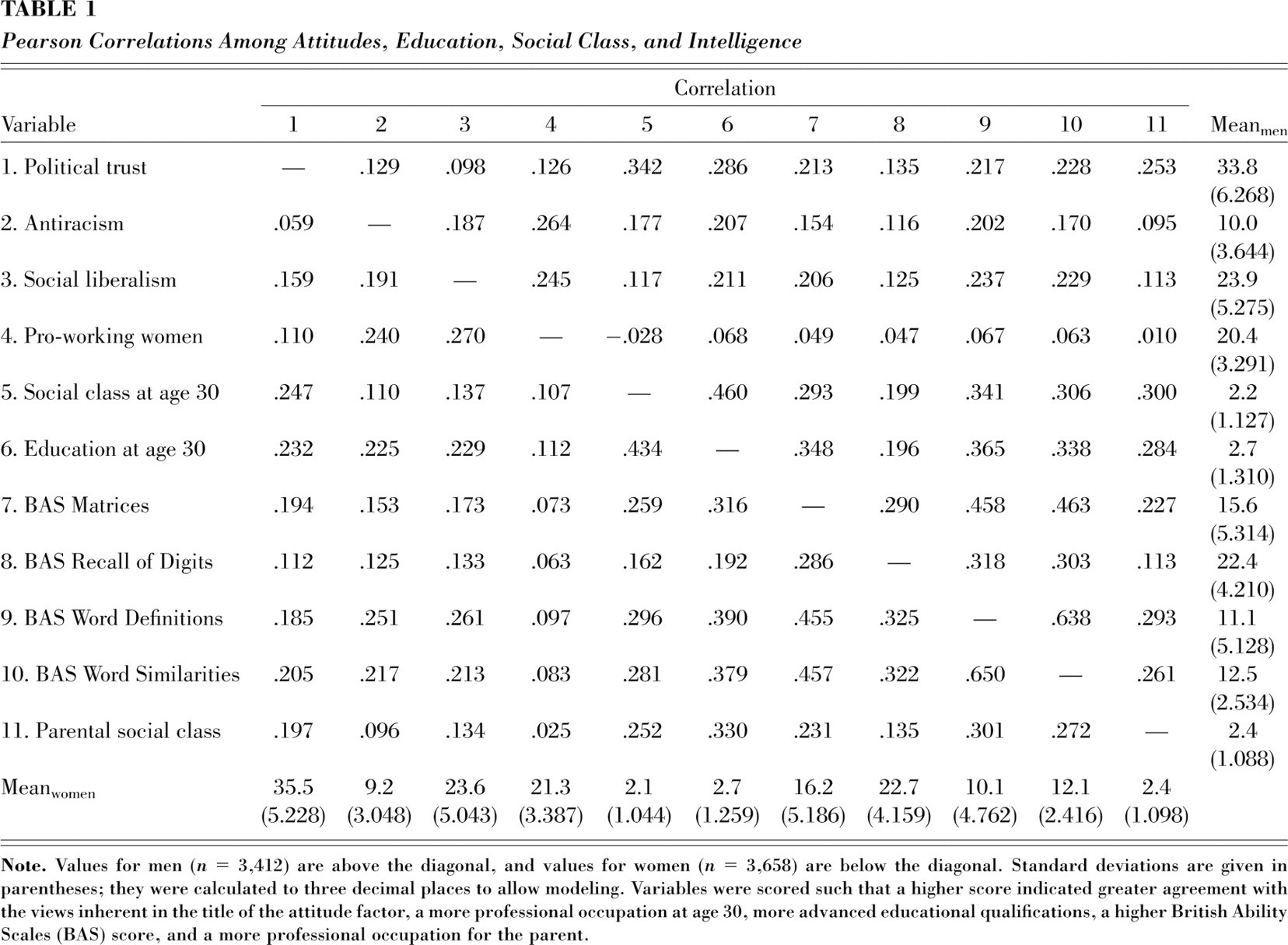
Next, we examined the association between mental ability at age 10 and social attitudes at age 30. The potentially confounding effect of parental occupational social class and the potentially mediating effects of the person's education and own occupational social class at age 30 were considered. Table 1 presents the correlations and the means and standard deviations of the variables, separately for men and women.
Pearson Correlations Among Attitudes, Education, Social Class, and Intelligence
We constructed a structural equation model to test the key hypothesis. The four British Ability Scales subtests were used as indicators of a latent trait of general mental ability (g). The four attitudes scales were used as indicators of a latent trait of general liberal and nontraditional attitudes. Paths in the model were set according to time. Thus, childhood mental ability and parental social class (which were allowed to correlate) were assumed to influence education, which in turn influenced occupational social class at age 30, which in turn was hypothesized to influence social attitudes at age 30. All direct and mediating paths were included in the model. The Wald and Lagrange Multiplier tests were used to indicate paths that could be dropped and added to the model, respectively, to improve the fit. The model was first fitted to the men's data, and a replication of the best-fit model was attempted for the women's data. EQS Version 6.1 software was used (Bentler, 1995). The models were tested using maximum likelihood.
Model Fit
The final model for men (Fig. 1) had only small changes from the model stipulated a priori in the previous paragraph. The Lagrange Multiplier test indicated that the associations between parental and the person's own occupational social class and the specific attitude scale indexing political trust should be added to the model. Adding these significantly improved fit. The Lagrange Multiplier test suggested a significant correlated residual between pro-working-women and antiracism attitudes, which was also added to the model. The Wald test indicated that the paths from parental social class to the attitudes trait and from the person's own social class at age 30 to the attitudes trait were not significantly greater than zero. Because of their importance, these paths were retained and tested again when the model was fitted to the women's data.
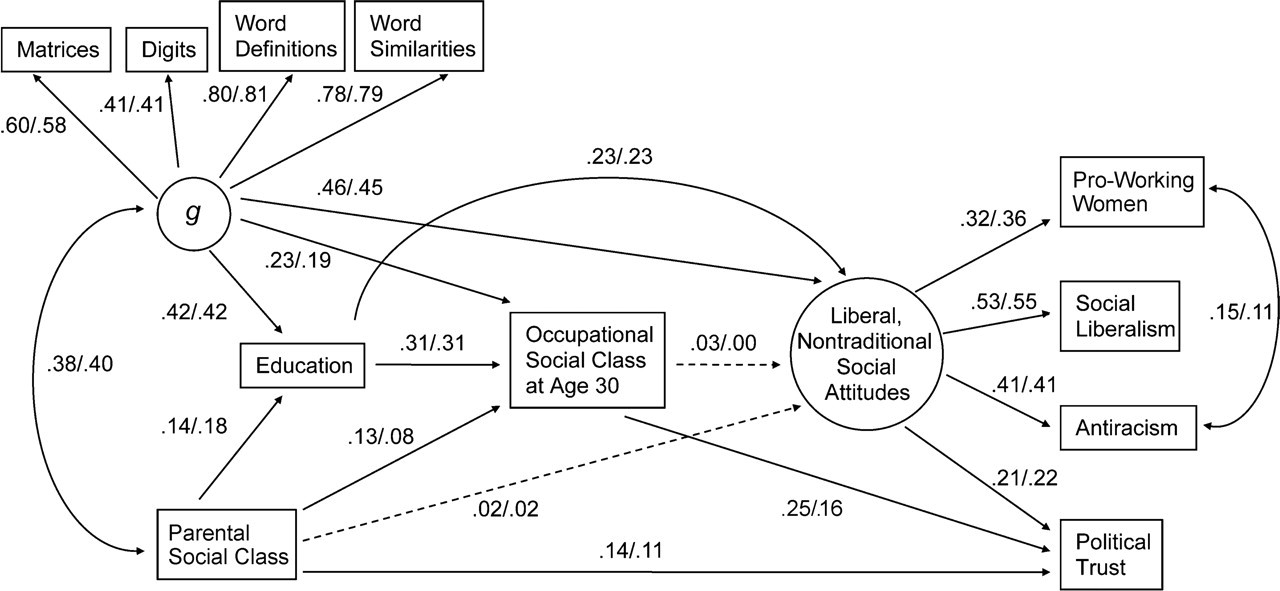
Structural equation model relating general cognitive ability (g) at age 10 to a latent trait of social attitudes (liberal, nontraditional social attitudes) at age 30 in the British Cohort Survey 1970. Each path is shown with the standardized path coefficients for men (left; n = 3,412) and women (right; n = 3,658). Circles represent latent traits, and rectangles represent manifest (measured) variables. Dashed lines indicate that the path coefficients are nonsignificant. See the footnote to Table 1 for an explanation of how the variables were scored.
In the final model for men (Fig. 1), the average of the off-diagonal absolute standardized residuals was .026, and the largest standardized residual was .077. The root-mean-square error of approximation was .046. The chi square was 274.4 (df = 33, p < .001). The normed and nonnormed Bentler-Bonett fit indices were .962 and .944, respectively; the comparative fit index was .966; and the goodness-of-fit index was .986. Therefore, the model fit well. The chi square was highly significant, but this is common with large samples. All paths were significant, except those between parental occupational social class and the latent attitudes trait and between the person's own occupational social class at age 30 and the latent attitudes trait.
The women were used as a replication sample (Fig. 1). The average of the off-diagonal absolute standardized residuals was .022, and the largest standardized residual was .075. The root-mean-square error of approximation was .041. The chi square was 238.0 (df = 33, p < .001). The normed and nonnormed Bentler-Bonett fit indices were .968 and .954, respectively; the comparative fit index was .973; and the goodness-of-fit index was .988. The same model fit the women's data well. All paths were significant, except those between parental occupational social class and the latent attitudes trait and between the person's own occupational social class at age 30 and the latent attitudes trait.
Model Description
The model linking childhood intelligence and adult social attitudes fit the men's and women's data almost identically, and the path coefficients were almost identical. The measurement models for the two latent traits were clearly supported. All four mental tests loaded strongly on the latent factor of general intelligence (g). All four attitude scales loaded moderately and significantly on the latent attitude trait. Childhood g and parental occupational social class were moderately correlated.
The key finding was the strong association between higher g at age 10 and generally more liberal, nontraditional social attitudes at age 30, even allowing for potential covariables. The weight for this direct path was very similar in men (.46) and women (.45). There was an additional, smaller indirect effect via education. There were no significant associations between g at age 10 and scores for specific attitudes after the association with general attitudes was taken into account.
Parental social class was significantly associated with education and with the person's own social class at age 30. General intelligence (g) at age 10 and education were both significantly associated with the person's own social class at age 30. There were no significant associations between parental social class or the person's own social class and the latent trait of social attitudes. There were significant associations between parental social class and political trust and between the person's own social class and political trust: People in more professional occupations had greater trust.
DISCUSSION
In a large, prospectively studied, population-representative sample, general mental ability at age 10 was strongly associated with a latent trait underlying four domains of important social attitudes at age 30. People with higher g scores in childhood were, as adults, less likely to endorse traditional values across a number of domains. The effect was not largely mediated by educational qualifications, and was not at all mediated by a person's own occupational social class. There was a specific effect of less political trust among people in more manual (blue-collar) occupations. Results were almost identical for men and women.
This study confirms cross-sectional findings that people with higher intelligence are less likely to have traditional moral values (Koenig & Bouchard, 2006; Saucier, 2000); these attitudes are also negatively correlated with the personality trait openness to experience (Saucier, 2000), which is positively correlated with intelligence (Gow, Whiteman, Pattie, & Deary, 2005). This study also accords with findings indicating that some psychological constructs that were once thought to be noncognitive are associated with mental ability (Lykken, 1991; Sanders et al., 1995). These include moral reasoning (Kohlberg, 1984; Sanders et al., 1995), self-actualization (Maslow, 1971), and ego development (Cohn & Westenberg, 2004; Loevinger, 1976, 1993). The decentering required for such social-moral developmental attainments, as well as the attitudes studied here, might be caused by higher intelligence.
The idea that social attitudes and views are caused by reasoning processes was suggested by Scarr and Weinberg (1981). McCourt et al. (1999) summarized their view: “Intelligence drives attitude formation. That is, when considering social, moral, and political situations, those with greater cognitive skill are able to form more individualistic and open-minded (i.e. antiauthoritarian) attitudes than those of lesser cognitive ability” (p. 987, emphasis added). The association between intelligence and social attitudes might partly arise from genetic influences that are common to them, perhaps via mediating factors such as “mobility and learning” (Martin et al., 1986, p. 4368).
Alternative explanations of this association should be considered, however. First, note that people with higher ability tend to read more. If print media are more likely to be produced by people who hold antitraditional views than by people who hold traditional views, then there might be a causal path from intelligence to social views via cultural exposure. The present results do not seem to support this explanation strongly, though, because education was not a particularly important mediator. Also, individuals who produce print media might tend toward antitraditional views because of their own relatively high intelligence. Second, a noncausal explanation could be that people with higher ability might have a more sophisticated view of what attitudes are considered “acceptable” to researchers and endorse these. One could test this possibility by examining whether people with high mental ability not only endorse broad-minded attitudes in research settings, but also behave in broad-minded ways.
In this large, longitudinal study, intelligent children became, on average, broad-minded adults. The state of mind common to the attitude scales used in this analysis is one of objective fairness to other individuals, an overturning of past prejudice that militated against fairness. Brighter 10-year-olds are, at age 30, more likely to hold to a “philosophy emphasising reason and individualism rather than tradition,” which is how The Concise Oxford Dictionary (Allen, 1990, p. 389) defines enlightenment.
Footnotes
Acknowledgements
Ian Deary is the recipient of a Royal Society-Wolfson Research Merit Award. David Batty is supported by a fellowship from the Wellcome Trust.
1The NVQs are national examinations, with Levels 1 and 2 normally taken at 16, the minimum age for leaving school, and Level 3 taken at age 18; Level 4 is postsecondary, and Level 5 is postgraduate.