







Abstract
In this article, we present a new framework for interpreting cultural differences in behavior—what we call the institutional approach. In this framework, individuals' behaviors are conceptualized as strategies adapted to various incentive structures. Cultural differences in behavior are thus viewed as differences in the default adaptive strategies that individuals come to rely on in unclear situations. Through two studies, we demonstrate that the East Asian “preference” for conformity is actually a default strategy to avoid accrual of negative reputation. When the possibility for negative evaluations in a given situation was clearly defined, cultural differences in the tendency for uniqueness disappeared. This approach carries important implications to psychologists who interpret cultural differences in behavior in terms of preferences, and can serve as a common framework branching out toward other disciplines in the social sciences.
Over the past two decades, there has been increasing interest in the culturally grounded nature of human psychology. An abundance of research on cultural differences in behavior has been conducted using the cultural psychology approach, in which a cultural difference in behavior or psychological processing is uncovered and is subsequently interpreted as an apparition of internalized cultural values and beliefs, such as beliefs about the nature of the self (Markus & Kitayama, 1991). Although the cultural psychology approach is commendable for bringing culture into the mainstream of psychology, it tends to be oversimplistic in attributing the cause of culture-specific behaviors to internalized cultural norms and values, or, as succinctly expressed by Kim and Markus (1999), in assuming that, “what the culture says is right and good becomes what people like” (p. 797). This assumption seems rather simplistic to researchers who take a game-theoretic perspective, according to which the expectations of how other players will behave given the rules of the game are much more important in determining a player's choices than the player's preferences per se. In this perspective, preferences are the dominant determinants of behavior only in a social vacuum where individuals do not need to consider the reactions of others, and we believe cultural psychologists would agree that culture-specific behavior does not occur in a social vacuum.
In this article, we approach the issue of the culturally grounded nature of human behavior from a game-theoretic perspective, by proposing an alternative to the cultural psychology approach that we call the institutional approach. The institutional approach to cultural differences views culture-specific behavior as strategies adapted to a set of collectively created social incentives. In this framework, no psychological concepts such as self-construals are required to interpret cultural differences, and therefore we believe that the institutional approach can provide a more parsimonious explanation of cultural differences that can extend toward social science disciplines outside of psychology.
An institution, as the term is used in comparative institutional economics (Aoki, 2001), is a self-sustaining system of beliefs, behaviors, and incentives that are shared among individuals. In an institution, an individual's behaviors are guided by incentives, or the individual's beliefs about others' responses to his or her actions. The core of this framework resides in the equilibrium approach forwarded by Cohen (2001), in that cultural systems are viewed as equilibria adapted to various socio-ecological contexts. We use the term institution, however, to emphasize that the continuity of these behavioral patterns is elicited though incentive structures, rather than through a simple inertia.
As the institutional approach is heavily based on game theory, individuals' behaviors are conceptualized as strategies. People have a variety of different behavioral strategies they can use in various situations, and the particular strategy relied on in a given situation depends on how that situation is conceptualized. Some strategies have better odds than others of producing favorable outcomes in the majority of situations, and individuals will generally come to rely on these strategies by default, in the absence of cues suggesting an ecological mismatch. We refer to a strategy of this type as a default strategy: an ecologically rational (Gigerenzer, 2000) decision rule used by individuals (both human and nonhuman animals) without conscious calculation. The particular strategy individuals in a society tend to rely on by default will depend on the strategy's ecological fit, that is, the frequency of situations in which the strategy's use or nonuse produces desirable or undesirable outcomes, respectively, and the seriousness of these outcomes.
THE PEN-CHOICE EXPERIMENT AND THE CULTURAL PSYCHOLOGY AND INSTITUTIONAL APPROACHES
Using the framework of cultural psychology, Kim and Markus (1999, Experiment 3) conducted a clever experiment involving pen choice. Their research team went to an airport and asked travelers to fill out a simple survey, offering the travelers the choice of a pen as a token of appreciation. The available pens were identical except in their external color, and the ratio of unique to majority pens was 1:4 or 2:3. Because Western culture values uniqueness, Kim and Markus argued, people from this culture would have an internalized preference for uniqueness and would demonstrate this preference by choosing unique pens. In contrast, East Asians, who belong to a culture that values conformity, would express their internalized preference for conformity by choosing one of the majority pens. The results of the study confirmed that East Asians were indeed more likely to choose majority pens than were Westerners.
The cultural psychology interpretation of these findings is that cultural values regarding uniqueness and conformity are instilled in the hearts and minds of the people in a given culture and reveal themselves as preferences. However, as numerous studies on the disparity between preferences and behavior have demonstrated (Ajzen & Fishbein, 1980; LaPiere, 1934; Wicker, 1969), behavior is not always an exact reflection of preferences, but can instead be a means to another goal. We speculate that participants' selection of a unique or majority pen in Kim and Markus's (1999) study was instrumental, rather than a direct reflection of participants' preferences. In particular, we speculate that the tendency for East Asians to select a majority pen was caused by the strategic motivation to avoid being negatively evaluated by others who may be affected by one's actions (see also Maddux & Yuki, 2006). We further argue that whether or not a strategy geared toward not offending others is used by default depends largely on the costs and benefits of using such a strategy.
Ultimately, the cost of being regarded negatively (and thus the benefit of acting so as not to offend other people) is a function of the number and quality of opportunities available to an individual in the event that he or she is excluded from current relationships. In a society in which groups or relationships are typically closed to outsiders, people who are excluded from their group or relationship may find no alternatives, and the cost of being excluded is therefore much higher in such a society than in a relatively “open” society where individuals can easily replace lost relationships (Greif, 1994; Yamagishi, Cook, & Watabe, 1998; Yamagishi & Yamagishi, 1994). In this sense, the ecological fit of a not-offend-others strategy is higher to the degree that most relationships and groups in a society are closed to outsiders. In the terms of error management (Haselton & Buss, 2000; Yamagishi, Terai, Kiyonari, Mifune, & Kanazawa, 2007), it is wise to avoid by default any behavior that might offend others and to potentially commit a Type I error (in which one pays a cost by refraining from asserting one's self-interest when that is unnecessary), in order to reduce the possibility of committing a Type II error (in which one acts in a way that offends others, thus increasing the chance of being excluded from current relationships). In a society in which being disliked by and excluded from one's peers is costly, it is a good idea for people to default to a safe strategy (i.e., employ the strategy in all situations unless it is obvious that the strategy is unnecessary) just in case, because the potential costs of doing otherwise are great.
STUDY 1
We conducted Study 1 to determine if cultural differences in pen choice could be directly attributed to internal preferences or, instead, could be explained through the institutional approach as differences in the default strategies employed by East Asians and Westerners. Japanese and American participants read vignettes describing Kim and Markus's (1999) pen-choice experiment and reported the pen they would likely select in four different situations. The first vignette depicted a variant of the study reported by Kim and Markus (1999). We call this the default-selection scenario. Next, we asked participants to report what pen they would select if they were the first of five people to choose (initial-selection scenario). Then, we asked which pen they would select if they were the last person to select a pen (final-selection scenario). Finally, we asked which pen they would purchase from a store (pen-purchase scenario).
When purchasing a pen or choosing a pen after other people had already made their choices, participants did not need to take into account others' possible reactions, and thus should have been able to freely select whichever pen they desired. In contrast, by thoughtlessly taking a resource that other people may have desired to obtain and thereby reducing access to this resource, participants ran the risk of making a negative impression on others. In these situations, the implications of participants' behaviors were clear, and therefore there was no need for them to rely on a default strategy. However, the implications of selecting a unique pen in the default scenario were not immediately obvious, and therefore we expected that people would be most likely to employ their default strategies in this situation. Thus, we expected cultural differences in pen selection to be most prominent in the default scenario.
Method
Fifty-five students (28 females and 27 males) from Hokkaido University and 50 students (36 females and 14 males) from the University of Michigan participated in the study. Participants were distributed packets including the following four scenarios and related questions. In the default-selection scenario, participants read a vignette describing a variant of Kim and Markus's (1999) experiment; the vignette indicated that students participated in a brief survey and were allowed to choose a pen (out of one unique and four majority pens) to take home as a token of appreciation. Participants were then asked to report which pen they would likely choose in that situation. Next, we presented participants with the initial-selection scenario and asked them to report which pen they would select (unique or majority) if they were the first out of five students. Similarly, in the final-selection scenario, participants reported which pen they would choose if they selected last among five students, and there happened to be five pens remaining. Finally, in the pen-purchase scenario, participants indicated which pen they would purchase from a store with one unique and four majority pens stocked on the shelf.
Results
Default-Selection Scenario
As Figure 1 shows, we succeeded in replicating the results of Kim and Markus's (1999) experiment in the default-selection scenario, as Americans showed a stronger tendency than Japanese to select uniquely colored pens; 53% of Japanese and 70% of Americans reported they would select the unique pen. A log-linear analysis with culture and gender as independent variables and pen color as the dependent variable found significant main effects for both culture, χ2(1, N = 105) = 4.34, p = .04, p rep = .90, ϕ = .20, and gender, χ2(1, N = 105) = 5.41, p = .02, p rep = .93, ϕ = .23, but no Culture × Gender interaction. The effect of gender indicated that men in both countries were generally more likely than women to select unique pens.
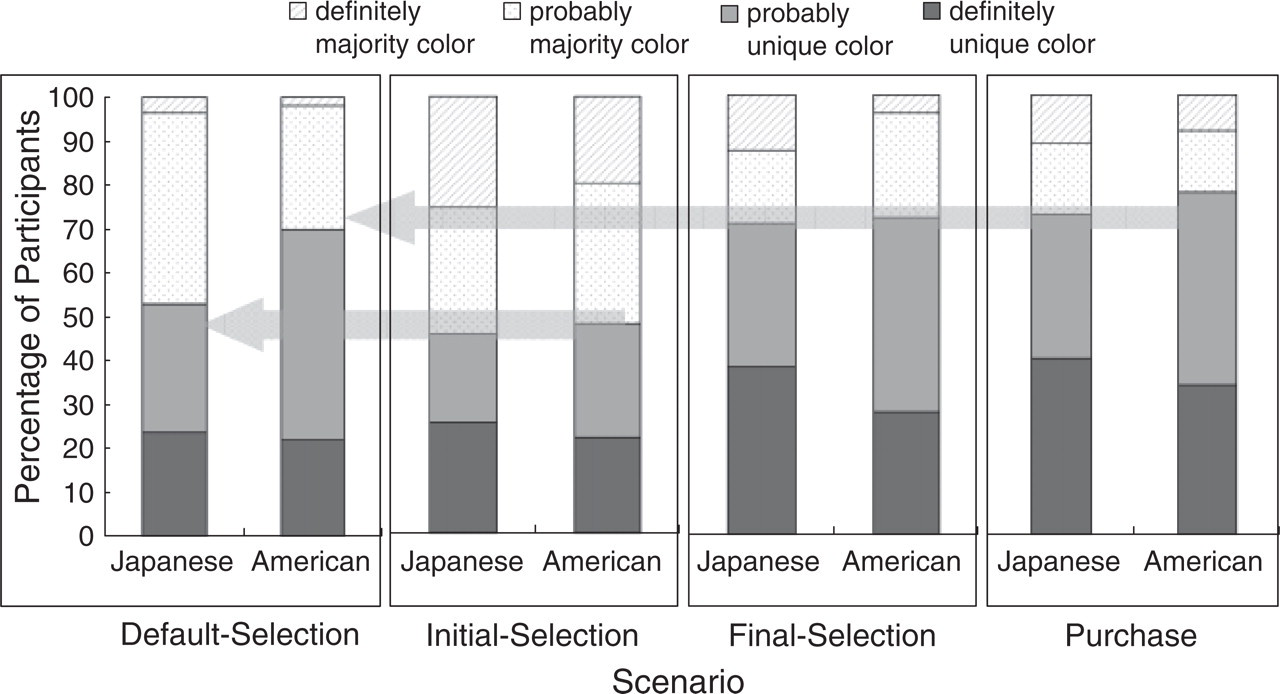
Results from Study 1: percentage of Japanese and American participants who chose the majority and unique pens in each scenario. The arrows highlight the scenarios for which each group of participants showed tendencies similar to those in the default scenario.
Initial-Selection Scenario
When participants considered being the first of five people to select a pen, the tendency for Americans to select the unique pen dropped to essentially the same level as the Japanese tendency to select the unique pen. In the same log-linear analysis, the main effect of country was no longer significant, χ2(1, N = 105) = 0.26, p = .61, p rep = .43, and the main effect of gender became marginal, χ2(1, N = 105) = 3.70, p = .06, p rep = .87. There was no significant interaction between culture and gender. The finding that Americans' ratio of majority-pen selection rose to the same level as the Japanese ratio demonstrates that equal majorities of Japanese and Americans understood the need to employ the not-offend-others strategy in this situation. The arrow running between the two left-hand panels in Figure 1 highlights the fact that for Japanese, the ratio of majority to unique pen choices was nearly identical in the default-selection and initial-selection scenarios. This suggests that Japanese participants appraised the default-selection scenario similarly to the initial selection scenario, in which the not-offend-others strategy is called for.
Final-Selection Scenario
When participants considered selecting a pen after others had already made their selection, there was no need to worry about the impact of their behavior on others or about receiving negative evaluations from others. Thus, in the final-selection condition, there was no need to employ the not-offend-others strategy. Indeed, Japanese participants' rate of selecting the unique pen rose (70.9%) to essentially the same level as American participants' rate (72.0%). As highlighted by the long arrow stretching across the four panels in Figure 1, Americans' rates of selecting the unique pen were approximately the same in the default-selection condition and the final-selection condition, which suggests that Americans regarded the default-selection scenario similarly to the final-selection scenario, in which there was no need to worry about other people's responses. In the final-selection scenario, the main effect of country was not significant, χ2(1, N = 105) = 0.01, p = .92, p rep = .17, and the main effect of gender found in the default-selection condition completely disappeared, χ2(1, N = 105) = 0.39, p = .53, p rep = .48. This latter result suggests that male-female differences in the selection rates (like cultural differences in the selection rates) can be attributed to differential sensitivity to the evaluations of other people, rather than to preferences.
Purchase Scenario
The frequencies with which both Japanese and American participants selected the unique pen in the purchase scenario were virtually identical to the frequencies with which both groups selected the unique pen in the final-selection scenario, as well as the frequency with which American participants selected the unique pen in the default scenario. When purchasing a pen at a store, as when making the final selection of a pen, there was little need to consider the effect of one's behavior on others, and therefore there was no need to take others' evaluations into consideration. In both of these scenarios, Americans and Japanese were equally likely to select the unique pen. As in the final-selection scenario, no significant effect of culture or gender was found in the pen-purchase scenario.1
Discussion
The results of Study 1 provide evidence that the cultural differences observed in the pen-choice task are not reflections of Japanese and American preferences for conformity and uniqueness, but rather are reflections of default strategies that underlie everyday behavior. First, we replicated the results of Kim and Markus's (1999) study in the default-selection scenario, in which the exact nature of the situation was not clearly defined. Second, when the need to take other individuals' evaluations into account was obvious (the initial-selection scenario), Americans chose majority pens just as often as Japanese. Third, when there was no need to take others' evaluations into account (final-selection and purchase scenarios), Japanese chose unique pens just as often as Americans. Furthermore, for Japanese, the ratio of majority to unique pens selected in the default-selection scenario was equivalent to the ratio in the initial-selection scenario, whereas for Americans, the ratio of majority to unique pens selected in the default-selection scenario was virtually identical to the ratios observed in the final-selection and purchase scenarios. These results suggest that Japanese tend to define ambiguous interpersonal situations (i.e., the default-selection scenario) as ones in which they should be concerned with other people's responses, whereas Americans tend to define such ambiguous situations as ones in which there is no need to be concerned with others' responses.
STUDY 2
We conducted Study 2 to determine if Japanese participants' actual, rather than hypothetical, choices of majority and unique pens would be affected by the situation in which the choice was made. To do so, we asked students participating in 12 experiments to select a pen to use in answering a postexperimental questionnaire and to take home as a token of appreciation. Participants were offered five pens, four of one color and one of a different color (with the majority and unique colors counterbalanced). In all, 654 Japanese students (291 women and 363 men) participated in the experiments; 406 selected a pen from a transparent cup held by the experimenter, and the remaining 248 selected a pen from the same cup placed on a desk in the privacy of an experimental booth. We predicted that the majority pen would be chosen more often in the experimenter-present condition than in the experimenter-absent condition, because the presence of the experimenter would increase evaluation concerns.
In addition, we predicted that the type of experiment participants experienced prior to selecting the pen would have an effect on their selection. Whereas some participants selected a pen after participating in nongame experiments in which they privately performed cognitive tasks without interacting with other students (n = 175), other participants participated in game-based experiments in which rewards were determined through interaction with other players (n = 373). These game-based experiments can be further broken down into two types: ones in which participants' actions were monitored by other players (monitored games; n = 101) and ones in which players' actions were completely anonymous (anonymous games; n = 272). In addition, 106 participants selected a pen before receiving instructions for the experiment they participated in (preexperiment choice; n = 106). We expected that participants would be less likely to select the unique pen in the monitored-game condition than in the anonymous-game and nongame conditions, as well as the preexperiment condition, which represents the default situation.
In order to demonstrate the compatibility of our pen-choice experiment with the one reported by Kim and Markus (1999), we asked 30 American students at Stanford University (19 females and 11 males) to select a pen from a cup held by the experimenter after participating in a nongame experiment.
Cultural Differences in Pen Choice
Our results for the 30 American participants and the 126 Japanese participants in the same nongame, experimenter-present condition successfully replicated the results of Kim and Markus's (1999) study. Nineteen of the 30 (63.3%) American participants selected the unique pen, whereas only 44 of the 126 (34.9%) Japanese participants did so, and the difference was significant, χ2(1, N = 156) = 8.12, p < .01, p rep = .98, ϕ = .23.
The Effect of Experiment Type
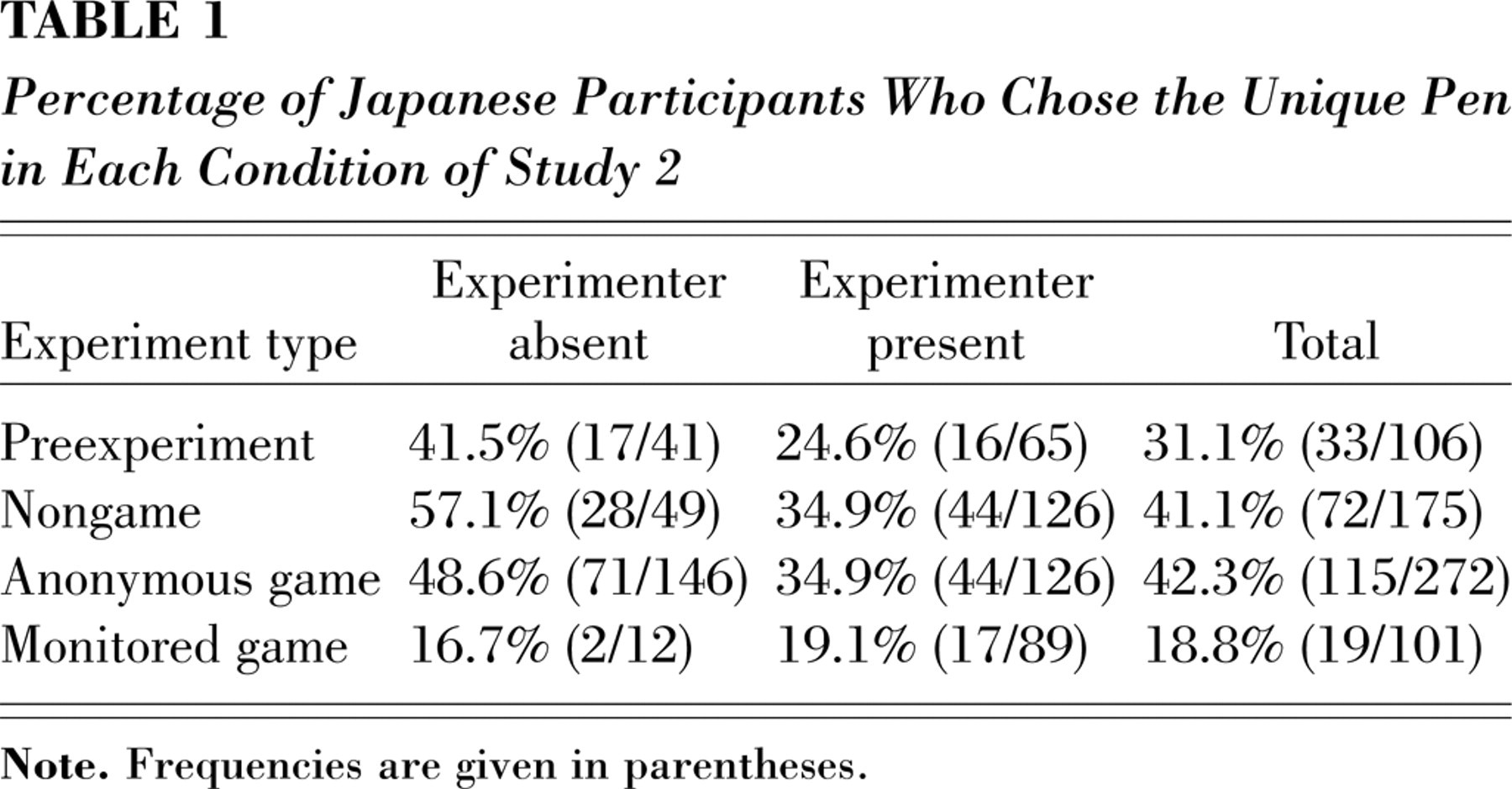
Having successfully replicated the cultural difference in pen choice, we tested our hypotheses that the choice of a majority pen (a) would be higher in the monitored-game condition than in the anonymous-game, nongame, and preexperiment conditions and (b) would also be higher in the experimenter's presence than in the experimenter's absence. A log-linear analysis with uniqueness of the pen as the dependent variable and with experiment type (preexperiment, nongame, anonymous-game, and monitored-game), presence/absence of the experimenter, and the participant's gender as independent variables found significant main effects for both experiment type, χ2(3, N = 654) = 11.93, p < .01, p rep = .96, ϕ = .08, and experimenter presence/absence, χ2(1, N = 654) = 5.13, p = .02, p rep = .92, ϕ = .09. No other effect was significant. Table 1 shows the percentage of participants who chose the unique pen for each of the four experiment types. As predicted, participants were more likely to select a majority pen if they had experienced monitoring from other participants than if they had not. Further, participants were less likely to select a unique pen in the presence than in the absence of the experimenter.2
Percentage of Japanese Participants Who Chose the Unique Pen in Each Condition of Study 2
GENERAL DISCUSSION
Together, the results of Studies 1 and 2 demonstrate that the cultural differences observed in the pen-choice task are a reflection of cultural (or, more precisely, societal) differences in default strategies, rather than preferences for uniqueness or conformity. In situations in which the participant's choice of a unique pen was not likely to interfere with other participants' choices, Americans and Japanese showed equally strong tendencies to select the unique pen. However, in situations in which it was clear that the participant's choice of a unique pen would have negative implications for others, the tendency for Americans to choose a majority pen rose to the same level as the Japanese tendency to choose a majority pen, and the cultural difference observed in the default scenario disappeared. Finally, the selection ratio in the default scenario was nearly identical to that in the initial-selection scenario for Japanese, but mirrored the ratio in the final-selection and purchase scenarios for Americans. Furthermore, participants in Study 2 were more likely to select the unique pen when they were in a private experimental booth than when they were watched by an experimenter, and their tendency to select the majority pen increased after they experienced monitoring from fellow participants. These results support our hypothesis that the observed cultural difference in pen choice between Japan and the United States is due to the difference in the way Japanese and Americans conceptualize situations by default, that is, whether or not the default conceptualization is that one must be concerned with evaluations of other individuals.
The idea that cultural beliefs and norms serve adaptive purposes and can vary according to context and ecological condition has been forwarded by both cultural and cross-cultural psychologists (Cohen, 2001; Matsumoto, 2007). The institutional approach shares this idea, but at the same time emphasizes the self-sustaining nature of social conditions. Individual behaviors, guided by a system of shared beliefs, collectively create an incentive structure that in turn makes these beliefs a reality. In other words, an institution is an equilibrium of beliefs and behavior, which jointly create the very incentive structure to which these beliefs and behaviors are adapted.
Collectivistic institutions are a good example of how a particular equilibrium can sustain itself. In a collectivistic institution, a majority of people favor the in-group in their behavior and exclude individuals who do not cooperate in a similar manner. In such an institution, individuals who do not cooperate with the group will cease to be able to receive resources from others, so as long as one wishes to receive resources from other members of the group, it is necessary for one to behave in a collectivistic manner as well. In this case, the collectivistic behavior of others creates incentives for one to act in a collectivistic way, and exclude those who behave in a noncollectivistic manner. This behavior does not need to be internalized as norms or preferences, but can be purely strategic (see Nowak & Sigmund, 1998, and Takahashi & Mashima, 2006, for mathematical treatments of the game-theoretic analysis of indirect reciprocity). For example, Hirai (2000) found that although most Japanese believed that they themselves held individualistic rather than collectivistic values, they also believed that other Japanese held collectivistic values. This result suggests that the collectivistic nature of Japanese society arises through pluralistic ignorance. Ohbuchi and Saito (2007) provided evidence for this argument, showing that the collectivistic behavior pattern of conflict avoidance in Japan is maintained as a self-fulfilling prophesy. Likewise, Yamagishi and his colleagues' research on collectivistic societies from the perspective of the “group heuristic” (Yamagishi, 2007; Yamagishi, Jin, & Kiyonari, 1999; Yamagishi, Jin, & Miller, 1998; Yamagishi et al., 2007) has demonstrated that situation-specific strategies geared toward eliciting positive responses and avoiding negative responses from other people are often used as default strategies as a form of error management.
Through the two studies presented in this article, we have demonstrated that some culture-specific behaviors can be better analyzed in terms of default strategies than as simple reflections of preferences. We believe that this is a first step toward a more systematic approach to investigating how culture-specific behaviors are generated and maintained. Although we do not claim that the institutional approach can explain all cultural differences reported by cultural and cross-cultural psychologists, we believe the field could benefit from examining what types of cultural differences are better explained and predicted through the institutional approach, rather than the “preference” approach frequently used in psychology. Through the application of the institutional approach, we hope to be able to provide a common framework for understanding cultural differences that can extend toward other social science disciplines.
Footnotes
1Because the four scenarios were presented to all participants in the same order, these results could have been confounded by order effects. In order to exclude this possibility, we conducted a replication study with a between-participants design. Each of 53 Japanese participants responded to one of two scenarios (the initial-selection and the final-selection scenarios). This study yielded results nearly identical to those reported here. The percentage of participants who chose the majority pen was 62.1 for the initial-selection scenario and 37.5 for the final-selection scenario. The difference between the two scenarios was significant in a log-linear analysis with gender as a control variable, χ2(1, N = 53) = 4.51, p = .03, p rep = .90.
2The data in  indicate that the presence/absence of the experimenter did not have an effect in the monitored-game condition. We speculate that this was the case because the experience of playing a game while being monitored by a peer was sufficient by itself to enhance reliance on the not-offend-others strategy to produce a ceiling effect.
Acknowledgements
We would like to thank Karen Cook and Keiko Ishii for their help in data collection, as well as Naoto Suzuki for his help throughout the experiment. This research was supported by a grant-in-aid from the Japan Foundation for the Promotion of Science awarded to the first author.