







Abstract
Environmental moderation of the level of genetic influence on children's reading disabilities was explored in a sample of 545 identical and fraternal twins (mean age = 11.5 years). Parents' number of years of education, which is correlated with a broad range of environmental factors related to reading development, was significantly related to the level of genetic influence on reading disability. Genetic influence was higher and environmental influence was lower among children whose parents had a high level of education, compared with children whose parents had a lower level of education. We discuss the implications of these results for behavior genetic and molecular genetic research, for the diagnosis and remediation of reading disabilities, and for policy in public education.
Interactions between genetic and environmental influences on behavior have been gaining considerable attention in recent years (Rutter, 2006). Molecular genetic studies have reported that specific genes' influences on maladaptive behaviors, such as conduct disorder and alcoholism, may depend on the environment (Caspi, 2002). Also, several behavior genetic studies with population samples of identical and fraternal twins have found that the degree of genetic influence on, or heritability of, individual differences in cognitive and academic abilities across the normal range (i.e., the bell curve) varies with family socioeconomic status (SES; Turkheimer, Haley, Waldron, D'Onofrio, & Gottesman, 2003). The present study of a selected twin sample from the Colorado Learning Disabilities Research Center (CLDRC; DeFries et al., 1997) is the first to explore gene-environment interactions (G × E interactions) in group deficits (i.e., the low tail of the normal distribution) in reading, referred to as reading disability, the most commonly identified learning disability.
We investigated whether there are G × E interactions between parental education (our proxy measure for SES and related environmental influences) and the heritability of group deficits in a composite measure of word recognition, spelling, and reading comprehension. Like other measures of SES, parental education has been shown to be a strong predictor for a variety of health and cognitive outcomes in childhood and adulthood (Bradley & Corwyn, 2002). Moreover, parental education may be indicative of level of investment in children's performance in school and educational attainment (Craig, 2006).
In behavior genetic studies, a G × E interaction is indicated by a significant difference in heritability that is moderated by a measured environmental factor. The direction of change in heritability may support one of two theoretical models of G × E interactions. The bioecological model, first proposed by Bronfenbrenner and Ceci (1994), suggests that genetic influences on behavior should be most evident when the environment is supportive, because there is greater actualization of genetic potential in supportive environments than in poor environments. The diathesis-stress model (Scarr, 1992; Zubin & Spring, 1977) suggests that heritability for a particular behavior should be greater in poorer environments, where stressors may lead to the expression of deleterious genes that would not be observed in more supportive environments. This model has been proposed to explain why certain behavioral disorders have a greater association with specific genes in environments where individuals have been exposed to a large number of stressful life events (cf. Caspi et al., 2002, 2003).
Both the diathesis-stress and the bioecological models of G × E interactions are plausible accounts of genetic influences on reading disability. For example, the heritability of reading disability might be greater in poorer educational environments than in supportive environments (diathesis-stress model) because the negative consequences of any genetic susceptibilities for reading disability can be avoided in educational environments in the school and home that promote good reading for all children, the goal of the No Child Left Behind Act of 2001. However, if the educational environment for reading acquisition is relatively poor for some children with reading disability, that environment may be the main reason for their failure, whereas genetic influences may tend to be stronger among children who fail despite a relatively good educational environment. Such a result would be consistent with the predictions of the bioecological model.
Reading ability is normally distributed in the population (Rodgers, 1983). Therefore, behavior genetic analyses of data from identical and fraternal twins can be used to assess and compare the degree of genetic influence and G × E effects on reading ability within the population as a whole, as well as within samples of twins who have been selected from the low tail of the reading-ability distribution (i.e., twins with reading disability). Heritability estimates for individual differences and group deficits appear to be quite similar for a variety of measures of academic and cognitive aptitude (Kovas & Plomin, 2007; Plomin & Kovas, 2005), but it is unknown whether the pattern of G × E effects previously reported for individual differences in reading and general cognitive ability is also found within samples selected for reading disability.
Although no previous studies have tested the predictions of the diathesis-stress and bioecological models for G × E interactions related to reading disability, a study by Kremen et al. (2005) investigated whether the heritability of individual differences in word recognition across the normal range varied as a function of parental education in a sample of 347 middle-aged male twin pairs. Kremen et al. reported results supporting the interaction predicted by the bioecological model: The heritability of individual differences in word recognition increased as a function of parental education. These results are consistent with those of three other studies of G × E effects on individual differences in general cognitive ability (Harden, Turkheimer, & Loehlin, 2007; Rowe, Jacobson, & Van den Oord, 1999; Turkheimer et al., 2003). However, two studies have reported no significant G × E interactions for general cognitive ability (Nagoshi & Johnson, 2005; Van den Oord & Rowe, 1997).
In summary, the majority of previous behavior genetic analyses of individual differences in reading and general cognitive abilities have provided evidence for G × E interactions that are consistent with the bioecological model. These studies found that heritability increased with increasing environmental support when that support was indexed by parental education, composite SES measures that included parental education, or parental income. However, no studies have investigated whether a bioecological model or a diathesis-stress model of G × E interaction describes group deficits in reading or other cognitive abilities. In the present study, we investigated potential G × E effects on reading disability in a sample of identical and fraternal twins with a school history of reading disability.
METHOD
Participants
Participants for this study were drawn from the twin pairs in the CLDRC studies of reading disabilities. The CLDRC used school records in 27 Colorado school districts to identify twin pairs. For the present study, we selected probands (index cases) using the following criteria: at least one IQ score (Verbal or Performance IQ; Wechsler, 1974, 1981) equal to or greater than 85, normal or corrected vision and hearing, no history of neurological problems, English as a first language, a positive school history of reading problems, and low performance on a weighted composite score indexing word recognition, spelling, and reading comprehension (the discriminant function, or DISCR, score; see the next section). This selection process yielded a sample of 545 twin pairs in which at least one member of the pair met the criteria for proband status. The mean age for this selected sample was 11.5 years. We also included a comparison sample of 673 twin pairs who did not have a school history of reading problems for either member. The mean age for this sample was 11.4 years. Ages of the two samples ranged from 8 to 20 years.
Measures
Reading ability was assessed with measures of word recognition, spelling, and reading comprehension from the Peabody Individual Achievement Test (Dunn & Markwardt, 1970). Scores on these measures were combined in the DISCR score, using weights determined on the basis of data from an independent sample of nontwin individuals that included both people with and people without a history of significant reading problems. The DISCR calculations yielded a normally distributed composite score (DeFries, 1985) that maximized the difference between individuals with significant reading problems and individuals without reading problems.
On a questionnaire, parents indicated how many years of education they had. Approximately 96% of the twin pairs had information for both parents. For these pairs, the parents' mean number of years of education was calculated. In all other cases, the number of years of education of the available parent, typically the mother, was used.
ANALYSES AND RESULTS
Distribution of Parents' Education
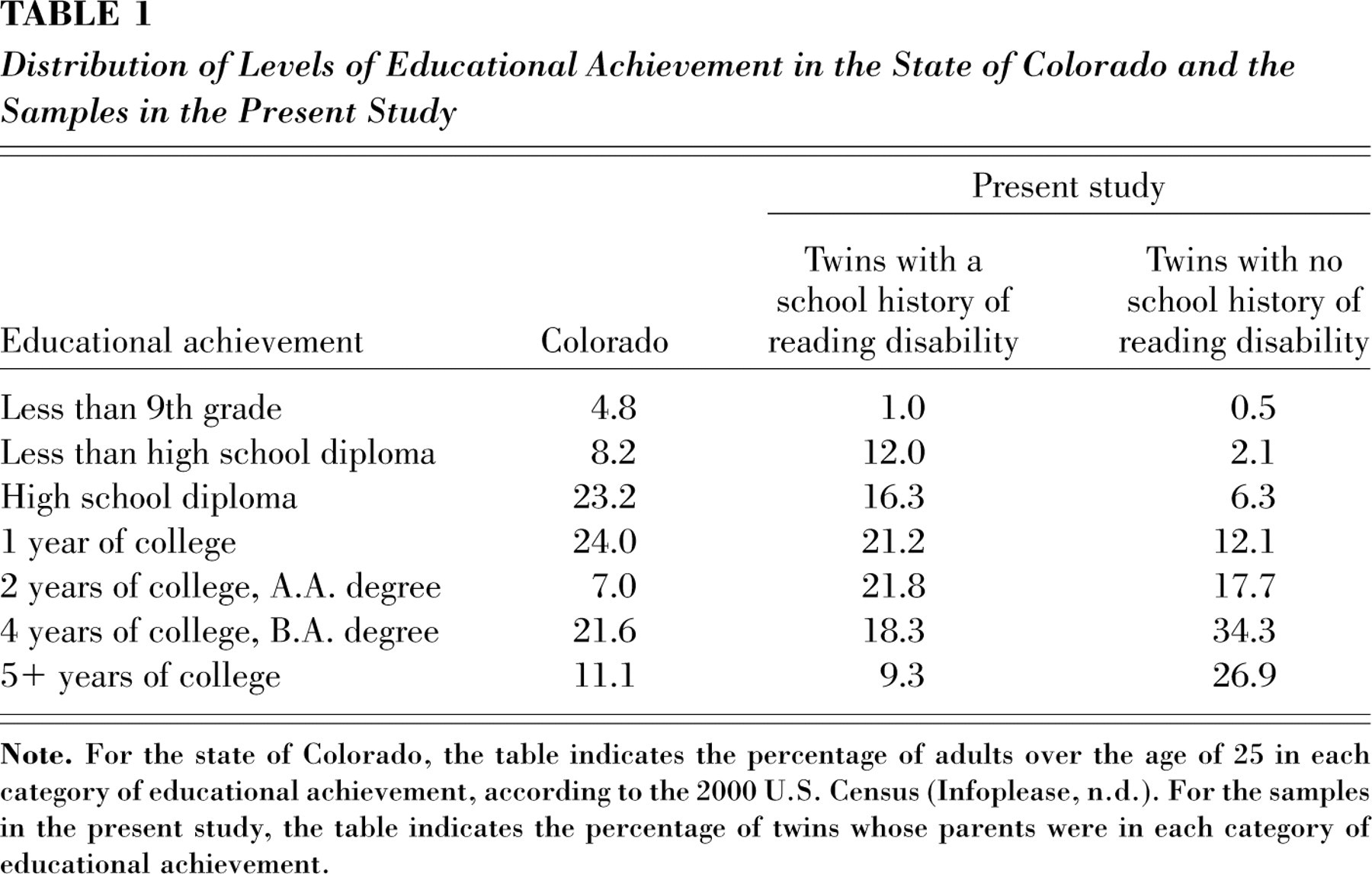
Table 1 presents descriptive information regarding parents' educational attainment. The educational attainment of the parents of twin pairs with a school history of reading disability was similar to the educational attainment of adults over the age of 25 in the state of Colorado, according to the 2000 U.S. Census (Infoplease, n.d.). However, the Colorado census data do not exclude the approximately 15% of families that spoke a language other than English at home, and all of the twins in the present study spoke English as their first language. The parents of twin pairs with no school history of reading disability tended to have higher levels of education than both the parents of twin pairs with a school history of reading disability and individuals over age 25 in Colorado.
Distribution of Levels of Educational Achievement in the State of Colorado and the Samples in the Present Study
Standardization of the Discriminant Score and Parental Education for Behavior Genetic Analyses
Analyses of genetic and environmental influences on reading disability were conducted using z scores calculated from age-adjusted DISCR scores standardized against the DISCR score distribution of the no-school-history group. Twins with a school history of reading disability were identified as probands if their performance was 1.5 standard deviations or more below the mean for the no-school-history group on DISCR. In cases in which both members of the twin pair were identified as probands, the pair was entered into the analyses twice, with each twin taking a turn as a proband. The standard error was corrected for double entry of such pairs. To control for potential correlation between genotype and environment, we adjusted the parental education variable for its correlation (.087) with probands' DISCR scores.
Regression Analyses of Average Genetic Influence on Proband Group Membership
The widely employed DeFries-Fulker (DF) multiple regression method (DeFries & Fulker, 1985, 1988) provides an estimate of average genetic influence on proband group membership based on data from selected samples of identical (or monozygotic, MZ) twins, who share all their genes, and fraternal (or dizygotic, DZ) twins, who share half of their segregating genes on average. Our estimates of heritability of proband group membership are based on the differential regression of transformed mean scores of MZ and DZ probands' cotwins to the mean of the no-school-history twin sample. The twins' z scores for reading ability were transformed by dividing each score by the mean proband z score. As a result of this transformation, the mean proband score became 1, and the mean cotwin score indicated how far the cotwins had regressed from the mean for the proband group (1) to the mean for the no-school-history group (0). We tested the average level of heritability for proband group membership regardless of parental education by analyzing these transformed scores in the basic DF model:

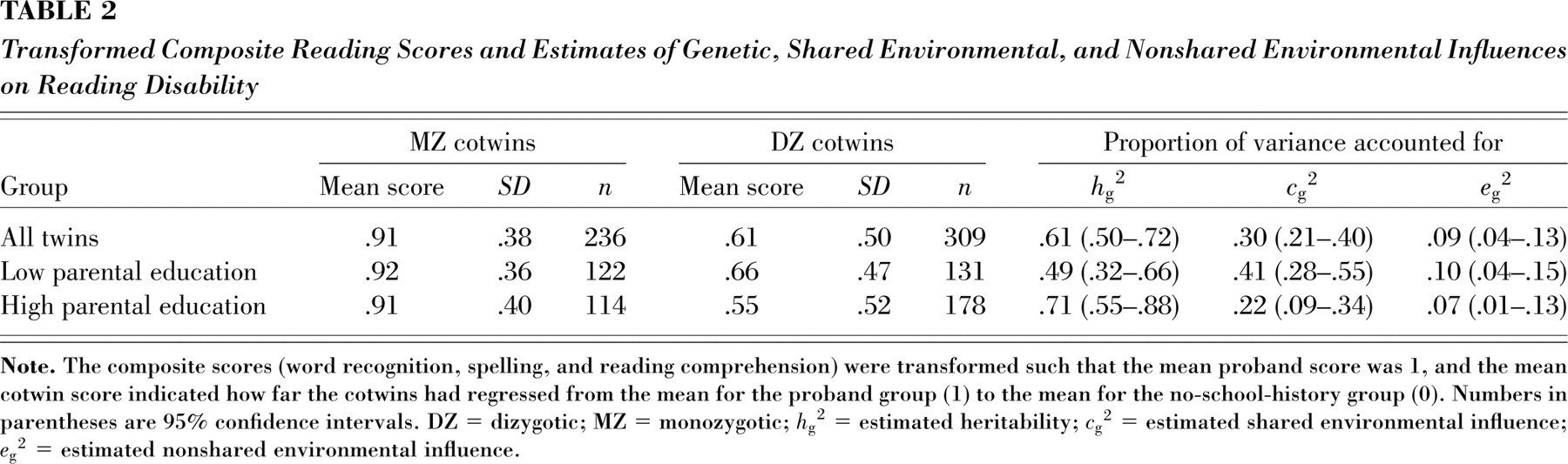
The first row of Table 2 presents mean transformed cotwin scores and the heritability estimate for the overall group deficit in our composite measure of reading, spelling, and comprehension (DISCR). The DZ cotwin mean regressed further toward the mean of the no-school-history sample than did the MZ cotwin mean. This suggests that group deficits in reading disability are substantially heritable (DeFries & Fulker, 1985). When the basic DF model was fitted to the transformed cotwin scores, the group heritability estimate (h g 2) was .61 for DISCR (p rep = .99). Following the procedure described in Gayán and Olson (2001), we were able to parse the environmental influence on membership in the reading-disability group into environmental influences shared by both members of a twin pair and environmental influences unique to each member of a twin pair. The estimate for shared environmental influences (c g 2) was .30, and the estimate for nonshared environmental influences (e g 2), which includes measurement error, was .09. These average estimates of genetic and environmental influences are consistent with the extant literature on group deficits in reading and related skills (for a review, see Olson, 2006; also see Pennington & Olson, 2005).
Transformed Composite Reading Scores and Estimates of Genetic, Shared Environmental, and Nonshared Environmental Influences on Reading Disability
Regression Analyses of Linear G × E Interactions
Next, we tested the hypothesis that the genetic and environmental etiologies of reading difficulties vary as a function of parental education. Equation 2 shows the extended DF regression model, which adds to the basic model (Equation 1) a main effect of parental education and two interaction terms involving parental education:

The results of the extended DF regression analysis demonstrated that genetic influences on reading disability increased significantly with increasing levels of parental education (β = .272, t(540) = 3.23, p rep = .99). The beta coefficient for the interaction provides a measure of the effect size, and a post hoc analysis using G∗Power 3 (Faul, Erdfelder, Lang, & Buchner, 2007) indicated that the power to find this effect was .74. The positive direction of the interaction demonstrated that the heritability of deficits in reading tended to be higher for children whose parents were more highly educated than for children whose parents were less educated.
Genetic and Environmental Influences in Low- and High-Education Groups
To illustrate how the pattern of genetic and environmental influences on reading disability depended on parental education, we conducted a third analysis in which a median (13.2 years) split on parents' years of education divided the sample into a lower-parental-education group and a higher-parental-education group. We then estimated the genetic, shared environmental, and nonshared environmental influences on reading disability separately within these two groups (see Table 2 and Fig. 1). We tested the significance of the group differences in genetic and environmental influences using the method described by Purcell and Sham (2003). Although this analysis did not demonstrate a significant two-tailed (p < .05) G × E interaction because of the linear variance within groups that was lost by the median split, the group contrasts for genetic and shared environmental influences were both significant in one-tailed tests (p < .05). These results are consistent with the direction of the significant linear G × E interaction within the full reading-disability group: Genetic influences were greater in the higher-education group (h g 2 = .71) than in the lower-education group (h g 2 = .49), and the estimate of shared environmental influence was greater in the lower-education group (c g 2 = .41) than in the higher-education group (c g 2 = .22). The estimates of nonshared environmental influence were similar in the lower-education (e g 2 = .10) and higher-education (e g 2 = .07) groups.
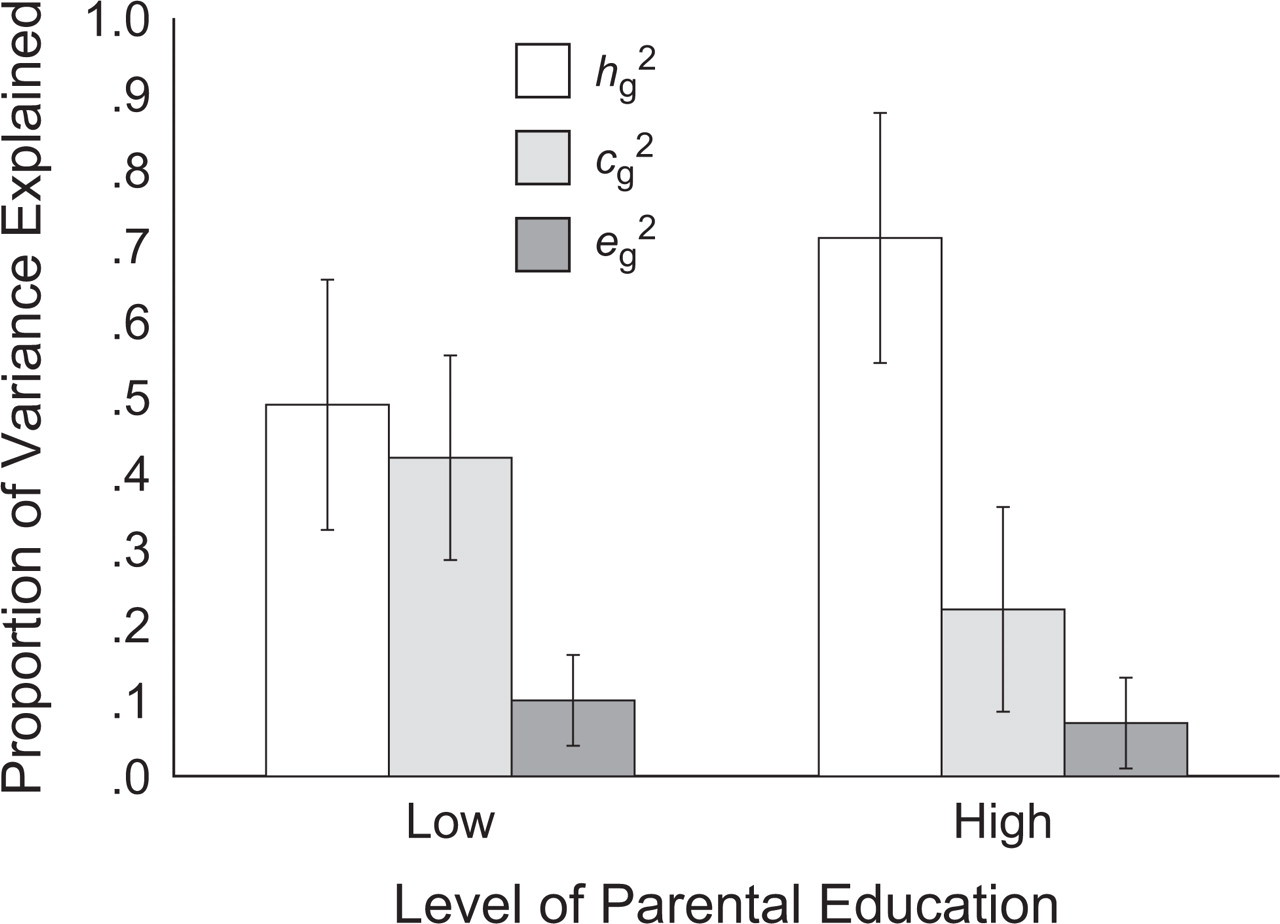
Proportion of variance in reading disability explained by heritability (h g 2), shared environmental effects (c g 2), and nonshared environmental effects (e g 2), among children with lower and higher levels of parental education. Error bars indicate 95% confidence intervals around the point estimates.
DISCUSSION
This study investigated whether level of parental education moderated the heritability of reading disability in a selected sample of 545 identical and fraternal twin pairs. Previous studies have explored G × E interactions for individual differences in reading and general cognitive abilities across the normal range, but this is the first study to explore possible G × E interactions within a sample specifically selected for reading disability.
We found that the heritability of reading disability, assessed by low performance on a composite measure of printed-word recognition, spelling, and reading comprehension, was .61 averaged across the whole sample. However, there was a significant linear interaction between parents' years of education and the heritability of reading disability within the selected sample: Children whose parents had higher levels of education tended to have stronger genetic influence on their reading disability. These results based on our composite measure are consistent with unpublished results for each skill analyzed separately.1
Our results support the hypothesis of a G × E interaction for reading disability because parental education has been shown to predict a variety of health and educational outcomes in childhood, investment in children's educational development, and family SES (Craig, 2006). In addition, a longitudinal twin study of individual differences in early reading development (Olson, Byrne, & Samuelsson, in press) showed that parental education correlated (r = .4) with the average third-grade school score on Colorado's state reading assessment. The correlation between mean school performance and parents' years of education might have been due to poorer reading instruction during the early grades, on average, in schools with lower-SES families. However, Olson et al. also found that the correlations between parents' years of education and their twins' reading performance (about r = .3) across several measures were not significantly moderated by mean school score.
We recognize that parental education may be influenced by parents' genes related to reading ability and that these genes may be transmitted to the children. It is also possible that these parental genes could influence children's family and school environment for reading development, resulting in a gene-environment correlation (Plomin, DeFries, McClearn, & McGuffin, 2008). Although it was not possible to assess this correlation directly with the data in the present study, we controlled for its potential influence on the G × E interaction by using a residual parental education variable adjusted for its correlation with probands' reading scores. We also included the main effect of parental education in the DF regression test of the G × E interaction to control for the influence of any gene-environment correlation on the G × E interaction (Purcell, 2002).
In the introduction, we discussed the bioecological and diathesis-stress models, which offer competing hypotheses for the direction of G × E interaction effects. The bioecological model states that heritability will be greater when there is environmental support for the actualization of genetic potential, whereas the diathesis-stress model states that heritability will be greater in stressful environments, which exacerbate genetic susceptibility. Our results clearly support the bioecological model of G × E interaction for the heritability of reading disability. On average, children who failed in reading despite good environmental support for learning to read tended to have stronger genetic influences on their reading disability than did children who learned to read in less supportive environments. The latter children tended to have stronger environmental influences on their reading disability. Of course, these results leave open many questions about the exact nature of the genetic and environmental influences on reading disability that are associated with parental education.
It is important to keep in mind that in behavior genetic studies, estimates of genetic and environmental influences on reading disability are estimates of average genetic and environmental influences on variance in group membership. The moderate correlation of .4 between parents' years of education and mean school performance (Olson et al., in press) indicates that some families with low parental education may have relatively supportive environments for learning to read. It is also possible that the range of environmental support for reading development is greater across families with lower parental education. A greater range would tend to increase estimates of shared environmental influence and decrease estimates of genetic influence.
CONCLUSIONS
The present results have important implications for genetic research on reading disability, the diagnosis of reading disability, and current federally mandated public education policies in the United States.
Implications for Behavior and Molecular Genetic Research on Reading Disability
Estimates of genetic and environmental influences in deviant groups and unselected populations are average estimates that do not specify the level of these influences for any individual. The present results indicate that behavior genetic estimates of genetic and environmental influences on reading disability and other learning disabilities may depend on the level of relevant environmental support within the population studied. Whenever direct information about the relevant environment for a behavior is available, it may be useful to include that information and test for potential G × E interactions. Of course, it is important to recognize that these interactions will not account for all the individual variation in genetic and environmental influence. In the context of the present study, this means that some children of parents with low education may have very strong genetic influence on their reading disability, whereas some children whose parents have very high levels of education may have little or no genetic influence on their reading disability.
Our behavior genetic results also are potentially useful for future molecular genetic studies of reading disability and other learning disabilities, because they may help in selecting samples that have a relatively large proportion of variance accounted for by genetic factors, which may increase the probability of finding genes that significantly influence behavior. Identifying specific genes that influence complex cognitive disorders, such as reading disability, is a considerable challenge. Current evidence suggests that there may be many different genes involved, each having small average effects in the population (Meaburn, Harlaar, Craig, Schalwyk, & Plomin, 2008). Molecular genetic studies could use information about relevant environmental factors such as parental education to select samples that are most likely to have strong genetic influences on their reading disability.
Implications for the Diagnosis and Remediation of Reading Disability
Much current research on the diagnosis of reading disability is focused on assessing children's response to instruction (Fuchs & Fuchs, 2006). The four Learning Disabilities Research Centers currently funded by the National Institutes of Health, including the CLDRC in Colorado (Olson, 2006), are tracking children's response to systematic and intensive interventions for reading disability. The basic rationale for this focus on response to instruction is that reading failure in many children may result from poor instruction, a lack of reading practice, or both. The goal is to identify and correct these instructional failures, and to provide much more intensive intervention for children who do not respond to good instruction. Results from the present study of G × E interactions support the idea that poor instruction or lack of reading practice may often be the main cause of reading disability in children from low-SES families, whereas genes may be the main influence on reading disability among most children in higher-SES families, who may already be receiving good instruction.
Implications for Public Education Policy
The No Child Left Behind Act of 2001 has the laudable goal of improving literacy by improving the educational environment. Our finding of a relatively strong influence of the environment on reading disability in children from low-SES families certainly supports the value of this effort. However, there is still some significant average genetic influence on reading disability among these children, and the relatively strong average genetic influence on reading disability in children from high-SES families indicates that many cases of reading disability, particularly those expressed in a supportive educational environment, are likely to have a primarily genetic origin.
The finding that some children's reading disability has a genetic basis does not imply that these children will not benefit from intense and systematic remedial intervention. However, recent evidence from a longitudinal twin study of early reading development has shown that genes have a strong influence on individual differences in young children's experimentally assessed learning rates for reading and related skills (Byrne et al., 2008). Genetic constraints on learning rates are not recognized in the No Child Left Behind legislation, which requires that all children reach “grade level” (i.e., average) performance in reading and other academic skills by 2014, and assumes that this lofty goal can be met through appropriate education. A more beneficial policy would acknowledge genetic constraints on meeting a grade-level standard among some children with reading disability. It would also recognize and honor the extraordinary effort that these children, their parents, and their teachers may have to expend to make functionally important gains in reading and other academic skills, even if they do not reach grade level (Olson, 2006; Olson et al., in press).
Footnotes
1These unpublished results are available from the authors.
Acknowledgements
We would like to acknowledge the support from the National Institute of Child Health and Human Development (Center Grant HD-27802, Training Grant HD-007289) and from participating families.