







Abstract
What is the nature of early words? Specifically, do infants expect words for objects to refer to kinds or to distinct shapes? The current study investigated this question by testing whether 10-month-olds expect internal object properties to be predicted by linguistic labels. A looking-time method was employed. Infants were familiarized with pairs of identical or different objects that made identical or different sounds. During test, before the sounds were demonstrated, paired objects were labeled with one repeated count-noun label or two distinct labels. Results showed that infants expected objects labeled with distinct labels to make different sounds and objects labeled with repeated labels to make identical sounds, regardless of the objects' appearance. These findings indicate that the 10-month-olds' expectations about internal properties of objects were driven by labeling and provide evidence that even at the beginning of word learning, infants expect distinct labels to refer to different kinds.
Do early words for objects refer to kinds or to distinct shapes? This is a long-standing debate in the study of language development. Many studies with young children provide evidence for a shape bias, that is, the expectation that objects that share the same shape should also share a label (e.g., Imai & Gentner, 1997; Landau, Smith, & Jones, 1988; Samuelson & Smith, 2005; Smith, Jones, Landau, Gershkoff-Stowe, & Samuelson, 2002; Yoshida & Smith, 2001). The question arises as to whether early words map onto distinct shapes, or whether early words refer to kinds and shape is a proxy for kind membership (Markson, Diesendruck, & Bloom, 2008; Samuelson & Bloom, 2008; Soja, Carey, & Spelke, 1991).
Representations of kinds specify categorization under concepts such as “dog,” “ball,” and “car,” categories of objects united by functional and causal features, as well as perceptual features. According to psychological essentialism, members of the same kind share both internal, nonobvious properties and external, perceptual properties. The perceptual similarity reflects, and is caused by, shared deeper properties (Gelman, 2003; Medin & Ortony, 1989). In fact, it is possible for objects that look different to be members of the same kind (e.g., a poodle and a Chihuahua, a telephone shaped like a banana and a telephone shaped like a stuffed dog), as well as for objects that look very similar, or the same, to be members of different kinds (e.g., a baseball and an orange, a rock and a fake rock made of foam).
There is evidence suggesting that older children rely on count-noun labels to make inferences about internal object properties. For example, Gelman and Coley (1990) showed 2-year-olds a picture of a familiar, prototypical object and reminded them of a familiar property of that object. The children were then tested on whether they generalized that property to another object that was similar in appearance or to an object that was different in appearance but labeled with the same count noun. When the object was not labeled, the children generalized the property only if the object was perceptually similar. Thus, in the absence of labeling information, children rely on perceptual cues (i.e., the shape of the object) for categorization. When a label was provided, the 2-year-olds inferred that objects that shared the same label would also share the same property. Thus, by 2 years of age, children who hear the same label applied to perceptually dissimilar objects assume that the objects are members of the same category, or kind, and expect those objects to share nonobvious, internal properties (e.g., Davidson & Gelman, 1990; Gelman & Coley, 1990; Gelman & Markman, 1986; Kalish & Gelman, 1992).
This ability has also been demonstrated in younger children (Graham & Kilbreath, 2007; Graham, Kilbreath, & Welder, 2004; Welder & Graham, 2001). For example, in a recent study by Graham and Kilbreath (2007), when objects with very minimal perceptual similarity were labeled with the same count noun, both 14- and 22-month-olds generalized nonobvious properties from one object to the other. If early words refer to object kinds, and not just distinct shapes, infants should expect other kind-relevant, nonobvious properties to be predicted by labeling.
In the absence of labeling information, object shape is not the only cue used by older children in service of object categorization. Indeed, there is evidence suggesting that intention may override shape information in word learning. Gelman and Ebeling (1998) showed 2- and 3-year-old children line drawings roughly shaped like various nameable objects. For half the participants, each line drawing was described as depicting a shape that was created intentionally (e.g., someone painted a picture). For the remaining participants, each drawing was described as depicting a shape that was created accidentally (e.g., someone spilled some paint). The children were then asked to name each picture. The findings suggest that children use shape as the basis of naming primarily when the shape is intentional. Thus, although shape does play an important role in children's early naming, other factors, including the mental state of a picture's creator, are also important (see also Bloom & Markson, 1998). More recent studies provide additional evidence that 18-month-old infants take into account conceptual knowledge (e.g., describing the object as “happy”) in labeling (Booth, Waxman, & Huang, 2005). Such findings imply that, for young children, labels for objects (and representations of those objects) are not wholly determined by shape similarity; young children may use shape as a proxy for kind membership.
Thus, by 14 to 18 months of age, children expect words for object categories to refer to kinds. However, it remains an open question whether infants, who are at the beginning of word learning, have the same expectation. It may be the case that infants expect words to refer to distinct shapes and only later in development realize that shape is correlated with kind membership.
For artifact objects, it has been shown that shape is correlated with kind membership, but color is not (e.g., Rosch, Mervis, Gray, Johnson, & Boyes-Braem, 1976). A recent set of studies from our lab demonstrated that 9-month-old infants expect objects differing in a kind-relevant property (shape) to be marked by distinct labels, but do not hold this expectation for objects differing in a property unrelated to kind (color; Dewar & Xu, 2007). These findings, however, are ambiguous as to whether infants who are on the cusp of learning words understand that shape is a salient cue to kind membership or have simply formed an association between labeling and shape, such that they expect objects referred to by the same label to have the same shape and objects marked by distinct labels to have different shapes.
Because shape is highly correlated with kind membership, it is very difficult to tease these interpretations apart, especially with very young word learners. In the study reported in this article, we investigated this issue by testing whether infants expect internal properties of objects to be predicted by labeling. This study makes two novel contributions to the literature on how labeling influences infants' representations of object properties. First, we employed a more stringent test of the roles of perceptual similarity and labeling than used in previous studies by Graham and her colleagues (Graham & Kilbreath, 2007; Graham et al., 2004; Welder & Graham, 2001). In those studies, “high similarity” objects were similarly shaped, and “low similarity” objects were differently shaped. Instead, we used identical objects and different-looking objects (i.e., objects that differed in shape, color, and texture) as our contrasting pairs. We tested whether labeling is such a powerful cue for nonobvious, internal object properties that it may, in fact, override perceptual similarity completely, both for identical and for different-looking pairs of objects. Second, we developed a looking-time method that has not been used before in these types of studies, and this method allowed us to test younger infants on the cusp of learning words for objects, namely, 10-month-olds. Previous studies, in contrast, used a manual manipulation task with infants between 13 and 24 months of age (Graham et al., 2004; Welder & Graham, 2001). Our study tested whether younger infants given perceptual and linguistic information might approach the task of predicting the nonobvious properties of objects differently from older, more expert word learners.
In the current study, infants were presented with pairs of objects whose ability to make sounds was demonstrated. In a between-subjects design, half the infants were shown only identical-looking object pairs, whereas the other half were shown only different-looking object pairs. During familiarization, each infant was familiarized with one object pair that made the same sound and a second object pair that made two different sounds. On the test trials, object pairs were labeled. Labeling also varied between subjects: For half the infants, object pairs were labeled with one repeated count-noun label, and for the other half, object pairs were labeled with two distinct labels. The dependent measure was looking time. The question of interest was whether infants could use the linguistic information to predict whether a particular pair of objects should make the same sound or different sounds, regardless of the objects' perceptual similarity. If labels reference kind for young infants, they should expect the internal properties of objects (properties determined by kind membership) to accord with the objects' labels. In this case, regardless of the perceptual similarity of an object pair (i.e., whether the objects are identical or different looking), upon hearing the pair labeled with the same count noun, young infants should expect the two objects to make identical sounds; conversely, regardless of the objects' appearance, upon hearing two objects labeled with two distinct count nouns, young infants should expect the objects to make different sounds. If, however, young infants merely expect that distinct labels mark distinct shapes, labeling should not lead to differential predictions about the internal properties of object pairs. In this case, regardless of the labeling information provided, infants should rely on the appearance of an object pair to drive their expectations regarding the properties of the objects, and they should expect identical pairs to make identical sounds and different-looking pairs to make different sounds.
METHOD
Participants
Participants were 64 full-term infants, 34 male and 30 female (mean age = 10 months 2 days; range = 9 months 15 days to 10 months 29 days). Each of four conditions included 16 infants. All infants were recruited from the Greater Vancouver area by mail and subsequent telephone calls. Most of the infants came from a middle-class, non-Hispanic White background; 20% were Asian. The infants received a token gift (a T-shirt or bib with a university logo) after the study. English was the primary language spoken at home for all the infants. An additional 13 infants were tested, but were excluded because of experimenter error (2), fussiness (8), or parental interference (3).
Materials
Two pairs of objects were used in the study. One pair consisted of a plush doglike toy (approximately 13 × 11 cm) and a plush toy fish (approximately 10 × 14 cm), and the other consisted of a cylinder covered with multicolored beads (approximately 14 × 6 cm), and a rectangle covered in foam flowers (approximately 12 × 7 cm). Each of the four objects produced a distinct sound when manipulated by the experimenter (the doglike toy squeaked when it was compressed, the plush fish contained beads that rattled when shook, the cylinder contained bells that jingled when moved, and the rectangle contained rocks that rattled when shook). Each of the four objects had two identical-looking copies: one that made the same sound as the original object and one that produced the sound made by the object with which the original object was paired. Thus, 12 objects were used in the experiment. The doglike toy and the fish were paired only with each other, and the rectangle and the cylinder were paired only with each other. Depending on assigned condition, an infant saw either all four objects or two identical-looking objects from each of the object pairs (e.g., identical fish and identical rectangles).
Apparatus
The events were presented on a stage with a display area that measured 94 cm wide and 55 cm high. The infant sat in a high chair about 60 cm from the stage, with eye level slightly above (about 8 cm) the floor of the stage. The parent sat next to the infant with his or her back toward the stage and was instructed not to look at the stage during the study. A video camera, set up under the stage, focused on the infant's face and recorded the entire session. The video camera was connected to a 19-in. television placed in one corner of the room. An observer watched the infant on the television monitor and recorded the infant's looking times. The observer was not able to see what was presented on the stage and was not aware of the order of the trials. Looking time was entered on a laptop computer by pressing a key while the infant was looking at the object pair. A computer program written specifically for looking-time studies (Hypercard, Version 2.4.1; Pinto, 2002) was used to record the looking times.
Design and Procedure
Four conditions were created by crossing the two levels of each of the independent variables: appearance of the object pairs (identical vs. different looking) and number of distinct labels heard (one vs. two). Infants were randomly assigned to these four conditions. Each infant received four familiarization trials and four test trials.
Familiarization Trials
During familiarization, each infant, regardless of condition, was presented with one object pair that made identical sounds and one object pair that made different sounds. The objects in each pair were either identical or different looking, depending on the infant's assigned condition.
On each familiarization trial, a pair of objects was placed on the stage in front of the infant. The experimenter picked up each object and demonstrated the sound it made. After each object's sound was demonstrated twice, the experimenter left the object pair positioned at the front of the stage and in infant-directed speech said, “Look, [baby's name], look!” The experimenter lowered her head and eye gaze to ensure that she was not making eye contact with the infant. The infant's looking time was recorded. When the infant looked away for 2 consecutive seconds, the trial ended, and the object pair was removed from the stage. A new object pair was placed on the stage in order to begin the next trial.
Objects from both object pairs (dog-fish, cylinder-rectangle) were shown during the first two familiarization trials, and the third and fourth familiarization trials were a repetition of the first two. The side of the stage an object was positioned on and the order of presentation of the object pairs were counterbalanced across infants.
Test Trials
Test trials were identical to familiarization trials with one critical difference: Before demonstrating the sounds made by the objects in the pair, the experimenter labeled the two objects with either the same label (e.g., “There's a zav! There's a zav!”) or two different labels (e.g., “There's a wug! There's a dak!”), depending on the infant's assigned condition. Each sentence was spoken in infant-directed speech as the experimenter picked up and looked at the object being labeled. (See Fig. 1 for a schematic representation of the test trials in each of the four conditions.)
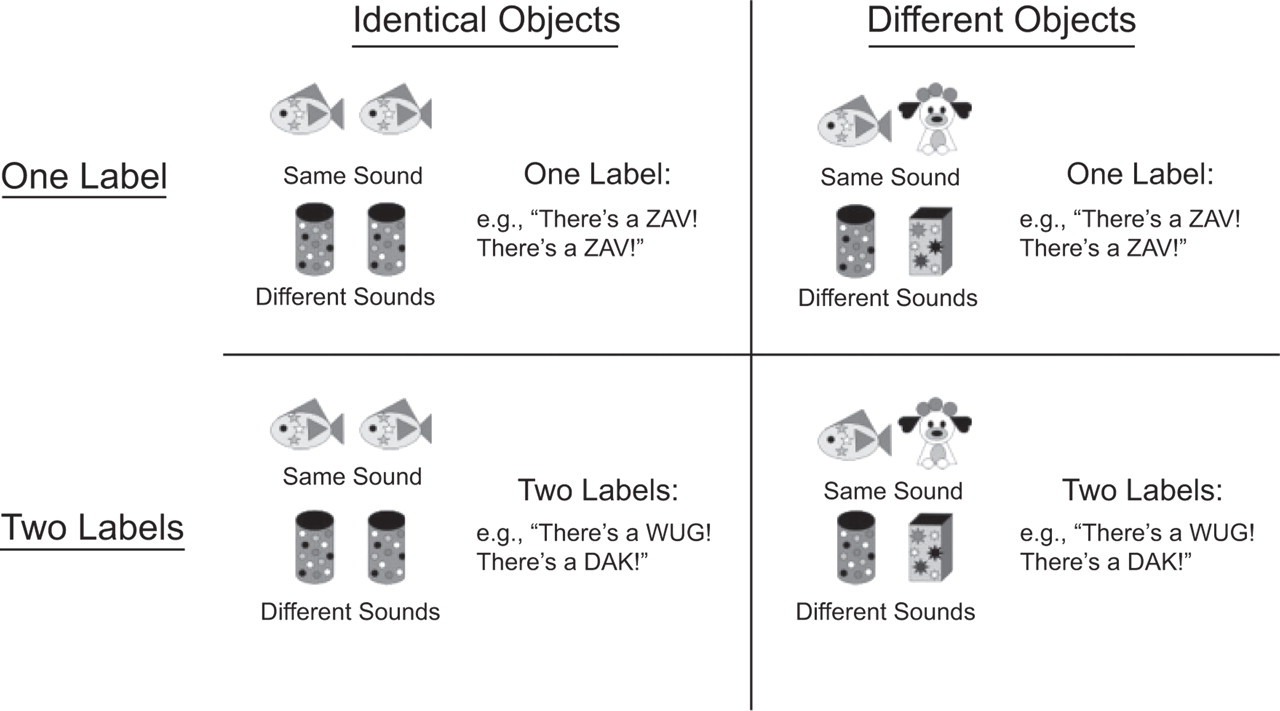
Schematic representation of the test trials in each of the four conditions. The manipulated variables were object-pair appearance (identical vs. different looking) and number of labels heard (one vs. two).
The four objects were labeled with nonsense words (fep, zav, wug, and dak). Throughout the study, a given object pair was always associated with the same labels; in addition, in the identical-objects/identical-labels and different-objects/different-labels conditions, a particular object was always given the same label. The same objects that were shown during the familiarization trials were shown on the test trials. The four test trials included two instances of expected outcomes and two instances of unexpected outcomes (see the descriptions of the individual conditions). The order of the outcomes (expected or unexpected) and of the sounds (same sound or different sounds) were counterbalanced across infants.
Identical-Objects/Identical-Labels Condition.
Infants in this condition saw only identical-looking object pairs. On each test trial, an object pair was labeled with one repeated label (e.g., “There's a zav! There's a zav!”). Hearing an identical-looking object pair being labeled with one repeated label should lead to the expectation that the two objects make the same sound; thus, it would be unexpected for the objects to produce different sounds. In this condition, the same-sound object pair constituted the expected outcome, whereas the different-sound object pair constituted the unexpected outcome.
Identical-Objects/Different-Labels Condition.
Infants in this condition saw only identical-looking object pairs. On each test trial, an object pair was labeled with two distinct labels (e.g., “There's a wug! There's a dak!”). Hearing an identical-looking object pair being labeled with two distinct labels should lead to the expectation that the objects make different sounds; thus, it would be unexpected for the objects to produce the same sound. In this condition, the different-sound object pair constituted the expected outcome, whereas the same-sound object pair constituted the unexpected outcome.
Different-Objects/Identical-Labels Condition.
Infants in this condition saw only different-looking object pairs. On each test trial, an object pair was labeled with one repeated label (e.g., “There's a zav! There's a zav!”). Hearing a different-looking object pair being labeled with one repeated label should lead to the expectation that the two objects make the same sound; thus, it would be unexpected for the objects to produce different sounds. In this condition, the same-sound object pair constituted the expected outcome, whereas the different-sound object pair constituted the unexpected outcome.
Different-Objects/Different-Labels Condition.
Infants in this condition saw only different-looking object pairs. On each test trial, an object pair was labeled with two distinct labels (e.g., “There's a wug! There's a dak!”). Hearing a different-looking object pair being labeled with two distinct labels should lead to the expectation that the objects make different sounds; thus, it would be unexpected for the objects to produce the same sound. In this condition, the different-sound object pair constituted the expected outcome, whereas the same-sound object pair constituted the unexpected outcome.
RESULTS
An alpha level of .05 was used in all statistical analyses. Preliminary analyses found no effects of gender or object animacy. Subsequent analyses were collapsed over these variables. All infants were observed off-line by a second observer who was completely blind to the order of the trials. Interobserver reliability averaged 98%.
Familiarization Trials
Averaging across all four familiarization trials, a 2 (object-pair appearance: identical vs. different) × 2 (sound: same vs. different) analysis of variance (ANOVA) revealed a significant interaction, F(1, 32) = 5.59, p = .02, η P 2 = .08. Infants who saw only identical object pairs looked equivalently to the object pair that produced different sounds (M = 12.23 s, SD = 7.61) and to the object pair that produced the same sound (M = 11.28 s, SD = 6.50), t(31) = −0.86, p > .05, d = 0.15. However, infants who saw only different-looking object pairs looked significantly longer at the object pair that produced identical sounds (M = 14.77 s, SD = 6.99) than at the object pair that produced different sounds (M = 11.81 s, SD = 5.41), t(31) = 2.40, p = .02, d = 0.42.
Test Trials
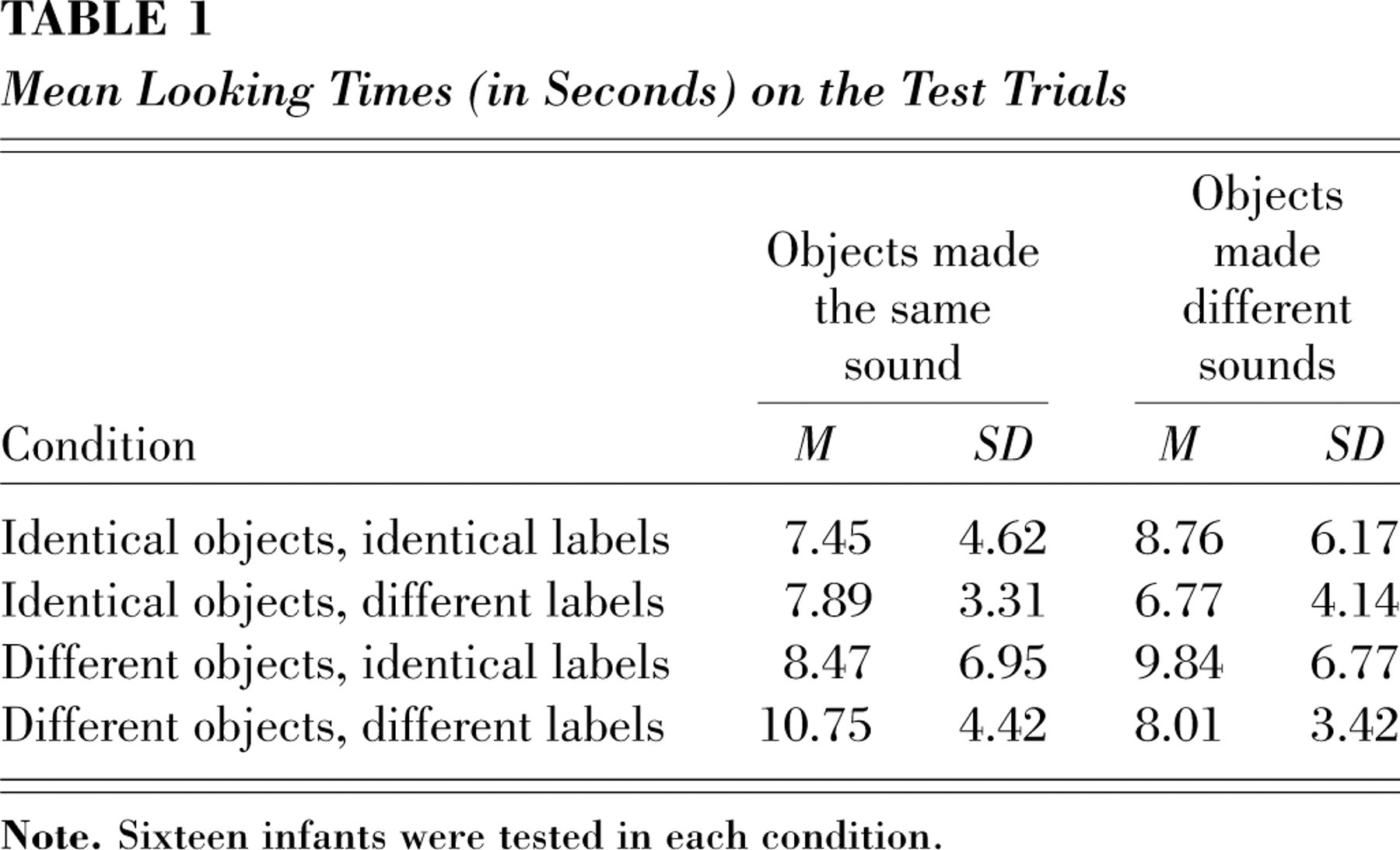
Table 1 presents the mean looking times to the same-sound object pair and the different-sound object pair for each of the four conditions. Infants' looking times on the test trials were analyzed by means of a 2 × 2 × 2 repeated measures ANOVA, with sound (same vs. different) as a within-subjects factor and number of labels (one vs. two) and object-pair appearance (identical vs. different) as between-subjects factors. The Sound × Number of Labels interaction was statistically significant, F(1, 60) = 8.46, p < .01, η P 2 = .12. Whether shown identical-looking object pairs or different-looking object pairs, infants who heard the objects in a given pair referred to with the same label looked significantly longer when the objects made two different sounds than when they made identical sounds, t(31) = −2.11, p = .04, d = 0.37. Conversely, whether shown identical-looking object pairs or different-looking object pairs, infants who heard the objects in a given pair referred to with two distinct labels looked significantly longer when the objects made identical sounds than when they made different sounds, t(31) = 2.09, p = .05, d = 0.37. There were no other main effects or two-way interactions, nor was there a three-way interaction (ps > .1). In other words, object appearance did not have a significant effect on infants' prediction of internal properties of objects.
Mean Looking Times (in Seconds) on the Test Trials
DISCUSSION
We found that 10-month-old infants used linguistic information (count-noun labels) to predict whether a particular pair of objects should make the same sound or different sounds, regardless of the objects' perceptual similarity or dissimilarity. Infants who heard two distinct labels expected the objects to make different sounds, whereas infants who heard one repeated label expected the objects to make the same sound. This effect was independent of the appearance of the objects, which is particularly remarkable given that, at least in the case of different-looking objects, infants had expected the objects to make different sounds in the familiarization trials. The provision of linguistic labels allowed the infants to override this initial expectation, a result suggesting a heavy reliance on linguistic information in identifying object kinds during the first year of development (see also Waxman, 2004; Xu, 2002, 2007).
Note that there is no evidence that the 10-month-olds in this study actually learned the labels for the objects, nor were they expected to. The events presented to the infants involved both novel objects and novel labels. These certainly are not optimal conditions for word learning, especially for infants of this age. However, even in the absence of specific word-object mappings, infants as young as 10 months seem to use labels, and not object appearance, to guide their expectations about objects' nonobvious internal properties.
Are the results of this study specific to the property of sound, or do they extend to nonobvious object properties more generally? One might theorize that the results obtained could have been due to the fact that the internal properties manipulated (i.e., sounds) were of the same modality as the count-noun labels (i.e., both auditory). However, this seems unlikely given that the appearance of the objects was constantly available. It would have been easier for the infants to match object appearance with sound (available concurrently) than to match labeling with sound (transient and temporally separated). There is reason to believe that these results should apply to nonobvious properties more broadly. Recent evidence regarding inductive generalization shows that infants as young as 14 months of age expect objects (even perceptually dissimilar objects) that share a label to also share other nonobvious properties (both perceptual internal properties and internal sound properties; Graham & Kilbreath, 2007). Thus, children who are several months older than the 10-month-olds in the current study react to nonobvious perceptual features (nonobvious properties) equivalently to nonobvious auditory features (squeaking when squeezed). It seems likely that 10-month-olds would also consider both hidden visual features and nonobvious sound properties as kind-relevant internal properties that should accord with an object's label.
We have provided the first evidence that infants as young as 10 months of age expect objects that share a label to have shared internal properties. This finding suggests that words for objects refer to kinds, not just shape, even at the beginning of word learning.
Footnotes
Acknowledgements
We thank members of the Infant Cognition Lab at the University of British Columbia for helpful discussion and Anjula Joshi for pilot-testing an earlier version of the study. We also thank the infants and parents who participated. This research was supported by a grant from the Natural Sciences and Engineering Research Council of Canada to F. Xu.