







Abstract
Models of eye guidance in reading rely on the concept of the perceptual span—the amount of information perceived during a single eye fixation, which is considered to be a consequence of visual and attentional constraints. To directly investigate attentional mechanisms underlying the perceptual span, we implemented a new reading paradigm—parafoveal magnification (PM)—that compensates for how visual acuity drops off as a function of retinal eccentricity. On each fixation and in real time, parafoveal text is magnified to equalize its perceptual impact with that of concurrent foveal text. Experiment 1 demonstrated that PM does not increase the amount of text that is processed, supporting an attentional-based account of eye movements in reading. Experiment 2 explored a contentious issue that differentiates competing models of eye movement control and showed that, even when parafoveal information is enlarged, visual attention in reading is allocated in a serial fashion from word to word.
During reading, the eyes remain stationary for brief periods called fixations (typically 200–250 ms), during which visual information is extracted. Fixations are punctuated by short (6–8 characters) and rapid (∼25 ms) movements called saccades. Making eye movements is necessary because of limitations in visual acuity and attention. The perceptual span is defined as that region of text from which useful information can be extracted (for a review, see Rayner, 1998). The relative influence of visual and attentional constraints on the perceptual span in reading is underspecified. In this article, we report work exploring this question and interpret our results in light of current models of eye guidance in reading.
On the basis of acuity limitations, the visual field is functionally divided into three areas: the fovea, parafovea, and periphery. Visual acuity is maximal in the foveal region. In reading experiments (Balota & Rayner, 1991), this region, the central 2° of visual angle around fixation, generally encompasses 6 to 8 characters. The parafoveal region, from 2° to 5°, extends beyond the foveal region to about 15 to 20 characters, and the peripheral region includes everything beyond 5° from fixation.
The perceptual span has been functionally approximated from moving-window studies (McConkie & Rayner, 1975), in which text outside a window defined around the fixated letter is altered in some way (e.g., valid text is replaced by strings of Xs). When parafoveal preview of upcoming text is invalid, reading time is slowed. For English, the perceptual span is estimated to extend from 3 characters to the left of fixation (approximately the beginning of the fixated word) to 14 characters to the right of fixation. The span's asymmetry is not hardwired, but instead reflects attentional demands linked to reading direction: In Hebrew (which is read from right to left), the perceptual span extends further to the left (Pollatsek, Bolozky, Well, & Rayner, 1981).
The perceptual span plays a key role in models of eye guidance in reading. The assumption that ongoing cognitive processing is a principal determinant of eye movement control (Rayner, Sereno, & Raney, 1996) is the central feature of current models. Models differ, however, in how visual attention is allocated, as exemplified by their differing accounts of the parafoveal-preview benefit (i.e., the advantage in fixation time on a word when parafoveal information obtained from the prior fixation is valid, relative to when this information is invalid; Rayner, 1975). In sequential attention-shift (SAS) models, the parafoveal-preview benefit is due to a covert, serial movement of attention toward the parafoveal word before the eye movement to that word (e.g., Morrison, 1984; E-Z Reader: Reichle, Rayner, & Pollatsek, 2003). In guidance-by-attentional-gradient (GAG) models, the preview benefit is explained by parallel processing of several words within the perceptual span (e.g., SWIFT: Engbert, Nuthmann, Richter, & Kliegl, 2005; Mr. Chips: Legge, Hooven, Klitz, Mansfield, & Tjan, 2002; Glenmore: Reilly & Radach, 2003).
SAS and GAG models can be discriminated by the presence of parafoveal-on-foveal effects, in which the ease or difficulty of processing word n + 1 begins to emerge on word n (Drieghe, Brysbaert, & Desmet, 2005; Inhoff, Eiter, & Radach, 2005; Kennedy & Pynte, 2005; Richter, Engbert, & Kliegl, 2006). SAS models cannot account for pervasive parafoveal-on-foveal effects, whereas GAG models can. The existence of such effects, however, is vigorously contested. Inconsistent parafoveal-on-foveal findings may be a consequence of the relative slowness of parafoveal processing, relative to foveal processing. That is, such effects may emerge only in certain experimental contexts, depending, for example, on the eccentricity of parafoveal information, the lexical properties of foveal and parafoveal words, and the readers' skill.
In short, while ongoing cognitive processing drives the eyes through text, the amount of information available on any given fixation is constrained by the perceptual span, which, in turn, is determined by acuity and attentional limitations. How attention is allocated is the main point of difference among current models of eye guidance in reading. In an early reading study, Morrison and Rayner (1981) manipulated acuity by varying readers' viewing distance from the text. Although saccade length (in characters) remained constant across changes in the number of characters per degree of visual angle, acuity and attentional demands were confounded in this study. Here, we report a study in which we sought to neutralize the effects of acuity drop-off in order to investigate attentional processes more directly.
Our work addresses two key questions: First, is the perceptual span constrained mainly by visual acuity or by attentional resources? Second, can enhanced parafoveal information promote parafoveal-on-foveal processing? To explore these questions, we implemented a novel paradigm—called parafoveal magnification (PM)—in which the display changes on every fixation, according to the reader's eye position. In PM, the size of text is enlarged as a function of its eccentricity from fixation, to compensate for the reduction of parafoveal acuity relative to foveal acuity. Specifically, for every eye fixation in reading, parafoveal information is magnified, to functionally equalize its perceptual impact with that of concurrent foveal information. The paradigm is depicted graphically in Figure 1.
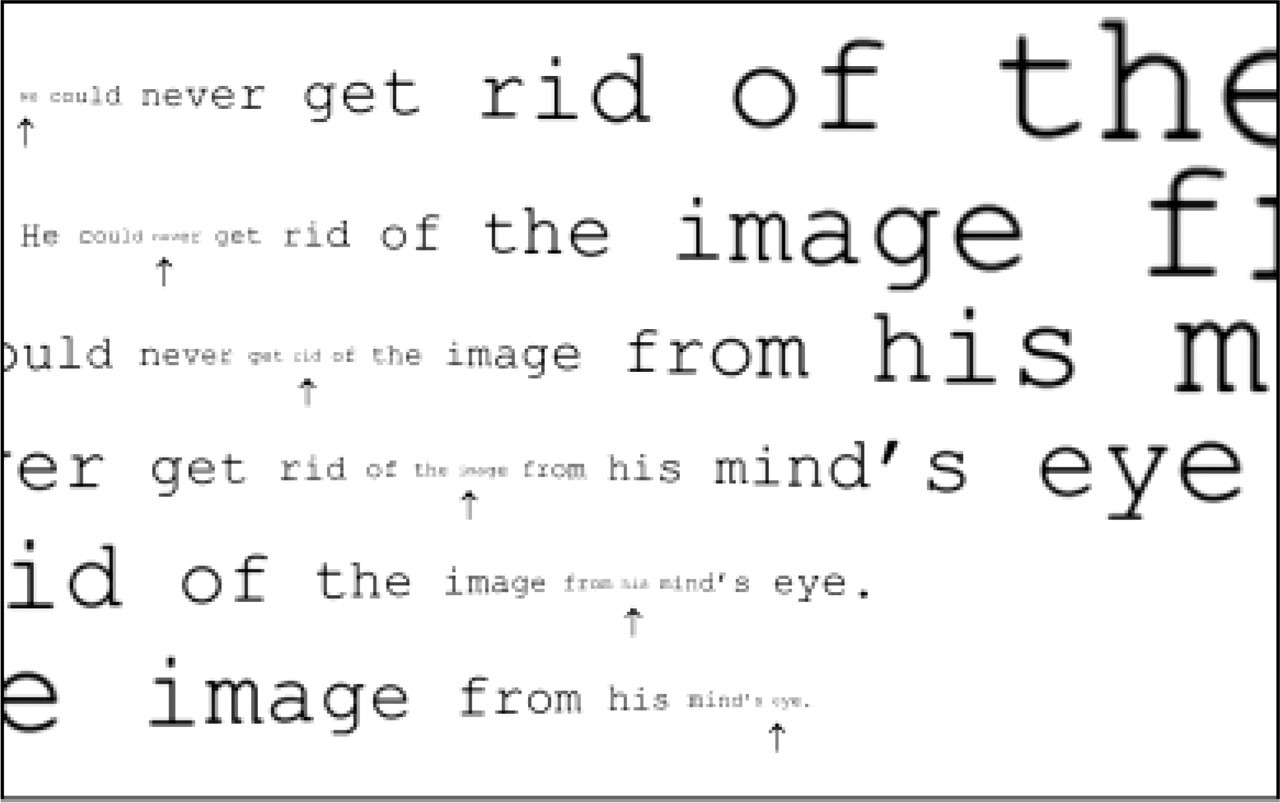
Graphical depiction of the parafoveal-magnification paradigm. The location of each fixation is indicated with an arrow, and the corresponding display for that fixation is represented. Consecutive lines represent the chronological order of fixations.
Nazir, Jacobs, and O'Regan (1998) investigated the identification of single words using a similar “butterfly” manipulation to study the relationship between reading time for a word and fixation location. Despite magnification, an effect of viewing position remained. However, because single words were presented in isolation, this study does not adequately address how visual attention is allocated in natural, dynamic reading of text. Indeed, the most efficient viewing position in single-word identification (optimal viewing position, slightly left of the word's center; O'Regan & Jacobs, 1992) is more central than the most frequent fixation location in normal reading, which is situated between the beginning and middle of the word (preferred viewing location; Rayner, 1979). This suggests that the rightward bias of the perceptual span (in left-to-right languages) is due to attentional asymmetry, which occurs in fluent reading, but not in single-word identification. To our knowledge, our study is the first using gaze-contingent PM to investigate natural reading.
We performed two experiments using the PM paradigm. In the first experiment, we sought to determine the relative influence of visual and attentional constraints in parafoveal processing. If parafoveal processing is limited mostly by visual acuity, then magnification of parafoveal letters should facilitate parafoveal processing. In fact, if eye movements in reading are made solely to compensate for the drop-off in visual acuity, then PM sentences could be read with a single fixation. Alternatively, if the perceptual span results from attentional limitations—with more resources being allocated to the text around fixation and fewer resources being allocated parafoveally—then the pattern of fixations should be similar for normal and PM text. In Experiment 1, participants read single-line sentences in normal or PM “font.” We also manipulated window size for both fonts (a no-window condition plus conditions with windows of 7 characters to the left and 21, 14, or 7 characters to the right), replacing letters outside the window with Xs. Global measures of reading behavior were analyzed. Releasing the constraints of visual acuity through PM allowed us to assess whether the perceptual span itself could be enlarged.
The second experiment explored whether parafoveal-on-foveal effects could be obtained in reading with PM. Magnifying parafoveal information should facilitate parafoveal preprocessing, thus maximizing the opportunity for parafoveal-on-foveal effects. Demonstrating robust lexical parafoveal-on-foveal effects would lend support to GAG models. If, however, no such effects were observed within this parafoveally enhanced context, SAS models would be upheld.
METHOD
Participants
A total of 60 native English speakers (mean age = 24 years; 37 females, 23 males) were paid to participate in the experiments, 40 in Experiment 1 and 20 in Experiment 2. All had normal or corrected-to-normal vision.
Apparatus
Eye movements were monitored via an SR Research (Mississauga, Ontario, Canada) Desktop Mount EyeLink 2K eye tracker, with a chin-forehead rest. This eye tracker has a spatial resolution of 0.01°, and eye position was sampled at 1000 Hz using corneal reflection and pupil tracking. Text was presented on a Dell P1130 19-in. CRT. Letters were black, on a white background. Viewing was binocular, and eye movements were recorded from the right eye. At the viewing distance of approximately 72 cm, three characters of nonmagnified text (25 pixels) subtended 1° of visual angle. The CRT was run at 170 Hz, and updating the display, which was contingent on gaze position, took 8 ms on average.
PM Implementation
PM was used to perceptually equate parafoveal and foveal information. We progressively magnified parafoveal text, increasing font size for each successive letter outside the foveated letters. Each sentence display was calculated and updated on-line in order to assign a different size and position for each character depending on its fixation location in the sentence. The size-increase function was taken from Anstis (1974), who showed that as distance from the fovea increases, the stimulus needs to be enlarged to be perceived equally well. Anstis's original equation is as follows: y = (0.046) ∗ x, where y is the letter size and x is the visual eccentricity in degrees. We chose a factor of 0.069 (1.5 times the original) in order to ensure a clear advantage in parafoveal identification. Finally, we maintained the “center of gravity” of text across all letters, aligning the middles of all letter bodies, so that eye movements programmed to the center of an enlarged parafoveal letter would land on the center of that letter when it became foveal (and smaller). The software was written in MatLab (R2006a), using the Psychophysics (PTB-3) and Eyelink Toolbox extensions (Brainard, 1997; Cornelissen, Peters, & Palmer, 2002).
Materials and Design
Experiment 1
Participants in Experiment 1 viewed a total of 160 single-line experimental sentences. The design crossed font (normal, PM) and window condition (no window, 21 characters, 14 characters, 7 characters), giving rise to eight experimental conditions. Twenty sentences were presented in each condition. Every participant read all the sentences; however, the order of the conditions and the sentences within each condition varied across four participant groups, each consisting of 10 participants. Sentence sets were roughly equated for sentence length (maximum of 60 characters), number of words, and difficulty. The window size corresponded to the number of characters to the right of fixation that were visible; characters outside this window were presented as Xs. In the 21-, 14-, and 7-character conditions, the leftward extent of the window was held constant at 7 characters.
Experiment 2
Participants in Experiment 2 viewed a total of 100 experimental sentences, all presented with PM. These sentences were used in a prior study, conducted both in English and in French (Miellet, Pernet, O'Donnell, & Sereno, 2007). In that study, we manipulated the overall plausibility and component-word frequencies of adjective-noun phrases: These phrases were either plausible (P) or less plausible (LP), and the adjectives and nouns were either high frequency (HF; 204 occurrences per million for adjectives, 277 occurrences per million for nouns) or low frequency (LF; 4 occurrences per million for adjectives, 7 occurrences per million for nouns).
Crossing plausibility, adjective frequency, and noun frequency gave rise to eight conditions. Frequency values were obtained from the Web site of the British National Corpus (http://www.natcorp.ox.ac.uk), which consists of 90 million written words. Natural log values (the standard measure in models of eye movement control) were also calculated. To generate the materials for the P and LP adjective-noun phrases, we determined contextual constraint via three indices. First, we measured predictability using a Cloze task in which 10 participants were asked to generate a word following a sentence fragment that ended just before the target noun phrase. They were then told what the actual word was (the adjective) and asked to generate another word to follow this augmented sentence fragment. Responses were coded as “1” for a correctly guessed word and “0” for other responses (mean scores for adjectives: P = .015, LP = .000; mean scores for nouns: P = .117, LP = .005). Second, we indexed contextual constraint using a plausibility task in which a different set of 20 participants were asked to rate the plausibility of each entire adjective-noun phrase on a 7-point scale (1 = low plausibility, 7 = high plausibility; mean ratings were 6.08 and 3.50 for P and LP phrases, respectively). Third, we indexed contextual constraint using the transitional probability value (obtained from the Brigham Young University interface of the British National Corpus; http://corpus.byu.edu/bnc/) of each noun phrase (i.e., the conditional probability of the noun given the adjective; mean values were .017 and .000 for P and LP phrases, respectively).
Length of the target words (i.e., adjectives and nouns) was similar across the eight experimental conditions (average = 5.8 characters). Twenty sentences were presented in the P/HF-adjective/HF-noun condition and in the P/HF-adjective/LF-noun condition, and 10 sentences were presented in each of the other six conditions (the difference in the number of sentences was due to requirements of counterbalancing in the original study).
Procedure
Both experiments began with calibration of the eye tracker, reading of practice sentences, and recalibration of the eye tracker before any experimental sentences were presented. The experimenter could check the accuracy of the calibration at any time and recalibrate if necessary. Each trial began with a central fixation cross. Fixating this cross triggered the presentation of another cross located at the left, marking the first character position of the sentence. When the eye tracker detected a successful fixation on the second cross, a sentence was presented. After reading the sentence, participants fixated another cross at the bottom right of the screen, and this cleared the display.
In Experiment 1, each block of 20 sentences was preceded by 5 practice items presented under identical display conditions so that participants could become accustomed to the new condition. Yes/no comprehension questions followed 80 of the 160 sentences to ensure that participants were paying attention (participants answered 94% of these questions correctly). In Experiment 2, participants read 30 practice sentences with PM before the 100 experimental sentences were presented. Thirty of the experimental sentences were followed by yes/no comprehension questions (participants answered 92% of these questions correctly).
RESULTS
Experiment 1
In Experiment 1, we analyzed three eye movement measures across participants: (a) total sentence reading time in seconds, (b) saccade length in pixels, and (c) saccade length in characters. We performed 16 pair-wise comparisons for each measure. First, we compared reading of normal versus PM font in each of the four window conditions (no window or 21-, 14-, or 7-character window). Then, we compared each window condition with the others, within each font type (normal or PM; six comparisons for each font). For each contrast, we calculated p rep (Killeen, 2005) and effect size (d) based on a bootstrapping procedure (5,000 resamples). Our criterion for reliability was a p rep value greater than .80. The pattern of reliability for each effect was confirmed using pair-wise t tests with the Bonferroni multiple-comparisons correction.
The means for total sentence reading time are presented in Table 1. There was no reliable difference between normal and PM font in any of the four conditions, all p reps < .70, |d|s < 0.40, p(strong support)s < .50. Other indices of general processing difficulty—reading time per character, average fixation duration, and number of fixations per sentence—showed the same (nonsignificant) pattern.
Average Sentence Reading Time (in Seconds) in Experiment 1
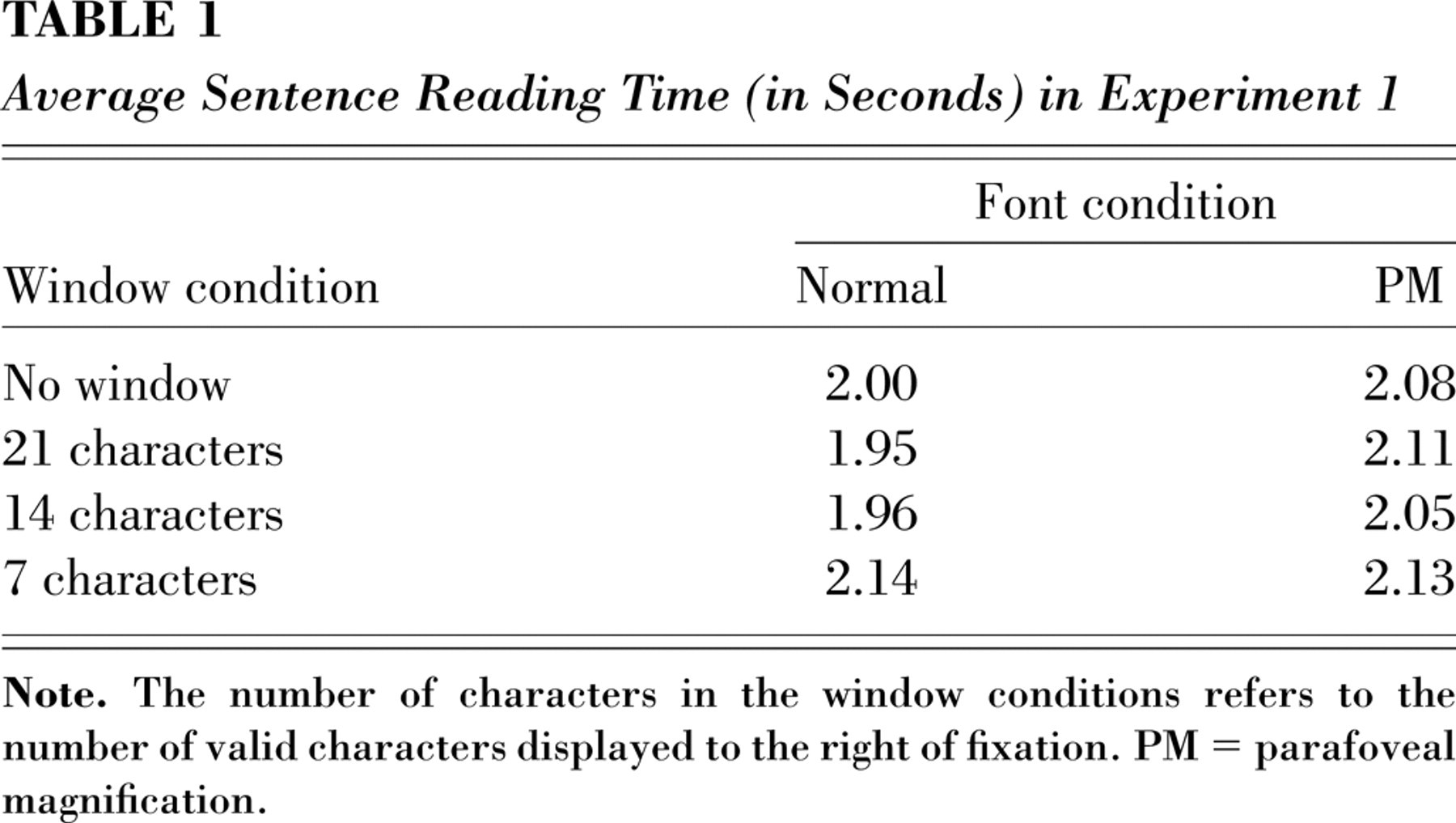
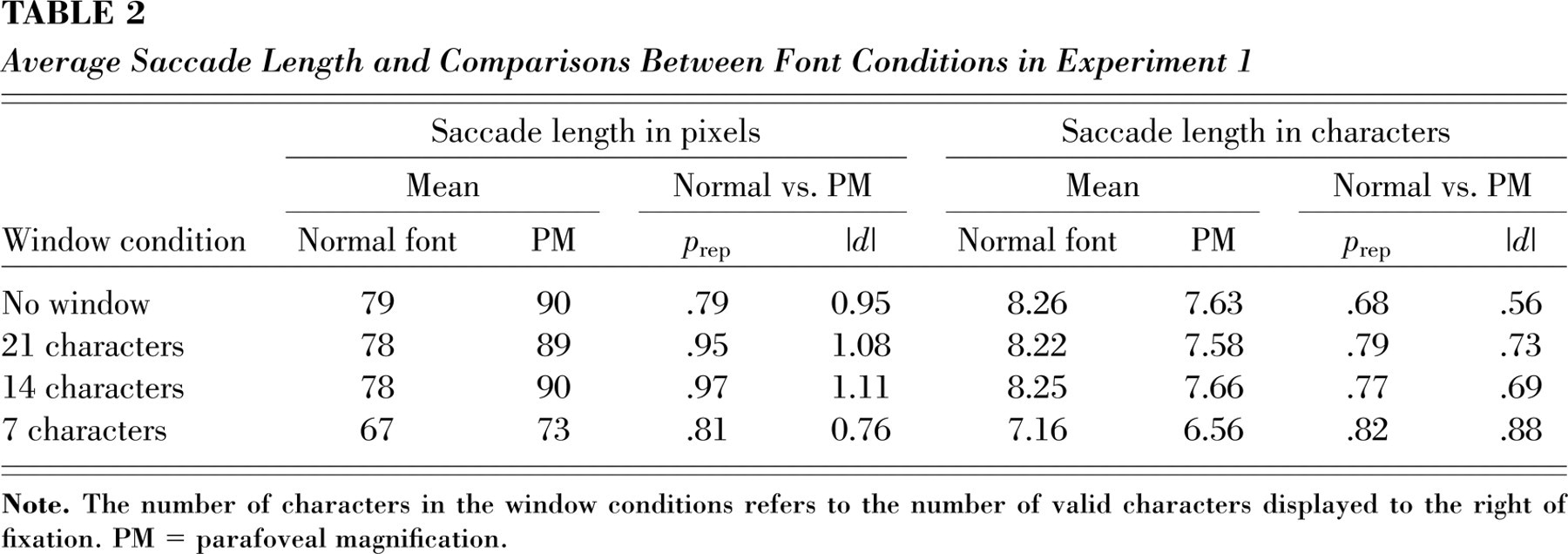
Table 2 presents the means for saccade length in pixels, along with the results of comparisons between the font conditions. Pixel measurement represents absolute distance. Saccade length in pixels was reliably longer for PM than for normal text in all four window conditions, which is not surprising given that parafoveal text was physically larger in the PM conditions. Saccades were reliably shorter in the 7-character window condition than in the other window conditions, both for normal and for PM font (see Table 3). Saccade length did not differ in the pair-wise comparisons of the no-window, 21-character, and 14-character conditions, for either normal or PM font, all p reps < .60, |d|s < 0.06, p(strong support)s < .50.
Average Saccade Length and Comparisons Between Font Conditions in Experiment 1
Reliable Pair-Wise Comparisons of Window Conditions in Experiment 1
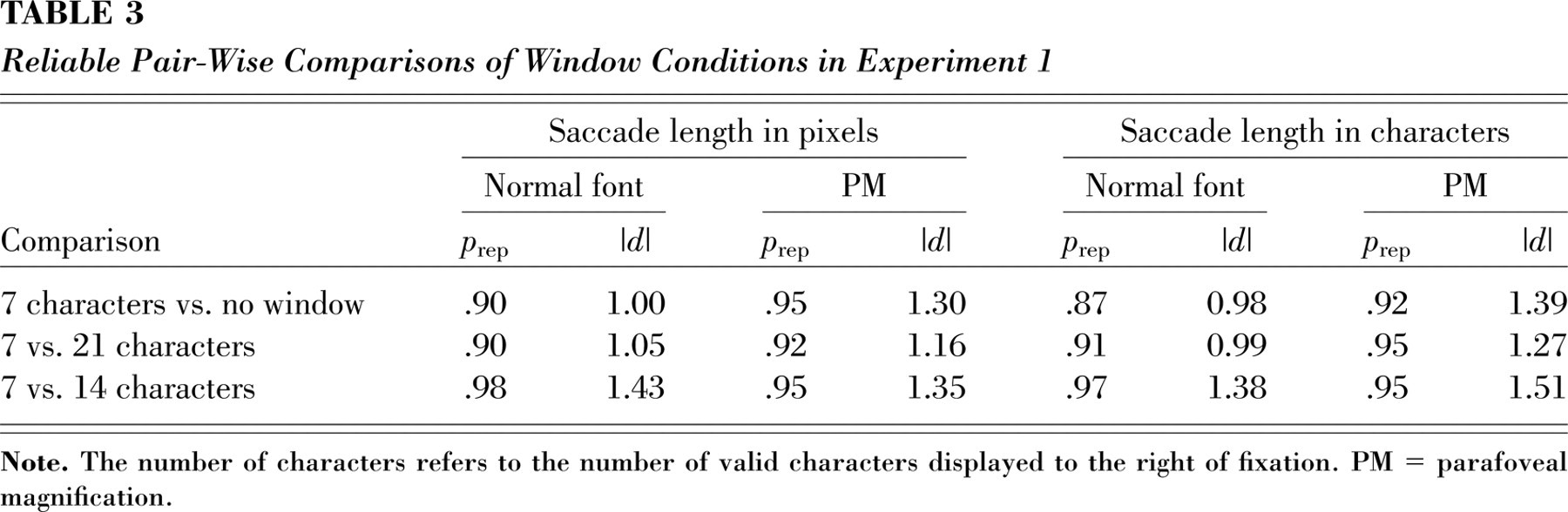
Saccade length in number of characters, a text-based measurement, is also presented in Table 2. In contrast to saccade length in pixels, saccade length in characters did not differ significantly between the normal and PM fonts, all p reps < .80, |d|s < 0.75, p(strong support)s < .50, except in the 7-character condition, p rep = .82, |d| = 0.88, although even in this case p(strong support) was only .53. As before, saccades were reliably shorter in the 7-character condition than in the other window conditions, both for normal and for PM font (see Table 3). Again, saccade length did not differ reliably in pair-wise comparisons of the no-window, 21-character, and 14-character conditions, all p reps < .60, |d|s < 0.15, p(strong support)s < .50. Note that saccades measured in pixels were significantly longer for PM than for normal font, but saccades measured in characters were numerically (nonsignificantly) shorter for PM than for normal font (see Table 2). This apparent paradox may be explained by the fact that saccadic undershoots are more probable with greater eccentricities, and the saccade target was physically much further away with the PM font than with the normal font.
Finally, we compared saccade length in characters for normal versus PM font separately for each participant. Although average saccade length varied across participants (e.g., between 6 and 12 characters with normal font), it remained remarkably constant across fonts within individual participants, r(38) = .80, p rep > .99.
Experiment 2
In Experiment 2, we looked for evidence of parafoveal-on-foveal effects—whether properties of the parafoveal noun (Word 2, the second word of the noun phrase) affected measures of reading time for the foveal adjective (Word 1, the first word of the noun phrase). Specifically, we examined first-fixation duration (FFD; the duration of the first fixation on a word), single-fixation duration (SFD; the duration of the first fixation on a word when that fixation was the only fixation on that word, as was true in the majority of cases), and gaze duration (GD; the summed duration of successive fixations on a word before the reader left it).
We performed a repeated measures multiple regression analysis (Lorch & Myers, 1990) for each fixation-time measure. Such analyses avoid using dichotomized variables (e.g., HF vs. LF) when actual values are available, and the variance explained by a set of predictors with known values can be removed from the error variance. These analyses allowed us to assess the degree to which the characteristics of Word 2 influenced fixation time on Word 1, independently of the influence of other predictors.
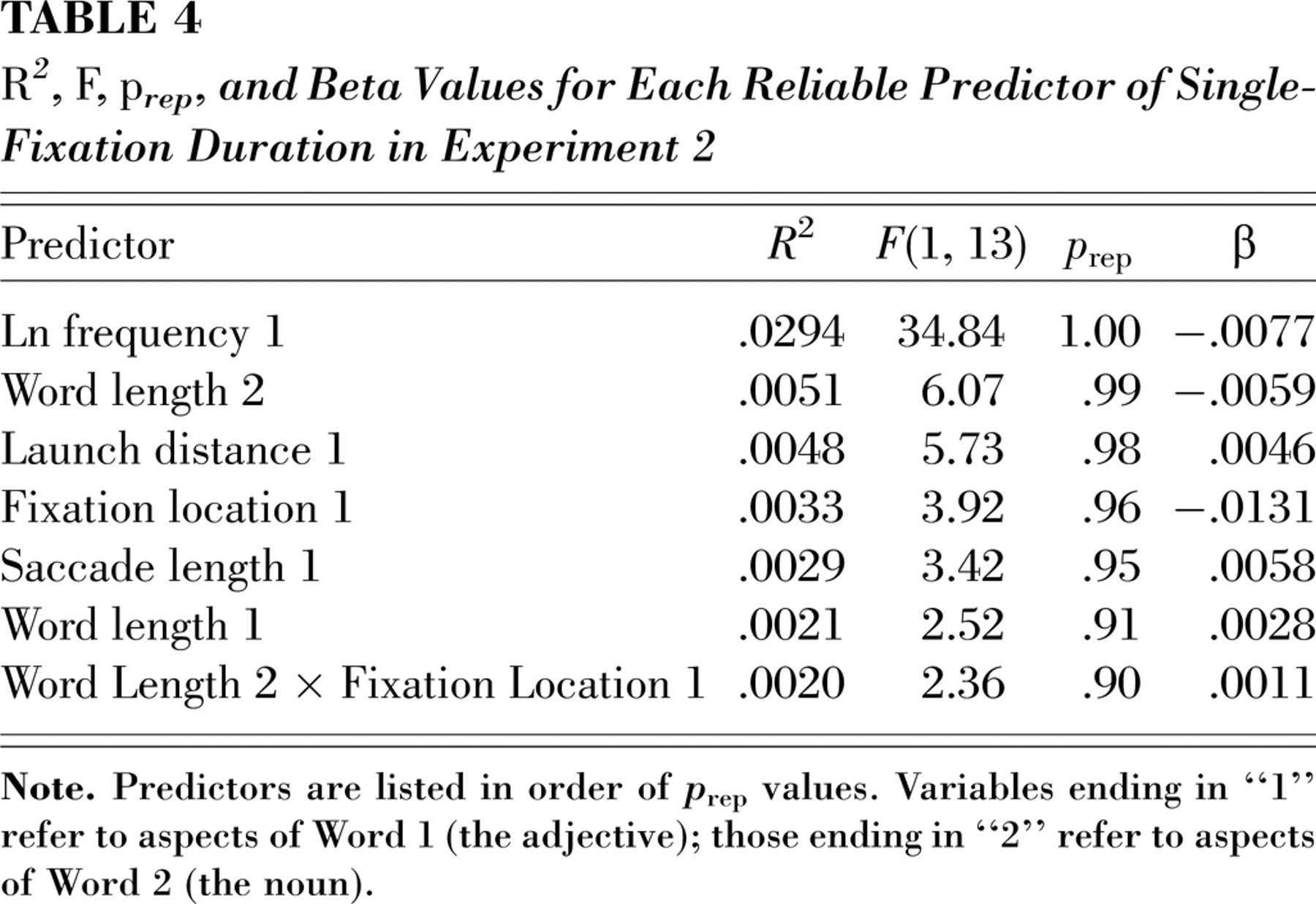
For all analyses, the regressors were psycholinguistic and oculomotor characteristics of Word 1 and Word 2: word length, natural log frequency, predictability, launch distance to the beginning of Word 1, total length of the saccade to Word 1, and location of the first fixation on Word 1 (i.e., the number of letters before the end of Word 1). All interactions with the first fixation location in Word 1 were also included, as the position of this fixation directly influences the degree to which Word 2 can be processed parafoveally. Plausibility of the noun phrase was also included as a regressor. R 2, F, p rep, and beta values for statistically reliable predictors of SFD (M = 257 ms) and GD (M = 295 ms) are given in Tables 4 and 5, respectively. As in Experiment 1, our criterion for reliability was a p rep value greater than .80 (confirmed with standard ps < .05). FFD showed a pattern of results similar to that for SFD.
R2, F, prep, and Beta Values for Each Reliable Predictor of Single-Fixation Duration in Experiment 2
R2, F, prep, and Beta Values for Each Reliable Predictor of Gaze Duration in Experiment 2
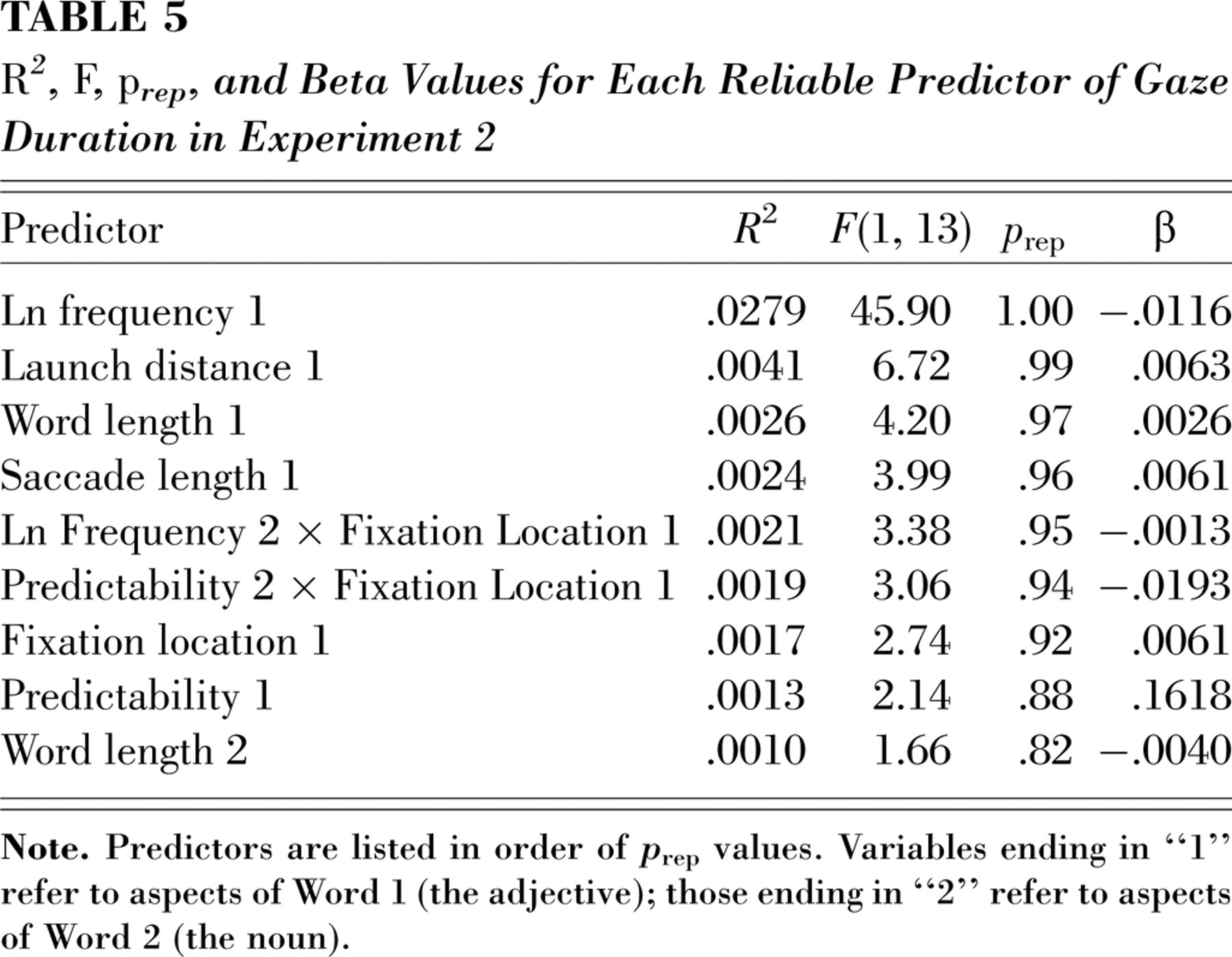
Only lower-level characteristics of Word 2 significantly influenced the early measures of Word 1 reading time: Both FFD and SFD showed an effect of Word 2 length and an interaction between Word 1 fixation location and Word 2 length. A main effect of Word 2 length also emerged in the analysis of GD. In general, researchers have not reported that an upcoming word's length affects fixation time on the current word. However, Kliegl, Nuthmann, and Engbert (2006) did show such an effect, but only on GD. Moreover, when we presented the materials from Experiment 2 in normal font in our previous study (Miellet et al., 2007), we found a similar effect on GD, F(1, 13) = 46, p < .01, but not on FFD or SFD (both Fs < 1). The PM paradigm used in the present study accentuates and augments the length of the parafoveal word. It is possible that the effect of Word 2 length on Word 1 fixation time reflects some aspect of programming saccades to words made longer as a result of magnification. A recent study showed that saccadic latencies are shorter when attention is directed to a smaller object (Harwood, Madelain, Krauzlis, & Wallman, 2008). The fact that PM exaggerates the difference between short and long words could, by itself, lead to parafoveal-on-foveal effects of word length.
Higher-level, lexical parafoveal-on-foveal effects appeared only in the later, GD measure, which showed interactions between Word 1 fixation location and both Word 2 frequency and Word 2 predictability. Using normal font and the same materials as in our previous study (Miellet et al., 2007), we did not find any evidence that frequency or predictability of Word 2 had parafoveal-on-foveal effects on FFD, SFD, or GD for Word 1 (all Fs < 1).
DISCUSSION
In summary, our study demonstrated that the perceptual span in reading is governed mainly by attentional demands and not by acuity limitations. We also tested parafoveal-on-foveal effects, a topic that is critical to competing models of eye movement control. Our results favor SAS models of eye guidance (as we discuss in detail later in this section). We introduced a new method of presenting text—PM—that allowed us to tease apart the relative contributions of visual acuity and attention in parafoveal processing of text in reading. Although the physical appearance of PM text is highly nonstandard, reading of PM text proceeds quite normally.
In Experiment 1, although PM induced physically longer saccades (as measured in pixels) than observed for normal text, the length of saccades in characters was similar across the two fonts. This finding demonstrates that the perceptual span is delineated in terms of amount of information, rather than a physical metric. Our results replicate those of Morrison and Rayner (1981) and extend their findings to a paradigm that compensates for the drop-off in acuity outside the foveal region.
Reading behavior, however, was affected by the size of the moving window. Saccades were shortest with a 7-character window, regardless of whether text was in normal or PM font. Moreover, saccade length was identical for the 14- and 21-character and no-window conditions. Thus, our findings replicate the classic finding that the perceptual span for normal text extends 14 characters to the right of fixation (McConkie & Rayner, 1975), and demonstrate that the same perceptual span is observed in the PM context. These results confirm that the perceptual span is limited by attentional rather than visual constraints, with the physical size of the span adapting to the amount of information to be processed.
We also found that, although saccade length varied between participants, a given individual's saccade length (in characters) was relatively stable across the normal and PM fonts. The fact that this was the case after only five practice sentences in the PM font indicates that individuals were able to immediately adapt their saccadic programs to a dramatically different display type.
Experiment 2 showed that the frequency and predictability of the noun (Word 2) in a noun phrase affected fixations on the preceding adjective (Word 1). These effects were not evident in early measures of fixation time, but only in GD. Moreover, they appeared only in interactions with the location of the first fixation on Word 1, and the global variance explained was quite small (see Table 5). Proponents of attentional-gradient (GAG) models of eye movement control would interpret these effects as evidence for parallel processing of several words. However, proponents of serial (SAS) models have recently suggested that parafoveal-on-foveal effects arise from saccadic undershoots of the parafoveal word that result in fixations on the foveal word (Drieghe, Rayner, & Pollatsek, 2008; Rayner, Warren, Juhasz, & Liversedge, 2004), although Kennedy (2008) has challenged this claim. Given that we observed parafoveal-on-foveal effects only when there were multiple fixations on Word 1 and only in interaction with the location of the first fixation on Word 1, the overall pattern of results in Experiment 2 lends support to SAS models in which parafoveal-on-foveal effects are driven by saccadic undershoots.
According to the saccadic-undershoot hypothesis, parafoveal-on-foveal effects should appear on the final fixation of multiple fixations on Word 1, but only when this fixation is close to Word 2. Unfortunately, we could not test this hypothesis because there were too few cases of two successive fixations on Word 1 in our data set (only 246 data points). A parallel model would also predict greater parafoveal-on-foveal effects for fixations near the end of a word than for fixations earlier in the word, because the next word is more visible. However, acuity did not decline with eccentricity in our experiment. Acuity drop-off was a factor in our previous study (Miellet et al., 2007), in which participants read the materials from Experiment 2 in a normal font. The only parafoveal-on-foveal effect revealed in that study was an effect of the length of Word 2 on GD for Word 1; the frequency and predictability of Word 2 did not affect fixation times for Word 1. It seems that the very same mechanism that facilitates parafoveal processing in PM (increased text size) also generates more saccadic undershoots because the parafoveal target is further away.
We close by suggesting some directions for further research. One concerns the fact that a stronger test of parafoveal semantic preprocessing is needed. One limitation of Experiment 2 was that, although the plausibility of the noun phrases was carefully manipulated, the lexical predictability of the nouns (as assessed by the Cloze task) was fairly weak. If the nouns were contextually highly predictable, reliable parafoveal-on-foveal effects might be observed for early fixation times on the adjectives.
A more fundamental issue concerns the act of reading itself. All our participants had nearly two decades of experience reading text in normal font, whereas their PM experience was limited to 100 or so sentences (including practice). Thus, perceptual learning may play a significant role in reading (e.g., Nazir et al., 1998). In terms of global measures of reading, PM neither helped nor hurt performance, most likely because of two opposing influences of PM: (a) a facilitative effect due to easier identification of parafoveal letters and (b) a disruptive effect due to processing of spatially atypical parafoveal information. Bai, Yan, Zang, Liversedge, and Rayner (2008) developed a similar argument to explain why nonstandard, spaced presentation of words in Chinese neither aids nor impairs reading. In a context contrived to maximize the perceptual impact of text, several hours of PM training may indeed prove beneficial to reading.
Footnotes
Acknowledgements
This research was supported by Economic and Social Research Council Grant RES-000-22-1907 to S.C. Sereno, S. Miellet, and P.J. O'Donnell. We thank Christopher J. Hand for providing materials for Experiment 1, and Simon Liversedge, Denis Drieghe, and an anonymous reviewer for their helpful comments on an earlier version of the article.